Showing posts with label indianapolis. Show all posts

Thursday, November 24, 2022

November 25, 1885: Vice President Thomas Hendricks Dies

November 25, 1885: Thomas Andrews Hendricks, Vice President of the United States, dies in Indianapolis. He was 66 years old.

He was born on September 7, 1819, in Fultonham, Ohio. The family moved to Indiana at the urging of an uncle, William Hendricks, who served that State in both houses of Congress, and eventually as Governor. His father, John Hendricks, became a success in farming, then in running a general store, and moved into politics, where his support for President Andrew Jackson earned him a political appointment. Young Thomas got to meet nearly every prominent Democrat in Indiana at the family home in Shelbyville.

He married Eliza Morgan, the daughter of a judge, and they had a son named Morgan, who died at age 3. He was elected to the General Assembly in 1847, to the U.S. House of Representatives in 1850, was appointed Commissioner of the U.S. General Land Office by President Franklin Pierce in 1855, and was elected to the U.S. Senate in 1862.

Three times, he ran for Governor, and lost twice, going back to the practice of law in the State capital of Indianapolis, before finally being elected in a squeaker in 1872. He did well enough there that he was nominated for Vice President on the ticket of Governor Samuel J. Tilden of New York. Although they got the most popular votes and the most Electoral Votes, they didn't not get the required majority of the latter, and a Commission to settle the issue did so in favor of the Republican nominee, Governor Rutherford B. Hayes of Ohio.

He fell into ill health, but this was not widely known, and, in 1884, he was again nominated as the 2nd half of a ticket whose 1st half was the Governor of New York, in this case Grover Cleveland.

His father-in-law, Judge Morgan, had lived outside Cincinnati, in North Bend, Ohio, next-door to President William Henry Harrison, the hero of the Battle of Tippecanoe. Running on the Whig Party ticket in 1840, with John Tyler, there came the 1st rhyming slogan in Presidential history: "Tippecanoe and Tyler, too!"

In 1844, the Whigs had, "Hurrah! Hurrah! The Country's risin', for Henry Clay and Frelinghuysen!" In 1876, the Republicans had "Hayes the True and Wheeler, too!" In 1884, the Democrats may have tried too hard, with:

We'll shout for our man and his important appendix!
We'll whoop 'er up lively for Cleveland and Hendricks!

(There haven't been too many rhyming Presidential slogans since. In 1936, the Republicans had "Off the rocks with Landon and Knox," and lost 46 out of 48 States. In 1952 and 1956, instead of trying to rhyme something with "Eisenhower and Nixon," the Republicans simply used Dwight D. Eisenhower's nickname: "I like Ike." In 1960, the Democrats had "All the way with JFK" and "K-E-Double-N-E-D-Y, Jack's the nation's favorite guy," and followed it in 1964 with "All the way with LBJ.")

The 1884 election between Cleveland and the Republican nominee, former Secretary of State James G. Blaine, was nasty by the standards of the time -- although Donald Trump might have called it "low-energy." The Cleveland-Hendricks ticket won in a very close race. Taking office on March 4, 1885, the 2 men maintained a strong working relationship. Hendricks spoke highly of Cleveland's character, and described him as "courteous and affable."

But Hendricks' poor health caught up with him. In November, he went home to Indianapolis. On the morning of November 24, he complained about feeling ill. He suffered a heart attack the next day, and was dead. 

There being no Constitutional mechanism for filling a vacancy in the Vice Presidency at the time, the office remained vacant until the following Inauguration Day, March 4, 1889, when Levi P. Morton took the office, on a ticket with Benjamin Harrison (William Henry's grandson), who had defeated Cleveland and his new running mate, Allen Thurman.

And with Congress not convening until December, the office of the next man in line for the Presidency, after Cleveland, the President Pro Tempore of the Senate, was vacant as well. This was the 7th time in 44 years that the Vice Presidency had become vacant, and it was decided to do something about it.

Congress convened on December 7, 1885, and John Sherman of Ohio, brother of General William Tecumseh Sherman, was sworn in as President Pro Tempore of the Senate. A new Presidential Succession Act was passed on January 19, 1886. From then onward, the net man in line was the Secretary of State, Thomas F. Bayard. Since it was believed that the office of Secretary of State would always be filled, the issue was thought settled. But it was adjusted by a new Presidential Succession Act in 1947, putting the Speaker of the House and then President Pro Tempore of the Senate between the Vice President and the Cabinet.

Hendricks was buried in Crown Point Cemetery in Indianapolis. Harrison would also be buried there, as would Theodore Roosevelt's Vice President, Charles W. Fairbanks; Woodrow Wilson's Vice President, Thomas R. Marshall; authors James Whitcomb Riley and Booth Tarkington; bank robber John Dillinger, pharmaceutical magnate Eli Lilly; and Indianapolis Colts owner Bob Irsay.

Eliza Hendricks lived on until 1903.

*

November 25, 1885 was a Wednesday. There were no scores on this historic day: No college football games were scheduled, baseball was out of season, hockey was in its infancy, and basketball hadn't yet been invented. 

Monday, October 31, 2022

October 31, 1963: The Indianapolis Holiday On Ice Explosion

October 31, 1963: A propane leak at a concession stand at the Indiana State Fair Coliseum in Indianapolis causes an explosion that kills 74 people during a Holiday On Ice show.

Opened in 1939, the 6,800-seat building was not seriously damaged. It still stands, known as the Indiana Farmers Coliseum. It was the 1st home of the Indiana Pacers, from 1967 to 1974, and they won the American Basketball Association title there in 1970, 1972, and 1973.

A recent photo of the Coliseum

It has also been home to a series of minor-league hockey teams. The Indianapolis Capitals won the Calder Cup, the championship of the American Hockey League, in 1942 and 1950. The Indianapolis Ice won the Turner Cup, the championship of the International Hockey League, in 1990; and the Ray Miron Cup, the championship of the Central Hockey League, in 2000. The Indiana Ice won the Clark Cup, the championship of the United States Hockey League, in 2009 and 2014. The current team is called the Indy Fuel.

UPDATE: The name was the Indiana State Fairgrounds Coliseum from its opening in 1939 to 1991, the then the Pepsi Coliseum until 2012, then the Fairgrounds Coliseum until 2014, then the Indiana Farmers Coliseum until 2024, before adopting its current name, the Corteva Coliseum. Corteva, Inc. (also known as Corteva Agriscience), headquartered in Indianapolis, is devoted to products for seed and crop protection. The company's name combines "cor" (Latin for "heart") with "teva" (the Hebrew word for nature).

*

October 31, 1963 was a Thursday. Baseball Hall-of-Famer Fred McGriff and All-Star Matt Nokes were born on this day. So were Brazilian soccer star Dunga, actors Rob Schenider and Dermot Mulroney, and Smiths guitarist Johnny Marr.

Baseball season was over. Football was in midweek. And there were no NBA games scheduled for this Halloween. There was 1 NHL game: The Detroit Red Wings beat the New York Rangers, 4-1 at the Olympia Stadium in Detroit. 

Sunday, October 30, 2022

October 31, 1903: The Purdue Wreck

October 31, 1903: A train carrying the Purdue University football team to its annual game with in-State rival Indiana University hits a coal train on the north side of Indianapolis, killing 17 people, including 14 players. The game is canceled.

The uninjured tried to help the others. Some got out and got the stationmaster to send a warning to the next train coming down the track, saving many more lives. Among these heroes were the President of Purdue University, Winthrop E. Stone.

Purdue's football and baseball captain, Harry Leslie, was pronounced dead at the scene. At the funeral home, the mortician was ready to begin the embalming process, when he found a pulse: Leslie was alive. He teetered on the brink of death for weeks, but recovered, becoming a folk hero.
With some irony, he went to Indiana University's law school, became a bank president, Speaker of the Indiana House of Representatives, and in 1928 was elected Governor. But he was a Herbert Hoover Republican, and did very little to help during the Depression, and was voted out in 1930. He died for sure in 1937.

Aside from the World War I years of 1918 and '19, 1903, the year of the Purdue Wreck, was the only time Purdue and Indiana have not met in football since the rivalry began in 1891. Since 1925, they have played each other for a trophy known as the Old Oaken Bucket. Through the 2021 game, Purdue leads the rivalry, 75-42-6. In just the "Bucket Games," Purdue leads 61-32-3.

*

October 31, 1903 was a Saturday. This was also the day that Hampden Park, Scotland's national stadium, opened in Glasgow. I have a separate entry for that event.

Baseball season was over. Basketball barely existed, and hockey hadn't yet turned professional. These other noteworthy games were played in college football:

* Michigan and Minnesota played to a 6-6 tie, at Northrop Field in Minneapolis. This began the rivalry known as the Little Brown Jug. I have an entry for that event as well.

* Army beat Vermont, 32-0 on The Plain in West Point, New York.

* Penn State beat Navy, 17-0 at Worden Field in Annapolis, Maryland.

* Yale beat Columbia, 25-0 at the Polo Grounds.

* Harvard beat the Carlisle Indian School, 12-11 at Soldier's Field in Boston. Jim Thorpe was too young to play on the Carlisle varsity, but they almost didn't need him. Two weeks later, on November 14, Harvard Stadium opened, and Harvard lost to Dartmouth. They still play there today.

* The University of Pennsylvania beat Bucknell, 47-6 at Franklin Field in Philadelphia. A new stadium by that name would be built on the same site in 1922.

* Lafayette beat New York University, 8-6 at Ohio Field in The Bronx.

* Princeton beat Cornell, 44-0 at University Field in Princeton, New Jersey.

* And Rutgers beat Stevens Institute, 36-6 at Neilson Field in New Brunswick, New Jersey.

Friday, October 7, 2022

October 7, 1914: A Pennant For Indianapolis

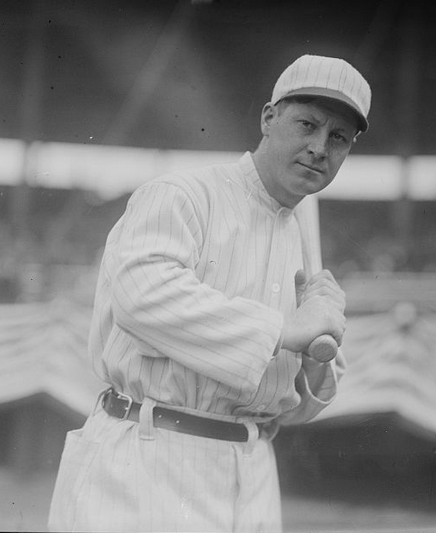
Benny Kauff

October 7, 1914: The Indianapolis Hoosiers defeat the St. Louis Terriers, 4-0 at Federal League Park in Indianapolis, and win the 1st Federal League Pennant. They finish a game and a half ahead of the Chicago Whales, and 4 1/2 ahead of the Baltimore Terrapins.

The Hoosiers, managed by Bill Phillips, had a future Hall-of-Famer, Indiana native Edd Roush, but he was still a rookie, and was not yet a starting player, let alone the great center fielder he would become. The outfielders they did have all batted at least .300: Al Scheer, Vin Campbell and Benny Kauff. 2nd baseman Frank LaPorte also did, and led the team with 107 RBIs. Kauff batted .370, with 95 RBIs. And Bill McKechnie, later to be a Pennant-winning manager, played 3rd base and batted .304. Cy Falkenberg was their ace, going 25-16 with a 2.22 ERA, and pitched a 3-hit shutout in the Pennant clincher.

However, their 4-2 win over the Terriers the next day will turn out to be the last Major League Baseball game ever played in the State of Indiana to this day -- if, that is, you consider the FL to have been a "major league." (MLB did not then, but it does now.) Financial losses lead them to be moved to Harrison, New Jersey, where they will become the Newark Peppers.

An Indiana-based team, the Fort Wayne Kekiongas, was a member of the 1st professional baseball league, the National Association, but only in its 1st season, 1871. Teams named the Indianapolis Hoosiers played in the American Association in 1884, and in the National League from 1887 to 1889.

But, despite Indianapolis being one of the 3 largest cities in the Midwest -- and, eventually, surpassing Detroit to become the 2nd-largest behind Chicago -- it's never had a major league team again after 1914. The Indianapolis Indians of the Class AAA version of the American Association won Pennants in 1920, 1908, 1917, 1928, 1949, 1956, 1963, 1982, 1986, 1987, 1988, 1989 and 1994. They moved to the International League, and won the Pennant in 2000, giving them 14 Pennants.

*

October 7, 1914 was a Wednesday. Elsewhere in the Federal League, the Baltimore Terrapins swept the Pittsburgh Rebels, 5-3 and 4-3 at Terrapin Park in Baltimore (later renamed Oriole Park); and the Brooklyn Tip-Tops beat the Buffalo Blues at Federal League Park in Buffalo.

No games were played in the National League. In the American League, at Fenway Park, the Washington Senators and the Boston Red Sox wound up the season in a meaningless game. Washington manager Clark Griffith, age 45, made his final mound appearance‚ while Boston's star center fielder Tris Speaker does the only pitching of his career‚ giving up a run in an inning. Babe Ruth‚ in relief of starter Hugh Bedient‚ pitches 3 innings for Boston. The Senators win, 11-4.

And the Philadelphia Athletics beat the New York Yankees, 10-0 at Shibe Park in Philadelphia. The A's had won their 4th Pennant in the last 5 years, while the Yankees were 30 games behind them. Oddly, Connie Mack used 4 pitchers to complete a 4-hit shutout: Rube Bressler for 3 innings; and, for 2 each, Bullet Joe Bush, Bob Shawkey and Herb Pennock. Those last 3 would all eventually pitch for the Yankees, and help them win Pennants.

Friday, July 22, 2022

July 22, 1991: Jeffrey Dahmer and Mike Tyson Are Arrested

July 22, 1991: Jeffrey Dahmer and Mike Tyson are arrested. Not at the same time, and not for the same thing, although Tyson did once (actually, twice) bite a man's ear.

Tyson had been Heavyweight Champion of the World until February 11, 1990, when he was knocked out by James "Buster" Douglas. When Douglas was subsequently knocked out by Evander Holyfield, an attempt was made to set up a fight between them. It was scheduled for November 8, 1991.

But Tyson was arrested in July 1991 for the rape of 18-year-old Desiree Washington at the Canterbury Hotel in Indianapolis. Washington, who had previously been crowned "Miss Black Rhode Island," was a contestant in the Miss Black America pageant, which was being held in Indianapolis. Tyson was convicted on February 10, 1992, and sentenced to 6 years in prison. He ended up serving 3.

Jeffrey Lionel Dahmer was born on May 21, 1960 in Milwaukee, and grew up in the Cleveland suburb of Bath, Ohio. As a boy, he became fascinated with dead animals and collected their bones. As a teenager, he discovered that he was gay, and, thinking himself weak, began to develop fantasies where he would be stronger than his partners, killing them and even dissecting them like animals. He developed a drinking problem.

He committed his 1st murder in 1978, shortly after graduating from high school, in nearby Chippewa Lake Park. The following year, at his father's urging, he joined the U.S. Army, but he was discharged in 1981, due to his drinking.

Since his grandmother, who lived in the Milwaukee suburbs, was the only family member who seemed to respond well to him, his father sent him to live with her. Things seemed to go well until 1985, when a male coworker propositioned him. Although he didn't accept, it reawakened his repressed tendencies, and he immersed himself in Milwaukee's underground gay subculture. In 1987, at a hotel, he awoke from a drunken stupor to discover he had killed his partner, with no memory of having done so.

He began taking men home, drugging them, sometimes only having his way with them, sometimes also killing them. He did not always properly dispose of their remains, and, in 1988, complaining about the drinking, the strange men, and the strange smells, his grandmother threw him out. Shortly thereafter, he was arrested for molesting a teenage boy, and pleaded guilty, serving 10 months. But law enforcement was still unaware of the murders he had committed.

On July 22, 1991, with Dahmer having killed 17 victims, ranging in age from 14 to 32, an intended victim, Tracy Edwards, escaped from Dahmer's Milwaukee apartment, and flagged down a police car. The policemen found the knife under his bed, and arrested him.

On February 15, 1992, after hearing evidence of Dahmer's sadism, including storing body parts in his freezer for alleged later consumption -- but, contrary to popular belief, he was never accused of eating the flesh of his victims -- Dahmer was convicted on 15 counts of murder, and sentenced to life in prison, plus 10 years, for each of them. He later pleaded guilty to a 16th count.

He was sent to the Columbia Correctional Institution in Portage, Columbia County, Wisconsin. By the time Mike Tyson got out of prison and started boxing again, Dahmer had left prison -- in a coffin. On November 28, 1994, inmate Christopher Scarver bludgeoned Dahmer and another inmate, Jesse Anderson, to death. Dahmer was 34 years old.

Tyson has since, sort of, been rehabilitated. Dahmer is still considered a monster.

*

July 22, 1991 was a Monday. These 4 Major League Baseball games were played:

* The Atlanta Braves beat the Pittsburgh Pirates, 7-3 at Three Rivers Stadium in Pittsburgh. John Smoltz outpitched former Brave Zane Smith. Barry Bonds went 1-for-3 with a walk.

* The Chicago White Sox beat the Milwaukee Brewers, 5-4 at the new Comiskey Park (now Rate Field) in Chicago. Dan Pasqua hit a home run for the Pale Hose. Robin Yount did not play. Paul Molitor went 0-for-5.

* The St. Louis Cardinals beat the Houston Astros, 9-1 at Busch Memorial Stadium in St. Louis.

* And the Texas Rangers beat the Boston Red Sox, 2-1 at Arlington Stadium in the Dallas suburb of Arlington, Texas. José Guzmán outpitched Roger Clemens.

July 22, 1934: John Dillinger Is Gunned Down

 
July 22, 1934: John Dillinger, "Public Enemy Number One," is killed.

John Herbert Dillinger Jr. was born on June 22, 1902 in Indianapolis. As a boy, he bullied smaller children. In 1922, he was arrested for auto theft. The following year, he enlisted in the U.S. Navy, but soon deserted, and was dishonorably discharged. He was arrested for stealing $50 from a grocery store, and served 9 years in State prison.

He was released on May 10, 1933. Just 42 days later, using advice he got from fellow prisoners, he robbed his 1st bank, getting $10,000 (about $207,000 in today's money) from a bank in New Carlisle, Ohio, outside Dayton. On August 14, he robbed another in Bluffton, Ohio, outside Toledo. But he got caught, and was sent to another prison. He escaped on October 12, and formed what became known as the Dillinger Gang.

On January 25, 1934, the Dillinger Gang was arrested in Tucson, Arizona, and extradited to Indiana, where one of their robberies had led to the death of a policeman. Local police boasted that the prison was escape-proof. On March 3, 1934, Dillinger proved them wrong.

He formed a new gang, made up of those members of his original gang not presently in jail, and other gangs, including Lester Gillis, a.k.a. "Baby Face Nelson." On March 20, the gang and FBI Agents had a shootout in St. Paul, Minnesota. Dillinger was wounded in the leg, but got away, and laid low in Minneapolis to recover. Eventually, he got to Chicago. One member of his gang, Eddie Green, was shot and killed by St. Paul police on April 10. Another, John Hamilton, was shot and killed by police in nearby Aurora, Illinois on April 26.

On May 23, 1934, Bonnie Parker and Clyde Barrow were ambushed by a posse in Bienville Parish, Louisiana. Dillinger and fellow Midwestern bank robber Charles "Pretty Boy" Floyd apparently never met either Bonnie or Clyde (or each other, and none of them ever met Al Capone), but both sent flowers to their funerals in Dallas.

Like Bonnie and Clyde, Dillinger was embraced by a section of the public that didn't like how the banks were foreclosing on their homes during the Great Depression. Also like Bonnie and Clyde, he was a ruthless killer who didn't deserve the adulation. That adulation, and his escapes from jail, much more than his crimes themselves, led J. Edgar Hoover, Director of the Federal Bureau of Investigation (FBI) to name him "Public Enemy Number One."

Hoover put Melvin Purvis on the case, and Special Agent in Charge (SAC) of the FBI's Chicago office. On July 22, 1934, John Dillinger went to the Biograph Theater at 2433 North Lincoln Avenue, on the North Side of Chicago, to see the film Manhattan Melodrama, starring Clark Gable and Myrna Loy. FBI Agents, including Purvis, aware that Dillinger liked to go to the movies, were already staking the place out.

At 10:40 PM, Dillinger walked out, and the Agents opened fire. He was hit 4 times, with 1 bullet entering through the back of the neck, severing his spinal cord, going into his brain, and coming out of his right eye. He was dead before he hit the ground. He was 31 years old.

As the body was taken away, souvenir hunters dipped things into his blood, like newspapers and handkerchiefs. A photo of his dead body showed his arm folded over his body, giving rise to the legend that Dillinger was phenomenally endowed. He was a known womanizer, but none of his girlfriends ever mentioned him "packing a cannon" other than his gun.

The rest of the Dillinger Gang didn't last much longer. Homer Van Meter was shot and killed by St. Paul police on August 23. Charles Makley was killed by guards at Ohio State Prison during an escape attempt on September 22. And Baby Face Nelson died in the Chicago suburb of Wilmette, Illinois on November 27, a few days after a shootout with police in nearby Barrington. Pretty Boy Floyd, not part of the Dillinger Gang, was given Dillinger's place as "Public Enemy Number One" by the FBI, and died on October 22, after a shootout with police in East Liverpool, Ohio. The year of "public enemies" was over.

Purvis became nationally famous. This angered Hoover, a publicity hound who wanted the credit for the Bureau in general and himself in particular. He went out of his way to marginalize Purvis, who ended up quitting the Bureau the next year, and, like the Communist leader he so despised, Joseph Stalin, "wrote his enemy out of history": Even when Purvis died in 1960, shot in the head, rather than tell the true story -- which the coroner couldn't determine, but the evidence suggests an accident -- Hoover smeared Purvis in the press, saying that he was mentally ill and that his death was definitely a suicide.
Dillinger was played by Lawrence Tierney in the 1945 film Dillinger, Leo Gordon in the 1957 film Baby Face Nelson, Nick Adams in the 1965 film Young Dillinger, Warren Oates in the 1973 film Dillinger, Robert Conrad in the 1979 film The Lady In Red, Mark Harmon in the 1991 TV-movie Dillinger, Martin Sheen in the 1995 film Dillinger and Capone (which was mostly fictional, as it appears that Dillinger and Al Capone never met), and Johnny Depp in the 2009 film Public Enemies.

*

July 22, 1934 was a Sunday. Actress Louise Fletcher was born on this day.

These games were played in what would later be called Major League Baseball: 

* The New York Yankees swept a doubleheader from the Chicago White Sox at Comiskey Park. The Bronx Bombers won the 1st game, 8-2. Babe Ruth had a home run and 4 RBIs, and Frank Crosetti had 3 hits, in support of Johnny Allen.

The Yankees also won the 2nd game, 15-2. Ruth did not play in this one, but the Bronx Bombers got 4 hits from Earle Combs, 3 hits and 4 RBIs each from Lou Gehrig and Samuel Byrd, 3 hits and 3 RBIs from Ben Chapman, 2 hits and an RBI each from Tony Lazzeri and Arndt Jorgens, and 2 hits from Jimmie DeShong, who went the distance and became the winning pitcher.

* The New York Giants beat the Cincinnati Reds, 2-1 at the Polo Grounds. Lefty O'Doul singled home the winning run in the 11th inning.

* The Brooklyn Dodgers swept a doubleheader from the Pittsburgh Pirates at Ebbets Field. Dem Bums won the opener, 3-2; and the nightcap, 13-10.

* The Philadelphia Phillies beat the Chicago Cubs, 6-5 in 12 innings at Baker Bowl in Philadelphia. 

* The St. Louis Cardinals swept a doubleheader from the Boston Braves at Braves Field. The "Gashouse Gang" won the 1st game 5-4, and the 2nd game 4-2.

* The Cleveland Indians swept a doubleheader from the Boston Red Sox at League Park in Cleveland. The Tribe won the 1st game 4-2, and the 2nd game 6-5.

* A doubleheader was split at Navin Field in Detroit. The Philadelphia Athletics won the 1st game, 1-0. Bill Dietrich pitched a 6-hit shutout by the A's. The Detroit Tigers won the 2nd game, 17-8. Jimmie Foxx hit a home run for the A's, and Hank Greenberg hit one for the Tigers. The ballpark was renamed Briggs Stadium in 1938, and Tiger Stadium in 1961.

* And the Washington Senators beat the St. Louis Browns, 6-4 at Sportsman's Park in St. Louis.

Sunday, June 26, 2022

June 26, 1977: Elvis Presley's Last Concert

June 26, 1977: Elvis Presley completes his tour at Market Square Arena in Indianapolis, home of the NBA's Indiana Pacers and the WHA's Indianapolis Racers.

The tour had been rough. His shows at the Omaha Civic Auditorium in Nebraska on June 19 and the Rapid City Convention Center in South Dakota on June 21 were videotaped for a CBS special, which the network intended to air in December. But the June 19 footage had technical issues, and, above and beyond that, Elvis looked awful. The footage was said to be "unusable." The June 21 footage was clear, but Elvis still looked like a mess, way overweight, and sweating too much under the hot stage lights.

The footage that CBS got has never been released to the public, except in "bootleg" footage. In their 1982 book Elvis: The Illustrated Record, Roy Carr and Mick Farren wrote, "Had it been shown during his lifetime, it would have caused more irrevocable damage to what was left of his career than almost a decade of starring in third-rate movies." The network decided they would have to try again on his next tour, to begin in mid-August.

On June 25, in Cincinnati, for the next-to-last show of the tour, he got arguably the worst reviews in his career, save for early on when middle-aged critics weren't willing to accept any rock and roll, especially from its "King." Typical of this was from Ken Williams in the Journal News, a newspaper in the Cincinnati suburbs. I have not changed a word, nor the spelling, nor the punctuation:

There comes a time when a performer should retire for the sake of his fans as well as for himself. I'm sad to say Elvis Presley has reached that time. Reports of recent Elvis concerts have been disheartening indicating that the King of Rock 'n' Roll is dead. Apparently the reports are founded upon truth, and the King confirmed the suspicions with his listless, lifeless performance Saturday night at Cincinnati Riverfront Coliseum before another sellout crowd.

It is obvious the fans still love Elvis, as they still pack arenas to see their idol. They come to see the legend, but only find the remains It is a most sad occasion for many, including myself. Gone from his performance is the magic price generated by one of the world's ultimate legends; gone is the energy and vitality of a healthy Elvis; gone is the beauty of the voice that charmed millions.

In last week's AWAY, magazine, Rolling Stone reporter Charles M. Young spoke of Elvis' disaster in Baltimore. I feared the worst for Cincinnati and the fears became a nightmare for me. I don't take pleasure in destroying legends.

On this night, in Indianapolis, the show began at 8:30 -- half an hour later that usual. As usual, there was a warmup comedian, in this case Jack Kahane; orchestra leader Joe Guercio put the orchestra through a few songs; and Elvis' backup singers, the soul group The Sweet Inspirations, including Cissy Houston (Whitney's mother), sang a few songs.
Market Square Arena

At 10:00, Richard Strauss' Also Sprach Zarathustra was cued up, and then the band went into the familiar opening vamp, and The King took the stage. He seemed to have lost weight, and definitely had more energy. As usual, the show began with his take on the blues standard "C.C. Rider," and included songs from throughout his career, including the early stuff and more recent recordings like "Moody Blue" and "Fairy Tale."

After 1 hour and 20 minutes, he closed his show, as usual, with his 1961 hit "Can't Help Falling In Love," written by George David Weiss (who also wrote "The Lion Sleeps Tonight"). He walked offstage, his "Memphis Mafia" bodyguards escorted him outside to a waiting limousine, and, as he was driven out, an announcer said, as was customary, to discourage people from waiting for an encore, "Ladies and gentlemen, Elvis has left the building."

The reviews were noticeably better. He flew back to his hometown of Memphis, where another tour was planned, to start in Portland, Maine on August 17. That tour would not take place.

Market Square Arena opened on September 15, 1974, with a concert by Glen Campbell. It hosted Wayne Gretzky's 1st professional hockey game in 1978, and Michael Jordan's return from exile in 1995. It closed on October 22, 1999, with a preseason game won by the Pacers over the Utah Jazz. The last concert was 5 days earlier, with ZZ Top as the headliner, and the surviving members of Lynyrd Skynyrd as the opening act.

On July 8, 2001, with the Pacers having moved into a new arena, currently named the Gainbridge Fieldhouse, and the Racers long defunct, Market Square Arena was demolished. When the implosion was done, an announcer told the gathered crowd, "Ladies and gentlemen, Elvis has left the building."

In 2017, Cummins, a vehicle components company, opened their Global Distribution Headquarters on the southern half of the site. A 28-story apartment building, with a Whole Foods store on the ground floor, opened on the northern half the next year. A plaque commemorating Elvis' last concert is also on the site.

*

June 26, 1977 was a Sunday. These Major League Baseball games were played:

* The New York Yankees beat their arch-rivals, the Boston Red Sox, 5-4 at Yankee Stadium. Don Gullett and Reggie Cleveland started, but neither figured in the decision. Gullett took a 4-1 lead into the 9th, but blew it, and had to be bailed out by Sparky Lyle.

Reggie Jackson, whose 11th-inning single had beaten the Sox 2 nights earlier, had already fallen victim to one of manager Billy Martin's moronic replacements of him with Paul Blair for defensive purposes -- this was 8 days after the shouting match in the Fenway Park dugout -- and Reggie would have been the 5th man up in the bottom of the 9th.

This time, though, it worked: With 1 out, Roy White drew a walk. Thurman Munson singled. Chris Chambliss was intentionally walked to load the bases, to set Blair up for the double play. But Martin's move paid off, as Blair singled White home, to complete a 3-game sweep of the Sox. Carl Yastrzemski went 0-for-4.

* The New York Mets lost to the Chicago Cubs, 5-2 at Wrigley Field in Chicago. Mike Krukow outpitched Jon Matlack. Bobby Murcer and Steve Ontiveros hit home runs for the Cubs. Bud Harrelson went 3-for-4 with an RBI.

* The Toronto Blue Jays beat the Baltimore Orioles, 2-0 at Memorial Stadium in Baltimore. Pete Vuckovich, not yet the ace of the Brewers, pitched a 6-hit, 1-walk, 12-strikeout shutout, to outpitch Jim Palmer. Rookie Eddie Murray got 2 of those 4 hits.

* A doubleheader was split at Three Rivers Stadium in Pittsburgh. The Pittsburgh Pirates won the opener, 7-4. Willie Stargell did not play. The Montreal Expos won the nightcap, 6-3. Stargell went 0-for-3 with a walk.

* The Atlanta Braves beat the San Diego Padres, 8-5 at Atlanta-Fulton County Stadium. Phil Niekro was the winning pitcher. Willie Montañez, Darrel Chaney and Jeff Burroughs hit home runs. Dave Winfield went 1-for-4 for the Padres.

* A doubleheader was split at Riverfront Stadium in Cincinnati. The Cincinnati Reds won the opener, 5-4. Fred Norman outpitched Rick Rhoden. The Los Angeles Dodgers won the nightcap, 9-3. Doug Rau went the distance for the win, while Paul Moskau didn't get out of the 1st inning.

Over the 2 games, Pete Rose went 1-for-7 with 2 walks, while Johnny Bench went 0-for-3 with a walk and then sat out the 2nd game.

* A doubleheader was split at Tiger Stadium in Detroit. The Cleveland Indians won the 1st game, 6-2. The Detroit Tigers won the 2nd game, 3-2.

* The Milwaukee Brewers beat the Seattle Mariners, 8-6 at Milwaukee County Stadium. Robin Yount went 2-for-4 with a walk.

* The Minnesota Twins beat the Chicago White Sox, 19-12 at Metropolitan Stadium in the Minneapolis suburb of Bloomington, Minnesota. Yes, that's an American League Western Division game, not an NFC Central Division game, although the Vikings also played at The Met before moving with the Twins to the Metrodome in 1982.

The Twins scored 6 runs in the bottom of the 2nd, knocking Steve Stone out of the box, but the Pale Hose came right back with 6 in the top of the 3rd, knocking Bill Butler out. Tom Johnson ended up the winning pitcher.

Rod Carew, in the middle of his Most Valuable Player season, went 4-for-5 with a home run, a walk, and 6 RBIs. He ended the day batting .403. Glenn Adams went 4-for-5 with a home run (a grand slam) and 8 RBIs.

The South Side Hit Men got homers from Lamar Johnson, Eric Soderholm, Jim Essian and Chet Lemon. Brian Downing did not hit a home run, but went 4-for-4 with an RBI.

* The Philadelphia Phillies beat the St. Louis Cardinals, 2-0 at Busch Memorial Stadium. Jim Kaat allowed 9 hits, but no walks, in 8 innings, and Gene Garber finished a 10-hit shutout. The Phils' runs came on solo home runs by Mike Schmidt (no surprise) and Garry Maddox (a bit of a surprise, since he was a contact hitter and better known for his defense).

* The California Angels swept a doubleheader from the Texas Rangers, each game ending 4-3 in the Halos' favor. Ron Jackson singled Gil Flores home in the bottom of the 11th inning to win the 1st game.

* The San Francisco Giants beat the Houston Astros, 2-0 at the Astrodome in Houston. Ed Halicki pitched a 6-hit shutout, and helped his own cause by going 2-for-3 with an RBI, to outpitch Ken Forsch.

* And a doubleheader was split at the Oakland Coliseum. The Oakland Athletics won the 1st game, 7-3. The Kansas City Royals won the 2nd game, 9-3. Over the 2 games, George Brett went 3-for-9 with a walk.

Tuesday, June 21, 2022

May 30, 1964: The Day the Indy 500 Was Stopped

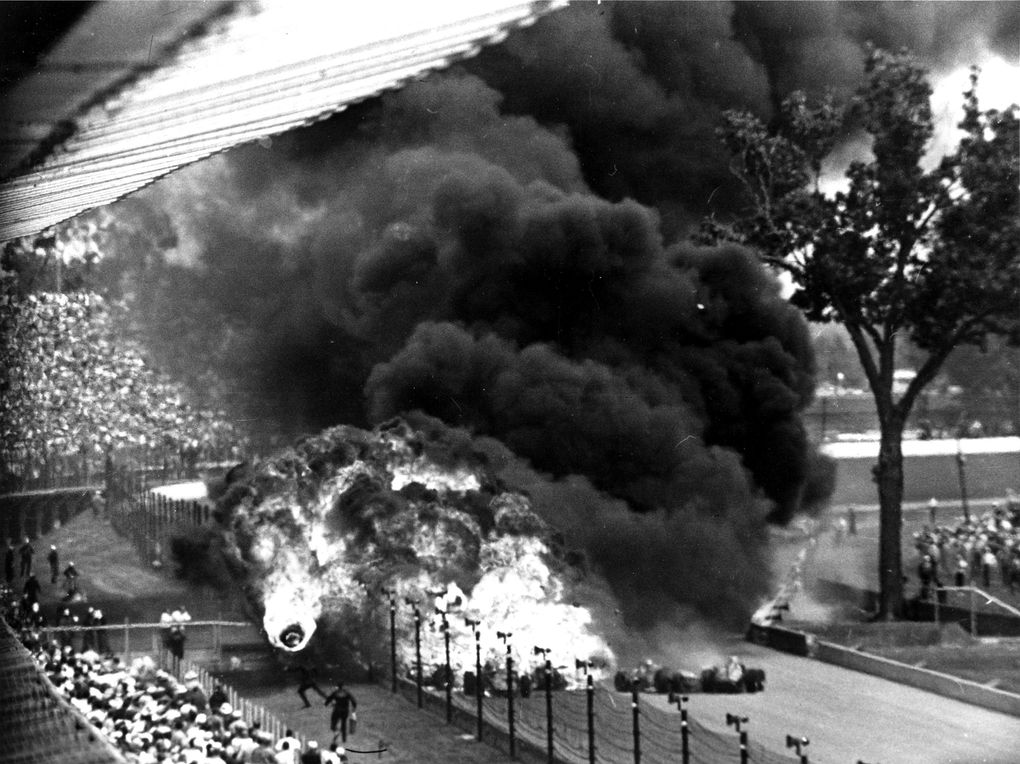
May 30, 1964: Dave MacDonald crashes in the 2nd lap of the Indianapolis 500, and his car explodes. Unable to see because of the smoke and flames, Eddie Sachs crashes into him, causing another explosion.

(I had resisted adding auto racing events to this feature, because I don't like the event, and consider it to not be a sport. I finally changed my mind, given how many people are interested.)

Sachs died instantly; he had just turned 37. Known as the Clown Prince of Racing, he wasn't very successful, but his personality made him popular. He was known for saying, "If you can't win, be spectacular." That's how he lived, and that's how he died. MacDonald died at the hospital 2 hours later; he was 27. Unlike Sachs, who never won a race, he won 47 and was in the top 3 in nearly 70 others.

This was the first time in its 53-year history that the Indy 500 was stopped outright, for any reason other than rain. Once the wrecks were cleared, the race resumed, and A.J. Foyt won it. Among the safety measures put in place before the next year was a different type of fuel, and cars with rear engines instead of front.

There have been 15 drivers killed during the 500 -- thankfully, none since 1973. Two former winners have been killed in subsequent races: 1938 winner Floyd Roberts in 1939, and 1953 winner Bill Vukovich in 1955.

After Chuck Rodee was killed in time trials for the race in 1966, the great Los Angeles Times sports columnist Jim Murray, remembering MacDonald and Sachs 2 years earlier, labeled the race "The Run for the Lilies," and titled a prerace column "Gentlemen, Start Your Coffins."

*

May 30, 1964 was a Saturday. Two very different kinds of American singers were born: Country music legend Wynonna Judd, and Rage Against the Machine frontman Tom Morello.

These baseball games were played:

* The New York Yankees beat the Kansas City Athletics, 9-1 at Kansas City Municipal Stadium. Whitey Ford outpitched Moe Drabowsky. Mickey Mantle did not play. Clete Boyer hit a home run. Roger Maris went 0-for-3 with a walk.

* The New York Mets beat the San Francisco Giants, 6-2 at the new Shea Stadium. Jack Fisher went the distance for the win. Ron Herbel only lasted 4 inning as the starter, followed by 2 innings of a not-yet-great -- not-yet-spitballing? -- Gaylord Perry. Charley Smith hit a home run for the Mets. Willie Mays went 2-for-4. Duke Snider, running out the string with the Giants of all teams, went 0-for-4. Willie McCovey did not play.

* The Philadelphia Phillies beat the Houston Colt .45s, 5-1 at Connie Mack Stadium in Philadelphia. Chris Short went the distance for the win. Wes Covington hit a home run. The next year, the Colts moved into the Astrodome, and changed their name to the Houston Astros.

* The Cleveland Indians beat the Washington Senators, 10-2 at District of Columbia Stadium (later Robert F. Kennedy Stadium) in Washington.

* The Los Angeles Dodgers beat the Pittsburgh Pirates, 10-3 at Forbes Field in Pittsburgh. Don Drysdale went the distance for the win, while Pirate starter Vernon Law didn't get a single out. Maury Wills, known for his speed instead of his power, went 3-for-4 with a home run, a walk, 3 stolen bases and 2 RBIs. Roberto Clemente and Willie Stargell each went 2-for-4.

* The Chicago White Sox beat the Detroit Tigers, 10-4 at Tiger Stadium in Detroit. Al Kaline went 0-for-4.

* The Chicago Cubs swept a doubleheader from the Milwaukee Braves, 4-2 and 2-0 at Wrigley Field in Chicago. Ernie Banks and Hank Aaron each hit a home run in the opener, with 43-year-old Warren Spahn pitching an inning of relief. In the nightcap, Sterling Slaughter pitched 7 innings of 3-hit shutout ball, and Lindy McDaniel pitched 2 perfect innings of relief.

* The Minnesota Twins beat the Boston Red Sox, 7-3 at Metropolitan Stadium in the Minneapolis suburb of Bloomington, Minnesota. Harmon Killebrew went 1-for-4 with an RBI. Tony Oliva and Bob Allison hit home runs. Carl Yastrzemski went 0-for-3 with a walk.

* The St. Louis Cardinals beat the Cincinnati Reds, 7-1 at the 1st Busch Stadium (which used to be the last Sportsman's Park) in St. Louis. Frank Robinson went 1-for-4. Pete Rose went 1-for-3 with a walk.

* And the Baltimore Orioles beat the Los Angeles Angels, 6-0 at Dodger Stadium in Los Angeles, where the Angels were groundsharing until their Anaheim stadium could be built. Milt Pappas pitched a 4-hit shutout. Jackie Brandt went 2-for-4 with a home run, a walk, and 2 RBIs. Sam Bowens went 4-for-5 with an RBI. Brooks Robinson went 1-for-4 with an RBI.

Monday, May 30, 2022

May 30, 1911: The 1st Indianapolis 500

May 30, 1911: The 1st Indianapolis 500-Mile Race is held. It is won by Ray Harroun, a 32-year-old Pennsylvanian.

(I had resisted adding auto racing events to this feature, because I don't like the event, and consider it to not be a sport. I finally changed my mind, given how many people are interested.)

The Indianapolis Motor Speedway was built in 1909, about 6 miles west of downtown Indianapolis, by Carl G. Fisher, who got rich in the automotive and real estate businesses. He combined the two with what is often said to be the 1st automobile dealership in America.

With a permanent capacity of 257,325 seats, it is the largest structure in the world built for the purpose of sports. (The largest stadium currently in use for sports other than auto or horse racing is the Narendra Modi Stadium, a 132,000-seat cricket facility in Ahmedabad, India.)
The oval track is 2.5 miles in length, and before it was asphalt, the track was brick, giving the track the nickname "The Old Brickyard." Today, 3 feet of original bricks remain exposed at the start-finish line. In addition to the "Indy 500," the Speedway is home to the Brickyard 400, and also hosted the United States Grand Prix and the Indianapolis Motorcycle Grand Prix. A major renovation was completed in 1992.

A tech facility was built over the finish line, among its purposes to aid in determining photo finishes. Because of its resemblance to the tiered towers of Japan, it is known as the Pagoda. The current version was erected in 2000.
The 1909 Bricks and the 2000 Pagoda

Why 500 miles? The math worked out: 2.5 miles times 200 laps, a nice round number, equals 500 miles, also a nice round number. Someone pointed out that this was the estimated distance a race car could, with refills of gasoline, run before dark descended on the track. In other words, if the Speedway had lights, they could have run a 24-hour race, as was already being done in places around the world, most notably in Le Mans, France. 

At the inaugural race, Harroun's use of what would now be called a rear-view mirror, rather than the riding mechanic specified in the rules, created controversy, but was ultimately allowed. Harroun went on to win at an average speed of 74.602 miles per hour. His historic Firestone-shod yellow #32 Marmon "Wasp" is on display at the Indianapolis Motor Speedway Hall of Fame Museum.
In 1927, Eddie Rickenbacker, a successful racer and a hero pilot of World War I, bought the Speedway from Fisher. He operated it through the 1941 racing season, then shut it down, to preserve gasoline for the World War II effort. Upon the war's end in 1945, he sold the Speedway to Tony Hulman, who restarted the 500 in 1946, and sold it to television as an annual Memorial Day Weekend spectacle. He died in 1977. Since 2019, the Speedway has been owned by the biggest man in auto racing, Roger Penske.

Just as "My Old Kentucky Home" is sung before every Kentucky Derby near the beginning of May, so, too, is "Back Home Again in Indiana" sung before this race, near the end of May. From 1972 to 2014, it was sung by entertainer Jim Nabors, known for his high-pitched Alabama drawl, but also having a deep operatic singing voice that shocked people with his ability.

The race begins with the words, "Gentlemen, start your engines!" Starting in 1955, it was always a member of the Hulman family saying it, until 2020, when Penske himself took over the duties. In 1977, Janet Guthrie became the 1st woman to qualify for the race. Not wanting to change the classic phrase, Tony Hulman, in what turned out to be his last race as owner, said, "In company with the first lady ever to qualify at Indianapolis, gentlemen, start your engines!" It became, "Lady (or Ladies) and gentlemen, start your engines!" Penske has made it, "Drivers, start your engines!" Danica Patrick has the best finish in the race by a woman, 3rd in 2009.

Because of the South's love of auto racing, the Atlanta-based comedian Jeff Foxworthy has included as part of his act, "If you think the last four words of the National Anthem are, 'Gentlemen, start your engines!' you might be a redneck!"

Sadly, there was a fatal crash in the 1st 500. With Harroun the only driver with a rear-view mirror, every other car was a two-seater, with a driver and a "riding mechanic." Sam Dickson, riding with Arthur Greiner, was killed on the 12th lap when one of the car's wheels came off and the car crashed. Greiner sustained only minor injuries, but survivor's guilt led to a mental breakdown, and he died in a sanitarium in 1917.

In 1919, Arthur Thurman and Louis LeCocq became the 1st 2 drivers killed in the race, followed by Bill Spence in 1929, Mark Billman and Lester Spangler in 1933, Clay Weatherly in 1935, Floyd Roberts (the defending Champion) in 1939, Shorty Cantlon in 1947, Carl Scarborough in 1953, Bill Vukovich (the defending Champion) in 1955, Pat O'Connor in 1958, Dave MacDonald and Eddie Sachs as a result of a crash between them in 1964, and David "Swede" Savage in 1973, for a total of 14. In addition, 9 drivers have been killed in qualifying runs, and 20 drivers have been killed in practice runs at the Speedway.

Between racing and qualifying, Jim Murray, the great sports columnist for the Los Angeles Times, claimed to have lost 3 friends at the Speedway. As the Kentucky Derby is "The Run for the Roses," Murray named the 500 "The Run for the Lilies," in honor of the flowers traditionally associated with funerals. He would end his annual column about the race, "Gentlemen, start your coffins."

Immediately after taking the checkered flag, the race winner drives to Victory Lane. The celebration to honor the winner begins with the car being wheeled onto a black and white checkered periphery. Since 1936, the driver is presented with one of the largest trophies in sports, the Borg-Warner Trophy. A floral wreath, containing 33 lilies to commemorate the 33 drivers of the field, is placed around the winner's neck. Since 1956, the winner is presented a bottle of milk for refreshment, sponsored by the American Dairy Association. 

In 1913, Jules Goux of France became the 1st non-American winner. Four drivers have won it 4 times: A.J. Foyt, whose last win was in 1977; Al Unser, in 1987; Rick Mears, in 1991; and Brazilian driver Hélio Castroneves, in 2021. Still active, Castroneves could become the 1st driver to win it 5 times.

Foyt remains the only driver to have won the Indianapolis 500, the Daytona 500, the 24 Hours of Le Mans and the 24 Hours of Daytona.

In 1961, the TV show I've Got a Secret -- which, like the similar game show To Tell the Truth, would be almost impossible with today's social media -- honored the race's 50th Anniversary, by bringing both inaugural winner Harroun and then-reigning champion A.J. Foyt on as guests.

Carl Fisher died in 1939, Ray Harroun in 1968, Eddie Rickenbacker in 1973.

*

May 30, 1911 was a Tuesday. Until 1970, Memorial Day was always celebrated on May 30. In 1971, it was moved to the last Monday in May.

Since this was Memorial Day, baseball was full of doubleheaders:

* The New York Highlanders were swept by the Philadelphia Athletics, 3-0 and 8-5 at Shibe Park in Philadelphia. Harry Krause pitched a 6-hit shutout in the opener. Over the 2 games, Eddie Collins was 1-for-7 with 2 walks and an RBI. The Highlanders became the New York Yankees in 1913.

* The New York Giants swept the Brooklyn Superbas, 4-1 and 3-0 at the Polo Grounds. Rube Marquard won the opener. In the nightcap, Arthur "Bugs" Raymond had to leave the game in the 5th inning, and Arthur Ames pitched the rest of the way, completing a 4-hit shutout. The Superbas became the Brooklyn Dodgers in 1911.

* The Philadelphia Phillies swept the Boston Rustlers, 3-0 and 11-4 at the South End Grounds in Boston. The 1st game went 10 innings, and Earl Moore pitched a 3-hit shutout. William Hepburn Russell had bought the Boston franchise of the National League from the Dovey family, and changed its name from the Doves to the Rustlers. But he died a few weeks after the 1911 season ended. He was involved in New York's Tammany Hall political machine, and one of his friends in that machine, James Gaffney, bought the team. In connection with their namesake being a Native American chief, a Tammany officer was called a "Brave," and so, Gaffney renamed the team the Boston Braves.

* The Boston Red Sox swept the Washington Senators, 6-5 and 5-4 at Griffith Stadium in Washington. The 1st game went 10 innings. Smoky Joe Wood outpitched Walter Johnson in the 2nd game. The following season, they would have one of the most famous pitchers' duels of all time. Tris Speaker went 2-for-8 with 3 walks. Wid Conroy went 5-for-9 with an RBI for the Senators.

* In the only single game of the day, the Pittsburgh Pirates beat the Chicago Cubs, 4-1 at Forbes Field in Pittsburgh. Honus Wagner went 2-for-4 with an RBI.

* The Detroit Tigers swept the Cleveland Naps, 3-2 and 6-5 at League Park in Cleveland. The 1st game went 10 innings. Over the 2 games, Ty Cobb went 2-for-8 with a walk; Sam Crawford went 5-for-9 with an RBI; and "Shoeless" Joe Jackson went 2-for-7 with a walk. Napoleon "Nap" Lajoie, the manager and 2nd baseman for whom the Cleveland team was named, did not put himself into either game. The Naps became the Cleveland Indians in 1915, and the Cleveland Guardians in 2022.

* There was a split at Comiskey Park in Chicago. The St. Louis Browns won the 1st game, 4-1. The Chicago White Sox won the 2nd game, 2-0, when Irv Young (no relation to Cy) pitched a 2-hit shutout.

* And there was a split at Robison Field in St. Louis. The St. Louis Cardinals won the 1st game, 4-2. The Cincinnati Reds won the 2nd game, 6-2.

Friday, May 6, 2022

May 6, 1965: The Van Arsdale Twins Are Drafted

Dick (left) and Tom

May 6, 1965: The Van Arsdale Twins are selected in the NBA Draft, by different teams. This will put them on separate teams for the first time.

Richard Albert Van Arsdale and Thomas Arthur Van Arsdale were born on February 22, 1943 in Indianapolis. Until the hockey-playing Sedins came along, they were the greatest pair of twins in the history of sports. (And I don’t want to hear about no DeBoers in soccer.) Tom and Dick played basketball together at Emmerich Manual High School in Indianapolis and at Indiana University. But they couldn't play together forever, and they would be split up in the 1965 NBA Draft, which was held at the Plaza Hotel in New York.

There were 3 "territorial picks," for the last time: The 1966 Draft would be the 1st without them. The New York Knicks chose Bill Bradley of Princeton, and the Los Angeles Lakers chose Gail Goodrich of UCLA, and both would make the Basketball Hall of Fame. The Detroit Pistons chose Bill Buntin, of the Michigan team that beat Princeton in the Semifinal of the NCAA Tournament, and then lost to UCLA in the Final.

The top 2 picks were Fred Hetzel of Davidson and Rick Barry of the University of Miami, both chosen by the San Francisco Warriors, picks gained through trades. Hetzel's pro career was undistinguished, although, like Barry, he helped the Warriors win the 1967 Western Conference title. Barry became a Hall-of-Famer.

The Knicks chose Dave Stallworth, a role player on their 1970 NBA Champions. The Baltimore Bullets chose Jerry Sloan, who became a star with the Chicago Bulls, and was elected to the Hall of Fame for his coaching of the Utah Jazz. The Philadelphia 76ers chose Billy Cunningham, and they've never won an NBA Championship without him: As a player in 1967, and as their head coach in 1983.

The St. Louis Hawks chose Jim Washington, a journeyman. The Cincinnati Royals chose Nate Bowman, another 1970 Knick. The Boston Celtics chose Ollie Johnson, but he never played in the NBA. The 2nd Round then started, and the Warriors chose Wilbert Frazier, no relation to Walt of the Knicks, and he barely played in the NBA, playing in the ABA and in minor leagues.

Then, with the 10th pick, the Knicks chose Dick Van Arsdale. With the 11th pick, the Pistons chose Tom Van Arsdale. The Royals went on to choose Flynn Robinson, and he won a title, for the Lakers in 1972.

Dick played 3 seasons for the Knicks, before being lost to the Phoenix Suns in the 1968 expansion draft, preventing him from playing with the Knicks in the 1970, '72 and '73 NBA Finals. He was selected for the NBA All-Star Game in 1969, '70 and '71, and helped the Suns reach their 1st NBA Finals, in 1976, where they lost to the Celtics.

In 1968, Tom was traded to the Cincinnati Royals, moving with them in 1972, as they became the Kansas City Kings. He was also selected for 3 All-Star Games, in 1970, '71 and '72. This made the '70 and '71 Games the 1st and 2nd to have twin brothers in it, but they were still split up: Tom's Royals were in the Eastern Division, and Dick's Suns were in the Western Division.

Tom went to the Philadelphia 76ers in 1973 and the Atlanta Hawks in 1974, before being reunited with Dick on the Suns, as they played their last season, 1976-77, together.

Statistically, they were close, as Dick averaged 16.4 points per game, Tom 15.3; and Tom had 4.2 rebounds per game, Dick 4.1. But Dick played in a Finals, whereas Tom holds the record for most games played in the NBA without having reached the Finals: 929.

In 1978, they appeared together in a commercial for Miller Lite beer, with Dick taking the "Less Filling" side, Tom the "Tastes Great" side. Dick briefly coached the Suns in 1987. They retired his Number 5. (Tom also wore 5 through most of his career, and switched to 4 with the Suns.) Since their retirements from basketball, they have remained in the Phoenix area, and have become artists. They also run the annual "Docs vs. Jocks vs. Drugs" game back in Indianapolis, where their original lockers have been preserved in the display case in the lobby of the Emmerich Manual High School gymnasium..

UPDATE: Dick died on December 16, 2024, at the age of 81.

*

May 6, 1965 was a Thursday. Actress Leslie Hope was born. This was also the day that the Symphony of the New World made its debut performance. I have a separate entry for that event.

The NBA season had ended 11 days earlier, when the Celtics beat the Lakers in the Finals. The NHL season had ended 5 days before this date, with the Montreal Canadiens winning the Stanley Cup over the Chicago Black Hawks. Football was out of season.

There were 4 games played in Major League Baseball:

* The Los Angeles Dodgers beat the Cincinnati Reds, 4-3 at Crosley Field in Cincinnati. Johnny Podres was the winning pitcher. Derrell Griffith and Ron Fairly hit home runs for the Dodgers. Frank Robinson homered for the Reds. Pete Rose went 0-for-4 with a walk.

* The Chicago Cubs beat the Pittsburgh Pirates, 5-3 at Wrigley Field in Chicago. Larry Jackson was the winning pitcher, and aided his own cause by going 3-for-3 with a home run and 3 RBIs. Ernie Banks went 1-for-3 with a walk and an RBI. Willie Stargell hit 2 home runs for the Pirates, and Jim Pagliaroni added 1. Roberto Clemente appeared as a pinch-hitter, and did not reach base.

* The Baltimore Orioles beat the Minnesota Twins, 5-1 at Metropolitan Stadium in the Minneapolis suburb of Bloomington, Minnesota. Brooks Robinson hit a home run off Jim Kaat, and Harmon Killebrew hit a home run off Robin Roberts.

* And the California Angels beat the Kansas City Athletics, 5-4 at Dodger Stadium in Los Angeles, where the Halos were groundsharing with the Dodgers while waiting for their stadium to be finished in Anaheim. Bobby Knoop went 2-for-3 with a home run and 4 RBIs.

December 31, 1999 & January 1, 2000: The Millennium

December 31, 1999:  The Millennium arrives. The people of planet Earth survived. At a terrible cost. But we hadn't destroyed ourselves. ...