Showing posts with label dallas cowboys. Show all posts

Saturday, December 31, 2022

December 31, 1967: The Ice Bowl

Lambeau Field as it appeared in 1967.
Note the shadow cast by the scoreboard
at the south end. This will matter later on.

December 31, 1967: As the narrator for a 1987 NFL Films production put it, "On a day savage enough to make a Saint Bernard whimper, they played the 1967 NFL Championship Game." Or, as it has become known in football lore, The Ice Bowl.

I don't know who the narrator was -- the Internet has failed me in this regard -- but the film was made in 1987, so it wasn't John Facenda, the voice of NFL Films from 1966 until his death in 1984. Let the record show that Facenda never actually spoke the words "the frozen tundra of Lambeau Field." ESPN's Chris Berman, imitating Facenda, made that up.

The Ice Bowl isn't even the coldest game in NFL history anymore. The 1981 AFC Championship Game, played at Riverfront Stadium in Cincinnati on January 10, 1982, was 9 degrees below zero without the wind chill factor, and 37 below with it. The San Diego Chargers, used to warm weather, had played one of the hottest games in NFL history just 8 days earlier, against the Miami Dolphins at the Orange Bowl, and were totally unused to this kind of cold. The Bengals won, 27-7. This one is known as the Freezer Bowl.

Many NFL Championship Games, nearly all played in December to that point, had been plagued by cold weather. Vince Lombardi had been born and raised in Brooklyn, and had coached the Green Bay Packers since 1959, so he could handle cold weather.

But from having coached in the title games of 1956, 1958 (these 2 as an assistant coach with the New York Giants), 1961, 1962 and 1965, he knew that cold weather could be a problem for football. Fortunately, since the Packers' unusual ownership structure, and his role as both head coach and general manager, left him a virtual dictator, he had the field torn up, and heating coils placed under the field. When resodded, the idea was that the coils would keep the field from freezing. It became known as "Lombardi's Electric Blanket."

Lombardi had been offensive coordinator to Giants head coach Jim Lee Howell. The defensive coordinator was Tom Landry, who became the 1st head coach of the Dallas Cowboys, the team the Packers had defeated to win the 1966 NFL Championship, and whom they would have to beat again to win for 1967. Lombardi and Landry were opposites: Landry was a great stone face, never showing emotion during the game; while Lombardi was, in the words of his Hall of Fame guard Jerry Kramer, "a raving Italian lunatic!"

But the teams were the other way around: The Cowboys -- not yet the dominant team that they would become -- were braggarts, having earned very little right to do so thus far; while the Packers let their performance do the talking for them. The exception was Hall of Fame running back Paul Hornung, but he was retired by this point. The Packers were going for their 5th NFL Championship in 7 years, which included ending the previous season by winning "The AFL-NFL World Championship Game," retroactively named "Super Bowl I."

The day before the game, NFL Commissioner Pete Rozelle made some phone calls, and was told that the game-time temperature would be about 5 degrees above zero. (All temperatures mentioned in this post will be in degrees Fahrenheit.)

Rozelle didn't like that, and began to consider postponing the game to the next day, Monday, New Year's Day 1968, despite the fact that it would compete for TV ratings with the college bowl games. But he was told that the oncoming cold front would make it even colder on Monday. So, already in Green Bay, he called Lombardi at his house, and Landry at his hotel, and told them the game would go on as scheduled.

But the cold front arrived sooner, and was worse than expected. As Cowboy receiver Rentzel reported, he was told that it was 15 degrees below zero. The official NFL Films record of the game shows a rotating bank clock backing that up, reading "-15°."
I couldn't find a photo online.
I had to photograph it off my computer screen.
Yes, that's me and my phone in the reflection.

When Lombardi got to Lambeau Field, he discovered that it was so cold (This was before comedians began doing things like, "How cold was it?"), the mechanism for the heating coils broke. With the machine inoperable, the field was frozen. To make matters worse, when the tarp was taken off the field, it had left moisture on it, which froze. The field was an ice rink.

At the time, Lambeau Field held 50,861 people. That was the official attendance: In spite of the cold, there was not an empty seat in the house -- until an elderly spectator died from exposure. Yes, only one fan died from the cold. Among those in attendance was a 12-year-old boy from Appleton, Wisconsin, who went on to become a renowned actor: Willem Dafoe. In 2017, NFL Films released a 50th Anniversary documentary on the Ice Bowl, with Dafoe narrating. 

The marching band of the University of Wisconsin-La Crosse was scheduled to perform the pregame and halftime shows. But during -- pardon the choice of words -- the warmups, the spit inside their woodwind instruments froze, rendering them impossible to play. The mouthpieces of brass instruments stuck to their players' lips. Seven members of the band were taken to the hospital for hypothermia.

The officials' whistles also had the spit freeze inside, and, during the pregame midfield meeting with the team captains, they said that play would be stopped by the officials putting their hands on the backs of players who, due to concentrating on the ballcarrier, couldn't otherwise see that play had stopped.

Frank Gifford, the Hall of Fame running back for the Giants who was serving as one of the CBS announcers for the game, said, on the air, "I'm going to take a bite of my coffee."
The game was played anyway. When it kicked off at 1:00 PM Central Standard Time -- 2:00 Eastern -- it was 13 below, with a wind-chill factor, on the since-changed current scale, of -36.
Note the ticket price: $10. That's about $83 in 2022 money.
For the Championship Game. Today, a regular-season game
would almost certainly cost you much more.

The game did affect the Cowboys more than the Packers. The film shows Hall of Fame linebacker Ray Nitschke running onto the field in short sleeves, with no gloves. He was from Chicago. He could handle it. But Meredith's face froze, to the point where he couldn't make his words understood in the huddle unless he pressed on his cheeks. Bob Hayes, the Olympic sprinting champion who'd hauled in so many of Meredith's passes, had to run with his hands tucked in a hole cut in his jersey.

The Packers opened the game with a 9-minute drive that ended with a touchdown pass from Bart Starr to Boyd Dowler. Starr connected with Dowler again in the 2nd quarter, giving the Packers a 14-0 lead. It would then have been very easy to guess that the Texas-based team were done in by the cold, and were finished.

They weren't. They showed a tremendous amount of courage, and came back. They didn't get a single 1st down in the 2nd quarter, but fumbles by Starr and of a punt return by Wood led to Cowboy scores, making it 14-10 Green Bay at the half.

In the 3rd quarter, the Packers stopped a Cowboy drive with a fumble, and ended another that resulted in a missed field goal by Danny Villanueva. At the start of the 4th quarter, Landry gambled, and called an option pass for Dan Reeves -- later to coach the Denver Broncos, the Giants and the Atlanta Falcons -- to Rentzel. It went for 50 yards and a touchdown.

Despite seemingly everything going against them, the Cowboys led 17-14. The Packers' Don Chandler missed a field goal, and it looked like the Packers would be dethroned.

With 4 minutes and 50 seconds left, the Packers took over on their own 32-yard line. Since the goalposts would be on the goal line until the 1974 season, but Chandler had already missed a 40-yard attempt, this meant that they probably needed to get the ball to the Dallas 30-yard line for a field goal -- but that would only have tied it, and sent this already-miserable experience to overtime.

Starr advanced the Packers with short passes to Dowler and Donny Anderson. But a hit knocked Dowler down, and his head hit the frozen turf. Even with the protection of a football helmet, he was knocked unconscious. As with the Super Bowl nearly a year earlier, Max McGee came in to replace him. Unlike that Super Bowl, McGee would not turn out to be the hero this time.

Lombardi's most famous play was the "power sweep": Both guards, Kramer and Fred "Fuzzy" Thurston, would pull out of the line at the snap, and run in the same direction (either left or right), and Starr would pitch to a running back, who would then run behind the guards. This had worked so many times with Hornung and Jim Taylor, and now with Anderson and Elijah Pitts.

This time, Lombardi had a trick up his sleeve, a play known in the Packer playbook as "54-Give." He called it the "sucker play": It was a fake power sweep, with Gale Gillingham, having replaced Thurston, pulling to the right. This caught the attention of the Cowboys' Hall of Fame defensive tackle, Bob Lilly, and he followed. This left a hole up the middle, and running back Chuck Mercein got to the 3-yard line.

The Packers then needed to get to the 1-yard line for a 1st down, and did. Some of the Cowboys thought Anderson had scored. Had there been a rule at the time, allowing a coach to challenge a call via instant replay, what happened next might not have happened, and Anderson would have been the big hero of the game. But the officials didn't see the ball cross the plane of the goal line, and so it was 1st and goal on the 1.

It was getting late. Lambeau Field did have lights, so darkness was not going to be an issue. But a lack of sunlight was. To make matters worse, the action was now at the south end of the field, where the shadow of the scoreboard loomed, making it even colder. I've seen sources say that, with the wind chill factor (on the old scale), it was as low as 48, or even 55, degrees below zero.

There was less than a minute left. On 1st down, Starr handed off to Anderson, but he slipped on the icy field. On 2nd down, Anderson slipped even before Starr could get the ball to him. Now, it was 3rd and goal on the 1. The Packers called their last timeout. There were 16 seconds left.

On the film, Lilly can be shown kicking the field, and he kicks up specks of frost. The Cowboys actually considered getting a drill, and drilling holes in the field, to get a better footing. I don't know if that was legal at the time, or if they would have had time for it, even if they took all their remaining timeouts.

The Packers' dilemma was equally tricky. Run the ball and fail, and they wouldn't be able to stop the clock in time to kick the tying field goal. Pass the ball, and it could fall incomplete, leaving 4th down with the clock stopped with a few seconds left, and you could still kick the field goal -- but it could also be intercepted, as Tom Brown did with Meredith's desperation pass with just under a minute to play, which clinched the Packer victory in the Championship Game the year before, in Dallas. Kick the field goal now, on 3rd down, and Chandler could miss again; and, even if he makes it, the game is still only tied.

Starr wasn't as good a passer as his contemporaries Johnny Unitas, Sonny Jurgensen and Joe Namath, but he was smarter than any of them. He recommended a play called "31-Wedge," telling Lombardi, "Coach, the linemen can get their footing on the wedge, but the backs are slipping. I'm right there. I can just shuffle my feet and lunge in."

At this point, Lombardi, who had famously said, "Fatigue makes cowards of us all," was as cold and as tired as anyone, and was not looking forward to overtime, so he told Starr, "Run it, and let's get the hell out of here!"

Starr called the play. It required guard Kramer and center Ken Bowman to double-team the Cowboys' other tackle, Jethro Pugh. Bowman snapped the ball, Starr took it, lowered his head, and followed the block.

Touchdown. On the film, Mercein can be shown raising his hands. He's not signaling, "Touchdown!" He's showing the referee that he's not illegally helping Starr. To this day, Cowboy fans insist that Kramer was offside. As if the Cowboys wouldn't win a whole slew of games due to cheating and favorable officials' calls in the years to come. Besides, Anderson might have broken the plane of the goal line 3 plays earlier, and the refs missed that.
Starr (15) over the goal line. Mercein (30) with his hands up.
Kramer (64) having blocked Pugh (75).
This is Walter Iooss Jr.'s photo for Sports Illustrated.
The most familiar shot of the touchdown is in black & white,
and I wanted a color photo.

In his 1981 book Pro Football's 10 Greatest Games, in which he included both this game and the previous season's NFL Championship Game between the Packers and the Cowboys, sports historian (usually specializing in baseball) John Thorn wrote, "It is the most famous touchdown in football history."

He published that book before the 1982 Dwight Clark "The Catch," but put Starr's Sneak ahead of the 1958 Alan Ameche overtime score (he included that title game in the book), and the 1974 Clarence Davis "Sea of Hands" catch (he included that game, too), and apparently ahead of the 1972 Franco Harris "Immaculate Reception" (he did not include that game).

Chandler kicked the extra point to make it 21-17. There were still 13 seconds left. The Packers kicked off, and the Cowboys let it go into the end zone. Meredith threw 2 incompletions, and, at 3:44 PM Central Time (4:44 Eastern), the game was over.
How anybody still had any desire to remain outside
long enough to tear down the goalposts, I'll never know.

The Packers went Super Bowl II, in considerably friendlier weather at the Orange Bowl in Miami, and beat the AFL Champion Oakland Raiders, 33-14. Lombardi retired as head coach after that game, but stayed on as general manager. As with the 1964-65 Yankees, the team seemed to get old all at once, and the dynasty collapsed. The team wouldn't reach the title game again for 29 years, winning Super Bowl XXXI in the 1996-97 season.

After the 1968 season, Lombardi accepted Edward Bennett Williams' offer to be head coach and general manager of the Washington Redskins, and began to rebuild them in 1969. But he developed colon cancer -- much more easily treatable now, but fatal then. He died on September 3, 1970, only 57 years old. The Redskins hired George Allen away from the Los Angeles Rams, and reached Super Bowl VII 3 seasons later.

The Cowboys got tagged as a team that "can't win the big one." They reached Super Bowl V, but lost to the Baltimore Colts. Finally, they came to dominate the NFC in the 1970s, reaching 5 Super Bowls, winning Super Bowls VI and XII. They began calling themselves "America's Team." They were featured on TV so much that people joked that CBS stood for "Cowboys Broadcasting System." Landry remained head coach until 1989, and died in 2000.

The Ice Bowl lives on in sports memory. It still gives chills, even to people like me who weren't even born yet. In 2019, a poll ranked this game 3rd on a list of the 100 Greatest Games of the NFL's 1st 100 years.

*

December 31, 1967 was a Sunday. The 1967 AFL Championship Game was played the same day. The Oakland Raiders beat the Houston Oilers, 40-7 at the Oakland Coliseum. While that stadium has been known for chilly conditions, there was no issue with the weather there on that day.

There were 2 games played in the NBA. The Los Angeles Lakers beat the expansion San Diego Rockets, 147-118. It was the 1st game the Lakers played at their new arena, The Forum, outside Los Angeles in Inglewood, California.

And the San Francisco Warriors beat the other expansion team, the Seattle SuperSonics, 126-124 at the Seattle Center Coliseum. For the Warriors, Nate Thurmond had 34 points and 25 rebounds.

There was 1 game played in the American Basketball Association, which was in its 1st season: The Pittsburgh Pipers beat the Indiana Pacers, 121-106 at the Civic Arena in Pittsburgh. The Pipers would go on to win the 1st ABA Championship. But before the 1972-73 season, they were out of business. The Pacers would win the ABA title in 1970, '72 and '73, and were 1 of the 4 teams absorbed from the ABA into the NBA in 1976.

There were 4 games played in the NHL that day:

* The New York Rangers beat the Toronto Maple Leafs, 4-0, in one of the last events at the old Madison Square Garden.

* The Philadelphia Flyers beat the Los Angeles Kings, 9-1 at The Spectrum in Philadelphia.

* The Detroit Red Wings beat the Boston Bruins, 6-4 at the Olympia Stadium in Detroit.

* The Chicago Blackhawks beat the Oakland Seals, 3-0 at the Chicago Stadium.

* The Montreal Canadiens, the Pittsburgh Penguins, the St. Louis Blues and the Minnesota North Stars were not scheduled.

Friday, December 30, 2022

December 30, 2023: The Longest Losing Streak In NBA History

NOTE: While these entries are dated 2022, I decided to backdate the posting dates of events from 2023 onward to the same date in 2022.

December 30, 2023: The Detroit Pistons beat the Toronto Raptors, 129-127 at the Little Caesars Arena in Detroit. Pascal Siakam scored 35 points for the Raptors, and Dennis Schröder scored 30. Cade Cunningham scored 30 to lead the Pistons.

This ended a 28-game losing streak for the Pistons. It was tied for the longest losing streak in not just NBA history, but the longest in the history of major league sports in North America. It also became the longest single-season losing streak.

The Pistons had lost their 1st game of the 2023-24 season, then won their next 2. But on October 30, they lost away to the Oklahoma City Thunder, 124-112. They eventually fell to 2-29. Of the 28 losses, 11 of them were by 8 points or less.

From March 27 to December 1, 2015, the Philadelphia 76ers lost 28 straight games, but that was over the course of 2 seasons: Their last 18 games of in 2014-15, and their 1st 10 of 2015-16. They broke their own record: From January 31 to March 29, 2014, they lost 26 straight, tying the record set by the Cleveland Cavaliers from December 20, 2010 to February 11, 2011.

In the 1972-73 season, when the Sixers had the worst record in NBA history, 9-73, their longest losing streak was 20 games, from January 9 to February 14, 1973. And, straddling the previous off-season, they lost 19 straight from March 21 to November 11, 1972.

*

December 30, 2023 was a Saturday. These other 5 NBA games were played that day:

* The New York Knicks lost to the Indiana Pacers, 140-126 at the Gainbridge Fieldhouse in Indianapolis.

* The Chicago Bulls beat the Philadelphia 76ers, 105-92 at the United Center in Chicago.

* The Minnesota Timberwolves beat the Los Angeles Lakers, 108-106 at the Target Center in Minneapolis.

* The Utah Jazz beat the Miami Heat, 117-109 at the Delta Center in Salt Lake City.

* And the Dallas Mavericks beat the Golden State Warriors, 132-122 at the Chase Center in San Francisco. Luka Dončić of the Mavericks led all scorers on the day with 39 points.

Baseball was out of season. One game was played in the NFL: The Dallas Cowboys beat the Detroit Lions, 20-19 at AT&T Stadium in the Dallas suburb of Arlington, Texas. The Lions scored a touchdown with less than a minute to go, and seemed to have taken the lead on a tackle-eligible play on the two-point conversion attempt. However, the referee ruled that the unusually-eligible player had not announced to him that the play would be tried. The video replay proved that the referee was a liar, and, through either malice or incompetence, the win was stolen from the Lions.

There were 4 college football bowl games played:

* Number 6 Georgia had lost the Southeastern Conference Championship Game to Alabama. Number 4 Florida State had won the Atlantic Coast Conference Championship, and were undefeated, but were denied a spot in the National Championship Playoff. They did not make their point well: Georgia beat them, 63-3 in the Orange Bowl, at Hard Rock Stadium in Miami Gardens, Florida. It was the biggest blowout in bowl game history.

* Number 11 Mississippi (a.k.a. "Ole Miss") beat Number 10 Penn State, 38-25 in the Peach Bowl, at Mercedes-Benz Stadium in Atlanta.

* Maryland beat Auburn, 31-13 in the Music City Bowl, at Nissan Stadium in Nashville.

* And the University of Wyoming beat the University of Toledo, 16-15 in the Arizona Bowl, at Arizona Stadium, on the University of Arizona campus in Tucson.

And there were 9 games played in the NHL:

* The New York Rangers beat the Tampa Bay Lightning, 5-1 at the Amalie Arena (now the Benchmark International Arena) in Tampa.

* The New Jersey Devils lost to the Boston Bruins, 5-2 at the TD Garden in Boston.

* The Florida Panthers beat the Montreal Canadiens, 4-1 at the Amerant Bank Arena in the Miami suburb of Sunrise, Florida.

* The Nashville Predators beat the Washington Capitals, 3-2 in a shootout at the Capital One Arena in Washington.

* The Carolina Hurricanes beat the Toronto Maple Leafs, 3-2 at the Scotiabank Arena in Toronto.

* The Buffalo Sabres beat the Columbus Blue Jackets, 3-2 at the KeyBank Center in Buffalo. Jeff Skinner scored the winning goal with 3:40 left in overtime.

* The Pittsburgh Penguins beat the St. Louis Blues, 4-2 at the PPG Points Arena in Pittsburgh.

* The Winnipeg Jets beat the Minnesota Wild, 4-2 at the Canada Life Centre in Winnipeg.

* The Edmonton Oilers beat the Los Angeles Kings, 3-2 in a shootout at the Crypto.com Arena in Los Angeles.

Wednesday, December 28, 2022

December 28, 1975: The Cowboys' Hail Mary, Full of Disgrace

December 28, 1975: The Minnesota Vikings host the Dallas Cowboys in an NFC Divisional Playoff game at Metropolitan Stadium, in the Minneapolis suburb of Bloomington, Minnesota. Each team had dominated, and would continue to dominate, its respective Division through the 1970s: The Vikings, the NFC Central; the Cowboys, the NFC East. The Cowboys had lost Super Bowl V and won Super Bowl VI; the Vikings had lost Super Bowls IV, VIII and IX, and were going for their 3rd straight NFC Championship.

The game's 1st half was relatively quiet, with only one score, a touchdown by the Vikings in the 2nd quarter that made it 7-0. The Cowboys tied it with a touchdown in the 3rd quarter. So the game was dominated by each team's defensive unit, the Cowboys' "Doomsday Defense" and the Vikings' "Purple People Eaters."

Early in the 4th quarter, Toni Fritsch, the Cowboys' Austrian-born placekicker, kicked a 24-yard field goal, and they led 10-7. But quarterback Fran Tarkenton, named the NFL's Most Valuable Player that season, led a touchdown drive that gave Minnesota a 14-10 lead with 5:24 left in regulation.

The Cowboys could not gain a 1st down on their next drive, so the Vikings got the ball with 3:12 left. With Tarkenton as a running quarterback, known as "Fran the Scrambler" -- as was the Cowboys' Roger Staubach, a.k.a. "Roger the Dodger" -- the Vikings kept the ball on the ground to run out the clock, forcing the Cowboys to use up all their timeouts.

But on a 3rd & 2 play, Charlie Waters sacked Tarkenton for a 3-yard loss, with the clock stopping for the 2-minute warning. Tarkenton later said, "That play cost us the game. It wasn't the Hail Mary pass. We had the game in control, but didn't make the play."

The Vikings punted, and the Cowboys got the ball back on their 15-yard line, with 1:51 left, and no timeouts, including the already-used 2-minute warning. Staubach got to the Cowboys' 31, then took a low snap and fumbled it, resulting in a 4th & 16 from the 23. He threw a pass to Drew Pearson, who was pushed out of bounds by Nate Wright before he caught it. Under the rule of the time, this counted as a reception. The rule was changed in 2008. The rule might not have been fair, but it was in place.

Staubach got the Cowboys to the 50-yard line with 32 seconds left. Staubach threw a long pass, usually called a "bomb" in those days. Being Catholic, he called it a "Hail Mary," putting that expression into the football lexicon.

The pass was intended for Pearson, who was again covered by Wright. Pearson pushed Wright, which should have resulted in a penalty for offensive pass interference. No penalty was called, and Pearson caught the pass, and took it in for a touchdown. The Cowboys led, 17-14.

To make matters worse for Tarkenton, he found out that his father -- named, with retroactive irony, the Reverend Dallas Tarkenton -- died while watching the game on television, back in their hometown of Athens, Georgia.

The Cowboys went on to beat the Los Angeles Rams for the NFC Championship, before losing Super Bowl X to the Pittsburgh Steelers. The Vikings rebounded to win the NFC Championship the next year, but lost Super Bowl XI to the Oakland Raiders. That made them 0-4 in Super Bowls, a total that would later be matched by the Denver Broncos and the Buffalo Bills. Through the 2021 season, the Vikings haven't even been to a Super Bowl since 1977. The Bills are still 0-4, but the Broncos have improved to 3-5.)

Viking fans have had to put up with a lot, but they still fume over the penalty that was not called on Staubach's pass. It wasn't a "Hail Mary, full of grace": It was full of disgrace. It remains the most infamous moment in the history of sports in the State of Minnesota.

The question needs to be asked, though: What if the penalty had been called? The Cowboys could still have won the game, anyway. Not for nothing was Staubach known as "Captain Comeback." And if the Vikings still won? They would have had to face the Rams in the NFC Championship Game, in Los Angeles. And if they'd won that, they would have had to face the Steel Curtain.

In this counterfactual scenario, I don't like their chances. They went to 4 Super Bowls between the seasons of 1969 and 1976, and they weren't the better team in any of them, and lost them all. So maybe their grievance over this game is bigger than it should be.

In hindsight, though, Pearson paid a price: It took until 2021 for him to be elected to the Pro Football Hall of Fame, his 33rd year of eligibility. For years, fans have speculated that there is a general bias against the Cowboys for the Hall: Mel Renfro had to wait 14 years; Rayfield Wright, 22 years; Bob Hayes, 30 years (and died before being elected); Cliff Harris, 36 years. Some are still waiting to get in: Don Meredith and Don Perkins have been eligible since 1974 (and both are dead), Chuck Howley since 1979, Lee Roy Jordan since 1981, Charlie Waters since 1987, Jay Novacek since 2001, and Darren Woodson since 2010. (UPDATE: Howley was elected in 2023, his 45th year of eligibility. He was 86 years old, but at least he was still alive. Jordan died in 2025.)

In Pearson's case, it seemed as though the statistical case was there: 489 receptions, 7,822 yards, 48 touchdowns, all big numbers for a 1970s receiver. It was widely believed that one play was keeping him out: Nobody had ever punished the Cowboys for this unfair result, so the Hall voters punished Pearson as an individual. Regardless, he is in now. And, unlike Hayes -- and the still-not-in Meredith and Perkins -- he lived long enough to see it.

*

December 28, 1975 was a Sunday. There was 1 other NFL Playoff game that day: The Oakland Raiders beat the Cincinnati Bengals, 31-28 at the Oakland Coliseum.

There were 6 games played in the NBA:

* The Cleveland Cavaliers beat the Buffalo Braves, 111-88 at The Coliseum in the Cleveland suburb of Richfield, Ohio. Dick Snyder scored 36 points for the Cavs.

* The Milwaukee Bucks beat the Phoenix Suns, 88-85 at the Milwaukee Exposition, Convention Center and Arena, or "The MECCA." Since 2014, it has been named the UW-Panther Arena.

* The Detroit Pistons beat the Kansas City Kings, 103-87 at the Kemper Arena (now the Hy-Vee Arena) in Kansas City.

* The Boston Celtics beat the Los Angeles Lakers, 123-113 at The Forum outside Los Angeles in Inglewood, California.

* The Portland Trail Blazers beat the Golden State Warriors, 96-92 at the Veterans Memorial Coliseum in Portland.

* And the Seattle SuperSonics beat the Houston Rockets, 116-106 at the Seattle Center Coliseum.

There were 2 games played in the American Basketball Association. The Denver Nuggets beat the Indiana Pacers, 110-105 at the Market Square Arena in Indianapolis. And the Spirits of St. Louis beat the Virginia Squires, 102-97 at the St. Louis Arena.

There were 4 games played in the NHL:

* The Boston Bruins beat the Philadelphia Flyers, 4-2 at The Spectrum in Philadelphia.

* The Vancouver Canucks beat the Detroit Red Wings, 3-2 at the Olympia Stadium in Detroit.

* The Buffalo Sabres and the Chicago Black Hawks played to a tie, 2-2 at the Chicago Stadium.

* And the Kansas City Scouts beat the California Golden Seals, 3-1 at the Oakland Coliseum Arena.

And there were 6 games in the World Hockey Association:

* The New England Whalers beat the Cleveland Crusaders, 4-0 at the Hartford Civic Center (now the PeoplesBank Arena).

* The Quebec Nordiques beat the Toronto Toros, 6-1 at Maple Leaf Gardens in Toronto.

* The Cincinnati Stingers beat the Indianapolis Racers, 4-1 at the Riverfront Coliseum (now the Heritage Bank Center) in Cincinnati.

* The San Diego Mariners beat the Minnesota Fighting Saints, 2-1 at the St. Paul Civic Center in St. Paul, Minnesota.

* The Phoenix Roadrunners beat the Denver Spurs, 5-2 at the McNichols Arena in Denver.

* And the Calgary Cowboys beat the Winnipeg Jets, 6-4 at the Stampede Corral in Calgary. 

Saturday, December 10, 2022

December 10, 1995: The Eagles Stop Emmitt Smith On 4th & 1 -- Twice

December 10, 1995: A cold night at Veterans Stadium in Philadelphia. The Philadelphia Eagles host the Dallas Cowboys. This is a rivalry that defies geography, due to the oddity of a Dallas team being in the NFC Eastern Division, along with Philadelphia, the New York Giants, and the team then known as the Washington Redskins. (From 1970 to 2001, the Division would also, strangely, including the team that began the period as the St. Louis Cardinals, and ended it as the Arizona Cardinals.)

The Cowboys had won Super Bowls XXVII and XXVIII, and lost the 1994 NFC Championship Game. The Eagles had been in contention throughout, and both were in Playoff contention again: The Cowboys were 10-3; the Eagles, 8-5.

Late in the 2nd quarter, the Cowboys led, 17-3, and blew it. With about 9 minutes left in the 4th quarter, the score was tied, 17-17. The Cowboys had a 4th & 1 on their own 26-yard line. The Eagle defense, including William Fuller, Danny Stubbs, Mike Mamula, William Thomas, and the man then ripped as the dirtiest player in the game, Bill Romanowski, knew they had one job: Stop the man the Cowboys were obviously going to give the ball, Emmitt Smith, then the best running back in the game, from gaining one yard.

If Smith got that yard, the Cowboys would have a new set of downs, and plenty of time to get within range of a game-winning field goal. If he didn't, the ball would be turned over on downs, and the Eagles would have the ball inside Cowboys territory.

Sure enough, Cowboy quarterback Troy Aikman gave the ball to Smith, and the Eagles stopped him. The Vet erupted in cheers.

Except... Ed Hochuli, not one of the NFL's most-respected referees, ruled that time-out had been called before the snap. It was the kind of thing that had led many NFL fans over the last 25 years to believe that the officials fixed games for the Cowboys. Regardless of whether that was true, the Cowboys got another chance. So the Eagles had to do it again.

Eagles radio announcer Merrill Reese had the call: "They give it to Smith, and they stop him again! They stop him again! And this time, they can't take it away from the Eagles!"

It became known as "The Groundhog Day Game," after the "time loop" movie starring Bill Murray, 2 years earlier.

The Eagles tried to run down the clock as best they could. Three running plays by Rickey Watters gained a total of 4 yards. With 3 minutes left, Gary Anderson kicked a 42-yard field goal, putting the Eagles up, 20-17.

Out of timeouts, with only the 2-minute warning to help them, the Cowboys got no closer than the Eagles' 47-yard line, and the 20-17 lead held. The Eagles had won, and 66,198 fans went wild.

The Eagles finished 10-6, made the Playoffs, and won in the 1st round, beating the Detroit Lions, 58-37. Alas, the Cowboys finished 12-4, won the NFC Eastern Division, and got their revenge in the Playoffs, beating the Eagles, 30-11 at Texas Stadium, before winning Super Bowl XXX.

*

December 10, 1995 was a Sunday. These other NFL games were played that day:

Detroit, Green Bay, Houston, Tampa Bay

* The New York Giants beat the Washington Redskins, 20-13 at Giants Stadium in the Meadowlands.

* The New York Jets lost to their arch-rivals, the New England Patriots, 31-28 at Gillette Stadium in the Boston suburb of Foxborough, Massachusetts.

* The San Francisco 49ers beat the Carolina Panthers, 31-10 at Memorial Stadium in Clemson, South Carolina. The Panthers played this, their expansion season, at Clemson University's stadium, then moved into what's now Bank of America Stadium in downtown Charlotte the next season.

* The Atlanta Falcons beat their arch-rivals, the New Orleans Saints, 19-14 at the Georgia Dome in Atlanta.

* The Indianapolis Colts beat the Jacksonville Jaguars, 41-35 at Jacksonville Municipal Stadium (now EverBank Stadium).

* The Tampa Bay Buccaneers beat the Green Bay Packers, 13-10 in overtime at Tampa Stadium.

* The Cincinnati Bengals beat the Chicago Bears, 16-10 at Riverfront Stadium in Cincinnati.

* The Buffalo Bills beat the St. Louis Rams, 45-27 at the Trans World Dome (now The Dome at America's Center) in St. Louis.

* The Detroit Lions beat the Houston Astros, 24-17 at the Astrodome in Houston.

* The Seattle Seahawks beat the Denver Broncos, 31-27 at Mile High Stadium in Denver.

* The Pittsburgh Steelers beat the Oakland Raiders, 29-10 at the Oakland Coliseum.

* The day before, Saturday, December 9, the Minnesota Vikings beat the Cleveland Browns, 27-11 at the Metrodome in Minneapolis.

* Also on the Saturday, the San Diego Chargers beat the Arizona Cardinals, 28-25 at Jack Murphy Stadium in San Diego.

* And on Monday, December 11, on ABC Monday Night Football, the Miami Dolphins beat the Kansas City Chiefs, 13-6 at Joe Robbie Stadium (now Hard Rock Stadium) in Miami Gardens, Florida.

There were 7 games in the NBA:

* The New York Knicks beat the San Antonio Spurs, 118-112 in double overtime at Madison Square Garden. David Robinson led all scorers on the day with 45 points in defeat. John Starks led the Knicks with 25 points.

* The Atlanta Hawks beat the Boston Celtics, 108-103 at the FleetCenter (now the TD Garden) in Boston.

* The Indiana Pacers beat the Los Angeles Clippers, 111-104 at the Market Square Arena in Indianapolis. Rik Smits scored 44 points.

* The Los Angeles Lakers beat the Detroit Pistons, 87-82 at The Forum outside Los Angeles in Inglewood, California.

* The Sacramento Kings beat the Miami Heat, 110-90 at the ARCO Arena in Sacramento.

* The Portland Trail Blazers beat the Houston Rockets, 103-101 in double overtime at the Rose Garden (now the Moda Center) in Portland.

* And the 2 expansion teams of that season, both based in Canada, played each other: The Toronto Raptors beat the Vancouver Grizzlies, 93-81 at General Motors Place in Vancouver. The Grizzlies moved to Memphis in 2001, and GM Place became the Rogers Arena in 2010.

And there were 4 games in the NHL:

* The New York Islanders beat the Philadelphia Flyers, 6-2 at The Spectrum in Philadelphia.

* The Chicago Blackhawks beat the Hartford Whalers, 4-1 at the United Center in Chicago.

* The Washington Capitals beat the Winnipeg Jets, 6-1 at the Winnipeg Arena.

* And the Edmonton Oilers beat the Mighty Ducks of Anaheim, 3-1 at the Arrowhead Pond of Anaheim (now the Honda Center).

Monday, November 28, 2022

November 28, 1974: The Clint Longley Game

November 28, 1974: For the last time, a football game is played at Tiger Stadium in Detroit. The Detroit Lions lose, 31-27 to the Denver Broncos. The Lions' 2 remaining regular-season games will be on the road. They split them, to finish 7-7, but, even if they'd won both, they still wouldn't have qualified for the Playoffs, much less gotten a home Playoff game.

The next season, the Lions began playing out in the suburbs, at the Silverdome in Pontiac. They move back into the city in 2002, at the new Ford Field.

But this milestone game is quickly forgotten by everyone outside Michigan. What happened that day at Texas Stadium in the Dallas suburb of Irving, Texas is still talked about.

The rivalry between the Dallas Cowboys and the Washington Commanders -- known from 1937 to 2019 as the Washington Redskins, and in the 2020 and '21 seasons as "The Washington Football Team" -- began in 1960, with the Cowboys' debut. The reason was personal. It wasn't based on proximity, that's for sure: The distance between the teams' respective stadiums is currently 1,367 miles. No, essentially, it is personal. And it's mostly Washington's fault.

But when Clint Murchison, leading the group that owned the Cowboys franchise, wanted entry into the NFL, a unanimous vote of the owners was required to admit them. The Redskins' owner, George Preston Marshall, refused. He also owned the team's radio network. (The NFL was already negotiating TV rights separately.) As the Southernmost team in the League at the time, he was marketing the 'Skins as the South's team. The Redskins were also the last NFL team that hadn't yet racially integrated. These facts are connected. Marshall didn't want to give up his Southern status.

So Murchison pulled a dirty trick: He bought the rights to the fight song, "Hail to the Redskins." He told Marshall that if he wanted the right to ever play the song at his games again, he would have to vote to admit the Cowboys. Certainly, as an oilman, Murchison could not be bought with mere money. (Marshall was rich, but not that rich.) Not wanting to lose the NFL's best-known fight song (even more than "Bear Down, Chicago Bears,"), Marshall caved.

In 1971, George Allen was named head coach of the Redskins. He knew that, in the newly-merged-and-realigned NFL, the Cowboys were well-positioned to dominate the NFC East -- in which, at least geographically, they didn't even belong. And, as a former coach of the Los Angeles Rams, he was already sick of the Cowboys for their success since 1966. So he made it his mission to beat the Cowboys, more than to win a title.

He made his players hate the Cowboys as much as he did. As Cowboy defensive end Harvey Martin said in an interview about the rivalry -- with some irony, given that the Cowboys played in the city where John F. Kennedy was assassinated, and that the Redskins' stadium was now named for JFK's assassinated brother, Robert F. Kennedy, "When you go to play the Redskins, you better have your guns on." The apotheosis of this was the Redskins' win over the Cowboys on New Year's Eve 1972, in the NFC Championship Game.

The biggest individual rivalry within the matchup was Allen vs. Cowboys head coach Tom Landry. Landry was always described as stoic, never using his face to betray his emotions. Allen was one of the most emotional head coaches in NFL history. In contrast, Landry and Joe Gibbs, who went on to coach the Redskins to 3 Super Bowl wins, 2 of them before Landry was finally forced out of the Cowboys' job, had a healthy respect for each other.

In the 1974 NFL Draft, the Cincinnati Bengals drafted Howard Clinton "Clint" Longley, a quarterback from Abilene Christian University in Texas (now an NCAA FCS school). Seeking a backup to his All-Pro quarterback, Roger Staubach, Landry had the Cowboys trade for Longley.

The Cowboys went into their game on Thanksgiving Day 1974 at 6-5, while the Redskins went in at 8-3. Two Sundays earlier, the Redskins had beaten the Cowboys, 28-21 at RFK Stadium. In the Turkey Day rematch, the Redskins led 16-3 in the 3rd quarter, and Staubach, who already looked like he was headed to the Pro Football Hall of Fame (and he was), left the game with an injury. Longley had to step in. Redskin fans were feeling very confident.

Before that quarter could end, Longley threw a touchdown pass to Billy Joe DuPree, and led another drive that ended with a touchdown run by Walt Garrison, giving them a 17-16 lead.

The Redskins retook the lead in the 4th quarter, on a run by, oddly enough, Duane Thomas, who had been a Super Bowl hero for the Cowboys 3 seasons earlier, but had worn out his welcome. But with 28 seconds left, no timeouts remaining, and the ball on the Cowboys' 44-yard line, Longley made up a play in the huddle, something Landry would not allow Staubach to do. (Years later, in his media career, Pittsburgh Steeler quarterback Terry Bradshaw, who beat the Cowboys in 2 Super Bowls, proudly said that his head coach, Chuck Noll, allowed him to call his own plays, but Landry wouldn't let Staubach do that.)

Drew Pearson took off, and got through the Redskins' talented defensive backfield including Hall-of-Famer Ken Houston and All-Pros Brig Owens, Mike Bass and Pat Fischer. Longley threw long, and Pearson caught it, for a 56-yard touchdown. Efren Herrera kicked the extra point to win it: Cowboys 24, Redskins 23.

Having just made his professional debut, and having played just a quarter and a half, Longley threw for 203 yards -- 147 yards even without the last bomb. Like former Oakland Raiders All-Pro quarterback Daryle Lamonica, he became known as "The Mad Bomber." That nickname would also later be given to San Diego Chargers Hall-of-Famer Dan Fouts.

The Cowboys missed the Playoffs anyway, the only time they did so between 1966 and 1983. Longley started only 2 games in his career, the 1975 regular-season finale, to give Staubach a rest before the Playoffs; and a game in 1976. That start would not be for the Cowboys: In their 1976 training camp, after nearly 2 years of telling Cowboy management, and Staubach, that he, rather than Staubach, should be the starter, Longley sucker-punched Staubach. Longley was traded, that very day, to the Chargers, for draft picks, one of whom turned out to be Heisman Trophy-winning and eventual Hall-of-Fame running back Tony Dorsett. 

Longley played 8 games with the Canadian Football League's Toronto Argonauts in 1977, and was released. He was signed by the football version of the St. Louis Cardinals for 1978, but was cut in preseason camp. He played that season for the semi-pro Shreveport Steamer (no S on the end). He was not signed by anyone for the 1979 season. In 1980, he went back to Canada, signed by the Hamilton-Tiger Cats. They released him after 12 days.

Longley sat for an NFL Films interview with Steve Sabol about the Cowboys-Redskins rivalry in 1991, and talked about his sucker-punch of Staubach. Years after that, interviewed for an NFL Network special on "One-Shot Wonders," Sabol said that the last he'd heard of Longley, he was "selling carpet remnants out of the back of a van in Marfa, Texas," in the State's Big Bend region. As of November 28, 2022, all I can tell you about Longley's current situation is that he is listed as still being alive, at the age of 70.

*

November 28, 1974 was, like all Thanksgiving Days, a Thursday. This was also the day of the Elton John concert at Madison Square Garden where John Lennon made his last concert appearance, and I have a separate entry for this event.

The Cowboys' Drew Pearson had played at South River High School in New Jersey. Ironically, as a sophomore there, his quarterback was future Redskin Joe Theismann. South River played New Brunswick at Rutgers on Thanksgiving every year from 1919 to 1976, first at Neilson Field, and then at Rutgers Stadium. The schools no longer play each other, due to New Brunswick now having a much higher enrollment. My Alma Mater, East Brunswick, next-door to South River (and to New Brunswick), did not play on Thanksgiving in 1974.

Also, 1974 was the 1st year that the New Jersey State Interscholastic Athletic Association played State Playoffs, and this would end up breaking up several longstanding rivalries.

Baseball was in the off-season. In recent times, the NBA and the NHL avoid scheduling games on Thanksgiving, to avoid trying to compete with football for television viewers.

But there were 2 games in the NBA that day. The Cleveland Cavaliers beat the Philadelphia 76ers, 110-103 at The Coliseum in the Cleveland suburb of Richfield, Ohio. And the Portland Trail Blazers beat the Phoenix Suns, 88-85 at the Arizona Veterans Memorial Coliseum. And there was 1 game in the American Basketball Association: The Kentucky Colonels beat the Virginia Squires, 108-95 at The Scope in Norfolk, Virginia.

There was 1 game in the NHL: The Buffalo Sabres beat the Detroit Red Wings, 5-2 at the Buffalo Memorial Auditorium. There were 4 games in the World Hockey Association:

* The Vancouver Blazers beat the Toronto Toros, 6-2 at Maple Leaf Gardens in Toronto.

* The Quebec Nordiques beat the Indianapolis Racers, 7-5 at the Market Square Arena in Indianapolis.

* The Houston Aeros beat the Edmonton Oilers, 2-0 at the Sam Houston Coliseum in Houston.

* And the Chicago Cougars beat the San Diego Mariners, 3-2 at the San Diego Sports Arena (now the Pechanga Arena).

Saturday, November 26, 2022

November 26, 1998: A Turkey of an Overtime Coin Flip

November 26, 1998: The Detroit Lions' annual tradition of hosting a game on Thanksgiving Day turns into a delicious result for them, because of a turkey of a turn of events.

The Lions were hosting the Pittsburgh Steelers at the Silverdome in the Detroit suburb of Pontiac, Michigan, in a game televised nationally on CBS. With Barry Sanders in the backfield, the Lions came into the game 4-7. With an offense with quarterback Kordell Stewart (known as "Slash" because he was a quarterback/runner/receiver) and running back Jerome Betts (known as "The Bus" because he was as big as one), the Steelers came in 7-4, and were leading the AFC Central Division.

The 1st quarter was scoreless. Norm Johnson kicked 2 field goals for the Steelers in the 2nd quarter, and Jason Hanson kicked 1 for the Lions, so it was 6-3 Pittsburgh at halftime. Stewart threw a touchdown pass to Will Blackwell to put the Steelers up 13-3. Hanson kicked another field goal, and it was 13-6 after 3 quarters.

In the 4th quarter, Charlie Batch threw a touchdown pass to Herman Moore, to tie the game. Hanson kicked a field goal to give the Lions their 1st lead of the game. But with 4 seconds left in regulation, Johnson kicked a 25-yard field goal, sending the game to overtime, 16-16.

Referee Phil Luckett called the team Captain to midfield for the overtime coin toss. As the visiting team, the Steelers had the right to call the toss, as they did at the beginning of the game. Luckett told Bettis to call the coin in the air.

Bettis had started to say, "Heads," but changed his mind in mid-syllable: "He -- Tails!" But Luckett went with the first syllable he said he heard, and ruled that Bettis had said, "Heads," which he hadn't. The coin landed tails, meaning the Steelers should have had the ball. Instead, Luckett ruled that the Lions had won the toss, and gave them the ball.

Batch took the Lions down the field, and, just 2 minutes and 52 seconds into overtime, with the Steelers never even getting the ball, Hanson kicked a 42-yard field goal to win it, 19-16.

The Steelers cried foul, but there was nothing they could do. The NFL was never going to order the overtime replayed. And while the win didn't affect the Lions much, as they lost the last 4 games of the season, to finish 5-11, the loss ruined the Steelers' season: It started a season-ending 5-game losing streak. They finished 7-9, and missed the Playoffs completely.

This play inspired 2 rule changes. First, the player making the call now does so while the ref is still holding the coin, and the ref repeats the call before flipping, with his microphone being piped into both the stadium public-address system and the television microphones. This way, no one, inside the stadium or outside, has any doubt as to what the Captain's call is.

That change took effect the next season. But it would be many more years before the NFL changed its rule so that the team winning the toss must score a touchdown to automatically win; if they only kick a field goal, the opposing team then gets the ball and a chance to win.

Luckett was also the referee 10 days later at the Meadowlands, when Vinny Testaverde of the New York Jets appeared to score a touchdown against the Seattle Seahawks, but the replay showed that the ball did not cross the plane of the goal line. Head linesman Earnie Frantz ruled it a touchdown, and Luckett, the man in charge, let it stand. The following season, the NFL instituted instant replay.

That didn't stop Luckett from being involved in a controversial play again the next season -- and this time, it was in the Playoffs. Luckett ruled that Frank Wychek's pass to Kevin Dyson, leading to Dyson's touchdown run that won the game for the Tennessee Titans against the Buffalo Bills was a lateral, and thus legal, and the play stood. This was the right call to make: It was a lateral.

Since 2012, Luckett has been a supervising official, in charge of instant replay.

*

November 26, 1998, like all Thanksgiving Days, was a Thursday. In the NFL's other game that day, the Minnesota Vikings beat the Dallas Cowboys, 46-36 at Texas Stadium in the Dallas suburb of Irving, Texas.

There were 2 college football games played that day, both of them intrastate matchups. Tulane, so rarely ranked since the 1st half of the 20th Century, were ranked Number 11, and beat Louisiana Tech, 63-30 at the Superdome in New Orleans. And Mississippi State, ranked Number 25, beat Mississippi, a.k.a. Ole Miss, 28-6 at Vaught-Hemingway Stadium in Oxford, Mississippi.

Baseball was in the off-season. Traditionally, the NBA and the NHL avoid scheduling games on Thanksgiving Day, so as not to compete with football for TV ratings. This time, however, the NHL scheduled 2 games, and a New York Tri-State Area team was in both. And both lost. The New York Islanders lost to the Ottawa Senators, 4-1 at the Corel Centre in the Ottawa suburb of Kanata, Ontario. (It's now the Canadian Tire Centre. The town was absorbed into Ottawa proper in 2001.) And the New Jersey Devils lost to the Phoenix Coyotes, 3-2 at the America West Arena (now the Footprint Center) in Phoenix.

Friday, November 25, 2022

November 25, 1993: The Leon Lett Game

November 25, 1993: Texas Stadium in the Dallas suburb of Irving, Texas is hosting its annual Thanksgiving Day game. The Dallas Cowboys are hosting the Miami Dolphins. These are 2 teams used to warm weather all year long.

Not today: It's snowing, and the weird roof at the stadium means that the fans are covered and protected, but the field is not, and it's a mess. The temperature at kickoff was 26 degrees Fahrenheit. With the wind-chill factor, it was zero. This remains the worst set of home-game weather conditions in the 1st 63 seasons of Cowboys history.

The Cowboys, coached by Jimmy Johnson, are the defending NFL Champions, having won Super Bowl XXVII thanks to a well-balanced team, featuring an offensive attack with "The Triplets," 3 future Hall-of-Famers: Quarterback Troy Aikman, running back and eventual NFL all-time rushing yards leader Emmitt Smith, and receiver Michael Irvin. They are 7-3, and, despite having lost to the Atlanta Falcons the previous week, are favorites to repeat.

The Dolphins were in their 24th season coached by Don Shula. Two weeks earlier, against the Philadelphia Eagles, Shula won his 325th game as a head coach, surpassing George Halas as the NFL's all-time leader. With Steve DeBerg filling in at quarterback for an injured Dan Marino, the Dolphins were 8-2, and among the favorites in the AFC. This game, broadcast nationally on NBC, was being talked about as a possible Super Bowl preview.

In spite of the slick field, Keith Byars ran 77 yards for a Dolphin touchdown, for the only score of the 1st quarter. The Cowboys struck back with 2 touchdowns by Kevin Williams, one on a 4-yard pass from Aikman, the other on a 64-yard punt return. It was 14-7 Cowboys at the half.

In the 3rd quarter, Pete Stoyanovich, a son of North Macedonian immigrants, and a native of the Detroit area, so he was used to watching the Detroit Lions on Thanksgiving, kicked a 20-yard field goal. In the 4th quarter, he kicked a 31-yarder, to pull the Dolphins within 14-13. The Dolphins launched a late drive, and, with 15 seconds left, set up a 41-yard field goal that, barring a miracle kickoff return by the Cowboys, would have won it. But, given the weather conditions, the field goal wouldn't be easy.

Among the players that Johnson sent out to defend the kick was defensive tackle Leon Lett, a 25-year-old native of Fairhope, Alabama, outside Mobile. The previous January, Lett had been one of the players who helped the Cowboys win the Super Bowl, beating the Buffalo Bills, 52-17. Late in the game, Lett picked up a fumble, and had nothing but green real estate between him and the end zone. It could have been 59-17, which would have topped the 55 that the San Francisco 49ers had scored 3 years earlier, and become the most points by a single team in Super Bowl history.

But Lett decided to count his chickens before they hatched: He waved the ball in the air well before reaching the goal line. He had no idea that Bills receiver Don Beebe was running like hell behind him, and managed to knock the ball out of his hand at the 1-yard line. The Cowboys entire team came out of that game looking like one of the greatest teams of all time, except for Lett, who came out of it looking like a fool.

But Lett was otherwise a good player, who went on to make 2 Pro Bowls. Despite missing the 1st 5 games of the '93 season due to injury, he had played all 4 defensive line positions, and was leading all NFL defensive linemen with 4 deflected passes. He seemed like a good choice to defend against a potential game-winning field goal.

As it happened, another lineman, Jimmie Jones, blocked Stoyanovich's kick. The ball spun harmlessly to the snow-covered artificial turf. Everyone from Cowboys owner Jerry Jones, who had come down to the sideline to stand with the team, to the crowd of 60,198 (about 5,000 short of a sellout, understandable due to the weather), was celebrating what looked like a Cowboys win.

Everyone, it seemed, except Lett. Had he done nothing, the play would have been whistled dead as soon as the ball stopped, and the Cowboys would have had the ball at the previous play's line of scrimmage, the Cowboys' 24. Instead, the ball came to a stop at the Cowboys' 10, spinning upright on one of its points. And a Cowboy player slid in, trying to recover what he thought was a fumble, and instead slipped, and kicked the ball forward, toward the Cowboys' end zone.

The Dolphins quickly realized what had happened, and went after the still-loose ball. Offensive tackle Ron Heller recovered it. At first, Cowboys radio announcers Brad Sham and Dale Hansen couldn't tell who the blundering player was. Then, they saw the replay. Sham: "Oh, no! Leon Lett! Leon Lett!" Hansen, really, really wanting it to be anybody else: "Not Leon Lett!"

The NBC cameras caught Jones pumping his fists in the air, and then realizing that the game hadn't been won after all. He looked like a kid on Thanksgiving who'd been promised the turkey's drumstick, and then it had just been snatched by his big brother.

Because it was off a blocked kick, the rule said that the ball had to be given back to the offensive team at the defensive team's 1-yard line. The Dolphins set up again, and, this time, Stoyanovich nailed the kick. Final score: Miami 16, Dallas 14.

Lett immediately went down in history. Comparisons were made to Bill Buckner of the Boston Red Sox in Game 6 of the 1986 World Series. Sure, Buckner's error was in a much more important game. But the thing everyone says about Buckner is that he shouldn't be judged by one awful moment in an otherwise sterling career. Now, Lett had two such moments.

In 2013, on the game's 20th Anniversary, Lett was interviewed, and said, "I have been trying to think back for, what, 20 years now, and I don't know what happened. It was a brain freeze."

With a result like that, a fan might have been forgiven for thinking it at the time that it would have ruined the Cowboys season, and sent the Dolphins on a great run. Just the opposite happened. The Dolphins lost their last 5 games, including in overtime to a terrible New England Patriots team in the regular-season finale. As of the conclusion of the 2021 season, the '93 Dolphins remain the last NFL team to start a season 9-2 and not make the Playoffs.

In contrast, the Cowboys never lost another game, winning the NFC Eastern Division, facing the Bills in Super Bowl XXVIII, and beating them again, 30-13. The following year, they lost the NFC Championship Game to the San Francisco 49ers. The year after that, they won Super Bowl XXX, beating the Pittsburgh Steelers. The count for Leon Lett: Super Bowl rings 3, big-game gaffes 2.

A graduate of Emporia State University, an NCAA Division II school in Kansas, Lett played until the 2001 season, and went into coaching, spending time on the staffs at the University of Nevada at Las Vegas (UNLV) and the University of Louisiana at Monroe (formerly known as Northeast Louisiana University).

Since 2011, Lett has been the assistant defensive line coach for the Cowboys, first under Jason Garrett, a backup quarterback to Aikman in the game in question, now under Mike McCarthy.
It seems silly to say that Lett had to redeem himself for one play in a Super Bowl won by his team, and another play in a season in which his team won the Super Bowl again. Clearly, he had something to do with all 3 of those Super Bowl wins.

The play will be shown on television, and looked up on YouTube, every Thanksgiving, and every time someone puts together a list of NFL mistakes, for as long as TV and YouTube exist. But Leon Lett deserves to be remembered for more than a moment which made him a "turkey."

*

November 25, 1993 was, like all Thanksgiving Days, a Thursday. In the other NFL game that day, on CBS, the Chicago Bears beat the Detroit Lions, 10-6 at the Silverdome in the Detroit suburb of Pontiac, Michigan.

There were 3 college football games played that day. The University of Louisville beat the University of Tulsa, 28-0 at Skelly Stadium in Tulsa, Oklahoma. That was not, and still is not, a major rivalry. Texas vs. Texas A&M was, and will be again when Texas joins the Southeastern Conference, as A&M did a few years ago. At this point, they were both still in the Southwest Conference, and A&M beat Texas, 18-9 at Kyle Field in College Station, Texas.

The other game was Georgia vs. Georgia Tech, at Grant Field at Bobby Dodd Stadium in Atlanta. The original structure was built in 1913, making it the oldest stadium in NCAA Division I-A (now FBS, the Football Bowl Subdivision), but so much has been built around it that it looks like a modern stadium.

This game was televised nationally on ABC, and the lead announcer was Keith Jackson, the greatest of all college football announcers. In his opening, Jackson said, "This is the day when the waistline takes a whuppin', and ancient rivalries are replayed." He was from Georgia, so he knew both programs well; but he graduated from Washington State, so he could be completely objective with this rivalry, known as "Clean Old-Fashioned Hate."

Georgia led only 16-10 at the start of the 4th quarter, but ran up the score. Late in the game, the Bulldogs scored to make it 43-10, and coach Ray Goff, who had quarterbacked them to the 1976 SEC title, decided to go for a two-point conversion. Echoes of former Ohio State coach Woody Hayes, who, on an occasion when he needlessly went for two in a blowout, was asked why, and said, "Because I couldn't go for three." The Yellow Jackets didn't like this decision, and a fight broke out on the field. The conversion was unsuccessful, and 43-10 was the final. This was one of many times, in many rivalries, that Jackson said, "These two teams just... don't... like each other!"

In recent years, the NBA and the NHL have chosen not to schedule games on Thanksgiving Day, to avoid competing for TV viewers with the NFL and the NCAA. On this day, however, 1 NHL game was played.

Fittingly, it was in Canada, which celebrates its Thanksgiving on the 2nd Monday in October: The Quebec Nordiques beat the Los Angeles Kings, 8-6 at the Colisée de Québec. That's only slightly less than the 10-6 by which the Bears beat the Lions. For the Nords, Joe Sakic and Valeri Kamensky each had 2 goals and an assist. For the Kings, Luc Robitaille had 4 goals, and Wayne Gretzky had a goal and 3 assists.

November 25, 1976: O.J.'s Romp In Defeat

November 25, 1976: As usual, the Detroit Lions play at home on Thanksgiving Day. However, for the 2nd year in a row, it's being held at the decidedly untraditional venue of an indoor stadium, the Silverdome in suburban Pontiac, 30 miles northwest of downtown Detroit.

The Lions certainly had a high-profile opponent for their game, televised nationally on NBC. Not so much the team, the Buffalo Bills, as their leading offensive threat, running back O.J. Simpson. The top running back in the NFL in the decade, he was already the holder of the single-season record for rushing yards, with 2,003 in 1973.

At this point, the NFL record for rushing yards in a game was 247, by Willie Ellison of the Los Angeles Rams in a 1971 game. In this game, however, the Lions couldn't stop O.J. He set a new record with 273 yards, and scored 2 touchdowns.

But, much like the Boston Celtics treated Wilt Chamberlain in the 1960s, the Lions approached the situation as if O.J. couldn't be stopped, but the rest of his team could. Quarterback Greg Landry led 4 scoring drives before the Bills got on the board, leading to a touchdown pass he threw to David Hill, 2 field goals from Benny Ricardo, and another pass from Landry to Hill. Midway through the 3rd quarter, the Lions led, 20-0. Simpson's 2 touchdowns bookended a touchdown run by the Lions' Dexter Bussey. Detroit won, 27-14.

The game was fairly typical of Simpson's career. In 11 seasons, he played in 1 Playoff game, a defeat to the Pittsburgh Steelers in 1974. In this season, with his best single-game performance, not only did the Bills lose that game, but went 2-12.

A year later, Walter Payton of the Chicago Bears broke the record, rushing for 275 yards. That was still the NFL record in 1994, when O.J. Simpson was arrested for killing 2 people, including his ex-wife. He was acquitted, but was later found liable for their deaths in a civil trial, and later spent time in prison, not for those murders, but for a separate armed robbery.

The NFL record for rushing yards in a game was raised to 278 by Corey Dillon of the Cincinnati Bengals in 2000, to 295 by Jamal Lewis of the Baltimore Ravens in 2003, and to 296 by Adrian Peterson of the Minnesota Vikings in 2007. That record still stands.

*

November 25, 1976, like all Thanksgiving Days, was a Thursday. One other game was played in the NFL: The Dallas Cowboys beat the football version of the St. Louis Cardinals, 19-14 at Texas Stadium in suburban Irving, 10 miles northwest of downtown Dallas. The leading rusher in that game only had 54 yards, and it was the Cowboys' quarterback, Roger "the Dodger" Staubach.

There were 3 college games:

* Number 11 Texas A&M beat arch-rival Texas, 27-3 at Memorial Stadium in Austin.

* Number 17 Rutgers beat Colgate, 17-9 at Rutgers Stadium in Piscataway, New Jersey. This completed an 11-0, undefeated season for Rutgers. I have a separate entry for that event.

* And Kent State beat Northern Illinois, 42-0 at Dix Stadium in the Cleveland suburb of Kent, Ohio.

One more note from football on this day: Philadelphia Eagles quarterback Donovan McNabb was born.

Baseball was out of season. In recent times, the NBA and the NHL have avoided playing on Thanksgiving, so as not to compete for TV ratings with the NFL. But, this time, there were 3 NBA games:

* The Cleveland Cavaliers, beat the Detroit Pistons, 111-105 at The Coliseum in the Cleveland suburb of Richfield, Ohio.

* The Houston Rockets beat the New Orleans Jazz, 105-99 at the Superdome in New Orleans. In defeat, "Pistol" Pete Maravich scored 35 points.

* And the Phoenix Suns beat the Washington Bullets, 104-98 at the Arizona Veterans Memorial Coliseum.

And there were 2 NHL games. The New York Islanders lost to the Detroit Red Wings, 3-1 at the Nassau Coliseum. And the Boston Bruins beat the Vancouver Canucks, 4-2 at the Boston Garden.

And there were 2 games in the World Hockey Association. The New England Whalers beat the Birmingham Bulls, 5-3 at the Jefferson County Civic Center in Birmingham. And the Quebec Nordiques beat the Indianapolis Racers, 5-0 at the Market Square Arena in Indianapolis.

This was also the day of the last concert by The Band, filmed for the documentary The Last Waltz. I have a separate entry for that event.

Thursday, November 24, 2022

November 24, 1983: "Sesame Street" Says Goodbye to Mr. Hooper

November 24, 1983: Sesame Street airs its best-remembered episode, perhaps its most important, and certainly its saddest.

William Lee (no middle name) was born on August 6, 1908 in Brooklyn. He was a member of the Group Theatre and then the Federal Theatre in New York in the 1930s, and was later blacklisted as a result of being an unfriendly witness before the House Un-American Activities Committee. He recovered from this, and in 1956, began appearing on the soap opera As the World Turns, as Grandpa Hughes -- already playing a grandfather at the age of 48.

He taught at the American Theatre Wing, and then, in 1969, at the age of 61, he got the part of Mr. Hooper on Sesame Street. Show co-creator Joan Ganz Cooney said, "He gave millions of children the message that the old and the young have a lot to say to each other." He said of the role:

I was delighted to take the role of Mr. Hooper, the gruff grocer with the warm heart. It's a big part, and it allows a lot of latitude. But the show has something extra, that sense you sometimes get from great theater, the feeling that its influence never stops.

Mr. Hooper operated Hooper's Store, across from 123 Sesame, the signature building on the show's set. In a 1974 episode, "Mr. Hooper" (everybody called him that, except Big Bird -- more on that in a moment) was, like his portrayer, canonically revealed to be Jewish, when his phone rang, and he began speaking Yiddish. In a 1977 episode, he told Big Bird, "I grew up in a neighborhood where that was the only language a lot of people spoke."

In the 1978 special Christmas Eve On Sesame Street, Mr. Hooper came through to provide a happy ending. Muppet roommates Bert and Ernie unwittingly recreated the O. Henry story The Gift of the Magi: Neither one of them had enough money to buy the other a Christmas present, so Ernie traded his beloved rubber duckie to Mr. Hooper for a cigar box, so Bert would have a good place to store his beloved paper clip collection; and Bert traded that collection to Mr. Hooper for a soap dish, so the rubber duckie wouldn't keep slipping off the edge and into the bathtub.

In one of the rare appearances by one of the show's human characters in Bert and Ernie's apartment, Mr. Hooper gave Ernie a present. He unwrapped it, and it was his rubber duckie. And he gave Bert a present. He unwrapped it, and it was a box containing his paper clip collection. The boys realized what had happened. Then they felt guilty that they hadn't gotten Mr. Hooper anything. He said, "I got the best Christmas present ever: I got to see that everybody got exactly what they wanted!"

A quirk in Big Bird's character was that he always mispronounced Mr. Hooper's name, usually coming out "Mister Looper." I remember a "Mr. Dooper" and a "Mr. Stooper" -- that last one really annoyed Mr. Hooper. When Mr. Hooper got his GED, we finally learned his first name, when he was introduced at the ceremony -- by a grownup -- as "Harold Cooper."

On November 24, 1982, at the age of 74, Will Lee taped an episode of Sesame Street -- as it turned out, for the last time. He didn't feel well that day, and barely spoke to the cast. The next day, he appeared live on national television as part of Sesame Street's float in the Macy's Thanksgiving Day Parade. There was no indication at that time that he was ill. But, just 12 days later, on December 7, 1982, he died of a heart attack. 

The Children's Television Workshop, producers of Sesame Street, had a dilemma. They based their whole show on the fact that kids were smart enough to learn things. So they knew that kids would notice if Mr. Hooper were played by a different actor, or if he stopped appearing altogether, and would need an explanation. They considered saying that the character had retired and moved away. In the end, they decided to tell the truth -- or, rather, to write the actor's truth into the character's story.

On November 24, 1983, one year to the day after his last taping -- Thanksgiving Day, a day when families were together, to help explain anything that the show might not have properly covered to the kids watching -- it was revealed that Mr. Hooper had died some time earlier (no cause was given), but that Big Bird still didn't grasp what this meant. He had to be told that it means, "Mr. Hooper's not coming back."

Bob McGrath, who played music teacher Bob Johnson, said of the human cast, "We barely got through that show." Carroll Spinney, who both wore the Big Bird costume and operated the Oscar the Grouch Muppet, said, "The best episode we ever did was Mr. Hooper's death. Those were real tears. Will was the sweetest man."
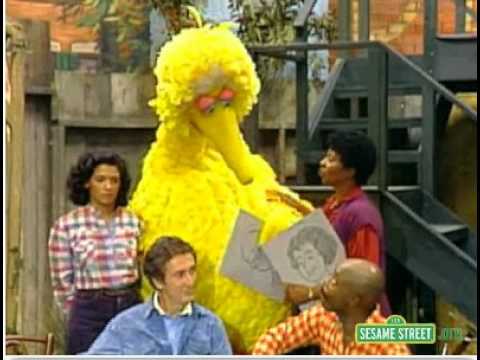
Big Bird, played by Carroll Spinney, surrounded by, left to right:
Maria (Sonia Manzano), Bob (Bob McGrath),
Susan (Loretta Long) and Gordon (Roscoe Orman)

For a few years by that point, Northern Calloway had played David (his last name was never mentioned), a young black man who had been Mr. Hooper's assistant. David inherited Hooper's Store. After that, David hired Gina Jefferson, a teenage girl played by Alison Bartlett-O'Reilly. But Calloway fell victim to mental illness, left the show in 1989, and died a year later.

The store was then bought by Mr. Handford, a black retired firefighter played by Leonard Jackson for one season, then by David L. Smyrl. Jackson played Mr. Handford as a grumpy old man, while Smyrl found the same balance between grumpy old man and kindly old gentleman that Lee had. (David's disappearance was explained as the character simply moving away, while the change in actor for Mr. Handford was less drastic, since the character wasn't original and beloved, as Mr. Hooper and, to a lesser extent, David were.)

In 1998, Smyrl left the show, and it was explained that Mr. Handford had sold the store to Alan (whose last name has never been revealed). Alan is played by Japanese-American actor Alan Muraoka, and has run the store ever since -- his 24 years in charge nearly twice as long as the 13 years we saw Mr. Hooper run it, although we have no way of knowing how long it was open before 1969.

But, to this day, the drawing of Mr. Hooper that Big Bird made, and showed in the farewell episode, rests adjacent to Big Bird's nest, as a reminder of Mr. Hooper, and of Will Lee.
Carroll Spinney, in his 80s, began to pull back, allowing Eric Jacobson to take over as Oscar in 2015, and Matt Vogel to replace him as Big Bird 2018. Spinney died the following year. But, like Oscar, Bert and Ernie, Grover, Cookie Monster, The Count, and all the rest, Big Bird lives. Which means he'll never see Mr. Hooper again -- barring the invention of a Star Trek-style holodeck or the intervention of an artificial intelligence setup that can simulate the character. 

*

November 24, 1983 was Thanksgiving Day, a Thursday. The NFL's usual suspects for the day both won. In the opener, on NBC, the Detroit Lions beat the Pittsburgh Steelers, 45-3 at the Silverdome in the Detroit suburb of Pontiac, Michigan. In the nightcap, on CBS, the Dallas Cowboys beat the football version of the St. Louis Cardinals, 35-17 at Texas Stadium in the Dallas suburb of Irving, Texas.

There was 1 college football game: Memphis State University (now the University of Memphis) beat the University of Louisville, 45-7 at Cardinal Stadium in Louisville.

At the time, I was in the 9th grade at Hammarskjold Junior High School in East Brunswick, Middlesex County, New Jersey. In East Brunswick, the High School is limited to 10th, 11th and 12th grades. EBHS played that day, away to Colonia High School in Woodbridge, the school's longest regular roadtrip, so I couldn't have gone even if I'd been aware of it at the time. EBHS won it, 21-7.

As usual, the NBA did not play on Thanksgiving. But the NHL did. The Quebec Nordiques beat the Boston Bruins, 6-3 at the Boston Garden. And the Winnipeg Jets and the Calgary Flames played to a 4-4 tie at the Saddledome in Calgary.

This was a little unusual, since 3 of the 4 teams that played on the day were in Canada. Canada does celebrate a Thanksgiving Day, on the 2nd Monday in October, when America celebrates Columbus Day.

And they do celebrate it with football: A nationally-televised doubleheader known as the Thanksgiving Day Classic. There's a game in the East, usually hosted by the Montreal Alouettes; and a game in the West, where the host varies. This year, the Alouettes beat the Ottawa Redblacks, 20-16 at Molson Stadium in Montreal; and, while Ontario is not exactly in Western Canada, the Toronto Argonauts beat the Hamilton Tiger-Cats, 24-23 at Tim Hortons Field in Hamilton.

December 31, 1999 & January 1, 2000: The Millennium

December 31, 1999:  The Millennium arrives. The people of planet Earth survived. At a terrible cost. But we hadn't destroyed ourselves. ...