Showing posts with label jersey city. Show all posts

Thursday, November 24, 2022

November 24, 1932: The Pulaski Skyway Opens

November 24, 1932: The Pulaski Skyway opens, connecting the downtowns of Newark and Jersey City via an ugly bridge that carries U.S. Routes 1 & 9 over the Passaic and Hackensack Rivers.

The "Black Beast" is a 3.5-mile long, ugly iron monstrosity, a steel deck truss cantilever bridge that connects the downtowns of Newark and Jersey City, over the New Jersey Turnpike, the Passaic River and the Hackensack River.

When the New Jersey Turnpike was being designed in the 1940s, there was a dilemma. Building it under the Skyway would have been a tight fit, especially for the kind of trucks that would be going under it. Building it over the Skyway would have been safer, but it would have required a very high bridge, costing a lot more money and taking a lot more time. They decided to build the Turnpike under the Skyway. There's never been a problem.

At only 56 feet wide, its 4 lanes of traffic are too narrow. By the dawn of the 21st Century, it was in bad shape. It underwent a major renovation between 2014 and 2018, as it was considered too expensive to build a new bridge and demolish the old one.

Kazimierz Michał Władysław Wiktor Pułaski was born on March 6, 1745 in Warsaw, the capital of Poland. He became one of the leading defenders of the Polish-Lithuanian Commonwealth, but was driven into exile after the First Partition of Poland in 1772.

He escaped to France, where he met Benjamin Franklin. He recommended Pulaski to the Continental Congress. He served alongside George Washington, saving his life at the disastrous Battle of Brandywine outside Philadelphia in 1777. He survived the frigid encampment at Valley Forge, Pennsylvania in 1777-78.
On Washington's direction, he reformed the Continental Army's cavalry units, and is recognized as "The Father of the American Cavalry" and "The Soldier of Liberty." He was killed at the Battle of Savannah in Georgia, dying on October 11, 1779, 2 days after being shot. He was only 34 years old.

Although Pulaski lived as a man -- he had a mustache that made him look a bit like later American author Edgar Allan Poe -- an examination of his bones in 1996 showed features that suggested that the person buried under the Pulaski Monument in Savannah was female. And yet, other factors, such as age, locations of wounds, and a DNA match to a Pulaski relative, conclusively proved the bones were his.

This led to a theory that Pulaski may have been transgender, "a woman living as a man," as has been the case with a few soldiers who later gained fame; or that he may have been "intersex," having both male and female features; or may simply have had an adrenal deficiency that would explain the female features of his bones. The organizations celebrating Pulaski since have treated him as exclusively male.

Along with Andrzej Tadeusz Bonawentura Kościuszko, he is the top hero of Polish-Americans, and Pulaski Day is a holiday in many places with high concentrations of Poles, on the 1st Monday in March (near his birthday), or on the 2nd Sunday in October (near the anniversary of his death, which is when New York holds its parade, usually the day before the big Italian-American parade on Columbus Day).

Pulaski is 1 of 8 foreign citizens to have been granted honorary U.S. citizenship by an act of Congress. Fellow Revolutionary heroes Gilbert du Motier, Marquis de Lafayette, of France, and Bernardo de Gálvez, of Spain, are among them. Not so included, as yet, are Kościuszko; French hero Jean-Baptiste Donatien de Vimeur, Comte de Rochambeau; and German hero Friedrich von Steuben of Prussia (Germany). The others are Pennsylvania founders William and Hannah Penn, Winston Churchill, Mother Teresa, and Swedish diplomat Raoul Wallenberg, who saved thousands from the Holocaust of World War II.

Another bridge, the Pulaski Bridge, built in 1954, connects the highly-Polish Greenpoint neighborhood of Brooklyn with Long Island City in Queens, over Newtown Creek. Another connector, the Kościuszko Bridge, part of the Brooklyn-Queens Expressway (BQE), built in 1939 and replaced in 2017, is also over Newtown Creek, between Greenpoint and the Queens neighborhood of Maspeth.  
The Pulaski Bridge, Brooklyn to Queens

Both Newark and Jersey City once had large Polish populations, but no longer. Two of my great-grandparents came from Borki Wielke, in the northeast of Poland, to Newark, where my grandfather and father were born. On the Waterfront at Jersey City's Exchange Place, where a major Pennsylvania Railroad station once stood, and there is now a PATH station, stands the Katyń Memorial, a 34-foot-high statue that stands as a tribute to Polish soldiers massacred by the Soviet Union's Red Army in 1940.

*

November 24, 1932 was a Thursday, Thanksgiving Day. There were 3 games in the NFL:

* The New York Giants and the Staten Island Stapletons played to a tie, 13-13 at Thompson Stadium on Staten Island.

* There were then 3 NFL teams in New York City, including 1 named the Brooklyn Dodgers. They lost to the Green Bay Packers, 7-0 at Ebbets Field.

* And the Chicago Bears beat the Chicago Cardinals, 24-0 at Soldier Field.

Among the college football games played that day were these:

* New York University beat Carnegie Tech, 13-6 at before 30,000 at Yankee Stadium. NYU were the only New York City school playing that day, or even that week. Nor did either of New Jersey's teams, Rutgers or Princeton, play that week.

NYU dropped its football program after the 1952 season. In 1967, the Carnegie Institute of Technology merged with another Pittsburgh school, the Mellon Institute for Industrial Research, and the combined school became Carnegie Mellon University. The following year, its athletic program was dropped to what's now called NCAA Division III.

* The University of Pennsylvania beat Cornell, 13-7 at Franklin Field in Philadelphia.

* Maryland beat Johns Hopkins, 23-0 at Municipal Stadium in Baltimore. Memorial Stadium would be built on the site in 1954. Johns Hopkins now play in Division III.

* Oklahoma and George Washington University played to a tie, 7-7 at Griffith Stadium in Washington. GWU dropped football after the 1966 season.

* Virginia beat North Carolina, 14-7 at Scott Stadium in Charlottesville, Virginia.

* Virginia Tech beat Virginia Military Institute, 26-0 at Maher Field in Roanoke, Virginia. VMI now play in the NCAA's Football Championship Subdivision (FCS, formerly known as Division I-AA).

* The University of Richmond beat the College of William & Mary, 18-7 at City Stadium in Richmond, Virginia. Both schools now play in the FCS.

* Tennessee beat Kentucky, 26-0 at Shields-Watskins Field (now Neyland Stadium) in Knoxville, Tennessee. Tennessee finished undefeated.

* Alabama beat Vanderbilt, 20-0 at Dudley Field in Nashville.

* The University of Mississippi (a.k.a. Ole Miss) beat Mississippi State, 13-0 in the "Egg Bowl" at Scott Field (now Davis Wade Stadium) in Starkville, Mississippi.

* Texas beat Texas A&M, 21-0 at Memorial Stadium in Austin.

* Nebraska beat Missouri, 21-6 at Memorial Stadium in Lincoln, Nebraska.

* In a traditional Rocky Mountain rivalry, Colorado A&M beat Wyoming, 23-0 at Colorado Field in Fort Collins, Colorado. A&M was renamed Colorado State in 1957.

* Washington State beat UCLA, 3-0 at the Los Angeles Memorial Coliseum.

* The University of Southern California beat the University of Washington, 9-6 at Husky Stadium in Seattle. USC finished undefeated, beat the University of Pittsburgh in the Rose Bowl, and were awarded the National Championship.

* Two days later, Notre Dame beat Army, 21-0 in front of 80,000 fans at Yankee Stadium.

Baseball was out of season. The NBA hadn't been founded yet. There were 3 games in the NHL, which was then based in Canada, whose Thanksgiving is held on the 2nd Monday in October:

* The New York Rangers and the Chicago Black Hawks played to a tie, 1-1 at the old (but then relatively new) Madison Square Garden.

* The Ottawa Senators beat the Montreal Maroons, 6-3 at the Montreal Forum.

* And the Toronto Maple Leafs beat the Montreal Canadiens, 2-0 at Maple Leaf Gardens in Toronto.

Sunday, November 13, 2022

November 13, 1927: The Holland Tunnel Opens

November 13, 1927: The Holland Tunnel opens to traffic. It connects Canal Street in Lower Manhattan, New York City, with 12th Street in Jersey City, Hudson County, New Jersey.

It was the 1st road crossing of the Hudson River between The City and New Jersey. Previously, there had only been ferry boats and, with the addition of the Hudson Tubes (now the PATH system) in 1908 and the construction of New York's Pennsylvania Station in 1913, railroads.

The Outerbridge Crossing and the original version of the Goethals Bridge opened the next year, and the Bayonne Bridge opened in 1931, all connecting New Jersey with Staten Island. Manhattan would again be connected to New Jersey by the George Washington Bridge in 1931 and the Lincoln Tunnel in 1937.

The name of the Holland Tunnel has nothing to do with the Netherlands' 1614 founding of the colony of New Netherland, which would include present-day New York State and northern New Jersey. Rather, it was named for its chief engineer, Clifford Milburn Holland.

On April 1, 1922 -- having already supervised the construction of the 14th Street, 60th Street, Clark Street and Montague Street Tunnels for New York's Subway system -- he drove a ceremonial pick into the ground at Canal and West Streets, on the Manhattan side of the Hudson.
But the stress of the project of building what was then the longest vehicular tunnel in the Western Hemisphere, and the 5th-longest in the world, wrecked his health. He went to a sanatorium in Battle Creek, Michigan, hoping to recover. He did not: On October 27, 1924, 20 years to the day after the Subway opened, and one day before the final charge of dynamite connected the tunneling, by air if not yet by road, Cliff Holland died of a heart attack. He was only 41 years old.

As a commuter from New Jersey to New York City, one of my pet peeves is a bus driver hearing his radio dispatcher tell him that there's a lot of traffic at the Lincoln Tunnel, so he decides to detour off the New Jersey Turnpike, onto the Newark Bay Bridge, and take the Holland Tunnel.

This never works. Every time it's been tried with me on the bus, and it must be half a dozen times by now, the traffic at the Holland Tunnel is every bit as bad. And then, once you get out onto Canal Street, you still have to go 50 blocks up the West Side Highway to get to the Port Authority Bus Terminal. It always takes at least 15 minutes longer than if you'd just stuck with the Lincoln Tunnel. It's just not worth it.

*

November 13, 1927 was a Sunday. It was the off-season for baseball. The NHL season hadn't started yet. The NBA hadn't been founded yet. But these NFL games were played that day:

* Yes, there was then an NFL team named the New York Yankees. On this day, they beat the Chicago Cardinals, 20-6 at Yankee Stadium.

* The Providence Steam Roller beat the Duluth Eskimos, 13-7 at the Cycledrome in Providence.

* The Cleveland Bulldogs beat the Frankford Yellow Jackets, the NFL's Philadelphia team at the time, 37-0 at Luna Park in Cleveland.

* The Chicago Bears beat the Pottsville Maroons, 30-12 at Wrigley Field in Chicago.

* The Green Bay Packers beat the Dayton Triangles, 6-0 at City Stadium in Green Bay, Wisconsin.

* The New York Giants had the week off. They went 11-1-1 that season, the only blemishes on their record  both coming at the hands of the Cleveland Bulldogs: An October 2 tie, 0-0 at Luna Park; and an October 16 loss, 6-0 at the Polo Grounds. But the Giants closed the season by defeating the Yankees, 14-0 on December 4 at the Polo Grounds, and 13-0 on December 11 at Yankee Stadium. This enabled the Giants to edge the 7-2-1 Packers for their 1st NFL Championship, in their 3rd season of play.

Friday, July 29, 2022

July 30, 1916: The Black Tom Explosion

July 30, 1916: German saboteurs set off what becomes known as the Black Tom Explosion in Jersey City, New Jersey.

"Black Tom" sounds like it might be a racially insensitive nickname. In fact, it was a munitions depot on an island on the New Jersey side of New York Bay, within sight of the Statue of Liberty and Ellis Island. Up until the breakout of World War I on August 1, 1914, munitions companies in America, which was then neutral in the war, could sell to any country. But with the outbreak of the war, Britain's Royal Navy blockaded Germany, and so only the Allied powers -- Britain and its Empire, France and its colonies, and the Russian Empire -- could buy American munitions.

So, just as they would in World War II a generation later, the German Empire sent saboteurs to America to mess with our ability to help their enemies. On July 29, 1916, about 2 million pounds of ammunition were stored at Black Tom, in freight cars and on barges, waiting to be shipped to Russia. After midnight, so it was now July 30, some small fires were found on the pier.

The pier was evacuated, and the Jersey City Fire Department was called in. At 2:08 AM, Johnson Barge No. 17 exploded, sending 50 tons of TNT up in smoke and flames. Several firemen were thrown into the air, some of them out of their boots. It registered at 5.5 on the Richter scale, making it equivalent to a serious earthquake. 

The explosion destroyed over 100 railroad cars and 13 warehouses, and left a 375-by-175-foot crater. Debris struck the Statue of Liberty's arm, and, for safety's sake, her  torch has been off-limits to human occupancy ever since. Fragments flew a mile away to Journal Square, striking the clock tower of The Jersey Journal newspaper, stopping the clock at 2:12 AM. Windows were broken all over New York City. The Brooklyn Bridge shook. The explosion was felt 90 miles away in Philadelphia.

The evacuation was mostly successful: The death toll was kept down to 4. With no FBI and no CIA at the time, and only Jersey City Police and New Jersey State Police available to investigate, finding out who actually set off the explosions proved impossible. If there was any punishment for Germany, it came after President Woodrow Wilson, who ran for re-election in 1916 on the slogan, "He kept us out of war," could do so no longer, and asked for a Declaration of War on April 2, 1917, and got it on April 6.

Landfill eventually connected the island to the Jersey City mainland, and what had been Black Tom Island is now part of Liberty State Park. A monument is now on the site.

Six months later, on January 11, 1917, another American munitions plant exploded in New Jersey, 11 miles to the northwest, in Lyndhurst. The Kingsland Explosion caused a lot of damage, but no deaths. German sabotage was suspected, but never proven.

On October 4, 1918, still another American munitions plant exploded in New Jersey, 27 miles to the south of Black Tom, in Sayreville. The Morgan Explosion killed over 100 people. Again, German sabotage was suspected, but an investigation revealed this one to be an accident.

*

July 30, 1916 was a Sunday. Actor Dick Wilson was born on that day, best known for playing Mr. Whipple in commercials for Charmin toilet paper from 1965 to 1989: "Please don't squeeze the Charmin!"

In baseball, as it turned out, the entire American League played that day, and the entire National League did not:

* The New York Yankees were swept by the St. Louis Browns in a doubleheader at Sportsman's Park in St. Louis. The Browns won the opener, 2-1, as Ernie Koob outpitched George Mogridge. The Browns won the nightcap, 2-0, as Eddie Plank outpitched Ray Fisher. No home runs were hit in either game. This was still the Dead Ball Era.

* The Washington Senators beat the Cleveland Indians, 2-1 in 10 innings at League Park in Cleveland. Walter Johnson outpitched fellow future Hall-of-Famer Stan Coveleski.

* The Boston Red Sox beat the Detroit Tigers, 9-3 at Navin Field in Detroit. It was renamed Briggs Stadium in 1938 and Tiger Stadium in 1961. Duffy Lewis and Larry Gardner each got 3 hits for the Red Sox. Babe Ruth did not play for them. Ty Cobb did play for the Tigers, going 3-for-3 with a walk and 2 RBIs.

* The Chicago White Sox swept a doubleheader from the Philadelphia Athletics at Comiskey Park in Chicago. The Pale Hose won the 1st game 10-1, and the 2nd game 7-0.

Saturday, July 2, 2022

July 2, 1921: Boxing's 1st Million-Dollar Gate

Boyle's Thirty Acres, July 2, 1921.
The little square in the middle is the boxing ring.
Fire laws? We don't need no stinkin' fire laws.

July 2, 1921: For the 1st time, a professional prizefight takes in more than $1 million in gate receipts. The era of the "Million-Dollar Gate" is on.

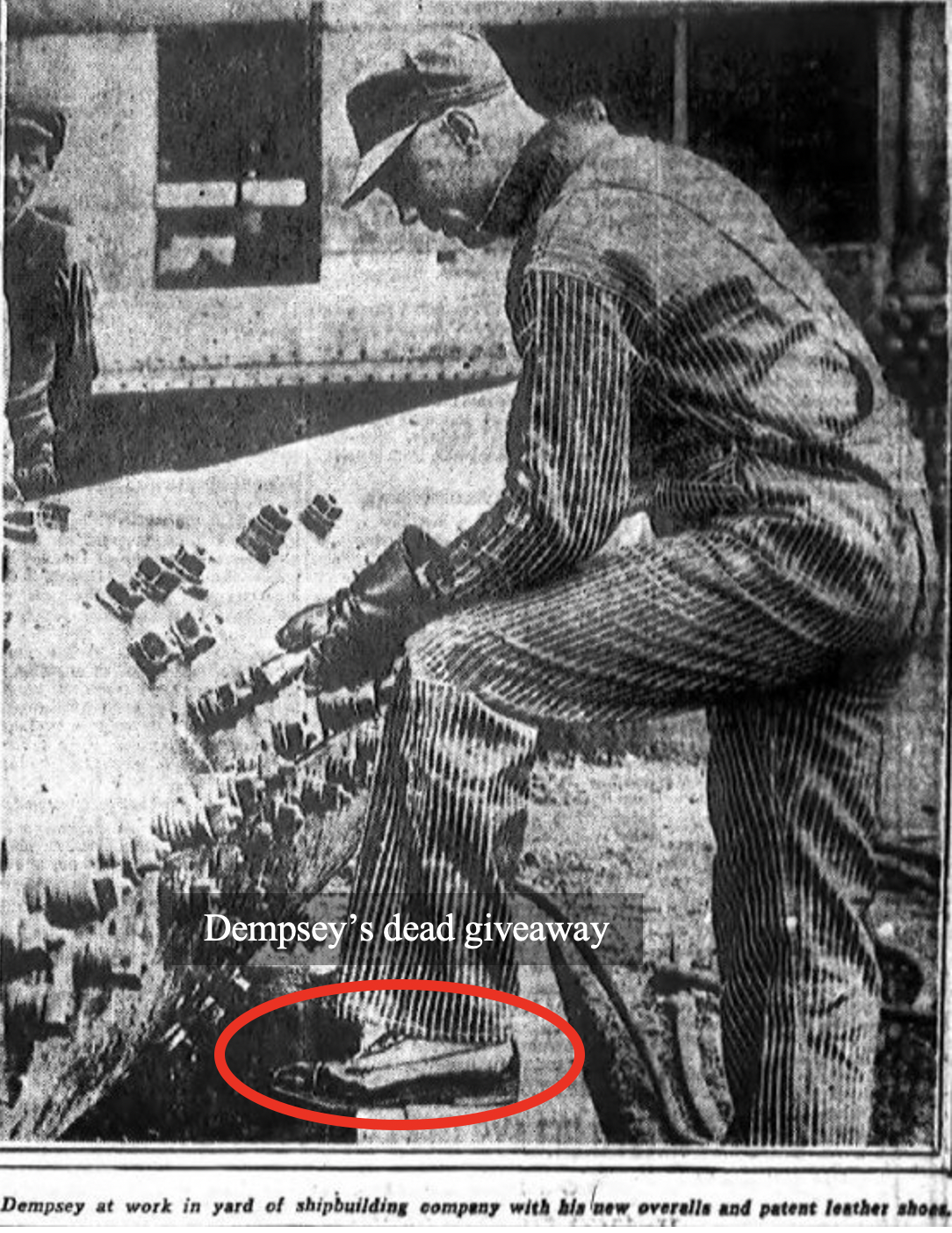
Jack Dempsey won the Heavyweight Championship in 1919, but he hadn't served in World War I. In 1920, a photo was produced showing Dempsey working in a shipyard, which should have ended the controversy right there. But someone noticed that he was wearing patent leather shoes in the photo, making some people think the photo was staged to take the curse off him.
Soon, evidence came to light that he had tried to enlist, but, despite being a very strong man for his size (he'd be classified as a cruiserweight today), the Army had classified him "4-F": "Registrant not acceptable for military service." This classification is nearly always applied to a person who fails either the physical or the psychological examination upon enlistment or reporting for the draft.
But some people still weren't satisfied. This became especially controversial in 1921, when he defended his title against the Light Heavyweight Champion, Georges Carpentier, a French pilot who had been awarded the Croix de Guerre and the Médaille Militaire. The contrast between the much-decorated Carpentier and the "slacker" Dempsey was staggering.
Professional boxing would still be illegal in the State of New York, not just the City of New York, for 2 more years. So George "Tex" Rickard, boxing's leading promoter, decided to put the fight as close to Midtown Manhattan as possible. He found a plot of land owned by John F. Boyle, a mile south of Journal Square in Jersey City, New Jersey, only 6 miles from Midtown Manhattan. There, Rickard built what was intended as a temporary structure, wooden bleachers to seat 90,000 people, calling it "Boyle's Thirty Acres."

The fight was a sellout, and generated $1,789,238, about $29 million in 2022 money. It was no contest: Dempsey knocked Carpentier out in the 4th round. Much of the crowd booed, but Carpentier showed no hard feelings. He kept the Light Heavyweight Championship for another year, and lived until 1975.

It wasn't until Dempsey was "robbed" in the "Long Count" fight against Gene Tunney in 1927 that he became a near-universal hero. He lived until 1983.

The year 1927 would also see the end of Boyle's Thirty Acres, having hosted boxing champions such as Dempsey, Benny Leonard and Jim Braddock, a Hudson County resident who would win the Heavyweight Championship in 1935. The site is now mixed residential and industrial.

*

July 2, 1921 was a Saturday. Football, basketball and hockey were out of season. These baseball games were played, all doubleheaders:

* The New York Yankees swept the Philadelphia Athletics at the Polo Grounds, 6-4 and 14-4. Bob Shawkey won the opener, with 2 home runs by Frank "Home Run" Baker. Both were former A's. Carl Mays won the nightcap. Babe Ruth went 3-for-7 with 2 walks and 3 RBIs, but no home runs.

* The New York Giants swept the Brooklyn Robins (as the Dodgers were known from 1914 to 1931) at Ebbets Field, 8-1 and 7-4.

* The Washington Senators swept the Boston Red Sox at Fenway Park in Boston, 4-1 and 7-3.

* The Boston Braves swept the Philadelphia Phillies at Baker Bowl in Philadelphia, 6-4 and 3-2, the latter in 10 innings.

* There was a split at Forbes Field in Pittsburgh. The Pittsburgh Pirates won the 1st game, 5-2. The St. Louis Cardinals won the 2nd game, 6-3.

* The Cleveland Indians swept the Chicago White Sox at League Park in Cleveland, 6-4 and 11-10. Tris Speaker went 4-for-7 with 2 walks and 2 RBIs.

* There was a split at Cubs Park in Chicago (renamed Wrigley Field in 1926). The Cincinnati Reds won the 1st game, 4-2. The Chicago Cubs won the 2nd game, 6-2.

* And the Detroit Tigers swept the St. Louis Browns at Sportsman's Park in St. Louis, 4-1 and 7-6. Neither team's superstar, the Tigers' Ty Cobb or the Browns' George Sisler, played in either game.

Saturday, February 26, 2022

February 26, 1908: The Hudson Tubes (PATH System) Open

February 26, 1908: The Hudson Tubes open, providing a subway link between New York City and the New Jersey cities of Hoboken, Jersey City, Harrison and Newark. 

Construction had begun in 1873, but it was a long process, with many accidents, including one in 1880 that killed 20 workers. In 1883, the project was abandoned.

The Hudson and Manhattan Railroad Company bought the rights to resume construction in 1902. It was run by William Gibbs McAdoo, who would later marry Eleanor Wilson, daughter of President Woodrow Wilson, and serve as his Secretary of the Treasury. They built a tunnel under 6th Avenue from 33rd Street in Midtown, just south of Herald Square, to 9th Street in Greenwich Village, then turned right under Christopher Street, then crossed the Hudson River.

From there, the tubes turned in 2 different directions. The northward tube went to Hoboken, and connected with the Erie-Lackawanna Railroad Terminal, now the Hoboken Terminal of New Jersey Transit. The southward tube opened in 1912, going to Jersey City, with stops at Newport-Pavonia, Grove Street, and Journal Square.

The H&M's plans to link the system to Grand Central Terminal in Manhattan, the Communipaw Terminal of the Central Railroad of New Jersey in Jersey City, and through Newark all the way to Montclair were abandoned. But in 1937, the line was extended to Harrison, and then across the Passaic River to Newark's Pennsylvania Station.

By 1962, the H&M was bankrupt, and was bought out by the Port Authority of New York and New Jersey. The Hudson Tubes were rebranded as the Port Authority Trans-Hudson, or PATH, system, although there are still a few tiled signs in the system mentioning "HUDSON TUBES" or "H&M."

In 1971, with the World Trade Center under construction, PATH extended the system to Exchange Place in Jersey City and to the World Trade Center. A plan to extend the Newark portion of the line to Newark International Airport and all the way to Plainfield was abandoned, paving the way for the creation of New Jersey Transit, which took over a Jersey Central line and turned it into the Raritan Valley Line, which included 2 stations in Plainfield, and going further into Somerset and Hunterdon Counties, terminating at High Bridge.

There have been 4 fatal incidents aboard the system:

  • On July 22, 1923, a collision near Manhattan Transfer killed one person and injured 15 others.
  • On April 26, 1942, a six-car H&M train derailed at Exchange Place. Five people were killed and 222 more were injured. A subsequent investigation found that the motorman was intoxicated.
  • On December 17, 1945, a seven-car H&M train collided with a steel barrier on the Dock Bridge west of Harrison, killing the motorman and injuring 67 passengers.
  • On July 23, 1963, a PATH train collided with a Pennsylvania Railroad engine east of Harrison, killing two passengers and injuring 28 more.

In 2017, the PATH system was used as a film substitute for the New York Subway for a scene in the film John Wick: Chapter 2.

The idea of extending the line to Newark Airport was renewed in the 2000s, and was approved in 2017, with construction set to begin in 2020, with service to be inaugurated in 2025. Then the COVID epidemic hit in March 2020, putting everything on hold. As of February 26, 2022, it's not clear when construction will begin.

UPDATE: The Port Authority announced in March 2023 that it was deferring funding for the Newark Airport extension to a future capital plan. In 2025, the Hoboken station was closed for a month, so that repairs left over from the 2012 Hurricane Sandy could be made all at once, instead of one weekend at a time over the course of an entire year.

*

February 26, 1908 was a Wednesday. Tex Avery, the animator who helped developed the cartoons of both Metro-Goldwyn-Mayer and Warner Brothers, was born on this day.

Baseball and football were out of season. Professional basketball barely existed. Even hockey was not fully professional. So there were no games on this historic day.

There were challenges for the Stanley Cup that Winter. On January 9 and 13, the Montreal Wanderers, "the Little Men of Iron," featuring later NHL team bosses Lester Patrick of New York and Art Ross of Boston, beat the Ottawa Victorias -- not to be confused with the Ottawa Hockey Club/Silver Seven/Senators. On March 10 and 12, they beat the Winnipeg Maple Leafs -- not to be confused with the later Toronto team of that name. And on March 14, they beat the Toronto Professional Hockey Club, keeping the Cup for another year. 

December 31, 1999 & January 1, 2000: The Millennium

December 31, 1999:  The Millennium arrives. The people of planet Earth survived. At a terrible cost. But we hadn't destroyed ourselves. ...