Showing posts with label turin. Show all posts

Saturday, October 15, 2022

October 15, 1967: The Tragedy of Gigi Meroni

October 15, 1967: Luigi "Gigi" Meroni darts into traffic on the Corso Re Umberto in Turin, Italy, and is hit by a car. The star winger for Torino F.C. was only 24 years old, and had just played in a 4-2 win over Genoa team Sampdoria.

Known as La Farfalla Granata (the Maroon Butterfly, for the color of Torino's shirts and for his fluttering around the field) and Il Beatnik del Gol (the Beatnik of Goals, for his bohemian lifestyle), Meroni was the matinee idol of Italian soccer. He became known for his stylish play, and had appeared for Italy in its ill-fated 1966 World Cup run that was tainted by a shocking loss to North Korea.

Torino, in the shadow of neighboring Juventus since the 1949 Superga Air Disaster killed most of their team, was on the rise again, and went on to win that season's Coppa Italia (and won it again 3 years later, and reached the Final the season before that). They won the Italian league, Serie A, in 1976, and finished 2nd in 1977, by which point Meroni would have been 34 and could still have been playing. They could have won more.
*

October 15, 1967 was a Sunday. There was 1 game played in the NBA: The St. Louis Hawks beat the San Francisco Warriors, 107-102 at the Cow Palace in the San Francisco suburb of Daly City, California. The Hawks were in their last season in St. Louis. In 1968, they moved to Atlanta.
There was 1 game in the new American Basketball Association. It was the debut game of the Denver Rockets, beating the Anaheim Amigos, 110-105 at the Denver Auditorium. They renamed themselves after Denver's 1st NBA team, becoming the Denver Nuggets in 1974, and join the NBA in 1976.
There were 4 games in the NHL:
* The New York Rangers lost to the Detroit Red Wings, 3-2 at the Olympia Stadium in Detroit.
* The Boston Bruins beat the Montreal Canadiens, 6-2 at the Boston Garden.
* The Toronto Maple Leafs beat the Chicago Black Hawks, 5-3 at the Chicago Stadium.
* And the Los Angeles Kings beat the Minnesota North Stars, 5-3 at the Long Beach Convention Center, outside Los Angeles. Their intended arena, The Forum in nearby Inglewood, wasn't ready, and didn't open until December 30.
In the NFL:
* The New York Giants beat the Pittsburgh Steelers, 27-24 at Pitt Stadium in Pittsburgh.
* The San Francisco 49ers beat the Philadelphia Eagles, 28-27 at Franklin Field in Philadelphia
* The Los Angeles Rams and the Baltimore Colts played to a tie, 24-24 at Memorial Stadium in Baltimore.
* The Washington Redskins and the Atlanta Falcons played to a tie, 20-20 at Atlanta Stadium (later Atlanta-Fulton County Stadium).
* The Cleveland Browns beat the football version of the St. Louis Cardinals, 20-16 at Cleveland Municipal Stadium.
* The Chicago Bears beat the Detroit Lions, 14-3 at Wrigley Field in Chicago.
* The Minnesota Vikings beat the Green Bay Packers, 10-7 at Milwaukee County Stadium.
* And the Dallas Cowboys beat the New Orleans Saints, 14-10 at the Cotton Bowl in Dallas.
And in the American Football League:
* The New York Jets and the Houston Oilers played to a tie, 28-28 at Shea Stadium.
* The Boston Patriots beat the Miami Dolphins, 41-10 at Alumni Stadium, on the campus of Boston College, just outside Boston in Chestnut Hill, Massachusetts. The Pats played home games at Fenway Park from 1963 to 1968, so this was their 1st home game of the season after 4 away games and a bye, and they still couldn't use Fenway for practice because the Boston Red Sox were in the World Series, so the game was moved to B.C.
* The Oakland Raiders beat the Buffalo Bills, 24-20 at War Memorial Stadium in Buffalo.
* The San Diego Chargers beat the Kansas City Chiefs, 45-31 at San Diego Stadium (later renamed Jack Murphy Stadium and Qualcomm Stadium).
* And the Denver Broncos had a bye week.

Friday, July 8, 2022

July 8, 1990: The 1990 World Cup Final

Manager Franz Beckenbauer, Lothar Matthäus and Andreas Brehme

July 8, 1990: What has often been called the best World Cup ever staged reaches its Final. But that Final turns out to be -- for everybody but fans of the winning team -- a tremendous letdown.

Most of the major stadiums in Italy either received major renovations, or were torn down and completely replaced, in preparation for this World Cup. Two years later, Camden Yards opened in Baltimore, changing stadium and arena architecture forever. Instantly, Italian soccer had 12 major stadiums that went from great to obsolete almost overnight. Today, those stadiums range from merely outdated to in serious need of repair. One of them, a Semifinal host, didn't even last 20 years.

The U.S. team, in the World Cup for the 1st time in 40 years, did not make the Final. They didn't even come close to reaching the knockout stage. In their 1st game, on June 10, they lost, 5-1 to Czechoslovakia, at the Stadio Comunale in Florence. The only U.S. goal was scored by Paul Caliguiri, then playing his club soccer in Germany's lower divisions. (Czech captain Ivan Hašek was not related to later hockey goaltending legend Dominik.)

It could have been much worse. It was already 3-0 to the Czechs when Eric Wynalda, now one of the worst soccer pundits on Earth, was rightly sent off in the 52nd minute. Tony Meola, creator of the Kearny Mullet, was lucky not to be lit up for 10. The U.S. team was like a dog that chased cars, until one day he caught one... and then the car started, and backed up.

After that, the last thing the U.S. team needed in their 2nd World Cup match was to play the host country at their national stadium. Nevertheless, Italy at the Stadio Olimpico in Rome on June 14 it was. Italy fielded some serious legends: Franco Baresi, Giuseppe Bergomi, Paolo Maldini, Roberto Donadoni, Gianluca Vialli and Salvatore Schillaci. (Roberto Baggio was an unused substitute.) And we were going to face them, with our best players being the Kearny Army -- Tony Meola, John Harkes and Tab Ramos? Plus Rutgers University's Peter Vermes of Delran?
Left to right: Tab Ramos, John Harkes, Tony Meola

Giuseppe Giannini scored in the 11th minute, and the worst fears of U.S. fans seemed to be realized. But the U.S. defense held on long enough to give their attack a chance to tie it up. But it just wasn't going to happen. Now, even with a win in their last Group Stage game against Austria, it was unlikely the U.S. would advance to the knockout stage.

On June 19, the campaign ended not with a bang, but with a whimper. Back in Florence, we lost 2-1 to Austria. Bruce Murray, a D.C.-area native who later played in England for London club Millwall and retired as the U.S. team's all-time leading scorer, scored in the 85th minute to make a game of it. But that was it, despite Austria being down to 10 men for 2/3 of the match. (Both their goals came after Peter Artner was sent off with a straight red card.)

The U.S. would qualify for the 1994 World Cup -- as hosts. At least we made more out of that opportunity than with the one we actually earned for 1990.

*

Cameroon was a story, led by Roger Milla. Like baseball pitcher Leroy "Satchel" Paige and boxing champion Archie Moore, Milla seemed more myth than man, partly because he'd been operating for so long on a level that white people hadn't seen, and partly because there was great speculation as to how old he was. Officially, the forward had just turned 38, but some people thought he was older than that.

He had led Léopards Douala to his country's top league's title in 1972, '73 and '74. He had led Tonnerre Yaoundé, in his country's capital city, to the 1975 African Cup Winners' Cup. He went to France's top league, and won the Coupe de France with AS Monaco in 1980 and Corsican team SC Bastia in 1981. And he had led Cameroon to the African Cup of Nations in 1984 and '88.

In the Group Stage, he captained Cameroon to an opening victory over defending Champions Argentina at the San Siro in Milan, and a win over Romania in Bari, guaranteeing advancement, before a bad but meaningless loss to the Soviet Union in Bari.
Roger Milla

The Republic of Ireland was a story: While Northern Ireland had made the World Cup twice before, this was the 1st time the Republic had made it. And their 1st game was to be against arch-rivals England, on June 11, at Stadio Sant'Elia in Cagliari on the island of Sardinia. Gary Lineker of Tottenham Hotspur scored for England in the 9th minute, but Kevin Sheedy of Everton equalized in the 73rd, and the Boys In Green escaped with a 1-1 draw.
Kevin Sheedy

They went to Palermo, on the island of Sicily, and got a 0-0 draw with Egypt. Their last Group Stage game was against the Netherlands, the winners of Euro 88. They needed at least a draw to advance. They followed the same script as against England: They gave up an early goal, to Ruud Gullit in the 11th, and got a late equalizer, from Arsenal's Niall Quinn in the 71st. It ended 1-1, and they moved on.

Then came the knockout stage. Cameroon were put up against Colombia, at Stadio San Paolo in Naples. It was 0-0 after regulation. On to extra time, and Milla scored in the 106th and the 108th minute. They let in a goal in the 115th, but hung on for a 2-1 win.

It was the 1st time any African nation had qualified for the Quarterfinals. Algeria had qualified in 1934, but no African team was admitted again until FIFA began allowing a single qualifier in 1970, which turned out to be Morocco. Zaire was the only team in 1974, making them the 1st team from sub-Saharan Africa to qualify. Tunisia was the 1978 qualifier. They got 2 qualifiers for 1982, '86 and '90; and would get 3 in 1994, expanding to 5 for 1998. South Africa hosting in 2010 meant a 6th qualifier. (UPDATE: In 2022, Morocco became the 1st African team to reach the Semifinals. The expansion of the tournament to 48 teams for 2026 meant 10 African nations qualified.)

As for Ireland, the consensus was, "Okay, lads: You've had your fun, now it's time for some serious football. You're about to be eliminated by a real football nation, Romania." The Boys In Green either didn't get the message, or rejected it: At the Stadio Luigi Ferraris in Genoa, home to Genoa and Sampdoria, they held Romania scoreless through normal time and extra time, and went to penalties. And while Glasgow Celtic goalkeeper Patrick "Packie" Bonner came through on Romania's last spot-kick, Arsenal's ageless defender David O'Leary made Ireland's last, and they were through to the Quarterfinals.

They gave it all they had against Italy in Rome. But Salvatore Schillaci of Juventus scored in the 38th, and Italy won, 1-0. Cameroon had a little more to give, leading England 2-1 after 65 minutes in Naples. But England were awarded 2 penalties, an equalizer in the 83rd, and in extra time, in the 105th. Lineker converted both, and England won, 3-2.

*

Both Semifinals became legendary, much more so than the Final. On July 3, one Semifinal was held in Naples. Hosts Italy played defending champions Argentina, featuring Diego Maradona, the hero (and villain) of the 1986 World Cup. He had just led the venue's main tenant, SSC Napoli, to their 2nd national title in 4 seasons.
Diego Maradona

Maradona had asked the people of Naples to root for Argentina, against Italy. No chance: During the game, a banner was hung, reading, "Maradona, we love you, but Italy is our home." The game was 1-1 after normal time, it went to penalties, and Argentina won. They would play the winner of the next day's Semifinal.

That game was played on July 4, but there was nothing American about it. It was played in the rain at Stadio Delle Alpi in Turin, home to Juventus FC and Torino FC from 1990 until 2009. It was another showdown between England and (West) Germany.

England were managed by Bobby Robson, who had been a forward on their World Cup teams of 1958 and 1962, and was famed for leading Ipswich Town to the 1978 FA Cup and the 1981 UEFA Cup. West Germany were managed by Franz Beckenbauer, who captained their 1974 World Cup winners while starring for Bayern Munich.

Andreas Brehme, familiar with the stadium because he played his "club football" for Internazionale Milano, opened the scoring at the hour mark. Gary Lineker of North London team Tottenham Hotspur tied it up in the 80th minute, and the game went to extra time.

Lineker's Tottenham teammate, Paul Gascoigne, had been one of the heroes of the tournament. This Newcastle-area native with the great skills, but also the great self-destructive streak, had thrilled TV audiences, and "Gazzamania" was born. For the first generation of English people not old enough to remember their country's win in 1966, the 1990 edition remains their favorite World Cup.

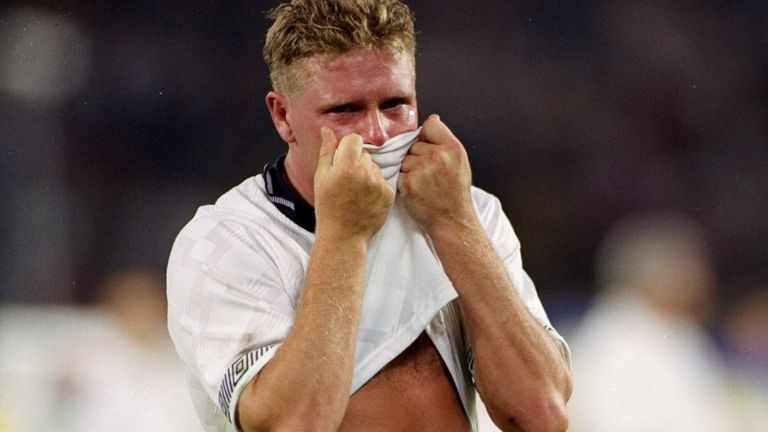
But in extra time, in the 99th minute, Gazza fouled Thomas Berthold, another German player in the Italian league, playing for A.S. Roma. Gazza could remain in this game, but, due to yellow card accumulation, he would be suspended for the Final if England won this game. The sight of Gazza wiping both tears and rain out of his eyes became an iconic image, and summed up what happened to England in this tournament:

Lineker told Robson to substitute Gazza off, because his head was no longer in the game: Using a classic English expression, Lineker told Robson, "He's lost the plot!" Robson left him Gazza, but he was useless for the game's last 20 minutes. So much passion, so much promise, but, in the end...
Paul Gascoigne

In the end, Bodo Illgner, goalkeeper for F.C. Köln of Cologne, held off the penalty of Stuart Pearce, and Chris Waddle -- a former teammate of Gazza at Newcastle, and of both Gazza and Lineker at Spurs, now with French club Olympique de Marseille -- blasted his shot over the bar, and the Germans advanced to the Final. They'd lost the last 2 Finals, to Italy in 1982 and to Argentina in 1986. Now, they would play Argentina again.

But after 2 great Semifinals, the Final, on July 8 at the Stadio Olimpico, was an anticlimax. TNT, Turner Network Television, broadcast it live in the U.S. The Germans had a few chances in the 1st half, but could not capitalize on them. Argentina played its usual dirty game, and were getting away with it. Twice, the Germans appealed for penalties, on a handball in the box by Oscar Ruggeri in the 13th minute, and a dirty tackle in the box by Simón on Rudi Völler in the 18th. Referee Edgardo Codesal, born in Uruguay but a citizen of Mexico, refused to grant either. Argentina had just one chance in the half, late, but Maradona sent a kick over the crossbar.

In the 58th minute, Argentine goalkeeper Sergio Goycochea took Klaus Augenthaler down inside the penalty area. Again, Codesal refused to award a penalty. Finally, in the 65th minute, Pedro Monzón of Independiente became the 1st player ever sent off in a World Cup Final, with Codesal showing him a straight red card for a reckless studs-up challenge on Jürgen Klinsmann. Still, despite Argentina being down to 10 men, West Germany couldn't score.

Finally, in the 83rd minute, Roberto Sensini brought Völler down in the box, and Codesal awarded a penalty. Brehme took it, and it was 1-0 to West Germany.

Gustavo Dezotti had already been cautioned in the 5th minute. In the 87th, he received a straight red card when he hauled Jürgen Kohler down with what The New York Times described as a "neck tackle right out of professional wrestling." After dismissing Dezotti, Codesal was surrounded and jostled by the rest of the Argentinian team, with Maradona receiving a yellow card for dissent.

Argentina were down to 9 men, and they were lucky to end the game with that many. West Germany hung on for the 1-0 win, as their opponents now had over half of their intended squad unavailable due to injury or suspension.

Beckenbauer joined Brazil's Mário Zagallo as only the 2nd man to both play on and manage a World Cup winner. He has been followed by France's Didier Deschamps.

UPDATE: An article for ESPN.com, published after the 2026 World Cup, ranking all 23 tournaments, rated this one 16th, citing the amount of dull games seeming to cancel out the large amount of star power.

*

July 8, 1990 was a Sunday. These Major League Baseball games were played:

* The New York Yankees lost to the Minnesota Twins, 6-3 at Yankee Stadium. David West outpitched Tim Leary. Mike Blowers hit a home run, but it was a rotten season for the Yankees, who finished last for only the 4th time in their history -- and, through the 2021 season, the last.

* The New York Mets beat the Atlanta Braves, 2-1 at Atlanta-Fulton County Stadium. Frank Viola was the winning pitcher.

* The Houston Astros beat the Montreal Expos, 5-3 at the Olympic Stadium in Montreal.

* The Philadelphia Phillies beat the Cincinnati Reds, 4-3 at Veterans Stadium in Philadelphia.

* The Seattle Mariners beat the Toronto Blue Jays, 6-3 at the SkyDome (now the Rogers Centre) in Toronto. Ken Griffey Jr. went 2-for-4 with a walk.

* The Oakland Athletics beat the Cleveland Indians, 8-3 at Cleveland Municipal Stadium. Rickey Henderson went 1-for-3 with 2 walks, a stolen base and an RBI.

* The Detroit Tigers beat the Kansas City Royals, 10-4 at Tiger Stadium in Detroit. George Brett went 1-for-3 with 2 walks and an RBI.

* The Baltimore Orioles beat the Chicago White Sox, 8-6 at Comiskey Park in Chicago. Mike Devereaux doubled home 2 runs in the top of the 11th inning. Cal Ripken went 1-for-5.

* The Milwaukee Brewers beat the California Angels, 20-7 at Milwaukee County Stadium. The Brewers scored 6 runs in the 4th inning, and 13 in the 5th inning.

* The Texas Rangers beat the Boston Red Sox, 4-3 at Arlington Stadium in the Dallas suburb of Arlington, Virginia. Gary Pettis hit a ground ball that Boston shortstop Luis Rivera bobbled, allowing Jack Daugherty to score the winning run in the bottom of the 11th.

* The St. Louis Cardinals beat the San Diego Padres, 4-1 at Jack Murphy Stadium in San Diego. Tony Gwynn did not play.

* The Pittsburgh Pirates beat the Los Angeles Dodgers, 7-2 at Dodger Stadium in Los Angeles. Barry Bonds went 2-for-4 with a walk and 3 RBIs.

* And the San Francisco Giants swept a doubleheader from the Chicago Cubs, 5-3 and 10-4 at Candlestick Park in San Francisco.

Wednesday, May 4, 2022

May 4, 1949: The Superga Air Disaster

May 4, 1949: A plane crash wipes out what might have been the best soccer team in the world at the time.

Torino Football Club, based in the Northern Italian city that the English language calls Turin, had dominated Serie A, Italy's football league. They had won Serie A in 1928, and Italy's version of the FA Cup, the Coppa Italia, in 1936.

Ferrucio Novo, who had played for Torino as a defender, had gotten rich in the leather industry -- possibly appropriate, given the team's symbol, also the city's symbol, a bull. (And the team was known as Il Toro, The Bull.) In 1939, he became the team's president and its manager. In modern sports, this might seem like a bad idea. But in Italy, during World War II, at the end of Benito Mussolini's fascist dictatorship, it worked like a charm.

In 1942, it all came together. Upon the recommendation of forward Felice Borel, they adopted what Italy called la sistema (The System), known in English football by its shape as the W-M formation: Goalkeeper, 3 fullbacks, 2 halfbacks, 2 midfielders, 3 forwards.

They finished 2nd in Serie A that season, and then won it in 1943, 1946, 1947, 1948 and 1949, becoming known as Il Grande Torino. They also won the Coppa Italia in 1943, becoming the 1st Italian team to, as they say in England, "do The Double."

This was the usual lineup:

1 Goalkeeper, Valerio Bacigalupo
2 Right Fullback, Mario Rigamonti
3 Left Fullback, Virgilo Maroso
4 Right Halfback, Aldo Ballarin
5 Centre Fullback, Eusebio Castigliano
6 Left Halfback, Danilo Martelli
7 Outside Right, Ezio Loik
8 Inside Right, Guglielmo Gabetto
9 Centre Forward, Romeo Menti
10 Inside Left, Valentino Mazzola
11 Inside Forward, Franco Ossola

In a land beset by conservative Catholicism, terrorized by organized crime, benighted by poverty, and devastated by a war on which it had chosen the wrong side, this team lifted people up, and provided them with thrills they enjoyed, even if far from Turin, even when it sent their local side down to defeat.

On May 3, 1949, the Torino team were in Lisbon, Portugal, playing Sport Lisboa e Benfica at the Stadio do Luz (Stadium of Light). Benfica were already known as Portugal's greatest sports team, and the game was a testimonial in honor of their Captain, midfielder Francisco Ferreira. He had already led Benfica to 3 titles in the Portuguese league, and 4 Portuguese Cups. He had also previously won a league title with F.C. Porto.

Novo had seen him play for Portugal against an Italy team with some of his Torino players. Although Italy won the game 4-1, Novo was very impressed with Ferreira, and arranged the special match. He did not make the trip, though, as he was ill with the flu. So his assistant, Ernő Egri Erbstein, a Hungarian Jew who had played in Italy and later escaped from the Nazis, took charge for the game. Benfica won, 4-3. Matches like this would help inspire the European Cup, which began in the 1955-56 season, and is now known as the UEFA Champions League.

The next day, May 4, the Torino team boarded their Avio Linee Italiane Fiat G.212CP for the flight home. It took off at 9:40 AM local time (Portugal is in the same time zone as Britain, an hour behind most of Europe, including Italy), and landed in Barcelona, Spain to refuel at 1:00 PM. At the Barcelona airport, the Torino players met with those of AC Milan, who were on their way to play a friendly against Real Madrid.

At 2:50, the plane took off again, flying over the French Riviera and the French and Italian Alps. But at 4:55, the pilot got a message that the weather in Turin was bad: Clouds almost touching the ground, and strong southwest wind gusts.

At 4:59, the control tower heard the pilot say he was 9 miles away, approaching the airport from the west (even though he had been flying east from Lisbon and Barcelona), and would use the Basilica of Superga, just past the eastern city limits of Turin, as his sign to turn toward the airport. At 5:03, he made his turn to the left. But he was too low -- a recent theory is that his altimeter had malfunctioned and locked, leading him to think he was higher than he was -- and the plane crashed into the back of the Basilica.

All 31 people on board the plane died, including the entire usual starting lineup. There were 7 other players on board who died, including Dino Ballarin, backup goalkeeper and brother of Aldo Ballarin. Assistant manager Egri Erbstein also died.
A memorial to the victims at the Basilica

There were still 4 games left in Serie A play. An agreement was reached that Torino would be declared league champions, and that all teams would play their youth teams in the remaining games. Torino won all 4 remaining games, and won the league by 5 points over Internazionale Milano (a.k.a. "Inter").

On May 26, a benefit match for the families of the victims was played at the Stadio Comunale in Turin. A group of 11 players donated from other clubs wore the maroon of Torino against visiting Argentine champions River Plate, including Alfredo Di Stéfano, already considered the best player in South America, who would later star for Real Madrid. The match ended 2-2.

The crash changed the course of Italian soccer history. Gabetto was 33 years old, Mazzola 30, Loik and Mento 29, Castigliano 28, Ossola and Aldo Ballarin 27, Rigamonti 26, Baciagalupo 25, Maroso and Dino Ballarin 23, Martelli just short of turning 22. Some of these men could have continued Torino's domination of Serie A, and been major forces for Italy in the World Cups of 1950, 1954, maybe even 1958. It was as devastating to their country as the Munich Air Disaster of 1958, killing 8 Manchester United players, was to England.
Translation: Superga, 4th of May 1949.
Raise your head great people,
You cannot forget the scream of faith.
Turn your gaze to the future
certain to be worthy of the glorious past. 

With Torino having supplied the bulk of the Italian national team, it was decided that Novo should rebuild that as well, and he managed them into the 1950 World Cup. (Italy had won the World Cup in 1934 and 1938, but the 1942 and 1946 editions were canceled due to the effects of World War II.) He took no chances: He had them travel to Brazil by ship, not plane. The long sea voyage may have taken a lot out of them: They beat Paraguay, but lost to Sweden, and did not advance to the knockout round. He remained in charge of Torino until 1953, and died in 1974.

For the 1949-50 season, the other teams in Serie A were each asked to donate a player to Torino. Essentially, it was what we in North American sports would call an expansion draft. But the team never really recovered. They didn't win another notable trophy until the 1968 Coppa Italia. Since then, they have won the Coppa again in 1971 and 1993, and Serie A in 1976. But, ever since, crosstown Juventus F.C. have dominated not just the city, but, often, the country.

The legacy of Valentino Mazzola, Captain of club and country, continued. His son, Sandro Mazzola, starred for the next Italian team to be known as "Grande," the Inter team of the 1960s.

*

May 4, 1949 was a Wednesday. American football was out of season. Basketball and hockey had wrapped their seasons up the month before. These games were played in what we would now call Major League Baseball:

* The New York Yankees beat the St. Louis Browns, 10-5 at Sportsman's Park in St. Louis. Phil Rizzuto and Jerry Coleman each went 3-for-5 in support of Vic Raschi. Rizzuto also had 4 RBIs, including a home run. Joe DiMaggio was injured, and did not play.

Rizzuto loved being Italian, but I don't know if he knew anything about Italian soccer, or "calcio," as it's known over there. His parents were from Calabria, "the toe in the boot of Italy," at the other end of the country. Unless it was covered in Life magazine or movie newsreels, he may never have known about Il Grande Torino or the Superga crash.

* The Brooklyn Dodgers beat the Cincinnati Reds, 5-1 at Ebbets Field. Gene Hermanski hit a home run in support of Joe Hatten. Jackie Robinson went 1-for-4 with an RBI double.

* The New York Giants beat the Pittsburgh Pirates, 11-4 at the Polo Grounds. Sid Gordon, Johnny Mize and Bobby Thomson hit home runs in support of Larry Jansen.

* The Philadelphia Phillies beat the St. Louis Cardinals, 7-5 at Shibe Park in Philadelphia.

* The Boston Braves beat the Chicago Cubs, 4-3 at Braves Field in Boston.

* The Cleveland Indians beat the Philadelphia Athletics, 4-3 at Cleveland Municipal Stadium.

* The Detroit Tigers beat the Boston Red Sox, 5-1 at Briggs Stadium in Detroit. (It was renamed Tiger Stadium in 1961.) Ted Williams went 2-for-4, including a solo home run.

* And the Washington Senators beat the Chicago White Sox, 8-7 at Comiskey Park in Chicago. 

Monday, January 31, 2022

February 1, 1896: "La Bohème" Premieres

Giacomo Puccini

February 1, 1896: Giacomo Puccini's opera La Bohème premieres at Teatro Regio (the Royal Theater) in Turin, Italy. Only 28 years old, Arturo Toscanini is the conductor.

The libretto was written by Luigi Illica and Giuseppe Giacosa. They would also collaborate to write the libretti for Puccini's operas Tosca in 1900 and Madama Butterfly in 1904. As credited on its title page, the libretto for La Bohème is based on Henri Murger's 1851 novel, Scènes de la vie de bohème (Scenes of the Bohemian Life), a collection of vignettes portraying young bohemians living in the Latin Quarter of Paris in the 1840s, in the latter years of the July Monarchy.

The opera's libretto focuses on the relationship between Rodolfo and Mimì, ending with her death. Also like the play, the libretto combines two characters from the novel, Mimì and Francine, into the single character of Mimì. Evangelista "Evan" Gorga played Rodolfo in the premiere, and Cesira Ferrani played Mimi. Ferranira had previously played the title role in Puccini's 1893 opera Manon Lescault.
Cesira Ferrani

In 1946, 50 years after the opera's premiere, Toscanini conducted a commemorative performance of it on radio with the NBC Symphony Orchestra. A recording of the performance was later released by RCA Victor on vinyl record, tape and compact disc. It is the only recording ever made of a Puccini opera by its original conductor.

In 1959, one of the songs from the opera, "Musetta's Waltz," was adapted by songwriter Bobby Worth for the pop song "Don't You Know?" It became the biggest hit for singer Della Reese.

Giuseppe Giocosa in 1906, Luigi Illica in 1919, Giacomo Puccini in 1924, Cesira Ferrani in 1943, and Arturo Toscanini and Evan Gorga in 1957.

The original Teatro Regio was built in 1740, and was destroyed by fire in 1936. A new Teatro Regio opened on the site of the original in 1973.

In 1965, Franco Zeffirelli staged it for Italian television. In 1990, Australian producer Baz Luhrmann staged it in his own country, moving the story up to 1957 but keeping it in Paris. In 2002, he staged this version on Broadway. But it had already been adapted for Broadway in 1996, by Jonathan Larson, as the musical Rent, with the deadly disease of tuberculosis being replaced by AIDS.

*

February 1, 1896 was a Saturday. Baseball and football were out of season. Basketball barely existed. Hockey season was in progress. The Ottawa Hockey Club, forerunners of the original Ottawa Senators, beat the Montreal Victorias, 3-2 at the Rideau Rink in Ottawa. And the Quebec Hockey Club, forerunners of the Quebec Bulldogs, beat the Montreal Hockey Club, 3-1 at the Quebec Skating Rink.

In English soccer, Woolwich Arsenal, which would evolve into the North London team I would one day support, lost to Burnley F.C., 6-1 at Turf Moor in Burnley, Lancashire.

December 31, 1999 & January 1, 2000: The Millennium

December 31, 1999:  The Millennium arrives. The people of planet Earth survived. At a terrible cost. But we hadn't destroyed ourselves. ...