Showing posts with label rodgers & hammerstein. Show all posts

Wednesday, October 19, 2022

October 19, 1963: "You'll Never Walk Alone" Is First Played at Anfield

October 19, 1963: The Gerry & the Pacemakers version of "You'll Never Walk Alone" is played at Anfield, home stadium of Liverpool Football Club, for the first time. It became a team tradition.

The song, with music by Richard Rodgers and lyrics by Oscar Hammerstein II, first appeared in 1945, in the Broadway musical Carousel, sung by Christine Johnson as Nettie Fowler, and later by John Raitt (father of rock music legend Bonnie Raitt) as Billy Bigelow, Jan Clayton as his wife Julie, and Bambi Linn as their daughter Louise.

The musical was made into a film in 1956. Gordon MacRae played Billy, Shirley Jones played Julie, Susan Luckey played Louise, Claramae Turner played Nettie, and Gene Lockhart played the Starkeeper and the doctor.

"You'll Never Walk Alone" became a standard. Jerry Lewis would use it to close his annual Labor Day telethon for research into muscular dystrophy and related conditions. Elvis Presley made it a mainstay of his live performances from his Las Vegas debut in 1969 until his death in 1977.

In 1963, Liverpool rock band Gerry & The Pacemakers recorded a version of it. In the 1960s, at Anfield, the home stadium of Liverpool F.C., games would be preceded by the public address system playing the Top 10 songs in the country. "You'll Never Walk Alone" debuted in the Top 10 on October 19, 1963, and so it was played at Anfield for the 1st time. Liverpool beat West Bromwich Albion, of the Birmingham area, 1-0 on a goal by Gordon Milne in the 32nd minute.
A recent photo of Anfield, seriously added-onto

Liverpool's other major team, Everton, who had won the League the previous season, traveled to the East End of London on this day, and lost to West Ham United, 4-2 at Upton Park. Everton fans would become sick of the song, and one of their fans' slogans is "I'd rather walk alone."

The Pacemakers were the 2nd-biggest band in Liverpool at the time, behind The Beatles, but their version of "YNWA" never became a hit in the song's country of origin, not even in the "British Invasion" year of 1964, when The Beatles caught fire in America and pretty much every other British band that was even remotely good followed them. The Pacemakers had a few songs reach the American charts, most notably "Don't Let the Sun Catch You Crying" and "How Do You Do It" in 1964, and "Ferry Cross the Mersey" (from the film of the same title) in 1965. But not "YNWA."

It did, however, hit Number 1 in Britain. But when it fell out of the Top 10, Liverpool fans demanded that it be played at Anfield, anyway, just before the team walked onto the pitch. This was done, and Liverpool, managed by Bill Shankly, won the Football League in 1964.

After that, in England, the song was considered a good-luck charm by fans of the Mersey Reds, and was irrevocably tied to the team. After the Hillsborough Disaster of 1989, the words of the song gave hope to a grieving city. The words "YOU'LL NEVER WALK ALONE" are now cast in iron atop the Shankly Gates leading into Anfield.

Most Liverpool fans don't even realize that the song debuted on Broadway, in New York, in America, during the waning days of World War II.

Fans of Celtic Football Club in Glasgow, Scotland also took it up. Like Liverpool fans, they sing it before every game, and after every win. In 2003, the teams faced each other in the UEFA Cup Quarterfinal, and Pacemakers singer Gerry Marsden was invited to sing it on the pitch before the game. He did so, wearing one of those "half scarves" produced before international matches with logos of both teams. Another British rocker, Rod Stewart, also attended, supporting Celtic.
Oscar Hammerstein died in 1960, having never learned of his song's connection with Liverpool. Richard Rodgers lived until 1979, and if he ever knew of the connection, he never made a public statement about it. Gerry Marsden died in 2021.

*

October 19, 1963 was a Saturday. North London team Arsenal traveled to Birmingham, and lost to Aston Villa, 2-1 at Villa Park.

In American football, among the college games played that day were these:

* Number 1 Texas beat Arkansas, 17-13 at War Memorial Stadium in Little Rock, Arkansas. Texas went on to win the Southwest Conference Championship.

* Number 2 Wisconsin beat Iowa, 10-7 at Iowa Stadium (now Kinnick Stadium) in Iowa City.

* Number 3 Pittsburgh beat West Virginia, 13-10 at the old Mountaineer Field in Morgantown, West Virginia. This is a rivalry known as "The Backyard Brawl."

* Number 4 Ohio State were upset by the University of Southern California (USC), 32-3 at the Los Angeles Memorial Coliseum. No, this was not the Rose Bowl game. And when that game was played, neither of these teams would be in it.

* Number 5 Mississippi beat Tulane, 21-0 at Tulane Stadium in New Orleans. "Ole Miss" went on to win the Southeastern Conference title.

* Number 6 Oklahoma beat Kansas, 21-18 at Owen Field in Norman, Oklahoma.

* Number 7 Illinois beat Minnesota, 16-6 at Memorial Stadium in Champaign, Illinois. With running back Jim Grabowski, and center and linebacker Dick Butkus, Illinois won the Big Ten Conference title.

* Number 8 Georgia Tech were upset by Auburn, 29-21 at Grant Field in Atlanta.

* Number 9 Alabama beat Tennessee, 35-0 at Legion Field in Birmingham, Alabama. Alabama didn't win the SEC title, but they didn't play Ole Miss. So those teams were matched up in the Sugar Bowl, the traditional home for the season's SEC Champion, and Alabama won. In fiction, that would have been the last game for 'Bama for running back Forrest Gump.

* Number 10 Navy beat the Virginia Military Institute (VMI), 21-12 at Foreman Field in Norfolk, Virginia. This was the annual Oyster Bowl game, which has featured Navy 10 times and VMI 16 times. These days, though, it's a game for FCS (formerly Division I-AA) teams, like the school for which Foreman Field, now named S.B. Ballard Stadium, is the home field, Old Dominion University. Although it was in VMI's home State, Norfolk, is home to America's largest naval base, so it felt more like a home field for Navy.

Navy were quarterbacked by Roger Staubach, who went on to win the Heisman Trophy, and rose to Number 2 in the country. Through the 2021 season, no service academy team has finished in the Top 10 since. They played Number 1 Texas for the National Championship in the Cotton Bowl, but Texas won.

* The University of Washington, then unranked, beat Stanford, 19-11 at Husky Stadium in Seattle. Washington went on to win the title in the American Association of Western Universities (AAWU, a forerunner of what's now the Pac-12), and beat Illinois in the Rose Bowl.

* Army beat Wake Forest, 47-0 at Michie Stadium in West Point, New York.

* Notre Dame beat UCLA, 27-12 at Notre Dame Stadium in South Bend, Indiana.

* In a rivalry game, North Carolina beat North Carolina State, 31-10 at Kenan Stadium in Chapel Hill, North Carolina.

* And among New Jersey teams, Rutgers beat Lehigh, 30-6 at Rutgers Stadium in Piscataway; while Princeton beat Colgate, 42-0 at Palmer Stadium in Princeton.

Neither the NFL nor the AFL played any games that day. But in Middlesex County, New Jersey, East Brunswick High School, which would one day be my Alma Mater, beat Bridgewater-Raritan, 27-21 at home, on a field that had no name, roughly where the school's practice field now is. Its stadium, later named Jay Doyle Field, wouldn't be built until 1965.

Baseball season had ended 13 days earlier, when the Los Angeles Dodgers completed a sweep of the New York Yankees in the World Series. There were 4 games played in the NBA:

* The New York Knicks lost to the Cincinnati Royals, 121-97 at the Cincinnati Gardens.

* The Detroit Pistons beat the Philadelphia 76ers, 124-121 at the Philadelphia Civic Center. This was only the 2nd regular-season game for the Sixers, and the 1st at home, after moving from being the Syracuse Nationals. I have a separate entry for that event. 

* The San Francisco Warriors beat the Baltimore Bullets, 103-102 at the Baltimore Civic Center (now the CFG Bank Arena). Walt Bellamy scored 36 points and grabbed 17 rebounds for the Bullets, who were played just their 3rd regular-season since moving from being the Chicago Zephyrs, and only their 2nd home game. They would last just 10 years before moving down Interstate 95, becoming the Washington Bullets, and eventually the Washington Wizards.

* And the St. Louis Hawks beat the Los Angeles Lakers, 117-108 at the Kiel Auditorium in St. Louis.

There were 2 games played in the NHL. The Montreal Canadiens beat the Boston Bruins, 2-0 at the Montreal Forum. And the Toronto Maple Leafs beat the Detroit Red Wings, 2-1 at Maple Leaf Gardens in Toronto. The New York Rangers and the Chicago Black Hawks were not scheduled.

Monday, June 20, 2022

June 20, 1948: "The Ed Sullivan Show" Premieres

June 20, 1948: Toast of the Town premieres on CBS. The host is Ed Sullivan, Broadway columnist for the New York Daily News. The first guests are the songwriting team of Richard Rodgers & Oscar Hammerstein, and the comedy team of Dean Martin & Jerry Lewis (both of whom also sang). In 1955, the program was renamed The Ed Sullivan Show.

In 1947, the Daily News hosted a dance competition titled The Harvest Moon Ball, and had it broadcast on local television. Sullivan was asked to host it. CBS founder and Chairman William S. Paley was looking for a host for a Sunday night variety show, and thought Sullivan would be a good choice.

Paley turned out to be right: As Sullivan's old friend, comedian Jack Benny, once said, "You don't sing, you can't dance, you don't tell jokes, you merely introduce the acts." But he also served as his own talent scout. Ed was progressive in some ways, willing to air rock and roll acts, and black performers of all kinds, when most variety-show hosts wouldn't.

All of it live, coast-to-coast, from CBS Studio 50 at 1697 Broadway, between 53rd and 54th Street in Midtown Manhattan. In 1967, the building was renamed the Ed Sullivan Theater.

Ed grew up watching vaudeville, and would have vaudeville-style acts, including every comedian in the business, from old-timers like Jimmy Durante and George Burns, to the top ones of the time like Alan King and Henny Youngman, to edgy new ones: George Carlin, Richard Pryor, Joan Rivers and Robert Klein.

He had jugglers, acrobats, circus performers. Wenceslao Moreno, a Spanish ventriloquist known professionally as Señor Wences, was a frequent guest. "Easy for you," his doll "Johnny" would say, "For me, is difficult!" And he would speak to a box, and ask, "Okay?" And open it, and "Pedro," a disembodied head, would say, "'S all right!" 

Erich Brenn had a talent for "plate spinning," and performed his act on Ed's show many times, to the tune of Aram Khatchaturian's Sabre DanceSeñor Wences liked Brenn's act so much, he copied it, and did it himself on a 1962 show.

He also liked impressionists, and some would even do impressions of him, including Will Jordan, who, from 1954 until his death in 2018, essentially "played Ed Sullivan" longer than Ed did. He noticed that Ed used phrases like, "here on this stage," "on this great stage," and "big show," and rolled his R's. So the centerpiece of his impression became, "Tonight, we've got a rrrreally big shew." Not "show," "shew," which Ed never actually said, except, occasionally, in self-deprecation.

He played Ed in the original 1960 Broadway production of Bye Bye Birdie, and in the films I Want to Hold Your Hand and The Buddy Holly Story in 1978, The Doors in 1991, and Mr. Saturday Night in 1992.

But there were, occasionally, issues. In 1956, he said he wouldn't have the hot newcomer of the moment, Elvis Presley, on his show, until rival Steve Allen brought him to his show on NBC. Ed saw Allen's ratings, took the hint, and had Elvis on his show 3 times, the last time showing him only from the waist up, to hide his gyrations. But, at the end of that January 6, 1957 show, Ed told the audience, "This is a real, decent, fine boy." Elvis took it was one of the greatest compliments of his career.

In May 1963, Bob Dylan was scheduled for the show. He wanted to sing his song "Talking John Birch Paranoid Blues." The censors, afraid that he would look like a Communist, told him after the 1st rehearsal to drop it. He refused. Ed backed him up. And Ed usually got what he wanted. This time, they overruled him. Dylan never appeared on the show, but he kept Ed's respect.

For his February 9, 1964 show, Ed booked The Beatles, and 73 million people watched. At the time, it was the biggest audience in U.S. TV history. That led to several other British bands being booked, one of them The Rolling Stones.

On October 18, 1964, the show was partly preempted by President Lyndon Johnson delivering a speech from the Oval Office at the White House. So Ed, always conscious of time since the show was done live, had to shorten the show, meaning he had to shorten the acts.

Ed's technique on the show was to introduce the act, then walk to a spot just offstage where he would sit on a stool and watch. On this night, he introduced Jackie Mason, a regular comedian whose humor was based largely on his Jewish identity. Ed held up two fingers, to tell Jackie that he had 2 minutes to do his act.

But Jackie didn't know what the 2 fingers meant, and he went over. Ed kept holding up the fingers, and got madder and madder. The studio audience could see this, and laughed at that, not at Jackie's jokes. "The TV audience couldn't see it," Jackie said, decades later, after he had become a star all over again. "They only knew one thing: This Jew is dying!"

Finally, Jackie decides to use Ed's gestures to his advantage, pointing offstage, and saying, "He keeps showing me fingers, this guy!" Suddenly, the studio audience is laughing at him, and he closes by pointing fingers at everybody, and runs off the stage -- to the other side from Ed.

Ed collared Jackie after the show, and, as Jackie remembered, "I saw a man livid, with violent rage." Ed claimed that Jackie had given him the middle finger. Jackie denied it, saying he'd never even heard of the gesture. Jackie was 36 years old, and had grown up in New York: He knew exactly what it meant. But the surviving videotape is inconclusive: It's not clear that Jackie had made the gesture, or what his intentions were.

Ed banned him from the show. Jackie sued him for defamation of character. After 2 years, they made peace, and Jackie made 5 more appearances on the show. But the damage was done: For 20 years, he was all but unemployable in show business, until starring in a one-man show on Broadway that made him a star again in his 50s.

On January 15, 1967, The Rolling Stones were on, and wanted to sing their song "Let's Spend the Night Together." Trying to avoid a conflict with the censors, Ed's producer, and also his son-in-law, Bob Precht, suggested a slight change: "Let's Spend Some Time Together." The Stones did it that way, but their anger is obvious on the tape.

Eight months later, on September 17, The Doors were on, and were told by Robert Precht -- Ed's producer, and also his son-in-law, married to his daughter Betty -- that the line, "Girl, we couldn't get much higher" from their Number 1 hit "Light My Fire" constituted an advocacy of drug use, and wouldn't be allowed, and they had to change it. They said they would.

They didn't: Lead singer Jim Morrison sang the lyrics exactly as lead guitarist Robbie Krieger had written them, and Precht told them, "We were going to book you for six more Ed Sullivan Shows, and you'll never do The Ed Sullivan Show again!" Morrison had the perfect comeback: "Hey, man, we just did The Ed Sullivan Show." He knew the difference between one and none was bigger than the difference between one and two, or even one and ten.

Ed would frequently get names wrong, especially if they were foreign. At some point, he must have pronounced singer Robert Goulet's name as "GOOL-ett" instead of the correct, French "Goo-LAY," because impressionist Rich Little worked that into his impression of Ed. A frequent guest was Italian opera singer Sergio Franchi (pronounced "FRONG-kee"), and, the 1st time he was on, Ed needed several tries to get his name right.

Ed's memory got worse in the show's later years, and Joan Rivers later suggested that he had developed Alzheimer's disease. Diana Ross recalled that he had trouble remembering the name of her group, The Supremes: "He called us 'the girls.'" After the show was taken off the air, former Beatle Paul McCartney recalled a visit to New York, and said that Ed didn't recognize him, even though The Beatles' appearance is now what the show is best remembered for.

CBS was in a transition in the early 1970s, as a lot of long-time fan-favorite shows were canceled, and a lot of new ones that turned out to be fan-favorites began. In 1971, with the show's ratings having dropped, CBS canceled the show. Ed found out by reading the newspaper. They didn't even have the decency to tell him face-to-face. Three more months of shows were scheduled, but he refused to do them.

The last new episode aired on March 28, 1971. The guests included singer Melanie Safka, impressionist David Frye, and opera singer Joanna Simon, whose sister Carly Simon was about to become a popular singer as well.

Ed Sullivan died of cancer on October 13, 1974, about a year after his wife Sylvia. Betty, his only child, lived until 2014. As of June 20, 2022, son-in-law Bob Precht is still alive, and still controls the show's footage through his company, Sofa Entertainment. (UPDATE: Precht died in 2023.)

*

June 20, 1948 was a Sunday. Frank Sinatra only appeared on The Ed Sullivan Show once, on June 28, 1964. But his daughter Tina Sinatra, later a TV producer, was born on the day that the show premiered.

These baseball games were played that day:

* The New York Yankees swept a doubleheader from the St. Louis Browns at Sportsman's Park in St. Louis. They won the opener, 4-2. Vic Raschi went the distance for the win, and was backed by a home run from Joe DiMaggio. They won the nightcap, 6-2. Red Embree went the distance, and got 2 homers from DiMaggio.

* A doubleheader was split at the Polo Grounds. The St. Louis Cardinals won the 1st game, 7-2. Stan Musial hit a home run. The New York Giants won the 2nd game, 6-4. The Giants hit 3 straight homers in the 8th inning, by Johnny Mize, Willard Marshall and Sid Gordon.

* The Brooklyn Dodgers lost to the Chicago Cubs, 6-3 at Ebbets Field. Jackie Robinson went 1-for-4.

* The Boston Braves swept a doubleheader from the Cincinnati Reds, 5-4 and 4-1 at Braves Field in Boston. And the eventual National League Champions did it without either of their aces, Warren Spahn or Johnny Sain: Red Barrett won the 1st game, and Vern Bickford outpitched former double-no-hitter hero Johnny Vander Meer in the 2nd game.

* And a doubleheader was split at Shibe Park in Philadelphia. The Philadelphia Phillies won the 1st game, 9-0. Dutch Leonard pitched a 4-hit shutout, and Richie Ashburn went 4-for-5. The Pittsburgh Pirates won the 2nd game, 7-5. Ralph Kiner hit 2 home runs.

* The Cleveland Indians swept a doubleheader from the Philadelphia Athletics, 4-3 and 10-0 at Cleveland Municipal Stadium. Bob Feller won the 1st game, and Bob Lemon pitched a 4-hit shutout in the 2nd game.

* The Boston Red Sox beat the Detroit Tigers, 8-3 at Briggs Stadium (later Tiger Stadium) in Detroit. Ted Williams went 2-for-4.

* A doubleheader was split at Comiskey Park in Chicago. The Chicago White Sox won the 1st game, 8-5. The Washington Senators won the 2nd game, 4-1.

Thursday, April 7, 2022

April 7, 1949: "South Pacific" Premieres On Broadway

April 7, 1949: South Pacific premieres on Broadway, at the Majestic Theatre, at 245 West 44th Street. (The Theatre is still operating.) It is based on Tales of the South Pacific, the Pulitzer Prize-winning World War II book by James Michener. Richard Rodgers wrote the music, Oscar Hammerstein II wrote the lyrics, and Hammerstein and Joshua Logan wrote the text. Logan also directed.

The story: Ensign Nellie Forbush is a young U.S. Navy nurse serving on a Polynesian island. Living there is Emile de Becque, a middle-aged French plantation owner. They fall in love, and recall their first meeting, with the musical's best-remembered song, "Some Enchanted Evening."

But Nellie, from the Southern city of Little Rock, Arkansas, discovers that he has had 2 children from a previous relationship with a native woman. After deciding that her prejudice is stronger than her love, singing, "I'm Gonna Wash That Man Right Outa My Hair," he persuades her to change her mind, and she sings, "I'm In Love with a Wonderful Guy."

A secondary plot involves men in the Navy's Construction Battalions -- C.B.'s, or Seabees. Some have become infatuated with Navy nurses, and they have to contend with the fact that nurses are officers, and off-limits to enlisted men like themselves. This leads to the song "There Is Nothing Like a Dame."

The two plots eventually combine, and one of the Seabees laments that he didn't start out feeling prejudiced, singing, "You've Got to Be Carefully Taught." Given that this was 2 years after the debut of Jackie Robinson, and 5 years before Brown v. Board of Education, Rodgers & Hammerstein (and Michener) had to use the Polynesians as an allegory for black Americans.

In the original Broadway cast, Nellie was played by Mary Martin, who ended up washing her hair (wearing a bathing suit inside a large tub, obscuring most of her body) onstage 8 times a week for 2 years; and Emile by the Italian bass singer Ezio Pinza.

The musical was filmed, with Logan again directing, in 1958, by which point Brown v. Board and the Montgomery Bus Boycott had happened. Mitzi Gaynor played Nellie, and, this time, Emile was played by 2 Italian actors: Rossano Brazzi played his physical form, but Giorgio Tozzi dubbed his singing. It was filmed again in 2001, long after the Civil Rights Movement. This time, Nellie was played by a much older actress, Glenn Close, and Emile by Croatian actor Rade Šerbedžija.

To put it in perspective: When they played Nellie, their ages were: Martin, 35; Gaynor, 27; and Close, 54. When they played Emile, Pinza was 56, Brazzi 41, and Šerbedžija 55. So only the 2001 couple were age-appropriate for each other.

Ezio Pinza died in 1957, before he could be included in the film. Oscar Hammerstein II died in 1960, Richard Rodgers in 1979, Joshua Logan in 1988, Mary Martin in 1990, Rossano Brazzi in 1994, and James Michener in 1997. As of April 7, 2022, Mitzi Gaynor is still alive. (UPDATE: She died in 2024.)

*

April 7, 1949 was a Thursday. Mitch Daniels was born. He was elected Governor of Indiana as a Republican, and served President George W. Bush as the Director of the Office of Management and Budget.

Scores were hard to come by, at least in America. The baseball season hadn't started yet. Football was in the off-season. The Basketball Association of America and the National Basketball League would merge before the next season to form the National Basketball Association. Their 1948-49 regular seasons had not yet ended, but the BAA had no games scheduled for April 7, and NBL teams' records don't seem to be available on any source I can find.

The Stanley Cup Finals began the next day. The Toronto Maple Leafs opened them by beating the Detroit Red Wings, 3-2 on an overtime goal by Joe Klukay. On April 10, the Leafs won again, 3-1. Both of those games were played at the Olympia Stadium in Detroit. At Maple Leaf Gardens in Toronto, the Leafs won Game 3, 3-1 on April 13; and completed the sweep, 3-1 on April 16.

Thursday, March 31, 2022

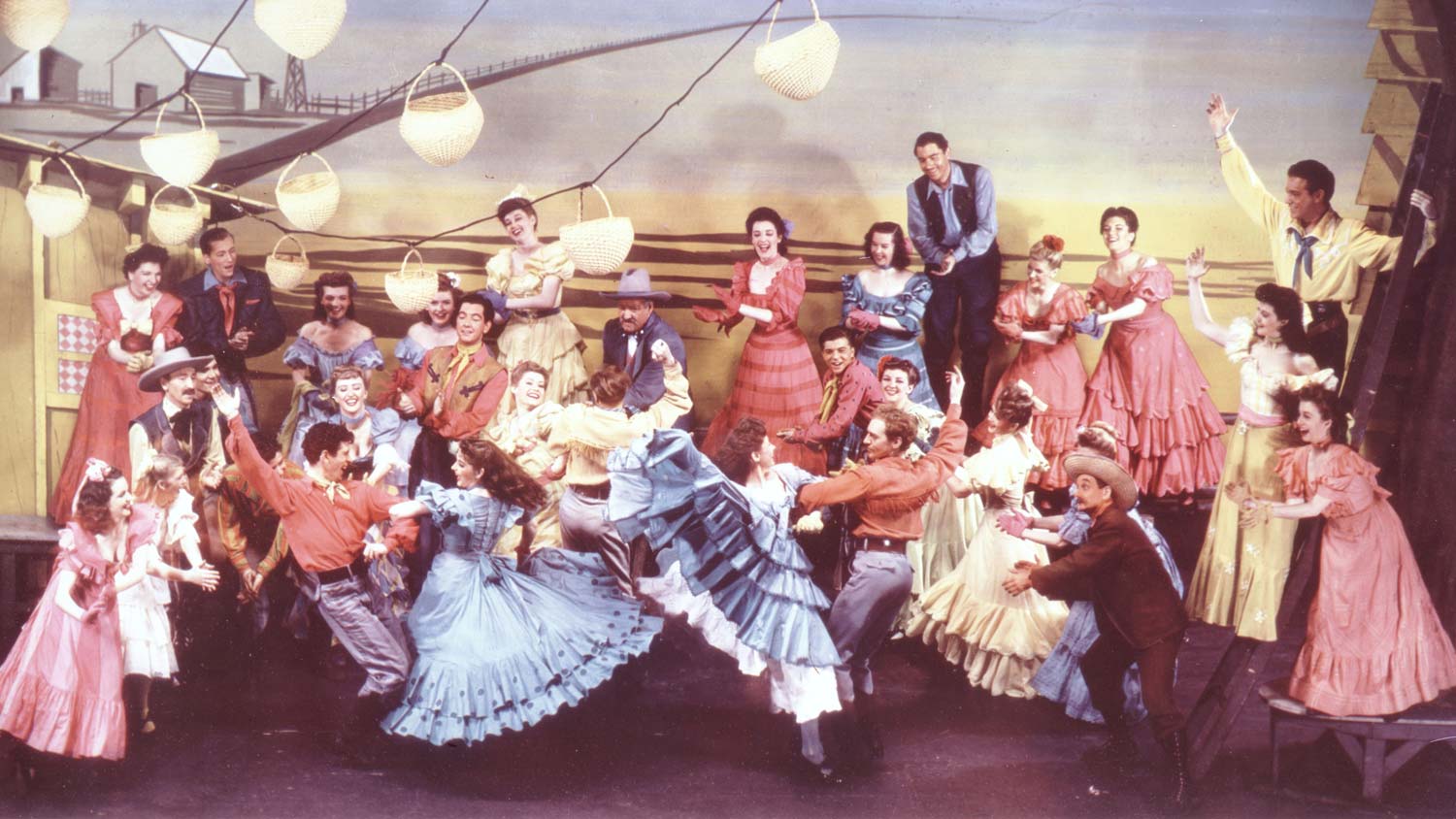
March 31, 1943: "Oklahoma!" Premieres On Broadway

March 31, 1943: The musical Oklahoma! premieres on Broadway, written by Richard Rodgers and Oscar Hammerstein II, beginning one of the great partnerships in musical history -- but also ending another.

In 1919, composer Richard Rodgers began to write songs with lyricist Lorenz "Larry" Hart. It took them until 1925 to have their first Broadway success, The Garrick Gaeties. Over the next 15 years, they would produce many instances of what would later be called "standards" and "The Great American Songbook": "Thou Swell," "Ten Cents a Dance," "Isn't It Romantic?" "Blue Moon," "There's a Small Hotel," "Where Or When," "My Funny Valentine," "The Lady Is a Tramp," and "Bewitched, Bothered and Bewildered."

By 1942, Hart had fallen so deep into alcoholism that he had become unreliable. So when Rodgers wanted to write his next musical, he turned to Oscar Hammerstein II. Neither Hart nor Hammerstein's writing partner, Jerome Kern, objected.

Hammerstein, the grandson and namesake of an opera impresario, and Kern had changed Broadway forever with Show Boat in 1927, including "Old Man River." Later, they wrote "I Won't Dance," "The Way You Look Tonight," and "Smoke Gets In Your Eyes."

Before Show Boat, most musicals were light in tone, light in tune, and light on story. Much like a rock and roll album from the Beatle era onward, a 1920s musical would be lucky to have one of its songs remembered. But Show Boat began the era of the "book musical," a play where the story mattered, might be serious, and the songs and dances were fully integrated into it.

Oklahoma!, based on Green Grow the Lilacs, a 1931 play by Lynn Riggs, took this a step further, featuring musical themes, or motifs, that recurred throughout the show, to connect the music and the story, set in 1907, at the time of Oklahoma gaining Statehood.

And the show would be remembered for considerably more than one song: There would be the title tune, plus "Oh, What a Beautiful Mornin'," "The Surrey with the Fringe on Top," "Kansas City" (not the later Wilbert Harrison song: This is a comedy tune, about how "Everything's up to date" there in 1907), and "People Will Say We're In Love."

It premiered  on March 31, 1943, at the St. James Theatre, at 246 West 44th Street. (It is still in operation.) Rouben Mamoulian directed it, and Agnes de Mille choreographed it. The original stars were Alfred Drake as Curly McLain, Joan Roberts as Laurey Williams, Celeste Holm as Ado Annie Carnes, and Howard Da Silva as Jud Fry.

The show was an absolute smash, just what the public needed during those dark days of World War II. The Tony Awards didn't start until 1948, so it didn't win any. But it ran for 5 years, 2,212 performances, a record that stood until My Fair Lady surpassed it at the end of the 1950s.

Just 8 months after the premiere, Hart was dead, only 48 years old; 2 years after that, so was Kern, at 60. Hammerstein lived on until 1960, Rodgers until 1979.

It was filmed in 1955, with Gordon MacRae as Curly, Shirley Jones (his real-life wife at the time) as Laurey, Gloria Graham as Ado Annie, and Rod Steiger as Jud. The film also had Eddie Albert and James Whitmore.

*

March 31, 1943 was a Wednesday. Actor Christopher Walken was born. But there were no scores on this historic day. The baseball season hadn't yet begun. Football was in the off-season. The NBA hadn't been founded yet. And the NHL had no games scheduled: The Stanley Cup Semifinals had both ended the day before, and the Finals began the next day. The Detroit Red Wings ended up beating the Boston Bruins in 4 straight.

December 31, 1999 & January 1, 2000: The Millennium

December 31, 1999:  The Millennium arrives. The people of planet Earth survived. At a terrible cost. But we hadn't destroyed ourselves. ...