Showing posts with label tarzan. Show all posts

Friday, October 7, 2022

October 7, 1912: The Debut of Tarzan

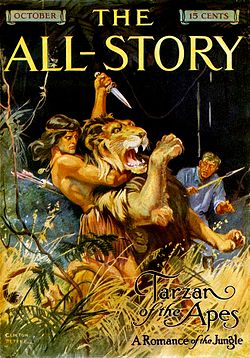
The debut cover

October 7, 1912: The All-Story Magazine prints a story by Edgar Rice Burroughs: Tarzan of the Apes: A Romance of the Jungle. It is the debut of one of the most famous fictional characters ever created. And while American audiences have tended to accentuate each syllable, pronouncing his name "TAR-ZAN," it was originally "TAR-zin," with the accent only on the 1st syllable.

While modern readers might define "romance" as "emotional attraction towards another person and the courtship behaviors undertaken to express the feelings," from the late 18th Century onward, the word was then understood within the realm of "Romanticism," a movement that broke away from neoclassicism, and emphasized nature, the imagination and emotions.

In Burroughs' story, John Clayton, Viscount Greystoke, the son of a British lord, the Earl of Greystoke, and his wife, who were marooned on the coast of West Africa by mutineers. When Tarzan was an infant, his mother died, and his father was killed by Kerchak, leader of the ape tribe by whom Tarzan was adopted.

Soon after his parents' death, Tarzan became a feral child, and his tribe of apes is known as the Mangani, great apes of a species unknown to the science of the time. Kala is his ape mother. She gives him the name "Tarzan," meaning "White Skin."

His jungle upbringing gives him abilities far beyond those of ordinary humans. These include climbing, clinging, and leaping as well as any great ape. He uses branches, swings from vines to travel at great speed, and can use his feet like hands, a skill acquired among the anthropoid apes. He prefers going barefoot, because he relies on the flexibility of bare feet.

His strength, speed, stamina, agility, reflexes, and swimming skills are extraordinary; he has wrestled not just full-grown apes, but also gorillas, lions, rhinos, crocodiles, pythons, leopards, tigers, and, in the most fantasy-laden stories, sharks, giant seahorses and dinosaurs. He is a skilled tracker, and uses his exceptional hearing and keen sense of smell to follow prey or avoid predators.

As originally depicted, Tarzan is very intelligent and articulate, and does not speak in broken English as the classic movies of the 1930s depict him. He can communicate with many species of jungle animals, and has been shown to be a skilled impressionist, able to mimic the sound of a gunshot perfectly.

Tarzan is literate in English before he first encounters other English-speaking people. His literacy is self-taught after several years in his early teens, by visiting the log cabin of his infancy and looking at children's primer/picture books. He eventually reads every book in his father's portable book collection, and is fully aware of geography, basic world history, and his family tree.

He is "found" by traveling Frenchman Paul D'Arnot, who teaches him the basics of human speech and returns with him to civilization. When Tarzan first encounters D'Arnot, he tells him (in writing): "I speak only the language of my tribe -- the great apes who were Kerchak's; and a little of the languages of Tantor, the elephant, and Numa, the lion, and of the other folks of the jungle I understand."

But he proves that he can learn a new language in days, ultimately speaking many languages, including that of the great apes, French, English, Finnish, Dutch, German, Swahili, other Bantu languages, Arabic, Ancient Greek, Ancient Latin, and Mayan.

At the age of 18, Tarzan meets a young American woman named Jane Porter. She, her father, and others of their party are marooned on the same coastal jungle area where Tarzan's human parents were 20 years earlier. When Jane returns to the United States, Tarzan leaves the jungle in search of her, his one true love.

Contrary to what many fans would come to believe, in The Return of Tarzan, published in magazine form in 1913 and in book form in 1915, Tarzan and Jane marry. In later books, he lives with her for a time in England. They have one son, Jack, who takes the ape name Korak, meaning "The Killer."

Tarzan is contemptuous of what he sees as the hypocrisy of civilization, so Jane and he return to sub-Saharan Africa, making their home on an extensive estate in British East Africa that becomes a base for Tarzan's later adventures. (British East Africa would become Kenya.)

Born on September 1, 1875 in Chicago, Edgar Rice Burroughs wrote 24 Tarzan novels, 11 John Carter of Mars novels, and many other works of adventure, including fantasy and science fiction, before dying on March 19, 1950 in Encino, California, at the age of 74.
Elmo Lincoln starred in the 1st Tarzan film, the silent, black & white Tarzan of the Apes in 1918. In 1932, Olympic swimming Gold Medalist Johnny Weissmuller starred in Tarzan, the Ape Man, the 1st of 12 films in which Maureen O'Sullivan (mother of Mia Farrow) played Jane. The first film introduced "the Tarzan Yell," which has become as synonymous with the character as as this version's broken English, wearing nothing but a loincloth, and swinging from the vines. The scene where Jane asks him his name, and he goes, "Tarzan, Jane, Tarzan, Jane," got mixed up in the public mind, and the incorrect phrase, "Me Tarzan, you Jane" entered the lexicon.

The 2nd film, Tarzan and His Mate, in 1934, was one of the most controversial films of all time. It's "His Mate," not "His Wife." At no time in the film are they said to married. But they sleep together, Jane is shown showering in silhouette, and, with a body double subbing for O'Sullivan, she is shown swimming naked in a river -- while Tarzan keeps his loincloth on. It was the movie that made the keepers of "The Hays Code," the moral guardians of the American film industry, get serious.

The films would show Tarzan joined by a chimpanzee named Cheetah, and, starting in 1939 with Tarzan Finds a Son!, by Johnny Sheffield, then 8 years old, as the older version of a baby that Cheetah had rescued and brought to Tarzan and Jane, whom this version of Tarzan, not the most imaginative of men, names "Boy."
From the 1939 film Tarzan Finds a Son! Left to right:
Jiggs Jr. as Cheeta, Johnny Sheffield as Boy,
Johnny Weissmuller as Tarzan, and Maureen O'Sullivan as Jane. 

Weissmuller died in 1984, O'Sullivan in 1998, Sheffield in 2010.

Lex Barker took over for 5 films from 1949 to 1953, then Gordon Scott for 6 from 1955 to 1960, then Jock Mahoney for 1 in 1962 and another in 1963, and Mike Henry for 3 from 1966 to 1968. At the same time as the Henry films, Ron Ely starred in a Tarzan series for NBC.  That series, as well as the films of Mahoney and Henry, did not include Jane or Boy, but did have Cheeta.

In 1981, Miles O'Keefe starred in Tarzan, the Ape Man, with Bo Derek as Jane, and her real-life husband John Derek directing. It was universally panned, and considered soft-core pornography. A much-better-regarded film came in 1984, with French actor Christopher Lambert in Greystoke: The Legend of Tarzan, Lord of the Apes. Casper Van Dien starred in Tarzan and the Lost City in 1998, the same year a Disney cartoon musical was released, with Tony Goldwyn voicing Tarzan. Swedish actor Alexander SkarsgĂ„rd starred in The Legend of Tarzan in 2016.

It has been suggested that Tarzan is the 2nd-most popular fictional character of all time, behind only Sherlock Holmes. The imitations of him, or at least the stories of jungle adventure after him, have been many. Frank Buck, hunter and animal collector, with his 1930 book Bring 'em Back Alive and the works based on it. King Kong and his copy, Mighty Joe Young. Jungle Jim. The cartoon parody George of the Jungle, and the parody of that on PBS' The Electric Company, Jennifer of the Jungle. Congo Bill and Congorilla.  

In 1947, The Andrews Sisters had a hit with "Civilization," with its chorus of, "Bongo, bongo, bongo, I don't wanna leave the Congo, oh no no no no no. Bingo, bangle, bungle, I'm so happy in the jungle, I refuse to go." In 1969, Ray Stevens, master of novelty songs, had a hit with "Gitarzan." In 1970, The Kinks had a hit with "Apeman."

The character of Sheena debuted in comic books in 1938. She was played on TV by model Nellie "Irish" McCalla in 1955. McCalla admitted that she couldn't act, but she looked good in the outfits. Tanya Roberts starred in a 1984 film version of Sheena, and Gena Lee Nolin played her in a new TV series in 2000. Ironically, the name "Sheena" comes from Gaelic, and is a variation of Jane, the feminine version of John. So Sheena, the closest thing pop culture has to a female Tarzan, is really "Jane." Even Sheena has been copied, with Marvel Comics' Shanna, the She-Devil.

*

October 7, 1912 was a Monday. It was the day before the start of the World Series, which the Boston Red Sox would win over the New York Giants in 8 games. Yes, 8: Game 2 would be called due to darkness while tied, and the Series would, as it was supposed to, continue until one team or the other had won 4 games.

But there was one score on this historic day, and it was in college football: The University of Iowa beat Iowa State Teachers College, 35-7 at Iowa Field in Iowa City. ISTC, located in Cedar Falls, became the State College of Iowa in 1961, and the University of Northern Iowa in 1967. In 1973, they began playing in NCAA Division II. In 1981, they moved up to Division I-AA, now the Football Championship Subdivision (FCS).

Monday, June 13, 2022

June 13, 1934: The Hays Code Gets Serious

Will Hays

June 13, 1934: The Hays Code gets serious, ending the 1st era of "talking pictures."

William Harrison Hays was born on November 5, 1879 in Sullivan, Indiana, outside Terre Haute. He became an elder in the Presbyterian Church. In 1918, he was named Chairman of the Republican National Committee. He wasn't the original jackass Republican from Indiana, but he was one of the jackiest such asses.

In 1920, he managed Warren Harding's successful campaign for President. Harding appointed him to be Postmaster General. In 1922, he resigned this office when he was offered the chance to become the 1st Chairman of the Motion Picture Producers and Distributors of America.

By that point, there had been some scandals involving film actors, including the one that ruined the image of comedian Roscoe "Fatty" Arbuckle, despite his rightful acquittal in a murder trial. At this point, films were still silent, and all in black and white. But the general perception had become that the film industry was morally questionable, and 37 States were now considering "decency laws" to govern the distribution and showing of films.

So the film studios decided to be proactive, and self-regulate. Hays was hired to do for them what another Republican official, federal Judge Kenesaw Mountain Landis, had recently been hired to do for baseball as its 1st Commissioner: Straighten it out, by punishing those who went too far. The New York Times labeled Hays "The Screen Landis."

In 1924, Hays introduced "The Formula," a series of recommendations as to what they could show. The 1927 release of The Jazz Singer, the 1st film with a recorded soundtrack that matched the actors' speech -- the first "talkie" -- meant that now, it wasn't just images and printed words that could cause worry, but spoken words.

So Irving Thalberg of Metro Goldwyn Mayer, Sol Wurtzel of Fox, and E.H. Allen of Paramount got together, and put together a list they called "The Don'ts and Be Carefuls." Hays approved this list. The "Don'ts" banned "pointed profanity," and included the words "God," "Lord," "Jesus" and "Christ," except when filming religious ceremonies. "Ridicule of the clergy," a big thing with the recent scandal of Aimee Semple McPherson and the publication of Sinclair Lewis' novel Elmer Gantry (not filmed until 1960), was also a "Don't." So was nudity and even its suggestion. So was mention of sex and birth control. So was race-mixing. So was drugs.

So was "Willful offense to any nation, race or creed." Fat chance of that being enforced: Racial stereotypes continued to abound, with no attempt to stop them. Nevertheless, in 1936, Robert Sherwood's play Idiot's Delight took place in Italy; when the 1939 film version was made, the country became a generic one, not named.

The "Be Carefuls" included how the American Flag was used, how guns were used, seeing to it that there was no cruelty to children or animals, or executions. The most famous execution in film history, that of James Cagney's gangster Rocky Sullivan in the 1938 film Angels with Dirty Faces, was shown only in shadow. We never even see the electric chair, only the machine powering it.

And sympathy for criminals was out. If a person was shown onscreen to have been an unrepentant criminal -- or even what would then have quaintly been called a "fallen woman" -- by the end of that film, that person either had to repent for what they had done, or be definitively punished for it, usually through death, either from illness, or an unseen accident accompanied by a scream. Even "Excessive or lustful kissing" was put in the "Be Careful" category.

A revision was put into place in 1930, published in the February 19 issue of the "trade paper" Variety, and this became known as "The Hays Code." But it wasn't enforced as strictly as you might think. Some films that have been retroactively labeled "Pre-Code" now seem pretty tame, but, by the standards of the Coolidge and Hoover years, were wild:

* This was the peak era for gangster films. In 1929, the year that Al Capone orchestrated the mob hit known as "The St. Valentine's Day Massacre," Edward G. Robinson appeared in his 1st talking picture, The Hole In the Wall. In 1931, the year that Capone went to prison for income tax evasion, Robinson starred in Little Caesar, and James Cagney in The Public Enemy. In 1932, Paul Muni starred in Scarface, the title being Capone's most familiar nickname. (This film would be very loosely remade with Al Pacino in 1983, with cocaine the drug of choice instead of alcoholic beverages, which were still banned under Prohibition until late 1933.)

* This was also the era of classic horror. The year 1931 saw the release of the Bela Lugosi version of Dracula, and then the Boris Karloff version of Frankenstein. Karloff followed this in 1932 with The Mummy. And 1933 saw the premieres of King Kong and the Claude Rains version of The Invisible Man. Frankenstein '31 and Invisible Man '33 were both directed by James Whale.

* And then there were the fallen women. In 1930, Norma Shearer starred in The Divorcee. She not only got away with playing a woman who happily gets a divorce, she won the Academy Award for Best Actress. (It helped that she was married to Thalberg, who could smooth things over -- at least, until his death in 1936.)

In 1932, Shearer starred in Strange Interlude. That same year, Red Dust showed Clark Gable (not yet with the mustache that he would make legend) finding Jean Harlow in an outdoor shower: He first sees her with her bare back turned to him, although the shower's screen means she can only be seen from the waist up, and then covers herself with a towel. She was playing a prostitute.

In 1933, Barbara Stanwyck starred in Baby Face, as a woman who sleeps her way to the top, including with a then-unknown John Wayne. (Both of them would go on to become among the most puritanical conservatives in Hollywood.) And in early 1934, The Road to Ruin starred Helen Foster (already 27 years old) as a teenage girl getting seduced, roofied, addicted to drugs, and finally pregnant. And she gets an abortion. In nineteen thirty-four.

None of these films pushed America's self-appointed moral arbiters over the edge. The one that did was Tarzan and His Mate, directed by Cedric Gibbons, and released on April 16, 1934. Two years earlier, Johnny Weissmuller (an Olympic Gold Medal swimmer) debuted as the legendary British noble child who grew to be an African jungle "ape man," and Maureen O'Sullivan (an Irish actress who later became the mother of actress Mia Farrow) played Jane Parker. (She is "Jane Porter" in the novels of Edgar Rice Burroughs.) Here, they each played their respective roles for the 2nd time.

Tarzan and Jane live together in the jungle. But, at this point, they are not married. They did get married in the novels, but they never married in the Weissmuller films. And yet, they are living together.

Remember: It's Tarzan and His Mate -- not Tarzan and His Wife. There is, as yet, no child that Tarzan would later find, and name simply Boy. In the books, Tarzan and Jane, married, had a son named Koark. But in the Weissmuller films, they simply found Boy. There was, however, a chimpanzee named Cheeta, originally played by Jiggs, and later by his son, Jiggs Jr.
From the 1939 film Tarzan Finds a Son! Left to right:
Jiggs Jr. as Cheeta, Johnny Sheffield as Boy,
Johnny Weissmuller as Tarzan, and Maureen O'Sullivan as Jane.

In this film, as Jane, O'Sullivan wears a halter top and a loincloth, showing, by the standard of that era, a lot of skin. She is shown in silhouette, dressing in a tent. She is shown sleeping with Tarzan. Not shown kissing in bed, certainly not shown having sex, but definitely shown sleeping with him. Again: "His Mate," not "His Wife."

And then there is the scene where Tarzan pushes Jane into a river, and her dress comes off. He jumps into the river as well. He keeps his loincloth on, but she is nekkid as a jaybird. The water is dark enough that we never see anything from the front, but there is plenty of bare butt. (Josephine McKim, another Olympic swimmer, winning a Gold Medal in a relay race in 1932, was used as a body double, so that O'Sullivan wouldn't have to do the nude scene.)

That was it. That was the last straw. The straw that broke the camel's back. Within days, John T. McNicholas, the Archbishop of Cincinnati, founded the Catholic Legion of Decency, and asked its members to sign a pledge refusing to see films the Legion deemed "immoral." The idea spread like wildfire, and soon Episcopal and mainstream Protestant churches hopped on the bandwagon. Within weeks, McNicholas happily changed the group's name to the National Legion of Decency.

Of course, it would have to be Cincinnati. Then as now, it was one of the most conservative cities in America. Mark Twain allegedly once said, "When the end of the world comes, I want to be in Cincinnati, because it's always 20 years behind the times."

And so, on June 13, Hays established the Production Code Administration. Effective July 1, all films had to receive a certificate of approval from the PCA before they could be released in America, even if made in a foreign country. From July 1, 1934 onward, in films, "The guilty are punished, the virtuous rewarded, the authority of church and state is legitimate, and the bonds of matrimony are sacred."

Terrified of losing the Catholic audience and the evangelical Protestant audience -- it was the Great Depression, and they needed every sold ticket they could get, and so they were terrified of any potential boycott -- the studio heads, most of them Jewish, caved in to Hays and the Legion. As a film historian described it decades later, it was "a Jewish-owned business selling Catholic theology to Protestant America."

And so, in 1938, in the aforementioned Angels with Dirty Faces, Cagney's Rocky had to keep up his tough-guy facade as he goes to the electric chair, and then beg for his life -- though, as Cagney himself insisted, the film leaves it ambiguous as to whether he's genuinely scared, or whether he's doing what his old pal, a priest played by Pat O'Brien, asked him to do: Pretend to be scared, so that the kids the priest watches over will know not to follow Rocky's path. And, 10 years later, in his last great gangster film, White Heat, Cagney's Cody Jarrett yells, "Made it, Ma: Top of the world!" and is then killed by the police.

In 1940, Rebecca was released, directed by Alfred Hitchcock. In the original novel by Daphne du Maurier, Maxim de Winter murdered his 1st wife, and got away with it. In the film, her death was an accident, but still his fault, and he only covered it up. In the 1941 version of The Maltese Falcon, starring Humphrey Bogart as private detective Sam Spade, Mary Astor, playing the killer, was shown being escorted into an elevator by the cops, going down, as if to Hell.

In 1942, Casablanca was released. That Rick Blaine (Bogart) and Ilsa Lund (Ingrid Bergman) were having sex in Paris during the flashback scenes, and did so one more time in Casablanca, making her an adulteress again (and, this time, knowingly), was not shown, but was heavily implied. So was Captain Louis Renault's (Rains) trading of governmental favors to women for sexual favors. But, in the end, Rick gives Ilsa up for the good of the resistance, and both he and Louis let Ilsa and her husband (Paul Heinreid's Victor Laszlo, who suspects everything) escape.

Hays retired from his post as Chairman in 1945, and died in 1954, with his Code intact. Archbishop McNicholas died in 1950.

Occasionally, there would be films that pushed the envelope. Hitchcock himself did so in 1960 with Psycho, with Janet Leigh's Marion Crane first fooling around in her underwear in a motel, and then coming to a grisly end in a shower.

By 1962, foreign films and rogue directors had successfully pushed the boundaries of what was acceptable. The censors had also become more lenient with comedies. That year, the Broadway musical Gypsy, based on the memoir of stripper Gypsy Rose Lee, was released as a film. During the burlesque scenes, Natalie Wood stripped down to elaborate corsets and gowns, but carefully left the stage before anyone could see her naked. And the script shifted the focus from the taboo nature of burlesque to the drama of a demanding, controlling mother living vicariously through her daughters.

In 1963, Jayne Mansfield did a topless scene in Promises, Promises! Also that year, by setting Irma La Douce, with Shirley MacLaine as a Paris prostitute, in a brightly colored, theatrical version of Paris and leaning into screwball comedy, and making sure everybody kept their clothes on, director Billy Wilder kept the squalid realities of sex work at arm's length.

In 1964, Goldfinger showed Shirley Eaton dead on a bed, seemingly incased in gold, face and breasts down and wearing only panties. It could be argued that she had "paid for" getting in bed with Sean Connery's version of James Bond. But Honor Blackman's character was still named "Pussy Galore." Then again, the film was British-made, with mostly British actors, so that allowed some "wiggle room." (No, that's not meant to be one of Bond's infamous double entendres.)

In 1966, Dean Martin starred in the spy spoof The Silencers. Nancy Kovack showed her bare butt, although her character, a villainess, was about to kill Dean's Matt Helm, and was then shot and killed herself.

Finally, in 1967, Arthur Penn directed Bonnie and Clyde, a very violent film by the standards of the time. While the title characters, like the real people they were based on, ultimately paid for their crimes with their lives, it was the hardest death scene in movie history to that point.

The following year, on November 1, 1968, the Motion Picture Association of America (MPAA) ratings system took effect: G for "general audiences"; M for "mature audiences, parental discretion advised"; R for "restricted, persons under 16 not admitted, unless accompanied by parent or adult guardian"; and X, for "persons under 16 not admitted," no matter what. Movie viewers could see these ratings, and then -- wonder of wonder, miracle of miracles -- decide for themselves, without any Legion of Decency saying, "Not without our permission, you don't."

In 1970, the ratings system was adjusted a little. M was replaced with GP, and the age limit for R and X was raised to 17. In 1972, "GP" became "PG," more accurately reflecting its abbreviation, "Parental Guidance."

In 1984, following a few movies that were a bit gory for PG, the PG-13 rating was created, as a halfway point between PG and R. And in 1990, recognizing that the X rating had become inextricably connected with films that were intentionally pornographic, and that this was not the sole intent of the rating -- the 1983 version of Scarface nearly got an X due to levels of violence and profanity few thought previously possible -- the X was replaced by NC-17, meaning "No Children under 17 admitted."

In 1996, a similar rating system was instituted for TV shows. "TV-G" meant general audiences. "TV-PG" meant parental guidance suggested. "TV-14" meant some scenes might be inappropriate for viewers under age 14. And "TV-MA" meant "Mature Audiences," and was considered the TV version of NC-17. TV-MA has rarely been used on major network TV, and isn't all that enforceable, anyway.

Cedric Gibbons died in 1960, Johnny Weissmuller in 1984, Josephine McKim in 1992, and Maureen O'Sullivan in 1998.

*

June 13, 1934 was a Wednesday. These Major League Baseball games were played:

* The New York Yankees beat the St. Louis Browns, 6-2 at Yankee Stadium. Lou Gehrig hit a home run in support of Lefty Gomez.

* The New York Giants beat the Cincinnati Reds, 6-4 at Crosley Field in Cincinnati. Bill Terry and Jo-Jo Moore each had 3 hits, Mel Ott only 1.

* The Brooklyn Dodgers lost to the Pittsburgh Pirates, 15-2 at Forbes Field in Pittsburgh. This was the era of "The Daffiness Boys," when calling the Dodgers "Dem Bums" was not a term of endearment.

* The Boston Red Sox beat the Detroit Tigers, 15-13 at Fenway Park in Boston. No, that's not a football game.

* The Philadelphia Athletics beat the Cleveland Indians, 11-9 at Shibe Park in Philadelphia.

* The Washington Senators swept the Chicago White Sox in a doubleheader at Griffith Stadium in Washington. The Senators won the 1st game, 11-3; and the 2nd game, 13-11.

* The Philadelphia Phillies beat the Chicago Cubs, 2-1 at Wrigley Field in Chicago.

* And the Boston Braves beat the St. Louis Cardinals, 9-0 at Sportsman's Park in St. Louis. 

December 31, 1999 & January 1, 2000: The Millennium

December 31, 1999:  The Millennium arrives. The people of planet Earth survived. At a terrible cost. But we hadn't destroyed ourselves. ...