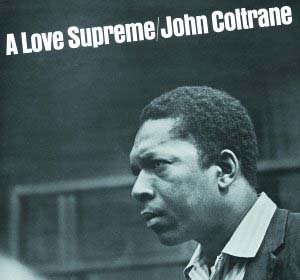
December 9, 1964: Jazz saxophonist John Coltrane records his album A Love Supreme. For a man known for his innovation, it is regarded as his greatest work. Or, as a saxophonist not yet born, Joshua Redman, put it in an interview for Ken Burns' miniseries Jazz, "That's one of the first records I can ever remember hearing, and I hope it's the last record I ever hear."
John William Coltrane was born on September 23, 1926 in Hamlet, North Carolina, and grew up there. After graduating from high school, he moved to Philadelphia, in the hope of making it as a musician there. He enlisted in the U.S. Navy toward the end of World War II, serving a full year, and returned to Philadelphia, where he used the G.I. Bill to enroll in the Granoff School of Music.
Originally influenced by saxophonists Lester Young and Johnny Hodges, he became a fan of Coleman Hawkins, Ben Webster and Tab Smith, citing them in a later interview as doing things "that I didn't understand, but that I felt emotionally." A Philadelphia-based pianist, Hasaan Ibn Ali, became an influence on him. The leading saxophonist of the immediate post-World War II years was Charlie Parker, and Coltrane was fortunate enough to work with him, and with Hodges, and the trumpeter with whom Parker developed "bebop," John "Dizzy" Gillespie.
In 1955, trumpeter Miles Davis invited Coltrane to play with him. This lasted for 2 years, before, like so many other jazz musicians had, including Davis, Coltrane fell to heroin addiction. Once past that, he worked with pianist Thelonious Monk for a few months, then rejoined Davis, working with him and Julian "Cannonball" Adderley on Davis' magnum opus, Kind of Blue.
In 1960, Coltrane went solo, and recorded the album Giant Steps on Atlantic Records. The following year, he formed a new quartet, with pianist McCoy Tyner, bass fiddler Jimmy Garrison, and drummer Elvin "The Emperor" Jones.
They recorded My Favorite Things, including the title track, a number from the Broadway show The Sound of Music, which, with extended solos from Coltrane on soprano saxophone and Tyner, became something completely different, something composers Richard Rodgers and Oscar Hammerstein had never imagined. It was a revelation, but not a total shock, as Davis had already done something similar with George & Ira Gershwin's Porgy and Bess.
Shortly thereafter, Impulse! Records (officially, with the exclamation point) bought Coltrane's contract. Label owner Rudy Van Gelder had worked with Davis while Coltrane was with him, and offered Coltrane full creative control at his studio in Englewood Cliffs, Bergen County, New Jersey, across the Hudson River from New York.
This period included a collaboration with Duke Ellington, and albums titled Ballads (all standards, including "All Or Nothing at All") and Impressions. And then, on a single day, December 9, 1964, the John Coltrane Quartet recorded A Love Supreme, in four parts, with Coltrane on tenor saxophone: "Acknowledgement," "Resolution," "Pursuance," and "Psalm."
A critic suggested that the album was intended to represent a struggle for purity, an expression of gratitude, and an acknowledgement that the musician's talent comes from a higher power. Indeed, in 1966, approaching his 40th birthday, Coltrane was asked what his goal was, and he said, "To become a saint."
The choice was taken out of his hands. He developed liver cancer, and died on July 17, 1967, at Huntington Hospital, not far from his home in Dix Hills, Long Island, New York. He had kept the illness quiet, and Miles Davis spoke for most when he said, "Coltrane's death shocked everyone, took everyone by surprise. I knew he hadn't looked too good... But I didn't know he was that sick, or even sick at all."
In 1982, the African Orthodox Church canonized Coltrane as a saint within their faith. His shrine is at St. John Coltrane Church, 2097 Turk Boulevard in San Francisco, even though he had little connection to that city.
His 1st wife, Naima Grubbs, died in 1996; his 2nd wife, pianist Alice MacLeod, continued to record and perform after his death, and lived until 2007. Son John Coltrane Jr. was 17 and already getting some recognition as a musician when he was killed in a car crash in Los Angeles in 1982. Son Ravi Coltrane, also a saxophonist, is better known as a music producer. Son Oranyan Coltrane, born shortly before his father's death, is also a producer, and plays multiple instruments.
As for the rest of his quartet: Garrison died of lung cancer in 1976, only 42; Elvin Jones lived until 2004; and McCoy Tyner was the last survivor, living until 2020, dying from a long-term illness, not COVID, although it was at the start of the COVID pandemic in America. Eric Dolphy, the brilliant flute player who sometimes joined them, had died of complications of diabetes while on tour in West Berlin earlier in 1964, rendering him unable to participate in A Love Supreme.
*
December 9, 1964 was a Wednesday. Baseball was out of season. Football was in midweek. There were 2 games played in the NBA. The New York Knicks beat the Baltimore Bullets, 111-90 at the Baltimore Civic Center (now the CFG Bank Arena). And the Cincinnati Royals beat the Detroit Pistons, 122-114 at Cobo Hall (now Huntington Place) in Detroit.
And there were 2 games played in the NHL. The New York Rangers lost to the Chicago Black Hawks, 6-1 at the old Madison Square Garden. And the Montreal Canadiens beat the Toronto Maple Leafs, 3-2 at Maple Leaf Gardens in Toronto. The Boston Bruins and the Detroit Red Wings were not scheduled.


