Showing posts with label joe louis arena. Show all posts

Sunday, June 12, 2022

June 12, 2009: Sidney Crosby Gets His Cup

June 12, 2009: The Pittsburgh Penguins beat the Detroit Red Wings, 2-1 at the Joe Louis Arena in Detroit, in Game 7 of the Stanley Cup Finals, clinching the Stanley Cup and reversing the result of the previous year's Finals. Sidney Crosby had his 1st Cup.

It should've been his last. It wasn't.

Clarence Campbell, NHL President from 1943 to 1977, had Maurice Richard (not that they got along), Gordie Howe, Bobby Hull and Bobby Orr to grow the League's popularity. His successor, John Ziegler, had Wayne Gretzky. He retired in 1992, handing the presidency to Gil Stein, who, due to a restructuring of League management, held the title for just 1 year, as the new office of Commissioner (to match the other major North American sports leagues) was created in 1993, for Gary Bettman. Bettman wanted his own Orr, his own Gretzky.

In 2005, with the yearlong lockout over, he got his Gretzky: Sidney Patrick Crosby. Born on August 8, 1987 in Halifax, Nova Scotia, his homeland of Canada follows the British custom of writing the date with the day, then the month, then the year: "7 August 1987," or "7/8/87." But since America does the month first, "August 7, 1987" or "8/7/87," Crosby decided that he would wear uniform Number 87.

By the time he was 14, he was already being hailed as Canada's best amateur hockey player. In 2003-04, at 16, he led Rimouski Océanic to the Quebec Maritimes Junior Hockey League title. That season, and in 2004-05 -- stuck there by the lockout -- he was named the Most Valuable Player of the Canadian Hockey League, the junior hockey organization that oversees the QMJHL, the Ontario Hockey League (OHL), and the Western Hockey League (WHL).

Three straight poor seasons left the Penguins in position to draft Crosby, and to be mentored by their owner and greatest player ever, Mario Lemieux. Between Lemieux and Bettman, Crosby got every advantage imaginable: Though Canadian, he would be a Gretzky for an American team from Day One.

Oddly, in his rookie season of 2005-06, Crosby did not win the Calder Memorial Trophy as NHL Rookie of the Year. It was awarded to Alexander Ovechkin of the Washington Capitals, who would spend the rest of his career, for the most part, as the 2nd-best player in the League, but in Crosby's shadow. The Penguins did not make the Playoffs that season: As is usually the case with a team having a sensational rookie, they needed more than that one player.

But in 2006-07, he was named to his 1st All-Star Game, and won the following awards: The Art Ross Trophy as leading scorer (goals and assists combined), the Hart Memorial Trophy as Most Valuable Player as voted by the Professional Hockey Writers' Association, the Ted Lindsay Award as Most Outstanding Player as voted by the NHL Players' Association, the Mark Messier Leadership Award (at the age of 19), and the ESPN ESPY Award for Best NHL Player. The Penguins made the Playoffs, but lost in the 1st Round.

In 2008, Crosby again won the NHL's ESPY, and led the Pens to the Stanley Cup Finals. In the process, they swept the Ottawa Senators, who had knocked them out of the Playoffs the season before; and then beaten both the New York Rangers and the Philadelphia Flyers in 5 games. But the Red Wings, with a veteran-laden lineup, beat them in the Finals in 6 games. It was a moment much like 1983: The New York Islanders were not yet ready to end their dynasty, and the Edmonton Oilers of Gretzky were not quite ready to take the Cup away from them.

In 2008-09, the Penguins finished 2nd in the Atlantic Division. In the Playoffs, they beat their intra-State rivals, the Philadelphia Flyers, in 6 games; outfought Ovechkin and the Washington Capitals in 7, and then swept the Carolina Hurricanes in 4 straight.

They would have a rematch with the Red Wings, who were not going down without a fight, especially since they would have the home-ice advantage for Games 1 and 2, and, if necessary, 5 and 7. And the Wings won each of the 1st 2 games by a 3-1 score. The series went back to the Mellon Arena (formerly the Civic Arena), and the Pens won Games 3 and 4, both by a 4-2 score.

The Wings won Game 5 at the Joe Louis Arena, 5-0. The Pens won Game 6 at home, 2-1. The home team had won every game. And Game 7 would be in Detroit.

There was no scoring in the 1st period. Just 1:13 into the 2nd, Maxime Talbot put the Penguins on the board. Halfway through, at 10:07, Talbot scored again. The Wings got a goal from Jonathan Ericsson with 6:07 left in regulation, but, as hard as the proud old team with 4 of the last 12 Cups fought, they couldn't find the equalizer. The Penguins won, 2-1.

It was their 1st Stanley Cup since 1992, their 1st without Mario Lemieux playing for them, and the 1st for Sidney Crosby, who, as Captain, was handed it by Commissioner Bettman.

Evgeni Malkin was awarded the Conn Smythe Trophy as the Most Valuable Player of the Playoffs. He was the 1st Russian-born, and the 1st Russian-trained, player to receive it.
The Pittsburgh Steelers had won Super Bowl XLIII on February 1. So, from June 12, 2009 to February 7, 2010, 250 days, Pittsburgh held the World Championships of both football and hockey.

*

June 12, 2009 was a Friday. Football was out of season. The NBA Finals were on a travel day. Two nights later, the Los Angeles Lakers beat the Orlando Magic, 99-86 at the Staples Center (now the Crypto.com Arena) in Los Angeles, in Game 5 to clinch the title.

And a full slate of Major League Baseball games was played:

* The New York Yankees beat the New York Mets, 9-8 at the new Yankee Stadium. This dramatic bottom-of-the-9th-inning comeback win is known as the Luis Castillo Game. I have a separate entry for that event.

* The Boston Red Sox beat the Philadelphia Phillies, 5-2 at Citizens Bank Park in Philadelphia. Kyle Kendrick collapsed in the top of the 13th inning, allowing 4 singles, a walk and a sacrifice fly that scored 3 runs.

* The Atlanta Braves beat the Baltimore Orioles, 7-2 at Oriole Park at Camden Yards in Baltimore.

* The Tampa Bay Rays beat the Washington Nationals, 4-3 at Tropicana Field in St. Petersburg.

* The Texas Rangers beat the Los Angeles Dodgers, 6-0 at Rangers Ballpark in the Dallas suburb of Arlington, Texas. (It's now named Choctaw Stadium.) The Rangers needed 3 pitchers to complete an 8-hit shutout.

* The Detroit Tigers beat the Pittsburgh Pirates, 3-1 at PNC Park in Pittsburgh.

* The Florida Marlins beat the Toronto Blue Jays, 7-3 at the Rogers Centre in Toronto.

* The Cleveland Indians beat the St. Louis Cardinals, 7-3 at Progressive Field in Cleveland.

* The Minnesota Twins beat the Chicago Cubs, 7-4 at Wrigley Field in Chicago.

* The Milwaukee Brewers beat the Chicago White Sox, 7-2 at Miller Park in Milwaukee. (It's now named American Family Field.)

* The Kansas City Royals beat the Cincinnati Reds, 4-1 at Kauffman Stadium in Kansas City.

* The Colorado Rockies beat the Seattle Mariners, 6-4 at Coors Field in Denver.

* The Arizona Diamondbacks beat the Houston Astros, 8-1 at Chase Field in Phoenix.

* The Los Angeles Angels beat the San Diego Padres, 11-6 at Angel Stadium of Anahiem.

* And the San Francisco Giants beat the Oakland Athletics, 3-0 at AT&T Park in San Francisco. (It's now named Oracle Park.) 

Tuesday, June 7, 2022

June 7, 1997: The Red Wings End a 42-Year Drought

Steve Yzerman

June 7, 1997: The Detroit Red Wings beat the Philadelphia Flyers, 2-1 at the Joe Louis Arena in Detroit, and complete a 4-game sweep of the Finals, for their 1st Stanley Cup in 42 years.

After winning 4 Cups in 6 years from 1950 to 1955, they reached the Finals again in 1956, 1961, 1963, 1964 and 1966, but lost every time. Then, under the misleadership of Bruce Norris, son of their guiding force James Norris, they made the Playoffs in only 2 of the next 17 seasons. Moving from the Olympia Stadium to the Joe Louis Arena in 1979 didn't help. Norris selling the team to Mike Ilitch in 1982 began to turn things around, but it still took a while to rebuild. In 1988, they won their Division, and reached the Conference Finals.

They began building a superteam, around high-scoring center Steve Yzerman, who would go on to serve as Captain longer than any player in NHL history; Swedish forward Nicklas Lidstrom; and "The Russian Five": Defensemen Viacheslav Fetisov and Vladimir Konstantinov, centers Sergei Fedorov and Igor Larionov, and left wing Vyacheslav Kozlov.

Larry Murphy had previously won 2 Cups with the Pittsburgh Penguins, Mike Vernon 1 with the Calgary Flames, and Joey Kocur 1 with... uh, let's move on. But for legends of the game like Yzerman, Lidstrom and Fetisov, winning a Cup in Detroit would be the first.

With former Montreal Canadiens coach Scotty Bowman leading them, the Wings reached the Stanley Cup Finals in 1995, but were upset in a 4-game sweep by the New Jersey Devils. After a little tinkering, they reached the Western Conference Finals in 1996, but lost to the Colorado Avalanche.

After just a little more tinkering by general manager Jim Devellano, they got back into the Stanley Cup Finals in 1997, playing the Philadelphia Flyers. The 1st 2 games were in Philadelphia, and the Wings won both of them by a score of 4-2.

Game 3 at "The Joe" was a wipeout, 6-1. Ron Hextall, who starred in defeat for the Flyers in the 1985 and '87 Finals, was traded away to Quebec for Peter Forsberg, and had been reacquired, was pulled in favor of Garth Snow. In the stands during Game 4, a fan held up a sign that said, "Hey Hextall: You and Snow get pulled more than a U-Haul!"

Lidstrom scored in the 1st period, Darren McCarty in the 2nd. Despite an Eric Lindros goal in the 3rd, the Wings hung on, and had their 1st Cup. The hard part was dodging all the octopus that fans were throwing onto the ice.

Vernon was awarded the Conn Smythe Trophy as the Most Valuable Player of the Playoffs. In his 14th season with the Wings, Yzerman finally received the Cup. Wings legend Gordie Howe was on hand, and said of Yzerman, "I'm just so dang happy for the kid, it's unbelievable."

Just 6 days after the clincher, Konstantinov and team massage therapist Sergei Mnatsakonov were badly hurt in a limousine crash, giving the team the motivation it needed to win a 2nd straight Cup.

UPDATE: In 1988, the Flyers established a team Hall of Fame. As of the 2025-26 season, from their 1997 Stanley Cup Finalists, they have elected Ron Hextall, John LcClair, Eric Lindros, Eric Desjardins and Rod Brind'Amour. Each has also been elected to the Philadelphia Sports Hall of Fame.

UPDATE: The Red Wings do not yet have a team Hall of Fame, but they do retire numbers. From their 1997, 1998 and 2002 Stanley Cups: 5, defenseman Nicklas Lidstrom; 19, center Steve Yzerman; and 91, center Sergei Fedorov. Lidstrom was still there for their 2008 Cup winners.

Each of those has also been elected to the Michigan Sports Hall of Fame. So have goaltender Chris Osgood, defensemen Mark Howe (son of Red Wings legend Gordie) and Vladimir Konstantinov, left wing Brendan Shanahan, head coach Scotty Bowman, executives Jim Devellano and Ken Holland, team owners Mike and Marian Ilitch, and broadcaster and former star Mickey Redmond. Center Henrick Zetterberg arrived after the 2002 Cup, but played on the 2008 Cup winners, and has also been elected to the Michigan Sports Hall of Fame.

*

June 7, 1997 was a Saturday. Football was out of season. The NBA Finals were between Games 3 and 4, and the Chicago Bulls would beat the Utah Jazz in 6 games. And these Major League Baseball games were played:

* The New York Yankees beat the Milwaukee Brewers, 2-0 at Yankee Stadium. David Wells pitched 8 innings of 4-hit shutout ball, and Mariano Rivera pitched a perfect 9th. The Yankees runs came on a double by Charlie Hayes and a single by Mark Whiten. Derek Jeter went 0-for-2 with 2 walks.

* The New York Mets lost to the Cincinnati Reds, 10-5 at Cinergy Field (formerly Riverfront Stadium) in Cincinnati.

* The Montreal Expos beat the Chicago Cubs, 5-0 at the Olympic Stadium in Montreal. Carlos Pérez pitched a 7-hit shutout, outpitching Terry Mulholland.

* The Cleveland Indians beat the Boston Red Sox, 9-5 at Fenway Park in Boston.

* The Toronto Blue Jays beat the Oakland Athletics, 3-1 at the SkyDome (now the Rogers Centre) in Toronto.

* The Pittsburgh Pirates beat the Philadelphia Phillies, 9-2 at Three Rivers Stadium in Pittsburgh.

* The Detroit Tigers beat the Seattle Mariners, 3-1 at Tiger Stadium in Detroit. Ken Griffey Jr. went 0-for-4. Alex Rodriguez went 1-for-4.

* The Chicago White Sox beat the Baltimore Orioles, 1-0 at the new Comiskey Park (now Rate Field) in Chicago. Harold Baines singled Dave Martinez home with the winning run in the bottom of the 11th inning. Roberto Hernández became the winning pitcher, the last 4 South Side pitchers to complete an 11-inning 9-hit shutout.

* The Minnesota Twins beat the Anaheim Angels, 6-1 at the Metrodome in Minneapolis. 

* The Kansas City Royals beat the Texas Rangers, 10-4 at Kauffman Stadium in Kansas City.

* The Florida Marlins beat the Colorado Rockies, 7-5 at Coors Field in Denver.

* The San Diego Padres beat the Houston Astros, 5-4 at Qualcomm Stadium (formerly San Diego Stadium and Jack Murphy Stadium). Scott Livingstone singled Tony Gwynn home in the bottom of the 10th inning. Gwynn and Wally Joyner had hit home runs. Rickey Henderson went 2-for-4 for the Padres.

* The Los Angeles Dodgers beat the St. Louis Cardinals, 5-2 at Dodger Stadium in Los Angeles.

* And the Atlanta Braves beat the San Francisco Giants, 5-2 at Candlestick Park (then named 3Com Park at Candlestick Point) in San Francisco. Barry Bonds went 0-for-4.

Saturday, February 5, 2022

February 5, 1980: Gordie Howe's Revenge

February 5, 1980: The greatest player in the history of hockey gets his due, from the fans who knew him the best. And the owner of those fans' team had to just sit there and take it.

Gordie Howe had debuted with the Detroit Red Wings in 1946. Between 1948 and 1966, he had helped them reach the Stanley Cup Finals 11 times, winning 4: In 1950, 1952, 1954 and 1955. In 1963, he became the NHL's all-time leader in goals. When a wrist injury convinced him to finally retire in 1971, at the age of 43, he had 786 goals. At the time, the man in 2nd place, Bobby Hull of the Chicago Black Hawks, had 552.

It wasn't just the wrist injury: Howe had spent a few years feuding with the Wings' owner, Bruce Norris. While his father James E. Norris and his brother James D. Norris had built 7 Stanley Cup winners, Bruce had merely presided over the '54 and '55 champions, having done nothing to build them. Taking full control for the 1955-56 season, he became a typical sports team operator of the period, preferring to save money than to win. He broke up his championship team, and tried to build another on the cheap. Over the next 11 years, they would go 0-5 in Stanley Cup Finals.

After the 1968-69 season, Howe, arguably still the best player in the game, and already nicknamed "Mr. Hockey," discovered that he was only the team's 3rd-highest-paid player, at $45,000. Norris gave him a raise to $100,000, making him the 1st hockey player to make that much. But Norris fumed: He was one of those sports team owners who couldn't stand to have his authority challenged. To him, players were merely means to an end.

Especially angering this old-school old-boy-networker was the fact that Gordie's agent was a woman: His wife, Colleen Howe, who would eventually be known as "Mrs. Hockey." Norris blamed Colleen for Gordie being out of order enough to demand a raise. (This foreshadowed M. Donald Grant blaming Nancy Seaver for Tom's demand for a raise on the 1977 Mets.) The relationship between Norris and the Howes had begun to be poisoned, and it was all Norris' fault: If he had paid Gordie as if he was the best player in the game, all the trouble afterward could have been avoided.

When Gordie retired after the 1971 season, he was given a job in the Wings' front office. Essentially, he was just a schmoozer, shaking hands with corporate clients at their arena, the Olympia Stadium, and allowing the Wings to put his magic name on their corporate letterhead.

Baseball legend Stan Musial, when asked what he did for the St. Louis Cardinals in his nice office at Busch Memorial Stadium, smiled and said, "I don't know, but they pay me a lot of money for it!" In contrast, Gordie grumbled about not having any actual input in the running of the organization. He wasn't the head coach, or an assistant coach, or the general manager, or the director of scouting, or anything of substance. In his words, he was "vice president in charge of paper clips."

Before the 1972-73 season, the expansion New York Islanders, thinking they needed a big name to get attention in the nation's biggest market, offered to make him their 1st head coach. He turned it down. It was probably for the best: The World Hockey Association was launching at the same time, and their Quebec Nordiques offered their head coaching job to Maurice Richard, the Montreal Canadiens icon who was the NHL's all-time leading scorer until Howe. He took it, and hated it. He lost his 1st game, quit on the spot, was talked into keeping the job until they could find someone else, won his 2nd game, and left anyway, and never coached again. But that's 2 more games than Gordie ever had as a head coach.

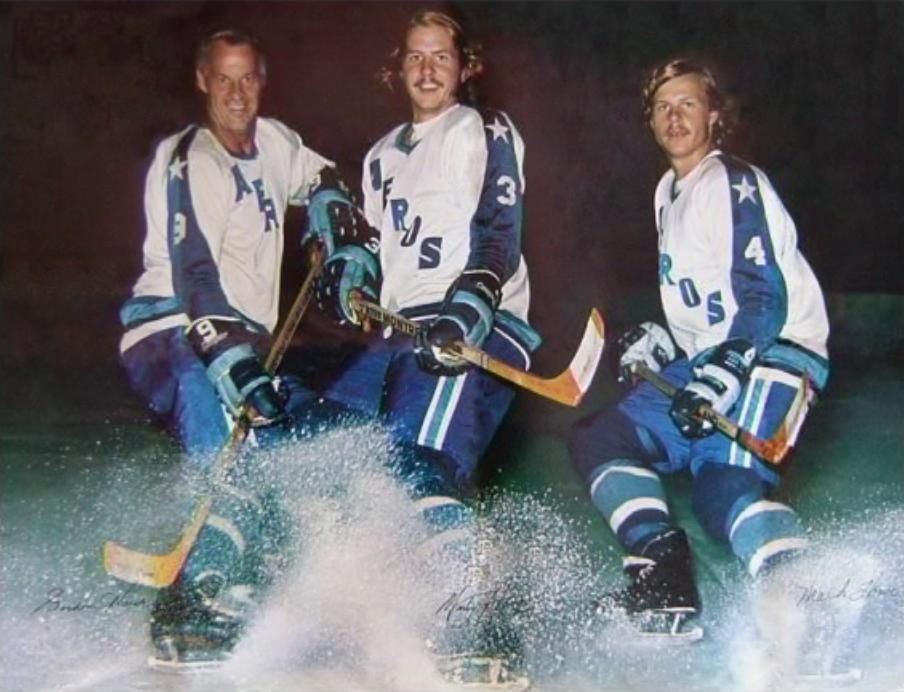
Bill Dineen, a teammate of Gordie's on the '54 and '55 Cup winners, was named head coach of the WHA's Houston Aeros. Another '55 (but not '54) teammate, Larry Hillman, was his assistant. In the 1973 WHA Draft, Dineen took Gordie's sons Mark and Marty.

To help the WHA get better publicity -- they'd already gotten Hull onto the Winnipeg Jets, a team essentially named for him (the Golden Jet, although their uniforms were blue and had no gold), Dineen asked Gordie to come out of retirement. He was willing to get surgery on his troubled wrist, and give it a shot.

Bruce Norris told the Howes that if Gordie quit the Wings' front office and went to "the rebel league," not only would he be blackballed from the NHL, never to work in it again in any capacity, but that Mark and Marty would also be blackballed -- and since they were players just starting out, this would affect them much more. In other words, he gave Gordie and Colleen an anti-incentive that would have hurt them much more than Gordie's own blackballing would have. It may not be the biggest dick move in the history of hockey, but it's the best-known dick move in NHL history.
Bruce Norris

And it backfired. Few decisions in the history of sports have backfired this much. Gordie and Mark -- or Gordie and Marty -- became the 1st father and son teammates in professional hockey history. They played on a line together. Mark and Marty got the traditional rookie hazings, and Gordie did not use his influence to stop it. On the other hand, the sons referred to their father as "Gordie," and even called him that to his face, in their teammates' presence, knowing that if they called him "Dad," they'd never hear the end of it.

Attendance went up all over the WHA, as people wanted to see the Howes. It probably kept the league going long enough for a merger with the NHL to be plausible. The Aeros won the AVCO World Trophy as WHA Champions in 1974. And Gordie, age 46, was awarded the Gary Davidson Trophy as Most Valuable Player.
Gordie, Marty, Mark

Davidson was the founder of the league. He was also a co-founder of the American Basketball Association and the World Football League. (There would be 4 teams each from the ABA and the WHA that would be admitted to the established leagues. The WFL, on the other hand, totally flopped.)

The next season, the WHA MVP award was renamed the Gordie Howe Trophy. Gordie didn't win it again, but the Aeros again won the AVCO Trophy. They reached the Finals again in 1976, but lost to the Jets.

Meanwhile, from the time that Gordie signed with the Aeros in 1973 until 1983, the Wings made the Playoffs only once. From 1970 until 1987, they only won 1 Playoff series. From 1966, Gordie's last trip to the Finals, until 1986, 20 seasons -- ending the year Norris died, although he'd sold the team to Mike Ilitch in 1982 -- they played in only 17 Playoff games, winning 4 of them. They became known as "The Dead Things."

They moved from the Olympia, in a bad neighborhood on Detroit's northwest side, and built the Joe Louis Arena downtown, but that was about the only thing they had to draw fans. They certainly weren't caring about what Larry Aurie and Ebbie Goodfellow did in the 1930s, or what Gordie and his teammates did in the 1950s.

I'm not saying the Wings would have been appreciably better if they still had Gordie, and had drafted Mark and Marty, and had paid them all what they were worth. It would have been tough to break through in a League that had the Big Bad Bruins in Boston, the Broad Street Bullies in Philadelphia, and the Flying Frenchmen in Montreal. But at least they would have been better. Instead, Bruce Norris found out that karma's a bitch.

The 1970s were a thrilling time for performances on the ice, in both leagues. But most hockey teams, in both leagues, were struggling financially. The Aeros needed money badly, and the New England Whalers were one of the few WHA teams that had it. So they bought all 3 Howes. Gordie was still a WHA All-Star.

In the 1979 off-season, the WHA folded, and 4 of its teams were admitted to the NHL. One was the renamed Hartford Whalers. The Wings still held Gordie's NHL rights, meaning that he could not legally play for any NHL team except Detroit. And Norris still owned the Wings.

But, despite being Chairman of the NHL's Board of Governors, Norris was outflanked by a former Wings executive, now President of the NHL, John Ziegler. Gordie was allowed to play in the NHL for Hartford. In that final season, Gordie played all 80 games, scored 15 goals, raising his record total to 801 (his 174 in the WHA giving him 975), and helped the Whalers make the Playoffs.

Bruce Norris' world had fallen in on him. The Wings had become laughably bad in Gordie's absence. And building the Joe Louis Arena had put a major kink in his finances. Now, he had to watch as his blackballing of the Howes and they were welcomed back into the NHL, and not for his team.

The 1980 NHL All-Star Game was given to Detroit and its new arena, as kind of a "gold watch" for Norris, as it was clear he would soon have to sell. And when Scotty Bowman, coaching the Wales Conference All-Star Team in that game, used his prerogative to fill out the roster with non-starters, he chose 3 legends: Jean Ratelle, Phil Esposito... and the nearly 52-year-old Gordie Howe, who was introduced as "Mr. Hockey, Number 9," and got an ovation from the Detroit crowd that went on and on and on. It was a massive middle finger to Norris -- not from any member of the Howe family, but from the Detroit fans.

This was the 32nd time the NHL had held an official All-Star Game. Howe had now appeared in 23 of them. Counting the WHA, he had played in an All-Star Game in 29 of a possible 32 seasons. In this game, he assisted on a goal by Real Cloutier of the Quebec Nordiques, and the Prince of Wales Conference team beat the Clarence Campbell Conference team 6-3. Playing for the Campbell team was 19-year-old Wayne Gretzky, of another team that came in from the WHA, the Edmonton Oilers.

The previous year, Howe and Gretzky had played together on a WHA All-Star Team that played legendary Soviet club Dinamo Moscow. It was the only time that "Mr. Hockey" and the man who would surpass him as the NHL's all-time leader in goals, assists and points would play together.

*

February 5, 1980 was a Tuesday. There were no other NHL games played. Baseball and football were out of season. These 6 games were played in the NBA:

* The New York Knicks lost to the Los Angeles Lakers, 116-105 at Madison Square Garden.

* The New Jersey Nets beat the San Antonio Spurs, 123-115 at the HemisFair Arena in San Antonio.

* The Seattle SuperSonics beat the Cleveland Cavaliers, 123-121 at The Coliseum in the Cleveland suburb of Richfield, Ohio. Dennis Johnson scored 34 points.

* The Philadelphia 76ers beat the Indiana Pacers, 109-108 at the Market Square Arena in Indianapolis. Julius "Dr. J" Erving scored 31 points.

* The Portland Trail Blazers beat the Kansas City Kings, 105-99 at the Kemper Arena (now the Hy-Vee Arena) in Kansas City.

* And the Utah Jazz, in their 1st season after moving from New Orleans, beat the Chicago Bulls, 116-106 at the Salt Palace in Salt Lake City. Adrian Dantley led all scorers with 47 points.

December 31, 1999 & January 1, 2000: The Millennium

December 31, 1999:  The Millennium arrives. The people of planet Earth survived. At a terrible cost. But we hadn't destroyed ourselves. ...