Showing posts with label tulane stadium. Show all posts

Wednesday, November 23, 2022

November 23, 1974: The 1st Bayou Classic

November 23, 1974: The 1st Bayou Classic is held, at Tulane Stadium in New Orleans. Grambling State University defeats Southern University, 21-0.

Northern Louisiana and Southern Louisiana is a cultural intrastate rivalry, and this extends even to what have come to be called Historically Black Colleges and Universities (HBCUs). These were often placed in the same cities as major white schools. Southern University is in Baton Rouge, the capital city of Louisiana, which is also where Louisiana State University (LSU) is. Grambling State University (or just "Grambling") is in the town of the same name, not far from Ruston, home of Louisiana Tech.

Grambling and Southern -- and I am listing them that way only due to alphabetical order -- began playing each other in football in 1932. Arnett "Ace" Mumford coached SU from 1936 to 1961 (except for 1943, during World War II), while Eddie Robinson coached GSU from 1941 to 1997 (except for 1943 and 1944). Each man's school named its respective stadium after him.

As early as 1948, the game was being called a "classic." But it was an unfortunate event that led it to becoming the extravaganza it's become: In 1972, there was political unrest on Southern's campus, and 2 students, Denver Smith and Leonard Brown, were shot and killed, presumably by white sheriff's deputies. I say, "presumably" because, officially, the murders have never been solved. Governor Edwin Edwards ordered the campus closed, and, since SU were hosting the game that season, they had to forfeit.

For the 1973 season, the game was moved to presumably neutral territory, although the site, what's now named Independence Stadium, in Shreveport, was considerably closer to Grambling, which was due to host that season, anyway. A crowd of 40,000 sold the place out.

When the schools realized just how many people wanted the game back, they decided to make a bigger deal out of it. So they moved the 1974 game to New Orleans, on the Saturday after Thanksgiving. And that's how it's been done ever since, first at Tulane Stadium and then, from the 2nd one onward, at the Superdome.

The only exceptions have been in 2005, when the damage from Hurricane Katrina forced the game to be moved to what's now named NRG Stadium in Houston -- which, appropriately enough, is known as the Bayou City; and in 2020, when, due to COVID restrictions, it was again played at Independence Stadium in Shreveport.

The Bayou Classic is, beyond any question, the biggest game of the year in the NCAA's Football Championship Subdivision, formerly known as Division I-AA, bigger even than its Playoffs. The winner almost always clinches -- or has already clinched -- the West Division of the Southwestern Athletic Conference (SWAC).

The game has been called "Black America's Family Reunion." Black-themed college fraternities, whether they have houses on either school's campus or not, have reunions in New Orleans that weekend. There's concerts, a black business showcase, a college recruitment fair (not just for the schools playing), and a charity golf tournament.

And, of course, there's the Battle of the Bands, at halftime, between Grambling's "World Famed" Tiger Marching Band, which famously performed at Super Bowl I, and Southern's Marching Band from Jaguarland, a.k.a. "the Human Jukebox."
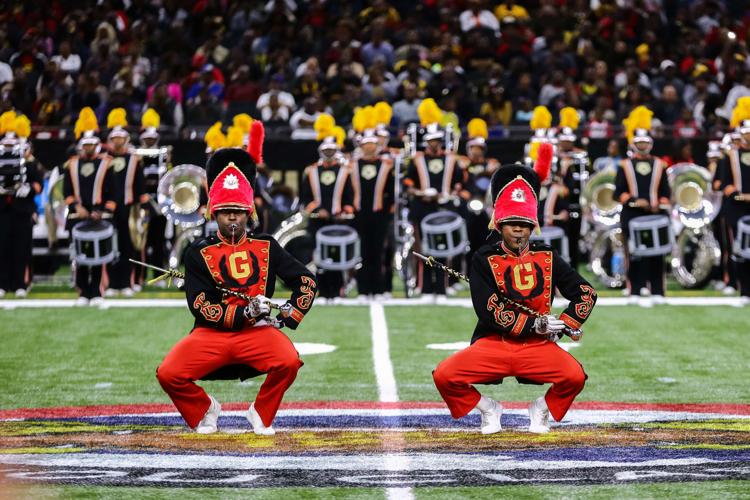
Each band's high-stepping, horn-swinging moves are accompanied by dancing girls in glittering outfits. It has been suggested that the Battle of the Bands is more important to the schools' bragging rights than the football game.
The Battle of the Bands was the main reason NBC began televising the game in 1991. Aside from Notre Dame home games and some bowl games, it's the Peacock Network's only college football broadcast, usually at 1:30 PM Central Time (2:30 Eastern).

*

November 23, 1974 was a Saturday. These other notable college football games, including some major rivalries, were played that day:

* Rivalry: Number 1 Oklahoma beat Number 6 Nebraska, 28-14 at Memorial Stadium in Lincoln, Nebraska. Oklahoma were on probation, so, while they were eligible to be ranked Number 1, and eligible to be awarded the National Championship, they were ineligible for a bowl game.

* Number 2 Alabama were idle, preparing for their rivalry with Number 7 Auburn the next week. 'Bama won, 17-13 at Legion Field in Birmingham. 

* Rivalry: Number 4 Ohio State beat Number 3 Michigan, 12-10 at Ohio Stadium in Columbus. This clinched the Big Ten Conference title for Ohio State.

* Number 5 Notre Dame beat Air Force, 38-0 at Notre Dame Stadium in South Bend, Indiana. Army and Navy had the week off, preparing for their game against each other, the following week at John F. Kennedy Stadium in Philadelphia. Navy won, 19-0.

Since Big Eight Conference Champion Oklahoma were ineligible for a bowl game, the Orange Bowl offered its bids to Notre Dame and to Southeastern Conference Champion Alabama. Notre Dame won. The Sugar Bowl offered its Southeastern Conference bid to the University of Florida, which lost to Nebraska.

* Rivalry: Number 8 University of Southern California (USC) beat the University of California at Los Angeles (UCLA), 34-9 at the Los Angeles Memorial Coliseum. USC won the Pacific-Eight Conference title, and beat Ohio State in the Rose Bowl.

* Number 10 Penn State were idle. They were preparing for their rivalry game next week, with the University of Pittsburgh. Penn State won, 31-10 at Three Rivers Stadium in Pittsburgh.

* Rivalry: Number 11 Maryland beat Virginia, 10-0 at Scott Stadium in Charlottesville, Virginia.

* One ranked team was upset, and it was by their arch-rivals: Number 19 California lost to Stanford, 22-20 at California Memorial Stadium in Berkeley.

* Baylor beat Southern Methodist University (SMU), 31-14 at the Cotton Bowl in Dallas. When Texas A&M beat Texas, that threw the Southwest Conference title to Baylor, and they went back to the Cotton Bowl, to play the game of the same name. Penn State beat them.

* Rivalry: Harvard beat Yale, 21-16 at Harvard Stadium in Boston.

* In New Jersey, Rutgers beat Colgate, 62-21 at Rutgers Stadium in Piscataway; and Princeton beat Cornell, 41-20 at Palmer Stadium in Princeton.

* Rivalry: Temple beat Villanova, 17-7 at Veterans Stadium in Philadelphia.

* Rivalry: William & Mary beat Richmond, 54-12 at City Stadium in Richmond, Virginia.

* Rivalry: North Carolina beat Duke, 14-13 at Kenan Stadium in Chapel Hill, North Carolina.

* Rivalry: Clemson beat South Carolina, 39-21 at Memorial Stadium in Clemson, South Carolina.

* Rivalry: Tennessee beat Kentucky, 24-7 at Neyland Stadium in Knoxville, Tennessee.

* Rivalry: Mississippi State beat Mississippi (Ole Miss) at Mississippi Veterans Memorial Stadium in Jackson.

* Rivalry: Louisiana State (LSU) beat Tulane, 34-22 at Tiger Stadium in Baton Rouge, Louisiana.

* Rivalry: Purdue beat Indiana, 38-17 at Ross-Ade Stadium in West Lafayette, Indiana.

* Rivalry: Illinois beat Northwestern, 28-14 at Memorial Stadium in Champaign, Illinois.

* Rivalry: Wisconsin beat Minnesota, 49-14 at Camp Randall Stadium in Madison, Wisconsin.

* Rivalry: Missouri beat Kansas, 27-3 at Faurot Field in Columbia, Missouri.

* Rivalry: Brigham Young beat Utah, 48-20 at what's now LaVell Edwards Stadium in Provo, Utah.

* Rivalry: Oregon State beat Oregon, 35-16 at what's now named Reser Stadium in Corvallis, Oregon.

* Rivalry: Washington beat Washington State, 24-17 at Martin Stadium in Pullman, Washington.

There were 7 games played in the NBA:

* The New York Knicks lost to the Milwaukee Bucks, 90-72 at Madison Square Garden.

* The Philadelphia 76ers beat their arch-rivals, the Boston Celtics, 98-96 at The Spectrum in Philadelphia. Don Nelson scored 35 points in defeat.

* The Kansas City-Omaha Kings beat the Atlanta Hawks, 103-100 at The Omni in Atlanta.

* The Buffalo Braves beat the Phoenix Suns, 117-104 at the Buffalo Memorial Auditorium. Bob McAdoo scored 33 points for the Braves.

* The Cleveland Cavaliers beat the New Orleans Jazz, 121-100 at The Coliseum in the Cleveland suburb of Richfield, Ohio.

* The Golden State Warriors beat the Detroit Pistons, 110-98 at Cobo Hall (now Huntington Place) in Detroit. Rick Barry scored 45 points for the Warriors.

* And the Seattle SuperSonics beat their arch-rivals, the Portland Trail Blazers, 117-110 at the Portland Memorial Coliseum. Fred Brown scored 40 points for the Sonics.

There were 4 games in the American Basketball Association:

* The New York Nets lost to the Indiana Pacers, 104-95 at the Market Square Arena in Indianapolis.

* The Denver Nuggets beat the Virginia Squires, 122-110 at the Hampton Coliseum outside Norfolk in Hampton, Virginia.

* The San Antonio Spurs beat the Spirits of St. Louis, 127-114 at the HemisFair Arena in San Antonio.

* And the Utah Stars beat the Kentucky Colonels, 111-110 in overtime at the Salt Palace in Salt Lake City.

There were 7 games played in the NHL:

* The New York Rangers lost to the Boston Bruins, 5-2 at Madison Square Garden.

* The New York Islanders and the Vancouver Canucks played to a tie, 3-3 at the Nassau Coliseum.

* The Philadelphia Flyers beat the Toronto Maple Leafs, 6-3 at Maple Leaf Gardens in Toronto.

* The Pittsburgh Penguins and the Los Angeles Kings played to a tie, 0-0 at the Civic Arena in Pittsburgh.

* The Chicago Black Hawks beat the Kansas City Scouts, 6-0 at the Chicago Stadium.

* The Minnesota North Stars beat the California Golden Seals, 3-1 at the Metropolitan Sports Center in the Minneapolis suburb of Bloomington, Minnesota.

* The St. Louis Blues beat the Detroit Red Wings, 4-2 at the St. Louis Arena.

* And the Montreal Canadiens, the Buffalo Sabres, the Atlanta Flames and the Washington Capitals were not scheduled.

And there were 4 games in the World Hockey Association:

* The Toronto Toros beat the Quebec Nordiques, 9-2 at the Colisée de Québec in Quebec City.

* The New England Whalers beat the Chicago Cougars, 3-2 at the Big E Coliseum in West Springfield, Massachusetts.

* The San Diego Mariners beat the Minnesota Fighting Saints, 5-3 at the St. Paul Civic Center in St. Paul, Minnesota.

* And the Houston Aeros beat the Vancouver Blazers, 4-2 at the Pacific Coliseum in Vancouver.

And in English soccer, the North London soccer team I would one day root for, Arsenal F.C., lost to Coventry City, 3-0 at Highfield Road in Coventry, West Midlands.

Tuesday, November 8, 2022

November 8, 1970: Sixty-Three Yards

November 8, 1970: The New Orleans Saints are playing the Detroit Lions at Tulane Stadium, and trail 17-16 with time for one more play.

The early Saints were terrible: They had debuted in 1967, and were 13-34-2 in their brief history, including 1-5-1 that season. Tom Fears, the Hall of Fame receiver for the Los Angeles Rams who had been named their 1st head coach, had just been fired, and this was their 1st game under J.D. Roberts, who finished out that season and lasted just 2 more.

At this point, the NFL had the goalposts on the goal line. And the record for the longest field goal was 56 yards, by Bert Rechichar of the Baltimore Colts in 1953. In the 17 years since, no one had even attempted a field goal longer than that. It was the kind of stunt that could only be done at the end of the 1st half or the end of the game, for fear of giving the opposition great field position.

The Saints were on their own 44-yard line. Their quarterback was Billy Kilmer. Two years later, Kilmer would take the Washington Redskins to the NFC Championship and Super Bowl VII. But, at this point, he was best remembered as a single-wing quarterback at UCLA, and not a great passer. The idea of Kilmer flinging the ball 55 yards for a touchdown did not fill Roberts with confidence.

But they had a placekicker named Tom Dempsey. Despite being born with no right hand and half of a right foot, requiring him to wear a special shoe, he had kicked a 55-yarder the year before. He thought he could make it from 62 yards, and convinced Roberts to let him try a field goal from a distance far beyond that from which anyone had yet had the guts to try. Not even in the freewheeling, recently wrapped-up AFL.

This was in New Orleans, a city below sea level. It was on real grass, not artificial turf, and this was the middle of the season, so the field was in bad shape. (Tulane Stadium would get artificial turf the next season.) There was no kicking tee: In the NFL, that's only legal for kickoffs. There was game-winning pressure. Years later, a scientist hired by ESPN determined that the flat front of Dempsey's half-shoe may actually have made the kick less likely to be good. His only advantage was a slight wind behind him.

What's more, he decided he'd actually have a better chance if the placement were an additional yard back, 8 yards instead of the legally-mandated minimum of 7, making the kick 63 yards.

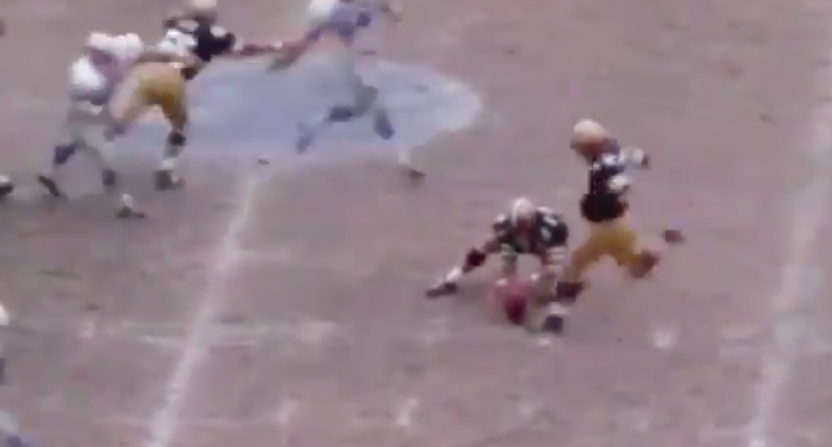
Dempsey faced the enclosed north end of Tulane Stadium's semicircle. Jackie Burkett snapped the ball, and it was low. Holder Joe Scarpati had trouble with it, but set it down properly. Dempsey sent the ball straight on, and it flew, and flew, and flew...

And it perfectly split the uprights, good by a full 3 yards. Final score: Saints 19, Lions 17.

There is surviving videotape of the kick, but it's in bad shapeYou're better off looking at NFL Films' version. Unfortunately, both are from the press box on the west side of the stadium, so the view is sideways. There appears to be no surviving footage that shows the kick straight-on, either from the front or the rear.

"I was more concerned about kicking it straight, because I felt I could handle the distance," Dempsey said. "I hit it sweet."
The stunning kick was the highlight of not just the Saints' season -- they wouldn't win another game, finishing 2-11-1 -- but, arguably, their entire history, until their Super Bowl season of 2009-10.

The next season, 1971, Dempsey was traded to the Philadelphia Eagles, and he led the NFL in field goal percentage, 70.4 percent, kicking a 54-yarder. He spent 4 seasons with them, the 1st 3 with those awful white helmets with green wings, before they went back to the traditional white (or silver) wings with green helmets for 1974. He spent the 1975 and 1976 seasons with the Los Angeles Rams, 1977 with the Houston Oilers, and 1978 and 1979 with the Buffalo Bills, before retiring.

In 1974, the NFL moved the goal posts from the goal line to the end line, at the back of the end zone. From that point onward, a 63-yard field goal would be made not at your own 37, but your own 47. In 1977, the NFL added the "Tom Dempsey Rule": "Any shoe that is worn by a player with an artificial limb on his kicking leg must have a kicking surface that conforms to that of a normal kicking shoe." Dempsey was still active, so he was "grandfathered in," and allowed to continue using his flat-fronted shoe.

He finished his career making 252 out of 282 extra points, or 89.4 percent; and 159 of 258 field goals, or 61.6 percent. (Maybe 63 would have been appropriate, but he wasn't quite that good.) He tried 39 field goals from 50 yards or longer, and made 12 of them, an astounding percentage for the time.

He was elected to the Saints' team Hall of Fame. He has never been elected to the Pro Football Hall of Fame in Canton, Ohio -- only 2 pure kickers, as opposed to pre-1970 kickers who also played other positions, have been: Jan Stenerud, and another Saint, Morten Andersen -- but the shoe he wore for the record-setting kick is on display there.

Dempsey's record stood alone until October 25, 1998, when Jason Elam of the Denver Broncos tied it. It was tied again on September 12, 2011, by Sebastian Janikowski of the Oakland Raiders. Both of these kicks came in the mile-high air of Denver. On September 28, 2008, at the end of a 1st half, Janikowski was sent in for the most ridiculous field goal attempt ever: 76 yards, on grass, into the wind, at the Oakland Coliseum, just 43 feet above sea level. It was 18 yards short (58 yards), and wide right.

On September 9, 2012, David Akers, then with the San Francisco 49ers, hit a 63-yarder against the Green Bay Packers. Green Bay is 581 feet above sea level.

On December 8, 2013, 43 years after Dempsey set the record, Matt Prater of the Broncos broke it, kicking a 64-yard field goal to end a half against the Tennessee Titans. This, too, was in Denver. I remind you that Dempsey kicked his 63-yarder below sea level.

On October 7, 2018, in Charlotte, North Carolina, 761 feet above sea level, Graham Gano did something no kicker had done since Dempsey: Kick a game-winning field goal 63 yards or more. He did so to give the Carolina Panthers a 33-31 win against the New York Giants. Afterward, he told the media that he always wanted to kick one that far to win a game, just like Dempsey had. Dempsey heard about it, and sent him an autographed kicking tee.

Following his career, Dempsey returned to New Orleans, worked as a salesman for an oil company, and then Saints owner Tom Benson, who owned a string of car dealerships, hired him to run one.

In 2013, he revealed he was suffering from dementia. He was eventually taken to a senior residence in New Orleans, and he was 1 of 15 residents who tested positive for the coronavirus. He died on April 4, 2020, at the age of 73.

On September 26, 2021, Justin Tucker of the Baltimore Ravens, at Ford Field in Detroit, 656 feet above sea level, kicked a 66-yard field goal, for a new record. It was well above sea level, on turf, indoors. But, like Dempsey, it was a game-winner. Also like Dempsey, it gave his team a 19-17 win over the Lions.

Before kicking tees were outlawed by the NCAA, 3 college players had kicked 67-yard field goals. The national high school record is 69 yards.

*

November 8, 1970 was a Sunday. These other NFL games were played on that historic day:

* The New York Giants beat the Dallas Cowboys, 23-20 at Yankee Stadium.

* The New York Jets lost to the Pittsburgh Steelers, 21-17 at Three Rivers Stadium in Pittsburgh.

* The Philadelphia Eagles beat the Miami Dolphins, 24-17 at Franklin Field in Philadelphia.

* The Minnesota Vikings beat the Washington Redskins, 19-10 at Robert F. Kennedy Stadium in Washington.

* The Cincinnati Bengals beat the Buffalo Bills, 43-14 at War Memorial Stadium in Buffalo.

* The San Francisco 49ers beat the Chicago Bears, 37-16 at Wrigley Field in Chicago.

* The football version of the St. Louis Cardinals beat the Boston Patriots, 31-0 at Busch Memorial Stadium in St. Louis.

* The Kansas City Chiefs beat the Houston Oilers, 24-9 at Kansas City Municipal Stadium.

* The San Diego Chargers beat the Denver Broncos, 24-21 at San Diego Stadium.

* The Atlanta Falcons and the Los Angeles Rams played to a tie 10-10 at the Los Angeles Coliseum.

* And the Oakland Raiders beat the Cleveland Browns, 23-20 at the Oakland Coliseum.

* The next day, on Monday Night Football, the Baltimore Colts beat the Green Bay Packers, 13-10 at Lambeau Field in Green Bay.

There were 4 games played that day in the NBA:

* The New York Knicks beat the expansion Portland Trail Blazers, 125-113 at the Portland Memorial Coliseum. Jim Barnett scored 40 points for the Blazers, but Captain Willis Reed had 28 points and 26 rebounds for the defending NBA Champion Knickerbockers.

* The Seattle SuperSonics beat the expansion Cleveland Cavaliers, 111-105 at the Cleveland Arena.

* The Milwaukee Bucks beat the Phoenix Suns, 125-105 at the Milwaukee Arena. In 1974, it was renamed the Milwaukee Exposition, Convention Center and Arena, or "The MECCA." Since 2014, it has been named the UW-Panther Arena.

* And the Los Angeles Lakers beat the Baltimore Bullets, 124-105 at The Forum outside Los Angeles in Inglewood, California. Jerry West scored 41 points. Wilt Chamberlain scored 20 and had 24 rebounds.

There were 4 games played in the American Basketball Association:

* The New York Nets beat the Denver Rockets, 114-104 at the Island Garden in Hempstead. The Rockets became the Denver Nuggets in 1974.

* The Memphis Pros beat the Pittsburgh Condors, 105-96 at the Civic Arena in Pittsburgh.

* The Carolina Cougars beat the Miami Floridians, 122-115 at the Miami Beach Convention Center.

* The Utah Stars beat the Indiana Pacers, 111-103 at the Indiana State Fair Coliseum (now the Corteva Coliseum). The Stars ended up dethroning the Pacers as ABA Champions that season.

And there were 4 games played in the NHL:

* The Boston Bruins beat the Montreal Canadiens, 6-1 at the Boston Garden.

* The Philadelphia Flyers beat the expansion Buffalo Sabres, 3-1 at the Buffalo Memorial Auditorium.

* The Pittsburgh Penguins and the Detroit Red Wings played to a tie, 3-3 at the Olympia Stadium in Detroit.

* And the Minnesota North Stars and the Chicago Black Hawks played to a tie, 3-3 at the Chicago Stadium.

Sunday, October 23, 2022

October 23, 1926: Tulane Stadium Opens

October 23, 1926: Tulane Stadium opens in New Orleans. Hosts Tulane University lose to Auburn, 2-0. Auburn scored a safety, one of the rare instances of the expression "Defense wins games" actually being true.
The Tulane Green Wave would continue to play in the 80,000-seat rounded horseshoe until the 1974 season. They had already won the Southern Conference title in 1925, and would win it again in 1929, 1930 and 1931. They would win the Southeastern Conference title in 1934, 1939 and 1949, before downgrading their program after the 1965 season.
From 1935 to 1975, usually on New Year's Day, the stadium would also host the Sugar Bowl, which became the stadium's nickname as well, usually with the Southeastern Conference Champions, often going for the National Championship. They were won in the Sugar Bowls of 1939, by Texas Christian University (TCU); 1940, by Texas A&M; 1952, by Maryland; 1953, by Georgia Tech; 1958, by Louisiana State (LSU), Tulane's arch-rivals; 1960, 1961 and 1963, by Mississippi (Ole Miss); 1961, by Alabama; and 1973, by Notre Dame.
The NFL's New Orleans Saints played there from their 1967 inception through 1974. Tom Dempsey set an NFL record there by kicking a last-play 63-yard field goal to give the Saints a win over the Detroit Lions in 1970.
It also hosted Super Bowl IV in 1970: Kansas City Chiefs 32, Minnesota Vikings 14; Super Bowl VI in 1972: Dallas Cowboys 24, Miami Dolphins 3; and Super Bowl IX in 1975: Pittsburgh Steelers 16, Vikings 6. In each case, it was the 1st World Championship won by each team.
Tulane Stadium was replaced by the Louisiana Superdome in 1975, and demolished in 1979. Yulman Stadium, Tulane's 30,000-seat stadium starting in 2014, was built on the site.
*
October 23, 1926 was a Saturday. These other notable college football games were played:
* Alabama beat Sewanee, 2-0 at Rickwood Field in Birmingham.
* Stanford beat Oregon, 29-12 at Hayward Field in Eugene, Oregon. Alabama and Stanford would play each other to a 7-7 tie in the Rose Bowl on January 1, 1927, and share the National Championship.
* Army beat Boston University, 41-0 at Michie Stadium in West Point, New York; and Navy beat Colgate, 13-7 at Thompson Stadium in Annapolis, Maryland.
* Among New York City teams, Columbia beat Duke, 24-0 at Baker Field; and Fordham lost to Washington & Jefferson, 28-13 at the Polo Grounds. Both stadiums were in Upper Manhattan. And New York University (NYU) beat Rutgers, 30-0 at Yankee Stadium in The Bronx. The other major New Jersey team, Princeton, beat Lehigh, 7-6 at Palmer Stadium in Princeton.
* Notre Dame beat Northwestern 6-0 at Dyche Stadium outside Chicago in Evanston, Illinois. Dyche Stadium had just opened 3 weeks earlier. In 1997, it was renamed Ryan Field.
* In rivalry games, Carnegie Tech (now Carnegie-Mellon) beat their neighbors, the University of Pittsburgh, 14-0 at Pitt Stadium; Virginia Tech beat Virginia, 6-0 at Miles Stadium in Blacksburg, Virginia; and Washington State beat Washington, 9-6 at Husky Stadium in Seattle.

Sunday, January 16, 2022

January 16, 1972: The Dallas Cowboys Win the Big One

Duane Thomas

January 16, 1972: The Dallas Cowboys, after some rough near-misses, finally win the big one.

An expansion team in 1960, they won the NFL Western Division title in 1966 and 1967, but lost the NFL Championship Game to the Green Bay Packers both times. They lost in the Divisional round in 1968 and 1969, both times to the Cleveland Browns.

In 1970, the 1st season after the full NFL-AFL merger, coach Tom Landry's Cowboys went 10-4, beat the Detroit Lions in the Divisional round, and beat the San Francisco 49ers in the 1st-ever NFC Championship Game. Quarterback Craig Morton, defensive tackle Bob Lilly, and the team that had lost a thriller at home on New Year's Day in 1967 and the Ice Bowl in Green Bay on New Year's Eve that same year was ready to take the final step.

They had advanced to Super Bowl V, against the Baltimore Colts, who were also seeking redemption, having lost Super Bowl III to the New York Jets, when they were favored by 18 points. It was a sloppy game, and the Colts won it, 16-13, on a field goal by Jim O'Brien with 5 seconds left.

The Cowboys had gained a reputation as "the team that couldn't win the big one." The idea that they would ever become what they would call themselves by the end of the decade, "America's Team," was ludicrous.

Landry decided he'd had enough: As the Cowboys were moving into a new home, leaving the Cotton Bowl for Texas Stadium in suburban Irving, he got a new quarterback, benching Morton for Roger Staubach. His running backs included Dan Reeves, Calvin Hill (an All-Pro whose son Grant would make the Basketball Hall of Fame), Walt Garrison, and Duane Thomas, a Dallas native long on both talent and complications.

Staubach's receivers included Bob Hayes, the Olympic sprinting Gold Medalist; and 2 men who would make the Pro Football Hall of Fame mainly for their achievements elsewhere, former San Diego Charger Lance Alworth and former Chicago Bear tight end Mike Ditka. They offensive line including 2 Hall of Fame offensive tackles, Rayfield Wright and former Packer Forrest Gregg. Between them, Reeves, Ditka and Gregg would be the head coaches of teams that reached 6 Super Bowls, although only Ditka would win one.

Landry had built what became known as the Doomsday Defense. Bob Lilly was a Hall of Fame tackle. The linebacking corps of Lee Roy Jordan, Chuck Howley, D.D. Lewis and former Packer Lee Roy Caffey was as good as any ever assembled. The backfield included another Packer, Hall-of-Famer Herb Adderley, plus Mel Renfro, Cornell Green, Cliff Harris and Charlie Waters.

They went 11-3 in the regular season. Their only losses were by 4 at home to the Washington Redskins, by 10 away to the New Orleans Saints, and by 4 away to the Chicago Bears. On Christmas Day, they beat the Minnesota Vikings in the Divisional Playoff, 20-12 at Metropolitan Stadium in the Minneapolis suburb of Bloomington, Minnesota. On January 2, 1972, in the 1st of 24 Playoff games that Texas Stadium would host, they won the NFC Championship by beating the San Francisco 49ers, 14-3.

They had advanced to Super Bowl VI, set for Tulane Stadium in New Orleans, home of Tulane University and the annual Sugar Bowl. Their opponents would be the Miami Dolphins. An even newer team, they had been founded in 1966, and had made the Playoffs the last 2 seasons. Their head coach was Don Shula, who had coached the Colts in their Super Bowl III loss. His team might not (yet) have needed redemption, but he sure did.

And so it was Landry and Shula, possibly the 1st 2 good defensive backs after the NFL went to two-platoon football, and of the 2 earliest great defensive coordinators, who both needed to cap their legacies with a championship, and needed it badly. But only one could get it on this occasion.

Also needing some kind of redemption was Duane Thomas. Based on the shenanigans of later players like Terrell Owens, Chad "Ochocinco" Johnson and Antonio Brown, the things Thomas did and said now seem rather tame. But football observers had never seen anyone like him before.

Before the season, he wanted his 3-year contract rewritten. Cowboy management refused. He called team president Tex Schramm "deceitful," player personnel director Gil Brandt "a liar," and Landry himself "a plastic man" and "no man at all." And he refused to report to training camp.

So the Cowboys traded him to the New England Patriots. But he wouldn't report to them, either. NFL Commissioner Pete Rozelle actually voided the trade, something sports league commissioners rarely do. Thomas reported to Dallas, but announced that he wouldn't talk to his teammates, or to team management, or to the media.

It worked. He scored the 1st touchdown at Texas Stadium -- with some irony, against the Patriots. He led the NFL in touchdowns with 13, and in rushing touchdowns with 11. A reporter tried to get him to break his silence in the leadup to the Super Bowl, and succeeded: He asked Thomas about playing in "the ultimate game," and Thomas said, "If it's the ultimate, how come they're playing it again the next year?"

Dallas and Miami. Texas and Florida. It was the 1st time any sport's championship game down to 2 teams whose home States had both been on the Confederate side in the American Civil War. And it was being played in a former Confederate State, Louisiana. If there were any racial issues arising from the game and its preparations, they were not made public.

Despite the American Southeast's reputation for heat, this was January, and the game was played outdoors, and the temperature at kickoff was 39 degrees. It remains the coldest Super Bowl ever, and the coldest NFL Championship Game under any name since the Ice Bowl in Green Bay in 1967.

Dolphin running back Larry Csonka had not fumbled all season long. But he fumbled in the 1st quarter, and the Cowboys recovered, eventually getting a field goal out of it. Later in the quarter, Lilly chased Dolphin quarterback Bob Griese back so far, he was sacked for a 29-yard loss, the longest loss of yardage from scrimmage, not counting turnovers, in the history of NFL championship games, under any name.

Despite this, the Dolphins were not yet out of the game. They got into Cowboy territory, and set up a 49-yard field goal attempt by Garo Yepremian. But it proved to be too long for him, and the Cowboys capitalized, with Staubach throwing a touchdown pass to Alworth to make it 10-0. Yepremian kicked a field goal late in the half, to give the Dolphins some hope.

The Cowboys' inside running game had worked very well in the 1st half. Shula decided to concentrate on that. But Landry guessed that Shula would do that, so he set up an outside running game for the 2nd half, and it worked: On their next drive, Thomas had 4 runs for 37 yards, capped by a 3-yard run for a touchdown. The Cowboys added a touchdown in the 4th quarter, Staubach passing to Ditka.

The final score was 24-3. Shula said the Doomsday Defense "destroyed" his offense. Not until Super Bowl XXXV, when the New York Giants got only a kickoff return touchdown against the Baltimore Ravens, would another team play an entire Super Bowl without an offensive touchdown. And not until Super Bowl LIII, when the Los Angeles Rams lost to the New England Patriots 13-3, would a team score so few points in a Super Bowl. Those 3 points remain the fewest scored in an NFL championship game, under any name, since 1964, when the Browns beat the Colts, 27-0.

The writers overcame their feelings about Thomas, and named him the game's Most Valuable Player. At the time, the Super Bowl MVP was announced by Sport magazine, and came with a new car, whose keys would be presented at a banquet in New York.

But Larry Klein, the magazine's editor, in attendance, didn't know how Thomas, black and with a record of insubordination, would act at the banquet. So he personally overrode the vote, and named Staubach, a white Naval Academy graduate and Vietnam War veteran with a reputation for doing as he was told, as the MVP. Pittsburgh Steeler quarterback Terry Bradshaw, in his later media career, was fond of pointing out his head coach, Chuck Noll, let him call his own plays, while Staubach didn't, always taking orders from Landry.

After the game, Tom Brookshier, the former Philadelphia Eagle defensive back working for CBS, tried to interview Thomas. Pointing out his speed, Brookshier, asked, "Are you that fast?" Thomas looked at him as if it was the dumbest question he'd ever heard, and said one word: "Evidently."

Thomas did not handle his fame to his team's satisfaction. So, in the next season's training camp, he was traded to the San Diego Chargers. He refused to report. He was suspended. He was played on the reserve list. He didn't play a down in the entire 1972 season. (He was lucky there was no ESPN, and no social media, at the time.)

The Chargers traded his rights to the Redskins -- the Cowboys' arch-rivals. For 2 years, he seemed to do all right there, even scoring a go-ahead 4th quarter touchdown against the Cowboys on Thanksgiving Day 1974, a game the Cowboys won anyway, in what became known as The Clint Longley Game. But he refused to report to training camp in 1975, and was waived.

Desperate for fans as their rebel league was floundering, the World Football League offered Thomas a new chance. He was signed by the Honolulu Hawaiians -- with some irony, to replace his former Cowboy teammate, the injured Calvin Hill. But he was released right before the league folded. The Cowboys brought him back in 1976, but waived him before the season.

He briefly played for the Vancouver-based BC Lions of the Canadian Football League, and was briefly at training camp with the 1979 Packers. Despite having the kind of talent that later led Houston Chronicle writer David Barron to say, "Some running backs looked for the hole. To Thomas, the whole field was the hole," his career ended with 2,038 rushing yards and 21 touchdowns.

He later hosted a radio talk show, telling an interviewer, "A lot of people get a kick out of that." He has said, "The Super Bowl wasn't the ultimate to me. I was just getting started. I was having fun, and I thought management was trying to take the fun out of it." He also says he made peace with Landry before his death.

He collaborated with Sports Illustrated writer Paul Zimmerman on a book titled Duane Thomas and the Fall of America's Team. The Cowboys did not "fall" after Super Bowl VI. It is true that they needed 3 years to get back to the Super Bowl, and 2 more after that to win one. But that's because their team that had reached 4 NFL Championship Games was getting old, and they were in transition, and still made the Playoffs in 2 of those 3 seasons out of the Super Bowl.

Once that transition was completed, Landry, Brandt and Schramm had built a team that dominated the NFC East for another decade, winning Super Bowl XII, but losing Super Bowls X and XIII.

As of January 16, 2022, Duane Thomas is still alive, age 74. (UPDATE: He died on August 4, 2024, at 77.)

*

January 16, 1972 was a Sunday. Obviously, this was the only football game played on the day. Baseball was out of season. There were 5 games played in the NBA that day:

* The New York Knicks beat the Houston Rockets, 109-108 at the Hofheinz Pavilion in Houston.

* The Atlanta Hawks beat the Philadelphia 76ers, 124-116 at the Alexander Memorial Coliseum in Atlanta. Pete Maravich scored 50 points.

* The Cincinnati Royals beat the Cleveland Cavaliers, 128-108 at the Cincinnati Gardens. Nate "Tiny" Archibald scored 41 points. But Cincinnati vs. Cleveland would not become a great NBA rivalry: The next season, the Royals moved to Kansas City. Since there was already a baseball team named the Kansas City Royals, they became the Kansas City Kings. In 1985, they moved again, becoming the Sacramento Kings.

* The Milwaukee Bucks beat the Portland Trail Blazers, 126-97 at the Milwaukee Arena. In 1974, it was renamed the Milwaukee Exposition, Convention Center and Arena, or "The MECCA." Since 2014, it has been named the UW-Panther Arena.

* And the Baltimore Bullets beat the Phoenix Suns, 107-104 at the Arizona Veterans Memorial Coliseum.

There were 2 games played in the American Basketball Association. The New York Nets lost to the Memphis Pros, 129-123 at the Mid-South Coliseum in Memphis. This was despite Rick Barry scoring 36 points for the Nets. And the Denver Rockets beat the Utah Stars, 110-102 at the Denver Auditorium Arena. The Rockets became the Denver Nuggets in 1974.

There were 5 NHL games played that day: 

* The Boston Bruins beat the Detroit Red Wings, 9-2 at the Boston Garden.

* The Philadelphia Flyers and the Los Angeles Kings played to a tie, 3-3 at The Spectrum in Philadelphia.

* The St. Louis Blues beat the Toronto Maple Leafs, 4-3 at Maple Leaf Gardens in Toronto.

* The Buffalo Sabres beat the Montreal Canadiens, 4-2 at the Buffalo Memorial Auditorium.

* The Chicago Black Hawks beat the Minnesota North Stars, 3-2 at the Chicago Stadium.

* And the New York Rangers, the Pittsburgh Penguins, the California Golden Seals and the Vancouver Canucks were not scheduled. 

Tuesday, January 11, 2022

January 11, 1970: The Redemption of the Kansas City Chiefs

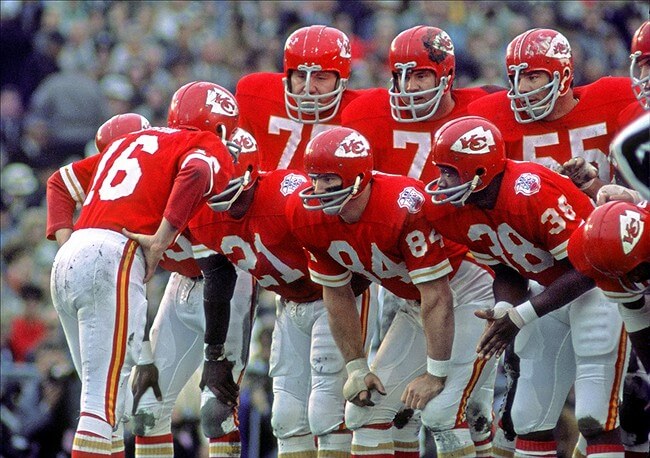
Len Dawson (16) and his offense

January 11, 1970: Super Bowl IV is played at Tulane Stadium in New Orleans. In spite of the New York Jets' win the season before, the American Football League Champions, the Kansas City Chiefs, already losers of Super Bowl I, are 13-point underdogs to the Minnesota Vikings, who won the National Football League Championship.

The Vikings did have future Hall-of-Famers in offensive linemen Mick Tinglehoff and Ron Yary, and defensive players known as "the Purple People Eaters": Alan Page, Carl Eller and Paul Krause. Also, head coach Bud Grant and general manager Jim Finks. Joe Kapp was then the quarterback: Hall-of-Famer Fran Tarkenton had been their quarterback, and would be again, but, at the time, he was the starting quarterback for the New York Giants.

The Chiefs, with Hall-of-Famers Len Dawson, Emmitt Thomas, Buck Buchanan, Curley Culp, Willie Lanier, Bobby Bell, Johnny Robinson and Jan Stenerud, plus coach Hank Stram and owner/AFL founder Lamar Hunt, weren’t having it. They proved beyond any doubt that the AFL was as good as the NFL, winning 23-7. This was the last game played before the AFL-NFL merger was complete. 
Hank Stram

The Vikings won the NFL or NFC Championship in the 1969, 1973, 1975 and 1976 seasons, but lost Super Bowls IV, VIII, IX and XI. Since then, they've lost the NFC Championship Game for the seasons of 1977, 1987, 1998, 2000, 2009 and 2017. Their Super Bowl record remains 0-4.

It took the Chiefs a while to get back to the Super Bowl, too. They reached the AFC Championship Game in the seasons of 1993 and 2018. On February 2, 2020, 50 years and 22 days after their last title, they won Super Bowl LIV, beating the San Francisco 49ers.

UPDATE: After losing Super Bowl LV to the Tampa Bay Buccaneers, they won Super Bowl LVII, beating the Philadelphia Eagles; and Super Bowl LVIII, beating the 49ers again. They lost Super Bowl LIX to the Eagles.

The Chiefs have a Hall of Honor. From before their 1st Super Bowl win, they have inducted running backs Abner Haynes and Mack Lee Hill, receiver Chris Burford, linebacker Sherrill Headrick. Although they honored running back Stone Johnson with the retirement of his number when he died of an in-game injury during a preseason game, they have not inducted him into their Hall of Honor.

From their Super Bowl IV win: Founding owner Lamar Hunt, general manager Jack Steadman, head coach Lamar Hunt, quarterback Len Dawson; running backs Curtis McClinton, Mike Garrett and Ed Podolak; receiver Otis Taylor, tight end Fred Arbanas, centers E.J. Holub and Jack Rudnay, guard Ed Budde, offensive tackles Jim Tyrer and Dave Hill; defensive tackles Buck Buchanan, and Jerry Mays and Curley Culp; linebackers Bobby Bell, Willie Lanier and Jim Lynch; cornerback Emmitt Thomas, safety Johnny Robinson and punter Jerrel Wilson.

Hunt, Stram, Dawson, McClinton, Garrett, Taylor, Podolak, Budde, Arbanas, Bell, Lanier, Robinson, Thomas and Stenerud have been elected to the Missouri Sports Hall of Fame.

From the 1970s and the 1980s, they have inducted running backs Joe DeLaney and Christian Okoye, receiver Carlos Carson, defensive end Art Still and defensive tackle Bill Maas.

From the 1990s, they have inducted head coach Marty Schottenheimer, running back Tony Richardson, center Tim Grunhard, guard Will Shields, offensive tackle John Alt, defesnive end Neil Smith and linebacker Derrick Thomas. Although he was the only quarterback between the 1969 and 2018 seasons to lead the Chiefs to an AFC Championship Game, doing so in 1993, Joe Montana only played 2 seasons for them, and so has not been inducted into the Hall of Honor.

From the 2000s, they have inducted tight end Tony Gonzalez, receiver Dante Hall, guard Brian Waters and running back Priest Holmes. From the 2010s, they have inducted linebacker Tamba Hall. They have not yet inducted any figures from their 2020s quasi-dynasty.

Still, Maas, Cherry, Spani, Lowery, Okoye, Smith, Shields, Schottenheimer, Holmes, Grunhard and Hall have been elected to the Missouri Sports Hall of Fame. So have 1980s quarterback Bill Kenney and 1990s running back Marcus Allen.

*

January 11, 1970 was a Sunday. Baseball was in the off-season. Already, the Super Bowl was getting so much hype that neither the National nor the American Basketball Association was willing to play more than 1 game on the day. In the NBA game, the Phoenix Suns beat the Cincinnati Royals, 125-118 at the Cincinnati Gardens. Connie Hawkins scored 39 points for the Suns. In the ABA game, the Los Angeles Stars beat the Miami Floridians, 103-98 at the Los Angeles Memorial Sports Arena.

And there were 3 games in the NHL:

* The New York Rangers lost to the Montreal Canadiens, 4-1 at the Montreal Forum.

* The Boston Bruins beat the Oakland Seals, 6-3 at the Boston Garden.

* And the Chicago Black Hawks beat the Los Angeles Kings, 3-1 at the Chicago Stadium.

Sunday, January 2, 2022

January 2, 1956: The 1st Integrated Bowl Game In the South

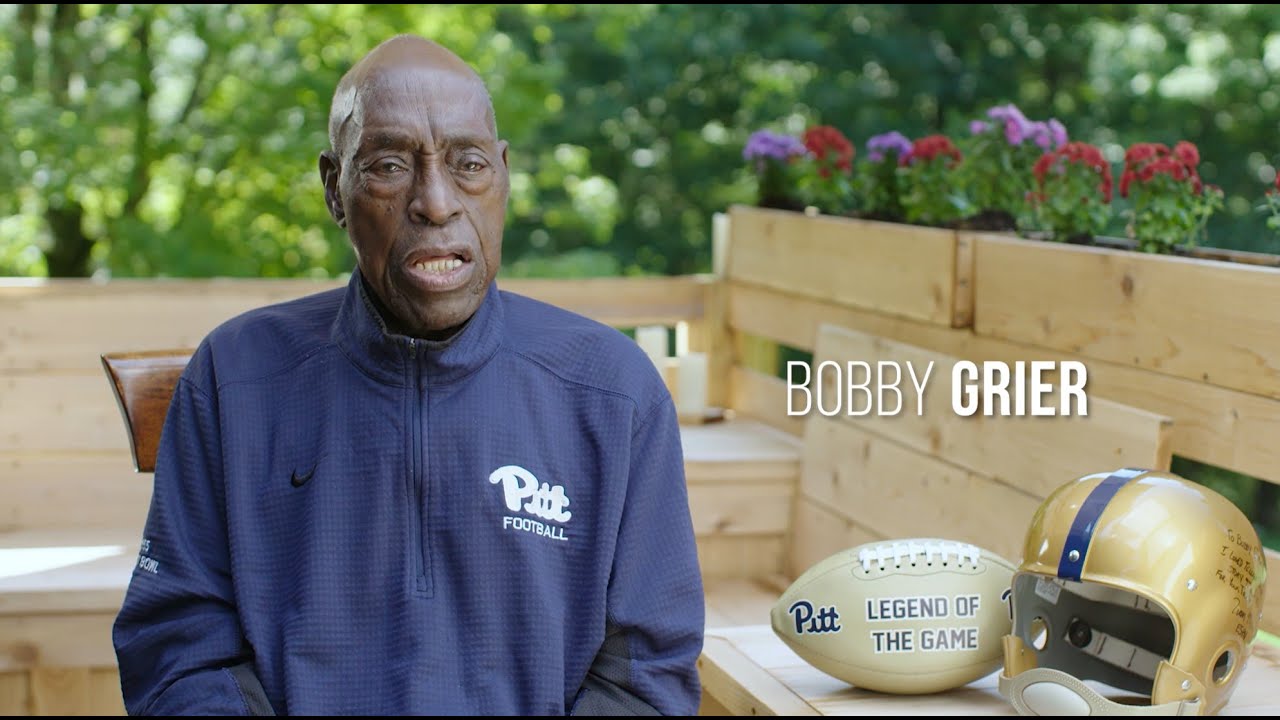
Bobby Grier

January 2, 1956: The college football season comes to an end, with the traditional New Year's Day bowl games, pushed back a day because January 1 was a Sunday.

This Monday saw the playing of the Sugar Bowl, at Tulane Stadium in New Orleans. The Georgia Institute of Technology, a.k.a. Georgia Tech, entered the game at 8-1-1, having lost to Auburn and been tied by Tennessee; however, they had beaten the University of Miami, Florida and Duke, each of them ranked at the time. Tech came in ranked Number 7.

However, they were only 3rd in the Southeastern Conference. Mississippi, instead of accepting the usual invitation given by the Sugar Bowl to the SEC Champions, instead accepted an invitation to play in the Cotton Bowl. "Ole Miss" and Tech did not play each other that season. Auburn, who finished 2nd, were not invited by the Sugar Bowl, and ended up losing the Gator Bowl to the 5th-place team in the SEC, Vanderbilt. (Tennessee finished 4th.) So the Sugar Bowl invited Georgia Tech.

Their opponents were the University of Pittsburgh. An Independent, Pitt were only 7-3, losing to Oklahoma, Navy and Miami. However, they had beaten ranked teams Duke and West Virginia, and teams from other regions, Nebraska and the University of California. They came into the game ranked Number 11.

Pitt's best player was Bobby Grier, a fullback and a linebacker, as most college football teams were still sending players to play what was known as "single-platoon football," the same players playing on both offense and defense. Grier, a native of the football-mad town of Massillon, Ohio, was black.

Segregationists didn't want Grier to play in the Sugar Bowl. Governor Marvin Griffin of Georgia sent a telegram to Tech's Board of Regents, in an attempt to pressure the school's president, Blake Van Leer, to pull the team out of the game. Van Leer was already catching heat for pushing through a vote to allow women in Georgia Tech.

But Van Leer, who had held the office since 1944, refused to be bullied by the ignorant redneck Governor: He told a meeting of the Faculty Senate, "Either we're going to the Sugar Bowl, or you can find yourself another damn president of Georgia Tech." The Senate gave him a standing ovation.

This was one month after Rosa Parks refused to stand up on a bus in Montgomery, Alabama, with the bus boycott ongoing; 4 months after the murder of 14-year-old Emmett Till in Money, Mississippi; and a year and a half after the U.S. Supreme Court struck down public school segregation in the case of Brown v. Board of Education of Topeka, Kansas.
Grier, supported by his white teammates 

As it turned out, there was no law that could prevent Grier from playing in the game, and, for the 1st time, a bowl game in the South had a black player in it.

Georgia Tech won the game, 7–0. The margin of victory mostly resulted from a disputed pass interference penalty, in the 1st quarter. It was called on Grier, giving Georgia Tech a 1st and goal on the Pitt 1-yard line. The Yellow Jackets scored the game's only touchdown on the next play. Photographic evidence later strongly indicated the referee's call was incorrect.

The irony of the bad call is that it was made by referee Rusty Coles, who was from the Pittsburgh area, and who had no objective in making the wrong call, but simply made a mistake, which he admitted after seeing the game films.

Grier finished the game as its leading rusher with 51 yards. After the game, he protested the pass interference call, but praised the Georgia Tech players, saying, "They were good sportsmen, perhaps the best I've played against all season. They played hard, but clean. It was a good game. But believe me. I didn't push that man."

As it turned out, the State of Georgia needed to find a new president of Georgia Tech, anyway: Blake Van Leer died of a heart attack on January 24, 1956, just 22 days after the game. Edwin D. Harrison was named the new president. In 1960, he oversaw a vote by an overwhelming majority of Tech students to endorse the integration of qualified applicants, regardless of race.

Bobby Grier did not play professional football. Instead, he enlisted in the U.S. Air Force, and later served as an administrator at a community college in the Pittsburgh area. As of January 2, 2022, he is still alive.
UPDATE: Later in 2022, Grier was elected to the Pitt Athletics Hall of Fame. He died in 2024.

*

January 2, 1956 was, as I said, a Monday. These other bowl games were played that day:

* Oklahoma beat Maryland, 20-6, in the Orange Bowl, at Burdine Stadium in Miami. In 1959, the stadium was renamed the Orange Bowl. This was, effectively, the National Championship Game: Oklahoma, in the middle of their 47-game winning streak, still a college football record, were ranked Number 1, and had won the Big Seven Conference title; while Maryland were ranked Number 3, and had won the Atlantic Coast Conference title.

Oklahoma were favored by 7 points. If Maryland had pulled the upset, it's likely that they would have been awarded the National Championship, regardless of whether Number 2 Michigan State won the Rose Bowl. At the very least, there could have been a split in the polls. But Oklahoma won, making the Rose Bowl academic.

* Michigan State did their part, beating the University of California at Los Angeles, 17-14, in the Rose Bowl, in the stadium of the same name in the Los Angeles suburb of Pasadena, California. Michigan State were ranked Number 2, and Champions of the Big Ten Conference. UCLA were ranked Number 4, and Champions of the Pacific Coast Conference. But Oklahoma's 2-touchdown win put the National Championship out of reach for Michigan State.

* Mississippi beat Texas Christian University, 14-13, in the Cotton Bowl, in the stadium of the same name in Dallas. As previously stated, Ole Miss were the SEC Champions, and went into the game ranked Number 10. TCU were the Champions of the Southwest Conference, and were ranked Number 6.

* Wyoming beat Texas Tech, 21-14 in the Sun Bowl, at Kidd Field in El Paso, Texas. Wyoming finished 4th in the Skyline Conference, while Texas Tech were the Champions of the Border Conference.

* Juniata College and Missouri Valley College played to a tie, 6-6 in the Tangerine Bowl, in the stadium of the same name in Orlando, Florida. The Tangerine Bowl game was a showcase for what were then called "small college" teams. Both the game and the stadium would become bigger, and become known as the Citrus Bowl.

Juniata, of Huntingdon, Pennsylvania, then an Independent, now competes in NCAA Division III. Missouri Valley, of Marshall, Missouri, were the Champions of the Missouri College Athletic Union, and now compete in the NAIA -- for all intents and purposes, NCAA Division IV.

Saturday, January 1, 2022

January 1, 1935: The 1st Sugar Bowl

January 1, 1935: The 1st Sugar Bowl is played, at Tulane Stadium in New Orleans. Tulane University beat Temple University, 20-14.

The most notable play of the game came in the 2nd quarter, when Tulane's quarterback, John McDaniel, caught a Temple kickoff, ran to the right to draw tacklers, then threw a lateral pass to his teammate Monk Simons, who ran 75 yards for the touchdown. Two more Tulane touchdowns in the second half outweighed Temple's early lead.

Tulane had been built on a sugar plantation, and sugar was long the leading crop in the State of Louisiana. Hence, the game was named for a local crop. New Orleans civic leaders wanted to copy Pasadena, California's Rose Bowl for a few years, and finally got it set up for 1934-35. There was no pregame parade, however.

Tulane had been one of the South's leading football schools, winning titles in the Southern Intercollegiate Athletic Association in 1920, and the Southern Conference in 1925, 1929, 1930 and 1931. That league was the forefather of both the Southeastern Conference (SEC) and the Atlantic Coast Conference (ACC).

In 1933, Tulane was a founding member of the SEC, and won the title in 1934, giving them the credibility to host the bowl game. They would win the SEC again in 1939 and 1949, but went into decline, and left the league after the 1965 season, surpassed in football importance in their State by Louisiana State University (LSU), and even by the black college rivalry between Grambling State and Southern University. They would later win the title in Conference USA in 1998, and are now members of the American Athletic Conference (AAC). (UPDATE: They won the AAC title in 2022.)

The game was held at Tulane Stadium from 1935 until 1975. In 1975, the Louisiana Superdome opened, and the game has been held there every year since, with the exception of 2006, when it was held at the Georgia Dome in Atlanta, due to repairs on the Superdome from Hurricane Katrina.
Tulane Stadium

Temple have also never again reached the football heights they reached in the 1930s. They devalued their program in 1958, but began moving back up in 1991, becoming members of the Big East Conference. In 2013, they joined the American Athletic Conference (AAC), winning it in 2016.

After the inaugural Sugar Bowl, they didn't go to another bowl game until the 1979 season, and then not again until 2009. They won the Garden State Bowl in 1979, the New Mexico Bowl in 2011, and the Gasparilla Bowl in 2017. But they've never been to another traditional New Year's Day bowl game.

Tulane Stadium hosted Super Bowls IV, VI and IX, and was home to the NFL's New Orleans Saints from 1967 to 1974, before they and the Green Wave moved into the Superdome for the 1975 season. Tulane Stadium was demolished in 1979, the 1st of the 4 classic New Year's Day bowl game facilities to go. (The Orange Bowl followed in 2008, while the Rose Bowl and Cotton Bowl stadiums still stand.) In 2014, Yulman Stadium was opened on the site of Tulane Stadium.
The Superdome

The Sugar Bowl has usually invited the SEC Champion, although this was not made official until the 1976 season. With the advent of the Bowl Championship Series (BCS) in the 1998 season, hosting the SEC Champion was no longer a given. Given the success of the SEC since the start of the National Championship Playoff in 2014, it's been almost impossible.

The Sugar Bowl has featured the National Champions of the preceding calendar year 23 times: Louisiana State University (LSU) in 1959 and 2007; the University of Mississippi (Ole Miss) in 1960, 1961 and 1963; Alabama in 1962, 1979, 1980 and 1993; the University of Miami in 1990 and 2001; Texas Christian University (TCU) in 1939; Texas A&M in 1940; Oklahoma in 1950; Maryland in 1952; Georgia Tech in 1953; Notre Dame in 1974; the University of Pittsburgh in 1977; Georgia in 1981; Penn State in 1983; Florida in 1997; Florida State in 2000; and Ohio State in 2021.

*

January 1, 1935 was a Tuesday. This was also the day the 1st Orange Bowl was played, at Miami Field in Miami. Unlike in a few later appearances, having the home-field advantage did not help the University of Miami, as they lost to Bucknell University, 26-0. I have a separate entry for that event.

Also on this day, the Rose Bowl was played at the stadium of the same name, outside Los Angeles in Pasadena, California. Alabama completed an undefeated season, ruining Stanford's, 29-13.

And the entire National Hockey League was in action:

* The New York Rangers lost to the Boston Bruins, 5-2 at the Boston Garden.

* The New York Americans beat the Montreal Canadiens, 5-3 at Madison Square Garden.

* The Detroit Red Wings beat the Toronto Maple Leafs, 1-0 at Maple Leaf Gardens in Toronto.

* And the Montreal Maroons beat the Chicago Black Hawks, 2-1 at the Chicago Stadium.

December 31, 1999 & January 1, 2000: The Millennium

December 31, 1999:  The Millennium arrives. The people of planet Earth survived. At a terrible cost. But we hadn't destroyed ourselves. ...