Showing posts with label franklin roosevelt. Show all posts

Saturday, December 31, 2022

December 31, 1940: The Nazi Plot to Hijack the Election

William Rhodes Davis

December 31, 1940: A Nazi plot to hijack the recent Presidential election is revealed. It had failed, of course.

As the calendar year began, it was believed by most people that President Franklin D. Roosevelt would respect the 2-term limit on the Presidency -- which, until the ratification of the 22nd Amendment to the Constitution, in 1951, was unofficial. The Nazis concluded that if Roosevelt could be replaced by someone not willing to intervene in the Nazis' takeover of Europe, the prospects of U.S. involvement in the European phase of World War II would be greatly reduced, and possibly eliminated.

So they found a sympathetic, well-connected American. William Rhodes Davis was an oilman with a sketchy business past who, in the late 1930s, made a fortune by selling cut-rate Mexican oil to the German government. Davis had cultivated connections inside the Democratic Party, making a big donation to its 1936 election efforts.

But when The War began, the British imposed a blockade on German ports, interfering with Davis' ability to make money from dealing with Germany. He believed that the only way to save his business was by personally making peace in Europe, by negotiating a deal between the warring parties himself. Davis approached the White House with his plan for peace. FDR turned him down.

Davis then traveled to Germany, met with leaders of the Third Reich, including Hermann Göring, President of the Reichstag -- in effect, Germany's equivalent of the Speaker of the U.S. House of Representatives -- and returned with the vague outlines of a deal that would have given Germany territorial gains in exchange for Roosevelt mediating a peace treaty. Roosevelt refused to even meet with Davis upon his return, worried that he might be compromised and acting as a Nazi agent.

As it turned out, FDR was absolutely right about that. Davis had talked to Göring about the possibility of a non-interventionist winning the 1940 election. He even had, he thought, the perfect candidate in mind: John L. Lewis, the head of the Congress of Industrial Organizations (CIO), and the President of the United Mine Workers. Widely popular among America's working people, he was nonetheless opposed to many of FDR's New Deal reforms, and was a non-interventionist. Of course, being the leader of a labor union, and aside from his New Deal opposition a leftist, he would have been considered unacceptable to German Chancellor Adolf Hitler himself, as anything other than a temporary tool to achieve Hitler's aims.

Göring gathered $5 million -- about $104 million in 2022 money, which would have bought quite a bit of newspaper and magazine advertising space, and radio airtime -- to support the plan, and had it stashed at the German embassy in Washington D.C. for Davis' use.

But both major parties put a stop to the plan. FDR ran for a 3rd term anyway, and was easily renominated. And the Republicans nominated an interventionist, Wendell Willkie. The Nazi money did Lewis no good: He paid for a national radio address by Lewis on Labor Day, September 2, denouncing Roosevelt. The President was re-elected on November 5, anyway, with an electoral landslide, although the popular vote was the closest of what turned out to be his 4 runs.

In December 1940, Verne Marshall, head of the No Foreign War Committee, claimed that Davis, upon returning from a trip to Germany in 1939, presented the State Department with a peace plan representing Göring's views, and called for President Roosevelt to serve as mediator between the warring nations. Marshall criticized FDR for failing to take advantage of the opportunity, but most viewed the plan as an attempt to impose a "German peace." The German government, of course, denied any knowledge of such a plan.

On December 31, 1940, in reaction to Davis's role in forming and financing the No Foreign Wars Committee, U.S. Senator Joshua B. Lee, Democrat of Oklahoma, said, "The record of this man Davis shows conclusively the great financial stake he has in a complete Nazi victory in the European war. Much of the gasoline sending showers of fiery death into the defenseless heart of London was sold to the German government by this man Davis."

On January 7, 1941, Davis was subpoenaed to testify before a grand jury in Washington, D.C., investigating campaign expenditures for violations of the Hatch Act and the Corrupt Practices Act during the 1940 Presidential campaign. The same day, Senator Burton K. Wheeler, Democrat of Montana, a non-interventionist, scheduled Davis to testify before the Senate Interstate Commerce Subcommittee about the "peace place" described by Marshall.

Davis died of a heart attack in Houston on August 1, 1941. The traitor was 52 years old. In 1946, O. John Rogge, an official in the U.S. Department of Justice, issued a report on Davis' activities, proving his guilt beyond a reasonable doubt. The report ended up being buried until 1961.

Davis' grandson, Joseph Graham Davis Jr., a.k.a. Gray Davis, served as Governor of California from 1999 to 2003 -- as a Democrat. His loyalty to America has never been seriously questioned.

*

December 31, 1940 was a Tuesday. Baseball was out of season. The NBA hadn't been founded yet. There were 2 games played in the NHL. The New York Rangers and the Boston Bruins played to a 2-2 tie at the Boston Garden. And the New York Americans beat the Montreal Canadiens, 4-2 at the old Madison Square Garden.

The next day, New Year's Day 1941, Stanford beat Nebraska in the Rose Bowl, Boston College beat Tennessee in the Sugar Bowl, Texas A&M beat Fordham in the Cotton Bowl, Mississippi State beat Georgetown in the Orange Bowl, and Western Reserve beat Arizona State in the Sun Bowl. 

December 31, 1934: The Oval Office Opens

December 31, 1934: The modern Oval Office opens, in the West Wing of the White House in Washington. It has been the seat of power for every President of the United States from Franklin Delano Roosevelt onward.

There is an Oval Room on the 2nd floor of the main building of the White House, and it inspired previous Oval Offices. In 1903, Theodore Roosevelt had the greenhouse on the west side of the building torn down, to make for more office space. He took a corner office, and had it built in an oval shape.

His successor, William Howard Taft, didn't like the design, and had it totally rebuilt. In 1929, a fire gutted the West Wing, and Herbert Hoover had to have it redone. Finally, FDR, wanting to remove every last vestige of Hoover, had it torn down and rebuilt.

That office has been the site of some of the most important speeches broadcast from the White House: FDR's "Fireside Chats" from 1935 to 1944, Dwight D. Eisenhower's announcement of sending federal troops to desegregate Little Rock Central High School in 1957, his Farewell Address warning of the dangers of the military-industrial complex in 1961, John F. Kennedy's announcement of the naval blockade during the Cuban Missile Crisis in 1962, his announcement of a civil rights bill in 1963, Lyndon Johnson's announcement that he wouldn't seek re-election in 1968, Richard Nixon's "Silent Majority" address in 1969, his resignation in 1974, Jimmy Carter's "Crisis of Confidence" speech in 1979, and Ronald Reagan's memorial to the Space Shuttle Challenger victims in 1986.

To this day, people working in the West Wing feel that others measure their influence by how close they are to "The Oval." Its importance is emphasized in its recreation in every Presidential Library from FDR's onward, decorated to look as it did during that President's tenure.

*

December 31, 1934 was a Monday. Baseball was out of season. The NFL season had ended 22 days earlier, with the New York Giants beating the Chicago Bears in the Championship Game. No college bowl games were played. The NBA hadn't been founded yet. And the NHL had no games scheduled for this date. So there were no scores on this historic day.

Friday, December 30, 2022

December 30, 1940: Los Angeles' 1st Freeway Opens

December 30, 1940: The Arroyo Seco Parkway opens, along the seasonal river of the same name, running 8 miles northeast from downtown Los Angeles to Pasadena. It is the 1st of many freeways in the Los Angeles metropolitan area.

It became part of the historic U.S. Route 66, but is no longer designated as such. Rather, it is California Route 110. In 1954, it was renamed the Pasadena Freeway. In 2010, its original name was restored.

In the 1988 film Who Framed Roger Rabbit?, Judge Doom (played by Christopher Lloyd) lays out his plan for such a road: "Eight lanes of shimmering cement, running from here to Pasadena. Smooth, safe, fast. Traffic jams will be a thing of the past." (Yeah, surrre! He continued.) "I see a place where people get on and off the freeway, on and off, off and on, all day, all night! Soon, where Toontown once stood will be a string of gas stations, inexpensive motels, restaurants that serve rapidly prepared food, tire salons, automobile dealerships, and wonderful, wonderful billboards, reaching as far as the eye can see! My God, it'll be beautiful!"

In other words, he foresaw freeway exits, and the shopping centers that sprang up around them, serving as the new "downtown shopping districts" in what became suburban America after World War II. Except that the film took place in 1947, when said 8 lanes were already in place in real life. (But then, that entire film requires a major suspension of disbelief.)

Those 8 lanes would be the first of many, strangling Southern California in asphalt, and choking it in smog, because all those cars would be producing carbon dioxide, drifting east until the gas smacked into the San Gabriel Mountains, which would push it back, causing it, with nowhere else to go, to settle dangerously over what had become America's 3rd-largest city after World War II, and by 1970, the 2nd-largest.

Not until 1990 would Los Angeles open its 1st subway line.

*

December 30, 1940 was a Monday. TV sitcom writer, director and producer James Burrows was born.

Baseball and football were out of season. The NBA hadn't been founded yet. And no games were scheduled for the NHL. Therefore, there were no scores on this historic day.

December 30, 1936: Hank Luisetti Revolutionizes Basketball

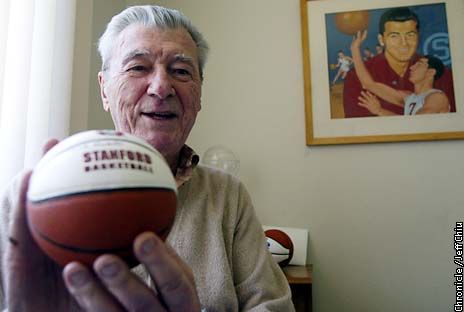
December 30, 1936: Hank Luisetti changes the game of basketball forever.

A forward, he took his Stanford University team, defending Champions of the Pacific Coast Conference, into the old Madison Square Garden in New York, to play the Number 1- ranked team in the country, Brooklyn-based Long Island University.

New Yorkers, who, even then, thought they knew everything about basketball, and that their teams had practically invented it (this while Dr. James Naismith was still alive), had heard that Luisetti had taken shots with just one hand. This was blasphemy: You had to use both hands, to steady your shot and make it more accurate. One-handed shots were took risky, unless you wanted to use a hook shot.

But Luisetti not only used one hand, he used jump shots. Combining the two? This was madness. Well, on this night, it was a glorious madness. He scored 15 points, but that was a big total in those days. Stanford beat LIU, 45-31, not merely ending the Blackbirds' 43-game winning streak, the longest in college basketball history to that point, but blowing them out.

"I'd get the ball, take a dribble or two and jump and shoot on the way up," Luisetti explained. "I didn't jump and shoot at the height of my jump, the way they do now. I'd let the ball go right near my face. I'd push and shoot, off my fingertips."

"Hank could take over a game like Michael Jordan if he had to," said former Stanford teammate Don Williams. "He was an absolute artist on the basketball court." Certainly, Ned Irish, head of basketball operations at Madison Square Garden and eventually the founding owner of the New York Knicks, thought so: Thinking that Luisetti was the only player who could singlehandedly sell out an arena the size of The Garden, he invited Stanford back for a Holiday Festival in 1937, and they won again. Two nights later, on January 1, 1938, in Cleveland, they played Pittsburgh school Duquesne, and won 92-27. In that game, Luisetti became the 1st player in NCAA history to score 50 points in a game.

Luisetti led the Stanford Indians -- they became the Cardinal in 1972 -- to 3 straight Conference Championships. This was before there was an NCAA Tournament, but they were voted National Champions in 1937.

He arrived on the scene too late to make the 1936 Olympics. He kept his amateur status by playing for Amateur Athletic Union (AAU) teams, including the Olympic Club of his hometown of San Francisco, but the 1940 and 1944 Olympics were canceled due to World War II. He served as a Navy officer, but developed spinal meningitis, ending his basketball career, ruining Irish's hopes of making him the Knicks' 1st star.

In 1950, when he was only 34 years old and should still have been playing, the Associated Press voted him 2nd behind the still-active George Mikan on their list of the top basketball players of the 1st half of the 20th Century. He was a charter inductee into the Basketball Hall of Fame. He ran a travel services company, and died in 2002, at the age of 86.

*

December 30, 1936 was a Wednesday. Baseball and football seasons were over. The NBA hadn't been founded yet. And no NHL games were scheduled. So there were no other scores on this historic day.

Thursday, December 29, 2022

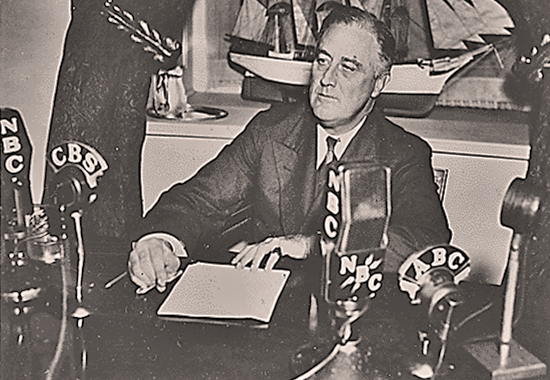
December 29, 1940: President Franklin D. Roosevelt's "Arsenal of Democracy" Speech

December 29, 1940: The Nazis' Luftwaffe carries out a massive incendiary bombing raid on London, starting 1,500 separate fires. Many famous buildings, including the Guildhall and Trinity House, are either damaged or destroyed. It becomes known as the Second Great Fire of London. (The first was in 1666.)

Hours later, President Franklin D. Roosevelt speaks from the White House, and his radio speech is broadcast around the world. He leaves no doubt that the fate of America is tied in with the fate of Britain. He used a phrase which had been hinted at before.

In 1918, Doubleday publishing executive Herbert S. Houston analyzed the soon-to-end World War I with an article titled "Blocking New Wars." He wrote that American business was the "Protector of Democracy," while the American free press was "one of the most effective weapons in the arsenal of democracy."

Writing in German, Nazi propagandist Joseph Goebbels useed the expression "arsenal of democracy" on April 30, 1928, in his newspaper Der Angriff (The Attack) to refer to using democratic institutions against themselves: "We enter the Reichstag to use the arsenal of democracy in order to assault it with its own weapons."

The concept of America as an actual arsenal came from the American playwright Robert E. Sherwood, who had written speeches for FDR. He who was quoted in the May 12, 1940 edition of The New York Times, as saying, "This country is already, in effect, an arsenal for the democratic Allies." Although the French economist Jean Monnet had used the phrase later in 1940, he was urged by Supreme Court Justice Felix Frankfurter, another longtime FDR ally, not to use it again, so FDR could make use of it in his speeches.

Which he did:

This is not a "fireside chat" on war. It is a talk on national security; because the nub of the whole purpose of your President is to keep you, now, and your children later, and your grandchildren much later, out of a last-ditch war for the preservation of American independence, and all the things that American independence means to you and to me and to ours...

The Nazi masters of Germany have made it clear that they intend not only to dominate all life and thought in their own country, but also to enslave the whole of Europe, and then to use the resources of Europe to dominate the rest of the world.

It was only three weeks ago that their leader stated this: "There are two worlds that stand opposed to each other." And then in defiant reply to his opponents, he said this: "Others are correct when they say: With this world we cannot ever reconcile ourselves... I can beat any other power in the world." So said the leader of the Nazis.

In other words, the Axis not merely admits, but the Axis proclaims that there can be no ultimate peace between their philosophy, their philosophy of government and our philosophy of government...

Some of our people like to believe that wars in Europe and in Asia are of no concern to us. But it is a matter of most vital concern to us that European and Asiatic war-makers should not gain control of the oceans which lead to this hemisphere.

One hundred and seventeen years ago, the Monroe Doctrine was conceived by our Government as a measure of defense in the face of a threat against this hemisphere by an alliance in Continental Europe. Thereafter, we stood guard in the Atlantic, with the British as neighbors. There was no treaty. There was no "unwritten agreement."

And yet, there was the feeling, proven correct by history, that we as neighbors could settle any disputes in peaceful fashion. The fact is that during the whole of this time the Western Hemisphere has remained free from aggression from Europe or from Asia.

Does anyone seriously believe that we need to fear attack anywhere in the Americas while a free Britain remains our most powerful naval neighbor in the Atlantic? Does anyone seriously believe, on the other hand, that we could rest easy if the Axis powers were our neighbors there?

If Great Britain goes down, the Axis powers will control the continents of Europe, Asia, Africa, Australasia, and the high seas -- and they will be in a position to bring enormous military and naval resources against this hemisphere. It is no exaggeration to say that all of us, in all the Americas, would be living at the point of a gun, a gun loaded with explosive bullets, economic as well as military...

Some nations of Europe were bound by solemn non-intervention pacts with Germany. Other nations were assured by Germany that they need never fear invasion. Non-intervention pact or not, the fact remains that they were attacked, overrun; thrown into modern slavery at an hour's notice, or even without any notice at all. As an exiled leader of one of these nations said to me the other day, "The notice was a minus quantity. It was given to my Government two hours after German troops had poured into my country in a hundred places."

The fate of these nations tells us what it means to live at the point of a Nazi gun.

The Nazis have justified such actions by various pious frauds. One of these frauds is the claim that they are occupying a nation for the purpose of "restoring order." Another is that they are occupying or controlling a nation on the excuse that they are "protecting it" against the aggression of somebody else.

For example, Germany has said that she was occupying Belgium to save the Belgians from the British. Would she then hesitate to say to any South American country, "We are occupying you to protect you from aggression by the United States"?

Belgium today is being used as an invasion base against Britain, now fighting for its life. And any South American country, in Nazi hands, would always constitute a jumping-off place for German attack on any one of the other Republics of this hemisphere.

In the election that FDR won a few weeks earlier, it was thought -- incorrectly, as it turned out -- that he might lose States in the Northeast where the Irish-American and Portuguese-American votes might turn on him, because the Irish hate the British and Portugal was neutral. So FDR went on to address the status of their ancestral homelands, to win their support:

Analyze for yourselves the future of two other places even nearer to Germany if the Nazis won. Could Ireland hold out? Would Irish freedom be permitted as an amazing pet exception in an unfree world? Or the Islands of the Azores which still fly the flag of Portugal after five centuries? You and I think of Hawaii as an outpost of defense in the Pacific. And yet, the Azores are closer to our shores in the Atlantic than Hawaii is on the other side.

There are those who say that the Axis powers would never have any desire to attack the Western Hemisphere. That is the same dangerous form of wishful thinking which has destroyed the powers of resistance of so many conquered peoples. The plain facts are that the Nazis have proclaimed, time and again, that all other races are their inferiors and therefore subject to their orders. And most important of all, the vast resources and wealth of this American Hemisphere constitute the most tempting loot in all the round world.

Let us no longer blind ourselves to the undeniable fact that the evil forces which have crushed and undermined and corrupted so many others are already within our own gates. Your Government knows much about them and every day is ferreting them out.

Their secret emissaries are active in our own and in neighboring countries. They seek to stir up suspicion and dissension to cause internal strife. They try to turn capital against labor, and vice versa. They try to reawaken long slumbering racial and religious enmities which should have no place in this country. They are active in every group that promotes intolerance. They exploit for their own ends our own natural abhorrence of war. These trouble-breeders have but one purpose. It is to divide our people; to divide them into hostile groups and to destroy our unity and shatter our will to defend ourselves.

There are also American citizens, many of them in high places, who, unwittingly in most cases, are aiding and abetting the work of these agents. I do not charge these American citizens with being foreign agents. But I do charge them with doing exactly the kind of work that the dictators want done in the United States.

These people not only believe that we can save our own skins by shutting our eyes to the fate of other nations. Some of them go much further than that. They say that we can and should become the friends and even the partners of the Axis powers. Some of them even suggest that we should imitate the methods of the dictatorships. But Americans never can and never will do that.

The experience of the past two years has proven beyond doubt that no nation can appease the Nazis. No man can tame a tiger into a kitten by stroking it. There can be no appeasement with ruthlessness. There can be no reasoning with an incendiary bomb. We know now that a nation can have peace with the Nazis only at the price of total surrender...

In a military sense Great Britain and the British Empire are today the spearhead of resistance to world conquest. And they are putting up a fight which will live forever in the story of human gallantry.
There is no demand for sending an American Expeditionary Force outside our own borders. There is no intention by any member of your Government to send such a force. You can, therefore, nail, nail any talk about sending armies to Europe as deliberate untruth...
He began his closing with the use of the key phrase:
As planes and ships and guns and shells are produced, your Government, with its defense experts, can then determine how best to use them to defend this hemisphere. The decision as to how much shall be sent abroad and how much shall remain at home must be made on the basis of our over-all military necessities.
We must be the great arsenal of democracy. For us this is an emergency as serious as war itself. We must apply ourselves to our task with the same resolution, the same sense of urgency, the same spirit of patriotism and sacrifice as we would show were we at war.

We have furnished the British great material support and we will furnish far more in the future.

There will be no "bottlenecks" in our determination to aid Great Britain. No dictator, no combination of dictators, will weaken that determination by threats of how they will construe that determination.

The British have received invaluable military support from the heroic Greek army, and from the forces of all the governments in exile. Their strength is growing. It is the strength of men and women who value their freedom more highly than they value their lives.

I believe that the Axis powers are not going to win this war. I base that belief on the latest and best of information.

We have no excuse for defeatism. We have every good reason for hope—hope for peace, yes, and hope for the defense of our civilization and for the building of a better civilization in the future.

I have the profound conviction that the American people are now determined to put forth a mightier effort than they have ever yet made to increase our production of all the implements of defense, to meet the threat to our democratic faith.

As President of the United States I call for that national effort. I call for it in the name of this nation which we love and honor and which we are privileged and proud to serve. I call upon our people with absolute confidence that our common cause will greatly succeed.


Given the preceding decade of English "football," FDR's use of the term "Arsenal" had greater resonance for the British than he could have realized.

At one point in this process, FDR called for the building of 50,000 airplanes to aid the Allied cause. In the end, twice as many were built: Over 100,000.

*

December 29, 1940 was a Sunday. Baseball and football were out of season. The NBA hadn't been founded yet.

There were 2 games in the NHL. The New York Rangers beat the Toronto Maple Leafs, 3-2 at the old Madison Square Garden. And the Detroit Red Wings beat the Chicago Black Hawks, 2-1 at the Olympia Stadium in Detroit. 

December 29, 1934: The 1st Madison Square Garden Doubleheader

December 29, 1934: Madison Square Garden in Midtown Manhattan hosts its 1st college basketball doubleheader. It was set up by Edward S. "Ned" Irish, then head of promotions for The Garden.

Irish, then 29 years old and a native of Brooklyn, had covered Manhattan College basketball games for the New York World-Telegram, and saw that their games, especially against other teams in New York City, had more demand than the seats had supply. So he quit his job to become promotions director for The Garden, whose current version, built in 1925, was between 49th and 50th Streets, and 8th and 9th Avenues.
Ned Irish

For the 1st doubleheader, each game featured a New York City-based team vs. one from outside the city. In the 1st game, New York University, of Manhattan, beat the University of Notre Dame, of South Bend, Indiana, 25-18. NYU would finish the 1934-35 season 19-1, and were recognized as National Champions. In the 2nd game, St. John's University, of Queens, lost to Westminster College, of New Wilmington, Pennsylvania, 37-33.

If those scores seem low to you, consider the state of the sport at the time: It was almost all slow, skinny white guys; there was no shot clock; and, until 1938, there was a center jump after every basket. In other words, what would become known as the fast break was not only difficult, it was completely impractical.

A crowd of 16,138 attended, then the largest crowd ever to pay to see a basketball game, at any level, marking the experiment as a success. Another doubleheader was set up for a week later, on January 5, 1935. NYU beat Kentucky, 23-22, before a new record high, 16,539.

Though defeated, Kentucky coach Adolph Rupp liked the idea so much that he suggested that there should be a national college basketball tournament. That was such a good idea that, by the end of the decade, there were 2: The National Invitation Tournament (NIT) started in 1938, the 1st one won by Temple University of Philadelphia; and the NCAA Tournament started in 1939, the 1st one won by the University of Oregon.

After the 1934-35 season, being invited to play in a "Garden doubleheader" was a sign that a school had made the big time. Already known as "The Mecca of Boxing," The Garden became known as "The Mecca of Basketball."
But the point-shaving scandal of 1951 crippled New York City basketball, with only St. John's among the City's schools emerging unscathed. After that, the pro game became more popular, with Ned Irish becoming the founding owner of the New York Knicks. The event that opened the new Garden in 1968 was a doubleheader. Dave DeBusschere scored the new Garden's 1st basket -- not for the Knicks, but for the Detroit Pistons in the 1st game of the doubleheader.

In 1959, Irish sold the Knicks to Irving Felt, but remained team president. He was elected to the Basketball Hall of Fame in 1964. In 1968, he and Felt moved the Knicks into the current Madison Square Garden, between 31st and 33rd Streets, and 7th and 8th Avenues. He retired as team president in 1974, and died in 1982.

The event that opened the new Garden in 1968 was a doubleheader. Dave DeBusschere scored the new Garden's 1st basket -- not for the Knicks, but for the Detroit Pistons, in the 1st game of the doubleheader.

*

December 29, 1934 was a Saturday. ABC News reporter Tom Jarriel was born on this day.

The NBA hadn't been founded yet. Baseball was in the off-season. No college football games were played that day, as there were, as yet very few bowl games. The NFL season had ended 20 days earlier, with the New York Giants beating the Chicago Bears in the Championship Game.

There were 2 games played in the NHL: The New York Americans beat the Montreal Canadiens, 3-1 at the Montreal Forum. and the Montreal Maroons beat the Toronto Maple Leafs, 4-2 at Maple Leaf Gardens in Toronto.

And in English soccer, Arsenal and Hampshire team Portsmouth played to a 1-1 draw at Highbury in North London.

December 29, 1933: Laurel & Hardy Star In "Sons of the Desert"

December 29, 1933: Sons of the Desert premieres, starring Stan Laurel and Oliver Hardy. The film's title became the name of the comedy duo's international appreciation society.

Arthur Stanley Jefferson was born on June 16, 1890 in Ulverston, Cumbria, in the North-West of England. Taking on the name Stan Laurel, he starred in English music halls (their version of vaudeville), developing the persona of a well-meaning bumbler in a bowler hat. In 1910, he came to America on the same sea voyage as Charlie Chaplin, and made his 1st film appearance in 1917.

Norvell Hardy was born on January 18, 1892 in Harlem, Georgia. Taking his father's name of Oliver, he developed an early interest in music, and played football at the University of Georgia. He made his 1st film appearance in 1914, in what was then the filmmaking capital of the South, Jacksonville, Florida. He moved to Los Angeles in 1917, and in 1921, he appeared in The Lucky Dog, as did Laurel: Hardy's character was a robber who tried to hold Laurel's character up. But they would not appear together again until 1927, as Hardy developed a persona of a fat man who became the film's "fall guy."

That year, they both appeared in Slipping Wives and Duck Soup (not to be confused with the later Marx Brothers film of the same title), both for Hal Roach Studios. Roach director Leo McCarey noticed that they worked well together, and teamed them up. Together, they would appear in 107 films, many of them comedy shorts, with 23 full-length features. Hardy also began wearing a bowler hat, which became identified with the duo long after going out of fashion.

My grandmother was a huge fan of theirs. Their theme song was "The Cuckoo Song," with a similarity to "The Worm Crawls In." Their slapstick humor carried through films like The Music Box, Way Out West, and Babes in Toyland, which became a Christmas-season classic.

But Laurel & Hardy is another entertainment institution with a famous catchphrase that was never actually used. Stan's bumbling would inevitably lead to "Ollie" saying, "This is another fine mess you've gotten us into, Stanley." Instead, it was, "Well, here's another nice mess you've gotten me into!" Stan's reply was usually to start crying and say, "Well, I couldn't help it!" Nevertheless, one of their films was titled Another Fine Mess.

When their contract ran out in 1944, they switched to a stage show, sometimes entertaining the troops in World War II. After the war, both men, only in their early 50s, had serious health issues, and they made only 1 more film together, a French film titled Atoll K., in 1951. On December 1, 1954, they appeared on This Is Your Life, and it was their only television appearance.

Hardy died from the last of a series of strokes on August 7, 1957, at the age of 65. Laurel refused to perform without him, and turned down a role in the 1963 cast-of-thousands comedy It's a Mad, Mad, Mad, Mad World. He died on February 23, 1965, at 75.

That same year, John McCabe, who'd written a book about them, founded The Sons of the Desert, not a "fan club," but an "appreciation society." Among the original members were actors Orson Bean and Chuck McCann, who occasionally appeared in character as the duo.

Larry Harmon, the most famous portrayer of Bozo the Clown, bought the legal rights to the Laurel & Hardy franchise, and produced new cartoons based on them, including a 1972 pairing with Scooby-Doo and Mystery, Inc.

In 1999, he produced a live-action film, The All New Adventures of Laurel & Hardy in For Love or Mummy. Bronson Pinchot, best known as Balki on the sitcom Perfect Strangers -- with Mark Linn-Baker's Larry being something of a Hardy to Pinchot's Laurel -- played Stan; while Gailard Sartain, known for playing fat Southerners like Hardy, played Hardy. It went direct to video, and was not a hit.
Maybe Matthew Broderick and Nathan Lane could do it better.

*

December 29, 1933 was a Friday. This was also the day the film Flying Down to Rio premiered, marking the 1st film pairing of Fred Astaire and Ginger Rogers. I have a separate entry for that event.

Baseball and football were in the off-season. The NBA hadn't been founded yet. And while the NHL season was in progress, no games were scheduled. So there were no scores on this historic day. 

December 29, 1933: The Debut of Fred Astaire & Ginger Rogers

December 29, 1933: The film Flying Down to Rio premieres. It is the 2nd film for Fred Astaire, the 22nd film of Ginger Rogers, and their 1st film together.

Frederick Austerlitz was born on May 10, 1899 in Omaha, Nebraska. Sidney Zion, a columnist for the New York Daily News, listed him as one of "The Century Seven," 7 people born in 1899, the last year of the 19th Century, whose work guided American popular culture through much of the 20th Century. They were: Duke Ellington, born on April 29; Fred Astaire, May 10; James Cagney, July 17; Alfred Hitchcock, August 13; Hoagy Carmichael, November 22; Noël Coward, December 16; and Humphrey Bogart, December 25.

He started dancing professionally with his sister, Adele. Their mother suggested a change of surname to "Astaire," after an uncle's nickname. In 1914, Fred met the brothers George and Ira Gershwin, and they worked together for the rest of George's life.

Virginia Katherine McMath was born on June 16, 1911 in Independence, Missouri, outside Kansas City. Independence became famous as her hometown before it became known as the hometown of President Harry S Truman: He was 27 years older, but she became nationally famous first.

A cousin had trouble saying, "Virginia," and it came out "Ginger." When her parents split up, and her mother remarried, Ginger took her stepfather's surname, Rogers. She was discovered in 1925 by vaudeville legend Eddie Foy.

In 1930, the Gershwins' musical Girl Crazy debuted on Broadway. Rogers appeared in it, and Astaire helped with the choreography. They met then, but they didn't star together until Flying Down to Rio. Despite being 12 years younger, Rogers actually become a film star first, earlier in the year, with Gold Diggers of 1933, with its signature song, "We're In the Money."

Fred & Ginger made 10 films together. Flying Down to Rio in 1933; The Gay Divorcee, featuring the song "Night and Day," in 1934; Roberta, featuring "I Won't Dance (Don't Ask Me)" and "Smoke Gets In Your Eyes," and Top Hat, featuring the title song and "Cheek to Cheek," in 1935; Follow the Fleet and Swing Time, the latter featuring "The Way You Look Tonight," in 1936; Shall We Dance, featuring "Let's Call the Whole Thing Off" and "They Can't Take That Away From Me," in 1937; Carefree in 1938; The Story of Vernon and Irene Castle, featuring "By the Light of the Silvery Moon," in 1939; and The Barkleys of Broadway in 1949.

Despite playing real-life couples in the last 2, they were never romantically involved with each other. With the rise of feminism in the 1970s, a joke developed: "Ginger Rogers did everything Fred Astaire did, but backwards and in high heels."

Rogers retired from acting in 1965, and ran a ranch in Oregon. Astaire continued to dance into the 1970s, and acted as late as 1981. Rogers married and divorced 5 times, and had no children. Astaire married, was widowed, and, many years later, married the much younger female horse-racing jockey Robyn Smith. Fred Astaire Jr. became a pilot and (interestingly, like Rogers but not his father) a rancher. Ava Astaire maintains her father's commercial legacy.

Astaire died on June 22, 1987, at the age of 88, the last survivor of the men that Sidney Zion called "The Century Seven." Rogers died on April 25, 1995, at 83. As of December 29, 2022, both Astaire children are still alive.

*

December 29, 1933 was a Friday. This was also the day the Laurel & Hardy film Sons of the Desert premiered. I have a separate entry for that event.

Baseball and football were in the off-season. The NBA hadn't been founded yet. And while the NHL season was in progress, no games were scheduled. So there were no scores on this historic day.

Wednesday, December 28, 2022

December 28, 1944: "On the Town" Premieres On Broadway

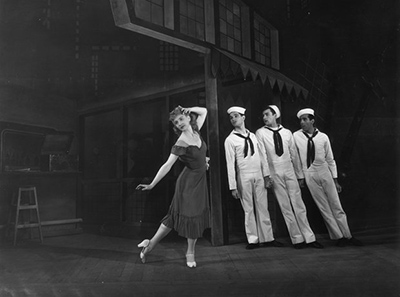
December 28, 1944: On the Town premieres at the Adelphi Theater. George Abbott directed, Leonard Bernstein composed the music, and Jerome Robbins choreographed.

The show is about 3 sailors on leave in New York during World War II, which was still going on at the time. It starred John Battles (after Kirk Douglas had to drop out, due to his son Michael having just been born), Cris Alexander and Adolph Green. The female leads were Betty Comden and Nancy Walker. Comden and Green also wrote the story, and the lyrics for the songs.

Nancy Walker would later become famous as Ida Morgenstern on Rhoda, and Rosie the waitress in commercials for paper towels: "Bounty's the quicker-picker-upper!"

The show ran until February 2, 1946. It was filmed in 1949, with Gene Kelly, Frank Sinatra and Jules Munshin. The Hays Code still being in effect, the show's signature song had to be changed: "New York, New York, it's a hell of a town!" became "New York, New York, it's a wonderful town!"

This led to Comden, Green and Bernstein writing another musical about New York, titled Wonderful Town. Many years after that, Comden and Green would write a film musical, titled New York, New York, whose theme would be sung by the movie's female lead, Liza Minnelli, but the more famous version would be by Sinatra.

Kelly and Sinatra, of course, were among the greatest entertainers of the 20th Century; but if you can name a Munshin role other than Ozzie in the film version of On the Town, then you're one up on me.

The Adelphi Theater was at 152 West 54th Street. It was demolished in 1970, and the New York Hilton Midtown was built on the site.

*

December 28, 1944 was a Thursday. Johnny Isakson, who served 14 years in the U.S. Senate as a Republican from Georgia, was born.

Baseball was out of season. Football season was over except for the New Year's Day bowl games. The NBA hadn't been founded yet.

There were 2 games in the NHL. The Boston Bruins beat the Chicago Black Hawks, 2-1 at the Boston Garden. And the Montreal Canadiens beat the Detroit Red Wings, 9-1 at the Montreal Forum. Maurice "the Rocket" Richard, on his way to a season in which he scored 50 goals in 50 games, scored 5 goals and had 3 assists. In other words, the Habs scored 9 goals, and he was involved in 8 of them. The New York Rangers and the Toronto Maple Leafs were not scheduled.

Monday, December 26, 2022

December 26, 1944: "The Glass Menagerie" Premieres

December 26, 1944: The Glass Menagerie premieres at the Civic Opera House in Chicago, catapulting its author, Thomas "Tennessee" Williams to stardom.

Eddie Dowling played Tom Wingfield, the author's counterpart, who supports his family by working in a shoe warehouse in St. Louis. Julie Haydon played Laura, Tom's sister, a mentally fragile teenage girl with a limp, who is afraid to leave the house. Her collection of glass animals gives the play its title.

Laurette Taylor plays Amanda, their mother, a once-rich native of a Mississippi plantation who has come to hate her children as much as her poverty. And Anthony Ross plays Jim O'Connor, Laura's "gentleman caller," a high school classmate of Tom's who now works in the same warehouse, as his family has also hit hard times.

Tom begins the play by telling the audience that the events are based on his memory, so he is what would now be called "an unreliable narrator." Given that Williams, like William Faulkner, was a Southern fabulist, this is not surprising. The gay subtext of Williams' stories, especially this one and Cat On a Hot Tin Roof, add to this.

The play moved to Broadway, and opened on March 31, 1945. It's been filmed twice, with the respective roles as follows: In 1950, with a happier ending that Williams didn't like (Laura loses her limp following her date with Jim, and now has a positive outlook), with Arthur Kennedy, Jane Wyman, Gertrude Lawrence and Kirk Douglas; and in 1987, with John Malkovich, Karen Allen, Joanne Woodward (wife of its director, Paul Newman) and James Naughton.

It's also been done for television twice: In 1966 on CBS, with Hal Holbrook, Barbara Loden, Shirley Booth and Pat Hingle; and in 1973 on ABC, with Sam Waterston, Joanna Miles, Katharine Hepburn and Michael Moriarty.

Built in 1929, the Civic Opera House in Chicago still stands, and with 3,276 seats, it is the 2nd-largest theater in North America that regularly hosts operas, behind the Metropolitan in New York's Lincoln Center.

*

December 26, 1944 was a Tuesday. This was also the day the U.S. relief troops arrived, turning the tide of the Battle of the Bulge in World War II. And Weather Underground founder Bill Ayers was born.

Baseball was out of season. Football season was over, except for the college bowl games on New Year's Day. The NBA hadn't been founded yet. And the NFL had no games scheduled. Therefore, there were no scores on this historic day.

December 26, 1943: Nagurski's Return Leads Bears to Title

Bronko Nagurski

December 26, 1943: The NFL Championship Game is played at Wrigley Field in Chicago. It features the 2 best teams in the League, based not just on recent history, but also on the fact that these are the 2 teams least affected by the manpower drain of World War II.

Sammy Baugh had debuted in the NFL in 1937, as the quarterback for the Washington Redskins, coached by Ray Flaherty. That year, they beat George Halas' Chicago Bears in the Championship Game. They faced each other again in the Championship Game in 1940, when the Bears won the biggest blowout in NFL history, 73-0; and in 1942, when the Redskins ruined an undefeated season for the Bears.

In 1943, Baugh did something never done before, nor since: He led the NFL in passing yards, interceptions by a defensive player, and punting yards. To put this into a more modern perspective: Imagine that, in the 2000s, Tom Brady, Ed Reed and Sean Landeta were one man doing what all three of those men did. That was "Slingin' Sammy": The 1st great quarterback, a great defensive back, and the best punter ever.

But the Bears had the era's other great quarterback, Sid Luckman. And an offense and a defense so mighty that they were nicknamed "The Monsters of the Midway." In addition to facing the Redskins in the title game in 1937, 1940 and 1942, they had also beaten the New York Giants in the title game in 1941.

What the Bears did not have was Halas, who was team founder, owner, general manager and, usually, head coach. But, having served in the U.S. Navy during World War I, he was called back to serve in World War II, overseeing the recreational needs of the Seventh Fleet, and eventually being discharged with the rank of Captain.

In his stead, his assistant coaches, Heartley "Hunk" Anderson and Luke Johnsos served as co-head coaches. Anderson had been a guard at Notre Dame on Knute Rockne's National Championship teams of 1919 and 1920, and had played for the Bears from 1922 to 1925. Johnson was a Chicago native who played end at Northwestern University, and helped the Bears win the NFL Championship in 1932 and 1933.

But the draft -- the U.S. Army's, not the NFL's -- had hit the Bears, too. While a deal was worked out to keep some players stateside, as long as they kept their jobs in defense plants, they lost other key players. They kept their great center and defensive tackle Clyde "Bulldog" Turner, but lost back Bill Osmanski. They needed help.

From 1930 to 1937, the Bears had Bronislau "Bronko" Nagurski. At 6-foot-2 and 230 pounds, he wouldn't be considered all that big today. But in the 1930s, he was considered huge, and was the prototype for the big bruising fullback, the progenitor of Marion Motley, Jim Brown, Larry Csonka, John Riggins, Jerome Bettis, etc.

The University of Minnesota didn't win anything while he was there, but, in the same backfield as Red Grange, he helped the Bears win the Championship in 1932 and 1933.

"Who would you pick to win a football game?" asked the great sportswriter Grantland Rice. "11 Jim Thorpes? 11 Glenn Davises? 11 Red Granges? Or 11 Bronko Nagurskis? The 11 Nagurskis would be a mop-up. It would be something close to murder and massacre. For the Bronk could star at any position on the field, with 216 pounds of authority to back him up."

Try 230, Mr. Rice. Otherwise, you're right. One year, Nagurski hurt his back, and, instead of sitting out and healing, accepted a switch to offensive tackle, and was great at it. He played defensive tackle. Oh yeah, he could also pass, pretty well by the standards of the time. Imagine Bettis throwing an option pass, and having it result in a touchdown: Nagurski did it. In an interview late in life, he said he'd probably be a linebacker, admitting he wouldn't be carrying the ball 30 times a game. I have no doubt that, with his speed, he would have excelled.

He was a professional wrestler in the off-season, because, at the time, it made him more money. He was the Heavyweight Champion of the World. And while pro wrestling was always a bit theatrical, it was not like today's WWE. He would have made mincemeat out of Hulk Hogan in the 1980s, Stone Cold Steve Austin in the 1990s, Dwayne "The Rock" Johnson (also a college football star) in the 2000s and John Cena today. And he would never have done Vince McMahon's bidding.

After the 1937 season, Nagurski quit football over a salary dispute with Halas. He kept wrestling, even though he had a bad back, and, once World War II came, it didn't make him as much money. In 1943, due to the manpower shortage, Halas sent a telegram to Anderson and Johnsos, telling them to offer Nagurski, now 35 and 6 years past his last down of football, $5,000 to come back. He took it.

In 1943, the Bears went 8-1-1. The season began with a 21-21 tie away to their arch-rivals, the Green Bay Packers. But they still had a shot at an undefeated season until their next-to-last game, when the Redskins beat them in Washington, 21-7.

The Redskins, by now coached by Dutch Bergman, had a bit more trouble. They started out 6-0-1, the only blot on their record a 14-14 tie with the Steagles in Philadelphia. Yes, the "Steagles": Because of the manpower drain, the 2 Pennsylvania teams, the Philadelphia Eagles and the Pittsburgh Steelers, joined forces for one season, playing 4 games at the Eagles' Shibe Park and 2 at the Steelers' Forbes Field.

But after beating the Bears, the Redskins dropped their last 3 games, 27-14 to the Steagles at Griffith Stadium, 14-10 to the Giants at the Polo Grounds, and then 31-7 to the Giants at home. This forged a tie with the Giants for the Eastern Division title. Under today's rules, the Giants would have won the Division, due to the head-to-head win. Under the rules of 1943, a Playoff game was needed, so the Giants and Redskins ended up playing 3 weeks in a row. Despite the Giants having home-field advantage, the Redskins won, 20-0.

So the NFL Championship Game was set for a week later than intended, on the day after Christmas. Since the game alternated between the Division titlists' homes, and it was the Western winner's turn to host, the game would be at Wrigley Field. Because of the weather, this became the 1st NFL game to earn the nickname "The Ice Bowl." After the 1967 NFL Championship Game, that name was retired, and nobody ever again used the name for the 1943 title decider.
Wrigley Field in its football configuration

There was no scoring in the 1st quarter. In the 2nd, Andy Farkas ran the ball in from 1 yard out to give the Redskins a 7-0 lead. That may have woken the Bears up: Later in the quarter, Luckman threw a 31-yard touchdown pass to Harry Clarke, and Nagurski ran the ball in from 3 yards, and it was 14-7 Chicago at the half.

The Bears dominated in the 2nd half as well. Luckman threw 2 touchdown passes to Dante Magnani in the 3rd quarter, 36 and 66 yards. On the 2nd of these, Bob Snyder missed the extra point, so it was 27-7 Bears. Baugh threw a 17-yard touchdown pass to Farkas, to give the 'Skins some hope as the quarter ran out, 27-14.

That hope ended quickly. Luckman threw touchdown passes to Jim Benton for 26 yards and Clarke for 10. Baugh threw one to Joe Aguirre for 25 yards, but it was small consolation. The Bears won, 41-21, and had their 3rd title in 4 seasons.

Nagurski retired again, returning to his farm in Minnesota in the Summer, and the pro wrestling circuit the rest of the year, until 1960. The University of Minnesota retired its Number 72 for him, and named its football facility the Gibson-Nagurski Football Complex. The Chicago Bears retired Number 3 for him. He was a charter inductee into the Pro Football Hall of Fame in 1963.

He was named to the NFL's 50th Anniversary Team in 1969, and its 75th Anniversary Team in 1994. Despite being named as a finalist, he was not named to the 100th Anniversary Team in 2019. The Sporting News ranked him 35th on their 100 Greatest Football Players in 1999. and the NFL Network's 100 Greatest Players in 2010, 73 years after he was a regular player, actually boosted him to 19th. In 2008, ESPN named ranked him 17th on their list of the Top 25 College Football Players of All Time. He died in 1990.

The 1944 season saw the continued decimation of the NFL. But by the start of the 1945 season, The War was over, and the players began to be discharged, and switch back from the battlefield to the football field. The Redskins reached the Championship Game again, losing to the Cleveland Rams, who then moved to Los Angeles for 1946. In that season, the Bears won another title, beating the Giants in the Championship Game. So it was 4 titles in 7 seasons.

The Bears would not reach another NFL Championship Game, under any name, until 1956; the Redskins, the 1972 season. The Bears would not win another title until the season of 1963; the Redskins, that of 1982.

*

December 26, 1943 was a Sunday. Baseball was out of season. The NBA hadn't been founded yet. There were 2 NHL games played on this day. The New York Rangers beat the Chicago Black Hawks, 7-6 at the old Madison Square Garden. For the Rangers, Bryan Hextall Sr. had 2 goals and 2 assists. For the Hawks. Bill Mosienko had 3 goals and an assist, while former Ranger Clint Smith had a goal and 3 assists.

And the Boston Bruins and the Detroit Red Wings played to a tie, 4-4 at the Olympia Stadium in Detroit.

The Montreal Canadiens and the Toronto Blue Jays were not scheduled. This strikes me as odd, since Canada was part of the British Empire, and December 26, the day after Christmas, is Boxing Day, a big day for the British, including major soccer games. But Canada's NHL teams didn't play on the day.

Saturday, December 24, 2022

December 24, 1944: The Agana Race Riot

Black sailors at Guam

December 24, 1944: The Agana Race Riot breaks out in Agana, Guam. It was one of the most serious incidents between African-American and white military personnel in the U.S. armed forces, segregated during World War II.

The U.S. Marine Corps retook Guam from Japan in July 1944, and then used it as a station for the 3rd Marine Division. Racial tensions heightened in late August when the African-American Marine 25th Depot Company arrived to start loading operations at the newly constructed naval supply depot. White Americans of the 3rd Marine Division, some new to the area, tried to prevent African-American Marines from visiting nearby Agana and its native women.

Over the next 3 months, racially-motivated incidents and a pervasive pattern of discrimination caused tensions to rise between the two groups. A white American sailor shot and killed a black Marine of the 25th Depot Company in a quarrel over a woman; and a sentry from the 27th Marine Depot Company reacted to harassment by fatally wounding his tormentor, a white Marine. Both men were eventually court-martialed for voluntary manslaughter.

A race riot erupted on Christmas Eve, when rumors spread that an African-American sailor had been shot and killed by a white Marine. There was fighting throughout Christmas Day, and it was finally put down by Military Police on December 26.

A total of 43 Marines were court-martialed, convicted, and received prison terms of several years. The NAACP later successfully campaigned with the Department of the Navy, and ultimately the White House, to have the black Marines' guilty verdicts overturned, and they were released from prison in 1946.

*

December 24, 1944 was a Sunday. Daniel Johnson Jr., who, like his father Daniel Sr. and his brother Pierre-Marc, would serve as Premier (Governor) of Quebec, was born.

Baseball was out of season. College football was between the end of the regular season and the New Year's Day bowl games -- no games on Christmas Eve or Christmas Day. The NFL season had ended a week earlier, when the Green Bay Packers beat the New York Giants in the NFL Championship Game. The NBA hadn't been founded yet. One game was played in the NHL: The New York Rangers and the Chicago Black Hawks played to a tie, 3-3 at the old Madison Square Garden.

Thursday, December 22, 2022

December 22, 1944: General McAuliffe Says, "Nuts!"

December 22, 1944: Seven days after beginning their last stand on the Western Front, and sensing victory, Nazi Germany sends a surrender demand to the American commander. They got a response they did not expect.

With the Allies having liberated France, and marching toward Germany itself from the West, and the Soviet Union's Red Army marching from the East, the Nazis needed a win, somewhere. On December 15, they attacked in the Ardennes Forest, which stretches over France, Belgium, Luxembourg, and even part of Germany.

They pushed forward, and formed a "bulge" in the American line, leading to the conflict being known as "The Battle of the Bulge." By the 22nd, they had the U.S. Army's 101st Airborne Division, then stationed in Bastogne, Belgium, virtually surrounded.

One of the reasons the attack was launched when it was is that the 101st's commanding officer, Major General Maxwell D. Taylor, was away, attending a staff conference. In temporary command was Brigadier General Anthony C. McAuliffe.

(In the Army, the Marine Corps, and, since its separation from the Army in 1947, the Air Force, A Brigadier General wears one star, a Major General two, a Lieutenant General three, a full General four, and a General of the Army five. In the Navy, the equivalent ranks are, respectively: Commodore, Rear Admiral, Vice Admiral, Admiral, and Admiral of the Fleet. However, the Navy discontinued the rank of Commodore in 1985.)

On December 22, the Nazi commander, General der Panzertruppe Heinrich Diepold Georg Freiherr von Lüttwitz, sent a major under a flag of truce, and delivered this message to McAuliffe:

To the U.S.A. Commander of the encircled town of Bastogne.
The fortune of war is changing. This time the U.S.A. forces in and near Bastogne have been encircled by strong German armored units. More German armored units have crossed the river Ourthe near Ortheuville, have taken Marche and reached St. Hubert by passing through Hompre-Sibret-Tillet. Libramont is in German hands.
There is only one possibility to save the encircled U.S.A. troops from total annihilation: that is the honorable surrender of the encircled town. In order to think it over a term of two hours will be granted beginning with the presentation of this note.
If this proposal should be rejected one German Artillery Corps and six heavy A. A. Battalions are ready to annihilate the U.S.A. troops in and near Bastogne. The order for firing will be given immediately after this two hours term.
All the serious civilian losses caused by this artillery fire would not correspond with the well-known American humanity.
The German Commander. 
According to those present when McAuliffe received the German message, he read it, crumpled it into a ball, threw it in a wastepaper basket, and muttered, "Aw, nuts." The officers in McAuliffe's command post were trying to find suitable language for an official reply when Lieutenant Colonel Harry Kinnard suggested that McAuliffe's first response summed up the situation pretty well, and the others agreed. The official reply was typed and delivered by Colonel Joseph Harper. It read as follows:
To the German Commander.
NUTS!
The American Commander.
The German major appeared confused, and asked Harper what the message meant. Harper said, "In plain English? 'Go to Hell.'"
The choice of "Nuts!" rather than something earthier was typical for McAuliffe. Captain Vincent Vicari, his personal aide at the time, recalled that "General Mac was the only general I ever knew who did not use profane language. 'Nuts' was part of his normal vocabulary."
The artillery fire did not materialize, although several infantry and tank assaults were directed at the positions of the 327th Glider Infantry. In addition, the German Luftwaffe attacked the town, bombing it nightly. The 101st held off the Germans until the 4th Armored Division arrived on December 26 to provide reinforcement.
The Battle of the Bulge was the largest battle ever to involve American troops, with 705,000 men eventually taking on a peak of 449,000 Germans. Losses: 75,000 Americans, 104,000 Germans. Among the Americans serving, and earning a Bronze Star and a Purple Heart, was Warren Spahn, who would survive the war and pitch his way into the Baseball Hall of Fame.
Once the American reinforcements arrived, the Nazis were doomed, both on the Western Front and overall. By January 28, 1945, they were in retreat.
A 1919 West Point graduate, McAuliffe would be awarded a Distinguished Service Cross, a Silver Star and 2 Bronze Stars over the course of his career. After General Taylor returned, McAuliffe was given command of the 103rd Infantry Division, which liberated the Kaufering concentration camp and the Austrian city of Innsbruck. He was named Commander of the Seventh Army in 1953. In 1955, he was promoted to a full General, and appointed Commander-in-Chief of the U.S. Army Europe. He retired in 1956, and lived until 1975.
Harry Kinnard, who recommended the response of "Nuts!", had already received the Distinguished Service Cross for his service in Operation Market Garden earlier in the year. He remained in the Army. During the Vietnam War, he came up with the "airmobile" concept: Using helicopters to send troops into battle and then get them out. He retired as a Lieutenant General, and lived until 2009.
Freiherr von Lüttwitz was captured in the Battle of the Ruhr Pocket on April 16, 1945, and was held as a prisoner of war until July 1, 1947. He was not charges with war crimes, was permitted to retire in peace, and lived until 1969.
*
December 22, 1944 was a Friday. Baseball Hall of Fame pitcher Steve Carlton was born on this day.

Baseball was in the off-season. The NFL Championship Game was played 5 days earlier, with the Green Bay Packers beating the New York Giants, 14-7 at the Polo Grounds in New York. The NBA hadn't been founded yet. And, while the NHL was in-season, no games were scheduled for that day. So there are no scores on this historic day.

December 31, 1999 & January 1, 2000: The Millennium

December 31, 1999:  The Millennium arrives. The people of planet Earth survived. At a terrible cost. But we hadn't destroyed ourselves. ...