Showing posts with label free agency. Show all posts

Saturday, December 31, 2022

December 31, 1974: The Yankees Hook a Catfish

December 31, 1974: The era of baseball free agency begins, as the Yankees "hook a Catfish."

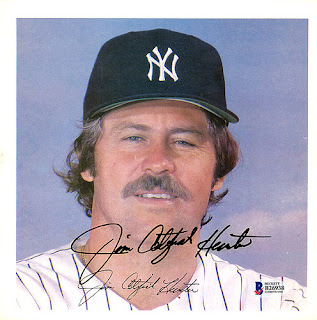
James Augustus Hunter was signed out of Perquimans High School in North Carolina by the Kansas City Athletics on June 8, 1964. Team owner Charles O. Finley thought "Jim Hunter" was too ordinary a name, and that he needed a nickname. Charlie asked "Jimmy" (as he was always known to his family) what he liked to do. Jim said he liked to hunt and fish, a common pair of passions for baseball players from rural areas in those days.

So Finley made up a story about how, when he was a boy, Jimmy caught a whole bunch of catfish, and that he had been nicknamed "Catfish Hunter" -- or, sometimes, just "Cat" -- from then on. Of course, no one had ever called him "Catfish" -- or "Cat" -- until June 8, 1964.

Hunter made his debut with the A's in 1965. In 1966, he made the 1st of what turned out to be 8 All-Star Games. The A's moved to Oakland in 1968. That season, Catfish pitched a perfect game. He helped them win the American League Western Division in 1971, and the World Series in 1972, 1973 and 1974. He won the AL Cy Young Award in 1974, leading in both wins (he went 25-12) and ERA. That year, despite Tom Seaver, Steve Carlton, Jim Palmer and Nolan Ryan all being in their prime, he was the best pitcher in baseball.

Charlie Finley was so cheap! (How cheap was he?) He was so cheap, he let the best pitcher in baseball get away because he refused to fulfill a part of the man's contract. The contract that Catfish signed for 1974 was for 2 years -- unusual under the still-holding reserve clause -- for $200,000, or $100,000 per year, which, while no longer a record, was still a benchmark for ballplayers.

But not all of that was salary: The contract stipulated that, in 1974 and again in 1975, Finley would make a $50,000 payment to a life insurance annuity. Since Finley had become rich selling insurance, he should have not only understood this, but respected this.

But after the 1974 season, Finley found out he had to pay $25,000 in taxes, due immediately. (Worth about $148,000 in 2022 money.) So he refused to pay the annuity. Catfish, who had been trying to secure his family's post-baseball future, was normally a very even-tempered man, which helped him a lot while pitching. Over this, though, he hit the roof, and appealed to Peter Seitz, Major League Baseball's arbitrator for contract disputes.

On December 16, 1974, foreshadowing the decision he would make a year later, killing the reserve clause, Seitz ruled in Catfish's favor: He was now a free agent, and the 24 teams then in Major League Baseball were all permitted to bid for his services for 1975 and beyond.

Suddenly, the small town of Hertford, in the Inner Banks of North Carolina, a small town of about 2,000 people, 60 miles south of the Class AAA city of Norfolk, Virginia, became the center of the baseball world. Every team, except the San Francisco Giants, bid for Catfish.

The winning bid came from the New York Yankees. Although team owner George Steinbrenner was suspended from operating the team until the 1976 season, general manager Gabe Paul had his permission to offer Catfish $3.35 million over 5 years -- $670,000 per season, a record at the time. (In today's money, about $3.98 million per year. How quaint that now sounds.)

Catfish actually refused 2 higher bids: From the San Diego Padres, because he was tired of being on the opposite coast from home; and from the Kansas City Royals, because he wanted to play on real grass, and Royals Stadium had artificial turf. (In 1993, that stadium was given both real grass and a new name, Kauffman Stadium, both of which it still has.)

To put the figure in perspective: The player who was paid the most for the 1974 season was Hank Aaron, MLB's new all-time home run leader: $240,000. (About $1.42 million in 2022 money.) Catfish's contract had broken the barriers of $250,000 (a quarter of a million), $300,000, $400,000, $500,000 (half a million) and $600,000.

Catfish struggled at first in 1975, losing his 1st 3 games. In fact, his debut, on April 8, 1975, was also Frank Robinson's 1st game as baseball's 1st black manager, and he hit a home run off Catfish to give the Cleveland Indians the win. But Catfish settled down, and went 23-12. It was his 5th straight season of at least 21 wins.

But all that pitching began to wear on his arm. He went just 17-15 in 1976, still helping the Yankees win the Pennant. He was injured for much of the 1977 and 1978 seasons, but a procedure on his shoulder allowed him to win 6 straight games down the stretch in 1978. After being hit hard in Game 2 of the 1977 World Series, but the Yankees won the Series anyway, Catfish won the clinching Game 6 of the 1978 World Series.

After the 1979 season, the 5th and last year of his contract, Catfish retired. He had always intended to, but his bad shoulder took the decision out of his hands. His final record was 224-166. After that season, the Houston Astros signed Ryan to the 1st contract to break the $1 million-per-season barrier.

Jim "Catfish" Hunter was elected to the Baseball Hall of Fame in 1987. Charlie Finley has never been elected. Then again, neither have George Steinbrenner, Gabe Paul and Peter Seitz.

Catfish died in 1999, like Lou Gehrig from amyotrophic lateral sclerosis, the disease now named for Gehrig.

For the 2023 season, the New York Mets will pay Max Scherzer and Justin Verlander, 2 pitchers whose statistics will make them sure Hall-of-Famers if they don't do anything stupid like Pete Rose did, record salaries of $43,333,333 each. In 1974, that would have been $7.1 million, or 10.6 times Catfish Hunter's former record salary.

*

December 31, 1974 was a Tuesday. Baseball was out of season. The NFL was in midweek. No college football bowl games were played that day. No NBA games were played. One game was played in the American Basketball Association: The San Antonio Spurs beat the Indiana Pacers, 140-105 at the HemisFair Arena in San Antonio. Despite that high score, the leading scorer for the Spurs was George Gervin: "The Iceman" scored 27.

Two games were played in the NHL. The Detroit Red Wings beat the California Golden Seals, 4-3 at the Olympia Stadium in Detroit. And the Los Angeles Kings beat the Chicago Black Hawks, 3-1 at the Chicago Stadium.

And 2 games were played in the World Hockey Association. The Chicago Cougars beat the Cleveland Crusaders, 4-3 at The Coliseum in the Cleveland suburb of Richfield, Ohio. And a 1-1 tie was played between the Phoenix Roadrunners and the Michigan Stags, at Cobo Hall in Detroit.

Friday, December 23, 2022

December 23, 1975: The Reserve Clause Is Killed

Peter Seitz

December 23, 1975: The reserve clause is struck down, changing baseball forever.

The clause -- nothing Christmassy about this -- began in 1879, when the National League instituted it, allowing teams to reserve players for each season, unless a player opted out of his contract and did not play in the league for a year. This allowed the team owners to control salaries, since the players could not play one team owner off another and get higher bids for their salaries.

In 1890, the Sherman Antitrust Act was passed. To some people in baseball, the reserve clause sounded like a violation of that act. In 1922, in Federal Baseball Club v. National League, the U.S. Supreme Court ruled otherwise, saying, in a 9-0 unanimous vote, baseball was an "amusement," therefore did not constitute "interstate commerce," and therefore antitrust laws did not to apply to it. That ruling has never been overturned by a later Supreme Court ruling.

So opponents of the reserve clause had to find another way to get it struck down. In 1969, the St. Louis Cardinals traded Curt Flood to the Philadelphia Phillies, and, having a home and a business in St. Louis, and believing Philadelphia to be a racist city, he didn't want to go. He contacted the Chairman of the Major League Baseball Players' Association, Marvin Miller, to see what could be done about it.
Curt Flood

Miller decided that the reserve clause was a legitimate basis for negotiation in collective bargaining between players and owners. The case of Flood v. Kuhn went to the Supreme Court in 1972, and the decision was 5-3 in favor of the owners.

Finally, Miller got the team owners to agree to impartial arbitration. What he needed was two players to challenge the clause, by playing the 1975 season without signing a contract. This was because Miller realized that the clause only reserved the player for one year. The owners had always interpreted it to mean the player was reserved until he was released: Even if traded, his new team assumed the reservation.
Marvin Miller

It had to be two players, so that it wouldn't look like one embittered player, as Flood, fairly or not, seemed to be. Both players turned out to be pitchers. Dave McNally had been traded from the Baltimore Orioles to the Montreal Expos, and had determined that 1975 would be his last season, as he planned to retire to his ranch in Montana. So he had nothing to lose.

Andy Messersmith had much to lose. Born on the Jersey Shore in Toms River, and raised in the Orange County suburbs of Los Angeles, the righthander was 29, and had gone 20-6 in helping the Los Angeles Dodgers win the National League Pennant in 1974. He was in position to make a great deal of money if he could put his skills up for bid. But Miller convinced him that striking the reserve clause down was more important. So he played the '75 season with the Dodgers, without a contract, turned 30, and went 19-14.
Andy Messersmith

In an interview with The Sporting News for the 10th Anniversary of the decision, Messersmith said, "It was less of an economic issue at the time than a fight for the right to have control over your own destiny. It was a matter of being tired of going in to negotiate a contract and hearing the owners say, 'OK, here's what you're getting. Tough luck.'"

The owners were terrified. There is one thing that a sports team owner values more than money, and that is control. If the clause were struck down, the owners would have to pay more in salaries, but, from their perspective, the bigger problem was that they would lose some measure of control over the players' fates. They could have compromised, but were too stubborn and set in their ways to do so.

So the decision went to arbitration. A three-man panel was chosen. Miller represented the players. John Gaherin, the chief negotiator of the MLB Player Relations Committee, argued on behalf of the team owners. Together, they found an arbitrator acceptable to both of them: Peter Seitz, a 67-year-old lawyer who had negotiated New York City's labor relations law a decade earlier.

On December 23, the ruling was handed down. Surprising no one, Miller sided with the players, and Gaherin sided with the owners. Seitz had the deciding vote, and he sided with the players, saying:

The grievances of Messersmith and McNally are sustained. There is no contractual bond between these players and the Los Angeles and the Montreal clubs, respectively. Absent such a contract, their clubs had no right or power, under the Basic Agreement, the Uniform Player Contract or the Major League Rules to reserve their services for their exclusive use for any period beyond the renewal year in the contracts which these players had heretofore signed with their clubs...

The leagues involved in these proceedings, without delay, shall take such steps as may be necessary to inform and instruct their member clubs that the provisions of Major League Rules 4-A(a) and 3(g) do not inhibit, prohibit or prevent such clubs from negotiating or dealing with respect to employment with the grievants in this case; also, that Messersmith shall be removed from the reserve list of the Los Angeles Club and McNally from the reserve or disqualified lists of the Montreal Club.

The next day, the owners fired Seitz as arbitrator. But that did nothing to change the official result of his decision: The reserve clause was mortally wounded. It wasn't quite dead, as the owners had the right to appeal. On February 4, 1976, the Seitz decision was upheld in a federal district court. On March 10, it was upheld in a federal appeals court.

Finally, rather than take the apparently inevitable beatdown from the U.S. Supreme Court, the owners decided to make a deal. On July 12, an agreement was reached on a 4-year labor deal, giving players with at least 6 years' play in the major leagues the right to free agency. (This would later be reduced to 5 years.) Finally, on August 2, 1976, the players voted on ratification, and the reserve clause was formally buried.

A few years later, Cardinals owner and Anheuser-Busch beer magnate Gussie Busch met with the man he had traded to unwittingly set all this in motion, Curt Flood. No owner had been more vehement than Busch that the reserve clause had to be maintained, or else baseball would be "destroyed." But Busch told Flood he was right, and the owners were wrong, and apologized to him.

Flood had sacrificed his career for Messersmith and all the players who came after him. Messersmith signed with the Atlanta Braves, for $1 million over 3 years. But he didn't pan out with them, due to injuries. He went 11-11 in 1976, and only 5-4 in 1977. He was traded to the Yankees for 1978, but made only 7 appearances, going 0-3.

The Yankees released him, and, with some irony, he signed as a free agent with the Dodgers. This was possible because their owner, Walter O'Malley, champion of the cheap, had died, and his son, Peter O'Malley, was one of the owners willing to pay big money if he thought it would bring big results. In Messersmith's case, it didn't: He made just 11 appearances, going 2-4, and was done at age 34.

Messersmith later coached at a community college in Northern California, while McNally worked on his ranch and ran a car dealership. Neither worked in professional baseball again.

Seitz died in 1983, Flood in 1997, McNally in 2002, Miller in 2012. As of December 23, 2022, Messersmith is still alive, age 76.

*

December 23, 1975 was a Tuesday. Baseball was out of season. Football was in midweek. There were 7 games played in the NBA:

* The New York Knicks beat the Milwaukee Bucks, 110-108 at the Milwaukee Exposition, Convention Center and Arena, or "The MECCA." Since 2014, it has been named the UW-Panther Arena.

* The Buffalo Braves beat the Boston Celtics, 101-92 at the Buffalo Memorial Auditorium.

* The Washington Bullets beat the Detroit Pistons, 120-102 at Cobo Hall in Detroit.

* The Houston Rockets beat the Chicago Bulls, 103-94 at The Summit in Houston. (The arena has since been converted into the Central Campus of the Lakewood Church, Dr. Joel Osteen's "megachurch.")

* The Los Angeles Lakers beat the Kansas City Kings, 111-97 at The Forum outside Los Angeles in Inglewood, California.

* The Golden State Warriors beat the New Orleans Jazz, 105-97 at the Oakland Coliseum Arena.

* And the Portland Trail Blazers beat their arch-rivals, the Seattle SuperSonics, 125-100 at the Veterans Memorial Coliseum in Portland.

There were 3 games played in the American Basketball Association:

* The New York Nets beat the Kentucky Colonels, 107-102 at Freedom Hall in Louisville. Julius "Dr. J" Erving scored 31 points.

* The Spirits of St. Louis (that was their official name, not "The St. Louis Spirits") beat the Virginia Squires, 115-103 at The Scope in Norfolk.

* And the Indiana Pacers beat the San Antonio Spurs, 111-106 at the HemisFair Arena in San Antonio.

There were 5 games played in the NHL:

* The New York Rangers beat the Pittsburgh Penguins, 4-3 at Madison Square Garden.

* The Los Angeles Kings beat the Boston Celtics, 4-3 at the Boston Garden.

* The Philadelphia Flyers and the Atlanta Flames played to a tie, 2-2 at The Omni in Atlanta.

* The Chicago Black Hawks beat the St. Louis Blues, 4-1 at the Chicago Stadium.

* And the Buffalo Sabres beat the Kansas City Scouts, 5-1 at the Kemper Arena in Kansas City. It's now named the Hy-Vee Arena, and the Scouts became the Colorado Rockies in 1976, and the New Jersey Devils in 1982.

And there were 5 games played in the World Hockey Association:

* The Phoenix Roadrunners beat the Cincinnati Stingers, 5-3 at the Riverfront Coliseum in Cincinnati. (The arena is now the Heritage Bank Center.)

* The Minnesota Fighting Saints beat the Denver Spurs, 5-4 at the McNichols Arena in Denver.

* The Calgary Cowboys beat the Toronto Tors, 10-1 at the Stampede Corral in Calgary.

* The Winnipeg Jets beat the Edmonton Oilers, 6-2 at the Northlands Coliseum in Edmonton.

* And the San Diego Mariners beat the Quebec Nordiques, 10-4 at the San Diego Sports Arena. (The arena is now the Pechanga Arena.) 

Monday, December 12, 2022

December 12, 1998: Baseball's 1st $100 Million Contract

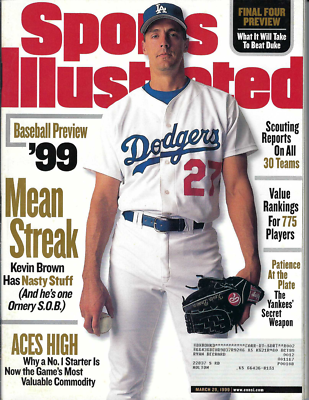
December 12, 1998: The Los Angeles Dodgers sign free agent pitcher Kevin Brown to a contract worth $105 million over 7 years. It is the 1st contract in any of the "Big Four" North American sports leagues worth as much as $100 million. And it turns out to be a bad contract.

James Kevin Brown was born on March 14, 1965 in Milledgeville, Georgia, outside Macon. A white couple in Georgia, naming their son "James Brown"? No wonder he went by "Kevin" -- although Kevin Brown is also a very common name, even in sports: There's another baseball pitcher, a year younger, with the name.

This Kevin Brown won 211 games in the major leagues, against 144 losses, a very good percentage. He was a 6-time All-Star, twice led the National League in earned run average, pitched a no-hitter in 1997, and reached the postseason with 3 different teams -- and it probably would have been 4 times with 4 teams if the 1994 strike hadn't hit, denying the Texas Rangers the American League Western Division title. He won the World Series with the 1997 Florida Marlins, and another Pennant with the 1998 San Diego Padres. In 1999, the Dodgers thought he was worth a contract worth more than $100 million.

(UPDATE: With inflation factored in, that $105 million in 1998 would be worth $190 million in 2022.)

So why isn't he in the Baseball Hall of Fame? Mainly because of the 2004 season, his last full one in the majors. Known as a "Yankee Killer" during is time with the Rangers and the Baltimore Orioles -- but losing twice against them in the '98 World Series -- the Yankees traded for him, and became a bigger Yankee Killer than ever. During a September loss, he reacted to being taken out of the game by punching the dugout wall and breaking his pitching and. He returned in time to start Game 7 of the AL Championship Series, and turned in the worst postseason start in Yankee history. He got hurt again the next year, and retired.

He has been the subject of steroid rumors, which may also be keeping him out of the Hall. He lives in Macon, and does not work in baseball, in any capacity. No one seems to want him around.

*

December 12, 1998 was a Saturday. Baseball was out of season. This was the weekend between college football's Conference Championship Games and its bowl games. And the NBA team owners had locked the players out, so the season hadn't started yet.

There were 11 games played in the NHL:

* The New York Islanders lost to the Tampa Bay Lightning, 2-1 at the Nassau Coliseum. Former Islander Benoit Hogue scored the winning goal, with 48 seconds left in overtime.

* The New Jersey Devils beat the Colorado Avalanche, 5-3 at the Continental Airlines Arena at the Meadowlands.

* The Buffalo Sabres beat the Boston Bruins, 4-1 at the FleetCenter (now the TD Garden) in Boston.

* The Carolina Hurricanes beat the Detroit Red Wings, 3-0 at the Greensboro Coliseum in Greensboro, North Carolina.

* The Calgary Flames beat the Florida Panthers, 4-2 at the National Car Rental Center (now the Amerant Bank Arena) in the Miami suburb of Sunrise, Florida.

* The Montreal Canadiens and the Nashville Predators played to a tie, 2-2 at the Nashville Arena (now the Bridgestone Arena).

* The Phoenix Coyotes beat the Ottawa Senators, 2-0 at the Corel Centre (now the Canadian Tire Centre) in Ottawa.

* The Philadelphia Flyers beat the Toronto Maple Leafs, 3-0 at Maple Leaf Gardens in Toronto.

* The Pittsburgh Penguins beat the St. Louis Blues, 4-3 at the Kiel Center (now the Enterprise Center) in St. Louis.

* The Los Angeles Kings beat the Vancouver Canucks, 3-0 at The Forum outside Los Angeles in Inglewood, California.

* The San Jose Sharks beat the Washington Capitals, 2-1 at the San Jose Arena (now the SAP Center).

* And the New York Rangers, the Chicago Blackhawks, the Dallas Stars, the Edmonton Oilers and the Anaheim Ducks were not scheduled.

Tuesday, November 29, 2022

November 29, 1976: Reggie Jackson Brings His Star to New York

Left to right: Thurman Munson,
Reggie Jackson, Roy White

November 29, 1976: The New York Yankees sign the biggest available free agent, Reggie Jackson. The contract is for $2,960,000 over 5 years – $592,000 a year, or about $3.04 million in today's money.

This was the 1st off-season in which free agency was widespread. Charlie Finley, Reggie's boss with the Kansas City and Oakland Athletics from his 1966 signing (including his 1967 major league debut) until the previous April, was not going to sign him to a big contract. Finley wasn't going to sign anybody, because, as Reggie himself said in his memoir, "Lord, but the man was cheap."

Just before the start of the 1976 regular season, Finley had traded Reggie to the Baltimore Orioles. But their owner, Jerry Hoffberger, wasn't going to sing him, either.

Three team owners were willing to sign Reggie: Shipbuilding tycoon George Steinbrenner of the Yankees, McDonald's head honcho Ray Kroc of the San Diego Padres, and Seagram's whiskey baron Charles Bronfman of the Montreal Expos. Reggie thought about it, and decided that he didn't want to deal with the Canadian exchange rate -- or to learn French, and narrowed it down to the Yanks and Padres.

"George Steinbrenner hustled me," Reggie said at the press conference for his signing. He told George that Kroc was offering him more money to go to San Diego. George revealed that, whatever Kroc intended, the promise of more money was a half-truth: "Kroc is offering you more salary to go to San Diego." George reminded Reggie that New York was the media capital of the world, including the advertising capital of the world. Between salary, endorsements, and the glory that would come with winning with the New York Yankees, Reggie could get a lot more from George Steinbrenner than he ever could from Ray Kroc.

The press conference was held at the Versailles Terrace at the Americana Hotel. Reggie posed for pictures with George, with coaches Yogi Berra and Elston Howard, and with new teammates Thurman Munson and Roy White. One notable Yankee not there was manager Billy Martin. He didn't want Reggie, for reasons both professional (if misguided) and personal.

A 1974 Sports Illustrated cover had called Reggie, then the reigning Most Valuable Player of the American League and the World Series, a "Superduperstar." So he wasn't kidding when he told the New York media, "I didn't come to New York to be a star. I'm bringing my star with me."

A lot of people didn't like that. Munson was one of them: George had promised him he would be the highest-paid Yankee as long as he was on the team. George had already broken that promise once, 2 years earlier, when the chance to sign the best pitcher in baseball at the time, Reggie's former Oakland teammate Jim "Catfish" Hunter, came up. Thurman understood then. But breaking the promise again?

And a SPORT magazine article printed early in the 1977 season, with quotes -- or perhaps misquotes, or perhaps simply made-up quotes -- from Reggie about himself, and about Thurman, further drove a wedge between them. Things got ugly.

Two million, nine hundred and sixty thousand dollars? In Jerry Ford dollars? Bargain. Reggie defined an era in baseball, earning the nickname Mr. October. In 5 seasons, he got the Yankees to 4 postseasons, winning 3 Pennants and 2 World Series, and making them the biggest show in baseball.

Finley's other stars that he cheaply let get away?

* Kroc signed relief pitcher Rollie Fingers and 1st baseman Gene Tenace. He got no Playoff berths as a result, as the Dodgers were too strong. But at least he tried.

* Gene Autry, the entertainment legend who owned the team then known as the California Angels, signed A's left fielder Joe Rudi and designated hitter Don Baylor, along with former Oriole 2nd baseman Bobby Grich. He got 2 Division titles, but no Pennants.

* Allan "Bud" Selig, the used car dealer who owned the Milwaukee Brewers, signed 3rd baseman Sal Bando, and would later acquire Fingers in a trade. He won a Pennant, but no World Series.

* Brad Corbett, the oil executive who owned the Texas Rangers, signed shortstop Bert Campaneris, and made some other notable acquisitions. He got no Playoff berths as a result.

* And real estate tycoon Bob Lurie, who owned the San Francisco Giants, was the final landing spot for pitcher Vida Blue, after Finley had previously tried to sell Blue to the Yankees and trade him to the Cincinnati Reds. Both of those teams did better without the increasingly drug-addled Blue than the Giants did: They didn't make the Playoffs again until 1987.

Minnesota Twins owner Calvin Griffith, was not only nearly as cheap as Finley, but also blatantly racist. He refused to lift a finger to re-sign pitcher Bill Campbell. He went to the free-spending Boston Red Sox, who thought that having a lockdown reliever would have made the difference in the 1975 World Series against the Reds and the 1977 AL Eastern Division race against the Yankees. But the Yankees had also improved.

And pitcher Wayne Garland, who went 20-7 for the Orioles in 1976, was signed by the Cleveland Indians for $2.3 million over 10 years. But he wrecked his shoulder in Spring Training, and went 13-19 in 1977. He had won 40 games in the major leagues before his 27th birthday. He won 15 games after it.

*

November 29, 1976 was a Monday. Actors Chadwick Boseman and Anna Faris were born on this day.

Baseball was out of season. No games were played in the NBA, the NHL or the WHA. On ABC Monday Night Football, the San Francisco 49ers beat the Minnesota Vikings, 20-16 at Metropolitan Stadium in the Minneapolis suburb of Bloomington, Minnesota.

Sunday, November 20, 2022

November 20, 1976: The Tragedy of Wayne Garland

No, the tragedy wasn't the Indians' uniforms.
They weren't a tragedy, they were a farce.

November 20, 1976: Before the New York Mets signed Mo Vaughn, before the Boston Red Sox signed Carl Crawford and Pablo Sandoval, before the New York Yankees signed Jacoby Ellsbury, before the Colorado Rockies signed Mike Hampton, before the Baltimore Orioles signed Chris Davis, before the Los Angeles Angels signed Josh Hamilton or Anthony Rendon, before the Chicago White Sox signed Adam Dunn...

The Cleveland Indians signed Wayne Garland.

Marcus Wayne Garland was born on October 26, 1950 in Nashville. Maybe he should have gone into his hometown's main industry, and become a country singer. Certainly, the career he did choose had plenty of heartbreak.

The lefthander debuted with the Orioles in 1973, but didn't crack the starting rotation until 1976. But what a crack it was: He went 20-7, with a 2.67 ERA. He was just 26 years old. And with free agency coming after the season, he would be one of the most sought-after pitchers.

The Cleveland Indians thought he could join Dennis Eckersley, Pat Dobson and Jim Bibby to form a great rotation, and build on a rare winning season in '76, 81-78. So they shoveled the money at him: $2.3 million over 10 years, making for an annual salary of $230,000. It sounds quaint now, but the average MLB salary in 1976 was $51,501.

Result: Garland pitched 283 innings, got little run support, and went 13-19 with a not-so-bad-for-the-time 3.60 ERA. The Indians went 71-90 in 1977. Late in the season, he reported feeling pain in his pitching arm. By Opening Day 1978, Dobson had retired, Eckersley was in Boston (traded for non-competitive reasons), Bibby was in Pittsburgh, and Garland was ruined. He was diagnosed with a torn rotator cuff, and missed most of the 1978 season. He won only 15 more games, and threw his last big-league pitch before turning 31.

He later served as a pitching coach in the organizations of the Cincinnati Reds and the Pittsburgh Pirates. But a bad back, perhaps aggravated by his pitching, led to several surgeries, and he was unable to continue coaching. In 1995, the doctor who was about to perform his 1st back surgery told him he had the back of a 75-year-old man. He was 44.

In 2007, an interviewer asked him when he fully recovered from his 1978 rotator cuff surgery. He said, "I'm still waiting for that." In 2020, he was reported as living in Las Vegas with his 2nd wife -- he had 3 children with his 1st -- and was subsisting on disability insurance.

*

November 20, 1976 was a Saturday. Olympic Gold Medal-winning gymnast Dominique Dawes was born. This was also the day that Rupert Murdoch bought the New York Post, and the film Rocky premiered. I have separate entries for those events.

Baseball was out of season. It was a college football day. Among the games played that day were these:

* Number 1 University of Pittsburgh and Number 16 Penn State had the week off, to prepare for each other as arch-rivals the next week. Pitt won, 24-7 at Three Rivers Stadium in Pittsburgh.

* Rivalry: Number 2 UCLA lost to Number 3 USC, 24-14 at the Los Angeles Memorial Coliseum. USC thus clinched the Pacific-Eight Conference title. They ended up beating Michigan in the Rose Bowl, then waited to see if Pitt lost the Sugar Bowl, which would have given USC the National Championship.

* Rivalry: Number 4 Michigan beat Number 8 Ohio State, 22-0 at Ohio Stadium in Columbus, to clinch the Big Ten Conference title.

* Number 5 Texas Tech were upset by Number 9 University of Houston, 27-19 at Jones Stadium in Lubbock, Texas. This gave UH the Southwest Conference title.

* Rivalry: Number 6 Maryland beat Virginia, 28-0 at Scott Stadium in Charlottesville, Virginia. This clinched the Atlantic Coast Conference title. Maryland received a bid to the Cotton Bowl, where Houston beat them.

* Number 7 Georgia had the week off, to prepare for arch-rival Georgia Tech the next week. They won, 13-10 at Sanford Stadium in Athens, Georgia. Having already won the Southeastern Conference title, they advanced to the Sugar Bowl, but lost to Pitt, who clinched an undefeated season and the National Championship.

* Number 11 Texas A&M beat Texas Christian University (TCU), 59-10 at Kyle Field in College Station.

* Number 13 Notre Dame beat the University of Miami, 40-27 at Notre Dame Stadium in South Bend, Indiana. This was not one of the more memorable games between those schools.

* Number 15 Colorado beat Kansas State, 35-28 at KSU Stadium (now Bill Snyder Family Stadium) in Manhattan, Kansas. This clinched the Big Eight Conference title, and a berth in the Orange Bowl. This was the 1st season in which the Big 10 allowed any of its schools to go to a bowl game other than the Rose, and Ohio State beat Colorado.

* Number 16 Oklahoma State beat Number 14 Iowa State, 42-21 at Lewis Field (now Boone Pickens Stadium) in Stillwater, Oklahoma.

* Rivalry: Kansas upset Number 19 Missouri, 41-14 at Faurot Field in Columbia, Missouri.

* Army and Navy had the week off, preparing for each other as arch-rivals the next week (Navy won, 38-10 at John F. Kennedy Stadium in Philadelphia); while Air Force beat Wyoming 41-21 at Falcon Stadium in Colorado Springs, Colorado.

* Rutgers also had the week off. Five days later, on Thanksgiving, they beat Colgate, 17-9 at the new Giants Stadium in the Meadowlands, and completed an undefeated season, 11-0.

* Rivalry: Villanova beat Temple, 24-7 at Veterans Stadium in Philadelphia.

* Rivalry: The University of Richmond beat William & Mary, 21-10 at City Stadium in Richmond, Virginia.

* Rivalry: North Carolina beat Duke, 39-38 at Kenan Stadium in Chapel Hill, North Carolina.

* Rivalry: Clemson beat South Carolina, 28-9 at Memorial Stadium in Clemson, South Carolina.

* Rivalry: Kentucky beat Tennessee, 7-0 at Neyland Stadium in Knoxville, Tennessee.

* Rivalry: Mississippi State beat Mississippi (Ole Miss), 28-11 at Mississippi Memorial Stadium in Jackson.

* Rivalry: Louisiana State University (LSU) beat Tulane, 17-7 at Tiger Stadium in Baton Rouge, Louisiana.

* Rivalry: Indiana beat Purdue, 20-14 at Ross-Ade Stadium in West Lafayette, Indiana, to win the Old Oaken Bucket.

* Rivalry: Illinois beat Northwestern, 48-6 at Memorial Stadium in Champaign, Illinois.

* Rivalry: Wisconsin beat Minnesota, 26-17 at Camp Randall Stadium in Madison, Wisconsin.

* Rivalry: Brigham Young University (BYU) beat Utah, 34-12 at Rice Stadium (later Rice-Eccles Stadium) in Salt Lake City, to win the Beehive Boot.

* Rivalry: Stanford beat the University of California, 27-24 at California Memorial Stadium in Berkeley.

* Rivalry: Oregon beat Oregon State, 23-14 at Parker Stadium (now Reser Stadium) in Corvallis, Arkansas.

* Rivalry: Washington beat Washington State, 51-32 at Martin Stadium in Pullman, Washington.

There were 6 games played in the NBA:

* The New York Knicks beat the Denver Nuggets, 120-115 at Madison Square Garden. David Thompson scored 35 points in defeat.

* The Washington Bullets beat the San Antonio Spurs, 109-103 at the Capital Centre in the Washington suburb of Landover, Maryland.

* The Philadelphia 76ers beat the Atlanta Hawks, 123-106 at The Omni in Atlanta.

* The Detroit Pistons beat the Boston Celtics, 116-110 at Cobo Hall (now Huntington Place) in Detroit. Bob Lanier scored 40 points.

* The Houston Rockets beat the Kansas City Kings, 127-126 in overtime at The Summit in Houston. (It's now the Central Campus of the Lakewood Church, Joel Osteen's "megachurch.") Ron Boone scored 37 points in defeat.

* And the Golden State Warriors beat the Buffalo Braves, 130-93 at the Oakland Coliseum Arena.

There were 4 games played in the NHL:

* The New York Rangers lost to the St. Louis Blues, 3-1 at the St. Louis Arena.

* The Toronto Maple Leafs beat the Minnesota North Stars, 8-3 at Maple Leaf Gardens in Toronto. Darryl Sittler, Dave "Tiger" Williams and Jack Valiquette each scored 2 goals.

* The Colorado Rockies beat the Pittsburgh Penguins, 5-2 at the Civic Arena in Pittsburgh.

* And the Buffalo Sabres beat the Los Angeles Kings, 4-3 at The Forum outside Los Angeles in Inglewood, California.

And there were 3 games played in the World Hockey Association:

* The New England Whalers and the Minnesota Fighting Saints played to a tie, 3-3 at the Hartford Civic Center (now the PeoplesBank Arena).

* The Indianapolis Racers beat the Winnipeg Jets, 8-4 at the Market Square Arena in Indianapolis.

* And the Houston Aeros beat the Phoenix Roadrunners, 5-2 at the Arizona Veterans Memorial Coliseum in Phoenix.

And in English soccer, Arsenal and Liverpool played to a 1-1 draw at the Arsenal Stadium, a.k.a. Highbury, in North London. 

December 31, 1999 & January 1, 2000: The Millennium

December 31, 1999:  The Millennium arrives. The people of planet Earth survived. At a terrible cost. But we hadn't destroyed ourselves. ...