Showing posts with label miller huggins. Show all posts

Saturday, October 15, 2022

October 15, 1923: The 1st Yankee World Series Win

The 1923 World Champion New York Yankees.
Babe Ruth is in the top row, 2nd from the right.

October 15, 1923: The New York Yankees, managed by Miller Huggins, win Game 6 of the World Series, riding a 1st-inning home run by Babe Ruth and the pitching of "Sad" Sam Jones, to beat the New York Giants, 6-4 at the Polo Grounds, and clinch their 1st World Championship, in their 1st season of playing in Yankee Stadium in The Bronx.

This was not, however, the 1st title for many of the Yankee players. Some of them, including Ruth and Jones, had won titles with the Boston Red Sox in the 1910s. In fact, of the 25 men on the Yankee roster when they won their 1st World Championship, 12, nearly half, had been Red Sox sold off by Boston owner Harry Frazee.

This was also the beginning of the end for Giant manager John McGraw and his style of baseball: Finally, the Yankees had put together a team that did not have to simply rely on Ruth's home runs to beat McGraw's style of "inside baseball" – what would, today, be called "small ball." The Giants would win another Pennant the next season, but that would be their last under McGraw’s leadership.

Up until this moment, the Giants had won 11 Pennants and 3 World Championships, either through the World Series, pre-1900 postseason series, or the title of the only league then playing; the Brooklyn Dodgers, 6 and, by the means available to them to win a "world championship" at the time, 3, but none since 1900; the Yankees, 3 and none.

From the Yankees' 3rd Pennant in September 1923 until the end of the Giants' and Dodgers' last season in New York, September 1957, the count was: Yankees, 21 and 17; Giants, 7 and 2; and Dodgers, 7 and 1.

Lou Gehrig had made his major league debut on June 15, 1923, a 10-0 Yankee win over the St. Louis Browns at Yankee Stadium. But he only played 13 games at the major league level that 1st season, and was not included on the World Series roster.

The last active member of the 1923 Yankees was rookie 1st baseman Lou Gehrig. The last surviving member of the team was center fielder Ladislaw Waldemar Wittkowski, a.k.a. Lawton Walter Witt, a.k.a. Whitey Witt, who lived until 1988.

*

October 15, 1923 was a Monday. Football was in midweek. Professional basketball barely existed. And the NHL season was 2 months away. So this was the only score on this historic day. 

Saturday, September 24, 2022

September 25, 1929: The Death of Miller Huggins

September 25, 1929: Miller Huggins dies. He remains the only manager of the New York Yankees to die in office. In spite of his illness, and the black-and-white pictures that make everybody look older, he was only 51 years old.

Miller James Huggins was born on March 27, 1878 in Cincinnati. A graduate of the University of Cincinnati and its law school, he was a pretty good player despite his size (5-foot-6, 140 pounds), playing 2nd base for the Reds and the St. Louis Cardinals, batting .304 in 1912 and leading the NL in walks 4 times. He managed the Cardinals from 1913 to 1917, and was then hired to run the Yankees, leading them to their 1st 6 Pennants, a pair of three-peats: 1921, '22, '23, '26, '27 and '28, winning the World Series in '23, '27 and '28.

From 1915 to 1923, the Yankees were owned by Jacob Ruppert and Tillinghast L'Hommedieu Huston. Huston had been an engineer, including in the U.S. Army in the Spanish-American War. He re-enlisted in World War I, and it was while he was away that Ruppert hired Huggins to manage the team.

Huston was furious, because he wanted to hire Wilbert Robinson away from the crosstown Brooklyn Dodgers. (They were actually known as the Robins while Robinson managed them, from 1914 to 1931.) But Ruppert was in New York to make the decision, and Huston wasn't, and Huggins was the manager.

Huston never liked Huggins, and undermined him whenever he could, occasionally telling the newspapers that Huggins would soon be fired. Ruppert assured them that this was not the case. Shortly after Yankee Stadium opened in 1923, Ruppert bought Huston's shares out, and told the media so. The next thing out of his mouth was, "Miller Huggins is my manager."

Huggins and the Yankees' star player, Babe Ruth, often clashed. In 1925, Huggins suspended Ruth indefinitely for insubordination, and Ruth told Huggins that he would appeal this to Ruppert, and that Huggins would be fired, because Ruth was more important to the team than Huggins. Ruth miscalculated: Ruppert was completely committed to Huggins, and, after apologizing to Huggins and to his teammates, Ruth was reinstated after 6 games.

The altercation seemed to raise the diminutive Huggins in the Babe's eyes, and there was mutual respect from then on. In September 1929, Huggins developed erysipelas, a blood disorder that, today, is cured by antibiotics in a matter of days. He went into St. Vincent's Hospital on September 20, and Ruth visited him. Art Fletcher, the 3rd-base coach, managed the team for the rest of the season.

Ruth was in left field at Fenway Park -- not his usual right field, and this was before the left-field wall became the 37-foot-high "Green Monster" -- as the Yankees were playing the Boston Red Sox when an announcement was made over the public-address system that Huggins had died. A moment of silence was held, and the American flag was lowered to half-staff.

The game resumed, and the Yankees won, 11-10, with Lou Gehrig driving Tony Lazzeri home with a sacrifice fly in the top of the 11th inning. Ruth had gone 1-for-5 with a walk and 2 RBIs; Gehrig, 3-for-4 with a walk and 4 RBIs.

On May 30, 1932, between games of a Memorial Day doubleheader, the Yankees dedicated a Monument to him, on the field in front of the flagpole at Yankee Stadium. This was the beginning of what became first "the Monuments" and then, after the 1973-76 renovation, "Monument Park."
From 1925 to 1961, the Yankees' spring training home was at Crescent Lake Park in St. Petersburg, Florida. In 1931, they renamed it Miller Huggins Field, using it as a practice facility while "real games" were played at Al Lang Field. When the Yanks moved across the State to Fort Lauderdale in 1962, the expansion Mets took it over, and renamed it Huggins-Stengel Field, using it until opening their Port St. Lucie complex in 1989.

In 1964, Miller Huggins was elected to the Baseball Hall of Fame. He was only the 6th person ever elected as a manager, following Connie Mack and John McGraw in 1937, the aforementioned Wilbert Robinson in 1945, Joe McCarthy (who became the next great Yankee manager) in 1957, and Bill McKechnie in 1962.

*

September 25, 1929 was a Wednesday. These other games were played that day:

* The New York Giants beat the Boston Braves, 8-4 at the Polo Grounds. Bill Terry went 1-for-5. Mel Ott went 0-for-3 with a walk.

* The Brooklyn Robins were swept in a doubleheader by the Philadelphia Phillies, 10-9 and 8-5 at Baker Bowl in Philadelphia.

* The Cleveland Indians beat the Chicago White Sox, 9-7 at League Park in Cleveland.

* The St. Louis Cardinals beat the Cincinnati Reds, 8-0 at Sportsman's Park in St. Louis. Al Grabowski pitched a 6-hit shutout.

* The St. Louis Browns beat the Detroit Tigers, 3-2 at Navin Field (later Briggs Stadium and Tiger Stadium) in Detroit.

* The Philadelphia Athletics and the Washington Senators were rained out at Griffith Stadium in Washington. The A's had already clinched the American League Pennant, and the game was never made up.

* And the Chicago Cubs and the Pittsburgh Pirates were rained out at Forbes Field in Pittsburgh. The Cubs had already clinched the National League Pennant, and this game was never made up, either.

Monday, May 30, 2022

May 30, 1932: The Beginning of Yankee Stadium's Monument Park

May 30, 1932: Memorial Day at Yankee Stadium. The Yankees dedicate a Monument for Miller Huggins, who had been their manager from 1918 until his death in 1929, winning 6 American League Pennants and the 1923, 1927 and 1928 World Series.
The Monument is in front of the center field flagpole, both on the field in front of the center field fence. This is the beginning of what will, eventually, be known as Monument Park.

Oh yes, there was a game that day. Two, in fact, as doubleheaders used to be traditional for Memorial Day. The Yankees swept the Boston Red Sox, 7-5 and 13-3. Over the 2 games, Babe Ruth went 1-for-6 with 3 walks and an RBI, while Lou Gehrig went 2-for-8 with 2 walks and 3 RBIs. The only Yankee home run in the doubleheader was by Lyn Lary in the nightcap.

Here's how Monument Park developed:

April 19, 1940: Plaque dedicated to Jacob Ruppert, team owner, 1915-39. Placed on the center field wall, to the right of the flagpole.

July 6, 1941: Monument dedicated to Lou Gehrig, 1st baseman, 1923-39 -- postponed from a rainout on July 4, hence the Plaque says it was dedicated on "JULY THE FOURTH." Placed to the left of the Huggins Monument. Gehrig's Number 4 had been retired after he retired as a player, in 1939.

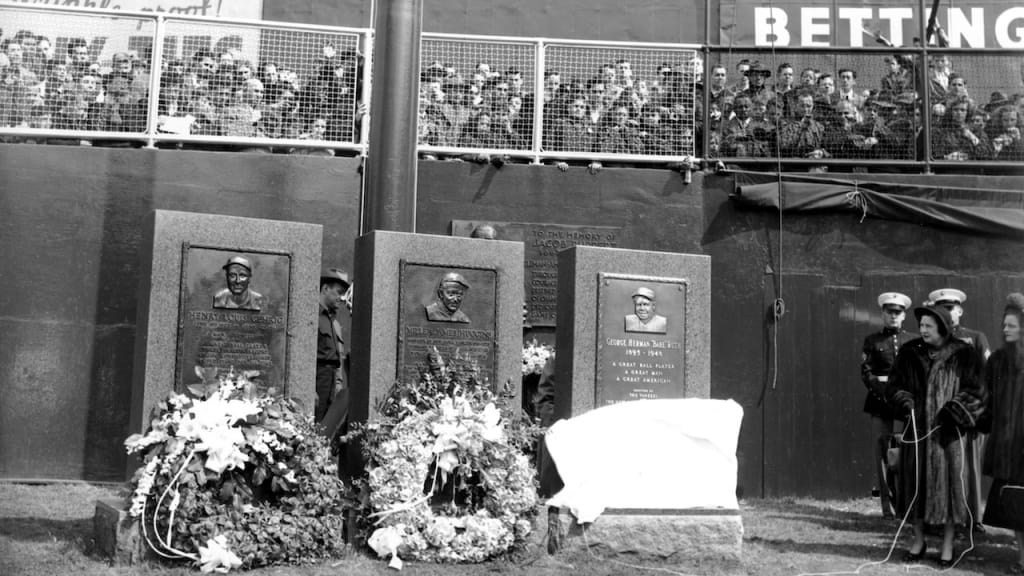
April 19, 1949: Monument dedicated to George "Babe" Ruth, right fielder, 1920-34. Placed to the right of the Huggins Monument. That's how it remained until 1973: Left to right, Gehrig, Huggins, Ruth. One time, a ball was hit out there, and Casey Stengel yelled, "Ruth, Gehrig, Huggins, somebody throw that ball back in!" Ruth's Number 3 had been retired the year before, shortly before he died.
Claire Ruth unveiling her husband's Monument

April 15, 1954: Plaque dedicated to Ed Barrow, general manager, 1921-46. Placed on the center field wall, to the left of the flagpole. So it appeared to someone looking in from home plate as follows: Barrow, Gehrig, Huggins, Ruth, Ruppert.

And this is how they appeared to fans as they were allowed to come onto the outfield -- but not the infield -- after the game, and walk out of the Stadium at a center field gate. Many fans -- including comedian Billy Crystal and broadcaster Bob Costas, both from nearby Long Island -- would recall doing this as boys, and thinking that the three Monuments looked like tombstones, and incorrectly thinking that Gehrig, Huggins and Ruth were buried there.

October 4, 1965: Plaque donated by the New York City chapter of the Knights of Columbus in honor of that day's Mass delivered by Pope Paul VI.  Placed on the center field wall, to the right of the Ruppert Plaque.

June 8, 1969: Plaque dedicated to Mickey Mantle, center fielder, 1951-68. Number 7 retired for him. Plaque also dedicated to Joe DiMaggio, center fielder, 1936-52. Number 5 had been retired for him in 1952.

April 12, 1970: Plaques installed for DiMaggio and Mantle. There was a second pole on the field, with speakers for the sound system, to the right of the main flagpole. The center fielders' Plaques were placed on the wall, to its right. So, until Yankee Stadium closed for renovations in 1973, the honors appeared as follows: Barrow, Gehrig, Huggins, Ruth, Ruppert, Paul VI, DiMaggio, Mantle.

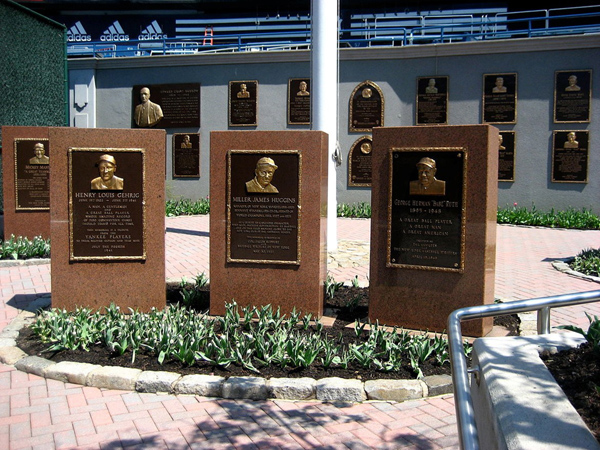
April 15, 1976: Yankee Stadium reopens after a renovation, forcing the Yankees to play the 1974 and 1975 seasons at Shea Stadium, home of the New York Mets. "Monument Park" is created, this time out of play, behind the fence in left-center field. The flagpole was placed there, and the Gehrig, Huggins, Ruth Monuments, left to right in that order, were put in front of it. The Plaques for Ruppert, Barrow, DiMaggio, Mantle and Paul VI were placed on the bleacher wall, still 460 or so feet from home plate, but now out of play, behind a fence that was about 430 feet from home plate.

April 21, 1976: Plaque dedicated to Joe McCarthy, manager, 1931-46. Despite managing in the major leagues as late as 1950, he never wore a number on his uniform, so there was no number for the Yankees to retire.

July 30, 1976: Plaque dedicated to Charles "Casey" Stengel, manager, 1949-60. Number 37 had been retired for Stengel in 1970.

October 2, 1979: Plaque donated by the Knights of Columbus in honor of that day's Mass delivered by Pope John Paul II.

September 20, 1980: Plaque dedicated to Thurman Munson, catcher, 1969-79. He had been killed in a plane crash the year before, and Number 15 was retired for him.

July 21, 1984: Plaques dedicated to Elston Howard, left fielder-catcher, 1955-67, and coach, 1969-80; and Roger Maris, right fielder, 1960-66. Number 32 retired for Howard, and Number 9 retired for Maris.

April 16, 1985: After 9 seasons -- 11, counting the renovation -- Monument Park is made accessible to fans once again, although additions to the line to see it are stopped at 45 minutes before the scheduled first pitch. This forces the Yankees to move the outfield fence in a bit.
The Mantle Monument is there, but the DiMaggio Monument isn't.
So this must be either late in the 1996 season, 1997, or 1998.

August 4, 1985: Plaque dedicated to Phil Rizzuto, shortstop, 1941-56, and broadcaster, 1957-96. Number 10 retired for him.

August 10, 1986: Plaque dedicated to Alfred "Billy" Martin, 2nd baseman, 1950-57, manager on and off 5 times, 1975-88. Number 1 retired for him.

August 2, 1987: Plaques dedicated to Vernon "Lefty" Gomez, pitcher, 1930-42; and Edward "Whitey" Ford, pitcher, 1950-67. Number 16 had been retired for Ford in 1974, but, to this day, Number 11 has not been retired, not for Gomez, nor for any other player who has worn it.

April 5, 1988: An expansion of Monument Park makes it more accessible to fans. This causes the Yankees to bring the fences in further, to the distances that Yankee Stadium, old and now new, have had ever since.

August 21, 1988: Plaques dedicated to Bill Dickey, catcher, 1928-46; and Lawrence "Yogi" Berra, catcher-left fielder, 1946-63, manager, 1964 and 1984-85, coach, 1975-83. Both players had worn Number 8, and in 1972, the Yankees made it the first uniform number in any sport to be retired for two different people.

August 27, 1989: Plaque dedicated to Allie Reynolds, pitcher, 1947-54. Number 22 has not been retired, not for Reynolds, nor for any other player who has worn it.

August 25, 1996: Monument dedicated to Mantle, replacing his Plaque, following his death the year before.

August 31, 1997: Plaque dedicated to Don Mattingly, 1st baseman, 1982-95; later coach, 2004-07. Number 23 was retired for him.

July 25, 1998: Plaque dedicated to Mel Allen, broadcaster, 1939-64, and again 1976-90.

April 25, 1999: Monument dedicated to DiMaggio, replacing his Plaque, following his death the month before.

May 7, 2000: Plaque dedicated to Bob Sheppard, Yankee Stadium public address announcer, 1951-2007. He had also been the P.A. announcer for the All-America Football Conference's Brooklyn Dodgers, 1946-49; and the NFL's New York Giants, 1956-96.

July 6, 2002: Plaque dedicated to Reggie Jackson, right fielder, 1977-81. Number 44 had been retired for him in 1993.

September 11, 2002: A Monument was dedicated to the September 11, 2001 terrorism victims and rescue workers.

August 23, 2003: Plaque dedicated to Ron Guidry, pitcher, 1975-88. Number 49 retired for him.

July 10, 2004: Plaque dedicated to Charles "Red" Ruffing, pitcher, 1930-46. He had worn Number 15, which was retired for Munson, and was not also retired for Ruffing. This made him the last player so honored at the old Yankee Stadium.

April 17, 2007: Plaque dedicated to Jackie Robinson, the 1st black player in modern baseball. The 60th Anniversary of major league debut had been 2 days earlier, but the Yankees were on the road that day. He is the only baseball-connected person honored in Monument Park who had never been employed by the Yankees in any way. His Number 42 had been retired for all of professional baseball in 1997, on the 50th Anniversary, but players then wearing it were allowed to continue wearing it until they retired, and Mariano Rivera of the Yankees would be the last one to do wear it regularly. Starting with the 70th Anniversary, in 2017, on every April 15 (or, for those teams on the road that day, in their closest home game to the date), all players on both teams wear Number 42 with no name on the back.

April 20, 2008: Plaque donated by the Knights of Columbus in honor of that day's Mass delivered by Pope Benedict XVI.

April 16, 2009: The new Yankee Stadium opens, across 161st Street from the old one, at River Avenue. A new Monument Park is placed behind straightaway center field, but it is positioned at field level, so it can't be seen from much of the stands. And the dark gray wall behind it makes it even harder to see from a distance. It is derisively nicknamed "Monument Cave."

September 20, 2010: Monument dedicated to George Steinbrenner, team owner, 1973-2010, who had died 2 months earlier. This was the 1st Monument Park dedication at the new Yankee Stadium.
"The Boss," between Mantle and DiMaggio,
behind Gehrig, Huggins and Ruth

April 16, 2014: Monument dedicated to Nelson Mandela, the civil rights advocate who spoke at a rally at the old Stadium in 1990, and served as the 1st President of a fully democratic South Africa, 1994-99. The date on the Plaque says April 15, because it was supposed to be part of the celebrations of Jackie Robinson Day, to be followed by a game. But it rained, and the ceremony was pushed back a day.

June 21, 2014: Plaque dedicated for Tino Martinez, 1st baseman, 1996-2001. This made Tino the 1st player given a Plaque at the new Stadium, and the 1st player from the Joe Torre Dynasty so honored. His Number 24 has not been retired for him, or for anyone else who has ever worn it.

June 22, 2014: Plaque dedicated for Rich "Goose" Gossage, pitcher, 1978-83. His Number 54 has not been retired for him, or for anyone else who has ever worn it.

August 9, 2014: Plaque dedicated for Paul O'Neill, right fielder, 1993-2001. He has since become a Yankee broadcaster. His Number 21 was not retired for him, or for anyone else who has ever worn it, and still hasn't been. (UPDATE: It was retired for O'Neill on August 21, 2022.)

August 23, 2014: Plaque dedicated for Joe Torre, manager, 1996-2007. Number 6 retired for him. With 5 Monument Park ceremonies in one season, plus a later ceremony honoring Derek Jeter on his retirement, it was widely remarked that the Yankees were holding these ceremonies to get big crowds in a season when they were out of the Playoff race. Of course, if that were true, it would have made more sense to wait until the next season, when they wouldn't have Jeter to help bring crowds in. Which did turn out to be the case, as there were 4 ceremonies honoring 5 men:

May 24, 2015: Plaque dedicated for Bernie Williams, center fielder, 1991-2006. Number 51 retired for him.

June 20, 2015: Plaques dedicated for Mel Stottlemyre, pitcher, 1964-74, pitching coach, 1996-2005; and Willie Randolph, 2nd baseman, 1975-88, and coach, 1994-2004. Both men wore Number 30, but it was not retired for either of them, or for anyone else who has ever worn it, and still hasn't been.

August 22, 2015: Plaque dedicated for Jorge Posada, catcher, 1995-2011. Number 20 retired for him.

August 23, 2015: Plaque dedicated for Andy Pettitte, pitcher, 1995-2013. Number 46 retired for him.

August 14, 2016: Plaque dedicated for Mariano Rivera, pitcher, 1995-2013. Number 42 had already been retired for him when he retired as a player.

May 14, 2017: Plaque dedicated for Derek Jeter, shortstop, 1995-2014. Number 2 retired for him.

June 25, 2019: Plaque dedicated, commemorating the 50th Anniversary of the Stonewall Inn Uprising, in New York on June 28, 1969, which sparked the movement for LGBT rights in America. It includes these words: "This Plaque serves to honor the struggle for equality and is a reminder of the richness we gain by nurturing inclusion and diversity. Acceptance forms the bedrock of our community, and let it be known that Yankee Stadium welcomes everyone as a gathering place for all." As of May 30, 2022, this is the most recent dedication in Monument Park.

UPDATE: Pope Francis, who succeeded Benedict XVI, died in 2025. He visited New York on September 25, 2015, and delivered a Mass at Madison Square Garden, but he did not visit Yankee Stadium. As of May 30, 2026, his successor, the American-born Pope Leo XIV, has not yet visited America since assuming the Papacy.

The Yankees have announced that they plan to honor CC Sabathia, pitcher, 2009-19, on September 26, 2026, with a Monument Park Plaque, and the retirement of his Number 52.

*

May 30, 1932 was a Monday. Although Memorial Day fell on a Monday this year, it would always be commemorated on May 30 until 1968, at which point it was moved to the last Monday in May. These other baseball games were played:

* The New York Giants swept a doubleheader from the Boston Braves, 6-2 and 4-2 at Braves Field in Boston. Carl Hubbell outpitched Tom Zachary in the opener, and went 1-for-4 in his own cause. Fred Lindstrom won the nightcap by singling Hughie Critz home in the top of the 10th inning. 

Over the 2 games, Bill Terry went 1-for-10 with an RBI, Mel Ott went 6-for-10 with a home run and 4 RBIs, and Travis Jackson went 3-for-9 with an RBI. Four days later longtime manager John McGraw retired, and Terry was named player-manager.

* The Brooklyn Dodgers swept a doubleheader from the Philadelphia Phillies, 13-4 and 5-3 at Ebbets Field. Over the 2 games, former Cubs slugger Lewis "Hack" Wilson went 3-for-5 with a home run, 3 walks and 3 RBIs.

* The Philadelphia Athletics swept a doubleheader from the Washington Senators, 13-2 and 8-6 at Shibe Park in Philadelphia. In the 1st game, Robert "Lefty" Grove (the top lefthanded pitcher in baseball at the time) outpitched Fred "Firpo" Marberry (so nicknamed because it was thought he resembled Argentine boxer Luis Firpo, who nearly took the Heavyweight Championship of the World from Jack Dempsey in 1923). Mickey Cochrane did not play in this game.

In the 2nd game, George Earnshaw went the distance for the win, and goes 3-for-4 with an RBI in his own cause. He outpitched Alvin "General" Crowder (so nicknamed because his surname reminded people of Enoch Crowder, the Judge Advocate General of the U.S. Army, who was responsible for implementing the military draft of World War I). Cochrane went 0-for-5.

Over the 2 games, Jimmie Foxx went 2-for-7 with a home run, 2 walks and 3 RBIs, Al Simmons went 6-for-10 with 2 home runs and 4 RBIs, Ed Coleman goes 6-for-9 with a home run and 4 RBIs, Jimmie Dykes went 4-for-9 with 2 home runs, a walk, and 7 RBIs, and Roger "Doc" Cramer went 4-for-9 with a walk and an RBI.

* A doubleheader was split at Forbes Field in Pittsburgh. The Cincinnati Reds won the 1st game, 4-2. The Pittsburgh Pirates won the 2nd game, 5-2. Over the 2 games, Paul and Lloyd Waner each went 2-for-8, with Paul adding 2 RBIs, and Pie Traynor only appeared in the 1st game, as a pinch-hitter, and did not reach base.

* The Cleveland Indians swept a doubleheader from the Chicago White Sox, 12-6 and 12-11 at League Park in Cleveland. Although Cleveland Municipal Stadium had opened the preceding July 1, the Indians would not play their 1st game there until July 31, 1932, and would then do so for special occasions, including holiday doubleheaders, and then for night games starting in 1939, as League Park never got lights. They began playing all home games there in 1947, and did so until moving to what's now named Progressive Field in 1994.

* A doubleheader between arch-rivals was split at Wrigley Field in Chicago. The St. Louis Cardinals won the 1st game, 6-4. Paul Derringer outpitched Burleigh Grimes. The Chicago Cubs won the 2nd game, 6-2. Guy Bush outpitched Tex Carleton. Over the 2 games, former Cardinal star Rogers Hornsby, now playing for the Cubs, went 2-for7 with a solo home run and 2 walks.

* And the Detroit Tigers swept a doubleheader from the St. Louis Browns, 17-9 and 4-0 at Sportsman's Park in St. Louis. Tommy Bridges pitched a 7-hit shutout in the 2nd game. Over the 2 games, John Stone went 4-for-10 with 4 RBIs, Charlie Gehringer went 6-for-9 with a walk and 5 RBIs, and Gerald "Gee" Walker went 5-for-10 with 3 RBIs.

Monday, January 10, 2022

January 11, 1915: Jacob Ruppert Buys the Yankees

January 11, 1915: Jacob Ruppert and Tillinghast L'Hommedieu Huston buy the New York Yankees. Professional sports in America will never be the same.

Jacob Ruppert Jr. was born on August 5, 1867 in Manhattan. What does a New York business lord, who would have been nothing without his father's money, do when he gets bored? He runs for office and buys a sports team.

Unlike Donald Trump, this one stayed a Democrat, and ran for office first, being elected to Congress in 1898, 1900, 1902, 1904 and 1906. But, again like Trump, he had a lousy attendance record -- as did a New York business lord friend of his who had also been elected to Congress, William Randolph Hearst. (Ruppert's friends called him "Jake." Although Hearst's friends called him "Willie," he is definitely not to be confused with the much later Yankee 2nd baseman, Willie Randolph.)

Eventually, Ruppert got bored with running the family brewery again, and tried to buy the New York Giants baseball team, owned by Harry Hempstead, son-in-law of their former owner, the late John T. Brush. Team manager John McGraw told him the Giants weren't for sale, but that the New York Yankees might be. So he bought them in 1915. In this, as in politics, he had a better record than Trump, once the owner of the USFL's New Jersey Generals.

His partner, Tillinghast L'Hommedieu Huston, was born on July 17, 1867 in Buffalo, and grew up in Cincinnati. He became a U.S. Army engineer, serving in the Spanish-American War, where "Til" Houston became "Cap" Huston. A baseball fan, he became friends with McGraw, and thought he had a deal to buy the Chicago Cubs from Charles Phelps Taft, a fellow Cincinnatian and half-brother of former President William Howard Taft. But it fell apart. McGraw introduced Huston to Ruppert, and they teamed up.

Frank Farrell and Bill Devery were the original owners of the New York Yankees, who were the New York Highlanders from their 1903 founding until 1912. They had not done well, either on the field or at the box office, and, as one team historian put it, they were sick of baseball and sick of each other, and wanted out. Ruppert and Huston spent $460,000 -- about $12.8 million in 2022 money.

When World War I broke out, Huston went back into the Army, and rose to the rank of Colonel. Ruppert had enlisted in the New York National Guard at age 19, and stayed in it, also rising to the rank of Colonel. So Ruppert and Huston became known as "The Colonels," but while Ruppert liked being called "Colonel Ruppert," Huston liked keeping his old nickname of "Cap."

What Huston didn't like was that, before the 1918 season, Ruppert hired a new manager without even contacting him. It didn't matter that the manager was a fellow Cincinnatian: It was done without Huston's okay, and the relationship between the Colonels was forever damaged. He was a former good-field-no-hit 2nd baseman, who had been managing the St. Louis Cardinals, and had a law degree: Miller Huggins.

In 1920, Ruppert bought Babe Ruth -- just in time, because Prohibition had come and he needed a source of income. An urban legend says that Ruppert designed the Yankee's Pinstriped uniforms because they made Ruth look thinner. This isn't true: Ruth wasn't fat yet, and the Yankees first wore Pinstripes in 1912, before Ruppert bought the team. Nor were they the first team to wear them: The Giants, among others, had.

In 1923, he built the original Yankee Stadium and signed Lou Gehrig. He also bought out Huston's share, letting him stay along long enough to take in some of the glory of the Stadium, which, as an engineer, he appreciated. When Huston died in 1938, none of the current Yankees had even met him.

Ruppert built the Yankee farm system, with general manager Ed Barrow and farm system director George Weiss, who eventually became GM himself. This included the Newark Bears and the Kansas City Blues, both of whom played in ballparks that would be named Ruppert Stadium.

In 1934, Ruppert signed Joe DiMaggio. By the time he died, on January 13, 1939, of phlebitis at the age of 71, he had overseen 10 American League Pennants and 7 World Series wins, and built the greatest team and the greatest stadium in the history of North American sports.

On April 16, 1940, a plaque was placed on the outfield wall at Yankee Stadium, its image of Ruppert derived from the photograph above. It was moved to Monument Park in 1976, and to the new Yankee Stadium in 2009, so it no longer rests in what its text calls "this imposing edifice."
For some reason -- probably more an oversight as much as anything else -- it took until 2013 to elect him to the Baseball Hall of Fame.

*

January 11, 1915 was a Monday. Baseball and football were out of season. Basketball was in its early stages. And the closest thing hockey had to major leagues -- the National Hockey Association in the East and the Pacific Coast Hockey Association in the West -- had their seasons underway, but played no games. So there were no scores on this historic day.

December 31, 1999 & January 1, 2000: The Millennium

December 31, 1999:  The Millennium arrives. The people of planet Earth survived. At a terrible cost. But we hadn't destroyed ourselves. ...