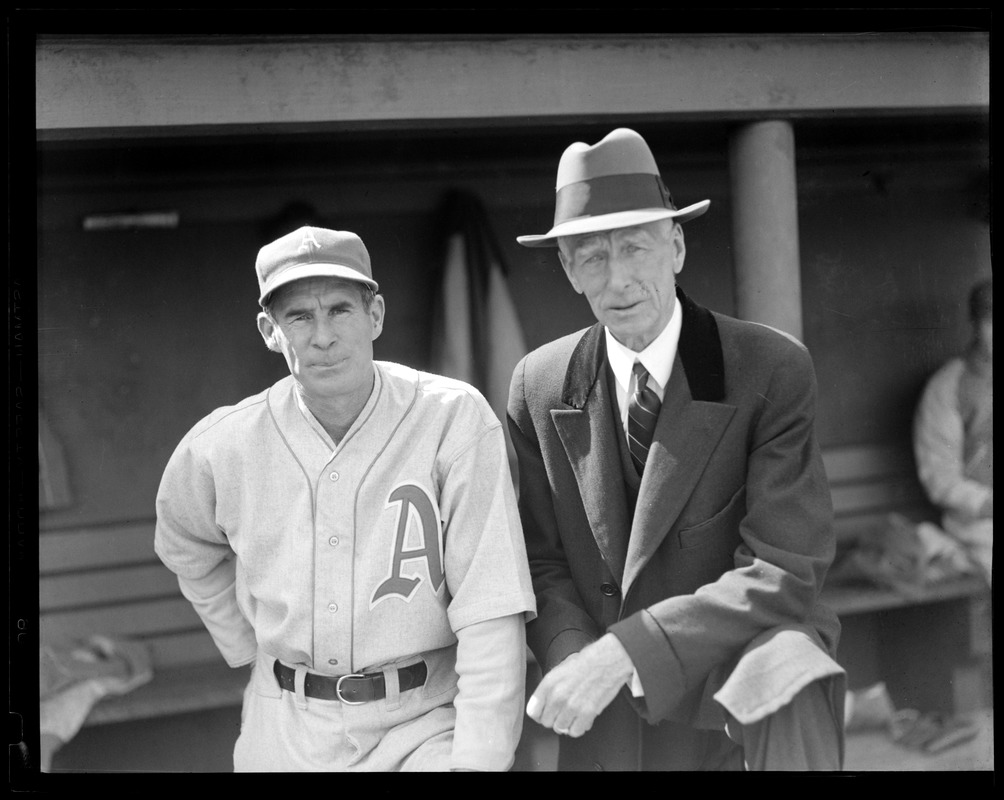
Connie Mack and Bobby Shantz, who turned out to be
the last living former player for the Philadelphia Athletics
Johnson's bid is $3‚375‚000 for the team and stadium‚ Shibe Park, recently renamed Connie Mack Stadium. He says he will sell the stadium to the Phillies for $1‚675‚000, although Phils owner Bob Carpenter, a very wealthy man as a member of both the Carpenter and the duPont families, says, "I need Shibe Park like I need a hole in the head."
One of the offers for the team is from a wealthy Texas group that proposes to move the A's to Los Angeles. This would have meant that the expansion team of 1961 that we currently know as the Los Angeles Angels would have been established elsewhere. However, given that the A's were in the American League, Walter O'Malley still might have moved the National League's Brooklyn Dodgers there.
But the A's did not go to L.A. Kansas City, long a hotbed of minor league and Negro League baseball, gets major league status for the 1st time since the Kansas City Packers of the Federal League in 1915 – or, if you don’t count that, since the Kansas City Cowboys of the old American Association in 1889.
The A's had won AL Pennants in 1902, 1905, 1910, 1911, 1913, 1914, 1929, 1930 and 1931. They had won the World Series in 1910, 1911, 1913, 1929 and 1930. Connie Mack had built 2 dynasties, then broke them up because he needed money.
Unlike in Boston, where the Red Sox stayed and the Braves left, and St. Louis, where the Cardinals stayed and the Browns left, in Philadelphia, the more historically successful team was the one that moved. But while the A's had 9 Pennants to the Phillies' 2, and 5 titles to the Phils' none, the Phils had money, and the A's didn't. And, since both teams couldn't survive in the city, the one without the money went.
Would Philadelphia have been better off if it had been the A's that stayed and the Phils that moved? Imagine, instead, that the Carpenters had bought the A's from the Macks in 1943, instead of buying the Phils from William D. Cox at that time. Here is what the teams won from 1931 to 1970:
Phillies: 1950 Pennant, plus that agonizing near-miss of 1964
A's: Nothing
Doesn't sound good for either team, but at least the Phils won something, right? Hold on, here's 1971 to 2006:
A's: 1971 AL West, 1972 World Series, 1973 World Series, 1974 World Series, 1975 AL West, 1981 AL West, 1988 Pennant, 1989 World Series, 1990 Pennant, 1992 AL West, 2000 AL West, 2001 AL Wild Card, 2002 AL West, 2003 AL West, 2006 AL West
Phils: 1976 NL East, 1977 NL East, 1978 NL East, 1980 World Series, 1981 NL East (1st half), 1983 Pennant, 1993 Pennant
Better for both, but now, it favors the A's. Now, check it out from 2007 onward:
Phils: 2007 NL East, 2008 World Series, 2009 Pennant, 2010 NL East, 2011 NL East, 2022 Pennant
Would Philadelphia have been better off if it had been the A's that stayed and the Phils that moved? Imagine, instead, that the Carpenters had bought the A's from the Macks in 1943, instead of buying the Phils from William D. Cox at that time. Here is what the teams won from 1931 to 1970:
Phillies: 1950 Pennant, plus that agonizing near-miss of 1964
A's: Nothing
Doesn't sound good for either team, but at least the Phils won something, right? Hold on, here's 1971 to 2006:
A's: 1971 AL West, 1972 World Series, 1973 World Series, 1974 World Series, 1975 AL West, 1981 AL West, 1988 Pennant, 1989 World Series, 1990 Pennant, 1992 AL West, 2000 AL West, 2001 AL Wild Card, 2002 AL West, 2003 AL West, 2006 AL West
Phils: 1976 NL East, 1977 NL East, 1978 NL East, 1980 World Series, 1981 NL East (1st half), 1983 Pennant, 1993 Pennant
Better for both, but now, it favors the A's. Now, check it out from 2007 onward:
Phils: 2007 NL East, 2008 World Series, 2009 Pennant, 2010 NL East, 2011 NL East, 2022 Pennant
A's: 2012 AL West, 2013 AL West, 2014 AL Wild Card, 2018 AL Wild Card, 2019 AL Wild Card, 2020 AL Wild Card
So, now, the A's have the edge. Here it is, overall, 1901 to 2014:
A's: 30 postseason appearances, 15 Pennants, 9 World Championships
Phillies: 15 postseason appearances, 8 Pennants, 2 World Championships
Definitely, the A's were the ones that should have stayed. At least then, they'd have been in a better stadium than either the Oakland Coliseum or Veterans Stadium by 2004.
Vic Power played until 1965, making him the last active Philadelphia Athletic.
UPDATE: On September 26, 2025, Bobby Shantz celebrated his 100th birthday. By that point, he was the last living Philadelphia Athletic, and the last living man who had played for Connie Mack.
*
November 8, 1954 was a Monday. Baseball season was over. Football was in midweek: There would be no Monday Night Football for another 16 years. And the NBA and NHL seasons were underway, but no games were scheduled in either. So there were no scores on this historic day.