Showing posts with label pele. Show all posts

Saturday, November 19, 2022

November 19, 1969: Pelé's 1,000th Goal

November 19, 1969: Pelé scores the 1,000th goal of his professional soccer career, the greatest career that any player has ever had.

Edson Arantes do Nascimento grew up in Bauru, in the Brazilian State of São Paulo. Like his father, and most other Brazilian "futebol" players, he became known by a single name. Often it's the player's first name, but it would not be "Edson" by which he would be known. Nor would it be "Dico," which his family had called him.

As a boy, his favorite player was a goalkeeper for Rio de Janeiro team Vasco da Gama, known as Bilé. But in his accent, "Bee-LAY" became "Peh-LAY." The more he was called "Pelé," the more he complained, and the more it stuck. While the Hebrew word for "miracle" is pronounced "Peh-LAY," the word "Pelé" has no known meaning in Brazil's main language, Portuguese.

In 1956, only 15 years old, he was signed to Santos Futebol Clube of Santos, an industrial and port city near the city of São PauloHe remained with Santos for 18 years, as the club refused all offers from the giants of South American, and eventually European, football. He helped them win the Campeonato Paulista, the State Championship, 10 times. He helped them win the Campeonato Brasileiro Série A, the National Championship, 6 times, including 5 in a row from 1961 to 1965.

He helped them win back-to-back titles in the Copa Libertadores, the South American continental club championship. Each time, they beat the winners of the European Cup to win the Intercontinental Cup (now called the FIFA Club World Cup): Benfica of Lisbon, Portugal, featuring Eusébio, in 1962; and AC Milan of Italy, featuring Gianni Rivera, in 1963. (Like Pelé, Eusébio, a native of the African nation of Mozambique, then a colony of Portugal, is the greatest player his continent has ever produced. Also like Pelé, he was nicknamed "The Black Pearl.")

He helped the Brazil national team win the World Cup in 1958, only 17 years old, and again in 1962. Although he had been heavily fouled in the 1966 edition, resulting in Brazil's knockout in the Group Stage, he continued to rise in popularity, mainly due to the world tours taken by Santos. Essentially, the ability to show Pelé around the world kept Santos in business.

On November 19, 1969, still only 29 years old, he led Santos into Brazil's national stadium, the Estadio do Maracanã in Rio de Janeiro, to play Vasco da Gama. In all competitions to that point, he had been credited with 999 goals. Since this game featured one of the big clubs in the biggest city, against the man known as O Rei (The King), it was nationally televised.

He thought he had his 1,000th goal when he was brought down in the penalty area. "It had to be a penalty," he said later. "It had to come when the whole world could stop, and not miss it." He got it, and a crowd of 125,000 in the gigantic stadium erupted in cheers, enough of them rushing the pitch that the game could not continue. (With renovations, including being made all-seater, it now has a capacity of 78,838.)

He would lead Brazil to the World Cup again in 1970, making him the tournament's only 3-time winner. In 1975, he was brought to America to play for the New York Cosmos, leading them to the North American Soccer League Championship in 1977, his last season.

Pelé finished his career claiming 1,283 goals in all competitions. FIFA, the governing body for world soccer, refusing to count friendlies, credits him with 757. For comparison's sake, see his 2 current challengers for the title of "Greatest Of All Time": Through the end of the 2021-22 season, Cristiano Ronaldo is credited with 833, Lionel Messi with 796. Diego Maradona, the other major contender for the title, had "only" 446 for Argentina and his clubs combined.

But those 3, between them, are 1-for-12 in World Cups, the 1 being Maradona's in 1986, and, more blatantly than Crissy or Messi ever did, he cheated. Pelé was 3-for-4. Maradona? Messi? Throw in
Alfredo di Stéfano, and it's possible that neither one of them is even the best Argentine player ever. Cristiano? Given the achievements of Ronaldo de Lima, including the 2002 World Cup, Cristiano is not even the best Ronaldo to have played for Real Madrid in the 21st Century.

These kids today, they don't know: Pelé is the greatest. It's why the Brazilians call him O Rei: The King.

*

November 19, 1969 was a Wednesday. Living Single actress Erika Alexander was born. And Apollo 12 landed on the Moon. I have a separate entry for that event.

The baseball season was over. Football was in midweek. There were 5 games played in the NBA that night:

* The Boston Celtics beat the Chicago Bulls, 122-106 at the Boston Garden.

* The San Diego Rockets beat the Philadelphia 76ers, 125-116 at The Spectrum in Philadelphia. (The Rockets moved to Houston in 1971.)

* The Baltimore Bullets beat the Phoenix Suns, 133-118 at the Baltimore Civic Center. (It's now named the CFG Bank Arena. The Bullets moved to Washington in 1973, and became the Washington Wizards in 1997.)

* The Los Angeles Lakers beat the Cincinnati Royals, 116-103 at the Cincinnati Gardens. (The Royals became the Kansas City Kings in 1972, and the Sacramento Kings in 1985.)

* And the Atlanta Hawks beat the Seattle SuperSonics, 137-116 at the Seattle Center Coliseum. (The Sonics became the Oklahoma City Thunder in 2008.)

There were 2 games played in the American Basketball Association. The New York Nets beat the Miami Floridians, 115-110 at the Island Garden in Hempstead. And the New Orleans Buccaneers beat the Washington Capitols, 122-115 at the New Orleans Municipal Auditorium.

There were 5 games played in the NHL:

* The New York Rangers played the Chicago Black Hawks to a tie, 1-1 at the Chicago Stadium.

* The Montreal Canadiens and the Detroit Red Wings played to a tie, 5-5 at the Montreal Forum.

* The Toronto Maple Leafs and the Los Angeles Kings played to a tie, 4-4 at Maple Leaf Gardens in Toronto.

* The St. Louis Blues beat the Pittsburgh Penguins, 4-0 at the Civic Arena in Pittsburgh.

* The Oakland Seals beat the Minnesota North Stars, 4-2 at the Metropolitan Sports Center in the Minneapolis suburb of Bloomington, Minnesota.

* And the Boston Bruins and the Philadelphia Flyers were not scheduled to play. 

Saturday, October 1, 2022

October 1, 1977: Pelé's Testimonial

October 1, 1977: Edson Arantes do Nascimento, a.k.a. Pelé, the greatest soccer player who ever lived, plays his last game at a sold-out Giants Stadium in East Rutherford, New Jersey. It is his testimonial, and he plays the 1st half for the New York Cosmos, with whom he recently won the North American Soccer League Championship, and scores a goal; and the 2nd half for Santos, for whom he starred so long in Brazil's São Paulo State. The Cosmos win, 2-1.

When it's over, he stands at midfield with a microphone, and asks the crowd, "Please, say with me, three times: Love! Love! Love!" They do.

President Jimmy Carter attended. So did Muhammad Ali, the Heavyweight Champion of the World, who frequently called himself "the Greatest of All Time." This time, he says, "Now, I understand: He is greater than me."

*

October 1, 1977 was a Saturday. These Major League Baseball games were played that day:

* The New York Yankees lost to the Detroit Tigers, 10-7 at Yankee Stadium. Elrod Hendricks, briefly a Yankee in a long career mostly with the Baltimore Orioles, hit his only home run in Pinstripes. Reggie Jackson drew a walk in his only plate appearances, and was taken out for a pinch-runner.

The rain that fell on Pelé's testimonial at the Meadowlands comes down much harder on The Bronx, as the Yankees sit through a 2-hour, 42-minute rain delay. But the Yankees clinched the American League Eastern Division title anyway, because...

* The Baltimore Orioles beat the Boston Red Sox, 8-7 at Fenway Park in Boston. The Sox had eliminated the O's from the race the night before, and the Birds returned the favor on this day. Both teams would end up 2 1/2 games behind the Yankees.

* A doubleheader was split at Busch Memorial Stadium in St. Louis. The New York Mets won the 1st game, 8-4. The St. Louis Cardinals won the 2nd game, 4-2. Lou Brock went 2-for-8 with an RBI over the 2 games.

* The Montreal Expos beat the Philadelphia Phillies, 6-5 at Veterans Stadium in Philadelphia. The Expos scored 3 runs in the top of the 12th inning, and the Phillies could only come back with 2 in the bottom of the 12th. Mike Schmidt went 0-for-2 with a walk.

* The Cincinnati Reds beat the Atlanta Braves, 6-2 at Riverfront Stadium in Cincinnati. Pete Rose went 1-for-3, and did not finish the game. Johnny Bench did not start the game, and went 0-for-2.

* A doubleheader was split at Comiskey Park in Chicago. The expansion Seattle Mariners won the opener, 5-3. The Chicago White Sox won the nightcap, 6-1.

* The Minnesota Twins beat the Milwaukee Brewers, 9-1 at Milwaukee County Stadium. Rod Carew went 3-for-5 with an RBI, to raise his batting average to .386. He would finish the next day at .388, after having been above .400 in early September. Robin Yount went 1-for-4 with an RBI.

* The California Angels beat the Kansas City Royals, 4-1 at Royals Stadium (now Kauffman Stadium) in Kansas City. George Brett went 1-for-2 with a walk before being replaced by a pinch-runner. The Yankees would beat the Royals for the AL Pennant.

* The Texas Rangers beat the Oakland Athletics, 6-5 at Arlington Stadium in the Dallas suburb of Arlington, Texas.

* The Los Angeles Dodgers beat the Houston Astros, 4-3 at Dodger Stadium in Los Angeles. The Dodgers would beat the Phillies for the National League Pennant, but lose the World Series to the Yankees.

* The San Francisco Giants beat the San Diego Padres, 13-4 at Candlestick Park in San Francisco.

* The Cleveland Indians and the expansion Toronto Blue Jays were rained out at Exhibition Stadium in Toronto. They played a doubleheader the next day. The Jays won the 1st game, 2-1 in 11 innings. The Indians won the 2nd game, 5-4.

* The Chicago Cubs and the Pittsburgh Pirates were rained out at Three Rivers Stadium in Pittsburgh. They played a doubleheader the next day. The Pirates swept, 5-1 and 3-2.

There were also college football games played on this day, including the following:

* Number 1 Oklahoma beat Kansas, 24-9 at Owen Field in Norman, Oklahoma. Oklahoma won the Big Eight title. 

* The night before, Number 2 Southern California beat Washington State, 41-7 at the Los Angeles Memorial Coliseum.

* Number 3 Michigan beat Number 5 Texas A&M, 41-3 at Michigan Stadium in Ann Arbor.

* Number 4 Penn State were upset by Kentucky, 24-20 at Beaver Stadium in State College, Pennsylvania.

* Number 6 Ohio State beat Southern Methodist (SMU), 35-7 at the Cotton Bowl in Dallas.

* Number 7 Colorado beat Army, 31-0 at Michie Stadium in West Point, New York.

* Number 8 Texas beat Rice, 72-15 at Memorial Stadium in Austin. While the Longhorns had running back Earl Campbell, who went on to win the Heisman Trophy, the big story in this game was placekicker and punter Russell Erxleben, who set a record with a 67-yard field goal. The record would be tied twice within the next year and change, but never broken, partly because kicking tees have been banned.

Erxleben remains the only punter to be a 3-time All-American, and played 5 seasons for the New Orleans Saints, plus 1 as a "scab" for the Detroit Lions during the 1987 strike. He went into the securities business, and has twice served time in prison for fraud. His son, Ryan Erxleben, went into the family business -- punting, that is, not securities (fraudulent or otherwise), at Texas Tech, although he didn't make it to the NFL. 

* Number 9 Florida were upset by Louisiana State, 36-14 at Tiger Stadium in Baton Rouge, Louisiana.

* Number 10 Alabama beat Georgia, 18-10 at Bryant-Denny Stadium in Tuscaloosa, Alabama. 'Bama won the Southeastern Conference title, and beat Ohio State in the Sugar Bowl.

* Number 11 Nebraska beat Indiana, 31-13 at Memorial Stadium in Lincoln, Nebraska.

* Number 12 Arkansas beat Texas Christian (TCU), 42-6 at Amon G. Carter Stadium in Fort Worth, Texas. Arkansas went on to lose to Texas, costing them the Southwest Conference title, but beat Oklahoma in the Orange Bowl.

* Number 14 Notre Dame beat Michigan State, 16-6 at Notre Dame Stadium in South Bend, Indiana.

* Number 20 Arizona State were upset by Missouri, 15-0 at Sun Devil Stadium in the Phoenix suburb of Tempe, Arizona.

* The University of Washington lost to Minnesota, 19-17 at Memorial Stadium in Minneapolis. But Washington rebounded to win the Pacific-8 title, and beat Michigan in the Rose Bowl.

* Duke beat Navy, 28-16 at Wallace Wade Stadium in Durham, North Carolina.

* Columbia beat Pennsylvania, 30-18 at Baker Field in Manhattan.

* Among New Jersey's teams, Rutgers beat Cornell, 30-14 at Schoellkopf Field in Ithaca, New York. And Princeton lost to Brown, 10-7 at Brown Stadium in Providence, Thode Island.

Also on this day, the St. Louis Blues retired the Number 3 of Bob Gassoff, a defenseman who'd been with them since 1973. The preceding May 27, he was killed in a motorcycle accident in Gray Summit, Missouri. He'd been racing motorcycles with friends at a barbecue at the home of teammate Garry Unger, but had driven off the property, wasn't wearing a helmet, and was hit by a car. The native of Quesnel, British Columbia was only 26.

In high school football, my Alma Mater, East Brunswick High School in Central New Jersey, beat Madison Central, 28-0 at Vince Lombardi Field in Old Bridge. Madison Central is now named Old Bridge.

And in English soccer, Arsenal of North London beat West Ham United of East London, 3-0 at Highbury in North London.

Wednesday, June 29, 2022

June 29, 1958: Brazil's Redemption

After the Final. Having kept his promise to his father,
17-year-old Pelé feels the moment.

June 29, 1958: The Brazil national soccer team, the Seleção, goes into the Final of the World Cup, against the host team, Sweden, and looking for redemption.

They had lost the Final in 1950, to neighboring Uruguay, on home soil, at the Estadio do Maracanã in Rio do Janeiro. The loss was a blow to the national psyche of Brazil, so often wrapped up in this sport of soccer. It is known as Maracanazo in Spanish, Maracanaço in Portuguese: "The Agony of Maracanã." The 1950 World Cup was supposed to be a statement for Brazil, showing the world that it was a modern country, worthy of respect and admiration around the postwar world. This was the country's coming-out party, and it was ruined.

Minister of Sport Aldo Rebelo said, "Losing to Uruguay in 1950 not only impacted on Brazilian football, it impacted on the country's self-esteem." Instead of hating Uruguay for the ruination, Brazilians blamed themselves.

In 1954, Brazil lost to Hungary in the Quarterfinal. At that point, Hungary were favored, so it wasn't as much of a blow. But by 1958, most the players from the 1950 team were gone, and replaced by new players, keeping in mind that many Brazilian players are known by nicknames:

* From Rio club Botafogo: Midfielders Garrincha and Didi, defender Nílton Santos.

* From Rio club Flamengo: Forward Mário Zagallo, midfielders Dida, Moacir and Joel.

* From Rio club Fluminense: Goalkeeper Carlos Castilho (a 1950 holdover, but a backup then).

* From Rio club Vasco da Gama: Defender and Captain Hilderaldo Bellini, defender Orlando Peçanha, forward Vavá.

* From Rio club Bangu: Defender Zózimo.

* From São Paulo FC: Midfielders Dino Sani and Nílton de Sordi, and defender Mauro Ramos.

* From São Paulo club Corinthians: Goalkeeper Gilmar, defender Oreco.

* From São Paulo club Palmeiras: Midfielder José Altafini.

* From São Paulo club Portuguesa: Defender Djalma Santos.

* And from São Paulo club Santos: Midfielders Zito and Pepe... and forward Pelé.

Pelé was born Edson Arantes do Nascimento. His father, known as Dondinho, had played for Fluminense, but his career came to an early end due to injury. Edson saw his father crying next to the radio after the 1950 World Cup Final, and promised him that, one day, the son would win the World Cup for the father. Now, he was 17 years old, might already have been the best player in the world.

This remains the only World Cup for which all 4 British “Home Nations” qualified. There were 4 Groups in the Group Stage, and each had 1 British team in it:

* Wales drew with a Hungary team weakened by the loss of players who had fled the country during their Revolution in 1956, drew with Mexico, and drew with Sweden, resulting in the need for a Playoff for the 2nd qualifier from their Group. They came from behind to beat Hungary, and advanced. They lost the Quarterfinal to Brazil.

* Northern Ireland beat Czechoslovakia, lost to Argentina, and drew with West Germany, to finish tied with the Czechs for 2nd in their Group. They beat the Czechs in a Playoff that went to extra time, and moved on to the Knockout Stage. They lost the Quarterfinal to France.

* Scotland weren't so lucky: They drew with Yugoslavia, then lost to Paraguay and France by 1 goal each, and finished last in their Group.

* And England, weakened by the Munich Air Disaster that killed 8 Manchester United players 4 months earlier, could only manage 3 draws: With the Soviet Union, then Brazil, then Austria. That forced them into a Playoff with the Soviets for the 2nd qualifier, and they lost.

Argentina lost their last Group Stage match, 6-1 to Czechoslovakia, at the Olympiastadion in Helsingborg on June 15, to finish last in their Group. The country remembers it as El Desastre de Suecia: The Disaster of Sweden.

Brazil topped their group, beating Austria 3-0 in Uddevalla, playing England to a 0-0 draw in Gothenburg, and beating the Soviet Union in Gothenburg. Pelé scored the only goal in Brazil's 1-0 win over Wales in the Quarterfinal at Gothenburg, and scored 3 in their 5-2 win over France at the Råsunda Stadium in Solna, part of the national capital of Sweden. The host nation had managed to reach the Final, despite never having gotten there before, and they haven't since.
Råsunda Stadium

As the host nation, Sweden got the first choice of uniform, and they chose yellow shirts with blue shorts -- Brazil's usual first-choice kit. Brazil was forced to wear their "change strip": Blue shirts and white shorts.

Nils Leidholm, the A.C. Milan legend, scored in only the 4th minute of the game, and the Swedish fans believed they were on their way to glory. But Vavá tied the game in the 9th, and gave Brazil the lead in the 32nd. Pelé made it 3-1 in the 55th, and Zagallo made it 4-1 in the 68th. Agne Simonsson scored in the 80th minute, to put the game back into doubt. But Pelé scored in stoppage time to give Brazil a 5-2 win, the Jules Rimet Trophy, and the redemption they sought.

Pelé had kept the promise he made to his father 8 years earlier. He would help Brazil win the World Cup again in 1962, although he would be injured during the Group Stage, and did not play in the Final in Santiago, Chile, beating Czechoslovakia. He helped them win again in 1970, beating Italy in the Final in Mexico City.

Brazil have gone on to win the World Cup a record 5 times, having beaten Italy in the Final again in the Rose Bowl in 1994, and beating Germany in Yokohama, Japan in 2002. They have also lost the Final to France in Paris in 1998.

You will notice that none of those 5 wins have been in Brazil. The World Cup has returned to that country only once, in 2014, and Brazil got to the Semifinal, but had an even more stunning loss at the Maracanã. It wasn't that they lost to Germany, who then beat Argentina in the Final. It wasn't even that they were looking forward to beating Argentina in the Final in the Maracanã themselves. The truly shocking part was the score: Germany beat Brazil, in the Maracanã, by a score of 7-1.

Opened in 1937, the Råsunda Stadium was Sweden's national stadium, and also the home field of Stockholm team AIK. It was demolished in 2013, having been replaced by the Friends Arena.

UPDATE: An article for ESPN.com, published after the 2026 World Cup, ranking all 23 tournaments, rated this one 14th, citing the 1950s' equivalent of big star power, but also suggesting that Brazil might have been a bit too dominant.

*

June 29, 1958 was a Sunday. These baseball games were played that day:

* The New York Yankees lost to the Kansas City Athletics, 12-6 at Kansas City Municipal Stadium. Bob Turley and once-and-future Yankee Ralph Terry were the starters, and neither got out of the 4th inning. Mickey Mantle went 1-for-4 with a home run, a walk and 2 RBIs. Yogi Berra went 2-for-5 with an RBI. Two future Yankees hit home runs for the A's: Roger Maris went 4-for-6 with 2 RBIs, and Héctor López went 1-for-2 with a walk and 2 RBIs.

* A doubleheader was scheduled for Connie Mack Stadium in Philadelphia. The Philadelphia Phillies won the 1st game, beating the St. Louis Cardinals, 5-4. Stan Musial went 3-for-5 with a walk. Harry Anderson doubled Solly Hemus home with the winning run in the bottom of the 13th inning.

Because Pennsylvania, the last State to legalize Sunday sports, still had a 7:00 PM curfew for the day, the game was suspended in the bottom of the 8th, with the Cards leading, 4-3. It was completed on July 29, and that score held. Musial got a hit as a pinch-hitter.

* A doubleheader was split at Forbes Field in Pittsburgh. The Pittsburgh Pirates won the 1st game, 4-3. The Chicago Cubs won the 2nd game, 8-3. Over the 2 games, Roberto Clemente went 1-for-5 (he left the 2nd game early), and Ernie Banks went 3-for-7 with 2 walks.

* The Baltimore Orioles swept a doubleheader from the Cleveland Indians, 11-6 and 5-2 at Cleveland Municipal Stadium.

* The San Francisco Giants beat the Cincinnati Reds, 2-0 at Crosley Field in Cincinnati. Al Worthington pitched 8 innings of 4-hit shutout ball, and Johnny Antonelli pitched a perfect 9th. Willie Mays went 2-for-5 with an RBI. Former Brooklyn Dodger star Don Newcombe pitched 8 strong innings, but was the losing pitcher. Frank Robinson appeared only as a pinch-hitter, and did not reach base.

* The Boston Red Sox beat the Detroit Tigers, 10-7 at Briggs Stadium (later Tiger Stadium) in Detroit. Ted Williams went 2-for-4 with a home run, a walk, and 3 RBIs. Al Kaline went 0-for-3.

* A doubleheader was split at Comiskey Park in Chicago. The Washington Senators won the opener, 12-0. Pedro Ramos pitched a 5-hit shutout. The Chicago White Sox won the nightcap, 12-11. Jim Rivera doubled Earl Battey home with the winning run in the bottom of the 11th inning.

* And the Milwaukee Braves beat the Los Angeles Dodgers, 10-6 at Milwaukee County Stadium. Hank Aaron went 4-for-5 with a grand slam off Don Drysdale, and 5 RBIs. Charlie Neal hit 2 home runs for the Dodgers.

Tuesday, June 21, 2022

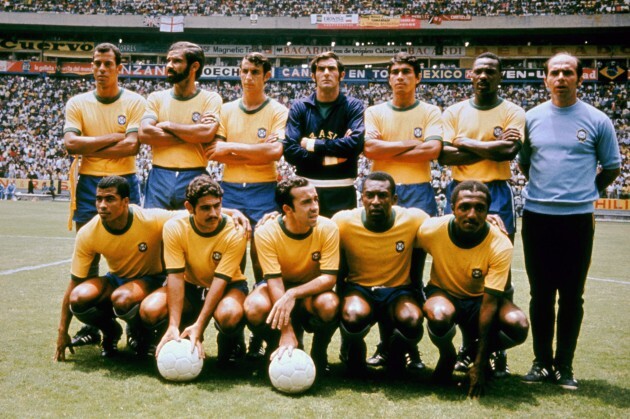
June 21, 1970: Brazil's Masterpiece

June 21, 1970: The World Cup Final is held before 107,412 fans at Estadio Azteca in Mexico City. It was the 1st World Cup televised in color around the world, and, as a recent article stated, the way it was broadcast and merchandised suggested that it was closer in style and form to the most recent World Cup, in Russia in 2018, than it was to the one it followed, in 1966 in England.

This was also the 1st World Cup that left the old, heavy, basketball-type ball behind, and used what became, largely because of this tournament, the most famous ball in the history of sports: The Adidas Telstar, with its black pentagons and white hexagons.
Let me get "the local angle" out of the way first. America -- or "the United States," if you prefer -- did not qualify for the 1970 World Cup. We did try, but, as was the case for every one between 1950 and 1990, we simply weren't good enough.
CONCACAF, the Confederation of North, Central American and Caribbean Association Football, put the U.S. in a Qualification Group Stage with Canada and Bermuda. On October 13, 1968, we lost 4-2 to Canada at Varsity Stadium in Toronto. On October 26, we beat Canada 1-0 at Atlanta (later Atlanta-Fulton County) Stadium. On November 2, we beat Bermuda 6-2 at Kansas City Municipal Stadium. And on November 11, we beat Bermuda 2-0 at their National Stadium in Hamilton.
So we advanced to the Semifinal, where we faced Haiti, a team we should have beaten, but didn't. On April 20, 1969, we lost 2-0 Stade Sylvio Cantor in Port-au-Prince. And on May 11, we lost 1-0 at San Diego (later Jack Murphy) Stadium, ending our bid. Haiti then lost the Final to El Salvador, who eliminated neighboring Honduras, a series of events that included a 2-day "Football War" between the countries.
So the 16 teams involved were:
* From CONCACAF: Mexico (as the host, they qualified automatically) and El Salvador.
* From CONMEBOL, the governing body for South America: Brazil, Peru and Uruguay.
* From UEFA, the governing body for Europe: England (as the defending champions, they qualified automatically), Belgium, Bulgaria, Czechoslovakia, Italy, Romania, the Soviet Union, Sweden and West Germany.
* From CAF, the governing body for Africa: Morocco.
* From AFC, the governing body for Asia: Israel.
* From OFC, the governing body for Oceania (centered on Australia): No teams qualified.
The Israelis were making their 1st appearance. It remains their only one. Eventually, the Muslim nations of the Middle East would refuse to allow their national teams play them, and would refuse to allow their club teams to play Israel's, resulting in FIFA, the governing body for world soccer (Fédération Internationale de Football Association), moving them into UEFA.
*

This was the 1st time the World Cup was held in a CONCACAF nation. The advantage to playing in Mexico was that the infrastructure was already in place, due to Mexico's solid Liga MX, and also to the country having hosted the Olympics in 1968. The disadvantages to playing in Mexico were the weather (much of the country is desert, so it was hot) and the elevation (the highest in World Cup history, even higher than the mountainous nations of Switzerland in 1954, Sweden in 1958 and Chile in 1962, thus the air was thinner, possibly dangerous when hot).
But the infrastructure already being in place meant that it wasn't an especially expensive World Cup to put on -- which helped in 1983, when Colombia, chosen as host for 1986, accepted that their internal strife was too much, and became the only nation ever to bow out as a World Cup host. As FIFA tended to alternate between Europe and Latin America, and Spain had hosted in 1982, they decided that the host had to be another Latin American nation. Mexico had done well as host in 1970, so they put it there again, and it worked pretty well again.
Brazil had hosted in 1950, but lost the Final to neighboring Uruguay, as devastating a loss as has ever been suffered in sports. In 1954, they won their Group, but were defeated in the Quarterfinal by a Hungary team known as "The Magnificent Magyars," which would also be stunned in a Final, by West Germany.
But in 1958, with 17-year-old Edson Arantes do Nascimento, a.k.a. Pelé, Brazil won their 1st World Cup, beating host nation Sweden in the Final. In 1962, in Chile, they won again, with a Final win over Czechoslovakia. Their 1966 experience was hard, with neighbors and arch-rivals Argentina literally kicking Pelé out of the tournament. England won the Final on home soil, over West Germany in extra time.
In the interim between 1966 and 1970, Brazil, as it occasionally does, fell to an autocratic government. What's more, the manager, João Saldanha, refused to pick Pelé for the 1970 team. He also refused to pick Dario José dos Santos, or simply "Dario." (Brazilian stars tend to be known by either just their first names, or nicknames as in Pelé's case.) Told that the military President, Emílio Garrastazu Médici, considered Dario one of his favorite players, and that Saldanha should pick him, Saldanha said, "Well, I also have some suggestions to give in the President's ministry choices."

Finally, his assistant manager quit, saying he was "impossible to work with." So Saldanha was fired. Mário Zagallo, who had played on the 1958 and '62 Cup winners, and had been managing Rio de Janeiro team Botafogo, was named to replace him. He named both Pelé and Dario to the team -- or, in Portuguese, O Seleção"the Selection."
Mário Zagallo

*

Venues for the World Cup were:

* Estadio Azteca in Mexico City, the 107,000-capacity (now 87,000-seat) home of Club América, the country's most successful team, and also of club sides Necaxa, Atlante, and soon Cruz Azul and the now-defunct Atlético Español.

* Estadio Jalisco in Guadalajara, then home to Guadalajara (a.k.a. Chivas, or Goats) and Jalisco; and, then as now, home to Atlas and Leones Negros (Black Lions).

* Estadio Cuauhtémoc in Puebla, home of Puebla F.C.

* Estadio Luis Dosal in Toluca, home of Deportivo Toluca. It is now named Estadio Nemesio Díez, and, like the home of Boca Juniors in Buenos Aires, Argentina, is nicknamed La Bombonera, or "The Chocolate Box."

* Estadio León, home of Club León. The stadium is nicknamed the Nou Camp, after the home of FC Barcelona in Spain.
Estadio Azteca

As I said, this was the 1st time the World Cup would be broadcast around the world in color, so no longer would teams be seen in shades of gray. Host Mexico would be in green. England, the Soviet Union, Belgium, Bulgaria, Morocco and Peru wore red. Brazil, Sweden and Romania wore yellow -- Brazil's shirt being nicknamed O Canarinho, "The Canary." Italy wore royal blue, the color of its former ruling House of Savoy. Uruguay and Israel wore sky blue. El Salvador and Czechoslovakia wore white for all of their matches. Peru wore white with a red sash. West Germany wore green once, and white for the rest of their matches.

Traditionally, the hosts play the 1st match, and Mexico opened against the Soviets on May 31, playing a 0-0 draw at the Azteca. Both advanced from Group 1. Italy and Uruguay advanced from Group 2, with Israel losing 2-0 to Uruguay, drawing 1-1 with Sweden, and bravely holding Italy to a 0-0 draw. West Germany and Peru advanced from Group 4.

The match everyone wanted to see was in Group 3, in Guadalajara on June 7. A cross at the corner from Jairzinho went right where he wanted it to, a spot soon met by the head of Pelé. As soon as he hit it, Pelé yelled, "Gol!"

This was a man who had already scored over 1,000 goals in all competitions -- and, contrary to what modern fans, citing Lionel Messi or Cristiano Ronaldo as the "GOAT" (Greatest Of All Time) would say, they were no more "all against farmers" than those current pretenders' goals have been -- so he usually knew what he was talking about.

Not this time. Gordon Banks, as much a reason as anyone why England won 4 years earlier, had been facing Jairzinho, expecting a shot to his left. He had just enough time to switch his dive to his right, stick out his right hand, and knock Pelé's shot over the crossbar.

Pelé, who did already speak English: "I thought that was a goal."
Banks: "You and me both."
Bobby Moore, England centreback and Captain: "You're getting old, Banksy. You used to hold on to them." (Banks was 32, Moore 29, Pelé also 29.)

It's been called the greatest save in the sport's history. But Brazil would not be denied. In the 59th minute, Jairzinho put one past Banks, and it was 1-0 Brazil, and would end that way. After the game, Moore, white, and a defender, swapped shirts with Pelé, black, and an attacker, each country's greatest sports legend joining for an act more important than anything that happened in the game.

*


In spite of the loss, England did advance to the knockout round, as did Brazil. The Quarterfinals, all played on June 14, were loaded with drama. Brazil had a little trouble with fellow South Americans Peru, but beat them 4-2. Uruguay and the Soviets went to extra time at the Azteca. Just when it looked like there might be a penalty shootout, Victor Espárrago scored in the 117th minute, allowing Uruguay, the 1930 and 1950 winners, to advance.

At Toluca, Italy eliminated the hosts. Mexico took an early 1-0 lead, but an own goal tied it up. In the span of 13 minutes in the 2nd half, Luigi "Gigi" Riva, whose spectacular strikes had given Sardinia-based Cagliari its only league title ever a few weeks earlier, scored 2 beauties. In between, Italy also got a goal from perhaps the greatest player they'd ever produced, A.C. Milan star Gianni Rivera.

At León came a rematch of the 1966 Final: England vs. West Germany. Banks came down with food poisoning, and, to this day, there are conspiracy theories that a German fan may have done it to him deliberately. (Shades of what would allegedly happen with Arsenal and Tottenham in 2006.) At gametime, manager Alf Ramsey, so dependent upon Banks 4 years earlier, dropped the Stoke City netminder for Chelsea's Peter Bonetti.

At first, things went well for England. Alan Mullery of Tottenham Hotspur scored in the 31st. In the 49th, Martin Peters of West Ham, who had scored in the '66 Final, tallied. Three-quarters of the way through the game, England were up 2-0, and looked like they were headed for a Semifinal date with Italy, who had won Euro 68.

But Franz Beckenbauer of Bayern Munich scored in the 68th minute. And then Uwe Seeler of Hamburg tied the game in the 82nd. The game went to extra time at 2-2, as had the '66 Final. This time, it was "Ze Germans" who found the 3rd goal, from Bayern striker Gerd Müller.

Looking at the tape of the game, I am firmly convinced that Banks would not have stopped any of the 3 German goals. It was England's vaunted defense that was to blame: Moore was the only '66 holdover, and newcomers Terry Cooper of 1969 Football League Champions Leeds United, and Brian Labone and Keith Newton of 1970 Champions Everton were not up to the task on this occasion.

Another conspiracy theory says that this defeat so depressed the people of England that it held down turnout in the United Kingdom's general election, allowing the Conservative Party to knock the Liberal Party out of power, resulting in Harold Wilson being replaced as Prime Minister by Edward Heath. This theory makes a bit more sense than the one about Banks being intentionally poisoned.

*

The Semifinals were played on June 17. It had been 20 years, minus a month, since Uruguay had humiliated Brazil in the World Cup Final at Estádio do Maracanã in Rio, an event known as Maracanaço, "The Agony of Maracanã." O Seleção wanted revenge.

And, for most of the 1st half in Guadalajara, it looked like they wouldn't get it. Uruguay took a 1-0 lead after just 19 minutes. But Clodoaldo scored near the end of the half. Jairzinho scored the winner in the 76th, and Rivelino added insurance in the 89th, giving Brazil a 3-1 win.

The other Semifinal, between Italy and West Germany at the Azteca, was a wild one, and has gone down in history as "The Game of the Century." It was a lot like the 1958 NFL Championship Game, a.k.a. "The Greatest Game Ever Played," in that it wasn't especially compelling most of the way, but became so, and went to overtime (or "extra time," as soccer calls it), and had a dramatic ending.

Roberto Boninsegna of Internazionale Milano put Italy on the board in the 8th minute. And 1-0 to the Azzurri (Blues) it remained. For whatever reason, Italy manager Ferruccio Valcareggi decided that he couldn’t make his country’s 2 best players, Gianni Rivera and Boninsegna's Inter teammate Sandro Mazzola, work together. So, for the 2nd half, he took Mazzola off, and put Rivera on.

Ironically, it was an A.C. Milan player, and a centreback to boot, Karl-Heinz Schnellinger, who got Germany the equalizer in the 90th and last minute of normal time. As German TV announcer Ernst Huberty said, "Schnellinger! Ausgerechnet Schnellinger!" (Schnellinger, of all people!)

After the restart, an Italian defensive error led to a goal by Müller in the 94th. But 4 minutes later, another defender leveled the game -- and, perhaps answering fate for fate, it was an ethnic German, Inter's Tarcisio Burgnich, a native of Udine near Italy's border with Austria and Slovenia (then part of Yugoslavia).

Riva scored in the 104th minute, and it looked like a 3-2 Italy win. Müller scored in the 110th, and, as English announcer Brian Moore might have said, it was up for grabs now. But just after the restart, Rivera came in and buried one past Bayern goalkeeper Sepp Maier. Italy's famed defense held on for the 4-3 win.

West Germany, having won the World Cup in 1954, would win Euro 72 and the 1974 World Cup. But, for now, it was Italy, winners in 1934 and 1938, against Brazil, winners in 1958 and 1962.

It was June 21, 1970. One nation, Brazil, was under a military dictatorship. The other, Italy, was constantly changing governments, as multi-party coalitions fell apart, with the current Prime Minister being Mariano Rumor. The host nation, Mexico, was effectively a one-party state, with Gustavo Díaz Ordaz as President.

In the last year and a half, New York City had seen 3 tremendous upsets give them "World" Championships: The Jets in Super Bowl III, the Mets in the 1969 World Series, and the Knicks in the 1970 NBA Finals. Joe Namath, Tom Seaver and Walt Frazier. Broadway Joe, Tom Terrific and Clyde.

In between, Richard Nixon had become President, man had landed on the Moon, the Woodstock music festival was held, and the Ohio National Guard had murdered 4 antiwar protestors at Kent State University outside Cleveland. The Beatles had broken up. And I had been born.

In America, ABC acquired the rights to broadcast the Final. But instead of airing it live, they waited several months and broadcast it on ABC Wide World of Sports on Christmas Day. The Spanish International Network, which later became Univision, recognized the unserved soccer audience, and provided much more extensive television coverage of the games. Local Spanish UHF stations, such as WXTV-Channel 41 in New York and KMEX-Channel 34 in Los Angeles, broadcast the tournament.

*

In the end, with 107,412 fans watching at the Azteca, it didn't matter that Valcareggi couldn't make Rivera and Mazzola work together. Because this was the climax of Brazil's show. It showed them to be the best national soccer team ever assembled, and Pelé, the best player ever. And if you think either Lionel Messi or Cristiano Ronaldo is better, you are a fool.

Pelé opened the scoring with a header in the 18th minute. Boninsegna tied it in the 37th, and the teams went into halftime at 1-1.

All through the 2nd half, Brazil passed the ball around in the way that led Pelé to call soccer O Jogo Bonito: "The Beautiful Game." Gérson picked the perfect time for his 1st-ever international goal, the 66th minute of the World Cup Final. Jairzinho put the game away 5 minutes later, becoming the 1st man ever to score in every round of a World Cup. Carlos Alberto, the Captain, put the cherry on the sundae in the 86th.

It ended Brazil 4, Italy 1. Brazil were the 1st 3-time winners of the World Cup. Zagallo became the 1st man ever to both play on and manage a World Cup winner.
Maybe it's the fact that it was the right time for the Baby Boomers, the largest generation ever, to see it. But the 1970 Brazil team embedded itself in the public consciousness as the greatest soccer team ever. Not just for results, but for quality. They were forerunner of the Netherlands' "Total Football" of the 1970s, the A.C. Milan mixture of Italian steel and Dutch free-flow in the late 1980s and early 1990s, and Arsène Wenger's Arsenal of the late 1990s and early 2000s.

Brazil won the World Cup again in 1994 and 2002, becoming the 1st 4-time and the 1st 5-time winner. (Italy would win in 1982 and 2006.) But, in spite of legends like Rivaldo, Ronaldo and Ronaldinho, it was never quite the same.

The late Spring and early Summer of 1970. There were wars with no end in sight. So many places in the world were a mess on their respective domestic fronts.

But 11 men from Brazil gave people all over the world something to marvel over. Then, and for the rest of their lives.

It wasn't just O Jogo Bonito, The Beautiful Game. It was Obra-Prima: A Masterpiece.

UPDATE: An article for ESPN.com, published after the 2026 World Cup, ranking all 23 tournaments, rated this one 5th.

*

June 21, 1970 was a Sunday. Football, basketball and hockey were out of season. These Major League Baseball games were played:

* The New York Yankees beat the Boston Red Sox, 14-11 at Fenway Park in Boston. Fritz Peterson started for the Yankees, and only lasted 2 innings. Gary Peters started for the Sox, and didn't get out of the 4th.

In spite of the length of this game, and the total number of hits, 38, there were no home runs. The Yankees scores 6 runs in the top of the 11th, with RBI singles by Jerry Kenney and relief pitcher Lindy McDaniel, an RBI double by Bobby Murcer, and a sacrifice fly by Danny Cater. The Sox came back with 2 in the bottom of the 11th, but McDaniel held them off for the win. For the Yankees, Cater and Thurman Munson each had 3 RBIs. So did Mike Andrews and Jerry Moses for the Sox. Carl Yastrzemski went 1-for-5.

* The Baltimore Orioles beat the Washington Senators, 4-2 at Memorial Stadium in Baltimore. Brooks Robinson went 1-for-4 with an RBI, but Frank Robinson did not play.

* The Atlanta Braves beat the Houston Astros, 6-4 at Atlanta Stadium. (It was renamed Atlanta-Fulton County Stadium in 1974.) Hank Aaron hit 2 home runs.

* The Montreal Expos beat the Pittsburgh Pirates, 3-2 at Forbes Field in Pittsburgh. Neither Roberto Clemente nor Willie Stargell got into the game.

* The Detroit Tigers swept a doubleheader with the Cleveland Indians at Cleveland Municipal Stadium. The Tigers won the opener, 7-2. Al Kaline was held out, to keep him fresh for the nightcap. The Tigers won that one, too, 9-8 in 12 innings.

The Indians led 6-1 after 2 innings, 8-5 after 6, and 8-7 after 7, and blew it. Tiger starter Mike Kilkenny didn't get out of the 1st inning, and Indian starter Rick Austin didn't get out of the 3rd. Tom Timmerman pitched 3 scoreless extra innings to become the winning pitcher.
Tiger shortstop Cesar Gutierrez tied a major league record by going 7-for-7: He singled to right in the 1st, singled to left in the 3rd, beat out a grounder to short in the 5th, doubled to left in the 7th, singled to right to drive in a run in the 8th, beat out another grounder to short in the 10th, and singled to center in the 12th. Gutierrez did not play in the 1st game.
 
None of his hits were home runs. But Jim Northrup hit 2, and Kaline and Mickey Stanley each hit 1 for the Tigers, Stanley's in the 12th making the difference. Tony Horton, Chuck Hinton and Ted Uhlaender each hit 1 for the Indians.

* A doubleheader was split at Crosley Field in Cincinnati. The Los Angeles Dodgers won the 1st game, and the Cincinnati Reds won the 2nd game. In each game, the final score was 9-3. Over the 2 games, Pete Rose went 4-for-9 with a home run and 2 RBIs, and Johnny Bench went 5-for-9 with 2 home runs and 4 RBIs.

* The St. Louis Cardinals swept a doubleheader from their arch-rivals, the Chicago Cubs, at Wrigley Field in Chicago, 3-0 and 3-2. Steve Carlton outpitched Ken Holtzman in the opener, and Bob Gibson outpitched Jim Colborn in the nightcap. Lou Brock went 2-for-8 with 2 walks and 3 stolen bases against his former team. Joe Torre went 3-for-7 with 2 walks and 2 RBIs. Ernie Banks went 1-for-3 in the 1st game, and got the 2nd game off.

* The Minnesota Twins beat the Kansas City Royals, 11-2 at Kansas City Municipal Stadium. Harmon Killebrew hit a home run, and Rod Carew went 2-for-4 with a a walk and an RBI.

* The San Francisco Giants beat the San Diego Padres, 7-2 at San Diego Stadium. (It was renamed Jack Murphy Stadium in 1980, and Qualcomm Stadium in 1997.) Willie Mays went 1-for-4. 

* The Oakland Athletics swept a doubleheader with the Chicago White Sox, 6-3 and 5-4 at the Oakland Coliseum. Reggie Jackson went 3-for-6 with an RBI, and Sal Bando hit 2 home runs in the 2nd game.

* The California Angels beat the Milwaukee Brewers, 6-5 at Anaheim Stadium. (It was renamed Edison International Field in 1997, and Angel Stadium of Anaheim in 2004.) Jay Johnstone doubled home the winning run in the bottom of the 10th inning.

* The New York Mets were supposed to play the Philadelphia Phillies at Shea Stadium, but it was rained out. It was made up as part of a doubleheader on September 9th. The Phillies won the 1st game, 3-2. The Mets won the 2nd game, 3-1.

Also on that day, Ball Four was published. It was pitcher Jim Bouton's diary of the 1969 season. Other players hated it because it showed them to be vain, immature and unfaithful to their wives. Team owners hated it because it showed just how badly they had been ripping the players off.

Bouton stood by his story for the rest of his life, and Ball Four remains the best-selling sports-themed book of all time – and maybe the funniest.

Friday, June 17, 2022

June 17, 1962: Brazil's World Cup Repeat

Manuel Francisco dos Santos, a.k.a. Garrincha

June 17, 1962: The World Cup Final is held at the Estadio Nacional in Santiago, Chile. Brazil take on Czechoslovakia. This was also the 1st Final in which both teams came from the same group in the Group Stage.

The Czechs had reached the Final in 1934, and had a better team this time, led by Captain and defender Ladislav Novák, and midfielder Josef Masopust, a midfielder. Both men played for Dukla Prague, which dominated Czech soccer in the 1950s and '60s.

But Brazil would go into the Final with 10 of the 11 players who had started for them in the 1958 Final: Gilmar in goal, Djalma Santos at right back, Nílton Santos at left back, Mauro Ramos (also Captain) and Zózimo at centerback, Zito at right halfback, Didi at left halfback, Garrincha at right wing, Mário Zagallo at left wing, and forward Vavá.

The only change was at the other forward, with Amarildo coming in for Pelé. All games in Group 3 were played at Estadio Sausalito in Viña del Mar. In Brazil's opening game, Pelé scored to help them beat Mexico, 2-0. The next day, Czechoslovakia beat Spain, 1-0. Two days after that, Brazil and Czechoslovakia played each other, and Pelé tore a thigh muscle, and had to leave the game. With substitutes not allowed at the time, Brazil played about 2/3rds of the game with 10 men, and it ended in a 0-0 draw. Brazil beat Spain, 2-1; while Czechoslovakia lost to Mexico, 3-1, giving Brazil the Group.

In the quarterfinals, Brazil beat England, 3-1 in Viña del Mar, thanks to 2 goals from Garrincha; while the Czechs beat Hungary, 1-0 in Rancagua. In the Semifinals, Brazil again got 2 goals from Garrincha, and beat Chile, 4-2 at Santiago; while Czechoslovakia beat Yugloslavia, 3-1 in Viña del Mar. So the final was set for Santiago.
Brazil wore their traditional yellow shirts with blue shorts. The Czechs wore white shirts with red shorts. Masopust scored in the 15th. Amarildo, subbing for Pelé, equalized 2 minutes later. It stayed 1-1 until the 69th minute, when Zito put Brazil ahead. In the 78th, Vavá became the 1st player to score in back-to-back World Cup Finals, and it ended 3-1 to Brazil. After Italy in 1934 and '38, they became the 2nd country to win back-to-back World Cups.

Czechoslovakia won Euro 76, but 1962 remains the last time they, or either of their now-separate nations of Czechia (the Czech Republic) or Slovakia have reached the knockout stage of the World Cup. Czechia have not qualified at all since 2006; Slovakia, only in 2010.

Built in 1937, Estadio Nacional has been used by several teams in the Santiago area, most notably Universidad de Chile. Sadly, it was used as a prison by the Fascist government of Augusto Pinochet. It had a significant renovation in 2010, and is still used for soccer today.

UPDATE: An article for ESPN.com, published after the 2026 World Cup, ranking all 23 tournaments, rated this one 18th, citing the violence while admiring the star power.

*

June 17, 1962 was a Sunday. These baseball games were played:

* The New York Yankees were swept in a doubleheader by the Cleveland Indians, 6-1 and 6-3 at Cleveland Municipal Stadium. Mickey Mantle was injured, and did not play. Dick Donovan outpitched Bill Stafford in the opener, and Pedro Ramos beat Jim Coates in the nightcap. Over the 2 games, Yogi Berra went 2-for-7 with a home run and 2 RBIs, and Roger Maris went 2-for-7 with a walk.

* The New York Mets were swept in a doubleheader by the Chicago Cubs, 8-7 and 4-3 at the Polo Grounds. The 1st game was "The Marv Throneberry Game," and I have a separate entry for that event: Throneberry made an error in the field, then hit a triple, and was called out for not touching 2nd base. He didn't touch 1st base, either.

Also in that 1st game, Lou Brock, not yet known as a base stealer, and never really known for his power, hit a home run in the 1st inning, into the center field bleachers at the Polo Grounds. Only 2 players had ever done that before: Joe Adcock, and, in a Negro League game, Luke Easter. Hank Aaron of the Milwaukee Braves did it the very next day.

* The Philadelphia Phillies beat the Cincinnati Reds, 7-2 at Connie Mack Stadium in Philadelphia. Frank Robinson went 1-for-3 with a walk.

* The Baltimore Orioles beat the Washington Senators, 4-3 at District of Columbia Stadium (later Robert F. Kennedy Stadium) in Washington. Brooks Robinson went 1-for-5.

* The Pittsburgh Pirates beat the Milwaukee Braves, 7-3 at Forbes Field in Pittsburgh. Hank Aaron went 2-for-4. So did Roberto Clemente, and he also had an RBI. Harvey Haddix outpitched Warren Spahn.

* A doubleheader was split at Tiger Stadium in Detroit. The Detroit Tigers won the 1st game, 8-5. Purnal Goldy hit 2 home runs for the Tigers. He was playing right field, and Al Kaline didn't play in either game. The Boston Red Sox won the 2nd game, 5-0. Ike Delock pitched a 7-hit shutout. Frank Malzone hit a home run for the Red Sox in each game. Carl Yastrzemski went 1-for-5 with 3 walks.

* The Los Angeles Angels swept a doubleheader from the Chicago White Sox, 5-3 and 6-5 at Comiskey Park in Chicago.

* The Kansas City Athletics beat the Minnesota Twins, 10-6 at Kansas City Municipal Stadium. Harmon Killebrew and Lenny Green hit home runs for the Twins, while Norm Siebern hit 2 and Ed Charles hit 1 for the A's.

* The Los Angeles Dodgers beat the Houston Colt .45s (who became the Astros in 1965), 6-2 at Dodger Stadium in Los Angeles.

* And the San Francisco Giants beat the St. Louis Cardinals, 6-3 at Candlestick Park in San Francisco. Stan Musial went 0-for-3. Willie Mays went 2-for-4 with 2 RBIs.

December 31, 1999 & January 1, 2000: The Millennium

December 31, 1999:  The Millennium arrives. The people of planet Earth survived. At a terrible cost. But we hadn't destroyed ourselves. ...