Showing posts with label u.s. soccer team. Show all posts

Sunday, December 18, 2022

December 18, 2022: The Crowning of Lionel Messi

December 18, 2022: A controversial World Cup comes to an end with a classic Final, won by Argentina, lifting its biggest star, Lionel Messi, into a legitimate place in the discussion for the title of the greatest player in the history of soccer.

The tournament never should have been given to Qatar. We all know that this country -- bigoted toward women, Jews and gays -- never should have been considered, let alone given the tournament. But the country's royal family guaranteed FIFA, the governing body of world soccer, its most profitable World Cup ever, and got it. As with Russia 2018, it was a bribe.

Throw in the moving of the tournament from late Spring and early Summer to late Autumn, due to the intense Middle East heat, the fact that the construction of these stadiums was a reminder of the plight of migrant labor, and even a reminder that there are places in this world where slavery still exists, and it was, clearly, the worst World Cup ever, from an administrative standpoint, surpassing the ones hosted by fascist governments in Italy in 1934, Argentina in 1978, and Russia in 2018.

The time zone differences were a minor issue. Certainly, it was more workable than in 2002, when Japan and South Korea teamed to hold it. If Australia -- with or without New Zealand stepping in as co-hosts -- want to host it in 2030 or beyond, that will have to be dealt with. The tournament has to be convenient for the hosts, but the rest of the world's needs also need to be taken into consideration. (At least Australia is a free country, and, due to having held the Olympics in 2000, and having a thriving A-League, would have the infrastructure already in place.)

(UPDATE: In 2023, FIFA awarded the World Cup for 2030 to a joint effort by the neighboring nations of Spain, Portugal and Morocco, because it was Europe's "turn," and Morocco was a bone thrown to Africa, which lasted hosted in South Africa in 2010. And they awarded the 2034 edition to Saudi Arabia, for the same reason as in 2018 and 2022: Money.)

Fox broadcast the tournament in America. A defeat during the Group Stage doesn't necessarily mean disaster. Argentina were upset by Saudi Arabia. It ended up not mattering, any more than did the most embarrassing Group Stage loss ever, West Germany falling to political (if not footballing) arch-rival East Germany on West German soil in 1974.

The English love to remind the Americans of certain things. "It's called 'football,' not 'soccer.'" The English love to remind us that they invented the sport. They did not. They invented its organization, but even that was a co-invention with the Scots. They love to remind us that they've won the World Cup, and we haven't. Well, we've won 4 World Cups. When they hear that, They say the women's game doesn't count. Then that means that their women's team, which has been more successful recently than their men's team, gets insulted.

And England claiming superiority because they've won 1 of the 17 World Cups, and that 1 being 56 years ago, is like Toronto Maple Leafs fans claiming 13 Stanley Cups, when they haven't even made the Finals since 1967. At least the New York Yankees have won 7 of their 27 World Series since England '66 and Toronto '67, and that's still the most since then, as well as overall.

And when the game was played, the U.S. did not play well, and England controlled the game most of the way. And still, it ended 0-0. It had all the markings of a Premier League game where Arsenal dominate but still can't find a win. England were better, but couldn't prove it on the scoreboard.

It was better for England than the 2010 match in South Africa, which became a 1-1 draw thanks to Rob Green's "Hand of Clod" mishandling of a Clint Dempsey shot. That was reminiscent of an Arsenal failure to win because of a fluke goal that never should have happened. For the vast majority of English fans, who like to mock Arsenal, the shoe seems to go on the other foot every 4 years.

Throw in the biggest upset in World Cup history, America's 1950 win over England in Brazil, and the record is as follows: American wins, 1; draws, 2; England wins, exactly none. For all their braggadocio, England have never beaten America at the World Cup.

The draw with England was encouraging, but it followed a draw with England's neighbors, Wales. That was depressing: We led 1-0 after 80 minutes, but indiscipline took over, and we gave away a stupid penalty.

This put us in a position where we had to beat Iran, which had the world supporting them as their people finally seem to have taken the initiative in challenging their evil religious-fanatic government. We won, but it was a very sluggish 1-0, and we felt like the least deserving team in the last 16.

And then we had to play the Netherlands, one of the teams that always seems to grab the world's attention at the World Cup. Haji Wright's goal to pull us within 2-1 was quickly canceled out, and the Dutch won, 3-1.

After not making the tournament at all the time before, making the knockout stage this time was a success. But the Dutch showed us that the difference between Top 16 and Top 8 is big. Manager Gregg Berhalter earned the right to be the man to bridge that difference, but, bridge it, he must, if we are to go any further than this on home soil in 2026.

To go with superstar midfielder Christian Pulisic, we need an out-and-out scorer, and we need stronger defenders. And it's not like "club football," where we can just go out and buy them. They have to be trained. Maybe Berhalter can bring Arsène Wenger in as a consultant, to help them develop "the quality" and "the mental strength." Because, for now, as to either one, we can truthfully say, "I did not see it."

One person who will never get to see it is Grant Wahl, a journalist who did as much as anyone in the MLS era to spread knowledge of soccer through America. The 49-year-old native of the Kansas side of the Kansas City area, a Princeton graduate, wrote the 2002 Sports Illustrated cover story that introduced the world to a high school basketball star named LeBron James, and continued to write for SI on the subject of soccer, for which Fox Sports hired him as a studio analyst.
He was in the press box watching the Quarterfinal between Argentina and the Netherlands, which Argentina won on penalties (of course: When it comes to penalties, the Dutch are famously as useless as the English), when he collapsed in his seat. Despite his detainment by Qatari authorities after flouting their rules against political statements, and subsequent death threats, it was quickly determined that his claims of feeling unwell were due to an aortic aneurysm, which ruptured.

After showing Senegal the difference between Teams 1 through 8 and Teams 9 through 16, England had to face France, and were lucky to be level going into the 78th minute, when former Arsenal star Olivier Giroud scored for France.

In the 84th minute, the Three Lions were awarded a penalty, and, of course, it would be Harry Kane, golden boy for England and Tottenham Hotspur, who took it. But his former Tottenham teammate, France goalkeeper Hugo Lloris, stopped him. After his giveaway performance in Russia 2018, and now this, any discussion of whether Kane, a known diver for penalties, is "world class" needs to end.

Of course, Kane wasn't the only choker. England haven't had a good defense in 30 years, and, once again, their attack tightened up after falling behind. For England, at least historically, the difference between Teams 1 through 4 and Teams 5 through 8 might be bigger than the U.S.'s difference between Teams 1 through 8 and Teams 9 through 16.

No team from the African continent had ever reached a World Cup Semifinal. The only Muslim-majority country to have done so was Turkey in 2002. But Morocco won Group F. Then, avenging their geopolitical defeat of the Middle Ages, they beat Spain on penalties after a 0-0 draw, with goalkeeper Yassine Bounou stopping 3 penalties. "Bono" then played his club soccer in Spain, for Sevilla.

They faced Portugal in the Quarterfinal. Portugal were expected to play hard in what was to be the last World Cup for Cristiano Ronaldo. But Morocco held them, and Bounou's Sevilla teammate Youssef En-Nesyri scored in the 42nd minute, and Morocco were through to the Semifinal.

Which meant that they would face their former colonial overlords, France, the defending Champions. The dream ended quickly, as France scored in the 5th minute, and Morocco never looked like scoring. France added a goal to make the final 2-0.

As Croatia had done in the previous tournament by reaching the Final and holding their own in it, Morocco had won the world's hearts, but someone else would win the World Cup. It would be between, France, Les Bleus, and Argentina, La Albiceleste (the Sky Blues), at the Lusail Iconic Stadium, in Lusail, outside the Qatari capital of Doha. 
Only once before had a player scored 3 goals -- known among hockey fans as a "hat trick," and the term has drifted to soccer -- in a World Cup Final. That was Geoff Hurst of England in 1966, and the 2nd of those goals remains controversial.

Kylian Mbappé was a big reason why France won in 2018. He stood to be an even bigger reason why France won in 2022, had they done so. For the 1st 80 minutes of the Final, France did practically nothing in attack. They couldn't: Argentina just controlled the ball the whole way. There was no doubt in my mind that Argentina were the better team.

That said, it was a very rough game. Argentina have been accused of dirty tactics by the world's English-language media since their performance in England in 1966, and this game was no exception. Eventually, the French began replying with their own roughhousing.

I watched the game at Jack Doyle's, a bar in Midtown Manhattan, supporting France but surrounded by Argentina fans. A few of them had been in America long enough to get the joke, adapted from comedian Rodney Dangerfield's line about going to a prizefight: "I went to the World Cup, and a hockey game broke out!" The fact that this bar was only 2 blocks from Madison Square Garden deepened the connection.

Argentina's 1st goal was a penalty, given after an obvious dive by Ángel Di María. No surprise there, because he's spent most of his career at teams where cheating is the norm: Real Madrid, Manchester United, and was then with Juventus. Of course, the penalty was taken by their premier player, Messi.

It would have been hard to say Argentina cheated their way to victory, though, had the subsequent score of 2-0 held up: In the 36th minute, they had a strong setup, leading to a very nice goal by Di María, totally legit. "Ballgame," I said at the time. "France are not coming back from this."

And, until the 80th minute, it looked like I was right. But Randal Kolo Mouani was brought down in the box. That gave France a penalty and a lifeline. Mbappé took it and scored, and France had a chance. Just 1 minute later, Mbappé scored brilliantly from open play. It was 2-2. Argentina had blown a game they had controlled for its 1st 87 percent. As the old English soccer saying goes, "Two-nil, and they fucked it up!"

The last 10 minutes were nervy. And, as usual, given the heat and the injury stoppages, there were 8 minutes of stoppage time, but neither team could find a 3rd goal. On to extra time.

In the 108th minute, Messi fired. The ball crossed the goal line, but was kicked out by a France player before it could reach the back of the next. VAR (Video-Aided Refereeing) showed that the goal was complete, and it was properly awarded. Argentina, again, had it won.

Except, again, they didn't. A handball in the box by Gonzalo Montiel meant another penalty for France. Mbappé took it, and it was 3-3. After 123 minutes -- 134 minutes, counting all the stoppage time -- referee Szymon Marciniak of Poland blew his whistle, and this insane game was not over yet. It went to penalties.
France won the toss, and elected to kick first, against Argentina goalkeeper Emiliano Martínez, of Aston Villa of Birmingham, England -- and, formerly, of Arsenal. There was no question that Mbappé was going to take the 1st one for them, even if it wouldn't be credited as a record-breaking 4th goal in a Final. He made it. Likewise, there was no question that the 1st Argentine to shoot toward Lloris would be Messi. He made it.

But in the 2nd Round, Martínez stopped Kingsley Coman. Paulo Dybala made it 2-1 Argentina. And then, after having a great tournament for France, Real Madrid's Aurélien Tchouaméni missed the net completely, shooting wide left. Leandro Parades made it 3-1. Kolo Muani converted to keep France going, but Montiel, a right back for Sevilla in the club game, converted to give Argentina the 4-2 win, and their 3rd World Cup.

And to give Lionel Messi the World Cup that had previously been denied to him, as he'd been with Argentina as they lost to Germany in penalties at the 2006 Quarterfinals; were knocked out by Germany in regular time at the 2010 Quarterfinals; lost to Germany yet again, in extra time, in the 2014 Final; and were knocked out by France in the Round of 16 in 2018. Finally, the "GOAT" (Greatest Of All Time) had removed the only doubt as to that title, by winning the biggest trophy of all, the one that had, until now, eluded him.

Pelé -- whose illness prevented his attendance at the World Cup for the 1st time since 1954, and who died before the month was out -- won 3 World Cups, was definitively the best player in the world longer than the debate between Messi and Cristiano Ronaldo has raged; and, unlike Messi and Cristiano, never had to cheat, or to benefit from his teammates' cheating.

But Messi and Argentina had the World Cup. Although I didn't like the result, it was a great way to end a very shady tournament.

UPDATE: An article for ESPN.com, published after the 2026 World Cup, ranking all 23 tournaments, rated this one 11th, citing the shadiness of the background, but also the upsets, and the atmosphere brought by the fans of the upsetting teams.

*

December 18, 2022 was a Sunday. As crazy as the World Cup Final was, in America, it was, beyond any doubt, the craziest weekend in NFL history, and I have a separate entry for that.

There were no college football bowl games. Baseball was out of season. There were 7 games in that NBA that day: 

* The New York Knicks beat the Indiana Pacers, 109-106 at the Gainbridge Fieldhouse in Indianapolis.

* The Brooklyn Nets beat the Detroit Pistons, 124-121 at the Little Caesars Arena in Detroit.

* The Orlando Magic beat the Boston Celtics, 95-92 at the TD Garden in Boston.

* The Golden State Warriors beat the Toronto Raptors, 126-110 at the Scotiabank Arena in Toronto.

* The Minnesota Timberwolves beat the Chicago Bulls, 150-126 at the Target Center in Minneapolis.

* The Denver Nuggets beat the Charlotte Hornets, 119-115 at the Ball Arena in Denver.

* And the Los Angeles Lakers beat the Washington Wizards, 119-117 at the Crypto.com Arena.

And there were 5 games played in the NHL:

* In an "Original Six" matchup, the New York Rangers beat the Chicago Blackhawks, 7-1 at the United Center in Chicago. The Rangers pulled off the unusual feat of having 7 different scorers: Filip Chytil, Artemi Panarin, Kaapo Kakko, Jacob Trouba, Vincent Trochck, Vitali Kravtsov and Jonny Brodzinski.

* The Carolina Hurricanes beat the Pittsburgh Penguins, 3-2 at the PNC Arena (now the Lenovo Center) in Raleigh, North Carolina.

* The Minnesota Wild beat the Ottawa Senators, 4-2 at the Xcel Energy Center in St. Paul, Minnesota.

* The Calgary Flames beat the San Jose Sharks, 5-2 at the SAP Center in San Jose.

* And the Seattle Kraken beat the Winnipeg Jets, 3-2 at the Canada Life Centre in Winnipeg.

Saturday, November 19, 2022

November 19, 1989: The Game That Saved American Soccer

Tony Meola (left) and John Harkes, two of the Kearny boys

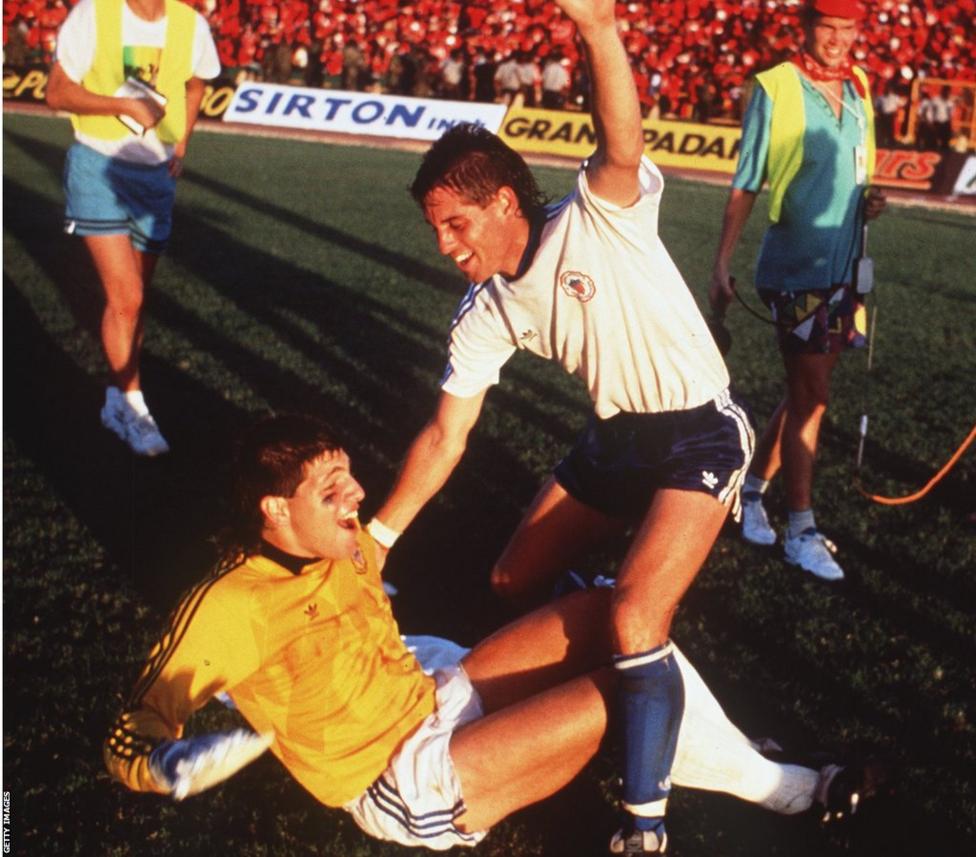
November 19, 1989: The U.S. national soccer team plays a game that will determine whether they qualify for the 1990 World Cup. Win it, and it could launch the country into a new era of soccer. Fail to win it, and it could be disastrous for the sport in the country.

The U.S. beat England at the 1950 World Cup in Brazil -- and hadn't qualified for the World Cup since. They were given hosting rights for the 1994 World Cup, but there was talk that, if they couldn't qualify in 1990, they might be stripped of those rights. So qualification was vital.

Bob Gansler, a German-Hungarian immigrant, became the U.S. team's head coach. His players, most in or just out of college, had grown up watching the North American Soccer League, with such stars as Pelé and Johan Cruijff, but few from the U.S. itself. That league had failed in 1984, preventing them from having a "top flight" league in which to play home games.

As the BBC's Adam Elder put it: "Many of them were 2nd-generation immigrants, their parents and family lives different from an 'apple pie' American ideal. They loved a sport that many around them reviled and yet there was no nationwide outdoor league for them to play in. Instead, most of the squad either played the indoor game or on teams in the so-called ethnic leagues found in large cities. Only three players had contracts in Europe."

And American fans weren't into it, either. Elder again: "For most of the 20th Century, football in the States was for "the others," to put it politely: Expats, cab drivers, dishwashers, exchange students, leftists, intellectuals, Euro snobs and the like." So the U.S. Men's National Team, or USMNT as we might now abbreviate it, had to generate excitement for people who weren't into soccer.

The heart of the team was from New Jersey: Peter Vermes, from Delran in the South; and, from Kearny in the North, Scot John Harkes, Uruguayan Tabaré "Tab" Ramos, and Italian goalkeeper Tony Meola. But the task before them was huge: "None of us were alive in 1950," said defender Paul Krumpe, from Southern California and of German descent.

FIFA, the governing body for world soccer, put the U.S. in CONCACAF: The Confederation of North, Central America and Caribbean Association Football. Aside from Canada and a few Caribbean nations and colonies, most of it was Spanish-speaking, and identified more with their roots as former colonies of Spain than their proximity to the U.S. So their big sport was soccer, not baseball. This wasn't true for Puerto Rico and Cuba, which had been taken by the U.S. in the Spanish-American War of 1898. but it was true for most of the others. (Mexico and the Dominican Republic are baseball-loving exceptions, but Mexico still prefers soccer.)

And those Latin American countries already had established soccer culture, including nasty rivalries between their domestic clubs and with neighboring nations. (El Salvador and Honduras had even had a "Football War" in 1969.) And many of those countries hated the U.S., for the CIA's role in trying to overthrow their elected leftist governments, sometimes succeeding. U.S. players, who had nothing to do with such things, recalled going down there and being hit with rocks, fruit, batteries, and even bags of urine. For them, winning on home soil was hard enough; winning on foreign soil was nearly impossible.

Advancing to the final round of CONCACAF qualification for the World Cup were 5 teams: The U.S. and, in alphabetical order: Costa Rica, El Salvador, Guatemala, and Trinidad and Tobago. (While they are separate islands, "Trinidad and Tobago" is one country.) That meant 8 games, home and home against each of 4 opponents.

On April 16, 1989, the U.S. lost away to Costa Rica, 1-0. On April 30, they beat Costa Rica, 1-0 at St. Louis Soccer Park in Fenton, Missouri. On May 13, they played Trinidad and Tobago to a 1-1 draw at Murdoch Stadium in Torrance, California (Krumpe's hometown), allowing a heartbreaking equalizer in the 88th of 90 minutes.

On June 17, they beat Guatemala, 2-1 at Veterans Stadium -- not the 67,000-seat one in Philadelphia, but the 8,448-seat high school football stadium in New Britain, Connecticut, outside Hartford. On September 17, they actually managed an away win, beating El Salvador, 1-0 in Tegucigalpa. They got a 0-0 draw away to Guatemala on October 8. A win against El Salvador on November 5 in Fenton would have qualified them with a game to spare, but they could only manage a 0-0 draw.

So, to qualify, along with the already-qualified Costa Rica, they had to beat Trinidad and Tobago, at their National Stadium, in their capital of Port of Spain, on November 19. A draw would have given T&T the 2nd CONCACAF slot.

The weather was hot and windy, with a very bright Sun. The pitch was dry and bumpy. T&T controlled the game for the 1st half-hour. But in the 32nd minute, Paul Caligiuri, a midfielder from Walnut, in Southern California, fired a 35-foot shot into the wind, and scored. Harkes later said, "I thought, 'There's no way he's hitting this.' But he just smacked it, and the ball dipped like crazy." The goalkeeper lost the ball in the Sun, and the home crowd seemed to scream in horror.

T&T would have their chances in the 2nd half, but the American defense held, and it ended 1-0. The U.S. had qualified for the World Cup, for the 1st time in 40 years. In the locker room, Budweiser, as American a product as there is, flowed freely -- until the Trinidadians graciously donated the champagne that they were expecting to drink.

The game was broadcast on NBC -- on tape delay after an American football game, and only 432,000 people watched it.

The U.S. did not do well at the World Cup in Italy. They were clobbered in their 1st game, 5-1 by Czechoslovakia in Florence. But they held the hosts to only a 1-0 win in Rome, and Austria to a 2-1 win in Florence. So it wasn't as bad as it looked like it would be after the opening game. But they still finished last in their Group.

Nevertheless, they were there. At the time, that was what mattered. They advanced to the Round of 16 on home soil in 1994, then crashed out of the Group Stage in 1998, made the Quarterfinals in 2002, crashed out of the Group Stage in 2006, and reached the Round of 16 in 2010. In 2014, they broke the pattern, reaching the Group Stage again -- and then, for 2018, failed to qualify for the 1st time in 32 years. They have qualified for 2022. (UPDATE: They reached the Round of 16, and will host again, or rather co-host with Canada and Mexico, in 2026.)

It was the 1990 team that laid the groundwork for America finally having the right to be taken seriously as a soccer-playing country. Every major league in Europe has had American players, and nobody laughs at us anymore.

Then again, we haven't gotten past the Quarterfinals since the very first World Cup, in 1930. And the women's team... Let's just say that, in American soccer, "You play like a girl!" is a huge improvement.

*

November 19, 1989 was a Sunday. Michael Ray Stevenson, the rapper known as Tyga, was born.

Baseball was out of season. These NFL games -- each with far more people watching it than the soccer game in question -- were played:

* The New York Giants beat the Seattle Seahawks, 15-3 at Giants Stadium in the Meadowlands.

* The New York Jets lost to the Indianapolis Colts, 27-10 at the Hoosier Dome in Indianapolis.

* The New England Patriots beat the Buffalo Bills, 33-24 at Sullivan Stadium (formerly Schafer Stadium, later Foxboro Stadium) in the Boston suburb of Foxborough, Massachusetts.

* The Philadelphia Eagles beat the Minnesota Vikings, 10-9 at Veterans Stadium in Philadelphia.

* The New Orleans Saints beat their arch-rivals, the Atlanta Falcons, 26-17 at Atlanta-Fulton County Stadium.

* The Pittsburgh Steelers beat the San Diego Chargers, 20-17 at Three Rivers Stadium in Pittsburgh.

* The Kansas City Chiefs and the Cleveland Browns played to a tie, 10-10 at Cleveland Municipal Stadium.

* The Cincinnati Bengals beat the Detroit Lions, 42-7 at Riverfront Stadium in Cincinnati.

* The Tampa Bay Buccaneers beat the Chicago Bears, 32-31 at Soldier Field in Chicago.

* The Miami Dolphins beat the Dallas Cowboys, 17-14 at Texas Stadium in the Dallas suburb of Irving, Texas.

* The Houston Oilers beat the Los Angeles Raiders, 23-7 at the Astrodome in Houston.

* The Los Angeles Rams beat the Phoenix Cardinals, 37-14 at Anaheim Stadium (now Angel Stadium of Anaheim).

* The Green Bay Packers beat the San Francisco 49ers, 21-17 at Candlestick Park in San Francisco.

* And on ABC Monday Night Football, the Denver Broncos beat the Washington Redskins, 14-10 at Robert F. Kennedy Memorial Stadium in Washington.

There were 3 games played in the NBA:

* The Houston Rockets beat the Miami Heat, 132-94 at The Summit (now the Central Campus of the Lakewood Church) in Houston.

* The Los Angeles Lakers beat the Washington Bullets, 120-115 at The Forum outside Los Angeles in Inglewood, California.

* And the Portland Trail Blazers beat their arch-rivals, the Seattle SuperSonics, 119-109 at the Portland Memorial Coliseum.

There were 2 games played in the NHL, both in Western Canada, and both went to overtime. The Buffalo Sabres and the Vancouver Canucks played to a 2-2 tie at the Pacific Coliseum in Vancouver. And the Edmonton Oilers beat the Chicago Blackhawks, 5-4 at the Northlands Coliseum in Edmonton. Mark Messier scored just 8 seconds into overtime.

Monday, September 26, 2022

September 26, 1948: Israel Debuts Its National Soccer Team

September 26, 1948: Israel debuts its national soccer team, 3 months after independence. They play the team that represented the U.S. at the recent Olympics in London, in front of 35,000 at the Polo Grounds in New York, the most Jewish city in the world outside of the new independent state.

Goalkeeper Avraham Bendori, right back Shalom Shalomzon, center half Yosef Mirmovich, and left half Eliyahu Fuchs came from Maccabi Tel Aviv FC. Left back Avraham Bogdanov, inside right Ernst Weinberger, and substitute defender Itzhak Schneor came from Beitar Tel Aviv FC. Right half Shmuel Den Dror and inside left Elieezer Spiegel came from Maccabi Petah Tikva FC. Outside right Israel Weiss, center forward Shimon Zimmerman, outside left Avraham Felman, and substitute winger Itzhak Rosenboim came from Hapoel Tel Aviv FC. Substitute midfielder Naftaly Schwalb came from Hapoel Ramat Gan FC.

Ed Souza opened the scoring for the U.S., in the 13th minute. Ben Dror equalized in the 20th. Ben McLaughlin took the lead back in the 44th, and Souza scored again in the 57th. The U.S. won, 3–1, due to the Boston-area and St. Louis players who, within 2 years, would shock England at the World Cup.

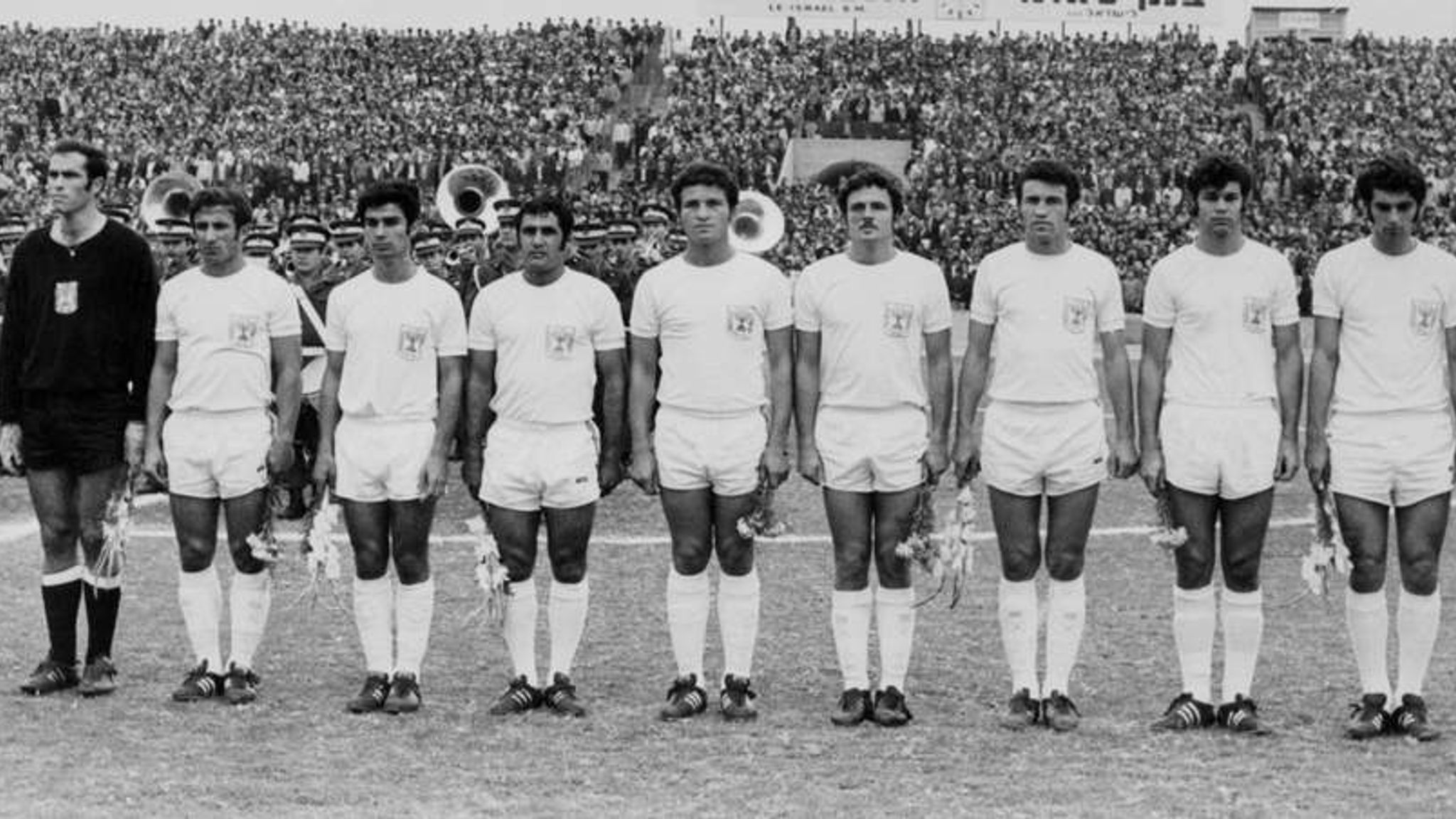
Because of anti-Semitism, and the refusal of many Asian countries to play them following the 1978 Camp David Accords, Israel must compete in European competitions for continental purposes. They have only qualified for the World Cup once, in 1970. But they did win the 1964 Asian Cup, and reached the Final of the 1974 Asian Games.

*

September 26, 1948 was a Sunday. These baseball games were played that day:

* The Boston Braves beat the New York Giants, 3-2 at Braves Field in Boston, and clinch the National League Pennant. Bob Elliott, the previous season's NL Most Valuable Player, and not to be confused with the comedian of the same name who had already formed a famed comedy duo with Ray Goulding, hits a home run.

Despite the refrain of "Spahn and Sain and pray for rain," it is Vern Bickford who starts and wins the clincher. Bill Voiselle was also a pretty good starter, although not a Hall-of-Famer like Warren Spahn, or having a Cy Young Award-worthy season like Johnny Sain. (That award wouldn’t start until 1956, after Young himself died.)

This is the 14th Pennant won by the team then calling itself the Boston Braves, the 10th in the National League. It will turn out to be the last: They later won 2 in Milwaukee, and, in 2021, won their 7th in Atlanta.

* The Brooklyn Dodgers beat the Philadelphia Phillies, 5-1 at Shibe Park in Philadelphia. Ralph Branca outpitched Robin Roberts. Jackie Robinson went 1-for-4 with a stolen base. Roy Campanella hit a home run. Gil Hodges went 0-for-4, and Duke Snider did not play.

This was a transition year for the Dodgers, as the stars who led them to the 1941 and 1947 Pennants began to be traded away, like Dixie Walker, Eddie Stanky and Joe Hatten. Campanella and Carl Erskine had debuted in 1948, and they had traded for Preacher Roe and Billy Cox. The season before was the debut year of Robison and Snider, and the 1st full season for Hodges. The year before was the debut of Carl Furillo. The 1949 season would be the 1st for Don Newcombe. With holdover Pee Wee Reese as Captain, the team that became known as "The Boys of Summer" took shape, and, of the next 8 NL Pennants, won 5 and just missed 2 others.

* The New York Yankees beat the Boston Red Sox, 6-2 at Yankee Stadium. Tommy Byrne outpitched Mel Parnell. Ted Williams went 1-for-4. So did Joe DiMaggio, who also had an RBI. Tommy Henrich hit a home run.

* The Pittsburgh Pirates swept a doubleheader from the Cincinnati Reds, 8-6 and 8-5. Pirate slugger Ralph Kiner went 0-for-3 with a walk in the opener, but 2-for-5 with a home run and 4 RBIs in the nightcap.

* The Cleveland Indians beat the Detroit Tigers, 4-1 at Briggs Stadium (later Tiger Stadium) in Detroit. Bob Feller outpitched Hal Newhouser. The day's games left the Indians 1 game ahead of both the Yankees and the Red Sox, with each team having 5 games left. When the regular season was over, the Indians and Red Sox were tied, with the Yankees 1 game back. The Indians beat the Red Sox in a Playoff for the Pennant, thus preventing an All-Boston World Series. The Indians then beat the Braves in 6 games. Cleveland hasn't won a World Series since.

* The St. Louis Cardinals beat their arch-rivals, the Chicago Cubs, 5-2 at Wrigley Field in Chicago. Stan Musial went 1-for-4 with an RBI. He was wrapping up perhaps his finest season, stat-wise, with career highs in batting average, .376; on-base percentage, .450; slugging percentage, .702; OPS+, 200; total bases, 429; home runs, 39; and RBIs, 131. He fell 1 home run short of the Triple Crown, as Kiner and New York's Johnny Mize each hit 40; and won the MVP.

It was in this season that he began to be called "Stan the Man," after a reporter overheard a fan at Ebbets Field say, "Uh-oh, that man is back in town."

* The Chicago White Sox beat the St. Louis Browns, 3-0 at Sportsman's Park in St. Louis. Randy Gumpert pitched a 6-hit shutout.

* And the Philadelphia Athletics and the Washington Senators were not scheduled.

Only 2 games were played in the NFL. The Washington Redskins beat the Pittsburgh Steelers, 17-14 at Griffith Stadium in Washington. And the Chicago Bears beat the team that would become their arch-rivals, the Green Bay Packers, 45-7 at City Stadium in Green Bay, Wisconsin.

There were 3 games in the All-America Football Conference. The Baltimore Colts beat the football version of the Brooklyn Dodgers, 35-20 at Municipal Stadium in Baltimore. The Cleveland Browns beat the Chicago Rockets, 21-10 at Municipal Stadium in Cleveland. And the San Francisco 49ers beat the Buffalo Bills, 38-28 at Civic Stadium (later renamed War Memorial Stadium) in Buffalo.

All 3 games were won by teams that were admitted to the NFL in 1950. The Bills were not, but were reborn in the American Football League in 1960, and were admitted to the NFL in the merger.

Saturday, August 20, 2022

August 20, 1916: The 1st Game of the U.S. National Soccer Team

August 20, 1916: The United States of America fields a national soccer team for the 1st time.

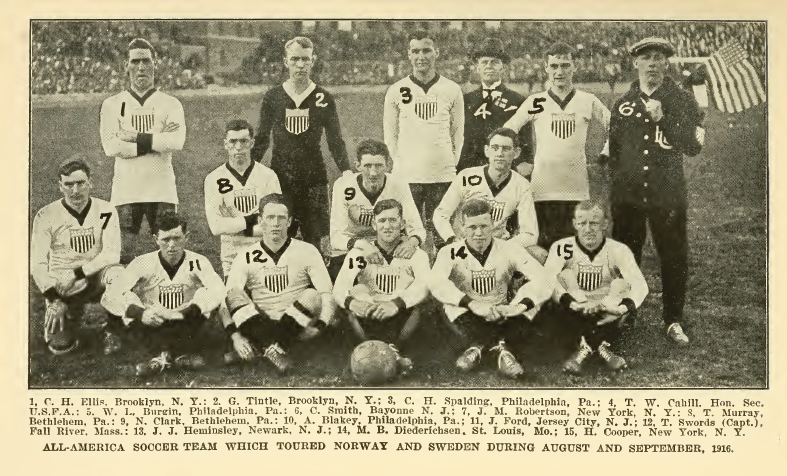
Sponsored by the United States Soccer Federation (USSF), founded in 1913, the team took the pitch against Sweden at the Stockholm Olympiastadion, site of the 1912 Olympics, where Jim Thorpe had won the decathlon. A crowd of 16,000 attended. The referee was Hagbard Vestergaard of Denmark.

This was the U.S. team for the game, keeping in mind that uniform numbers were not used in soccer until 1933:

* Goalkeeper: George Tintle of Harrison, New Jersey
* Right Back: Tommy Murray of Bethlehem, Pennsylvania
* Left Back: Jimmy Robertson of New York
* Defender: Dick Spalding of Philadelphia
* Defender: Neil Clarke of Scotland, moved to Paterson, New Jersey
* Defender: Clarence Smith of Bayonne, New Jersey
* Outside Right: Jimmy Ford of Kearny, New Jersey
* Inside Right: Charles Ellis of New York
* Center Forward: John Hemingsley of Newark
* Inside Left: Thomas Swords of Fall River, Massachusetts (Captain)
* Outside Left: Harry "Buck" Cooper of Newark

As you can see, the tradition of soccer in Newark, its across-the-Passaic-River towns of Harrison and Kearny, and its across-Newark-Bay town of Bayonne goes back at least this far. Bethelehem, in the Lehigh Valley of northeastern Pennsylvania, was home to Bethlehem Steel Football Club, a "company team" (or, as the English would have called it, a "works side"), one of the top U.S. teams of the era.

And Fall River and nearby New Bedford, Massachusetts, manned by Portuguese immigrants and their sons, would have strong teams into the 1950s, including the legendary Ponta Delgada, named for an island in the Portugal-controlled Azores Islands. Because of Massachusetts' "blue laws," if these teams wanted to play on Sunday, they would go right across the State Line, and play at St. Mark's Stadium in Tiverton, Rhode Island.

James Robertson is a very common name among soccer players, especially in Scotland. A later Jimmy Robertson was the 1st player ever to score for both Tottenham Hotspur against Arsenal and for Arsenal against Tottenham in the North London Derby.

Konrad Törnqvist scored for Sweden, in only the 7th minute of the game. But Spalding equalized in the 22nd. Ellis scored in the 53rd. Cooper scored in the 68th. Törnqvist brought the Swedes back within 1 in the 81st, but the U.S. defense held on for a 3-2 win.

On September 3, still in Scandinavia, the U.S. team played Norway to a 1-1 draw in Kristiana. Ellis scored the only goal.

History seems to have lost track of some of these players. As far as I can tell, the last survivor was Cooper, who died in 1963.

The stadium still stands. Djurgårdens IF, Sweden's most successful soccer team, played there until the new Tele2 Arena opened, but maintain their offices there.
Due to World War I continuing through 1918, and then for longer for reasons I don't have, the U.S. national team didn't play another game until 1924, and then seemed to play only 2 or 3 games a year until World War II. This may have held them back. The U.S. team didn't play its 1st game on home soil until November 8, 1925, beating Canada 6-1 at Ebbets Field in Brooklyn, thanks to 5 goals from Archie Stark. Like so many early U.S. soccer stars, Stark was born in Glasgow, Scotland but grew up in Kearny, New Jersey.

This period did include reaching the Semifinal of the 1st World Cup in 1930, and reaching the World Cup again in 1934, before failing to qualify in 1938.

*

August 20, 1916 was a Sunday. Because many States still banned professional sports on Sunday, only 3 games were played in what would later be known as Major League Baseball:

* The New York Giants lost to the St. Louis Cardinals, 5-0 at Robison Field in St. Louis. Bob Steele allowed the Giants 8 hits, but kept the shutout. Rogers Hornsby, a rookie, went 2-for-2 with 2 walks for the Cardinals.

* The Boston Braves beat the Cincinnati Reds, 4-3 at Redland Field (renamed Crosley Field in 1934) in Cincinnati.

* The Brooklyn Robins (as the Dodgers were known from 1914 to 1931) beat the Chicago Cubs, 1-0 at Weeghman Park (renamed Cubs Park in 1920 and Wrigley Field in 1926) in Chicago. Jack Coombs allowed only 1 hit, a single by Max Flack. Coombs even got a hit for Brooklyn. So did the man who is still the Dodger franchise's all-time leader in hits, Zack Wheat. So did future managing legend Casey Stengel.

Wednesday, June 29, 2022

June 29, 1950: The Miracle On Grass

June 29, 1950: The U.S. national soccer team beats England, 1-0 at Estádio Independência in Belo Horizonte, Brazil, in the 1950 World Cup.

The England team had some of the greatest players in the world, including Stanley Matthews, "the Wizard of Dribble." But Matthews was kept out of this game, and that may have made the difference. Among England stars who did play in this game were Matthews' Blackpool teammate Stan Mortenson, Jackie Milburn of Newcastle United, Billy Wright of Wolverhampton Wanderers, Laurie Hughes of Liverpool, Tom Finney of Preston North end, Wilf Mannion of Middlesbrough, and goalkeeper Ted Ditchburn of Tottenham Hotspur.

Counting Bill Nicholson of Tottenham, who was much more honored for his managing of that team than for his playing, 6 of the players -- the others being Wright, Milburn, Matthews, Finney and Mannion -- would have statues dedicated outside their teams' stadiums.

The U.S. team was taken from various clubs in the top league in the country at the time, the American Soccer League. There was nothing like a "first division" as in European or South American countries. And none of them was still in college, although they weren't over the hill: One player was 38, the rest were between the ages of 21 and 31, coming from ASL clubs.

The U.S. got off to a good start in their 1st game, against Spain, scoring in the 17th. But the defense collapsed late, allowing 3 goals between the 81st and 89th minutes, and Spain won, 3-1. For the England game, Frank Borghi was in goal. In front of him were the fullbacks, Harry Keough on the right, Joe Maca on the left. In front of them were the halfbacks: Right to left, Ed McIlvenny, Charlie Colombo and Walter Bahr. Then the forwards: Right to left, Frank Wallace, Gino Pariani, Joe Gaetjens, John Souza and Ed Souza. Bahr was usually the Captain of this team, but, since he was British, McIlvenny was chosen as Captain for this game.

* 1 Goalkeeper: Frank Borghi, born April 9, 1925 in St. Louis, played for St. Louis team Simpkins-Ford.
* 2 Right Back: Harry Keough, born November 15, 1927 in St. Louis, played for St. Louis McMahon, later known as St. Louis Kutis.
* 3 Left Back: Joe Maca, born September 28, 1920 in Brussels, Belgium, played for Brooklyn Hipsano.
* 4 Right Halfback, Ed McIlvenny, born October 21, 1924 in Greenock, Scotland, played for Philadelphia Nationals.
* 5 Center Halfback: Charlie Colombo, born July 20, 1920 in St. Louis, played for Simpkins-Ford.
* 6 Left Halfback: Walter Bahr, born April 1, 1927 in Philadelphia, played for Philadelphia Nationals.
* 7 Outside Right: Frank Wallace, born July 15, 1922 as Frank Valicenti in St. Louis, played for Simpkins-Ford.
* 8 Inside Right: Gino Pariani, born February 21, 1928 in St. Louis, played for Simpkins-Ford.
* 9 Center Forward: Joe Gaetjens, born March 19, 1924 in Port-au-Prince, Haiti, played for New York team Brookhattan.
* 10 Inside Left: John Souza, born July 12, 1920 in Fall River, Massachusetts. Played for Ponta Delgada, which was named after one of the Azores, off the coast of Portugal, and was staffed by Portuguese immigrants and their sons from Fall River and nearby New Bedford. Early in their history, to get around Massachusetts' "blue law" prohibiting playing professional sports on Sundays, teams like Ponta Delgada and the New Bedford Whalers would go just over the State Line, and play at St. Mark's Stadium in Tiverton, Rhode Island.
* 11 Outside Left: Ed Souza, born September 22, 1921 in Fall River. Played for Ponta Delgada, although was believed to not be related to John Souza. "Souza" and its variant "Sousa" are common names in Portugal: The most famous American of Portuguese descent has been "March King" John Philip Sousa.

The U.S. team's manager was William Jeffrey, born on August 3, 1892 in Edinburgh, Scotland. Since 1927, he had been the head coach of the soccer team at Pennsylvania State University (a.k.a. Penn State).

As a British citizen familiar with the English game, as well as that of the country he had adopted, Jeffrey told the press, "We have no chance," and called his team "sheep ready to be slaughtered." One of the English national newspapers, the Daily Express, wrote, "It would be fair to give the U.S. three goals of a start." Indeed, England's 1st half attack was so fierce that, if even half of their attempts had gone in, they would have been up at least 4-0.

Then came the 37th minute. McIlvenny made a throw-in. Bahr took it, and shot from 25 yards out. Williams moved to his right to get it. But before he could, Gaetjens threw himself forward, and headed it in to Williams' left.
Joe Gaetjens

One-nil to the Stars and Stripes. Years, later Bahr said, "The overwhelming majority was Brazilians, but they rooted for us the entire time. We didn't realize why until after. They were hoping we would beat England and that Brazil would not have to play England in the final game." (In hindsight, this may have been counterproductive, as Brazil also suffered a tremendous upset, losing the Final to neighboring Uruguay.)

The Americans' confidence had been seriously boosted, and they came out for the 2nd half like a house afire. They had another scoring chance in the 54th, but couldn't do anything with it. In the 59th, Generoso Dattilo, the Italian referee, awarded England a direct free kick, but Borghi saved Mortensen's shot. England was dominant for a while, and it wasn't until the 74th minute that the U.S. could get another shot.

In the 82nd minute, soccer history hung in the balance. Mortensen drove toward the penalty area, and Charlie Colombo brought him down. The way Keough described it, it sounds like Colombo should have been sent off. (No red and yellow cards in those days, but a player could be sent off for an egregious foul.) But the film cameras didn't get the foul into the highlights, so there's no way to know for sure.

England pleaded for the awarding of a penalty, but Dattilo didn't buy it, saying the foul was outside the area. He awarded a free kick. Ramsey took it, and Mullen headed it toward the goal. Borghi tipped it away. Again, the England players appealed to Dattilo, saying the ball had gone in, but he ruled that it hadn't crossed the line.

In the 85th, Peewee Wallace managed to draw Williams out of position, giving himself an empty net. But Ramsey managed to get in and clear his shot off the line.

Without much stoppage time, Dattilo blew his whistle. Final score: America 1, England 0. Or, as would be said in soccer circles, England 0-1 USA. No "Man of the Match" was given. Clearly, it was Borghi, who kept it from being about 7-1 in England's favor.

No one could believe it. Contrary to what we would expect today, not only was the game not broadcast live to the U.K. on BBC television, it wasn't even broadcast around the world on BBC radio. When the BBC reporter delivered the final score that night (it would have been around 10:00 PM, London time), many people remembered hearing it, and thinking it was an error: That it must have been England that won 1-0.

And in America? It was barely reported at all. Since 5 players were from St. Louis, Dent McSkimming of the St. Louis Post-Dispatch wanted to cover it. He couldn't talk the paper into covering his expenses. So he applied for "vacation" time, paid his own way, and, when he got there, he discovered that he was the only American reporter at the game.

Soccer was so low on the totem pole of American sports at the time, the Post-Dispatch was one of the few papers to report the result at all. Not only had The New York Times refused to send a reporter, but, when they got the result from the Associated Press wire report, they refused to print it, figuring the report of the upset was a hoax.

The World Cup went on. On July 2, the Americans were knocked out of the tournament, losing 5-2 to Chile in Recife. And England fell to Spain 1-0 at the Estadio Maracanã in Rio de Janeiro. Spain thus won Group 2, and only the 4 Group winners advanced to a knockout round.

The 1-0 win over England has been nicknamed "The Miracle Match." In a nod to the U.S. hockey upset over the Soviet Union at the 1980 Winter Olympics, known as "The Miracle On Ice," this game has been called "The Miracle On Grass." Given how many shots Borghi had to stop, Belo Horizonte '50 was much closer to being a miracle than was Lake Placid '80.

The U.S. and England have played only 1 World Cup match since, a 1-1 draw in Bloemfontain, South Africa in 2010.

The Miracle On Grass was hardly seen then, and it has hardly been seen since. But it might just be the greatest upset in American sports history. Not the most satisfying -- that remains the Miracle On Ice -- but the greatest.

Gaetjens eventually returned to Haiti. In 1964, he was one of thousands of people arrested by the government of dictator François "Papa Doc" Duvalier. He was never seen again, nor has his body ever been found, but it is presumed that he was executed in jail. So there is no known final resting place for the man who may still be America's greatest soccer hero.

Jeffrey died in 1966, Wallace and Ed Souza, in 1979, Maca in 1982, Colombo in 1986, McIlvenny in 1989, Pariani in 2007, Keough and John Souza in 2012, Borghi in 2015. Bahr was the last survivor, living until 2018. He was also the father of Matt and Chris Bahr, Super Bowl-winning placekickers.

*

June 29, 1950 was a Thursday. It was the off-season for the NFL, the NBA and the NHL. There wasn't quite a full slate of Major League Baseball games played that day:

* The New York Yankees lost to the Washington Senators, 12-7 at the old Yankee Stadium. The Yanks jumped out to a 5-1 lead in the 1st inning, including a home run by Cliff Mapes. But the Senators scored 6 runs in the 4th, including a home run by Irv Noren, whom the Yankees would later acquire. Joe DiMaggio went 0-for-3 with a walk. Joe Ostrowski was the Yanks' starting pitcher, and didn't get out of the 2nd inning, while Tom Ferrick didn't make it out of the 4th.

* In what was then baseball's biggest rivalry, the New York Giants beat the Brooklyn Dodgers, 11-5 at Ebbets Field. Eddie Stanky hit a home run, and Hank Thompson got 3 hits. The Dodgers got 2 home runs from Jackie Robinson and 1 from Billy Cox, neither really a home run hitter. But the Giants scored 4 in the 8th and 3 in the 9th to take it. 

* Boston played Philadelphia in each League. In the National League, the Boston Braves beat the Philadelphia Phillies, 3-2 at Braves Field in Boston.

* In the American League, a football score developed. The Boston Red Sox beat the Philadelphia Athletics 22-14 at Shibe Park in Philadelphia. Here's the damage: It was 6-4 Sox after 1 inning, 14-7 after 2, 15-7 after 4, 16-8 after 5, 18-9 after 6, 20-12 after 7, 20-14 after 8 and 22-14 after 9. As you might guess, Ted Williams hit a home run for the Sox, going 2-for-6 with 6 RBIs. Matt Batts had 4 RBIs, and Bobby Doerr 3.

The A's didn't hit any home runs, but Bob Dillinger, their leadoff hitter and 3rd baseman went 5-for-6 with 3 RBIs. As far as I know, "Duke" was no relation to Depression-era gangster John Dillinger, but he was a thief: In each of the previous 3 seasons, he led the AL in stolen bases, and batted .306 over 6 major league seasons. Elmer Valo and Billy Hitchcock also had 3 RBIs for the A's.

* The Chicago White Sox beat the Detroit Tigers, 7-3 at Briggs Stadium (later renamed Tiger Stadium) in Detroit.

* In another arch-rivalry game, the Chicago Cubs beat the St. Louis Cardinals, 6-1 at Wrigley Field in Chicago.

* The Cleveland Indians beat the St. Louis Browns, 4-1 at Sportsman's Park in St. Louis.

* And the Cincinnati Reds and the Pittsburgh Pirates were not scheduled for the day.

Thursday, June 23, 2022

June 23, 2010: The Landon Donovan Goal

June 23, 2010: Landon Donovan scores the most famous goal in the history of American soccer.

* More famous than Joe Gaetjens' goal to allow the U.S. national team to beat England in the 1950 World Cup, because nobody was watching on television.

* More famous than any goal ever scored in the North American Soccer League, during its run of 1967 to 1984.

* More famous than any goal ever scored in Major League Soccer since its debut in 1996.

* And more famous than the goals scored by Brian McBride and Donovan himself in the 2002 World Cup "Dos a Cero" win over arch-rival Mexico.

On that occasion, Donovan was 20 years old, and already the winner of an MLS Cup with the San Jose Earthquakes. He would win another with them, and then win one for the Los Angeles Galaxy. And he would help the U.S. team win 3 CONCACAF Gold Cups. He would also play for the U.S. in the 2006 World Cup, a disappointment for the team. And he had played in Germany's Bundesliga for Bayer Leverkusen and Bayern Munich.

The 2010 World Cup was held in South Africa. The U.S. team, led by Donovan and Clint Dempsey, was placed in a Group with England, Slovenia and Algeria, and it was expected that the 1st 2 games would be lost, and the U.S. would fail to qualify for the Knockout Stage.

But goalkeeper Rob Green's mishandling of a Dempsey shot gave the U.S. a 1-1 draw with England in Rustenberg. And they dominated Slovenia in Johannesburg, and should have won, but a goal, a Maurice Edu volley off of a Donovan pass, was wrongly disallowed, leaving a 2-2 draw, with Donovan and Marcus Bradley scoring the goals.

So the game against Algeria, at the Loftus Versfeld Stadium in Pretoria -- named for the founder of organized sports in that city, and home of the historically black soccer team Mamelodi Sundowns and the traditionally white rugby team Blue Bulls -- was huge. A win would send the U.S. to the knockout stage. A draw might, depending on who won between England and Slovenia, and by how much. A loss, and we were definitely out.
Loftus Versfeld Stadium

Oddly, only 35,827 fans paid to see the game. Loftus Versfeld Stadium, built in 1923 and substantially renovated in 2008, has a capacity of 51,752. But ticket prices for this World Cup were very high, pricing poor black South Africans out, and there weren't enough people from other countries willing to pay.

After an early Algerian shot hit the crossbar, the American defense settled down. Jozy Altidore missed a sitter. Dempsey scored, but it was disallowed for offside. The joke went around the world: Now, the U.S. is a true footballing nation, because they've gotten screwed twice at one World Cup.

At the end of 90 minutes, it was still 0-0. But the final had come in: England had beaten Slovenia 1-0. England were in. If the U.S. could not score in stoppage time, they would finish 3rd in the Group to Slovenia's 2nd, and would be out.

Three minutes were added on. Goalkeeper Tim Howard, of North Brunswick, Middlesex County, New Jersey, threw an outlet pass to Donovan. He dribbled a bit, then passed to Altidore, who crossed to Dempsey. Raïs M'Bolhi, born in Paris but playing his national soccer for Algeria and his club soccer, at the time, for Slavia Sofia in Bulgaria, moved forward, and blocked Dempsey's shot.

But he only blocked it, unable to stop it. Donovan was moving forward, the ball came right to him, and he put it in the net. The social media reaction was delayed because fans all over America were pretty much still celebrating when the referee, Frank De Bleeckere of Belgium, blew his final whistle during the 94th minute. One-nil to the Stars & Stripes.

Those of us who are both Americans and Arsenal fans thought of the Michael Thomas goal that won Arsenal the 1989 Football League title against Liverpool, partly because that goal was also started by a goalkeeper's long throw, and was in the 92nd minute instead of the 91st.

Unfortunately, all the Donovan goal won was a World Cup Group. It didn't guarantee anything other than a place in the Round of 16. Although the U.S. held Ghana to 1-1 after regulation, with Donovan converting a penalty, they ran us ragged in extra time, and we lost, 2-1. Spain went on to win the World Cup, defeating Netherlands in extra time in the Final in Johannesburg.

Still, Donovan's goal, the win it secured, and the advancement that the win secured, was a huge moment for American soccer. The "Miracle On Grass" in 1950 was an anomaly: We didn't qualify for the Knockout Stage, and we didn't qualify for the World Cup again for 40 years. "Dos a Cero" in 2002 was a great moment, and we did advance to the Quarterfinal, but it had more of an effect on our reputation within the CONCACAF region (the Confederation of North, Central America and Caribbean Association Football) than in the world at large. Europe, Asia, Africa, Oceania, and even South America didn't particularly care that we embarrassed Mexico.

But 1950 was the dawn of the television era. It might have been different if the game had been covered on TV, but it wasn't. And 2002, while in the Internet era, wasn't in the social media era. In contrast, Donovan's goal was shared almost immediately. Almost: We did celebrate a bit before we tweeted about it. 

After the 2010 World Cup, Donovan won 2 more MLS Cups with the Galaxy, and 1 more CONCACAF Gold Cup. He also played in England for Liverpool-based Everton, and, with some irony, in Mexico with Club León. In 2020, the minor-league team San Diego Loyal was founded, and Donovan has been their manager ever since.

*

June 23, 2010 was a Wednesday. As I said, the other World Cup Group C game played that day was England's 1-0 win over Slovenia at Nelson Mandela Bay Stadium in Port Elizabeth.

In Group D, Germany beat Ghana 1-0 at FNB Stadium, a.k.a. Soccer City, in Johannesburg; and Australia beat Serbia 2-1 at Mbombela Stadium in Nelsprit.

American football was out of season. The basketball season had ended 6 days earlier, when the Los Angeles Lakers won the NBA Championship by beating the Boston Celtics. The hockey season had ended 14 days earlier, when the Chicago Blackhawks won the Stanley Cup by beating the Philadelphia Flyers.

These Major League Baseball games were played that day:

* The New York Yankees beat the Arizona Diamondbacks, 6-5 at Chase Field in Phoenix. Curtis Granderson won it with a home run in the top of the 10th inning, making Mariano Rivera a winner in relief of Javier Vazquez.

* The New York Mets beat the Detroit Tigers, 5-0 at Citi Field. José Reyes hit a home run, and knuckleballer R.A. Dickey pitched a 4-hit shutout.

* The Philadelphia Phillies beat the Cleveland Indians, 7-6 at Citizens Bank Park in Philadelphia. The Tribe scored a run in the top of the 9th. But, Cliché Alert: Walks can kill you, especially the leadoff variety. Brian Schneider drew a leadoff walk for the Phils, and Jimmy Rollins hit a home run.

* The Florida Marlins beat the Baltimore Orioles, 7-5 at Oriole Park at Camden Yards in Baltimore.

* The Kansas City Royals beat the Washington Nationals, 1-0 at Nationals Park in Washington. Brian Bannister and 2 relievers pitched a 6-hit shutout.

* The San Diego Padres beat the Tampa Bay Rays, 5-4 at Tropicana Field in St. Petersburg.

* The St. Louis Cardinals beat the Toronto Blue Jays, 1-0 at the Rogers Centre in Toronto. Matt Holliday singled home the only run of the game in the top of the 9th, making a winner of Chris Carpenter, who had pitched 8 innings of a 3-hit shutout, with Ryan Franklin allowing a 4th hit but keeping the shutout.

* The Chicago White Sox beat the Atlanta Braves, 4-2 at U.S. Cellular Field (now Rate Field) in Chicago. Mark Buerhle outpitched Tim Hudson.

* The Milwaukee Brewers beat the Minnesota Twins, 5-3 at Miller Park (now American Family Field) in Milwaukee.

* The Texas Rangers beat the Pittsburgh Pirates, 13-3 at Rangers Ballpark (now Choctaw Stadium) in the Dallas suburb of Arlington, Texas.

* The Houston Astros beat the San Francisco Giants, 6-3 at Minute Maid Park (now Daikin Park) in Houston.

* The Colorado Rockies beat the Boston Red Sox, 8-6 at Coors Field in Denver. Ian Stewart and former Yankee Jason Giambi (with Clint Barnes on base) hit home runs of Jonathan Papelbon in the bottom of the 9th to win it.

* The Los Angeles Angels beat their regional rivals, the Los Angeles Dodgers, 2-1 at Angel Stadium of Anaheim. Both of the Halos' runs were scored in part due to errors.

* The Cincinnati Reds beat the Oakland Athletics, 3-0 at the Oakland Coliseum. Johnny Cueto and 2 relievers pitched a 7-hit shutout.

* And the Seattle Mariners beat the Chicago Cubs, 8-1 at Safeco Field (now T-Mobile Park) in Seattle.

December 31, 1999 & January 1, 2000: The Millennium

December 31, 1999:  The Millennium arrives. The people of planet Earth survived. At a terrible cost. But we hadn't destroyed ourselves. ...