Tony Meola (left) and John Harkes, two of the Kearny boys
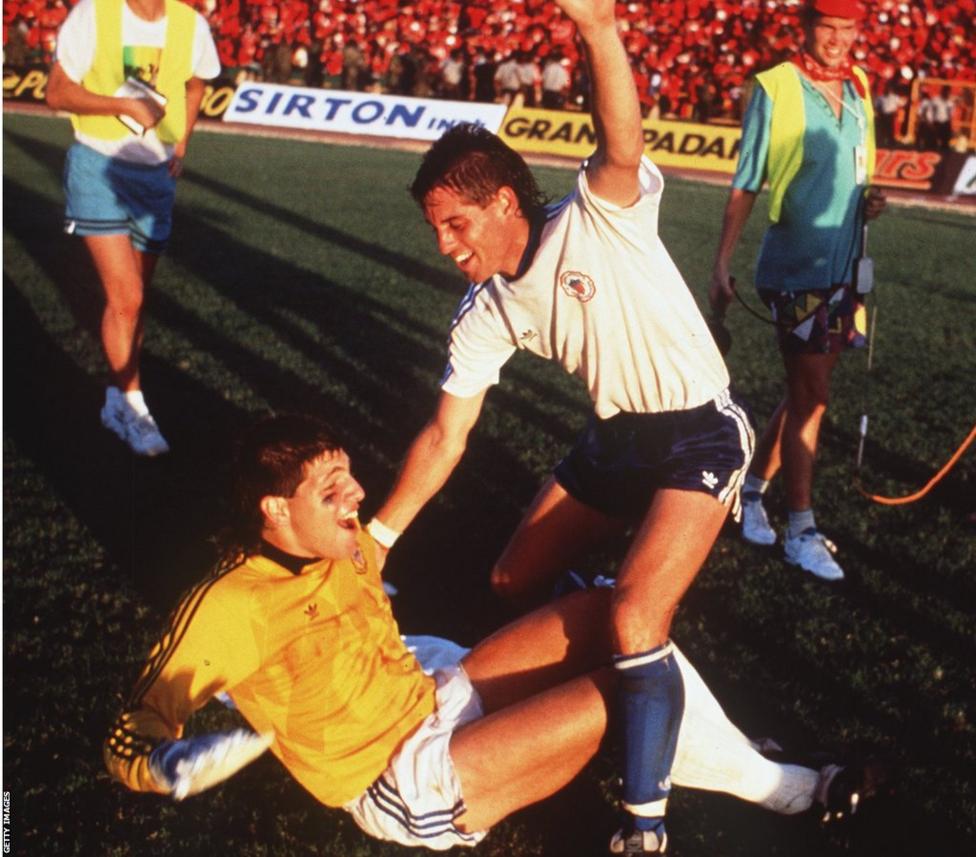
November 19, 1989: The U.S. national soccer team plays a game that will determine whether they qualify for the 1990 World Cup. Win it, and it could launch the country into a new era of soccer. Fail to win it, and it could be disastrous for the sport in the country.
The U.S. beat England at the 1950 World Cup in Brazil -- and hadn't qualified for the World Cup since. They were given hosting rights for the 1994 World Cup, but there was talk that, if they couldn't qualify in 1990, they might be stripped of those rights. So qualification was vital.
Bob Gansler, a German-Hungarian immigrant, became the U.S. team's head coach. His players, most in or just out of college, had grown up watching the North American Soccer League, with such stars as Pelé and Johan Cruijff, but few from the U.S. itself. That league had failed in 1984, preventing them from having a "top flight" league in which to play home games.
As the BBC's Adam Elder put it: "Many of them were 2nd-generation immigrants, their parents and family lives different from an 'apple pie' American ideal. They loved a sport that many around them reviled and yet there was no nationwide outdoor league for them to play in. Instead, most of the squad either played the indoor game or on teams in the so-called ethnic leagues found in large cities. Only three players had contracts in Europe."
And American fans weren't into it, either. Elder again: "For most of the 20th Century, football in the States was for "the others," to put it politely: Expats, cab drivers, dishwashers, exchange students, leftists, intellectuals, Euro snobs and the like." So the U.S. Men's National Team, or USMNT as we might now abbreviate it, had to generate excitement for people who weren't into soccer.
The heart of the team was from New Jersey: Peter Vermes, from Delran in the South; and, from Kearny in the North, Scot John Harkes, Uruguayan Tabaré "Tab" Ramos, and Italian goalkeeper Tony Meola. But the task before them was huge: "None of us were alive in 1950," said defender Paul Krumpe, from Southern California and of German descent.
FIFA, the governing body for world soccer, put the U.S. in CONCACAF: The Confederation of North, Central America and Caribbean Association Football. Aside from Canada and a few Caribbean nations and colonies, most of it was Spanish-speaking, and identified more with their roots as former colonies of Spain than their proximity to the U.S. So their big sport was soccer, not baseball. This wasn't true for Puerto Rico and Cuba, which had been taken by the U.S. in the Spanish-American War of 1898. but it was true for most of the others. (Mexico and the Dominican Republic are baseball-loving exceptions, but Mexico still prefers soccer.)
And those Latin American countries already had established soccer culture, including nasty rivalries between their domestic clubs and with neighboring nations. (El Salvador and Honduras had even had a "Football War" in 1969.) And many of those countries hated the U.S., for the CIA's role in trying to overthrow their elected leftist governments, sometimes succeeding. U.S. players, who had nothing to do with such things, recalled going down there and being hit with rocks, fruit, batteries, and even bags of urine. For them, winning on home soil was hard enough; winning on foreign soil was nearly impossible.
Advancing to the final round of CONCACAF qualification for the World Cup were 5 teams: The U.S. and, in alphabetical order: Costa Rica, El Salvador, Guatemala, and Trinidad and Tobago. (While they are separate islands, "Trinidad and Tobago" is one country.) That meant 8 games, home and home against each of 4 opponents.
On April 16, 1989, the U.S. lost away to Costa Rica, 1-0. On April 30, they beat Costa Rica, 1-0 at St. Louis Soccer Park in Fenton, Missouri. On May 13, they played Trinidad and Tobago to a 1-1 draw at Murdoch Stadium in Torrance, California (Krumpe's hometown), allowing a heartbreaking equalizer in the 88th of 90 minutes.
On June 17, they beat Guatemala, 2-1 at Veterans Stadium -- not the 67,000-seat one in Philadelphia, but the 8,448-seat high school football stadium in New Britain, Connecticut, outside Hartford. On September 17, they actually managed an away win, beating El Salvador, 1-0 in Tegucigalpa. They got a 0-0 draw away to Guatemala on October 8. A win against El Salvador on November 5 in Fenton would have qualified them with a game to spare, but they could only manage a 0-0 draw.
So, to qualify, along with the already-qualified Costa Rica, they had to beat Trinidad and Tobago, at their National Stadium, in their capital of Port of Spain, on November 19. A draw would have given T&T the 2nd CONCACAF slot.
The weather was hot and windy, with a very bright Sun. The pitch was dry and bumpy. T&T controlled the game for the 1st half-hour. But in the 32nd minute, Paul Caligiuri, a midfielder from Walnut, in Southern California, fired a 35-foot shot into the wind, and scored. Harkes later said, "I thought, 'There's no way he's hitting this.' But he just smacked it, and the ball dipped like crazy." The goalkeeper lost the ball in the Sun, and the home crowd seemed to scream in horror.
T&T would have their chances in the 2nd half, but the American defense held, and it ended 1-0. The U.S. had qualified for the World Cup, for the 1st time in 40 years. In the locker room, Budweiser, as American a product as there is, flowed freely -- until the Trinidadians graciously donated the champagne that they were expecting to drink.
The game was broadcast on NBC -- on tape delay after an American football game, and only 432,000 people watched it.
The U.S. did not do well at the World Cup in Italy. They were clobbered in their 1st game, 5-1 by Czechoslovakia in Florence. But they held the hosts to only a 1-0 win in Rome, and Austria to a 2-1 win in Florence. So it wasn't as bad as it looked like it would be after the opening game. But they still finished last in their Group.
Nevertheless, they were there. At the time, that was what mattered. They advanced to the Round of 16 on home soil in 1994, then crashed out of the Group Stage in 1998, made the Quarterfinals in 2002, crashed out of the Group Stage in 2006, and reached the Round of 16 in 2010. In 2014, they broke the pattern, reaching the Group Stage again -- and then, for 2018, failed to qualify for the 1st time in 32 years. They have qualified for 2022. (UPDATE: They reached the Round of 16, and will host again, or rather co-host with Canada and Mexico, in 2026.)
It was the 1990 team that laid the groundwork for America finally having the right to be taken seriously as a soccer-playing country. Every major league in Europe has had American players, and nobody laughs at us anymore.
Then again, we haven't gotten past the Quarterfinals since the very first World Cup, in 1930. And the women's team... Let's just say that, in American soccer, "You play like a girl!" is a huge improvement.
*
November 19, 1989 was a Sunday. Michael Ray Stevenson, the rapper known as Tyga, was born.
Baseball was out of season. These NFL games -- each with far more people watching it than the soccer game in question -- were played:
* The New York Giants beat the Seattle Seahawks, 15-3 at Giants Stadium in the Meadowlands.
* The New York Jets lost to the Indianapolis Colts, 27-10 at the Hoosier Dome in Indianapolis.
* The New England Patriots beat the Buffalo Bills, 33-24 at Sullivan Stadium (formerly Schafer Stadium, later Foxboro Stadium) in the Boston suburb of Foxborough, Massachusetts.
* The Philadelphia Eagles beat the Minnesota Vikings, 10-9 at Veterans Stadium in Philadelphia.
* The New Orleans Saints beat their arch-rivals, the Atlanta Falcons, 26-17 at Atlanta-Fulton County Stadium.
* The Pittsburgh Steelers beat the San Diego Chargers, 20-17 at Three Rivers Stadium in Pittsburgh.
* The Kansas City Chiefs and the Cleveland Browns played to a tie, 10-10 at Cleveland Municipal Stadium.
* The Cincinnati Bengals beat the Detroit Lions, 42-7 at Riverfront Stadium in Cincinnati.
* The Tampa Bay Buccaneers beat the Chicago Bears, 32-31 at Soldier Field in Chicago.
* The Miami Dolphins beat the Dallas Cowboys, 17-14 at Texas Stadium in the Dallas suburb of Irving, Texas.
* The Houston Oilers beat the Los Angeles Raiders, 23-7 at the Astrodome in Houston.
* The Los Angeles Rams beat the Phoenix Cardinals, 37-14 at Anaheim Stadium (now Angel Stadium of Anaheim).
* The Green Bay Packers beat the San Francisco 49ers, 21-17 at Candlestick Park in San Francisco.
* And on ABC Monday Night Football, the Denver Broncos beat the Washington Redskins, 14-10 at Robert F. Kennedy Memorial Stadium in Washington.
There were 3 games played in the NBA:
* The Houston Rockets beat the Miami Heat, 132-94 at The Summit (now the Central Campus of the Lakewood Church) in Houston.
* The Los Angeles Lakers beat the Washington Bullets, 120-115 at The Forum outside Los Angeles in Inglewood, California.
* And the Portland Trail Blazers beat their arch-rivals, the Seattle SuperSonics, 119-109 at the Veterans Memorial Coliseum in Portland.
There were 2 games played in the NHL, both in Western Canada, and both went to overtime. The Buffalo Sabres and the Vancouver Canucks played to a 2-2 tie at the Pacific Coliseum in Vancouver. And the Edmonton Oilers beat the Chicago Blackhawks, 5-4 at the Northlands Coliseum in Edmonton. Mark Messier scored just 8 seconds into overtime.


No comments:
Post a Comment