Showing posts with label martha's vineyard. Show all posts

Monday, July 18, 2022

July 18, 1969: The Chappaquiddick Crash

July 18, 1969: A tragic accident ends a life, and possibly prevents a Presidency.

Mary Jo Kopechne worked for Senator Robert F. Kennedy of New York, including on his campaign for President in 1968. She was devastated by his assassination on the night of his win in the California Primary, but returned to politics, working on campaigns in late 1968 and early 1969.

RFK's brother, Senator Edward M. "Ted" Kennedy of Massachusetts, was every bit as close to Bobby as Bobby was to their older brother, President John F. Kennedy, who was assassinated in 1963. Bobby's wife, Ethel, said of him in the days after the assassination, "You couldn't reach him. The wound was too deep." So it was true for Ted after Bobby was killed. At one point, he drove all the way from the compound of family homes at Hyannis Port, on Massachusetts' Cape Cod, to his apartment in Washington, D.C., only to drive all the way back, because he couldn't yet face public life again.

By the following Summer, he had recovered enough that he decided to honor Bobby's campaign workers, by holding a party at a house, owned by his friend Sidney K. Lawrence, a lawyer for the Massachusetts Department of Labor, on Chappaquiddick Island, a small island just off the larger island of Martha's Vineyard, off the coast of Cape Cod.

Mary Jo, 8 days short of her 29th birthday, and not yet married, was one of the invitees. She was staying at the Katama Shores Motor Inn, about 2 miles south of the ferry between the Vineyard and Chappaquiddick. At about 11:15 PM, she asked the Senator to give her a ride back to her hotel. This required making the last ferry of the night, at 12:00 Midnight.

They got into Ted's 1967 Oldsmobile Delmont 88, and he drove north on Chappaquiddick Road. What he should have done was turn left at the first crossroads. This would have sent him west on a road also labeled Chappaquiddick Road, and taken him to the ferry slip at Chappaquiddick Point. Had he done this, Mary Jo would have made the ferry with plenty of time to spare.

Instead, he turned right, onto Dike Road, a dirt road. (Going straight ahead would have put him on a dead-end street labeled Willett Lane.) He approached the Dike Bridge. The entire island is only about 3 miles wide. And the Dike Bridge only connects to a narrow sandbar. Even if Ted had negotiated it correctly, he might have crashed into a fence on East Beach, possibly through it into Nantucket Sound.

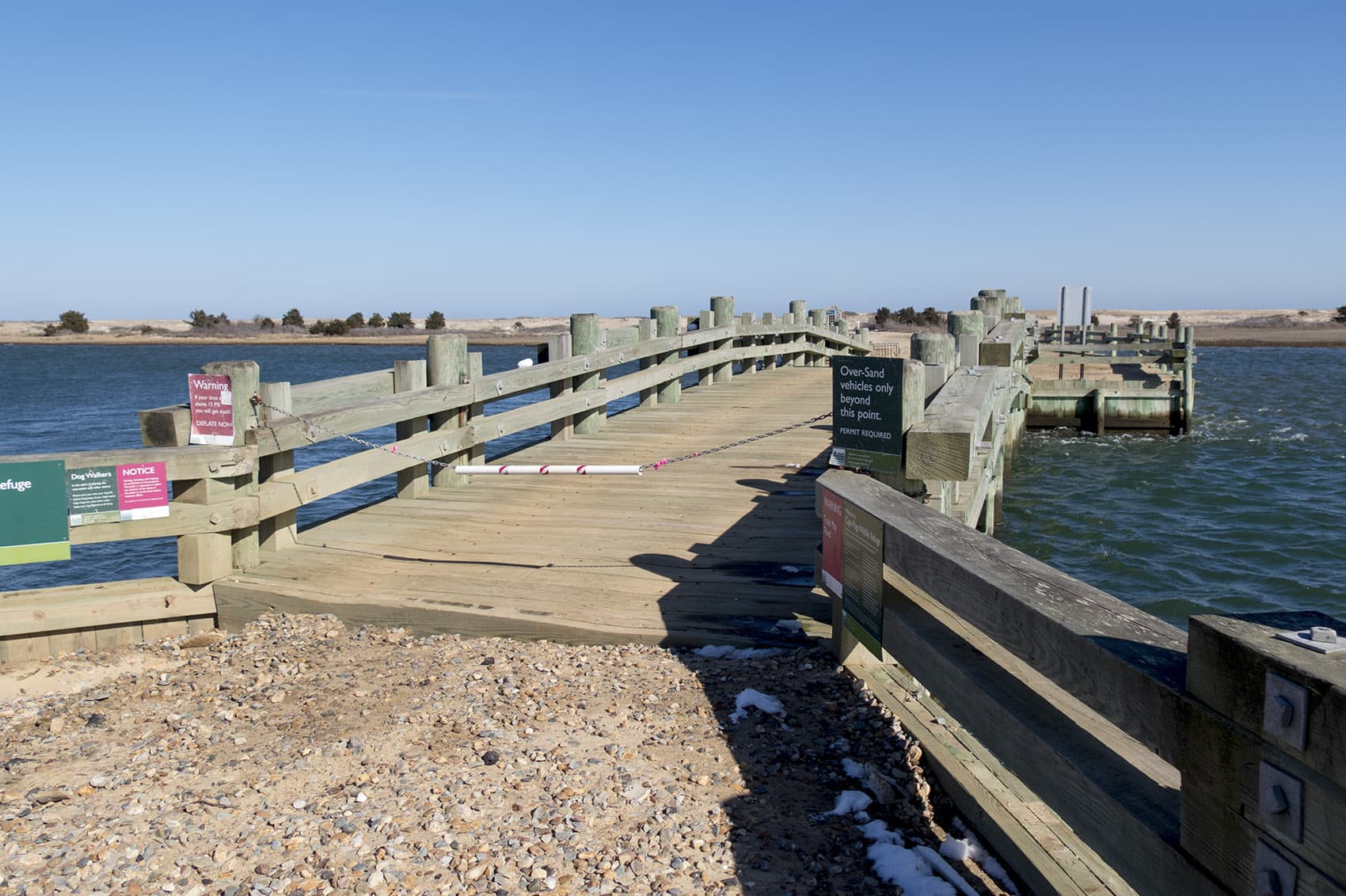
But there was no lighting on the bridge. And it was wooden, single-lane, with no guardrails, and at an angle from the road. By his own testimony, by the time Ted realized what he was driving onto and hit the brakes, it was too late: The car went off the bridge into a water channel.
Investigators on the bridge. Note the narrowness,
and the lack of guardrails.

Ted had survived a plane crash in 1964, though his back was badly injured. This time, he was able to get out of the car and get on land. But Mary Jo was not. He later claimed to have dived in 7 or 8 times to try to rescue her, but was unable to; and that he then stayed at the scene for 15 minutes before walking the mile or so back to the house, bypassing houses that could have been approached for help.

When he got there, he talked to his cousin, Joe Gargan, and Gargan's college friend Paul Markham. Both men had served as U.S. Attorney for Massachusetts, and had planned on competing with Ted in a boat race the next morning -- hence, Ted's choice of date for the party, as he would be there for both events. Both men told Ted he had to report the accident immediately. He talked them into driving back to the site of the crash to see if they could rescue Mary Jo themselves. This would likely have been useless, as the car would already have been filled with water. They went back, and were unable to get her out.

Again, they told Ted to report the accident. Still, he didn't. Why not? There are 3 theories, running from most to least likely:

1. He sustained a concussion in the crash, and wasn't thinking straight.
2. He was thinking that maybe the police would think Mary Jo was driving, and alone in the car, and that, when they asked Ted about it, he could simply say he lent her the car. So, instead of being impaired, he was a coward.
3. President Richard Nixon, paranoid as ever, always suspicious of the Kennedy family, wanted to eliminate the biggest threat to his re-election in 1972: Ted, who was very popular, more because of his martyred brothers than in his own right; and that he had people "take care of the situation," making it look like Ted had committed a crime. This was before it was widely known just how dirty "Tricky Dick" and his "dirty tricks" could truly be, so any claim that Ted could make about it would be completely implausible, and he dare not try it, and so he'd have to take the fall.

The car was found at 8:00 AM on July 19. The medical examiner, Dr. Robert Nevin, said there was no sign of foul play, and the cause of death was accidental drowning. He said that Mary Jo's blood-alcohol content was 0.09 percent -- just below the legal limit for driving.

The car's registration was found, and it was discovered to be Ted's car. The police found him, and there was no further escape: He gave a statement, admitting he was the driver.

To the end of his life, Ted insisted that he had not been drinking that night, that the crash was a complete accident, and that there was no relationship between him and Mary Jo, not even a professional one as there was between her and Bobby.

Enemies of the Kennedy family, and conservatives inclined to believe them, have spread rumors to the contrary: That Ted was drunk; or that he made a pass at her, and that's why he made the wrong turn or why he crashed; or that he had gotten her pregnant, and killed her to cover it up. Given Ted's history of drinking, and his history of womanizing and that of other members of the family, these rumors, while having absolutely no evidence to them whatsoever, were plausible.

On July 20, 2 days after the crash, Neil Armstrong became the 1st human being to walk on the Moon, fulfilling the goal made 8 years earlier by Ted's brother, JFK. But the President making the congratulatory phone call from the White House to Mission Control in Houston to the Moon was Richard Nixon.

And if Ted was paralyzed by indecision, considering maintaining his viability for the 1972 Presidential election, Nixon, too, was obsessed over it. One of his speechwriters, Patrick J. Buchanan -- himself later to be a candidate for President -- met with Nixon late that night, after that phone call, and wanted to know the President's thoughts about it. Nixon knew that Buchanan was perhaps the most partisan of his staff, and, as Buchanan recalled after Nixon's death in 1994, the first thing Nixon said to him after he sat down was, "You think this guy's gonna get away with this, Teddy?"

On July 22, 4 days after the crash, wearing a suit but also a cervical collar, Ted, along with his wife Joan, attended Mary Jo's funeral in Plymouth, Pennsylvania. Mary Jo's parents never forgave him, but neither did they tell him to stay away from the funeral.

On July 25, 7 days after the crash, Ted reported to Edgartown District Court on Martha's Vineyard, and pleaded guilty to a charge of leaving the scene of an accident that had caused bodily injury. Judge James Boyle sentenced him to the minimum sentence for the crime, 2 months in prison, but suspended the sentence: It would appear on the record, but he wouldn't actually have to serve it. Boyle told the witnesses in his courtroom, "He has already been, and will continue to be, punished far beyond anything this court can impose."

That night, at 7:30 PM Eastern Time, having bought half an hour of national network TV time, Ted read a statement to the country, written by Ted Sorensen, who had written speeches for both of his brothers. He stuck by his story, adding that he engaged in no "immoral conduct." However, he said, "I regard as indefensible the fact that I did not report the accident to the police immediately."

Finally, he addressed the voters of his home State, as he had to face re-election to the Senate in 1970, before considering whether to run for President in 1972:

It has been seven years since my first election to the Senate. You and I share many memories. Some of them have been glorious. Some have been very sad. The opportunity to work with you and serve Massachusetts has made my life worthwhile.

And so I ask you tonight, the people of Massachusetts, to think this through with me. In facing this decision, I seek your advice and opinion. In making it, I seek your prayers -- for this is a decision that I will have finally to make on my own.

While much of the country felt that Ted had not been sufficiently punished for what he did, the phone calls, telegrams and mail that came in from Massachusetts was overwhelmingly supportive. In the 1970 election for U.S. Senator from Massachusetts, Ted was opposed by Josiah Spaulding, a businessman who had served 2 years as Chairman of the Massachusetts Republican Party. Ted won 62 percent of the vote, Spaulding 37 percent.

But there was no way Ted could run for President in 1972. It was too soon. And his friend and colleague, Senator George McGovern of South Dakota, was nominated, and got clobbered. Going into the 1976 race, with no other obvious candidate, the nomination -- if not the general election -- was probably Ted's for the asking, but he wouldn't run. Jimmy Carter, a former Governor of Georgia, won.

In 1979, with millions of people, including Democrats, unhappy with Carter's leadership, Ted made his 1st run for President. But before he made his official announcement, he was interviewed by Roger Mudd for the news program CBS Reports. Mudd asked him the obvious question: "Why do you want to be President?"

When Jack made his announcement in 1960, he had a great short answer: "The Presidency is the center of action." When Bobby made his announcement in 1968, he had a longer, but no less telling, answer: "I run to seek new policies, because I believe our country is on a perilous course, and I feel obliged to do all that I can." Ted's answer was long, rambling, and not the least bit definitive. He made himself look like the only reason he was running was because he felt he had to live up to his brothers' legacy.

What's more, Mudd asked him about the Chappaquiddick crash. At various times in his life, Ted answered that question with sadness and remorse. This time, he gave an answer so soft it was barely even human. He sounded not the least bit sympathetic to the memory of Mary Jo Kopechne. Anybody who was still doubtful about him because of the crash now, at the very least, their doubts deepened.

By and large, Democrats stuck with Carter. At the 1980 Democratic Convention at Madison Square Garden in New York, Ted gave a much better speech than Carter. It wasn't the first time, nor was it the last, that Convention attendees saw a defeated candidate give a better speech than the nominee, leaving them thinking they'd nominated the wrong guy. Carter lost badly to former Governor Ronald Reagan of California.

Ted's personal life was in shambles. He had divorced Joan, and his drinking was getting worse. His kids urged him not to run in 1984, because, since the nomination would again be open, it would be his for the asking, thus he'd have to face the hard questions all the way until November 6, and he couldn't beat Reagan, and it would be the end of the Kennedy political story.

He didn't run, and never did again. Various family members have since run for office, including both of Ted's sons: Patrick was elected to the Rhode Island legislature and then to Congress; and, after Ted's death, Ted Jr. served a term on Connecticut's State Senate. Ted remarried, got his life under control, and was still re-elected to the Senate every 6 years, and still spoke at the Democratic Convention every 4 years, until his death in 2009.

If Ted Kennedy had become President? On the one hand, there might have been universal health coverage by the end of his term(s), and possibly an earlier end to the Cold War. Depending on when he was elected... 

* In 1972? Watergate wouldn't have mattered much, since Nixon would already have been gone.

* In 1976? He would have been in office in 1979, and he probably wouldn't have blundered into the Iran Hostage Crisis the way Carter did.

* In 1980? The Reagan tax cuts, the decapitation of the American labor movement, and the Iran-Contra scandal wouldn't have happened. He might have put the 1st woman on the U.S. Supreme Court, as Reagan did, but he wouldn't have put Anthony Kennedy (no relation) there, and he certainly wouldn't have promoted Nixon appointee William Rehnquist from Associate Justice to Chief Justice.

* Possibly in 1984 (if re-elected in 1988)? Definitely in 1988? He wouldn't have put Clarence Thomas on the Supreme Court.

On the other hand, we might have had our 1st President to have the First Lady leave him while in office, and we might have had our 1st genuine active alcoholic as President since Franklin Pierce left in 1857. (Andrew Johnson and Ulysses S. Grant were known for their drinking, but weren't regularly drunk as President. Warren Harding and Franklin Roosevelt liked their cocktails, Lyndon Johnson loved beer and bourbon, and George W. Bush was a recovering alcoholic, but they weren't active alcoholics in the White House. Nixon? Toward the end, it seemed like it, but we can't be sure.)

And if the Republicans gained control of Congress at any time while he was in office, he might have gotten impeached for something far short of what Donald Trump did.

But Ted Kennedy never got close to the Presidency. And the crash haunted him to the end. So did the rumors, and the sick jokes. The year before, when Nixon ran against Vice President Hubert Humphrey, Nixon's reputation for dishonesty led to a joke comparing him to a profession with the same reputation: "Would you buy a used car from this man?" Republicans now repeated the question, and said, "Yes, but I wouldn't let Teddy Kennedy drive it." Gun-rights advocates would say, "Ted Kennedy's car has killed more people than my gun." (Then you're not a very good shot, are you?)

National Lampoon magazine, based at Harvard University, alma mater to all the Kennedy brothers and their father, published a picture of a Volkswagen Beetle bobbing in water, mimicking a magazine print ad, saying, "If Ted Kennedy drove a Volkswagen, he'd be President today." Somebody at the magazine should have done some fact-checking: Mary Jo's own car was a Volkswagen Beetle. But it wasn't the Kopechnes, or the Kennedys, who sued the Lampoon: It was Volkswagen, for copyright infringement. The case was settled out of court.

In 2018, running for re-election to the Senate from Texas, Ted Cruz pointed out that his Democratic opponent, Beto O'Rourke, had Representative Joseph P. Kennedy III, Bobby's grandson, campaigning with him, even driving him, and Cruz said, "It may be the first time in history anyone's ever asked a Kennedy to drive."

(For the record, Joe's father, Joseph P. Kennedy II, was also involved in a bad crash, in 1973. While his injuries were minor, his female passenger was paralyzed. But Joe II still went on to serve 10 years in Congress; Joe III, whose driving record is clean, served 8.)

The Dike Bridge eventually got guardrails, warning signs that motor vehicles are prohibited, and a small plaque memorializing Mary Jo. Joseph P. Kennedy Sr. died 4 months after the crash, believing that his last chance to see one of his sons become President had disappeared. Sidney Lawrence, owner of the house that hosted the party, died of cancer in 1970, just over a year after the crash.
Joe Gargan, the cousin and lawyer that Ted asked to help him after the crash, published an unflattering book about it in 1988, and was cut off by the main branch of the Kennedy family. He died in 2017. Paul Markham, the other man Ted contacted that night, died in 2019.

In 2017, shortly before Gargan's death, the film Chappaquiddick premiered, starring Jason Clarke as Ted, and Kate Mara as Mary Jo. It took a lot of liberties with the story, including having old Joe Kennedy, played by Bruce Dern, lead the damage control, when he was in no condition to do anything about it accept lament it.

*

July 18, 1969 was a Friday. These games were played in Major League Baseball that day:

* The New York Yankees beat the Washington Senators, 5-0 at Yankee Stadium. Fritz Peterson pitched a 6-hit shutout, and was backed by a home run from Frank Fernandez.

* The New York Mets beat the Montreal Expos, 5-2 at Jarry Park in Montreal. Art Shamsky and Jerry Grote hit home runs in support of Jerry Koosman.

* The Boston Red Sox beat the Baltimore Orioles, 6-1 at Fenway Park in Boston. Carl Yastrzemski went 0-for-4 for the Sox, but Mike Andrews hit a home run. For the O's, Brooks Robinson went 1-for-4, and Frank Robinson went 0-for-4.

* The Chicago Cubs beat the Philadelphia Phillies, 9-5 at Connie Mack Stadium in Philadelphia. Ernie Banks, Jim Hickman and Randy Hundley hit home runs.

* The Pittsburgh Pirates beat the St. Louis Cardinals, 4-1 at Forbes Field in Pittsburgh. Roberto Clemente hit a 3-run home run off Bob Gibson, in support of Dock Ellis. Willie Stargell, Lou Brock and Joe Torre each went 1-for-4, and Torre added an RBI.

* The Houston Astros beat the Cincinnati Reds, 7-4 at Crosley Field in Cincinnati. For the Reds, Tony Pérez and Lee May hit home runs, Pete Rose went 1-for-4, and Johnny Bench went 0-for-2 with 2 walks.

* The Detroit Tigers beat the Cleveland Indians, 4-0 at Cleveland Municipal Stadium. Denny McLain pitched a 7-hit shutout. Bill Freehan and Willie Horton hit home runs. Al Kaline was injured, and did not play.

* The Atlanta Braves swept a doubleheader from the San Diego Padres, 6-2 and 6-3 at Atlanta Stadium (later Atlanta-Fulton County Stadium). Hank Aaron went 1-for-4 in the opener, and had the nightcap off.

* The Chicago White Sox beat the Kansas City Royals, 6-1 at Comiskey Park in Chicago.

* The Oakland Athletics beat the California Angels, 6-3 at Anaheim Stadium (now Angel Stadium of Anaheim). Reggie Jackson went 1-for-4, and Rick Monday hit a home run.

* The Los Angeles Dodgers beat their arch-rivals, the San Francisco Giants, 3-2 at Candlestick Park in San Francisco. Manny Mota went 3-for-4, Wes Parker went 2-for-4 with 2 RBIs, and Maury Wills went 2-for-4 with an RBI. Willie Mays only appeared as a pinch-hitter, and did not reach base.

* Hold on to your hats, Ball Four fans: The Seattle Pilots swept a doubleheader. And it was against, as Pilot pitcher Jim Bouton put it, "The Fat Kid and his wrecking crew." The Pilots beat the Minnesota Twins, 2-1 and 3-2 at Sick's Stadium in Seattle. Bouton did not enter either game.

"Tennis Ball Head" himself, Steve Hovley, had probably his best day in the major leagues. He drove in the winning run in the 1st game, by drawing a bases-loaded walk against Ron Perranoski in the bottom of the 9th. Diego Seguí went the distance for the win. In the 2nd game, Hovley hit a 2-run homer off Dave Boswell, in support of Fred Talbot. Bouton quoted Pilot pitcher John Gelnar as saying, "You know, one good thing about having Hovley up there, he's too goony to be scared.

Tommy Davis had 2 hits in each game. Over the 2 games, "The Fat Kid," Harmon Killebrew, went 2-for-6 with 2 walks. Rod Carew went 5-for-9. Bouton quoted Pilot catcher Jerry McNertney as saying of Carew, "He can't miss. If I were him I'd go looking for wallets."

Saturday, July 16, 2022

July 16, 1999: The Death of John F. Kennedy Jr.

July 16, 1999: John F. Kennedy Jr., son of the 35th President of the United States, and, fairly or not, heir to so many Americans' dreams, dies in a plane crash of the coast of Martha's Vineyard, Massachusetts. He was 38 years old. Lost along with him are his wife, Carolyn Bessette Kennedy, 36; and her sister, Lauren Bessette, 34.

John Fitzgerald Kennedy Jr. was born on November 25, 1960, in Washington, D.C., 17 days after his father was elected President. He and his sister, Caroline, 3 years older, became the first children to live in the White House since those of Theodore Roosevelt, over half a century earlier. Most Presidents are in their 50s or older, but JFK was 43, the youngest ever elected, and only TR ever took office younger; while his mother, formerly Jacqueline Bouvier, at 31, was the youngest First Lady since Frances Cleveland in the 1880s.

At one point, Jackie could be heard yelling at him, as a toddler, "John! John!" The media misunderstood this, and began calling him "John-John," a nickname that stuck with him for life, one he didn't like. As an adult, he always referred to himself as simply "John Kennedy," a common enough name without the middle initial that gave it away.

When interviewed by Oprah Winfrey in 1996, he said he didn't remember the picture of himself dancing with Caroline in the Oval Office while their father clapped along, or the picture of himself playing under the desk while his father worked, both taken mere days before JFK's assassination. He also said he didn't remember the salute he gave as his father's casket passed by during the funeral procession, on his 3rd birthday, November 25, 1963. "I remember he used to call me 'Sam,'" he said, "and I didn't like that. I said, 'My name's not Sam, it's John.' And he said, 'Okay, Sam.'"

In the one and only interview she gave after the assassination, to William Manchester a few days later, Jackie mentioned something a bit off-color: Once, JFK said good night to his son, and John said, "Good night, poo-poo-head!" and ran off. And JFK, laughing, said, "Come back here! You can't call the President of the United States a poo-poo-head!" If only he could have known what every President since him has been called, by people considerably older.

Jackie took John and Caroline back to New York. After marrying Greek shipping tycoon Aristotle Onassis, they divided their time between Jackie's apartment on 5th Avenue and Ari's private island, Skorpios. Jackie took them to the 1969 World Series at Shea Stadium.

He attended Phillips Academy in Andover, Massachusetts, which was attended by both Presidents George Bush -- but not his father, who had gone to Choate Rosemary Hall in Wallingford, Connecticut. Unlike his father, his grandfather and his 3 uncles, all Harvard men, he attended Brown University in Providence, Rhode Island, which would later be attended by his uncle Ted's son, Patrick. In 1988, he gave a speech at the Democratic National Convention in Atlanta, and it was well-received enough that people began to believe a political career was in his future.

He then attended New York University School of Law, but needed 3 tries to pass the New York State bar exam. He became a prosecutor in the Manhattan District Attorney's Office, lived in the Tribeca neighborhood, and rode a bicycle to work, even though the family fortune meant that he could have afforded a limousine.

Like his mother and his sister, he guarded his privacy intensely, and it was difficult to confirm stories about who America's most eligible bachelor was dating. Apparently, like his father and grandfather before him, he had a thing for actresses, including dating Brooke Shields, Sarah Jessica Parker, and, for 4 years, Daryl Hannah.

On September 21, 1996, a few weeks after founding George, a political magazine named after George Washington and aimed at younger readers, he married Carolyn Bessette, who worked in New York's fashion industry. This took many people by surprise: Not only was she not famous in her own right, but the general public didn't even know they were dating.

It was still believed that he would run for political office, as a stepping-stone to becoming President like his father. With the defeat of Governor Mario Cuomo -- whose son Andrew would one day be Governor, and had married Kerry Kennedy, daughter of John's uncle Robert F. Kennedy -- by Republican George Pataki in 1994, it was speculated that John would oppose Pataki in 1998. He chose not to.

When Senator Daniel Patrick Moynihan, a Democrat who had been a sub-Cabinet official under his father, announced his retirement rather than run in the 2000 election, the wide guess was that John would run for Moynihan's seat. He never publicly denied it, but there was no indication that he was making preparations to run for the seat, which ended up being won by First Lady Hillary Clinton.

But the spectre of tragedy has long hung over the Kennedy family. In addition to his father's assassination in 1963, his uncle Robert was assassinated while running for President in 1968. His uncle Ted (Edward M. Kennedy) was involved in a fatal car crash the following year. Joseph P. Kennedy Jr., the eldest brother of Jack, Bobby and Ted, was killed in service in World War II in 1944. One of their sisters, Kathleen, was killed in a plane crash in 1948. Another, Rosemary was left hopelessly disabled in 1940, in a surgical attempt to cure the apparent disability she already had.

Several of Bobby's kids had gotten involved in drugs, and it killed Bobby's son David in 1984. And Bobby's son Michael had been killed in a skiing accident in 1997. At the time, John was taking flying lessons, and he remembered that his mother, who died of cancer in 1994, was worried that he might die in a plane crash. He resumed his lessons, anyway.

On July 15, 1999, I attended the New York Yankees' game against the Atlanta Braves at the old Yankee Stadium, a 6-2 defeat. Unbeknownst to me until after the weekend, when the media showed footage of it on TV, John and Carolyn Kennedy had also attended the game. Despite the family's Boston roots making most of them Boston Red Sox fans, and the Shriver wing of the family coming from Baltimore and being Baltimore Orioles fans, JFK Jr. was, apparently, a Yankee fan.

The following day, John, Carolyn, and Carolyn's sister Lauren, who worked for brokerage firm Morgan Stanley Dean Witter, left New York for Essex County Airport in Fairfield, New Jersey. They were headed for the family home, known as the Kennedy Compound, in Hyannis Port, on Massachusetts' Cape Cod, for the wedding of Bobby's last child, Rory Kennedy, born 6 months after her father's assassination, to Mark Bailey. They had met through their work, as both are documentary filmmakers.

Traffic out of Manhattan, understandable due to it being evening rush hour on a Friday, was bad, and it wasn't until 8:38 PM that John was able to take off in the Piper Saratoga that he had bought 3 months earlier. The plan was to land at Martha's Vineyard Airport, on the island off the coast of Massachusetts, not far from another island, Nantucket; drop Lauren off there; and then take off again with Carolyn for Barnstable Airport on the mainland.

It was later determined that the plane hit the Atlantic Ocean at 9:41 PM, and that the most likely cause was spatial disorientation: As an under-experienced pilot, John may have been lower in the air than he realized.

At 2:15 AM on July 17, the Kennedy family notified Coast Guard Air Station Cape Cod that the plane had not arrived. I woke up Saturday morning to the news that the plane was missing. Knowing of the "Kennedy Curse," I was convinced he and whoever was with him on the plane were dead.

It was a weird, and very hot, weekend, which also included the perfect game pitched by David Cone of the Yankees: The plane and the bodies hadn't been found, so we didn't have confirmation that they were dead, so a small hope still lingered. The tent set up for the wedding became the focal point of the family's vigil.

But fragments of the plane were found on the 19th. Late at night on the 20th, the fuselage was found. On the afternoon of the 21st, the bodies were found, all still strapped into their seats. Autopsies proved that they died on impact. All 3 were cremated, and their ashes scattered at sea.

Even more than for his father, who had accomplished many things as President, the question of "What might have been" hangs over the memory of John F. Kennedy Jr. At the John F. Kennedy Museum in Hyannis Port, there is a statue of both of them as grown men, arms around each other. A copy is in Rapid City, South Dakota, along with statues of all the other Presidents at a public park.

The Kennedy-Bailey wedding was postponed to August 2. Rory and Mark have 2 daughters and a son. George magazine printed a memorial issue for John, and folded in 2001.

The psychotic QAnon movement believes that John will return from the dead and tell people to support Donald Trump, and save America from sin. I guess they forgot, or are too insane to consider, than John was a Democrat, and, like the rest of the Kennedy family, would oppose Trump. Indeed, given the legal pursuit of Trump, it's entirely possible that John Kennedy Jr., rather than Alvin Bragg, might be leading one of the prosecution teams against Trump.

*

July 16, 1999 was a Friday. These Major League Baseball games were played that day, all of them in Interleague Play:

* The New York Yankees lost to the Atlanta Braves, 10-7 at Yankee Stadium. Neither starting pitcher, Greg Maddux and Orlando "El Duque" Hernandez, got out of the 5th inning. The Yankees led 7-6 going into the 9th inning, but Mariano Rivera blew the save, including giving up a home run to Andruw Jones. It was 1 of 2 homers hit by Andruw on the night, and Ryan Klekso also hit 2 homers, and Chipper Jones hit 1. Derek Jeter hit a home run, and he and Ricky Ledee each got 3 hits for the Yankees, but it wasn't enough.

* The New York Mets beat the Tampa Bay Devil Rays, 9-7 at Tropicana Field in St. Petersburg, Florida. Matt Franco hit a home run in support of Rick Reed. Wade Boggs had an RBI double.

* The Philadelphia Phillies beat the Boston Red Sox, 5-4 at Fenway Park in Boston.

* The Baltimore Orioles beat the Montreal Expos, 9-4 at Camden Yards in Baltimore. This was one of the rare Oriole games between 1982 and 2001 in which Cal Ripken Jr. did not appear.

* The Florida Marlins beat the Toronto Blue Jays, 4-2 at the SkyDome (now the Rogers Centre) in Toronto.

* The Pittsburgh Pirates beat the Cleveland Indians, 11-3 at Three Rivers Stadium in Pittsburgh. 

* The Colorado Rockies beat the Cincinnati Reds, 6-2 at Cinergy Field (formerly Riverfront Stadium) in Cincinnati.

* The Chicago Cubs beat the Minnesota Twins, 11-10 at Wrigley Field in Chicago. The wind was blowing out: The Cubs got home runs from Sammy Sosa, Henry Rodriguez, Jeff Blauser and former Twin Gary Gaetti; while the Twins got them from Torii Hunter, Chad Allen and Ron Coomer.

* A doubleheader was split at Milwaukee County Stadium. The Milwaukee Brewers won the opener, 2-0. The Kansas City Royals won the nightcap, 12-10.

* The Chicago White Sox beat the St. Louis Cardinals, 9-8 at Busch Memorial Stadium in St. Louis. Mark McGwire hit 2 home runs.

* The Texas Rangers beat the Arizona Diamondbacks, 9-8 at The Ballpark (now Choctaw Stadium) in the Dallas suburb of Arlington, Texas. Todd Zeile drew a walk off Dan Plesac with the bases loaded in the bottom of the 9th, to win it.

* The Houston Astros beat the Detroit Tigers, 2-1 at the Astrodome in Houston.

* The Los Angeles Dodgers beat the Anaheim Angels, 3-1 at Edison International Field (now Angel Stadium of Anaheim).

* The Oakland Athletics beat the San Francisco Giants, 4-2 at the Oakland Coliseum (then named the Network Associates Coliseum). Barry Bonds went 0-for-3, but did draw a walk -- not an intentional one.

* And the San Diego Padres beat the Seattle Mariners, 2-1 at the new Safeco Field (now T-Mobile Park) in Seattle. Ken Griffey Jr. went 1-for-4. Tony Gwynn did not enter the game.

One more game of note: In the independent Atlantic League, the Newark Bears played their 1st home game at Riverfront Stadium, across from Broad Street Station, and beat the Lehigh Valley Black Diamonds, 9-8 on a walkoff home run. Sadly, despite winning Pennants in 2002 and 2007, the Bears, named for a former Yankee farm team, never caught on, and went out of business in 2013. Their stadium was demolished in 2019, only 20 years old.

Monday, June 20, 2022

June 20, 1975: "Jaws" Premieres

June 20, 1975: Jaws premieres, turning Steven Spielberg into a star director, and inventing the "Summer blockbuster film."

It was based on the novel of the same title, by Peter Benchley, grandson of Robert Benchley of Algonquin Round Table fame. He later regretted writing the book, because the movie led people to go out and kill sharks who had done nothing wrong.

Steven Spielberg was only 27 years old during filming, but he was already a genius, capable of out-Hitching Alfred Hitchcock for fear, suspense and characterization.

The movie was filmed on Martha's Vineyard, off the coast of Massachusetts, and "The Vineyard" stood in for the fictional Amity Island.

Roy Scheider, having previously played a second banana in The French Connection, proved that you didn't have to look like Steve McQueen, Paul Newman or Robert Redford to be an action hero.

Richard Dreyfuss, having played teenagers in American Graffiti and The Apprenticeship of Duddy Kravitz, was so much better playing a young, thoughtful scientist like Hooper than being a rotten old man. It's one thing to play a mean old Republican, like he did in The American President and W., and he was damn good at both. It's another thing to be one.

English actor Robert Shaw played Quint, who became a shark-hunter after surviving the shark attack on the survivors of the Japanese attack on the USS Indianapolis in the waning days of World War II. Surviving a harrowing wartime experience should make a man less of a jerk, not more. Quint never figured this out.

Murray Hamilton played Mayor Larry Vaughn, a coward who pandered to local businesses. He would have made a great modern Southern Republican. In contrast, as Chief Brody, Scheider gives off serious "I'm a Republican of conscience, and that's why I'm now a guest on MSNBC at least 3 times a week" vibes.

Look, I get why some people root for the shark. Frankly, I wept not at all when it chomped Quint up. I would have cheered if it had gotten that useless Mayor, the real villain of the movie. But you're not supposed to root for the shark, any more than you root for the witch in The Wizard of Oz, or Barzini in The Godfather, or Darth Vader in Star Wars, or Thanos in the Marvel movies.

"Smile, you son of a bitch!" is a better "I'm about to kill you!" line than was ever delivered by John Wayne, and neither Clint Eastwood, nor Sylvester Stallone, nor Arnold Schwarzenegger, nor Bruce Willis has ever topped it, either. Nor will they, in whatever time is left to them.

There were 3 sequels by 1987. The less said about them, the better.

Shaw died in 1978, Hamilton in 1986, Scheider in 2008. As of June 20, 2022, Spielberg, Dreyfuss, and Lorraine Gary, who played Ellen Brody, the Chief's wife, are still alive.

I don't like horror movies, and Jaws has too much screaming for me to buy some people's argument that it's a "perfect movie." But it's a great movie, one proven by both the post-9/11 hysteria and COVID to have stood the test of time.

If had not been made then, and were made today, would it have the same impact? Probably not, since we've been desensitized to some forms of fear. Except... You're gonna need a bigger bank account.

In a 2014 episode of the YouTube series Epic Rap Battles of History, "Nice" Peter Shukoff played Spielberg. It became a "battle royale" of film directors, with Peter also playing Michael Bay, while "Epic" Lloyd Ahlquist played Alfred Hitchcock, rapper Michael "Wax" Jones played Quentin Tarantino, and rapper Ruggles Outbound played Stanley Kubrick.

*

June 20, 1975 was a Friday. These Major League Baseball games were played:

* The New York Yankees lost to the Detroit Tigers, 10-9 at Tiger Stadium in Detroit. Rudy May didn't get out of the 1st inning, as the Tigers tagged him for 7 runs. But the Yankees nearly came back against Vern Ruhle, with 6 runs in the top of the 9th. Mickey Stanley's home run in the 7th made the difference. Graig Nettles and Bobby Bonds, in his only season with the Yankees, hit home runs. Nettles and Walt "No Neck" Williams each got 3 hits.

* The New York Mets lost to the Pittsburgh Pirates, 5-1 at Shea Stadium. Tom Seaver and Brooklyn native John Candelaria had a pitcher's duel going, until Willie Stargell hit a home run in the top of the 7th. The Mets tied it in the bottom of the 8th. Met manager Yogi Berra brought Tom Hall in to pitch the 9th, and he had nothing, and neither did Bob Apodaca, and the Bucs scored 3 runs, to make a winning pitcher out of Candelaria.

* The Boston Red Sox beat the Baltimore Orioles, 4-3 at Memorial Stadium in Baltimore. Rick Burleson hit a sacrifice fly to score Doug Griffin with the winning run in the top of the 12th inning. Carl Yastrzemski went 3-for-3 with 3 walks. Brooks Robinson went 0-for-5.

* The Philadelphia Phillies beat the Montreal Expos, 7-4 at Veterans Stadium in Philadelphia. Greg Luzinski hit a home run. Mike Schmidt did not play.

* The Atlanta Braves beat the San Francisco Giants, 4-2 at Atlanta-Fulton County Stadium.

* The Milwaukee Brewers beat the Cleveland Indians, 6-0 at Cleveland Municipal Stadium. Jim Slaton pitched a 6-hit shutout. Robin Yount went 2-for-4 with a walk. Hank Aaron was available for the Brewers, but did not play. Nor did Cleveland player-manager Frank Robinson insert himself into the game. So that's 2 men with a combined 1,321 career home runs who could have played in this game, but didn't.

* The Minnesota Twins beat the Chicago White Sox, 5-3 at Comiskey Park in Chicago. Rod Carew went 2-for-5 for the Twins, while Steve Brye hit a home run. Bucky Dent went 3-for-4 for the White Sox, while Ken Henderson hit a home run.

* The St. Louis Cardinals beat their arch-rivals, the Cago Cubs, 8-3 at Busch Memorial Stadium in St. Louis.

* The Cincinnati Reds beat the Houston Astros, 7-3 at the Astrodome in Houston. Pete Rose went 2-for-5. Johnny Bench went 1-for- 4 with a walk.

* The San Diego Padres beat their arch-rivals, the Los Angeles Dodgers, 2-1 at San Diego Stadium (later renamed Jack Murphy Stadium and Qualcomm Stadium). Willie McCovey, who never looked right in a Padre uniform -- then again, in the 1970s, nobody did -- hit a home run.

* The California Angels beat the Texas Rangers, 12-11 at Anaheim Stadium (now Angel Stadium of Anaheim). The Rangers scored 6 runs in the 1st inning, before the Angels even came to bat, chasing Bill Singer. But Gaylord Perry couldn't hold it, and the Angels led 8-7 after 6.

The Rangers sent the game to extra innings, and scored 3 runs in the top of the 11th. But the Angels scored 4 in the bottom half, the winning run scoring when 2nd baseman Mike Cubbage mishandled Jerry Remy's ground ball. Morris Nettles, no relation to Graig (Morris was black), had an RBI double in the inning.

* And the Oakland Athletics beat the Kansas City Royals, 3-1 at the Oakland Coliseum. Reggie Jackson went 2-for-4 with 2 RBIs. George Brett went 0-for-4. 

December 31, 1999 & January 1, 2000: The Millennium

December 31, 1999:  The Millennium arrives. The people of planet Earth survived. At a terrible cost. But we hadn't destroyed ourselves. ...