Showing posts with label coney island. Show all posts

Saturday, November 12, 2022

November 12, 1941: The Canary Who Could Sing But Couldn't Fly

November 12, 1941: Abe Reles, a former Murder Inc. hitman turned federal government witness, whose testimony had sent some mobsters to the electric chair, is whacked. He was 35 years old.

He was pushed out the window of Room 623, on the 6th floor of the Half Moon Hotel in Coney Island, Brooklyn. It was a few hours before he was supposed to testify against Albert Anastasia, the boss of the crime family that would later bear the name Gambino, but not yet American organized crime's "boss of all bosses." It was suggested that he jumped, because he couldn't take the pressure, but who was kidding who?

The newspapers called Reles "The Canary Who Could Sing, But Couldn't Fly." It was later revealed that the policeman who was supposed to be guarding his room, Detective Charles Burns, was a person of interest in the disappearance of Judge Joseph Crater in 1930, which has also never officially been solved.

The rubout of Reles, known in his time as "Kid Twist," was referenced on a 2002 episode of The West Wing, in which White House Press Secretary Toby Ziegler (played by Richard Schiff) hinted to his father, Julius (Jerry Adler) that he suspected his involvement in Reles' death.

The Half Moon Hotel, named for the ship that Henry Hudson was sailing when he discovered the river that would bear his name, was at 2827 Mermaid Avenue. During World War II, the hotel was operated by the U.S. Navy, and became known as the "U. S. Naval Special Hospital Sea Gate, NY", a convalescent hospital. In the 1950s, it became a senior citizens' home called the Metropolitan Jewish Geriatric Center. They moved to another building, and it was demolished in 1995. Today the Seagate Rehabilitation and Nursing Center is on the site.

*

November 12, 1941 was a Wednesday. Baseball was out of season. Football was in midweek. The NBA hadn't been founded yet. And while the NHL season was underway, no games were scheduled. So there were no scores on this historic day.

Wednesday, July 6, 2022

July 6, 1988:"Hypodermics On the Shore"

July 6, 1988: The first reported medical waste on beaches in the Greater New York area, including hypodermic needles and syringes possibly infected with the AIDS virus, washes ashore on Long Island.

Subsequent medical waste discoveries on beaches in Coney Island, Brooklyn and in Monmouth County, New Jersey forced the closure of numerous area beaches in the middle of one of the hottest summers on record in the American Northeast. New England was also hit hard by this phenomenon.

Dumping dirty needles into the ocean was typical of how people treated the seas before the environmental movement, discouraged into dormancy by the Presidency of Ronald Reagan, got going again after the old bastard left office.

It got so bad, Long Islander Billy Joel worked it into his song "We Didn't Start the Fire": "Hypodermics on the shore." In an interview with Rolling Stone magazine in 1990, following the successful revolutions in Eastern Europe and the failed one in China, he said, "I almost added, 'Poison apples in the store,' because that whole 'Alar' thing was happening. Then Tienanmen Square happened, and it became 'China's under martial law.' Think what I'd have to write about Eastern Europe now."

*

July 6, 1988 was a Wednesday. These Major League Baseball games were played:

* The New York Yankees lost to the Texas Rangers, 4-2 at Arlington Stadium in the Dallas suburb of Arlington, Texas. Jeff Russell outpitched Ron Guidry, who was nearing the end of the line. Pete Incaviglia hit a home run for the Rangers. For the Yankees, Dave Winfield went 2-for-4 with a walk. Don Mattingly went 3-for-5. Rickey Henderson went 0-for-3 with 2 walks.

* The New York Mets beat the Cincinnati Reds, 5-4 at Shea Stadium. Ron Darling was the winning pitcher. Darryl Strawberry hit a home run.

* The Atlanta Braves beat the Philadelphia Phillies, 3-2 at Atlanta-Fulton County Stadium. Mike Schmidt appeared as a pinch-hitter, and did not reach base.

* The California Angels beat the Toronto Blue Jays, 5-4 at Exhibition Stadium in Toronto. Chili Davis hit a home run in the top of the 10th inning.

* The Cleveland Indians beat the Oakland Athletics, 8-6 at Cleveland Municipal Stadium.

* The Detroit Tigers beat the Seattle Mariners, 7-6 at Tiger Stadium in Detroit.

* The Chicago White Sox beat the Baltimore Orioles, 4-1 at Comiskey Park in Chicago. Eddie Murray went 0-for-4. Cal Ripken went 2-for-4.

* The Minnesota Twins beat the Boston Red Sox, 8-1 at the Metrodome in Minneapolis.

* The Milwaukee Brewers beat the Kansas City Royals, 4-2 at Royals Stadium (now Kauffman Stadium) in Kansas City. Robin Yount went 3-for-4 with an RBI. Paul Molitor went 1-for-4 with a walk. George Brett went 1-for-4.

* The Montreal Expos beat the Houston Astros, 4-2 at the Astrodome in Houston.

* The Los Angeles Dodgers beat the St. Louis Cardinals, 7-3 at Dodger Stadium in Los Angeles.

* The San Francisco Giants beat the Chicago Cubs, 2-0 at Candlestick Park in San Francisco. Former Cub Rick Reuschel pitched 8 innings of 6-hit shutout ball, but needed Craig Lefferts and Scott Garrelts to finish the 7-hit shutout.

It was the 176th out of the 218 wins Reuschel would have in his career, that began in 1972. The losing pitcher was Jamie Moyer, who then had 24 of the 269 wins he would have in his career, that ended in 2012, 50 years after Reuschel's began.

* And, despite playing each other at Jack Murphy Stadium in San Diego both the day before and the day after, the Pittsburgh Pirates and the San Diego Padres did not play. Baseball-Reference.com gives no explanation, nor suggests that a game was postponed and made up later in the year.

Sunday, June 26, 2022

June 26, 1927: The Coney Island Cyclone Opens

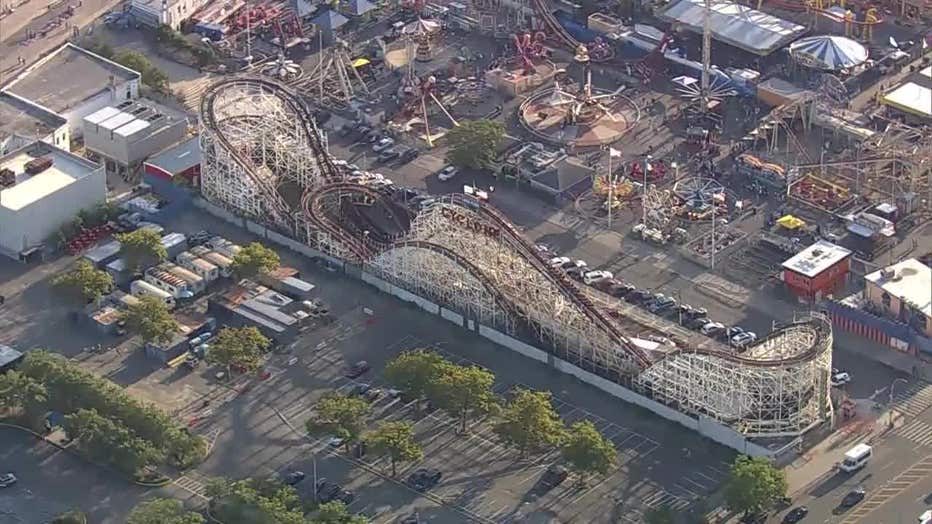
June 26, 1927: The Cyclone opens at Luna Park in the Coney Island section of Brooklyn, in New York City. It becomes the most famous roller coaster ever built.

Luna Park is the current name for an amusement park that was built on the site of Astroland and Dreamland, adjacent to the original Luna Park.

Brothers Irving and Jack Rosenthal, who also developed Palisades Amusement Park in Bergen County, New Jersey, bought the land for the park. Vernon Keenan designed the coaster, which reaches a maximum speed of 60 miles per hour, and has a total track length of 2,640 feet (exactly half a mile), with a maximum height of 85 feet. It has 6 turns and 12 drops. Refurbishments were done in 1975 and 2016.
My grandmother, born in Brooklyn and raised in Queens, had ridden the Cyclone. She told me it was overrated as a ride, and said I wouldn't enjoy it. To this day, I've never ridden it. 

In 2001, the New York Mets opened a ballpark, 4 blocks to the west of the coaster, for their team in the Class A New York-Penn League. They named the team the Brooklyn Cyclones. 

*

June 26, 1927 was a Sunday. These baseball games were played:

* The New York Yankees split a doubleheader with the Philadelphia Athletics at Yankee Stadium. The A's won the opener, 4-2. Jack Quinn, a 43-year-old former Yankee born Joannes (Jan) Pajkos in Hungary, and 1 of the 17 pitchers permitted to keep throwing the spitball after 1920, outpitched Myles Thomas. The Yankees won the nightcap, 7-3. Wilcy Moore, normally a reliever, went the distance, while A's starter Sam Gray didn't make it to the 2nd inning.

Lou Gehrig went 2-for-8 with a solo home run in the 2nd game, Babe Ruth did not play in either game, and Ty Cobb, the former Detroit star playing out the string with the A's, only appeared in the 2nd game, as a pinch-hitter, and did not reach base.

* The Brooklyn Robins (as the Dodgers were known while Wilbert Robinson managed them from 1914 to 1931) beat their arch-rivals, the New York Giants, 7-1 at Ebbets Field. Dazzy Vance went the distance for the win. Rogers Hornsby went 1-for-4. Bill Terry went 0-for-4. Rookie Mel Ott appeared as a pinch-hitter, and did not reach base.

* The Washington Senators beat the Boston Red Sox, 8-7 at Griffith Stadium in Washington. Walter Johnson was the winning pitcher, for the 414th time in his career. He would win 3 more games that season, and retire.

* A doubleheader was split at League Park in Cleveland. The Cleveland Indians won the 1st game, 2-0. George Uhle pitched a 4-hit shutout. The St. Louis Browns won the 2nd game, 7-3. Over the 2 games, George Sisler went 3-for-8 with a walk.

* The Cincinnati Reds beat the Chicago Cubs, 8-5 at Redland Field (later Crosley Field) in Cincinnati.

* The Chicago White Sox beat the Detroit Tigers, 9-7 at Comiskey Park in Chicago.

* The Pittsburgh Pirates beat the St. Louis Cardinals, 9-3 at Sportsman's Park in St. Louis. Paul Waner went 3-for-5 with an RBI, and Lloyd Waner went 1-for-5.

* And the Boston Braves and the Philadelphia Phillies did not play: Massachusetts did not legalize professional sports on Sunday until the next year, and Pennsylvania did not do so until 1933.

Thursday, May 26, 2022

May 27, 1911: The Dreamland Fire

May 27, 1911: The fire destroys the Dreamland amusement park at Coney Island in Brooklyn, New York City.

The park had opened on May 15, 1904, in competition with Steeplechase Park (1897) and Luna Park (1903).  it included a human zoo (basically, a freak show), several early roller coasters, a Shoot the Chutes ride, and a replica of the canals of Venice, Italy. Dreamland also hosted entertainment and dramatic spectacles based on morality themes. Several buildings, such as the Pompeiian, Electricity, and Submarine Boat buildings, were dedicated to exhibits.
Dreamland Tower, 1904-1911, before the fire

But at the start of the Summer of 1911, a worker kicked over a bucket of hot pitch, starting a fire that spread through the park's wooden buildings. Firefighters were unable to control the fire because of low water pressure, and nearly all of the structures were quickly destroyed. It had been only 2 months since the Triangle Shirtwaist Factory fire killed 146 people in Lower Manhattan. This time, fortunately, no one was killed.

The northern portion of the site, on Surf Avenue, was quickly redeveloped with various concessions. The New York City government acquired the southern portion through condemnation in 1912, but disputes over compensation continued for 8 years. The site became a parking lot in 1921, and was redeveloped as a recreation center in 1935. The new version of the New York Aquarium, which had previously been at Castle Garden in The Battery at the southern tip of Manhattan since 1896, opened on June 6, 1957.

Luna Park burned down on August 13, 1944. Steeplechase Park hung on for another 20 years, closing on September 20, 1964. Steeplechase was driven out of business by a new park, Astroland, that opened on May 25, 1962. Astroland was badly damaged by a fire on July 12, 1975, but rebuilt. It closed for good on September 7, 2008. On May 29, 2010, a new Luna Park opened on the site of Astroland.

*

May 27, 1911 was a Saturday. These baseball games were played:

* The New York Highlanders split a doubleheader with the Philadelphia Athletics, at Shibe Park in Philadelphia. The A's win the opener, 8-1. Eddie Plank outpitches Ray Caldwell. Rube Oldring goes 3-for-5 with 2 RBIs. For the Highlanders, Birdie Cree goes 4-for-5, and Harry Wolter goes 3-for-5, but it's in vain.

The Highlanders win the nightcap, 8-3. Russ Ford (no relation to Whitey) pitches a complete game, while Jack Coombs has to leave the game due to injury after the 1st inning. Roy Hartzell and Earle Gardner each go 3-for-5 with 2 RBIs, and John Knight goes 2-for-3 with a walk and 3 RBIs. The Highlanders, already frequently called the Yankees, make that name official in 1913.

* The New York Giants beat the Philadelphia Phillies, 2-0 at Hilltop Park in Manhattan, home of the Highlanders, where the Giants were playing while they rebuilt the Polo Grounds after a fire the previous month. Christy Mathewson allowed 8 hits, but kept a shutout.

* The Brooklyn Dodgers beat the Boston Rustlers, 9-8 at the South End Grounds in Boston. The Rustlers were named for their owner, William H. Russell. He died after the season, and the new owner was James Gaffney, a "Brave" (officer) in New York's Tammany Hall political organization. He renamed the team the Boston Braves.

* The Washington Senators beat the Boston Red Sox, 9-4 at American League Park (later Griffith Stadium) in Washington.

* The Cincinnati Reds beat the Pittsburgh Pirates, 1-0 at Forbes Field in Pittsburgh. Art Fromme allowed only 1 hit, a double by Honus Wagner.

* The Detroit Tigers beat the St. Louis Browns, 9-3 at Bennett Park in Detroit. Ty Cobb went 2-for-5 with 3 RBIs.

* The Cleveland Naps beat the Chicago White Sox, 6-5 in 10 innings at Comiskey Park in Chicago. The Naps were named for their 2nd baseman and manager, Napoleon "Nap" Lajoie. After he left in 1914, they were renamed the Cleveland Indians, and they became the Cleveland Guardians in 2022. Lajoie did not put himself into this game. He did put "Shoeless" Joe Jackson in, and he went 2-for-3 with a walk.

* And the Chicago Cubs beat the St. Louis Cardinals, 7-6 in 11 innings at Robison Field in St. Louis.

Friday, April 15, 2022

April 15, 1931: The End of the Castellammarese War

Joe Masseria

April 15, 1931: The Castellammarese War, a battle for control of American organized crime, comes to an end.

It began on October 10, 1928, between the forces of Giuseppe "Joe the Boss" Masseria and Salvatore Maranzano, for whose hometown in Sicily, Castellammare del Golfo, the conflict was named.

Masseria, the biggest crime boss of the time, was invited to Nuova Villa Tammaro, a restaurant in the Coney Island section of Brooklyn, by one of his lieutenants, Charles "Lucky" Luciano. Luciano excused himself to use the bathroom.

In came 4 men: Albert Anastasia, Vito Genovese, Joseph "Joe Adonis" Doto and Benjamin "Bugsy" Siegel. They left the building alive. So did Luciano. Masseria did not. He was 45 years old. Siegel drove the getaway car.

There was one more act to play: Maranzano's side won, but he paid the price. He got nervous over Luciano's rise, and was determined to kill him. But Luciano was tipped off, and had Maranzano killed on September 10, 1931. Maranzano's organization was taken over by Joseph Bonanno, and became known as the Bonnano family.

Luciano took over Masseria's "family." When he was deported in 1942, Genovese succeeded him, and the family still bears the Genovese name. Adonis became one of Genovese's most trusted lieutenants. Siegel moved out to Los Angeles, then "invented Las Vegas," before his actions led to his being removed from the scene in 1947.

It was shortly after the Castellammarese War ended that Luciano founded the Commission, the closest thing that American organized crime has to a governing body. It was founded with the purpose of mediating disputes peacefully, to avoid such turf wars in the future. After all, unlike in real life, within the Mob, war is not good for business. The Commission allowed crime in New York City to be run by what became known as the Five Families: Bonnano, Colombo, Gambino, Genovese and Lucchese. (That's in alphabetical order. It seemed the most respectful way to list them.)

Anastasia rose to become Il capo di tutti capi – the Boss of All Bosses, a distinction that Luciano wanted to use the Commission to avoid coming into being, but, by this point, he was alive, but out of the picture. Anastasia founded what became known as the Gambino family. For the most part, there was peace in American organized crime, until Anastasia went for a haircut in 1957, and never came back.

These "families" were severely weakened by federal prosecution in the 1980s and '90s, and none is run today by a namesake.

In the 1972 film The Godfather, there were numerous uses of the term "Five Families," and they were named Corleone, Tattaglia, Barzini, Cuneo and Stracci, although how much any of them corresponds to any of the real ones is debatable. Vito Corleone has been compared to both Vito Genovese and Carlo Gambino in terms of manner and style. The 1969 novel on which the film is based, by Mario Puzo, makes reference to "The Olive Oil War" of the early 1930s, in which Corleone rose to become the boss of all bosses, a title he loses later in the book. In an agreement made with... certain men... Puzo, who also wrote the screenplay, and director Francis Ford Coppola agreed to not use the words "Mafia" or "Mob" in the film, although they were used in the sequels.

The Banner Smoked Fish Company now occupies the site of the Masseria hit, at 2715 West 15th Street.

*

April 15, 1931 was a Wednesday. Football was out of season. The NBA hadn't yet been founded. The Stanley Cup had been won the night before, by the Montreal Canadiens over the Chicago Black Hawks. But all 16 teams in what would later be called Major League Baseball were in action:

* The New York Yankees beat the Boston Red Sox, 8-7 at Yankee Stadium. Despite blowing a lead for starting pitcher Hank Johnson, Roy Sherid was named the winning pitcher. Lou Gehrig hit a 3-run home run, and Babe Ruth won it in the bottom of the 9th with, uncharacteristically for him, a sacrifice fly.

* The New York Giants lost to the Philadelphia Phillies, 10-7 at Baker Bowl in Philadelphia. The Phils scored 8 runs in the bottom of the 2nd, knocking Hal Schumacher out of the box. Bill Terry and Mel Ott each went 1-for-5 with 2 RBIs for the Giants, but it was far from enough. Hall-of-Famer Chuck Klein was 1 of 3 Phils to hit home runs.

* The Brooklyn Robins lost to the Boston Braves, 9-3 at Braves Field in Boston. This would be the last season for Brooklyn with Wilbert Robinson managing. For 1932, they dropped the name they took in his honor, and went back to the name they'd last used in 1913: The Brooklyn Dodgers.

* The Washington Senators beat the Philadelphia Athletics, 7-1 at Griffith Stadium in Washington.

* The Chicago White Sox beat the Cleveland Indians, 7-6 at League Park in Cleveland. Cliché Alert: Walks can kill you, especially the leadoff variety. Johnny Watwood led off the top of the 10th inning with a walk, and was doubled home by Bennie Tate to win it for the Pale Hose.

* The St. Louis Cardinals beat the Cincinnati Reds, 4-0 at Redland Field in Cincinnati. (It was renamed Crosley Field in 1934.) Burleigh Grimes, the last pitcher legally allowed to throw a spitball, used it to pitch a 7-hit shutout.

* The Chicago Cubs beat the Pittsburgh Pirates, 6-5 at Wrigley Field in Chicago. Rogers Hornsby hit a home run for the Cubs.

* And the St. Louis Browns beat the Detroit Tigers, 6-4 at Sportsman's Park in St. Louis.

Wednesday, February 9, 2022

February 9, 1979: "The Warriors" Premieres

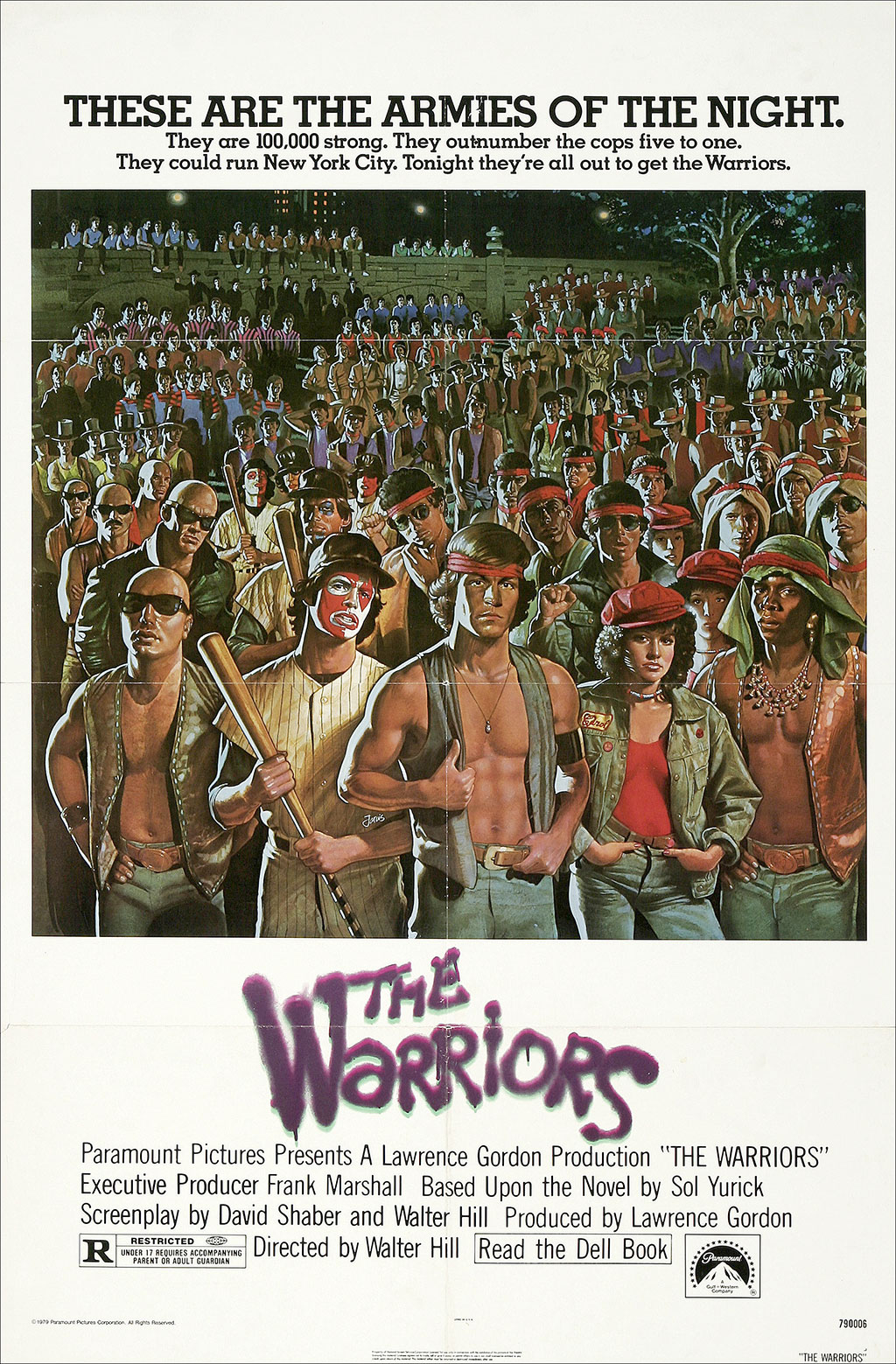
February 9, 1979: The film The Warriors premieres, based upon the 1965 novel of the same name by Sol Yurick, and directed by Walter Hill. In the intervening 14 years, crime, especially gang violence, had gotten noticeably worse in America's cities, especially New York, where the story takes place.

The story is based on the Anabasis, meaning "expedition up from," by the ancient Greek soldier Xenophon, about his story of being part of a Greek army making its attempt to get home from a mission in Persia in 401 BC. During the novel, the character of Junior reads a comic book version of that story.

In the book, the gang that serves as the protagonists is the Coney Island Dominators, and are black and Hispanic. In the film, the protagonists are the Warriors, and they are a complete mix, racially and ethnically.

The film's poster read, "These are the armies of the night. They are 100,000 strong. They outnumber the cops five to one. They could run New York City. Tonight they're all out to get the Warriors."

A "summit" of New York's gangs is held in the City's northernmost part, Van Cortlandt Park, in The Bronx. Cyrus (played by Roger Hill), leader of the City's most powerful gang, the Gramercy Riffs, proposes a truce, having the gangs work together for the benefit of all of them, as they outnumber the City's police -- not unlike the Mafia began working together under the Commission, nearly half a century earlier. In layman's terms, he tells them that peace is good for business. "Can you dig it?" he asks the assembled crowd. Their cheer is taken as a "Yes."

But Luther (David Patrick Kelly), leader of the Rogues, does not agree, and he shoots and kills Cyrus. He then pins the murder on the Warriors, who now have to get all the way through each of 3 Boroughs -- The Bronx, Manhattan and Brooklyn, 25 miles -- to get back to their home territory. And that requires going through several enemy territories, with every gang in the City, not knowing the truth, now pissed at them.

They take the Subway, but get stranded in Tremont, one of the worst neighborhoods in The Bronx. They have a fight with the Orphans, a gang considered too small to be invited to the gathering. Mercy (Deborah Van Valkenburgh, later to play Jackie Rush on the sitcom Too Close for Comfort), the girlfriend of one of the Orphans, abandons them and joins the Warriors as they head back into the Subway.

They get to 96th Street, on the Upper West Side of Manhattan, but the cops find them, and they have to split up. One of the Warriors, Fox (Thomas G. Waites), is hit by a train and killed. Four others are chased into Riverside Park by the Baseball Furies, a gang wearing baseball uniforms but with their faces made up so that they look like members of the rock band Kiss. (No gang in the novel dressed like that, and I seriously doubt that any real New York gang did. If they did, they probably didn't last long.) They fight, and the Warriors win, and resume their journey.

They have another fight at Union Square (14th Street), with the Punks, a gang on roller skates. At around this time, word gets to the Riffs (whose Gramercy Park base is just north of Union Square) of the identity of the real killer, Luther, and the bounty on the Warriors is called off. But the Warriors don't know this yet.

The Warriors cross Brooklyn, and reach Coney Island at dawn. But the Rogues are waiting for them. In the film's best remembered scene, Luther sits in his car (a graffiti-festooned 1955 Cadillac hearse), with his fingers jammed into the necks of three soda bottles, clinking them together, and challenges them, saying, over and over again, in one of the great at-libs in movie history (it was not in the script), "Warriors! Come out to play-yay!"

Swan (Michael Beck), leader of the Warriors, decides to settle it by challenging Luther to single combat. But Luther pulls a gun. Swan manages to dodge his shot, and throws a switchblade that lands in Luther's wrist, causing him to drop the gun. At that moment, the Riffs arrive. They let the Warriors know that they now know the truth, and leave them alone, and fight the Rogues. When last seen, Luther is alive, but screaming under the beating he is taking. In a nod to Western movies, where the hero often rides off into the sunset, Swan and Mercy walk off into the sunrise.

Showings of the film were linked to violent incidents over its 1st 2 weeks. So theater owners were relieved of their contractual obligations if they did not want to show the film, and Paramount offered to pay costs for additional security and damages due to vandalism. In the end, this film, which cost $4 million to make, made over $22 million, a big sum for the era, and became a cult favorite.

I once saw a meme of the Warriors on the Subway with Paul Kersey, the vigilante played by Charles Bronson in the Death Wish films. The meme asked what would have happened if they'd met. It’s obvious: The Warriors were looking to avoid trouble, just to get home -- just like Kersey. They would have left each other alone, and nothing would have happened.


*

February 9, 1979 was a Friday. This was also the day that Trevor Francis became the 1st British footballer (soccer player) to be transferred from one team to another for a few of £1 million or higher. I have a separate entry for that event. And Chinese actress Zhang Ziyi, known for her roles in martial arts films, was born on this day.

Baseball and football were out of season. There were 9 games played in the NBA:

* The Boston Celtics beat the Indiana Pacers, 112-101 at the Boston Garden.

* The Philadelphia 76ers beat the San Diego Clippers, 117-106 at The Spectrum in Philadelphia.

* The Houston Rockets beat the New Orleans Jazz, 106-99 at the Superdome in New Orleans. Moses Malone had 33 points, and a whopping 37 rebounds.

* The Kansas City Kings beat the Chicago Bulls, 124-114 at the Chicago Stadium.

* The Milwaukee Bucks beat the Seattle SuperSonics, 118-116 in overtime at the Milwaukee Exposition, Convention Center and Arena, or "The MECCA." Since 2014, it has been named the UW-Panther Arena.

* The Atlanta Hawks beat the Phoenix Suns, 105-102 at the Arizona Veterans Memorial Coliseum in Phoenix.

* The Los Angeles Lakers beat the Cleveland Cavaliers, 106-103 at The Forum outside Los Angeles in Inglewood, California.

* The Denver Nuggets beat the Golden State Warriors, 106-104 at the Oakland Coliseum Arena.

* And the Portland Trail Blazers beat the San Antonio Spurs, 125-106 at the Portland Memorial Coliseum. Despite the defeat, the Spurs' George Gervin led all scorers with 34 points.

The NHL was in its All-Star Break. There were 2 games played in the World Hockey Association. The Cincinnati Stingers beat the Winnipeg Jets, 4-0 at the Riverfront Coliseum (now the Heritage Bank Center) in Cincinnati. And the Edmonton Oilers beat the Quebec Nordiques, 3-0 at the Northlands Coliseum in Edmonton.

Monday, January 3, 2022

January 4, 1903: The Electrocution of Topsy the Elephant

January 4, 1903: When people want to call Thomas Edison a great man or a genius, they can point to any number of examples. When they want to call him unpleasant things, there are several examples of that, too.

The electrocution of Topsy was one of those things. Except he had almost nothing to do with it.

Topsy was a female Asiatic elephant, believed to have been born in 1875, somewhere in Southeast Asia -- an area encompassing the present-day nations of Myanmar (formerly Burma), Thailand (formerly Siam), Malaysia (formerly Malaya), Laos, Cambodia and Vietnam. She was secretly brought into the United States soon thereafter, and added to the herd of performing elephants at the Forepaugh Circus, which who fraudulently advertised her as the first elephant born in the United States.

During her 25 years at Forepaugh, Topsy gained a reputation as a "bad" elephant and, after killing a spectator in 1902, was sold to Sea Lion Park in the seaside Coney Island section of Brooklyn, New York City. Sea Lion was leased out at the end of the 1902 season, and during the construction of the park that took its place, Luna Park, Topsy was used in publicity stunts, and also involved in several well-publicized incidents, attributed to the actions of either her drunken handler or the park's new publicity-hungry owners, Frederic Thompson and Elmer "Skip" Dundy.

Their end-of-the-year plans to advertise the opening of their new park, by euthanizing approximately 27-year-old Topsy in a public hanging, and charging admission to see the spectacle, were prevented by the American Society for the Prevention of Cruelty to Animals (ASPCA). Apparently, though, there was no law preventing them from staging it and inviting people to attend for free.

The event was instead limited to invited guests and press only, and Thompson and Dundy agreed to use a more sure method of strangling the elephant with large ropes tied to a steam-powered winch, with both poison and electrocution planned as backup, a measure officially supported by the ASPCA.

On January 4, 1903 -- a Sunday, but no "Sabbatarians," people who tried to prevent, either by law or by force, various actions from taking place on the Sabbath, appear to have gotten involved -- in front of a small crowd of invited reporters and guests, Topsy was fed carrots laced with 460 grams of potassium cyanide, then strangled, then electrocuted, which turned out to be what finished the job.

Among the invited press that day was a crew from Edison Studios, who filmed the event. Their film of the electrocution part was released to be viewed in coin-operated kinetoscopes, under the title Electrocuting an Elephant. It is probably the first filmed death of an animal in history -- and, though it was not a human being that was murdered, it counts as the first "snuff film," too.

The men worked for Edison. Edison was not there, and had no role in the execution itself, either the decision to do it or its carrying out. And it had nothing to do with his "War of the Currents," his determination that direct current (DC) triumph over alternating current (AC): Edison had already lost that war to George Westinghouse during the World's Columbia Exhibition in Chicago in 1893. Edison did not use the electrocution of Topsy to promote his position that DC was the better choice, because it would have done him no good by that point.

He still had to approve its filming. And he had no problem profiting from the film. So, while he was only a side character in this story, his tangential role in it still doesn't improve his image. Edison, on occasion, was a villain. This time, though, the villains were Frederic Thompson and Skip Dundy.

They didn't live much longer. Unlike Topsy, Dundy did not suffer much: He had a heart attack in 1907. He was 44 years old. Thompson did suffer: The kidney disorder Bright's disease, treatable today, killed him in 1919. He was only 45. Edison lived on until 1931, at 84.

*

January 4, 1903, as I said, was a Sunday. There were no scores on this historic day: Baseball and football were in the off-season, professional basketball barely existed, and professional hockey only existed under the table. There were soccer games in England's Football League the day before, but not on this day.

December 31, 1999 & January 1, 2000: The Millennium

December 31, 1999:  The Millennium arrives. The people of planet Earth survived. At a terrible cost. But we hadn't destroyed ourselves. ...