Showing posts with label nhl all-star game. Show all posts

Thursday, October 13, 2022

October 13, 1947: The 1st NHL All-Star Game

October 13, 1947: The National Hockey League hosts its 1st official All-Star Game, at Maple Leaf Gardens in Toronto.

There had been 3 unofficial all-star games, all benefits:

* In 1934, also at Maple Leaf Gardens, for Maple Leaf player Irvine "Ace" Bailey, who had suffered a career-ending injury. The Leafs beat a team made up of players from all the other teams in the League.

* In 1937, at the Montreal Forum, for the family of the late Montreal Canadiens superstar Howie Morenz. The Canadiens and the Montreal Maroons combined to face a team from the other teams of the League, which won.

* And in 1939, also at the Forum, for the family of the late Canadiens star Albert "Babe" Siebert. The Maroons having folded in the interim, it was just the Canadiens against the rest of the League. The late 1930s was a rare period when the Canadiens were actually a bad team, and they lost this one.

Unlike what would later be called Major League Baseball, which had its All-Star Game at roughly the midpoint of its season, and the National Football League, which had its Pro Bowl after the season, the NHL decided that its All-Star Game would be at the beginning of its season. Its setup would parallel the Chicago College All-Star Game, which began the football season with the defending NFL Champions and a team of recently graduated college stars playing at Soldier Field in Chicago.

(This game ran from 1934 to 1976. When the National Basketball Association first played an All-Star Game in 1951, it followed the baseball model and did it in midseason.)

And so, the 1st NHL All-Star Game would be the holders of the Stanley Cup, the Maple Leafs, against a team made up of players from the other five of the "Original Six" teams.

The Leafs: 1, goaltender Walter "Turk" Broda; 2, defenseman Bob Goldham; 3, defenseman Wally Stanowski; 4, left wing Harry Watson; 5, right wing Don Metz; 7, center Norman "Bud" Poile; 9, center Ted "Teeder" Kennedy; 10, center and team Captain Syl Apps; 12, right wing Bill Ezinicki; 14, defenseman Vic Lynn; 15, right wing Howie Meeker; 16, left wing Gaye Stewart; 17, left wing Joe Klukay; 19, defenseman Gus Mortson; 20, defenseman Jimmy Thomson; 21, defenseman Bill Barilko, and 22, center Fleming Mackell.

Broda, Watson, Poile, Kennedy, Apps would be elected to the Hockey Hall of Fame, which would eventually give Meeker its Foster Hewitt Award for broadcasters. Head coach Clarence "Hap" Day and general manager Conn Smythe would also be elected. Barilko, famously, would switch to Number 5, and score the goal that won the 1951 Stanley Cup, and then died in a plane crash 4 months later, getting the number retired.

The rest of the League:

* From the Boston Bruins: 1, goaltender Frank Brimsek, a native of Eveleth, Minnesota, and the only non-Canadian in the game; and the entire "Kraut Line": 14, left wing Woody Dumart; 15, center Milt Schmidt; and 17, left wing Bobby Bauer.

* From the Montreal Canadiens: 1, goaltender Bill Durnan (both he and Brimsek wore 1 on the night); 3, defenseman Emile "Butch" Bouchard; 9, right wing Maurice "the Rocket" Richard; and 17, defenseman Ken Reardon. Canadiens head coach Dick Irvin Sr. coached this team as well.

* From the Detroit Red Wings: 2, defenseman Jack Stewart; 4, defenseman Bill Quackenbush; and 11, left wing Ted Lindsay (better known for wearing 7).

* From the Chicago Black Hawks (the name began to be written as one word, "Blackhawks," in 1986): 5, center Max Bentley; 6, right wing Bill Mosienko; and 7, left wing Doug Bentley, Max's brother.

* And from the New York Rangers: 8, right wing Grant Warwick; 10, center Edgar Laprade; and 18, left wing Tony Leswick. Of all the players on this All-Star Team, only Warwick and Leswick have not yet been elected to the Hockey Hall of Fame. Leswick went on to score the Cup-winning goal in overtime of Game 7 for the 1954 Red Wings.
The NHL All-Stars. Top row, left to right:
Frank Brimsek, Woody Dumart, Dick Irvin, Butch Bouchard,
Ken Reardon, NHL President Clarence Campbell,
Jack Stewart and Bill Durnan. Middle row, left to right:
Milt Schmidt, Tony Leswick, Max Bentley, Grant Warwick,
Maurice Richard, Doug Bentley, and Canadiens trainer Ernie Cook.
Bottom row, left to right: Bill Quackenbush, Bill Mosienko,
Bobby Bauer, Ted Lindsay and Edgar Laprade.

The Leafs, as home teams usually did at the time, wore their white sweaters with blue trim. The All-Stars wore red sweaters, with a white and red NHL shield as their team logo.
Richard's sweater (Americans would say "jersey")

Richard and Lindsay had already fought often in regular-season games. Irvin put them on a line together. (This was after Toe Blake's injury broke up the Canadiens' "Punch Line" with Richard and Elmer Lach, but before the formation of the Wings' "Production Line" with Lindsay, Sid Abel and Gordie Howe.) In his memoir, Richard said that he and Lindsay did not speak a word to each other for the course of the game.

Reardon, the Canadiens' main tough guy, was involved in 2 incidents in the 2nd period. First, he laid a dirty cross-check on Goldham, resulting in a cut on Goldham's forehead. Later, he got into a stick-swinging incident with Ezinicki and Mortson.

Watson opened the scoring, at 12:29 of the 1st period. Ezinicki assisted on that goal, and put the Leafs up 2-0 just 1:03 into the 2nd period. Max Bentley got the All-Stars onto the board about 3 minutes later, but Apps made it 3-1 Leafs just 22 seconds after the restart.

Warwick, arguably the least talented player in the entire game, scored midway through the 2nd. Within 1:26 of the start of the 3rd period, Richard scored a spectacular unassisted goal to tie the game, and Doug Bentley scored to put the All-Stars up 4-3. That's how it ended.

The Leafs would end up winning the Cup in 1948, anyway. And again in 1949. And again in 1951, after the Wings won it in 1950. This completed a great run for Toronto: From 1942 to 1951, 10 seasons, they won 6 Cups.

Up until the 1966-67 season, the format remained defending Champions vs. the rest of the League at the beginning of the season. An exception was made for 1951 and 1952, when it was "Team #1" vs. "Team #2." But that season, the last of the "Original Six" lineup, the game was moved to midseason. So there was an NHL All-Star Game in 1965 and 1967, but not in 1966.

The defending Champs vs. the rest of the League format lasted until 1968. Over that stretch, Toronto went 2-4-1, Montreal went 3-4-1, Detroit went 2-0-1, Chicago went 0-1; and neither New York nor Boston won a Cup, so neither were All-Star hosts.

From 1969 to 1997, the format was an East (or Prince of Wales Conference) team against a West (or Clarence Campbell Conference) team. From 1998 to 2002, the format was North America vs. The World -- basically, Canada and the U.S. vs. Europe, as no player from a country outside North America or Europe was named to any roster. North America led this format, 3-2. East vs. West was restored from 2003 to 2009. All told, the East led, 21-9-1.

In 2011, 2012 and 2015, two captains were chosen, and they chose up sides, like it was a kids' game in the street. (The NBA has also tried this for its All-Star Game.) Since 2016, the NHL has made Divisional teams, which doesn't really work since there are now 6 Divisions.

The anomalies were 1979, replaced by a Challenge Cup between an NHL All-Star Team and a Soviet All-Star Team; 1987, replaced by the same format under the name Rendez-Vous '87; 1995 and 2005, canceled due to the team owners locking the players out; 2006, 2010 and 2014, canceled due to NHL players being allowed to play in the Winter Olympics (though this was not done in 1998, 2002, 2018 or 2022); and 2020, canceled due to the COVID-19 epidemic.

Howie Meeker was the last living player from the 1st NHL All-Star Game, living until November 8, 2020, at the age of 97.

*

October 13, 1947 was a Monday. As I said, this game started the NHL season, so there were no other games played in the League that day. The forerunners of the NBA, the Basketball Association of America and the National Basketball League, hadn't started their seasons yet, either. There was no Monday Night Football in those days. And the baseball season had ended a few days earlier, with the New York Yankees having beaten the Brooklyn Dodgers in the World Series.

In fact, the only other major league game on this historic day also took place in Toronto -- and that's if you count the top flight of Canadian football as "major league." It wasn't even the Canadian Football League, as that wouldn't be founded until 1958, although both of the teams involved would be charter members.

The game was in the Interprovincial Rugby Football Union. The game was played at Varsity Stadium, on the campus of the University of Toronto. And Ontario rivals, the Toronto Argonauts and the Hamilton Tigers, played to a 6-6 tie. In 1950, the Tigers would merge with the Hamilton Wildcats, and form the Hamilton Tiger-Cats, or "Ticats," and they maintain their rivalry with the "Argos" to this day.

In fact, they are 2 of the oldest professional sports teams in North America: The Tigers had been founded in 1869, making them older than any team in the "Big Four" North American sports leagues; while the Argos were founded in 1873, making them older than any team except the Ticats, the Chicago Cubs (1870) and the Atlanta Braves (founded as the Boston Red Stockings in 1871).

Also, rock singer Sammy Hagar, the 2nd lead singer of Van Halen, was born on this day.

Tuesday, March 8, 2022

March 8, 1937: The Death of Howie Morenz

March 8, 1937: Howie Morenz, perhaps the greatest player the game of hockey had yet seen, dies while, technically, still an active player, sending shock waves through the sport.

He was born on September 21, 1902 in Mitchell, Ontario. At age 15, he was moved with his family to Stratford, Ontario. He played his 1st organized hockey game at age 8, as a goaltender. He allowed 21 goals. The coach switched him to rover, a position soon phased out of hockey, basically a player who switched from offense to defense as the flow of the game required. At 14, he was switched to center because of his speed. That speed, and his hometowns, would lead to nicknames: The Mitchell Meteor and the Stratford Streak.

Morenz worked for the Canadian National Railway (the CN in Toronto's CN Tower), and played on their semi-pro team. The referee told a friend, Montreal Canadiens owner Léo Dandurand, how good Morenz was. He had already led a junior league and a senior league in scoring, and the Toronto St. Patricks (who became the Maple Leafs in 1927) were already looking at him. Dandurand wanted Morenz signed at any cost, and got him.

He debuted on December 26, 1923, and scored, although the Canadiens lost in overtime to the Ottawa Senators, 3-2 at the Ottawa Auditorium. But, as a rookie, he helped the Canadiens win the Stanley Cup. He also led the team to the Stanley Cup in 1930 and 1931.

Even at the time, the 1920s was called "The Golden Age of Sports." It was Babe Ruth in baseball, Red Grange in football, Jack Dempsey in boxing, Paavo Nurmi in track, Bill Tilden in tennis, Bobby Jones in golf, and Man o' War in horse racing. In hockey, it was Howie Morenz.

He led the NHL in scoring in 1928 and 1931, before the founding of the Art Ross Trophy for the leading scorer. In both of those seasons, and again in 1932, he won the Hart Memorial Trophy as the League's Most Valuable Player. In addition to his geographical nicknames, the Francophone fans of the Canadiens nicknamed him L'Homme Eclair: The Lightning Man.

In 1934, he and his Canadiens linemate, Aurèle Joliat, were named to the NHL All-Star Team that faced the Toronto Maple Leafs in the Ace Bailey Benefit Game. But he was barely able to play in it, as he hurt his ankle, and just returned in time. He was never the same player: His production dropped off, and, right before the next season, he was traded to the Chicago Black Hawks.

A little more than a year later, he was traded to the New York Rangers. Before the 1936-37 season, he was reacquired by the Canadiens. It seemed to reinvigorate him, as his scoring and assisting output increased.

But on January 28, 1937, the Canadiens played the Black Hawks at the Montreal Forum. The Canadiens won, 6-5, but few cared. In the 1st period, Morenz and the Hawks' Earl Seibert went after the puck. Morenz lost his balance, crashed into the boards, and caught his left skate in the wooden siding. Seibert was unable to stop, and fell on Morenz. The sound of Morenz' leg breaking could be heard all through the Forum.

At Hôpital Saint-Luc, Morenz' leg was X-rayed, and found to be broken in 4 places. He was out for the season, and his career was now in jeopardy. He received so many visitors, from his own team and the teams visiting the Canadiens, that a teammate said, "The whisky was on the dresser, and the beer was under the bed."

But once visiting hours were over, there was nothing to do, except read the newspapers, which told of how badly the Canadiens were doing without him. This, and the thought that he might never play again, sent him spiraling into depression. The team doctor examined him, and said that he'd suffered a nervous breakdown, and banned all visitors except for family and team officials.

On March 8, 1937, 39 days after his injury, he got up to use the bathroom, and collapsed on the floor. A blood clot from his broken leg led to a coronary embolism. Howie Morenz was dead at age 34.

His death cast a pall over the Province of Quebec, and over hockey as a whole. The Canadiens were scheduled to play their fellow tenants of the Forum, the Montreal Maroons, the next night, and asked his widow, the former Mary McKay, if the game should be canceled. She said he would want them to play. The teams took to the ice wearing black armbands, and observed two minutes' silence in his memory before beginning play. The Maroons won, 4-1.

At the old Madison Square Garden, another intra-building rivalry was set to take place, and a moment of silence was held there as well. The New York Rangers beat the New York Americans, 7-5. One other game was played that night: The Boston Bruins beat the Detroit Red Wings, 6-1 at the Boston Garden.

On March 11, Morenz' funeral was held at the Forum. A rotating guard of honor of 4 Canadiens players stood around his coffin. Joliat had contributed a floral arrangement that included a Number 7. The service was broadcast on radio.

He was buried in Mount Royal Cemetery in Montreal, which is also the final resting place of 3 other members of the Hockey Hall Fame: NHL founder Frank Calder, executive Sir Montagu Allan, and former Canadiens owner Hartland Molson. And also of 1890s Prime Minister John Abbott, author Mordecai Richler, and Anna Leonowens, the "I" of The King and I.

On November 2, 1937, a benefit game was held at the Forum for the Morenz family. A combined team of Canadiens and Maroons played a team from the rest of the NHL, which won, 6-5. Morenz' Number 7 was also retired by the Canadiens that night. A total of $26,595 was raised for the Morenz family. This would work out to $490,984 in 2021 money, or $387,297 in U.S. dollars.

The money went to his wife and 3 children: Son Howie Jr., son Donald, and daughter Marlene. Marlene married a later Canadiens legend, Bernie "Boom-Boom" Geoffrion. Their son Dan Geoffrion played briefly in the NHL and the WHA, including the 1979-80 season with the Canadiens.

Dan's son, Blake Geoffrion, won the Hobey Baker Award, hockey's version of the Heisman Trophy, with the University of Wisconsin in 2010. He played only 3 seasons in the NHL, but that included 13 games in 2012 with the Canadiens. So that's 4 straight generations of one family (and 3 of another) playing for the Canadiens.

At the time of his death, Morenz had 270 goals and an NHL career record 472 points. He was a charter inductee into the Hockey Hall of Fame in 1945. In 1950, the Canadian Press (Canada's version of the Associated Press) named him the greatest hockey player of the 1st half of the 20th Century. In 1998, The Hockey News ranked him 15th on its list of the 100 Greatest Hockey Players. In 2017, he was named to the NHL's 100th Anniversary 100 Greatest Players.

The AP's other 1950 honorees: Ruth for baseball, Dempsey for boxing, Tilden -- despite his recent scandal -- for men's tennis, George Mikan for basketball, Suzanne Lenglen for women's tennis, Man o' War as the greatest racehorse; and Jim Thorpe for football and track and field, and as greatest athlete overall.

*

March 8, 1937 was a Monday. There were no NHL games scheduled for that day. The NBA hadn't been founded yet. Baseball was in Spring Training. And the NFL was out of season. So there were no scores on this historic day. 

Tuesday, February 8, 2022

February 8, 1983: The Horsenapping of Shergar

February 8, 1983: Shergar, winner of the 1981 Epsom Derby, is kidnapped from Ballymany Stud in County Kildare, Ireland. A ransom of £2 million was demanded, but before an agreement was reached to pay it, the kidnappers broke off negotiations.

No body has ever been found, and no one has claimed responsibility, although a grass (or, as we would say in America, an informant or rat) claimed the Irish Republican Army did it to raise money for weapons.

Shergar was owned by Prince Karim Al-Husseini Aga Khan, known as the Aga Khan IV, a religious leader, businessman, and socialite best known as the 49th imam of Isam'ilism. Horse racing has long been known as "the sport of kings," and, like the British royal family, his has long been involved in it.

Foaled and trained in Ireland, Shergar began his first season of racing in September 1980, and ran two races that year, where he won one and came second in the other. In 1981, he ran in six races, winning five of them, including the prestigious Epsom Derby by 10 lengths, the longest winning margin in the race's history. After the season, the Aga Khan decided to retire him to stud in Ireland.

The Aga Khan sold 40 shares in the horse, valuing it at £10 million. Retaining six shares, he created an owners' syndicate with the remaining 34 members. Shergar was stolen from the Aga Khan's stud farm by an armed gang on February 8, 1983. Negotiations were conducted with the thieves, but the gang broke off all communication after four days when the syndicate did not accept as true the proof provided that the horse was still alive. The horse was never seen in public again.

In 1999, Sean O'Callaghan, a former member of the Irish Republican Army, published details of the theft, and stated that it was an IRA operation to raise money for arms. He said that very soon after the theft, Shergar had panicked and damaged his leg, which led to him being killed by the gang. An investigation by The Sunday Telegraph concluded that the horse was shot four days after the theft. No arrests have ever been made in relation to the theft. Shergar's body has never been recovered or identified.

In honour of Shergar, the Shergar Cup was inaugurated in 1999. His story has been made into two film dramatizations, several books and two documentaries.

Among English soccer fans traveling to tournament matches on the European continent, where horse meat is more common, it became a common joke that you should be careful what you eat, because you never know when you're going to end up with a mouthful of Shergar.  

*

February 8, 1983 was a Tuesday. Baseball and football were out of season. There were 8 games in the NBA:

* The New Jersey Nets beat the Atlanta Hawks, 115-109 at The Omni in Atlanta.

* The Washington Bullets beat the Boston Celtics, 104-101 in overtime at the Capital Centre in Landover, Maryland.

* The Portland Trail Blazers beat the Chicago Bulls, 109-93 at the Chicago Stadium.

* The Houston Rockets beat the Kansas City Kings, 116-115 in overtime at The Summit in Houston. (It's now the Central Campus of the Lakewood Church, televangelist Joel Osteen's "megachurch.")

* The Dallas Mavericks beat the Phoenix Suns, 112-100 at the Arizona Veterans Memorial Coliseum.

* The San Antonio Spurs beat the Detroit Pistons, 147-143 in overtime at the HemisFair Arena in San Antonio. George Gervin scored 41 points. In defeat, Isiah Thomas scored 46, and Kelly Tripucka scored 34.

* The San Diego Clippers beat the Denver Nuggets, 125-98 at the San Diego Sports Arena (now the Pechanga Arena).

* And the Los Angeles Lakers beat the Seattle SuperSonics, 121-118 at the Seattle Center Coliseum.

And the NHL All-Star Game was played at the Nassau County Veterans Memorial Coliseum in Hempstead (mailing address, Uniondale), Long Island, New York. The Clarence Campbell Conference (West) All-Stars beat the Prince of Wales Conference (East) All-Stars, 9-3. Wayne Gretzky of the Edmonton Oilers scored 4 goals for the Campbell team, and was named the game's Most Valuable Player.

Monday, February 7, 2022

February 7, 1989: 2 Live Crew Release "As Nasty As They Wanna Be"

February 7, 1989: Mystery Girl, Roy Orbison's last album, is released. Roy had died 2 months earlier, of a heart attack at the age of 52, while he was in the midst of a comeback that included his participation in a "supergroup," The Traveling Wilburys. The album contained his last hit, "You Got It."

From the sublime to the ridiculous: 2 Live Crew, a Miami-based rap group, release their album As Nasty As They Wanna Be. It becomes one of the most controversial records ever made -- and perhaps the last to actually be a record.

2 Live Crew was the project of Luther Campbell, a 28-year-old native of Miami. The lead singer was David P. Hobbs, a.k.a. Mr. Mixx. The leadoff track was "Me So Horny," which became the group's only Top 40 hit. Other tracks included "Dick Almighty," "Dirty Nursery Rhymes" and "The Fuck Shop." On June 15, the Crew released a cleaned-up version, titled As Clean As They Wanna Be. "The Fuck Shop" became "The Funk Shop," and "Dick Almighty" and "Dirty Nursery Rhymes" were dropped, although "Me So Horny" was kept.

In 1990, the U.S. District Court for the Southern District of Florida ruled that the album was legally obscene, the 1st album in history to be so deemed. This ruling was later overturned by the Eleventh Circuit. This led Campbell to record, to the tune of Bruce Springsteen's "Born in the U.S.A.," "Banned In the U.S.A.," a Top 40 hit under his own name.

But Campbell's career was ruined. He said, "I guess America wasn't ready to hear a black man rapping about his penis."

*

February 7, 1989 was a Tuesday. Baseball and football were out of season. There were 7 games played in the NBA:

* The New York Knicks beat the Washington Bullets, 117-105 at Madison Square Garden.

* The New Jersey Nets beat the Seattle SuperSonics, 109-99 at the Brendan Byrne Arena at the Meadowlands. Dale Ellis scored 34 points in defeat for the Sonics.

* The Chicago Bulls beat the Charlotte Hornets, 118-93 at the Chicago Stadium. Michael Jordan scored 32 points.

* The Milwaukee Bucks beat the Cleveland Cavaliers, 115-106 at the Bradley Center.

* The Utah Jazz beat the Miami Heat, 96-77 at the Salt Palace in Salt Lake City, Utah.

* The Sacramento Kings beat the San Antonio Spurs, 114-99 at the ARCO Arena in Sacramento.

* And the Portland Trail Blazers beat the Dallas Mavericks, 134-125 at the Portland Memorial Coliseum. In defeat, Rolando Blackman led all scorers on the night with 37 points.

And the NHL All-Star Game was played, at the Northlands Coliseum in Edmonton. The Clarence Campbell Conference (West) All-Stars beat the Prince of Wales Conference (East) All-Stars, 9-8. Wayne Gretzky, having left the Edmonton Oilers for the Los Angeles Kings, was named the game's Most Valuable Player, having scored a goal and 2 assists.

Sunday, February 6, 2022

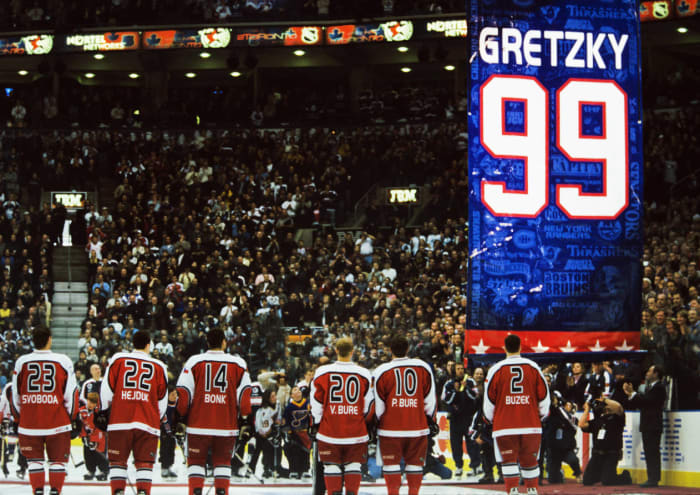
February 6, 2000: Wayne Gretzky's Number 99 Is Retired for All NHL Teams

February 6, 2000: The National Hockey League hosts its 50th All-Star Game in the same city in which it hosted its 1st, its historic home and the home of the Hockey Hall of Fame: Toronto, at the Air Canada Centre (now named the Scotiabank Arena).
The game's commemorative logo

Wayne Gretzky, the League's all-time leading scorer, and widely (but not universally) regarded as the greatest player in the sport's history, had retired at the end of the previous season. NHL Commissioner Gary Bettman had announced that he would retire Gretzky's uniform Number 99, for the entire League. This followed Major League Baseball doing it for the Number 42 for its 1st modern black player, Jackie Robinson, in 1997.

A banner with his name and number, in the colors of his foremost team, the Edmonton Oilers, blue and orange, but also containing the names and logos of all current NHL teams, was raised to the rafters. Following this, he performed a ceremonial puck drop between Paul Kariya of the Anaheim Ducks, captaining Team North America, and Jaromir Jagr of the Pittsburgh Penguins, captaining Team World.

Gretzky reached the World Hockey Association with the Indianapolis Racers in 1978, only 18 years old. But they went out of business after he'd only been with them for 8 games. He was picked up by the Edmonton Oilers, and won 4 Stanley Cups with them, before being traded to the Los Angeles Kings in 1988. In 1996, at the end of his contract, he was traded to the St. Louis Blues, playing 18 games for them. He then signed with the New York Rangers as a free agent, playing 3 seasons before retiring.

Prior to Gretzky's last game, at Madison Square Garden on April 18, 1999, the Rangers retired Number 99 for him. The Oilers followed on October 1, 1999, before this All-Star Game. The Kings did not hold a number retirement ceremony for him until October 9, 2002. Every other team, including the Blues, has simply accepted that Number 99 is retired, without having a ceremony honoring him.

As for the game itself: Scotty Bowman, then head coach of the Detroit Red Wings, and with 8 Stanley Cups to his name (and a record-breaking 9th to come), coached Team World; while Pat Quinn, head coach of the host Toronto Maple Leafs, who never won a Cup but got to the Finals with the 1980 Philadelphia Flyers and the 1994 Vancouver Canucks, coached Team North America.

Team World led 5-4 after 2 periods, then broke out in the 3rd, and won, 9-4. Pavel Bure of the Florida Panthers was named the game's Most Valuable Player, with 3 goals and an assist. His brother, Valeri Bure of the Calgary Flames, husband of Full House actress Candace Cameron, assisted on one of Pavel's goals. Pavol Demitra of the St. Louis Blues scored 2 goals, and Jagr added 1. For Team North America, goals were scored by Joe Sakic of the Colorado Avalanche, Jeremy Roenick of the Phoenix Coyotes, Tony Amonte of the Chicago Blackhawks, and Ray Whitney of the Panthers.

UPDATE: Upon the death of Bill Russell in 2022, the NBA announced that his Number 6 would be retired for all teams. So now, MLB, the NBA and the NHL have each honored one player in this fashion. The NFL is unlikely to follow.

*

February 6, 2000 was a Sunday. This being the All-Star Break, there were no NHL games scheduled. Baseball was out of season. The NFL season ended a week earlier, when the St. Louis Rams beat the Tennessee Titans, 23-16, in Super Bowl XXXIV at the Georgia Dome in Atlanta.

There were 9 games played in the NBA:

* The New York Knicks beat the Miami Heat, 94-80 at Madison Square Garden.

* The New Jersey Nets beat the Golden State Warriors, 110-90 at the Continental Airlines Arena at the Meadowlands.

* The Portland Trail Blazers beat the Boston Celtics, 100-94 at the FleetCenter (now the TD Garden) in Boston.

* The Philadelphia 76ers beat the Sacramento Kings, 119-108 at the First Union Center in Philadelphia. Allen Iverson scored 50 points. Back when the Wells Fargo Center was using that name, Philly fans -- especially when the Flyers were playing -- liked to call the arena "The F.U. Center."

* The Detroit Pistons beat the Houston Rockets, 109-105 at The Palace in the Detroit suburb of Auburn Hills, Michigan. Grant Hill scored 36 points.

* The Phoenix Suns beat the Seattle SuperSonics, 105-93 at the AmericaWest Arena (now the Mortgage Matchup Center) in Phoenix.

* The Utah Jazz beat the San Antonio Spurs, 93-90 at the Delta Center in Salt Lake City.

* The Chicago Bulls beat the Los Angeles Clippers, 100-90 at the Staples Center (now the Crypto.com Arena) in Los Angeles.

* And the Dallas Mavericks beat the Vancouver Grizzlies, 103-99 at General Motors Place (now the Rogers Arena) in Vancouver. Shareef Abduar-Rahim had 36 points and 22 rebounds in defeat for the Grizzlies, who moved to Memphis after the 2000-01 season.

Saturday, February 5, 2022

February 5, 1980: Gordie Howe's Revenge

February 5, 1980: The greatest player in the history of hockey gets his due, from the fans who knew him the best. And the owner of those fans' team had to just sit there and take it.

Gordie Howe had debuted with the Detroit Red Wings in 1946. Between 1948 and 1966, he had helped them reach the Stanley Cup Finals 11 times, winning 4: In 1950, 1952, 1954 and 1955. In 1963, he became the NHL's all-time leader in goals. When a wrist injury convinced him to finally retire in 1971, at the age of 43, he had 786 goals. At the time, the man in 2nd place, Bobby Hull of the Chicago Black Hawks, had 552.

It wasn't just the wrist injury: Howe had spent a few years feuding with the Wings' owner, Bruce Norris. While his father James E. Norris and his brother James D. Norris had built 7 Stanley Cup winners, Bruce had merely presided over the '54 and '55 champions, having done nothing to build them. Taking full control for the 1955-56 season, he became a typical sports team operator of the period, preferring to save money than to win. He broke up his championship team, and tried to build another on the cheap. Over the next 11 years, they would go 0-5 in Stanley Cup Finals.

After the 1968-69 season, Howe, arguably still the best player in the game, and already nicknamed "Mr. Hockey," discovered that he was only the team's 3rd-highest-paid player, at $45,000. Norris gave him a raise to $100,000, making him the 1st hockey player to make that much. But Norris fumed: He was one of those sports team owners who couldn't stand to have his authority challenged. To him, players were merely means to an end.

Especially angering this old-school old-boy-networker was the fact that Gordie's agent was a woman: His wife, Colleen Howe, who would eventually be known as "Mrs. Hockey." Norris blamed Colleen for Gordie being out of order enough to demand a raise. (This foreshadowed M. Donald Grant blaming Nancy Seaver for Tom's demand for a raise on the 1977 Mets.) The relationship between Norris and the Howes had begun to be poisoned, and it was all Norris' fault: If he had paid Gordie as if he was the best player in the game, all the trouble afterward could have been avoided.

When Gordie retired after the 1971 season, he was given a job in the Wings' front office. Essentially, he was just a schmoozer, shaking hands with corporate clients at their arena, the Olympia Stadium, and allowing the Wings to put his magic name on their corporate letterhead.

Baseball legend Stan Musial, when asked what he did for the St. Louis Cardinals in his nice office at Busch Memorial Stadium, smiled and said, "I don't know, but they pay me a lot of money for it!" In contrast, Gordie grumbled about not having any actual input in the running of the organization. He wasn't the head coach, or an assistant coach, or the general manager, or the director of scouting, or anything of substance. In his words, he was "vice president in charge of paper clips."

Before the 1972-73 season, the expansion New York Islanders, thinking they needed a big name to get attention in the nation's biggest market, offered to make him their 1st head coach. He turned it down. It was probably for the best: The World Hockey Association was launching at the same time, and their Quebec Nordiques offered their head coaching job to Maurice Richard, the Montreal Canadiens icon who was the NHL's all-time leading scorer until Howe. He took it, and hated it. He lost his 1st game, quit on the spot, was talked into keeping the job until they could find someone else, won his 2nd game, and left anyway, and never coached again. But that's 2 more games than Gordie ever had as a head coach.

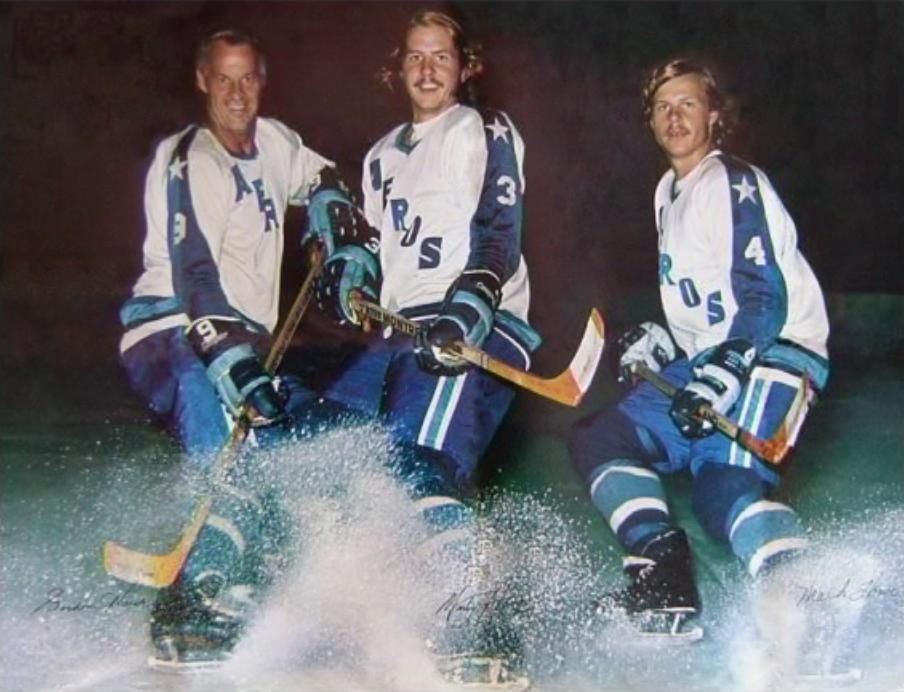
Bill Dineen, a teammate of Gordie's on the '54 and '55 Cup winners, was named head coach of the WHA's Houston Aeros. Another '55 (but not '54) teammate, Larry Hillman, was his assistant. In the 1973 WHA Draft, Dineen took Gordie's sons Mark and Marty.

To help the WHA get better publicity -- they'd already gotten Hull onto the Winnipeg Jets, a team essentially named for him (the Golden Jet, although their uniforms were blue and had no gold), Dineen asked Gordie to come out of retirement. He was willing to get surgery on his troubled wrist, and give it a shot.

Bruce Norris told the Howes that if Gordie quit the Wings' front office and went to "the rebel league," not only would he be blackballed from the NHL, never to work in it again in any capacity, but that Mark and Marty would also be blackballed -- and since they were players just starting out, this would affect them much more. In other words, he gave Gordie and Colleen an anti-incentive that would have hurt them much more than Gordie's own blackballing would have. It may not be the biggest dick move in the history of hockey, but it's the best-known dick move in NHL history.
Bruce Norris

And it backfired. Few decisions in the history of sports have backfired this much. Gordie and Mark -- or Gordie and Marty -- became the 1st father and son teammates in professional hockey history. They played on a line together. Mark and Marty got the traditional rookie hazings, and Gordie did not use his influence to stop it. On the other hand, the sons referred to their father as "Gordie," and even called him that to his face, in their teammates' presence, knowing that if they called him "Dad," they'd never hear the end of it.

Attendance went up all over the WHA, as people wanted to see the Howes. It probably kept the league going long enough for a merger with the NHL to be plausible. The Aeros won the AVCO World Trophy as WHA Champions in 1974. And Gordie, age 46, was awarded the Gary Davidson Trophy as Most Valuable Player.
Gordie, Marty, Mark

Davidson was the founder of the league. He was also a co-founder of the American Basketball Association and the World Football League. (There would be 4 teams each from the ABA and the WHA that would be admitted to the established leagues. The WFL, on the other hand, totally flopped.)

The next season, the WHA MVP award was renamed the Gordie Howe Trophy. Gordie didn't win it again, but the Aeros again won the AVCO Trophy. They reached the Finals again in 1976, but lost to the Jets.

Meanwhile, from the time that Gordie signed with the Aeros in 1973 until 1983, the Wings made the Playoffs only once. From 1970 until 1987, they only won 1 Playoff series. From 1966, Gordie's last trip to the Finals, until 1986, 20 seasons -- ending the year Norris died, although he'd sold the team to Mike Ilitch in 1982 -- they played in only 17 Playoff games, winning 4 of them. They became known as "The Dead Things."

They moved from the Olympia, in a bad neighborhood on Detroit's northwest side, and built the Joe Louis Arena downtown, but that was about the only thing they had to draw fans. They certainly weren't caring about what Larry Aurie and Ebbie Goodfellow did in the 1930s, or what Gordie and his teammates did in the 1950s.

I'm not saying the Wings would have been appreciably better if they still had Gordie, and had drafted Mark and Marty, and had paid them all what they were worth. It would have been tough to break through in a League that had the Big Bad Bruins in Boston, the Broad Street Bullies in Philadelphia, and the Flying Frenchmen in Montreal. But at least they would have been better. Instead, Bruce Norris found out that karma's a bitch.

The 1970s were a thrilling time for performances on the ice, in both leagues. But most hockey teams, in both leagues, were struggling financially. The Aeros needed money badly, and the New England Whalers were one of the few WHA teams that had it. So they bought all 3 Howes. Gordie was still a WHA All-Star.

In the 1979 off-season, the WHA folded, and 4 of its teams were admitted to the NHL. One was the renamed Hartford Whalers. The Wings still held Gordie's NHL rights, meaning that he could not legally play for any NHL team except Detroit. And Norris still owned the Wings.

But, despite being Chairman of the NHL's Board of Governors, Norris was outflanked by a former Wings executive, now President of the NHL, John Ziegler. Gordie was allowed to play in the NHL for Hartford. In that final season, Gordie played all 80 games, scored 15 goals, raising his record total to 801 (his 174 in the WHA giving him 975), and helped the Whalers make the Playoffs.

Bruce Norris' world had fallen in on him. The Wings had become laughably bad in Gordie's absence. And building the Joe Louis Arena had put a major kink in his finances. Now, he had to watch as his blackballing of the Howes and they were welcomed back into the NHL, and not for his team.

The 1980 NHL All-Star Game was given to Detroit and its new arena, as kind of a "gold watch" for Norris, as it was clear he would soon have to sell. And when Scotty Bowman, coaching the Wales Conference All-Star Team in that game, used his prerogative to fill out the roster with non-starters, he chose 3 legends: Jean Ratelle, Phil Esposito... and the nearly 52-year-old Gordie Howe, who was introduced as "Mr. Hockey, Number 9," and got an ovation from the Detroit crowd that went on and on and on. It was a massive middle finger to Norris -- not from any member of the Howe family, but from the Detroit fans.

This was the 32nd time the NHL had held an official All-Star Game. Howe had now appeared in 23 of them. Counting the WHA, he had played in an All-Star Game in 29 of a possible 32 seasons. In this game, he assisted on a goal by Real Cloutier of the Quebec Nordiques, and the Prince of Wales Conference team beat the Clarence Campbell Conference team 6-3. Playing for the Campbell team was 19-year-old Wayne Gretzky, of another team that came in from the WHA, the Edmonton Oilers.

The previous year, Howe and Gretzky had played together on a WHA All-Star Team that played legendary Soviet club Dinamo Moscow. It was the only time that "Mr. Hockey" and the man who would surpass him as the NHL's all-time leader in goals, assists and points would play together.

*

February 5, 1980 was a Tuesday. There were no other NHL games played. Baseball and football were out of season. These 6 games were played in the NBA:

* The New York Knicks lost to the Los Angeles Lakers, 116-105 at Madison Square Garden.

* The New Jersey Nets beat the San Antonio Spurs, 123-115 at the HemisFair Arena in San Antonio.

* The Seattle SuperSonics beat the Cleveland Cavaliers, 123-121 at The Coliseum in the Cleveland suburb of Richfield, Ohio. Dennis Johnson scored 34 points.

* The Philadelphia 76ers beat the Indiana Pacers, 109-108 at the Market Square Arena in Indianapolis. Julius "Dr. J" Erving scored 31 points.

* The Portland Trail Blazers beat the Kansas City Kings, 105-99 at the Kemper Arena (now the Hy-Vee Arena) in Kansas City.

* And the Utah Jazz, in their 1st season after moving from New Orleans, beat the Chicago Bulls, 116-106 at the Salt Palace in Salt Lake City. Adrian Dantley led all scorers with 47 points.

Saturday, January 29, 2022

January 29, 2017: The Bowling Green Massacre -- That Never Happened

January 29, 2017: The Bowling Green Massacre occurs. Actually, it didn't occur on this day. Or on any other day.

In an interview with Cosmopolitan magazine, Kellyanne Conway, counselor to the new President, Donald Trump, said that the outgoing President, Barack Obama, had limited Iraqi immigration because, "Two Iraqi nationals came to this country, joined ISIS, traveled back to the Middle East to get trained and refine their terrorism skills, and come back here, and were the masterminds behind the Bowling Green massacre of taking innocent soldiers' lives away."
Kellyanne Conway, wearing her ridiculous
"Revolutionary War" getup to Trump's Inauguration

On the same day, in a brief interview with the gossip website TMZ, Conway said, "He did that because, I assume, there were two Iraqis who came here, got radicalized, joined ISIS, and then were the masterminds behind the Bowling Green attack on our brave soldiers."

Three days later, on February 2, in an interview with Chris Matthews on MSNBC's Hardball with Christ Matthews, Conway described the "Bowling Green massacre" as an attack of terrorism carried out within the United States by refugees:

I bet there was very little coverage. I bet it's brand-new information to people that President Obama had a six-month ban on the Iraqi refugee program after two Iraqis came here to this country, were radicalized. And they were the masterminds behind the Bowling Green massacre. I mean, most people don't know that because it didn't get covered.

It didn't get covered because it never happened. There was no massacre in Bowling Green, Kentucky, of anyone, by anyone, affiliated with a terrorist group or otherwise, affiliated with any nation or otherwise.

The day after the interview, Conway said she misspoke, and had been referring to the 2011 arrest of two Iraqi refugees in Bowling Green on charges including "attempting to provide material support to terrorists and to al-Qaeda in Iraq."

She stated that she had mentioned the incident because it led previous Obama to tighten immigration procedures for Iraqi citizens. She did it because she wanted her boss, Trump, to grant her more favor, and because she knew that her statement would touch on two of Trump's favorite subjects: His hatred of nonwhite people and his obsession with Obama, the 1st black President.

Conway's lie went viral, and became the top trending topic on Twitter, with many tweets parodying it. A website was set up anonymously for the purpose of collecting donations for supposed victims. Facebook users used the site's "safety check feature" to act as if the event were real. Mock vigils were held in Kentucky and New York in commemoration.

It provoked widespread press reaction, with many relating it to Conway's earlier use of the phrase "alternative facts" to describe false statements by White House Press Secretary Sean Spicer in the wake of Trump's sparsely-attended Inauguration.

It became symbolic of Trump and his Administration being willing to tell any lie, hide any truth, exaggerate any fact, and turn any failure into a public-relations victory -- successfully or otherwise.

*

January 29, 2017 was a Sunday. Baseball was out of season. The NFL was halfway between the Conference Championship Games and the Super Bowl. There were 8 games in the NBA:

* The New York Knicks lost to the Atlanta Hawks, 142-139 in 4 overtimes at the Philips Arena (now the State Farm Arena) in Atlanta. Paul Millsap scored 37 points for the Hawks, Carmelo Anthony 45 for the Knicks.

* The Washington Wizards beat the New Orleans Pelicans, 107-94 at the Smoothie King Center in New Orleans. Anthony Davis scored 36 points in defeat for the Pels.

* The Dallas Mavericks beat the San Antonio Spurs, 105-101 at the AT&T Center (now the Frost Bank Center) in San Antonio.

* The Orlando Magic beat the Toronto Raptors, 114-113 at the Air Canada Centre (now the Scotiabank Arena) in Toronto. Kyle Lowry scored 33 points.

* The Cleveland Cavaliers beat the Oklahoma City Thunder, 107-91 at the Quicken Loans Arena (now the Rocket Arena) in Cleveland.

* The Indiana Pacers beat the Houston Rockets, 120-101 at the Bankers Life Fieldhouse (now the Gainbridge Fieldhouse) in Indianapolis. Paul George scored 33 points.

* The Chicago Bulls beat the Philadelphia 76ers, 121-108 at the United Center in Chicago.

* And the Golden State Warriors beat the Portland Trail Blazers, 113-111 at the Moda Center in Portland. Kevin Durant scored 33 points.

And the NHL held its All-Star Game, at the Staples Center (now the Crypto.com Arena) in Los Angeles. It was a dumb setup, with a single-elimination tournament, with the NHL's 4 Divisions facing each other, with each game consisting of two 10-minute halves played 3-on-3, and going directly to a shootout if tied after 20 minutes.

In the 1st Semifinal, the Pacific beat the Central, 10-3. In Game 2, the Metropolitan beat the Atlanta, 10-6. In the Final, the Metropolitan beat the Pacific, 4-3. Wayne Simmonds of the Philadelphia Flyers, representing the Metropolitan Division, was named the tournament's Most Valuable Player.

Thursday, January 20, 2022

January 20, 1996: Fox Sports Introduces the Glow Puck

January 20, 1996: Fox Sports introduces the Glow Puck for its hockey broadcasts. It was designed to make the puck easier to see on TV.

For whatever reason, unlike the CBC (Canadian Broadcasting Corporation), U.S. networks have had difficulty showing hockey on TV. NBC, CBS and ABC had all tried, with, at best, mixed results. Part of the problem is that, despite being black on a white ice surface, the puck, an object smaller than a baseball, was too hard to follow, with the players passing it around and shooting it too fast for the human eye to follow.

The system, officially called FoxTrax but nicknamed the Glow Puck, used modified hockey pucks containing shock sensors and infrared emitters, which were then read by sensors and computer systems to generate on-screen graphics, such as a blue or red "glow" around the puck, and other enhancements such as "trails" to indicate the hardness and speed of shots. The glow also allowed viewers to follow the puck near the bottom of the rink, where the traditional center ice camera was unable to see it due to the sideboards obstructing the puck's location.

It was introduced at the NHL All-Star Game in Boston, at the brand-new FleetCenter, the arena now named the TD Garden. The Boston Bruins had moved there the preceding October, after 67 seasons at the old Boston Garden.

The Glow Puck ended up backfiring: When Bruins hometown hero Ray Bourque scored the winning goal with 37 seconds left in regulation, giving the Eastern Conference a 5-4 win, the red streak didn't kick in, and the puck was every bit as hard to see as it always was.

Purists hated it, and people who had never been to a hockey game live saw that it was just a TV effect, and that, in person, there was no glow. When Fox's contract with the NHL ran out in 1998, and ABC/ESPN got the next contract, they didn't use the Glow Puck. Nor has NBC on its subsequent contracts.

*

January 20, 1996 was a Saturday. This being the NHL's All-Star Break, there were no regular-season games. Baseball was out of season. The NFL was between its Conference Championships and Super Bowl XXX, which the Dallas Cowboys won over the Pittsburgh Steelers.

There were 7 games in the NBA:

* The New York Knicks lost to the Vancouver Grizzlies, 84-80 at General Motors Place (now the Rogers Arena) in Vancouver.

* The New Jersey Nets beat the Minnesota Timberwolves, 103-97 in overtime at the Continental Airlines Area at the Meadowlands.

* The Golden State Warriors beat the Charlotte Hornets, 110-102 at the Charlotte Coliseum.

* The Atlanta Hawks beat the Miami Heat, 98-78 at The Omni in Atlanta.

* The Sacramento Kings beat the Denver Nuggets, 115-110 at the McNichols Arena in Denver. Despite being on the losing side, Mahmoud Abdul-Rauf led all scorers on the day with 36 points.

* The Utah Jazz beat the Los Angeles Clippers, 106-82 at the Los Angeles Memorial Sports Arena.

* And the Cleveland Cavaliers beat the Los Angeles Lakers, 93-82 at The Forum outside Los Angeles in Inglewood, California.

And in English soccer, Arsenal lost to Everton, the blue team in Liverpool, 2-1 at the Arsenal Stadium, a.k.a. Highbury, in North London.

December 31, 1999 & January 1, 2000: The Millennium

December 31, 1999:  The Millennium arrives. The people of planet Earth survived. At a terrible cost. But we hadn't destroyed ourselves. ...