On July 20, the Sox led the American League Eastern Division by 9 1/2 games. The New York Yankees were 14 games back. But it wasn't over: The Yankees changed managers, allowing Billy Martin to claim a resignation and hiring Bob Lemon, and went on a tear.
On September 10, they completed a 4-game sweep of the Red Sox at Fenway Park, to tie them for 1st place. Outscoring them 42-9 over the 4 games, it became known as the Boston Massacre. By September 16, after taking 2 more games at Yankee Stadium, the Yankees were 3 1/2 games up.
But it wasn't over then, either: The Sox won the finale of that series, and 12 of their last 14, including their last 8 straight, and both teams ended with 99-63 records. A one-game Playoff would be necessary to decide the AL East title, won by the Sox in 1975 and the Yankees in 1976 and 1977.
So at the conclusion of play on October 1st, Lemon had a big decision to make. He had been in such a situation before, although as a piece of the decision, rather than as the decider: In 1948, he was a pitcher for the Cleveland Indians, and they had to go to Fenway Park and play the Red Sox in a one-game playoff for the Pennant.
Lou Boudreau, who was their manager, and also their shortstop, asked the players who they would pitch. To a man, they all said that whoever he chose would be fine with them. Given the dimensions of Fenway Park, Boudreau knew that picking a fastball pitcher like Bob Feller might be a bad idea. Lemon's out pitch was a slider, but he was only in his 3rd year as a full-time pitcher, so the possibility of his hanging a slider and having it sent over the Green Monster in left field made Boudreau back off.
So Boudreau went with a knuckleballer, Gene Bearden, who pitched well despite not much rest. Boudreau himself hit 2 home runs. The Indians won, stayed in Boston to begin the World Series against the Braves (this was the closest baseball would ever come to an all-Boston World Series), and won the Series in 6 games.
Thirty years later, Lemon really only had one choice: Ron Guidry, a lefthander with a 98-mile-per-hour fastball and a devastating slider. He stood at 24-3, with a 1.71 ERA. And the man known as "Louisiana Lightning" said, "Skip, give me the ball." And Lemon knew that he would be ready, even though he was only on 3 days rest.
Leaving Yankee Stadium on October 1, Guidry ran into the Yankees' owner, George Steinbrenner. George told Ron he was nervous. Ron said, "Boss, what are you so worried about?" And George whined about having to go up to Fenway and how strong the Red Sox were. Ron said, "Don't worry, Boss. I got this." George would later say that calmed him down a lot.
Red Sox manager Don Zimmer chose Mike Torrez as his starting pitcher. The year before, Torrez had been a Yankee, and went the distance in winning Games 3 and 6 of the World Series. But his contract ran out, and Steinbrenner, in the process of replacing Gabe Paul as general manager with Al Rosen, didn't make a move to re-sign Torrez.
So Torrez signed with the Red Sox, and went 16-12. Red Sox fans loved Luis Tiant and Bill Lee, but the truth was, that season, Torrez won more games than any Sox pitcher except Dennis Eckersley. (Lee had been terrible down the stretch, Tiant had pitched the day before, and Eckersley, who wouldn't be converted into one of the greatest relievers in the game's history, wasn't rested enough, either.)
In hindsight, lots of Red Sox fans bemoaned the selection of Torrez. But, at the time, many saw it as a good sign. Guidry had lost only 3 games all season long, and all 3 times, it was to an opposing pitcher named Mike: Caldwell of the Milwaukee Brewers, Flanagan of the Baltimore Orioles, and Willis of the Toronto Blue Jays. The problem with this theory was, all 3 of those were lefthanded, like Guidry. Torrez was righthanded.
Some Sox fans took comfort in the fact that Guidry was lefthanded, and Fenway was great for righthanded hitters, with its 37-foot-high left field wall, nicknamed the Green Monster, with a foul pole listed at just 315 feet from home plate. They would later relabel it as 310. Some people suspect that it may even be closer than that: A World War II bomber pilot, who studied reconnaissance photos, looked at an aerial shot, made some measurements, and said it was 304 feet. Some people have suggested it's even as close as 290. And it wasn't just the pole: That wall turned pop flies into home runs, and fly outs into singles and doubles.
Except Guidry had already pitched a 2-hit shutout there in Game 3 of the Massacre series. And Ron Guidry was not going to be intimidated. Not by Carl Yastrzemski, nor by Jim Rice, nor Carlton Fisk, or any of the other Sox hitters.
But neither would Torrez be intimidated by the Yankee hitters. After all, he knew them well.
*
These were the starting lineups. For the Yankees:
17 CF Mickey Rivers
15 C Thurman Munson
14 RF Lou Piniella
44 DH Reggie Jackson
9 3B Graig Nettles
10 1B Chris Chambliss
6 LF Roy White
25 2B Brian Doyle
20 SS Bucky Dent
Only Rivers and Dent were in their usual places in the order. The usual 2nd baseman, Number 30, Willie Randolph, was injured, and would miss the entire postseason if the Yankees made it. He usually batted 2nd. So Munson was moved up from 3rd to 2nd.
Piniella, usually either the left fielder or the designated hitter, was moved up from 5th to 3rd. Jackson was put in the DH slot, not because Lemon had little confidence in his fielding, the way Martin did, but because Reggie had injured his thumb attempting a catch off the wall a few days earlier, and it still hurt to put a glove on. This would prove to be a critical change later on, one of the few examples ever of a well-timed injury. It didn't stop him from hitting, though.
Nettles was moved up from 6th to 5th; Chambliss from 7th to 6th; and White from 8th, where he was frequently the DH, to 7th.
For the Red Sox:
7 SS Rick Burleson
2 2B Jerry Remy
14 RF Jim Rice
8 LF Carl Yastrzemski
27 C Carlton Fisk
19 CF Fred Lynn
4 DH Butch Hobson
5 1B George Scott
3 3B Jack Brohamer
Differences from the usual: Rice was moved from left field to right, filling in for the injured Dwight Evans; Yaz, at this point in his career, was the usual DH or 1st baseman, but moved back to his old position to fill in for the moved Rice; Hobson was usually the 3rd baseman and the 9th hitter, but an injured elbow took him out of the field; the slumping Scott was dropped from 7th to 8th; and Brohamer was an emergency backup, leading to Hobson being moved from 9th to 7th.
17 CF Mickey Rivers
15 C Thurman Munson
14 RF Lou Piniella
44 DH Reggie Jackson
9 3B Graig Nettles
10 1B Chris Chambliss
6 LF Roy White
25 2B Brian Doyle
20 SS Bucky Dent
Only Rivers and Dent were in their usual places in the order. The usual 2nd baseman, Number 30, Willie Randolph, was injured, and would miss the entire postseason if the Yankees made it. He usually batted 2nd. So Munson was moved up from 3rd to 2nd.
Piniella, usually either the left fielder or the designated hitter, was moved up from 5th to 3rd. Jackson was put in the DH slot, not because Lemon had little confidence in his fielding, the way Martin did, but because Reggie had injured his thumb attempting a catch off the wall a few days earlier, and it still hurt to put a glove on. This would prove to be a critical change later on, one of the few examples ever of a well-timed injury. It didn't stop him from hitting, though.
Nettles was moved up from 6th to 5th; Chambliss from 7th to 6th; and White from 8th, where he was frequently the DH, to 7th.
For the Red Sox:
7 SS Rick Burleson
2 2B Jerry Remy
14 RF Jim Rice
8 LF Carl Yastrzemski
27 C Carlton Fisk
19 CF Fred Lynn
4 DH Butch Hobson
5 1B George Scott
3 3B Jack Brohamer
Differences from the usual: Rice was moved from left field to right, filling in for the injured Dwight Evans; Yaz, at this point in his career, was the usual DH or 1st baseman, but moved back to his old position to fill in for the moved Rice; Hobson was usually the 3rd baseman and the 9th hitter, but an injured elbow took him out of the field; the slumping Scott was dropped from 7th to 8th; and Brohamer was an emergency backup, leading to Hobson being moved from 9th to 7th.
(Because of the bone chips in his elbow, Clell Lavern Hobson Jr., who once had good enough of an arm to be a backup quarterback for Bear Bryant at the University of Alabama, made 43 errors in 1978. No player has had as many in a season since.)
The starting pitchers were Ron Guidry for New York, Mike Torrez for Boston. The umpires were Don Denkinger behind home plate, Jim Evans at 1st base, Al Clark at 2nd, and Steve Palermo at 3rd. All good ones, regardless of what St. Louis fans would eventually think of Denkinger.
Game-time temperature was 68 degrees. No rain was forecast. Paid attendance was 32,925, and there may have been another 2,000 or so freebies inside Fenway. Getting tickets was a crapshoot, with or without scalpers, but face value for box seats was $5.75 -- about $25.78 in 2022 money.

The game began at 2:30 PM, and I didn't get to see the start of it, because Bowne-Munro let out at 2:35. By the time I got home, it was already 1-0 Red Sox. Here's what I missed:
Top of the 1st: Torrez walked Rivers. Cliché Alert: Walks can kill you, especially the leadoff variety. And the last thing Torrez wanted to do was put Mick the Quick on 1st to start the game. Sure enough, Rivers stole 2nd. But Torrez struck Munson out, and got Piniella to ground to 3rd and Reggie to fly to left.
Bottom of the 1st: Guidry struck Burleson out, got Remy to fly to left, and struck Rice out. Top of the 2nd: Torrez got Nettles to pop to short, got Chambliss to pop to 1st, and struck White out.

Bottom of the 2nd: Yaz led off with a home run, curling it around the right-field pole that would later be named for Johnny Pesky. The Fenway crowd went bananas over their 39-year-old Captain, the hero of the 1967 "Impossible Dream" Pennant, coming through again. But Guidry settled down, and got Fisk to fly to left, Lynn to fly to center, and Hobson to ground to 3rd. Still: Red Sox 1, Yankees 0.
Top of the 3rd: Torrez got Doyle to pop to 2nd and Dent to fly to right. Rivers hit a double to right, but Torrez Struck Munson out. Bottom of the 3rd: Scott doubled to center. Smelling blood, Zimmer had Brohamer bunt Scott over to 3rd. A fly ball would make it 2-0 Sox. But Guidry got Burleson to gound to 3rd, and the chubby Scott did not dare test Nettles, who threw Burleson out. Then Remy flew to left, ending the threat.
Top of the 4th, which is probably where the game was when I got home: Piniella, who seemed to be the biggest Red Sox killer of all, led off with a grounder to deep short, and Burleson couldn't quite throw him out. Despite Reggie's line, "Lou Piniella runs like a dump truck," Sweet Lou had an infield single. But it was in vain: Reggie flew to right, Nettles popped to short, and Chambliss grounded to short. Bottom of the 4th: Guidry got Rice to ground to short, struck Yaz out, and got Fisk to fly to center.
Top of the 5th: Torrez worked out of another leadoff walk situation, this time by White, but getting Doyle to ground to 2nd, Dent to pop to short, and Rivers to ground to 3rd, where Brohamer tagged out White, who was running because there were 2 outs. Bottom of the 5th: Lynn grounded back to Guidry, Hobson beat out a grounder to 3rd, and Guidry struck Scott out and got Brohamer to fly to left. Still 1-0 Red Sox.
Top of the 6th: Torrez struck Munson out, got Piniella to fly to center, and got Reggie to ground to 2nd. Bottom of the 6th: Burleson led off with a double. Remy bunted him over to 3rd. This time, it worked: Rice singled to center, bringing Burleson home. Yaz grounded to 1st. Fisk was intentionally walked. Lynn flew to right. End of 6: Red Sox 2, Yankees 0. Sox fans were getting very confident.
Think about it: Today, Torrez's manager would probably have told him he'd pitched a great game, and let the bullpen handle it from here. Although, to be fair, Sox fans generally don't blame Torrez for what happened next. They blame manager Don Zimmer, who left Torrez in.
The starting pitchers were Ron Guidry for New York, Mike Torrez for Boston. The umpires were Don Denkinger behind home plate, Jim Evans at 1st base, Al Clark at 2nd, and Steve Palermo at 3rd. All good ones, regardless of what St. Louis fans would eventually think of Denkinger.
Game-time temperature was 68 degrees. No rain was forecast. Paid attendance was 32,925, and there may have been another 2,000 or so freebies inside Fenway. Getting tickets was a crapshoot, with or without scalpers, but face value for box seats was $5.75 -- about $25.78 in 2022 money.

Fenway Park, sometime between 1976 (new scoreboards)
and 1987 (before the club seating went up)
The game began at 2:30 PM, and I didn't get to see the start of it, because Bowne-Munro let out at 2:35. By the time I got home, it was already 1-0 Red Sox. Here's what I missed:
Top of the 1st: Torrez walked Rivers. Cliché Alert: Walks can kill you, especially the leadoff variety. And the last thing Torrez wanted to do was put Mick the Quick on 1st to start the game. Sure enough, Rivers stole 2nd. But Torrez struck Munson out, and got Piniella to ground to 3rd and Reggie to fly to left.
Bottom of the 1st: Guidry struck Burleson out, got Remy to fly to left, and struck Rice out. Top of the 2nd: Torrez got Nettles to pop to short, got Chambliss to pop to 1st, and struck White out.
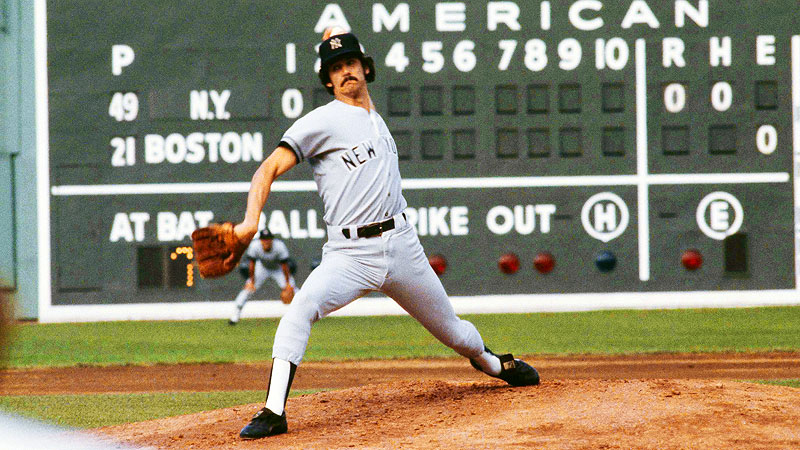
Ron Guidry, in the bottom of the 1st
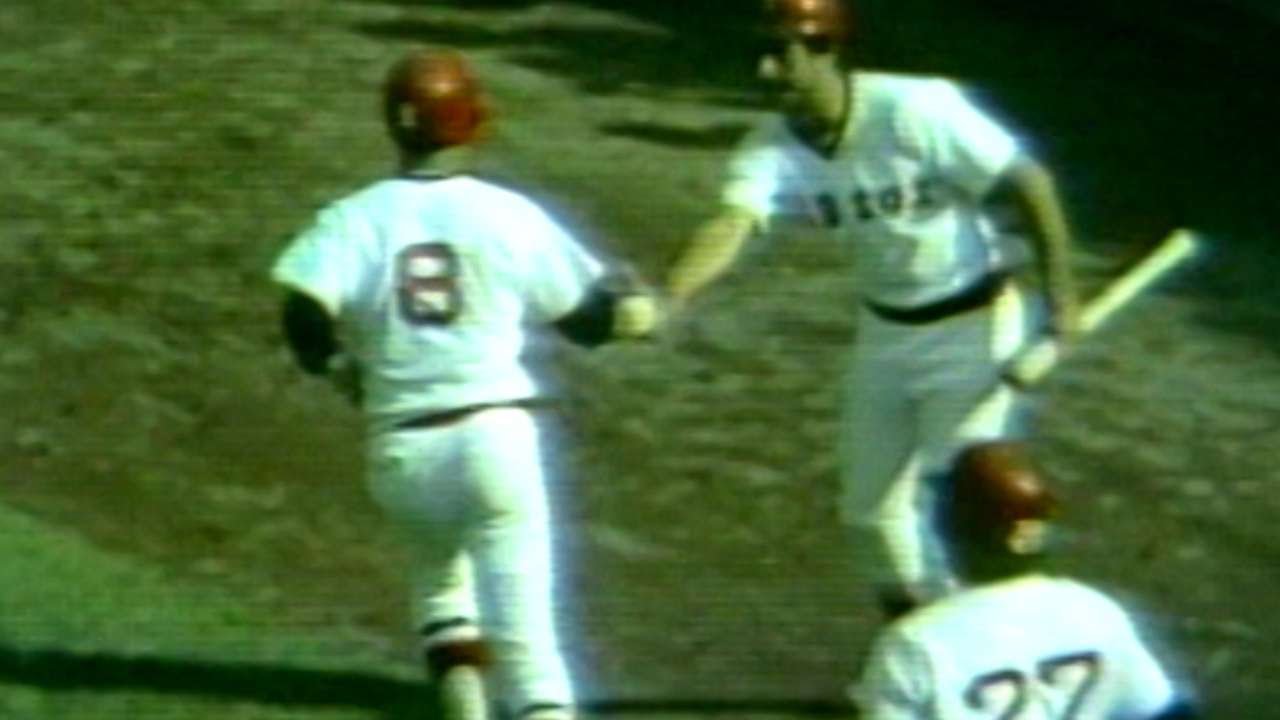
Bottom of the 2nd: Yaz led off with a home run, curling it around the right-field pole that would later be named for Johnny Pesky. The Fenway crowd went bananas over their 39-year-old Captain, the hero of the 1967 "Impossible Dream" Pennant, coming through again. But Guidry settled down, and got Fisk to fly to left, Lynn to fly to center, and Hobson to ground to 3rd. Still: Red Sox 1, Yankees 0.
Yaz shakes hands with Lynn, as Fisk looks on
Top of the 3rd: Torrez got Doyle to pop to 2nd and Dent to fly to right. Rivers hit a double to right, but Torrez Struck Munson out. Bottom of the 3rd: Scott doubled to center. Smelling blood, Zimmer had Brohamer bunt Scott over to 3rd. A fly ball would make it 2-0 Sox. But Guidry got Burleson to gound to 3rd, and the chubby Scott did not dare test Nettles, who threw Burleson out. Then Remy flew to left, ending the threat.
Top of the 4th, which is probably where the game was when I got home: Piniella, who seemed to be the biggest Red Sox killer of all, led off with a grounder to deep short, and Burleson couldn't quite throw him out. Despite Reggie's line, "Lou Piniella runs like a dump truck," Sweet Lou had an infield single. But it was in vain: Reggie flew to right, Nettles popped to short, and Chambliss grounded to short. Bottom of the 4th: Guidry got Rice to ground to short, struck Yaz out, and got Fisk to fly to center.
Top of the 5th: Torrez worked out of another leadoff walk situation, this time by White, but getting Doyle to ground to 2nd, Dent to pop to short, and Rivers to ground to 3rd, where Brohamer tagged out White, who was running because there were 2 outs. Bottom of the 5th: Lynn grounded back to Guidry, Hobson beat out a grounder to 3rd, and Guidry struck Scott out and got Brohamer to fly to left. Still 1-0 Red Sox.
Top of the 6th: Torrez struck Munson out, got Piniella to fly to center, and got Reggie to ground to 2nd. Bottom of the 6th: Burleson led off with a double. Remy bunted him over to 3rd. This time, it worked: Rice singled to center, bringing Burleson home. Yaz grounded to 1st. Fisk was intentionally walked. Lynn flew to right. End of 6: Red Sox 2, Yankees 0. Sox fans were getting very confident.
Think about it: Today, Torrez's manager would probably have told him he'd pitched a great game, and let the bullpen handle it from here. Although, to be fair, Sox fans generally don't blame Torrez for what happened next. They blame manager Don Zimmer, who left Torrez in.
Torrez got Nettles to fly to right, but allowed singles to Chambliss and White. Lemon, knowing he's short of players in the middle infield, rolled the dice, and sent Jim Spencer, a lefthanded power hitter and normally a 1st baseman, to pinch-hit for Doyle. Spencer flew to left. Two out.
And then up came shortstop Russell Earl "Bucky" Dent. Let's be clear about something: Bucky Dent was not some stiff who lucked into, as CBS' college basketball broadcasts would say, "one shining moment." He was a very good fielder. He was an occasional clutch hitter for contact. And he was a very good bunter. What he was not was a power hitter: He came into that game with only 4 home runs on the season. There was a reason he was 9th in the batting order every day, but there was also a reason he was in the batting order every day.
He took ball one. He fouled the next pitch off his foot for strike one. Yankee trainer Gene Monahan came out to tend to his injury.
This being an injury time-out, the pitcher was allowed to make as many warmup throws as he could fit in, until the injured player was ready to continue. Torrez chose to make none.
Rivers, the on-deck batter, noticed that Bucky's bat was broken. He took one of his own, given to him by White, and told the batboy, "Give this bat to Bucky. It has a home run in it."
It's worth noting that the wind had shifted: Where it had been blowing from left field to right, thus aiding Yaz's homer, it was now blowing the other way. With the building of the larger press box and club seats in 1988, the wind currents were changed, and what happened next might not have happened had it been in place 10 years earlier.
It was around 4:30 in the afternoon. I can't find a reference to an exact time, and I certainly wasn't looking at the clock back then. That would be a habit of mine later, and I can tell you that the 1996 World Series win was clinched at 10:53 PM, and Aaron Boone hit his home run at 12:16 AM. (And the New Jersey Devils won their 1st Stanley Cup at 11:09 PM on June 24, 1995. Don't bet me.)
Bucky got back into the box. Torrez delivered. Bucky swung. As Yankee broadcaster Bill White said on WPIX-Channel 11: "Deep to left, Yastrzemski will… not get it! It's a home run! A three-run home run for Bucky Dent, and now, the Yankees lead it by a score of 3-2!"
The ball landed in the netting atop the Green Monster, put up to protect businesses across Lansdowne Street (now Ted Williams Way) from home run balls. The netting is no longer there, replaced by the Green Monster Seats. I don't know where the netting or the ball are today. I hope the Baseball Hall of Fame has both of them.

Rattled, Torrez walked Rivers, and then Zimmer pulled him for Bob Stanley. Mick the Quick stole 2nd. Munson doubled him home, before Stanley finally ended the rally by getting Piniella to fly to right. Yankees 4, Red Sox 2.
Bottom of the 7th. Fred Stanley, known as "Chicken" because he's so skinny, and normally a shortstop, goes out to 2nd base. Guidry struck Hobson out, but Scott singled to right. Zimmer sent Bob Bailey up to pinch-hit for Brohamer.
Recognizing that Guidry was exhausted, Lemon took him out, and replaced him with Rich "Goose" Gossage. It seemed a little early for it, but there was no tomorrow until April if this game was lost. Gossage struck Bailey out, and got Burleson to ground to short.
Top of the 8th: Frank Duffy was sent in at 3rd to replace Brohamer. Reggie reminded everyone that he was Mr. October, and crushed a Stanley pitch to dead center field, almost hitting a TV camera set up in the corner of the Fenway bleachers, where that stand met the Green Monster. Zimmer removed Stanley and put in Andy Hassler, a lefthander who usually pitched very well against the Yankees. Hassler struck Nettles out, and got both Chambliss and White to ground to 2nd.
Still, it was 5-2 Yankees, and it seemed like the Red Sox season was ending not with a bang, but with a whimper.
Not so fast: Remy, who'd been a pain in the neck to the Yankees all season, opened the bottom of the 8th with a double to right. Rice flew to right. Yaz singled to center, scoring Remy. 5-3. Fisk singled to center. Lynn singled to right, scoring Yaz. 5-4.
The Goose was in trouble. But Lemon stuck with him, trusting him the way Billy Martin didn't. The Goose got Hobson to fly to right, and struck Scott out.
Top of the 9th: Hassler still pitching for Boston. Stanley grounded to 2nd. Dent struck out. Lemon sent Paul Blair, once the best defensive center fielder in baseball while with the Baltimore Orioles, but now mainly a defensive replacement in right field for Reggie (but not today, as Reggie was the DH -- which turned out to be crucial), to pinch-hit for Rivers, because Rivers and Hassler were both lefties and Blair was righthanded. Blair singled to left. Zimmer removed Hassler, and brought in Dick Drago. Earlier in the season, Drago had purposely beaned Munson. This time, he gets Munson to ground to short, producing an inning-ending force play at 2nd.
Bottom of the 9th. One of the tensest innings in each team's history. Lemon put Blair in center, and moved Gary Thomasson to left field in place of White. Zimmer sent Evans, still dealing with post-concussion symptoms from a beaning weeks earlier, up to pinch-hit for the weak Duffy. It doesn't work, as he flies to left. Two outs to go. But the Sox refuse to go quietly. Burleson draws a walk.
The next play summed up the entire season for these teams. Remy hit a fly ball to right. Had the 1988 press box and club seating been in place in 1978, that section of right field would have been shaded, and Piniella -- in right field because of Reggie's decline as a fielder -- would have caught the ball easily. But it wasn't, and Lou lost the ball in the Sun. As Bill White said on Channel 11, "Piniella... can't see the ball!"
The crowd sensed this, and roared their approval. Lou had no choice but to stick his arms out, and hope that the ball either bounced off his body or one of his arms, or, if he was lucky, landed in his outstretched left-hand glove like a hockey goaltender.
And that's almost exactly what happened: It landed right in front of him, he realized it would go to his left, and he lunged, caught it on the next hop, turned, and threw it back to the infield.
Burleson was watching him, and might have been the one guy in Fenway Park who didn't realize that Lou couldn't see the ball in the Sun. He had to hold up between 1st and 2nd, for fear of being doubled off 1st to end the game. Because of his hesitation, he only got to 2nd, not to 3rd. This turned out to be critical, because Rice flew to right, where Piniella again lost the ball for a moment, but caught it, and a tagging Burleson could only go from 2nd to 3rd, not from 3rd to score a tying run.
The batter was Carl Yastrzemski, against Rich Gossage. Here was Yaz, one of the best fastball hitters of all time, against the Goose, one of the fastest pitchers who ever lived, but not yet renowned as a big-game pitcher.
This being an injury time-out, the pitcher was allowed to make as many warmup throws as he could fit in, until the injured player was ready to continue. Torrez chose to make none.
Rivers, the on-deck batter, noticed that Bucky's bat was broken. He took one of his own, given to him by White, and told the batboy, "Give this bat to Bucky. It has a home run in it."
It's worth noting that the wind had shifted: Where it had been blowing from left field to right, thus aiding Yaz's homer, it was now blowing the other way. With the building of the larger press box and club seats in 1988, the wind currents were changed, and what happened next might not have happened had it been in place 10 years earlier.
It was around 4:30 in the afternoon. I can't find a reference to an exact time, and I certainly wasn't looking at the clock back then. That would be a habit of mine later, and I can tell you that the 1996 World Series win was clinched at 10:53 PM, and Aaron Boone hit his home run at 12:16 AM. (And the New Jersey Devils won their 1st Stanley Cup at 11:09 PM on June 24, 1995. Don't bet me.)
Bucky got back into the box. Torrez delivered. Bucky swung. As Yankee broadcaster Bill White said on WPIX-Channel 11: "Deep to left, Yastrzemski will… not get it! It's a home run! A three-run home run for Bucky Dent, and now, the Yankees lead it by a score of 3-2!"
The ball landed in the netting atop the Green Monster, put up to protect businesses across Lansdowne Street (now Ted Williams Way) from home run balls. The netting is no longer there, replaced by the Green Monster Seats. I don't know where the netting or the ball are today. I hope the Baseball Hall of Fame has both of them.
White, Chambliss, Dent. Except for the Yankee Fan in the middle,
everybody else in this photo looks like they just lost their best friend.
Bottom of the 7th. Fred Stanley, known as "Chicken" because he's so skinny, and normally a shortstop, goes out to 2nd base. Guidry struck Hobson out, but Scott singled to right. Zimmer sent Bob Bailey up to pinch-hit for Brohamer.
Recognizing that Guidry was exhausted, Lemon took him out, and replaced him with Rich "Goose" Gossage. It seemed a little early for it, but there was no tomorrow until April if this game was lost. Gossage struck Bailey out, and got Burleson to ground to short.
Top of the 8th: Frank Duffy was sent in at 3rd to replace Brohamer. Reggie reminded everyone that he was Mr. October, and crushed a Stanley pitch to dead center field, almost hitting a TV camera set up in the corner of the Fenway bleachers, where that stand met the Green Monster. Zimmer removed Stanley and put in Andy Hassler, a lefthander who usually pitched very well against the Yankees. Hassler struck Nettles out, and got both Chambliss and White to ground to 2nd.
Still, it was 5-2 Yankees, and it seemed like the Red Sox season was ending not with a bang, but with a whimper.
Not so fast: Remy, who'd been a pain in the neck to the Yankees all season, opened the bottom of the 8th with a double to right. Rice flew to right. Yaz singled to center, scoring Remy. 5-3. Fisk singled to center. Lynn singled to right, scoring Yaz. 5-4.
The Goose was in trouble. But Lemon stuck with him, trusting him the way Billy Martin didn't. The Goose got Hobson to fly to right, and struck Scott out.
Top of the 9th: Hassler still pitching for Boston. Stanley grounded to 2nd. Dent struck out. Lemon sent Paul Blair, once the best defensive center fielder in baseball while with the Baltimore Orioles, but now mainly a defensive replacement in right field for Reggie (but not today, as Reggie was the DH -- which turned out to be crucial), to pinch-hit for Rivers, because Rivers and Hassler were both lefties and Blair was righthanded. Blair singled to left. Zimmer removed Hassler, and brought in Dick Drago. Earlier in the season, Drago had purposely beaned Munson. This time, he gets Munson to ground to short, producing an inning-ending force play at 2nd.
Bottom of the 9th. One of the tensest innings in each team's history. Lemon put Blair in center, and moved Gary Thomasson to left field in place of White. Zimmer sent Evans, still dealing with post-concussion symptoms from a beaning weeks earlier, up to pinch-hit for the weak Duffy. It doesn't work, as he flies to left. Two outs to go. But the Sox refuse to go quietly. Burleson draws a walk.
The next play summed up the entire season for these teams. Remy hit a fly ball to right. Had the 1988 press box and club seating been in place in 1978, that section of right field would have been shaded, and Piniella -- in right field because of Reggie's decline as a fielder -- would have caught the ball easily. But it wasn't, and Lou lost the ball in the Sun. As Bill White said on Channel 11, "Piniella... can't see the ball!"
The crowd sensed this, and roared their approval. Lou had no choice but to stick his arms out, and hope that the ball either bounced off his body or one of his arms, or, if he was lucky, landed in his outstretched left-hand glove like a hockey goaltender.
And that's almost exactly what happened: It landed right in front of him, he realized it would go to his left, and he lunged, caught it on the next hop, turned, and threw it back to the infield.
Burleson was watching him, and might have been the one guy in Fenway Park who didn't realize that Lou couldn't see the ball in the Sun. He had to hold up between 1st and 2nd, for fear of being doubled off 1st to end the game. Because of his hesitation, he only got to 2nd, not to 3rd. This turned out to be critical, because Rice flew to right, where Piniella again lost the ball for a moment, but caught it, and a tagging Burleson could only go from 2nd to 3rd, not from 3rd to score a tying run.
The batter was Carl Yastrzemski, against Rich Gossage. Here was Yaz, one of the best fastball hitters of all time, against the Goose, one of the fastest pitchers who ever lived, but not yet renowned as a big-game pitcher.
If you were a Red Sox fan at the time, this was the guy you wanted up -- never mind that he had made the last out of the 1975 World Series, with the tying run on base and serving as the potential winning run. If you were a Yankee Fan, this was the last guy you wanted to see, and your confidence in the Goose was not as high as it would soon become.
The Goose threw one low and in. Ball 1. Then he threw one right over the plate, figuring Yaz wouldn't take it, but might swing and miss. Yaz didn't miss...

...but he did get jammed by the Goose's fastball, and popped it up by the 3rd base foul line. Nettles got under it, and caught it for the final out.

For the Yankees: 5 runs, 8 hits, no errors, and 6 men left on base. For the Red Sox: 4 runs, 11 hits, no errors, 9 men left on base. The winning pitcher: Ron Guidry, 25-3. The save: Rich Gossage, his 27th -- on his way to becoming the 1st man ever to get the final out of a Division clincher, a Pennant clincher, and a World Series clincher all in one season. The losing pitcher: Mike Torrez, 16-13.
The attendance was 32,925, with a TV audience -- on WPIX-Channel 11, WSBK-Channel 38 in Boston, and nationally on ABC (WABC-Channel 7 in New York and WCVB-Channel 5 in Boston) -- of over 20 million, despite it being a weekday afternoon.
And the time of the game, as later Yankee broadcaster Michael Kay would say, a manageable 2 hours and 52 minutes, meaning it lasted from 2:30 to 5:22 in the afternoon.
*
The difference between this Sox loss to the Yankees and the one 25 years later is stark. When Nettles caught Yaz's popup for the final out, the Sox, as can be seen on the videotape, sort of slink back into their dugout, looking as if they were thinking, "If we couldn't do it this time, we'll never be able to do it." And, sure enough, the next time they got close, in 1986, only 8 years later, only 3 players were left from '77 and '78: Rice, Evans and Stanley. And only Rice and Evans were still there from the '75 World Series.
Russell Earl O'Dey. That was his birth name. Legally, he is Russell Earl Dent. Professionally, he is Bucky Dent. Red Sox fans call him "Bucky Fucking Dent." Sometimes written as "Bucky Bleeping Dent" or "Bucky F. Dent." It's been suggested that his name sounds like a profanity: As comedian and Cambridge, Massachusetts native Lenny Clarke would say, "You buckydent bastard!"
Check it out. A Boston newspaper (I can't seem to track down which one, it might have been one in the suburbs) had the headline, "Destiny 5, Red Sox 4."
You fools, don't you know DESTINY ends with NY?
The Goose threw one low and in. Ball 1. Then he threw one right over the plate, figuring Yaz wouldn't take it, but might swing and miss. Yaz didn't miss...
Yaz hit 452 home runs in his career. This was not one of them.
...but he did get jammed by the Goose's fastball, and popped it up by the 3rd base foul line. Nettles got under it, and caught it for the final out.
Nettles and Gossage
The attendance was 32,925, with a TV audience -- on WPIX-Channel 11, WSBK-Channel 38 in Boston, and nationally on ABC (WABC-Channel 7 in New York and WCVB-Channel 5 in Boston) -- of over 20 million, despite it being a weekday afternoon.
And the time of the game, as later Yankee broadcaster Michael Kay would say, a manageable 2 hours and 52 minutes, meaning it lasted from 2:30 to 5:22 in the afternoon.
*
The difference between this Sox loss to the Yankees and the one 25 years later is stark. When Nettles caught Yaz's popup for the final out, the Sox, as can be seen on the videotape, sort of slink back into their dugout, looking as if they were thinking, "If we couldn't do it this time, we'll never be able to do it." And, sure enough, the next time they got close, in 1986, only 8 years later, only 3 players were left from '77 and '78: Rice, Evans and Stanley. And only Rice and Evans were still there from the '75 World Series.
They had won 196 games in 2 seasons -- just as they had won 192 in 1948 and 1949 -- and, as in that 1940s instance, they hadn't even made baseball's official postseason, partly because they'd lost a one-game playoff at home.
On July 20, the Sox led the American League Eastern Division by 9 1/2 games. The Yankees were 14 games back. This time, the Sox finished with 99 wins, and they didn't even make the Playoffs. The Yankees? They went on to win their 22nd World Championship, all since the Sox won their last, 60 years earlier.
That night, Billy Joel, a Yankee Fan born in The Bronx and raised on Long Island, played the Boston Garden, home of the NBA's Celtics and the NHL's Bruins. I wonder if he played "New York State of Mind." I wonder if he played "Miami 2017," a dark fantasy about the destruction of New York. I wonder if the Bostonians cheered. I wonder if they booed the line about an aircraft carrier picking the Yankees up for free.
:format(jpeg):mode_rgb():quality(90)/discogs-images/R-8506922-1462993180-1779.jpeg.jpg)
:max_bytes(150000):strip_icc():focal(749x0:751x2)/tim-allen-2-b046e208d4164666833f1b52d402463b.jpg)
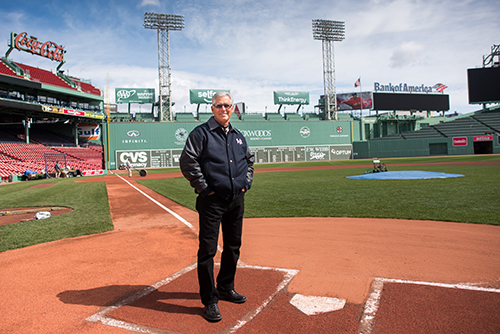
As for Bucky, he is approaching his 71st birthday, and still runs his baseball school in Delray Beach, Florida. He lives in Lake Worth. His wife Marianne died in 2015. They had 4 children, including daughter Caitlin, who played softball at North Carolina State University and coached it at Hofstra University; and son Cody, who played baseball at the University of Florida.On July 20, the Sox led the American League Eastern Division by 9 1/2 games. The Yankees were 14 games back. This time, the Sox finished with 99 wins, and they didn't even make the Playoffs. The Yankees? They went on to win their 22nd World Championship, all since the Sox won their last, 60 years earlier.
That night, Billy Joel, a Yankee Fan born in The Bronx and raised on Long Island, played the Boston Garden, home of the NBA's Celtics and the NHL's Bruins. I wonder if he played "New York State of Mind." I wonder if he played "Miami 2017," a dark fantasy about the destruction of New York. I wonder if the Bostonians cheered. I wonder if they booed the line about an aircraft carrier picking the Yankees up for free.
"Ah, but sooner or later, you sleep in your own space.
Either way, it's okay: You wake up with yourself."
It was also on October 2, 1978 that Tim Allen -- later to star in the TV sitcoms Home Improvement and Last Man Standing, and in the Santa Clause films and in the Toy Story films as the voice of Buzz Lightyear -- was arrested at the airport in his hometown of Kalamazoo, Michigan, for possession of over 1.4 pounds of cocaine.
To avoid spending the rest of his life in prison he decided to plead guilty, and provide all the names he had of dealers in the area. In exchange, he was sentenced 3 to 7 years. He was paroled after serving less than 2 1/2 years.
To this day, even after their team has finally cheated its way to 4 World Series wins, October 2, 1978 still bothers Sox fans. Let it.
A recent photo of Bucky at Fenway
Russell Earl O'Dey. That was his birth name. Legally, he is Russell Earl Dent. Professionally, he is Bucky Dent. Red Sox fans call him "Bucky Fucking Dent." Sometimes written as "Bucky Bleeping Dent" or "Bucky F. Dent." It's been suggested that his name sounds like a profanity: As comedian and Cambridge, Massachusetts native Lenny Clarke would say, "You buckydent bastard!"
Check it out. A Boston newspaper (I can't seem to track down which one, it might have been one in the suburbs) had the headline, "Destiny 5, Red Sox 4."
You fools, don't you know DESTINY ends with NY?
In 1981, baseball historian John Thorn published Baseball's 10 Greatest Games. He included this game as, at the time, the most recent of them. In 2010, the MLB Network listed this game at 11th on their list of MLB's 20 Greatest Games -- limited in scope, due to the availability of surviving videotape, to 1975 onward. Due to the timing -- 1975 to 1980 -- along with the Bucky Dent Game, it was 1 of 2 games to make both lists.
UPDATE: The Red Sox have a team Hall of Fame. From their 1977 and 1978 near-misses, they have inducted: left fielder Carl Yastrzemski, catcher Carlton Fisk, 1st baseman George Scott, 2nd baseman Jerry Remy, shortstop Rick Burleson, left fielder Jim Rice, center fielder Fred Lynn, right fielder Dwight Evans; pitchers Luis Tiant, Bill Lee, Bob Stanley and Dennis Eckersley; owner Jean Yawkey, manager Don Zimmer, executive Haywood Sullivan, farm system director Ben Mondor, scout George Digby, executives Edward Kenney and Dick Bresciani, groundskeeper Joe Mooney, guest relations director Al Green, broadcasters Ken Coleman and Ned Martin, and longtime vendor Arthur D'Angelo.
*
October 2, 1978 was a Monday. This was the only baseball game played that day. It was too early in the year for the NBA and NHL seasons to begin. There was 1 NFL game, on ABC Monday Night Football: The Washington Redskins beat their arch-rivals, the Dallas Cowboys, by the unusual score of 9-5. Mark Moseley kicked 3 field goals for Washington. For Dallas, Rafael Septién kicked 1, and Randy White scored a safety when he sacked Joe Theismann in the end zone in the 4th quarter.