Showing posts with label new brunswick. Show all posts

Friday, November 11, 2022

November 11, 1916: Rutgers Stands By Paul Robeson

November 11, 1916: The football team at Rutgers College stands up for their best player -- a month after cowardly refusing to do so.

On October 14, Rutgers were hosting Washington & Lee University at Neilson Field in New Brunswick, New Jersey. Washington & Lee is in Lexington, Virginia, and is named for George Washington and Robert E. Lee. Lee was the leading General of the Confederate States of America. Virginia was still a Southern State. And it had only been 51 years since the end of the American Civil War.

And Paul Robeson was a sophomore offensive lineman, tackle and guard, for Rutgers. And he was really good. And he was black. And the Washington & Lee players refused to play against him, because of his race.

So Rutgers head coach George Sanford benched Robeson. A friend of him called it "a wound that never healed." The game ended in a 13-13 tie.

A month later, West Virginia University sent its team to play Rutgers. West Virginia had seceded from Virginia and rejoined the Union in 1863. And their campus is further north than one-quarter of Rutgers' home State of New Jersey. Nevertheless, the Mountaineer players also insisted that Robeson not play.

This time, Sanford stood up for Robeson, saying that if the Mountaineers didn't want to play against a black man, they could go home. They didn't want to forfeit either the game, or the money their school would make by playing, so they played, and Robeson made a game-saving tackle near the goal line to preserve a 0-0 tie. Afterward, the WVU players lined up to shake his hand.

In 1917 and 1918, Robeson was considered by many observers to be the best player in the country. In 1920, making his all-time All-American team, Walter Camp, the legendary Yale player and coach who invented the "All-American team" concept, named Robeson the best defensive end he'd ever seen.
Robeson's pro career was brief, but he did play for the 1st champions of the league that became the NFL, the Akron Pros, led by black coach and back Fritz Pollard. Robeson went on to bigger things in the law, music, acting and social activism.
Rutgers' original name, in use from 1766 to 1825, was Queens College. Their administration building, opening in 1825, it still known as Old Queens. And so, when they began intercollegiate sports, their teams became known as the Queensmen.
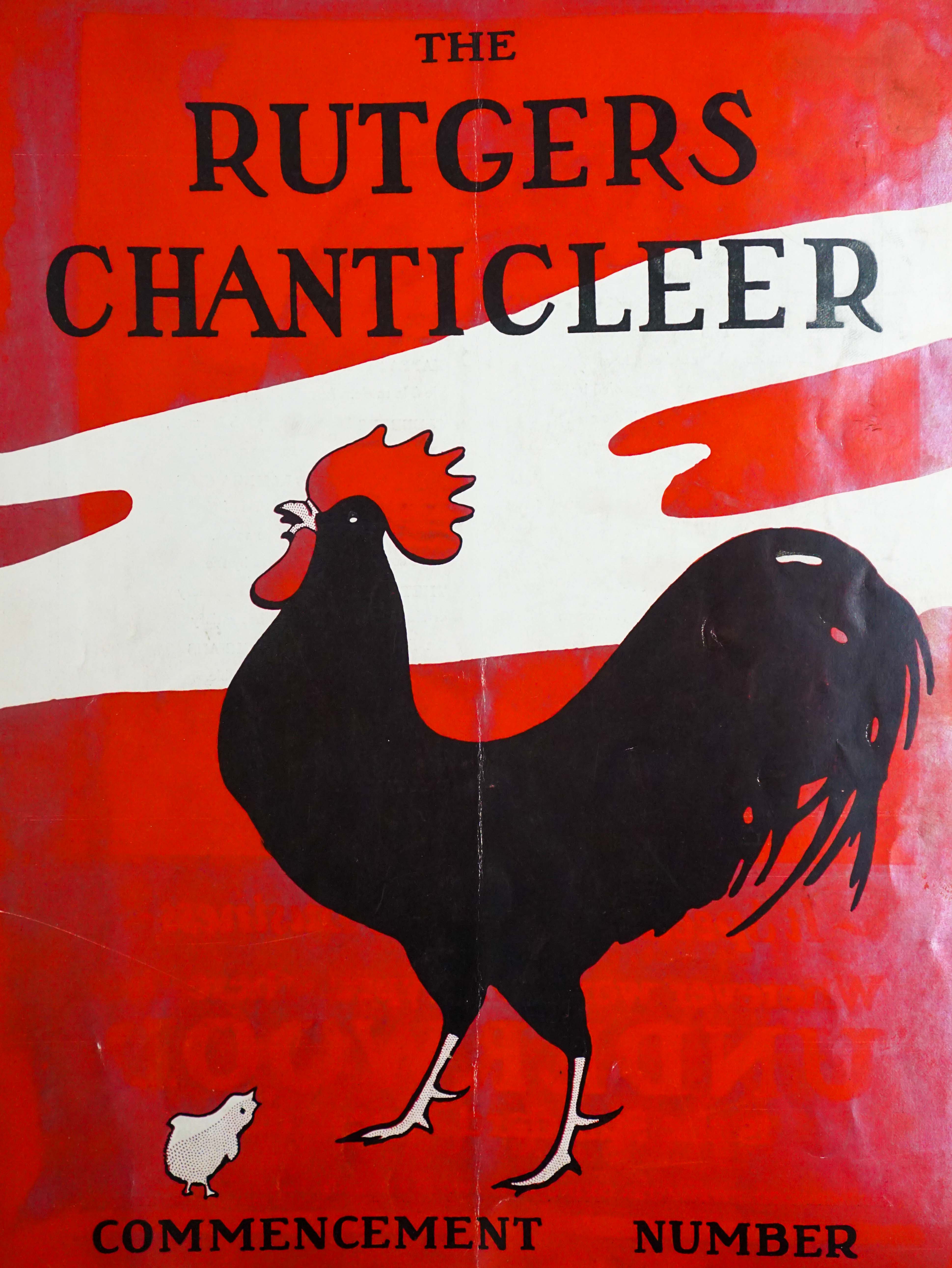
In 1925, the name was changed to the Chanticleers. A chanticleer is a rooster, a fighting cock. There was precedent: The University of South Carolina calls their teams the Gamecocks -- although calling them the Cocks for short is a bit problematic. New Brunswick's radio station, and the carrier for Rutgers' football games, at 1450 on the AM dial, named their call letters after the ChanTiCleers: WCTC.
But too many people associated "Chanticleer" with "chicken," and thus with cowardice. So, in 1955, a student vote was held, and the name chosen the most was "Scarlet Knights." And so they have been ever since.
*
November 11, 1916 was a Saturday. These other noteworthy college football games were played that day:
* Harvard beat Princeton, 3-0 at Harvard Stadium in Boston.
* Army beat Maine, 17-3 on The Plain in West Point, New York.
* Cornell beat Michigan, 23-20 at Schoellkopf Field in Ithaca, New York.
* Dartmouth and Pennsylvania played to a 7-7 tie at the original Franklin Field in Philadelphia.
* Navy beat North Carolina State, 50-0 at Worden Field in Annapolis, Maryland.
* Georgia Tech, 5 weeks after beating Cumberland College 222-0, took it relatively easy on Alabama, beating them 16-0 at Grant Field in Atlanta. Tech went 8-0-1, and were retroactively named National Champions by the Billingsley Report in 1996.
* Rivalry: Tennessee beat Vanderbilt, 10-6 at Waite Field in Knoxville, Tennessee.
* The University of Pittsburgh made Washington & Jefferson continue to pay for their racism, beating them, 37-0 at Forbes Field in Pittsburgh. Pitt went 8-0, and were retroactively named National Champions by most sources other than Billingsley.
* Notre Dame beat South Dakota, 21-0 in Sioux Falls, South Dakota.

Monday, November 7, 2022

November 7, 1925: The Rutgers Chanticleer

November 7, 1925: Rutgers College, the New Brunswick, New Jersey-based "colonial college," whose teams had previously been called the Queensmen, after their school's original 1766-1825 name, Queen's College, takes on a new name: The Chanticleers. A chanticleer is a fighting rooster, roughly equivalent to the University of South Carolina's Gamecocks. Another school in South Carolina, Coastal Carolina University, a former junior college founded in 1954, uses "Chanticleers."

The change didn't work: They traveled to March Field in Easton, Pennsylvania, where Lafayette College was also introducing a new mascot, the Leopards, and Lafayette won, 34-0.

In 1946, a New Brunswick radio station was founded, at 1450 on the AM dial, and committed to broadcasting Rutgers games. It took its call letters from "Chanticleer": WCTC.

In 1955, the mascot was changed to the Scarlet Knights, after a campus-wide election. Head football coach Harvey Harman supported the change, saying, "You can call it the Chanticleer, you can call it a fighting cock, you can call it any damn thing you want. But everybody knows it's a chicken."

In Middlesex, north of London, fans of the soccer team Tottenham Hotspur Football Club, whose symbol was a cockerel, were unaware of the change, and had no comment.

In 2021, WCTC was bought by Fox, and is now "Fox Sports New Jersey," but it kept the call letters, a vestige of the Chanticleer name.

*

November 7, 1925 was a Saturday. Among the other noteworthy college football games that day were these:

* Army beat Davis & Elkins, 14-6 at Michie Stadium in West Point, New York.

* Fordham beat Holy Cross, 17-0 at the Polo Grounds.

* Columbia and New York University (NYU) played to a tie, 6-6 at Columbia's Baker Field in Upper Manhattan.

* City College of New York beat Manhattan College, 13-10 at CCNY's Lewisohn Stadium in Upper Manhattan.

* Princeton beat Harvard, 36-0 at Palmer Stadium in Princeton, New Jersey.

* Navy beat Western Maryland, 27-0 at Farragut Field in Annapolis, Maryland.

* Alabama beat Kentucky, 31-0 at Rickwood Field in Birmingham, Alabama. 'Bama won the Southern Conference, a precursor to the Southeastern Conference, and finished the season undefeated.

* Texas Christian University beat Texas A&M, 3-0 at Clark Field in Fort Worth, Texas. TCU won the Southwest Conference.

* Notre Dame and Penn State played to a tie, 0-0 at New Beaver Field in State College, Pennsylvania.

* Northwestern upset Michigan, 3-2 at Municipal Grant Park Stadium in Chicago, the building that would soon be renamed Soldier Field. This was the only game Michigan lost all season, and they still won the Big Ten Conference title, and were recognized by one of the determining bodies as the National Champions.

* In what then amounted to a rivalry game, the University of Illinois beat the University of Chicago, 13-6 at Memorial Stadium in Champaign, Illinois.

* Missouri beat Washington University, 14-0 at Francis Field in St. Louis. Mizzou won the Missouri Valley Conference, a precursor to the league eventually known as the Big Eight Conference.

* The University of Washington beat Stanford, 13-0 at University of Washington Stadium, later renamed Husky Stadium, in Seattle. Washington won the Pacific Coast Conference, a precursor to the league eventually known as the Pacific-12 Conference. They were invited to the Rose Bowl, where they were beaten by Alabama, which led to most organizations that chose the National Champion to recognize 'Bama as such.

One game was played in the NFL, due to Pennsylvania's ban on playing professional sports on Sundays, which remained in effect until 1933: The Frankford Yellow Jackets beat the Akron Pros, 17-7 at Frankford Stadium in Northeast Philadelphia.

Saturday, November 5, 2022

November 6, 1869: The 1st American Football Game

The First Game, painted in 1968 by Arnold Friberg,
commissioned for the 1969 College Football Centennial

November 6, 1869: What is generally recognized as the 1st college football game -- and the 1st game of what is usually, outside the United States, called "American football" -- is played. Rutgers College plays the College of New Jersey, on Rutgers' campus in New Brunswick.

Legend has it that the impetus for the game was Rutgers wanting to redeem its honor after losing the 1st-ever baseball game between the schools, on May 2, 1866, 42-0 on CNJ's campus in Princeton, 18 miles down the road that would become the Lincoln Highway and then New Jersey Route 27 -- known as Albany Street, French Street and Somerset Street in New Brunswick, and Nassau Street in Princeton.

The game is essentially a very large soccer game, with a round leather ball, and 25 men on a side. As agreed upon before the game, by Captains William Leggett of Rutgers and William Gummere of CNJ, there was no clock, and the 1st team to 6 goals would win.

The Rutgers men, finding the color inexpensive to obtain, wrap scarlet red cloth around their heads like turbans, so that they can tell each other apart on the field. Thus did they invent school colors and, in a way, the football helmet.

The men of Old Queens must have had less trouble telling team from team than did the men of Old Nassau, as Rutgers won, 6-4 -- that's 6 goals to 4, or 42-28 under today's scoring system.

The next week, the CNJ men returned the favor in Princeton. As before, the home team set the rules, with 8 goals to win. They also wanted "fair catches," which Rutgers had denied them the week before. This played to the Nassau men's strength, and they won, 8-0. There was supposed to be a 3rd game, but the colleges' presidents got together,  and decided that too much emphasis was being placed on athletics, and forbade it.

The field where "the first football game" was played is now the parking lot for Rutgers' College Avenue Gym. Rutgers played at College Field until 1891, then opened Neilson Field across the street, playing there until 1938, when Rutgers Stadium opened across the River in Piscataway. The Alexander Library, the school's main library, was built on the site of Neilson Field in 1953. Rutgers Stadium was replaced on the same site by what's now named SHI Stadium in 1994, while they played their 1993 home games, and many others from 1976 to 2009, at Giants Stadium.
The site of College Field today. In the background,
College Avenue Gym (left) and the Rutgers Student Center.

George Large of Rutgers was the last surviving player from this game, living until August 15, 1939, age 88. The native of Readington, Hunterdon County played on the Rutgers side, and in 1888 served as President of the State Senate, making him the Acting Governor on a few occasions.
Plaque inside the Gym

In 1874, Harvard University would accept a challenge from McGill University in Montreal, and discover on the McGill men's arrival that by "football," McGill meant "rugby," not "soccer." Adjustments were made, Harvard liked the results, and convinced the other "football"-playing schools to join them in this adaptation of "football." In 1906, the forward pass was legalized and hashmarks prevented dangerous scrimmages close to the sideline. "Football" as America knows it now was on its way.

In 1896, the College of New Jersey changed its name to Princeton University, while a nearby school would later be founded as Trenton State College, and change its name to The College of New Jersey. Rutgers College would become, and remains, the centerpiece of the larger system of Rutgers, The State University of New Jersey.

Princeton's nickname, the Tigers, would inspire 2 professional team names: Baseball's Detroit Tigers and the Canadian Rugby Union's Hamilton Tigers, now the Canadian Football League's Hamilton Tiger-Cats.

Rutgers was known as "The Queensmen" until 1925, when they became the Chanticleers, after a fighting rooster. The school's literary magazine was already called The Chanticleer. But this carried the connotation of "chicken" -- and, as the University of South Carolina has found out with their similarly-named Gamecocks, they can be called "Cocks." In 1955, head coach Harvey Harman recommended the change to the Scarlet Knights, and such they have been ever since.
The West Stand of what's now named SHI Stadium

Rutgers continues to bill itself as "The Birthplace of College Football," or simply "The Birthplace." You know the joke: Rutgers invented football in 1869, and they haven't done a damn thing since. It's not completely true -- they had undefeated seasons in 1961 and 1976, won 6 bowl games between 2006 and 2014, and shared the Big East Conference Championship in 2012 -- but it sure feels like it at times.
Statue outside the stadium's North End

After that 1st game, Rutgers did not beat Princeton again until the dedication game for the original Rutgers Stadium in Piscataway, in 1938, going 0-33 in between. But, starting in 1958, Rutgers won 4 straight, before Princeton then won 6 straight.

Rutgers began to dominate the rivalry in 1968. They wanted "bigger-time football" in the 1970s, and started recruiting better, to the point where Princeton, wanting to stay in the Ivy League, couldn't keep up. Rutgers won the last 5 games before Princeton decided to stop playing them, including the finale, on September 27, 1980, a 44-13 win in Piscataway. Nevertheless, Princeton still leads the all-time rivalry, 53-17-1, despite Rutgers going 9-3-1 from 1968 onward.

The rivalry remains intense in other sports, including basketball.

*

November 6, 1869 was a Saturday. You might think that there were no other scores on this historic day. But you'd be wrong. The 1st openly professional baseball team wrapped up its season that day: The Cincinnati Red Stockings beat the Mutual Base Ball Club of New York, 17-8 at the Union Grounds in the Williamsburg section of Brooklyn.   

Saturday, October 22, 2022

October 22, 1977: Stuff Yer Face Opens

The original location, 43 Easton Avenue, 1977-82

October 22, 1977: Stuff Yer Face opens at 43 Easton Avenue in New Brunswick, New Jersey. Five years later, in 1982, it moves into larger quarters at 49 Easton Avenue, where it remains.
The current location, 49 Easton Avenue

The restaurant is known for its stromboli, named for a volcanic island in the Tyrrhenian Sea, off the coasts of the Italian mainland and Sicily, pronounced "STRAHM-buh-lee." The food, usually pronounced "Strahm-BOH-lee," is a type of turnover, made of Italian bread dough, and filled with pretty much anything you want, but usually cheese, vegetables like onions and peppers, and Italian cold cuts such as salami. But the menu allows you to pick your own fillings, if none of the dozens of varieties fit you well at that moment,
Unlike the similar calzone, which are always stuffed and folded into a crescent shape, the stromboli is folded into a cylinder. Like the cheesesteak, it's believed to have been invented by Italian-American bakers in South Philadelphia, about 60 miles southwest of New Brunswick.

New Brunswick is the seat of Rutgers, the State University of New Jersey, and Stuff Yer Face not only caters to the Rutgers crowd, but is festooned with Scarlet Knights memorabilia -- and, to a lesser extent, that of other local teams, including the Yankees, the Mets, the Giants, the Jets, and the New Jersey Devils.

SYF (the initials are occasionally used, but no one calls it "Stuff's," "Stuffy's" or "Face's") is also known for its "beer library," an extensive array of beers from around the world, including small breweries in the Northeastern U.S. The slogan is, "Enjoy a boli and a beer!" They are also known for their "potachos," potato chips cooked like nachos.

They have become an institution in New Brunswick. They are one of those places that likes to say, "We were here before you were born." For pretty much any visiting Rutgers student from the Class of 1996 onward, that has been true.

*

October 22, 1977 was a Saturday. And how did Rutgers do on this momentous day in the history of its hometown? Actually, they weren't even scheduled to play. The team that were then RU's arch-rivals, Princeton, beat Harvard, 20-7 at Harvard Stadium in Boston.

* Number 1 Michigan lost to Minnesota, 16-0 at Memorial Stadium in Minneapolis, a rare win for Minnesota in the battle for the Little Brown Jug. But Michigan rebounded to win the Big Ten Conference title.

* Number 2 Texas, with the eventual Heisman Trophy winner, running back Earl Campbell, beat Southern Methodist (SMU), 30-14 at the Cotton Bowl in Dallas. Texas won the Southwest Conference title, and would return to the Cotton Bowl stadium for the game of the same name.

* Number 3 Alabama beat Louisville, 55-6 at Bryant-Denny Stadium in Tuscaloosa. Alabama won the Southeastern Conference title.

* Number 4 Ohio State beat Northwestern, 35-15 at Dyche Stadium (now Ryan Field) in the Chicago suburb of Evanston, Illinois. Ohio State blew its chance at the Big 10 title by losing to Michigan, and lost the Sugar Bowl to Alabama.

* Number 5 Southern California were upset by Number 11 Notre Dame, 49-19 at Notre Dame Stadium in South Bend, Indiana. Or maybe it wasn't such an upset: Notre Dame, with sophomore quarterback Joe Montana, went undefeated, and beat Texas in the Cotton Bowl, deciding the National Championship.

* Number 6 Oklahoma beat Number 16 Iowa State, 35-16 at Owen Field in Norman. Oklahoma won the Big Eight title, and went into the Orange Bowl ranked Number 2 behind Texas, who lost.

* Number 7 Colorado were upset by Number 18 Nebraska, 33-15 at Memorial Stadium in Lincoln. Nebraska could have won the Big 8 by beating Oklahoma, but they didn't, and ended up beating North Carolina in the Liberty Bowl.

* Number 8 Kentucky beat Georgia, 33-0 at Sanford Stadium in Athens, Georgia. Kentucky went 10-1 on the season, but were on probation, and thus ineligible for the SEC title or a bowl game.

* Number 9 Arkansas beat the University of Houston, 34-0 at War Memorial Stadium in Little Rock. But, as in their famous 1969 "Game of the Century," Arkansas lost its chance at the SWC and national titles by losing to Texas. But they did ruin Oklahoma's shot at the National Championship by beating them in the Orange Bowl.

* Number 10 Penn State beat West Virginia, 49-28 at Beaver Stadium in State College, Pennsylvania. Penn State, whose only loss was to Kentucky, beat Arizona State on their own field in the Fiesta Bowl on Christmas Day.

* Number 15 University of California (usually called "Cal" for sports purposes, and "Berkeley" for everything else) were upset by unranked University of California at Los Angeles (UCLA), 21-19 at the Los Angeles Memorial Coliseum.

* The University of Washington, then unranked, beat Oregon State, 14-6 at Husky Stadium in Seattle. Washington won the Pacific-Eight Conference title, and beat Michigan in the Rose Bowl.

* Among the service academies, Army beat Lafayette, 42-6 at Michie Stadium in West Point, New York; Navy beat William & Mary, 42-17 at Navy-Marine Corps Memorial Stadium in Annapolis, Maryland; and Baylor beat Air Force, 38-7 at Floyd Casey Stadium in Waco, Texas.

The baseball season had ended 4 days earlier, when the New York Yankees beat the Los Angeles Dodgers in Game 6 of the World Series, thanks to 3 home runs from Reggie Jackson and a complete game by Mike Torrez.

There were 11 games played in the NBA:

* The New York Knicks beat the Washington Bullets, 141-115 at Madison Square Garden.

* The New Jersey Nets, in their 1st month as a New Jersey team after playing on Long Island, lost to the Buffalo Braves, 101-96 at the Buffalo Memorial Auditorium.

* The New Orleans Jazz beat the Philadelphia 76ers, 104-103 in overtime at The Spectrum in Philadelphia.

* The Atlanta Hawks beat the Cleveland Cavaliers, 107-101 at The Omni in Atlanta.

* The Houston Rockets beat the Boston Celtics, 110-98 at The Summit in Houston. (The arena has since been converted into the Central Campus of the Lakewood Church, Dr. Joel Osteen's "megachurch.")

* The Detroit Pistons beat the Denver Nuggets, 126-106 at Cobo Hall (now the Huntington Center) in Detroit.

* The Indiana Pacers beat the Kansas City Kings, 106-101 at the Market Square Arena in Indianapolis.

* The Milwaukee Bucks beat their arch-rivals, the Chicago Bulls, 113-95 at the Milwaukee Exposition, Convention Center and Arena, or "The MECCA." Since 2014, it has been named the UW-Panther Arena.

* And the Portland Trail Blazers beat the San Antonio Spurs, 130-115 at the Portland Memorial Coliseum. Lionel Hollins led all scorers on the night with 36 points.

There were 6 games played in the NHL:

* The New York Islanders beat their arch-rivals, the New York Rangers, 7-2 at the Nassau Coliseum. Michel Bergeron and Bobby Nystrom each scored 2 goals.

* The Toronto Maple Leafs beat the Philadelphia Flyers, 6-1 at Maple Leaf Gardens in Toront.

* The Pittsburgh Penguins beat the Atlanta Flames, 5-2 at the Civic Arena in Pittsburgh.

* The Detroit Red Wings beat the Minnesota North Stars, 4-2 at the Metropolitan Sports Center in the Minneapolis suburb of Bloomington, Minnesota.

* And the Boston Bruins beat the Los Angeles Kings, 4-3 at The Forum outside Los Angeles in Inglewood, California.

And there was 1 game in the World Hockey Association: The Quebec Nordiques beat the Birmingham Bulls, 8-5 at the Colisée de Québec.

In New Jersey high school football, the school that would become my Alma Mater, East Brunswick, played John F. Kennedy High School of Woodbridge to a 6-6 tie at Louis M. Bartha Field in Woodbridge.

And in English soccer, the North London team I would one day begin to support, Arsenal, traveled to the West Country, and beat Bristol City, 1-0 at Ashton Gate in Bristol.

Wednesday, October 19, 2022

October 19, 1946: The Rutgers-Princeton "Cannon War"

"Big Cannon," with Nassau Hall behind it

October 19, 1946: Princeton beats Rutgers 14-7 at Rutgers Stadium. An attempt to steal the cannon proves even more embarrassing for RU.

Rutgers University is in New Brunswick, in Middlesex County, New Jersey. (The stadium is across the Raritan River, in Piscataway.) Princeton University is in the town of the same name, in Mercer County. They are separated by 17 miles of State Route 27. In 1869, Rutgers beat Princeton in "the first college football game," in New Brunswick, hence Rutgers calls itself "the Birthplace of College Football."

Two cannons were left on the Princeton campus after the War of the American Revolution, although neither of them were used in the Battle of Princeton of January 3, 1777, as is often claimed. "Big Cannon" is located behind Nassau Hall in the center of the quadrangle there, called "Cannon Green," and "Little Cannon" is situated between Whig and Clio Halls.

For the War of 1812, Big Cannon was transported to New Brunswick to help defend the city against potential attack by the British, remaining on the Rutgers campus, where it was used for training during and after the American Civil War of 1861-65 by Rutgers cadets, until it was taken back to Princeton in 1875 by the "Princeton Blues," a local militia.

On the night of April 25, 1875, 10 members of the Rutgers Class of 1877 set out to take Big Cannon from Princeton. However, they were unable to move it, so instead they returned to New Brunswick with Little Cannon. Princeton responded with a raid on Rutgers, stealing some muskets, and the presidents of the colleges exchanged polite but demanding correspondence. Eventually, a joint committee settled the matter, and Little Cannon was returned to Princeton, escorted by the New Brunswick Police Chief. In other words, Rutgers was forced to cave.

On October 19, 1946, a contingent of Rutgers men slipped onto the Princeton campus, and again tried to steal the famed Big Cannon. This attempt was even more disastrous than the first. They attached one end of a heavy chain to the cannon and the other to their car, a Ford. Surprised by Princeton students and the police, they gunned the engine of the car so hard that the car, weighted down by the cannon, was torn in half. The Rutgers students managed to escape, but with neither the car nor the cannon.

On the eve of the annual Rutgers-Princeton game of 1971, Big Cannon was apparently "stolen" again. A 5-foot-deep hole was found where the cannon sat. Campus police were baffled that the cannon had been taken, given its extreme weight. After crime photos were taken, it appears that a hole had simply been dug next to Big Cannon and the dirt from the hole used to bury it. Reports appeared in the Rutgers newspaper, the Daily Targum, as well as nearby papers such as the New Brunswick-based Daily Home News, the Princeton Packet and The Times of Trenton. (Rutgers won the game, 33-18.)

With Rutgers having committed to "big-time" (sometimes written as "bigger time") football, and Princeton having committed to the smaller-time Ivy League, the schools haven't played each other in football since 1980, a 44-13 Rutgers win in Piscataway, although they still play each other in other sports.
Big Cannon at Princeton is routinely painted red by Rutgers students, particularly in the week leading to Rutgers commencement, as well as on other notable Rutgers dates. In November 2011, a group of Rutgers students who went to paint the cannon in Princeton brought a video camera with them and made a documentary about the tradition.
The footage became part of a larger project about the history of the Cannon War and its perception in the minds of current students today. The film, Knights, Tigers, and Cannons. Oh My!, by Zack Morrison, premiered at the New Jersey Film Festival in September 2012, and won the award for Best Student Film.
*
October 19, 1946 was a Saturday. In other notable college football games:
* Number 1 Army beat Number 11 Columbia, 48-14 at Michie Stadium in West Point, New York.
* Number 2 Notre Dame were idle that week. Notre Dame would play Army in a de facto National Championship game at Yankee Stadium 3 weeks later, but it ended in a 0-0 tie. Notre Dame, naturally, were awarded the National Championship.
* Number 3 Texas beat Number 14 Arkansas, 20-0 at Memorial Stadium in Austin, Texas. Arkansas won the Southwest Conference title, anyway.
* Number 4 UCLA beat the University of California, 13-6 at Memorial Stadium in Berkeley, California. UCLA won the Pacific Coast Conference title.
* Number 5 Michigan and Number 10 Northwestern played to a tie, 10-10 at Michigan Stadium in Ann Arbor.
* Number 6 University of Pennsylvania beat the University of Virginia, 40-0 at Franklin Field in Philadelphia.
* Number 7 Alabama were upset by Number 9 Tennessee, 12-0 at Shields-Watkins Field (later Neyland Stadium) in Knoxville, Tennessee.
* Number 8 Georgia beat Oklahoma A&M (later Oklahoma State), 33-13 at Sanford Stadium in Athens, Georgia.
* Number 12 Louisiana State University were upset by Georgia Tech, 26-7 at Tiger Stadium in Baton Rouge, Louisiana.
* Number 15 North Carolina beat Navy, 21-14 at Municipal Stadium in Baltimore.
* Number 16 Rice beat Southern Methodist University (SMU), 21-7 at Rice Field in Houston. Rice shared the SWC title with Arkansas, but lost the head-to-head tiebreaker. Nevertheless, they were invited to the Orange Bowl, where they beat Tennessee. Rice went to the Cotton Bowl, where they played LSU to a tie.
* Illinois, then unranked, beat Number 20 Wisconsin, 27-21 at Memorial Stadium in Champaign, Illinois. Illinois went on to play UCLA in the Rose Bowl. That was the 1st time that the Champions of the leagues that would come to be known as the Big Ten and the Pac-12 were locked into playing each other in the Rose Bowl. Illinois won, 45-14.
* New York University beat the University of Rochester, 6-0 at River Campus Stadium in Rochester, New York.

* Fordham University lost to St. Mary's of the San Francisco Bay Area, 33-2 at the Polo Grounds.

There were 2 games in the All-America Football Conference. The New York Yankees beat the Brooklyn Dodgers, 21-10 at Yankee Stadium. Yes, that's in football. And the Buffalo Bisons beat the San Francisco 49ers, 17-14 at Civic Stadium (later renamed War Memorial Stadium) in Buffalo.

Baseball season ended 4 days earlier, with the St. Louis Cardinals beating the Boston Red Sox in Game 7 of the World Series. The league that would become the NBA played its 1st game on November 1. The NFL scheduled no games for this day, but the nascent All-America Football Conference played 2. The New York Yankees beat the Brooklyn Dodgers, 21-10 at Yankee Stadium. Yes, there were football teams with those names. And the Buffalo Bisons beat the San Francisco 49eres, 17-14 at Civic Stadium (later War Memorial Stadium) in Buffalo.
And there were 2 NHL games on this day. The Boston Bruins and the Montreal Canadiens played to a tie, 1-1 at the Montreal Forum. And the Toronto Maple Leafs beat the Detroit Red Wings, 6-3 at Maple Leaf Gardens in Toronto. The New York Rangers and the Chicago Black Hawks were not scheduled,
Also on this day, Arsenal defeated Staffordshire team Stoke City 1-0 at Highbury. Kevin O'Flanagan scored the goal. Soccer was not his best sport: He was renowned as a rugby player for Ireland, and excelled in sprint races and the long jump. He was also a noted amateur golfer and tennis player, and played Gaelic football as a boy.
But he's not the most notable player in this game. That would be Albert Sigurður Guðmundsson. Although this is the 1st of only 2 League matches he plays for Arsenal, it makes him the 1st native of Iceland ever to play professional soccer. He later served his country as Minister of Finance.

October 19, 1943: Streptomycin Is Isolated

Schatz and Waksman

October 19, 1943: Streptomycin, the first antibiotic remedy for tuberculosis, is isolated by researchers at Rutgers University in New Brunswick, Middlesex County, New Jersey. Rutgers has had a lot of victories in the laboratory. On athletic fields, uh, let me get back to you. 

This antibiotic, which gained fame as a treatment for tuberculosis, may be RU's greatest contribution to the world, far more so than "American football." It was isolated by Albert Schatz, a graduate student, in the laboratory of Selman Waksman, in a research product funded by Merck and Company.

Waksman and his staff discovered several other antibiotics, including neomycin. In 1952, Waksman was awarded the Nobel Prize in Physiology or Medicine. Schatz, who had to sue Waksman in order to get his proper credit, tends to get forgotten. Waksman lived until 1973, Schatz until 2005.

*

October 19, 1943 was a Tuesday. Baseball season was over. Football was in midweek. The NBA hadn't been founded yet. And the NHL season didn't start for another 11 days. So there were no scores on this historic day.

Wednesday, September 14, 2022

September 14, 1922: The Hall-Mills Murder

September 14, 1922: Two people are found murdered on a farm in Franklin Township, New Jersey. They are the Rev. Edward Wheeler Hall, an Episcopal priest; and Eleanor Mills, a member of his choir.

Hall, 41, was a native of Brooklyn, and was the pastor at St. John the Evangelist Episcopal Church in New Brunswick, about 2 miles south of where he was found. He was married to the former Frances Noel Stevens.

The former Eleanor Reinhardt, 34, was married to James E. Mills, the sexton at the church, and the janitor at the nearby Lord Stirling Elementary School. They had 2 children.

Rev. Hall and Mrs. Mills had been having an affair, and their bodies were positioned to suggest this. Both had been shot in the head. An investigation did not lead to an indictment. But the story wouldn't go away. Finally, in 1926, Governor A. Harry Moore of New Jersey ordered a 2nd investigation.

The suspects were Frances Hall, the Reverend's wife, the former Frances Noel Stevens; her brothers, Henry and William Stevens; and a cousin of theirs, Henry Carpender. Mrs. Hall was related to many of the wealthy families of New Brunswick, including the Carpenders, the Nielsons, and possibly the Johnsons of Johnson & Johnson pharmaceuticals.

Although New Brunswick is the seat of Middlesex County, the murder was just over the City and County Line, in Somerset County. And so, on November 3, 1926, the trial began at the Somerset County Courthouse in Somerville.

Henry Stevens was an accomplished marksman, and the prosecution contended that he fired the shots, on Frances' orders. He testified that he was away on a fishing trip on the night of the murder, and this was backed up with 3 witnesses. William Stevens supposedly supplied the pistol that served as the murder weapon, but his testimony led to doubt that he knew what was going on. It has since been suggested that he was autistic.

On December 3, 1926, Mrs. Hall and her brothers were acquitted. Carpender had won the right to a separate trial, which was never held. Forensics being what they were then, it was probably too difficult for the prosecution to prove the case. Despite this, the general consensus was that Mrs. Hall was guilty, but the public seemed to side with her, anyway: She was being cheated on, and Mrs. Mills was not held in high regard.
Henry Carpender died in 1934, Henry Stevens in 1939, and both Frances Hall and William Stevens in 1942. The farm on which the bodies were found is long-gone. It is now a residential area. The famous apple tree was roughly where 70 Dayton Avenue now stands, 4 blocks from the intersection of Franklin Boulevard and Easton Avenue.
Roughly where the bodies were found.
Photo taken by me, November 11, 2019.

The case continues to fascinate, and a local historian conducts tours of the various locations: The site, the church, and each side's respective homes.

*

September 14, 1922 was a Thursday. Football was in midweek. Basketball and hockey were out of season. These baseball games were played that day:

* The New York Yankees beat the Chicago White Sox, 4-1 at Comiskey Park in Chicago. Babe Ruth hit a home run in support of Bullet Joe Bush.

* The New York Giants beat the Chicago Cubs, 7-6 at the Polo Grounds.

* The Brooklyn Robins (as the Dodgers were known under Wilbert Robinson's managing from 1914 to 1931) lost to the Cincinnati Reds, 7-3 at Ebbets Field.

* The Pittsburgh Pirates beat the Boston Braves, 8-0 at Braves Field in Boston. Babe Adams pitched a 5-hit shutout.

* The St. Louis Cardinals beat the Philadelphia Phillies, 9-4 at Baker Bowl in Philadelphia.

* The Cleveland Indians beat the Washington Senators, 4-3 at League Park in Cleveland. Center fielder and manager Tris Speaker only appeared in the game as a pinch-hitter, and drew a walk.

* The Detroit Tigers beat the Philadelphia Athletics, 5-2 at Navin Field in Detroit. (It was renamed Briggs Stadium in 1938, and Tiger Stadium in 1961.) Ty Cobb had an RBI triple.

* And the St. Louis Browns beat the Boston Red Sox, 5-3 at Sportsman's Park in St. Louis. George Sisler did not play.

Saturday, July 30, 2022

July 30, 1918: Joyce Kilmer Dies In Combat

July 30, 1918: Joyce Kilmer dies while serving his country in World War I. He was 31 years old.

Ever since, his death has been noted as the end of a great career in poetry.

It wasn't.

Alfred Joyce Kilmer was born on December 6, 1886 -- the same month as painter Diego Rivera, actor Victor McLaglen, and baseball legend Ty Cobb, and 5 days before the 1st match played by the soccer team that would become Arsenal Football Club -- in New Brunswick, Middlesex County, New Jersey. The house in which he was born had the address of 17 Codwise Avenue. The street was later renamed Joyce Kilmer Avenue.

His father, Dr. Frederick Barnett Kilmer, worked in New Brunswick for pharmaceutical giant Johnson & Johnson, and invented perhaps their most famous product, their baby powder. He named his son after Alfred R. Taylor and Dr. Elisha Brooks Joyce, the curate and the rector, respectively, of Christ Church, an Episcopal Church in New Brunswick. Dr. Joyce baptized the baby. And how did the boy thank his father and these 2 priests? In 1913, he converted to the Roman Catholic Church.

He went to Rutgers Preparatory School (since relocated up Easton Avenue in Franklin, Somerset County) and Rutgers College (now part of Rutgers, The State University of New Jersey), where he edited the student newspaper, The Daily Targum. ("Targum" is an Aramaic word meaning "interpretation.") But he couldn't handle the overall curriculum at Rutgers, and, on his mother's advice, transferred to Columbia University in New York, from which he graduated in 1908, and where he again edited the paper, The Columbia Spectator.

He taught at Morristown High School, then edited a dictionary for Funk & Wagnalls, while his poetry began to be published. In 1912, he was hired as a "special writer" by The New York Review of Books, and bought a house in Mahwah, Bergen County, New Jersey. The house was surrounded by trees, inspiring him to write the poem "Trees," which was published in Poetry: A Magazine of Verse in August 1913:

I think that I shall never see
A poem lovely as a tree.

A tree whose hungry mouth is prest
Against the earth's sweet flowing breast;

A tree that looks at God all day,
And lifts her leafy arms to pray;

A tree that may in Summer wear
A nest of robins in her hair;

Upon whose bosom snow has lain;
Who intimately lives with rain.

Poems are made by fools like me,
But only God can make a tree.

Literary critic Guy Davenport wrote that it is "the one poem known by practically everybody." Sure, because it's simple. Even simplistic. It looks like it could have been written by a child. (Kilmer was 26 years old.) Or even, as Kilmer himself admitted, a fool.

In 1917, with the American entry into World War I, Kilmer enlisted in the New York National Guard. He was assigned to the mostly-Irish 69th New York Infantry Regiment, later immortalized in the James Cagney film The Fighting 69thThough he was a college graduate, and thus eligible for a commission as an officer, and was often recommended for such posts during the course of the war, he refused, stating that he would rather be a Sergeant in the Fighting 69th than an officer in any other regiment.

Before he was sent to France, he signed a contract to write poems about the war. One was "Rouge Bouquet," a tribute to 19 friends lost in a German artillery attack on March 7, 1918. In a war in which many finer poets served, it wasn't much better than "Trees." And if you can name a Kilmer poem other than those two, then you're one up on me.

His courage was greater than his writing skill: He volunteered for intelligence duty, and his comrades in arms developed great respect for him. On July 30, 1918, he volunteered to accompany Major "Wild" Bill Donovan to lead an attack as part of the Second Battle of the Marne. Donovan would go on to found the Office of Strategic Services, the forerunner of the CIA.

He led a scouting party in search of a German machine gun, near Muercy Farm, beside the Ourcq River, near the village of Seringes-et-Nesles. He was found with a bullet in his head. The French Republic posthumously awarded him their highest honor, the Croix de Guerre.

Kilmer was buried in a battlefield cemetery in France, while a cenotaph in his honor is in the family plot in New Brunswick. The American Legion post in nearby Milltown is named for him. He left behind a wife, fellow poet Aline Murray; and 5 children, 3 of whom lived to adulthood, one living until 1999. Had that bullet flown a few inches in either direction, and he'd lived a full life, he would have been alive in the 1960s, but would his poetry have gotten any better?

God decides who lives and who dies, but who is determined to be a great poet is made by fools like you and me. Joyce Kilmer was a hero, and a man of strong character. But he was a man of weak poetic skill, and it's time we admitted it, in spite of his heroism.

*

July 30, 1918 was a Tuesday. These 5 baseball games were played that day:

* The New York Yankees lost to the Detroit Tigers, 3-0 at Navin Field (later Briggs Stadium and Tiger Stadium) in Detroit. Bernie Boland pitched a 4-hit shutout, outpitching Edward "Slim" Love. Ty Cobb didn't start the game, but pinch-hit, and went 2-for-2 with 3 RBIs.

* The Cleveland Indians swept a doubleheader from the Philadelphia Athletics, 4-2 and 5-1 at League Park in Cleveland. Tris Speaker went 0-for-3 in the opener, but 2-for-4 with 2 RBIs in the nightcap.

* The Washington Senators beat the Chicago White Sox, 3-0 at Comiskey Park in Chicago. Jim Shaw pitched a 3-hit shutout, outpitching Eddie Cicotte.

* And the Boston Red Sox beat the St. Louis Browns, 11-4 at Sportsman's Park in St. Louis. Babe Ruth went 3-for-4 with a walk and an RBI, but no home runs.

Saturday, June 11, 2022

June 11, 1986: East Brunswick High School Wins Its 1st County Baseball Title

Photo shown in the next day's Home News.
Yes, at the time, we wore a green variation on the
Houston Astros' "Rainbow Brite" uniforms.

June 11, 1986: I was at the baseball field of the Memorial Stadium complex in New Brunswick, New Jersey, watching the final of the 1st Greater Middlesex Conference Tournament, the successor to the Middlesex County Tournament. Dear Old Alma Mater was playing.

East Brunswick High School played Madison Central -- the Old Bridge-based school now known as Old Bridge High School. Here's the starting lineup for Da Bears, coached by Lou Kosa, better known as the school's girls' soccer coach, builder of the best such program in the State:

* Batting 1st, the right fielder, a lefthanded sophomore, Number 1, Craig Semchyshyn. Normally, underclassmen did not make the starting lineup, but "Semy" stepped in due to an injury to a senior. He turned out to be an ideal leadoff man, his speed allowing him to beat out some infield hits (including some good bunts), steal bases, and get to some tough plays in the outfield.

He starred for the team for the next 2 years, although when the Class of '86 and then the Class of '87 players graduated, the team around him was not what it had been in 1984 (County final), '85 (nearly won Conference title) and '86.

* Batting 2nd, the 3rd baseman, a righthanded senior, Number 30, Keith Motusesky. Also the leader of the E.B. basketball team that won the GMC Red Division and Central Jersey Group IV (largest enrollment classification) title the preceding winter. "Mot" could also play catcher.

* Batting 3rd, the shortstop, a righthanded senior, Number 6, Ken Wainczak. Probably our best all-around player, "Check" (a shortening of his name, not his ethnicity, as I think he was Polish like me rather than Czech) was in the mold already formed by Robin Yount, Alan Trammell and the young Cal Ripken Jr., of shortstops no longer being spindly, good-field-no-hit types, rather becoming big guys with power, presaging the era of Derek Jeter, Alex Rodriguez and Nomar Garciaparra.

* Batting 4th, the 1st baseman, a lefthanded senior, Number 11, Mike Cioffi. He had a very good glove, he was our 2nd starting pitcher, and I don't think E.B. has ever had a player who could hit the ball farther.

Earlier in the season, in an otherwise unpleasant loss to Woodbridge, he hit one that I paced off at 492 feet. In retrospect, having read books about long-distance home runs, I probably measured wrong -- or, perhaps, the measurements on the outfield fences at the former EBHS baseball field (since totally redone with FieldTurf, and with dugouts that wouldn't be condemned by the health inspector) were wrong.

But in another game that season, at Perth Amboy, then forced to play their home games at their football stadium, resulting in a mirror image of the Los Angeles Memorial Coliseum when the Dodgers played there (right field was much too close, rather than left field), he hit a ball over the houses on Myrtle Street across from the stadium. That had to be at least 450 feet. (Too bad we lost that game, too, but better times were coming and he would be a big part of it.)

* Batting 5th, the 2nd baseman, a righthanded junior, Number 5, Don Marchiselli. "March" also played a bit of 3rd base, and when he got a hold of a pitch, the opposing 3rd baseman learned why the position is called the hot corner.

* Batting 6th, the left fielder, a righthanded junior, Number 7, Andy Wang. Although E.B. already had a large South Asian population at that time (much more interested in cricket than baseball, although they did perform on our soccer, field hockey and track teams), we didn't have a lot of East Asians then. A few of them were on the track team, but Andy was good with both the bat and the glove.

* Batting 7th, the center fielder, a lefthanded senior, Number 10, John Breen. Normally the right fielder, "Breener" moved over due to another player's injury. Three brothers, three good baseball players, three different schools: His older brother Bill had pitched no-hitters for the East Brunswick campus of Middlesex County Vo-Tech H.S. (now named the Middlesex County Magnet School), and younger brother Sean starred for St. Joseph's of Metuchen. John went on to become an East Brunswick policeman.

* Batting 8th, the catcher, a righthanded senior, Number 20, Rich Helmold. The son and namesake of the head coach of the town's team in the Middlesex County league of American Legion baseball, Rich was a Crash Davis type, a catcher you did not cross up, who would remind you, "Don't think, Meat, just throw." And "Cheese" (I have no idea how he got that nickname) could hit, too. There was no weak spot in this lineup.

* Batting 9th, the designated hitter, a lefthanded senior, Number 3, Rich Loninger. This was the injury I mentioned earlier: "Los" was a good fit as a center fielder and as a leadoff man, but he got hurt shortly before the tournament began. The final was his 1st appearance in the tournament.

* Pitching, a righthanded starter, Number 41, Steve Hochman. A serious Met fan, Hoch (pronounced like "Hock") wore 41 in honor of Tom Seaver, and even copied Tom Terrific's pitching motion, overhand with his right knee brushing the ground with a permanent dirt-stain.

One time, in American Legion Ball, an opposing pitcher took the mound wearing 41, and was awful. Steve said, "He's making Seaver look like an asshole." His coach wisely benched the scrub, and brought in a pitcher wearing Number 36, and he wasn't much better. This was before David Cone reached the majors with the Mets, let alone came to the Yankees and wore 36, so I said, "He's making Robin Roberts look bad." Hochman gave me this dirty look. I hope it meant he was suggesting that Roberts wasn't as good as Seaver. Or maybe it was because he'd already gotten into the University of Michigan, and Roberts was a Michigan State graduate.

Steve's brother Brad, a year behind him, was also on the baseball team, and a star on the soccer team. Another brother, Brandon, was a key cog on the next E.B. team to win a County baseball title, in 1991.
Head Coach Lou Kosa

*

If Connie Mack was right, and "Pitching is 75 percent of baseball," then Steve's Spring 1986 performance can be Exhibit A for the prosecution. He was the reason we went from entering the tournament 11-12 – having been eliminated from the State Tournament in the 1st round the day before the County Tournament began – and the 12th seed to reaching the final.

Hochman struck out 14 batters against heavily favored Carteret in the 1st round. On the bench, we were wondering what the school record was. Being the school's resident trivia freak, they figured I would know, but I didn't. Wayne Beck, a sophomore on the '86 team, told us he thought it was 17, set by his father, also named Wayne Beck, back in 1966, when the school won its 1st Central Jersey Group IV title in the sport. As far as I know, he was correct, but I don't know if that record has since been broken. We won the game, 6-4.

Three days later, in the quarterfinal, against GMC Gold Division (small-school) Champion Harold G. Hoffman High School (which has since reverted to its original name of South Amboy H.S.), Hoch fanned 11 batters in just 5 innings, with Jim Craig (a junior righthander, no relation to the 1980 U.S. Olympic hockey goalie of the same name) finishing the game. (New Jersey high school baseball games are 7 innings, barring a tie.) We won, 15-1.

Don't be fooled by the score, or by the fact that Hoffman was a small school (barely 300 students): They did win their Division, and were then perennial contenders for the Central Jersey Group I title.

Next up was the semifinal against South Plainfield, Champions of the GMC White Division, soon to win the Central Jersey Group II title, and ranked Number 1 in the entire State by the Star-Ledger, the Newark-based largest newspaper in the State. Were we intimidated?

If we were, it wasn't for long: We kicked the stuffing out of them, 16-4, crushing the horsehide in support of Cioffi, who threw some serious smoke. (Well, serious by the standards of New Jersey high school ball.)

South Plainfield was led by Phil Aiello, like Cioffi a lefthanded 1st baseman and pitcher, and we clobbered him. One of the spectators that day, waiting for his own semifinal against Old Bridge, was yet another lefty 1st baseman-pitcher, Chuck Frobosilo of Sayreville, a school which had just clinched its 3rd straight Conference title (the Middlesex County Athletic Conference in 1984 & '85, and the GMC Red Division in '86). This game was such a laugher, literally so, that we were joking with him that this game pretty much clinched the Home News' Middlesex County Player of the Year award for him (and he did get it, over Aiello).

Part of the reason we scored 31 runs in 2 games, and ended up scoring 51 in the 4 games of the tournament, was the field dimensions. From the 1990s onward, GMC Tournament games have been played at the home field of the higher-seeded school until the Final. In the 1990s, the Final was played at the immaculate, professional-quality field of East Brunswick Vo-Tech. Since the turn of the 21st Century, it's been played at TD Bank Ballpark in Bridgewater, home of the independent Atlantic League's Somerset Patriots, even though it's in an adjoining County. But in the 1980s, the entire tournament was played at the Memorial Stadium complex in New Brunswick.

New Brunswick High School was established in 1875, as the 1st public high school in Middlesex County. It had played its football games at the complex since 1940, with the press box of the (thankfully now-renovated) football stadium being strangely a few yards off midfield.

When they moved off their old campus at Livingston Avenue (State Route 26) & Comstock Street and opened their new school in 1967, they built it on Livingston between 9th and 12th Streets, with Joyce Kilmer Avenue (the "Trees" poet, killed in combat in World War I, was born on that street when it was Codwise Avenue) behind it and the stadium on that street.

Behind the stadium was the old Pennsylvania Railroad tracks, by this point (as they still are) used by Amtrak and New Jersey Transit, and whenever an event is held there, it's fun to watch the trains go by. The baseball field, on the 9th Street side of Joyce Kilmer Avenue, is limited by the tracks, and has a chain-link fence that is 300 feet all the way around, but is 20 feet high to discourage cheap home runs. It does not, however, discourage cheap doubles, and the Bears were smacking the ball all over the yard.

A new NBHS was built on the other side of the tracks, on Somerset Street (State Route 27), in 2010, and the previous high school was repurposed as a middle school. But the stadium complex remains their home for outdoor sports.

*

We dusted off South Plainfield to advance to the final, and Madison Central did the same by upsetting Sayreville. In 1986, Madison was the closest divisional opponent to EBHS in terms of distance. A few others, such as E.B. Tech, Spotswood and South River -- once much larger, and the school to which East Brunswick 9th-to-12th graders were sent up until 1958, and thus our original rivals -- were closer, but had smaller enrollments, so we could only play them in County Tournaments. Because of distance, Madison was considered a rival, but not really our biggest rival.

St. Joseph's of Metuchen, a school which took so many E.B. athletes in the 1970s and '80s that they were nicknamed "East Brunswick Catholic," would have been our biggest rival, except they had no football team. (They finally debuted a varsity football team in 2011.) They said they never recruited, absolutely insisting on this. As New Jersey native Jim Bouton would say, "Yeah, surrrre!"

And, in this era, we had some legendary football games against J.P. Stevens H.S. of Edison, including games that decided the Conference and Central Jersey Group IV Championships. It would be a little longer, with some nasty defeats, including two terrible State Playoff football losses, before Madison, and its successor Old Bridge, became the unquestioned school that we hated the most.

Still, we already didn't like them, and the feeling was very mutual. Even more than the Township of East Brunswick, the Township of Old Bridge had a reputation for ginkers. If you're not a Middlesex County native and are not familiar with this term, you probably have your own term for this type: Ginkers were the 1970s & '80s successors to the greasers of the '50s, liking "hair metal" as opposed to greasers' love of Elvis and the 1950s rock and roll pioneers.

These were guys who needed to take 3 or 4 steps up in class and articulation before they could be celebrated in a Bruce Springsteen song. They were more like the kid in John Mellencamp's song "Pink Houses," with the greasy hair and the greasy smile, who knows that nothing better than what he's got now will ever be his destination, unless he wises up. Think Judd Nelson as John Bender in The Breakfast Club, Scott Valentine as Nick Moore on Family Ties, or Ashton Kutcher as Michael Kelso on That '70s Show.

There were a few ginker types on EBHS' athletic teams, but not many. Cigarettes reduce lung power, and nicotine is not exactly a performance-enhancing drug. But the guys at the 2 high schools Old Bridge had at the time, Madison Central and Cedar Ridge, they took the cake. And probably robbed the bakery in the process. Nah, they didn't rob anything. They were too lazy.

*

But it wouldn't have mattered if the Madison hitters were all in tip-top condition: We crushed them. In the top of the 1st inning, Semchyshyn and Motusesky both reached base, and Wainczak stepped up. He cranked one down the left-field line. It cleared the high fence, and this was no cheap shot: It was an absolute no-doubt-abouter.

I've often said this was "the longest home run ever hit," because it went onto the tracks and landed on a passing Amtrak train that carried it all the way to Florida. Now, I don't have any proof that this happened -- Amtrak and NJT trains went past all night, but the homer didn't hit any of them -- but I looked for this ball, and it was nowhere to be found. The only thing I can think of is that it did leave the complex and land on the tracks. And I wasn't about to go onto the tracks and find out. Wherever it went, everybody associated with E.B. was over the moon.

Hochman was dealing. We built up a 7-0 lead, and it looked like we would win easily. Well, it wasn't that easy: In the 4th inning, Madison rallied, made it 7-3, and loaded the bases with 2 out. A shot went to dead center, and it looked like it would clatter off the high fence for a double, scoring at least 2 and making this a game again. But Breen (playing out of his usual position, mind you) made a leaping grab, and the rally was stymied.

That was it: They couldn't touch Hoch, as if Seaver (who, by this point, was wrapping up his brilliant career) himself were on the mound, and we tacked on a few more runs, for the 14-3 final score.

This was E.B.'s 25th season of varsity baseball. We had never won the County Title under the old format, and only reached 1 final, losing to Edison 2 years earlier. This would be our 1st title, if we could finish it off. At 10:02 PM on June 11, 1986, Steve Hochman did just that: His arm must've felt like Swiss cheese at this point, but he fired an aspirin past Rob Jessup, who started the game as the opposing pitcher, but had long since been moved off the mound. He swung and missed. Strike 3.

The mighty mighty Bears were County Champions. Well, Greater Middlesex Conference Champions, but since the only County school not in the GMC was Piscataway (which joined 2 years later), and they didn't reach the sectional final or win their league, it's safe to say E.B. was County Champions.

As one of the student managers on that team, it was, at the time, the happiest moment in my life. For the 1st time ever, my 3 great loves all came together: East Brunswick, baseball, and winning.

*

In 1991, at East Brunswick Vo-Tech, East Brunswick won the Tournament again, beating South Plainfield in the Final. They did it again in 1997, also at E.B. Tech, beating Woodbridge's John F. Kennedy H.S., just 1 day after beating Edison at Hamilton's Mercer County Park for the Central Jersey Group IV title. In 2005, they won the Tournament Final, beating St. Joe's at TD Bank Ballpark in Bridgewater. I was in attendance for each of these. I was not there in 2016, 30 years after winning the 1st one, when they won the 5th one, defeating J.P. Stevens at Bridgewater.

*

June 11, 1986 was a Wednesday. This was also the day the film Ferris Bueller's Day Off premiered. I have a separate entry for that event.

Football was out of season. Hockey season had ended on May 24, with the Montreal Canadiens winning the Stanley Cup, beating the Calgary Flames in Game 5 of the Finals. Basketball season had ended on June 8, with the Boston Celtics winning the NBA Championship, beating the Houston Rockets in Game 6 of the Finals. These Major League Baseball games were played on the day:

* The New York Yankees lost to the Detroit Tigers, 9-3 at Tiger Stadium in Detroit. Ron Guidry was done in by 2 errors, although Dave Winfield hit a home run off Frank Tanana. Don Mattingly went 0-for-4, and Rickey Henderson went 1-for-3 with a walk.

* The New York Mets beat the Philadelphia Phillies, 5-3 at Shea Stadium. Ron Darling outpitched Steve Carlton: The days when a Carlton start meant, "It's Win Day" were long-gone. Ray Knight hit a home run off Carlton. He, Mookie Wilson, Kevin Mitchell and Rafael Santana each got 2 hits. Knight and Gary Carter each had 2 RBIs. For the Phillies, Von Hayes hit a home run, and Mike Schmidt singled as a pinch-hitter.

* The Boston Red Sox beat the Toronto Blue Jays, 3-2 at Exhibition Stadium in Toronto. Roger Clemens advanced to 11-0 on the season, finishing 24-4.

* The Pittsburgh Pirates beat the Chicago Cubs, 5-3 at Three Rivers Stadium in Pittsburgh.

* The Cleveland Indians beat the Oakland Athletics, 7-4 at Cleveland Municipal Stadium.

* The California Angels beat the Chicago White Sox, 12-11 at Comiskey Park in Chicago. Reggie Jackson went 2-for-5 with an RBI.

* The Baltimore Orioles beat the Milwaukee Brewers, 4-3 at Milwaukee County Stadium. Eddie Murray went 2-for-3 with a walk and an RBI, Cal Ripken went 2-for-4 with an RBI, Robin Yount went 1-for4, and Paul Molitor was injured and did not play.

* The Texas Rangers beat the Minnesota Twins, 6-2 at the Metrodome in Minneapolis. Kirby Puckett went 4-for-6 with an RBI, but Kent Hrbek went 0-for-6. Oddibe McDowell won it with a home run in the top of the 16th inning.

* The Montreal Expos beat the St. Louis Cardinals, 4-3 at Busch Memorial Stadium in St. Louis. Jim Wohlford won the game with a sacrifice fly in the top of the 10th inning.

* The Seattle Mariners beat the Kansas City Royals, 12-2 at Royals Stadium in Kansas City. (It was renamed Kauffman Stadium in 1993.) George Brett went 0-for-3 with a walk.

* The San Diego Padres beat the Houston Astros, 11-7 at Jack Murphy Stadium in San Diego. Tony Gwynn went 2-for-2 with an RBI before leaving the game with an injury.

* The Los Angeles Dodgers beat the Cincinnati Reds, 5-4 at Dodger Stadium in Los Angeles. Franklin Stubbs singled home the winning run in the bottom of the 11th inning. He and Alex Trevino had homered earlier in the game for L.A. Dave Parker homered for the Reds, and player-manager Pete Rose went 1-for-3 with a walk.

* And the Atlanta Braves beat the San Francisco Giants, 2-1 at Candlestick Park in San Francisco. Ozzie Virgil Jr. won the game with a home run in the top of the 10th inning.

One more baseball game of note, from high schools in New Jersey: The Final of the 1st-ever Greater Middlesex Conference Tournament, replacing the former Middlesex County Tournament, was played at Memorial Stadium in New Brunswick, Middlesex County, New Jersey. East Brunswick beat Madison Central of Old Bridge, 14-3.

I have a separate entry for this event. Why? Because I was then a junior at EBHS, and the scorekeeper for their baseball team. It was one of the best nights of my life, and that's before I knew that Ferris had been released the same day.

Also, the 1986 World Cup was underway in Mexico. The host nation beat Iraq 1-0 in Mexico City. England beat Poland 3-0 in San Nicloás de los Garza. Morocco beat Portugal 3-1 in Zapopan. And Belgium and Paraguay played to a 2-2 draw in Toluca.

And actor Shia LaBeouf was born. 

Tuesday, May 31, 2022

May 31, 1997: The Confederation Bridge Opens

May 31, 1997: The Confederation Bridge opens. It is the 1st road crossing linking the Canadian Province of Prince Edward Island with the rest of the country: Borden-Carleton, PEI with Cape Jourimain, New Brunswick.

The bridge was designed by French engineer Jean M. Muller, who was a specialist of multiple span match-casting bridges. Construction began on November 1, 1993, took 3 1/2 years, and cost C$1.3 billion.

It is 8 miles long, making it Canada's longest bridge. It is 36 feet wide, 2 lanes, and most of it is 131 feet above the Northumberland Strait. The speed limit on the bridge is 80 kilometres (50 miles) per hour, but can vary with wind and weather conditions. When travelling at the speed limit, it takes about 12 minutes to cross the bridge. It is part of the Trans-Canada Highway, which had previously been part of a ferry crossing at that location.

Prince Edward Island, part of "Atlantic Canada" or "The Maritime Provinces," was named after a son of King George III of Britain, a brother of King George IV and King William IV, the Duke of Kent and Strathearn, the Earl of Dublin, and the father of Queen Victoria. She was on the British throne when Confederation was proclaimed in 1867, and thus he is known as "The Father of Confederation," even though he died in 1820, a few days before his father, never mind before his brothers, and never got to be King.

Nevertheless, there is a reason the Island is named for him: He was commander-in-chief of British forces in what become known as the Maritime Provinces from 1791 to 1800. In 1794, he became the 1st British royal to visit the United States following its independence.

(The 1st eventual King of Great Britain to visit was Edward VIII, as Prince of Wales, in 1919 and 1924, and most things in North America named "Prince of Wales," including the hockey trophy, are named for him. The 1st reigning British monarch to visit the United States, and the 1st one to visit Canada, was King George VI, in 1939.)

PEI is Canada's smallest Province by area, 2,190 square miles, and 157 miles by road from North Cape to East Point; its smallest by population, about 155,000; and its smallest by representation in the House of Commons, 4 seats. Nevertheless, it is a popular Summertime resort, similar to Martha's Vineyard and Nantucket off the coast of Massachusetts.
(UPDATE: As of 2026, of the 343 seats in the House of Commons, Ontario has 122, Quebec 78, British Columbia 43, Alberta 37, Saskatchewan and Manitoba 14 each, Nova Scotia 11, New Brunswick 10, Newfoundland and Labrador 7, PEI 4; and each of the Territories, Yukon, Northwest and Nunavut, each has 1. The Maritimes, combined, have 32, not even 10 percent.)

*

May 31, 1997 was a Saturday. Football was out of season. The NBA Playoffs were between the Conference Finals and the Finals. The Chicago Bulls would beat the Utah Jazz in 6 games. Game 1 of the Stanley Cup Finals was played at the CoreStates Center (now the Xfinity Mobile Arena) in Philadelphia. The Detroit Red Wings beat the Philadelphia Flyers, 4-2, starting a 4-game sweep.

And these games were played in Major League Baseball:

* The New York Yankees beat their arch-rivals, the Boston Red Sox, 7-2 at Fenway Park in Boston. Andy Pettitte outpitched Tim Wakefield. Paul O'Neill went 3-for-5 with 2 home runs and 3 RBIs. Derek Jeter went 1-for-3 with a walk.

* The New York Mets beat the Philadelphia Phillies, 10-3 at Shea Stadium. Armando Reynoso outpitched Mark Leiter. Carlos Baerga went 4-for-5 with 4 RBIs. The only home run was hit by the Phillies' Darren Daulton.

* The Baltimore Orioles beat the Cleveland Indians, 8-5 at Camden Yards in Baltimore. The O's got home runs from Cal Ripken, Tony Tarasco, Mike Bordick and Jeffrey Hammonds. The Tribe got them from Manny Ramirez, David Justice and Pat Borders.

* The San Francisco Giants beat the Atlanta Braves, 6-4 at Turner Field (now Center Parc Stadium) in Atlanta. Barry Bonds went 0-for-3 with a walk, and an RBI on a sacrifice fly.

* The Colorado Rockies beat the Florida Marlins, 8-4 at Pro Player Stadium (now Hard Rock Stadium) in Miami Gardens, Florida.

* The Montreal Expos beat the Pittsburgh Pirates, 4-2 at Three Rivers Stadium in Pittsburgh.

* The Chicago Cubs beat the Cincinnati Reds, 7-4 at Wrigley Field in Chicago.

* The Milwaukee Brewers beat the Chicago White Sox, 4-3 at Milwaukee County Stadium.

* The St. Louis Cardinals beat the Los Angeles Dodgers, 6-3 at Busch Memorial Stadium in St. Louis.

* The Texas Rangers beat the Kansas City Royals, 3-1 at The Ballpark in the Dallas suburb of Arlington, Texas.

* The San Diego Padres beat the Houston Astros, 12-5 at the Astrodome in Houston. Tony Gwynn did not play.

* The Anaheim Angels beat the Minnesota Twins, 5-3 at Edison International Field of Anaheim (now Angel Stadium of Anaheim).

* The Toronto Blue Jays beat the Oakland Athletics, 13-3 at the Oakland Coliseum.

* And the Detroit Tigers beat the Seattle Mariners, 4-2 at the Kingdome in Seattle. Ken Griffey Jr. went 1-for-4. Alex Rodriguez went 0-for-4.

December 31, 1999 & January 1, 2000: The Millennium

December 31, 1999:  The Millennium arrives. The people of planet Earth survived. At a terrible cost. But we hadn't destroyed ourselves. ...