Showing posts with label cricket. Show all posts

Sunday, October 16, 2022

October 16, 1952: The 1st India-Pakistan Cricket Match

October 16, 1952: India and Pakistan, both having become independent from Britain 5 years earlier, play each other in cricket, a sport they inherited from their former colonial masters and kept because they loved it, for the 1st time. From October 16 to 19, at Feroz Shah Kotla Stadium in New Dehli, India, they play a traditional 5-day test match, and India win, by an innings and 70 runs.
The original stand at Feroz Shah Kotla Stadium opened in 1883.
In 2019, it was renamed Arun Jaitley Cricket Stadium.

(The current national capital of New Dehli was created as a separate district from the wider city of Dehli, and includes the venue for this test match, which is now named Arun Jaitley Stadium. The renaming came in 2019 after the death of Jaitley, former President of the Dehli & District Cricket Association.)

But such international cricket competitions usually come in runs of 5 tests. At the University Ground in Lucknow, Pakistan won the 2nd Test, October 23 to 26, by an innings and 43 runs. At Brabourne Stadium in Bombay (now known by its native name, Mumbai), India won the 3rd Test, November 13 to 16, by 10 wickets. At MA Chidambaram Stadium in Madras, the 4th Test, November 28 to December 1, was drawn. And at Eden Gardens in Calcutta, the 5th Test, December 12 to 15, was also drawn. So, India won, 2-1-2.

I've been told by an Indian who I know online from our shared fandom of London soccer team Arsenal that this is the greatest sports rivalry in the world. It carries with it the weight of history and the influence of religion: Most Indians are Hindu, while Pakistanis are, by definition, Muslim.

Despite India's massive edge in population -- 1.38 billion, as opposed to 243 million -- they've only beaten Pakistan 71 times, while Pakistan has beaten India 88 times. There have been 43 draws. India has won the Cricket World Cup in 1983 and 2011, while Pakistan won it in 1992. (The tournament, which began in 1975, has also been won by Australia 5 times, in 1987, 1999, 2003, 2007 and 2015; the West Indies team twice, in 1975 and 1979; Sri Lanka in 1996, and England in 2019.)

*

October 16, 1952 was a Thursday. Baseball season had ended 9 days earlier, with the New York Yankees beating the Brooklyn Dodgers in the World Series. Football was in midweek. The NBA season started 15 days later. The NHL's entire "Original Six" were in action:

* The New York Rangers lost to the Montreal Canadiens, 3-1 at the Montreal Forum.

* The Boston Bruins beat the Toronto Maple Leafs, 2-1 at the Boston Garden.

* And the Detroit Red Wings beat the Chicago Black Hawks, 7-0 at the Olympia Stadium in Detroit.

Sunday, August 28, 2022

August 29, 1882: The Birth of Cricket's "Ashes"

The Ashes Urn, held by Captains
of England (blue) and Australia (green).

August 29, 1882: A legend is born in the sport of cricket.

As a colony of Great Britain until independence in 1901, Australia adopted cricket as its national sport. They also came to love rugby, and adapted it into what became known as Australia Rules Football; and soccer, although it took them longer to achieve anything in that sport; and tennis; and swimming, because it's an island nation.

In August 1882, under team Captain Billy Murdoch, the Australia cricket team, successful against England on home soil the preceding Winter, made the long passenger ship journey to England, and played only 1 test, against Surrey County Cricket Club. Then as now, although it is in Kennington, South London, not in Surrey, The Oval was Surrey's home ground, and that's where the matches were played.

Fred Spofforth was known as "The Demon Bowler," and the English players could do little against him. Cricket historian C.P. Moody wrote, "Spofforth was bowling the most remarkable break-backs at tremendous pace." Despite the skill of W.G. Grace, whom some observers still call England's greatest cricketer ever, the offensive star of the test turned out to be Australia's Hugh Massie.
Fred Spofforth

When it was over, Australia had won, 185-178. For the first time, an England side had lost a Test match in England. After the match, a mock obituary was famously inserted in the Sporting Times, which read:

"In Affectionate Remembrance of ENGLISH CRICKET, which died at the Oval on 29 August 1882, Deeply lamented by a large circle of sorrowing friends and acquaintances R.I.P.
N.B. – The body will be cremated and the ashes taken to Australia."
Ivo Bligh, later the 1st Earl of Darnley, was the Captain of the England team, and promised that, on the tour to Australia in 1882–83, he would regain "those ashes." He spoke of them again several times over the course of the tour, and the Australian media quickly caught on. The three-match series resulted in a two-one win to England, notwithstanding a fourth match, won by the Australians, whose status remains a matter of ardent dispute.

Upon England's victory, Bligh was presented with a small urn, 4.1 inches high, which contained the ashes of a burnt cricket ball. This original urn is on display at the Middlesex Cricket Club Museum at Lord's, the other major cricket venue in London, known as "The Home of Cricket," much as the "real" Stanley Cup is on display at the Hockey Hall of Fame in Toronto. A replica urn is presented to the winning Captain.

The 2022 contest was won by Australia, who have now won it 34 times. England have won it 32 times. There have been 6 draws. In the event of a draw, the holders retain the urn.

Sammy Jones was the last survivor of the 1882 Australia cricket team, living until 1951.

*

August 29, 1882 was a Tuesday. The only professional sport in North America at the time was baseball. These games were played in the National League:

* The Boston Red Stockings beat the Chicago White Stockings, 3-1 at the Union Base-Ball Grounds in Chicago. The Red Stockings became the Braves, and the White Stockings became the Cubs.

* The Cleveland Blues beat the Worcester Ruby Legs, 5-4 at Kennard Street Park in Cleveland. The Ruby Legs became the Philadelphia Phillies the next season. The Blues went out of business after 1884.

* The Detroit Wolverines beat the Troy Trojans, 4-3 at Recreation Park in Detroit. The Trojans became the New York Gothams the next season, and eventually the Giants. The Wolverines won the NL Pennant in 1887, but that led to salary demands that management couldn't keep up with, and they went out of business after 1 more season.

And, for reasons lost to history, a game scheduled for this date was postponed until September 1: The Buffalo Bisons beat the Providence Grays, 6-2 at Riverside Park in Buffalo. Despite the Grays having already won a Pennant in 1879, and winning another in 1884, both teams went out of business after the 1885 season.

And these games were played in the American Association:

* The Pittsburgh Alleghenys beat the Philadelphia Athletics, 2-1 at Exposition Park in Pittsburgh. The Alleghenys would become the Pirates, and join the NL. The Athletics went out of business with the AA in 1891, but an American League team would take their name.

* The Louisville Eclipse beat the Cincinnati Red Stockings, 6-2 at Eclipse Park in Louisville, Kentucky. Both teams would join the National League, with the Red Stockings shortening their name to the Reds. But the Eclipse, who became the Louisville Colonels, were consolidated out of the NL after the 1899 season.

* And the St. Louis Brown Stockings beat the Baltimore Orioles, 3-2 at Sportsman's Park in St. Louis. Both teams would join the NL. The Brown Stockings would become the Browns, and eventually the Cardinals. The Orioles would win NL Pennants in 1894, 1895 and 1896, but go bankrupt in 1899. An AL team would take the St. Louis Browns name, but in 1954 would move, becoming... the Baltimore Orioles.

Sunday, August 14, 2022

August 14, 1948: Australia's "Invincibles" Take The Ashes from England

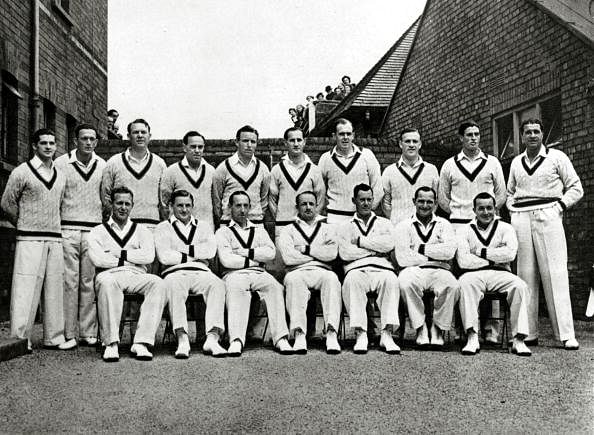
August 14, 1948: The Australia national cricket team completes "The Ashes" series with England, drawing the Third Test and winning the other four. Having gone unbeaten in "test matches" since before World War II began 9 years earlier, they became known as "The Invincibles."

Each State of Australia has its own cricket team: New South Wales, which includes Sydney; Victoria, which includes Melbourne; Queensland, which includes Brisbane; South Australia, which includes Adelaide; Western Australia, which includes Perth; and the island State of Tasmania. The Northern Territory has its own team; but the Australian Capital Territory (ACT), which includes Canberra, does not.  

Captain Don Bradman started out in 1927, playing for New South Wales. In 1948, the national side also included these New South Wales players: Ray Lindwall, Keith Miller, Arthur Morris, Sid Barnes, Ernie Toshack and Ron Saggers. Since 1935, Bradman had played for South Australia. Also from South Australia on the 1948 Australian team was Ron Hamence.

Vice Captain Lindsay Hassett, Sam Loxton, Neil Harvey, Ian Johnson (no relation to Keith), Bill Johnston and Doug Ring played for Victoria. Bill Brown, Don Tallon and Colin McCool played for Queensland. They were managed by Keith Johnson, from New South Wales.

Bradman was turning 40 later that month, and was retiring. In cricket, a "batting average" is runs scored divided by number of times out. In the last of the five Tests of this series, Bradman was bowled between bat and pad for a duck -- in baseball terms, he struck out. Had he provided just 4 runs, he would have retired as the only man to have a lifetime batting average of at least 100. Instead, he retired at 99.94. He was known as the Babe Ruth of Cricket, and, as a citizen of the British Commonwealth, was knighted. 

Among the defeated players for England was Denis Compton. He and his brother Leslie Compton, 6 years older, had both played cricket and football (soccer) for England, and had both played for North London's Arsenal Football Club. Les was better in football, while Denis was better in cricket.

Keith Johnson died in 1972, Sid Barnes in 1973, Don Tallon in 1984, Colin McCool in 1986, Ron Saggers in 1987, Lindsay Hassett in 1993, Ray Lindwall in 1996, Ian Johnson in 1998, Don Bradman in 2001, Ernie Toshack and Doug Ring in 2003, Keith Miller in 2004, Bill Johnston in 2007, Bill Brown in 2008, Ron Hamence in 2010, Sam Loxton in 2011, Arthur Morris in 2015. As of August 14, 2022, one member of the Australia Invincibles is still alive: Neil Harvey, now 93 years old.

*

August 14, 1948 was a Saturday. These baseball games were played that day:

* The New York Yankees beat the Philadelphia Athletics, 14-3 at Yankee Stadium. Vic Raschi went the distance for the win. Joe DiMaggio went 3-for-4 with a home run, a walk, and 4 RBIs. Yogi Berra went 4-for-5 with 2 RBIs.

* The New York Giants beat the Philadelphia Phillies, 3-1 at Shibe Park in Philadelphia. Walker Cooper hit a home run.

* The Brooklyn Dodgers lost to the Boston Braves, 4-3 at Braves Field in Boston. Jackie Robinson went 1-for-3 with a walk and an RBI.

* The Boston Red Sox beat the Washington Senators, 4-3 at Griffith Stadium in Washington. Ted Williams went 1-for-5.

* The St. Louis Cardinals beat the Pittsburgh Pirates, 6-3 at Forbes Field in Pittsburgh. Stan Musial went 1-for-3 with a walk. Ralph Kiner went 2-for-5 with 2 RBIs.

* The Cleveland Indians beat the Chicago White Sox, 4-2 at Comiskey Park in Chicago.

* The Detroit Tigers beat the St. Louis Browns, 10-3 at Sportsman's Park in St. Louis.

* And the Chicago Cubs and the Cincinnati Reds were rained out at Crosley Field in Cincinnati. The game was made up as part of a doubleheader the next day. The Cubs won the opener, 7-6. The Reds won the nightcap, 5-0. Ken Raffensberger pitched a 3-hit shutout.

Thursday, May 5, 2022

May 5, 1928: The West Indies Cricket Team Debuts

Kensington Oval, Bridgetown, Barbados

May 5, 1928: The West Indies Cricket Team competes for the 1st time, in a "test match" against Derbyshire Cricket Club, at the County Ground in Derby. Playing on this day, and on the 7th and the 8th, West Indies win by 2 wickets.

The first combined West Indian team was formed in the 1880s, and toured Canada and the United States. In the 1890s, the first representative sides were selected to play visiting English sides.

Administered by the West Indies Cricket Board ("WICB"), and known colloquially as The Windies, the team represents a sporting confederation of English-speaking Caribbean countries. Despite the British influence, these countries prefer cricket to soccer; and, despite their proximity to America and its radio broadcasts, because of the British influence, these countries prefer cricket to baseball.

Although blessed with some great players in their early days as a Test nation, their successes remained sporadic until the 1960s, by which time the side had changed from a white-dominated to a black-dominated side. By the late 1970s, the West Indies had a side recognized as unofficial world champions, a title they retained throughout the 1980s. Their team from the 1970s and 1980s is now widely regarded as having been one of the best in test cricket's history.

During these glory years, the Windies were noted for their four-man fast bowling attack, backed up by some of the best batsmen in the world, including Sir Garfield "Gary" Sobers, who starred for them from 1954 to 1974, and from 1965 onward as Captain. With all due respect to singer Rihanna, Sir Garfield remains the most famous person ever to come from Barbados.

The 1980s saw them set a then-record streak of 11 consecutive Test victories in 1984, which was part of a still-standing record of 27 tests without defeat (the other tests being draws), as well as inflicting two 5–0 "blackwashes" against the old enemy of England.

Throughout the 1990s and 2000s, however, West Indian cricket declined, in part due to the rise in popularity of track & field and soccer in West Indian countries, and the team today is struggling to regain its past glory.

The current side represents the now independent states of, in alphabetical order: Antigua and Barbuda, Barbados, Dominica, Grenada, Guyana, Jamaica, Saint Kitts and Nevis, Saint Lucia, Saint Vincent and the Grenadines, and Trinidad and Tobago; the British dependencies of Anguilla, Montserrat, and the British Virgin Islands; and the U.S. Virgin Islands and the Dutch "country" of St. Maarten. The most common home ground for the team is the Kensington Oval in Bridgetown, Barbados, named for the ground of the same name in South London.

*

May 5, 1928 was a Saturday. This was also the day that Dixie Dean completed a season in which he scored 60 goals in Football League play, leading Liverpool-based team Everton F.C. to the League title. I have a separate entry for that event.

These baseball games were played:

* The New York Yankees beat the Chicago White Sox, 7-0 at Yankee Stadium. George Pipgras pitched a 6-hit shutout. Babe Ruth went 0-for-3, but drew 2 walks. Lou Gehrig went 1-for-3 with an RBI.

* The New York Giants lost to the Cincinnati Reds, 11-3 at Redland Field in Cincinnati. (The ballpark was later renamed Crosley Field.) Mel Ott went 2-for-5 with an RBI.

* The Brooklyn Dodgers (or the Robins, as they were known while Wilbert Robinson managed them from 1914 to 1931) beat the St. Louis Cardinals, 3-2 at Sportsman's Park in St. Louis. Watson Clark outpitched future Hall-of-Famer Jesse Haines. Del Bissonette and Harry Riconda hit home runs.

* The Cleveland Indians beat the Boston Red Sox, 5-4 at Fenway Park in Boston.

* The Philadelphia Athletics beat the Detroit Tigers, 6-5 at Shibe Park in Philadelphia. Ty Cobb, playing for the A's against his former team, went 2-for-5. Tris Speaker, also wrapping up his career with the A's, went 2-for-4 with a home run, a walk and 2 RBIs.

* The Washington Senators beat the St. Louis Browns, 6-5 at Griffith Stadium in Washington.

* The Pittsburgh Pirates beat the Boston Braves, 6-2 at Forbes Field in Pittsburgh. Paul Waner went 1-for-4, and Lloyd Waner went 3-for-4. For the Braves, Rogers Hornsby went 1-for-4 with a walk and an RBI.

* And the Chicago Cubs beat the Philadelphia Phillies, 5-1 at Wrigley Field in Chicago.

Although it was the 1st Saturday in May, which is the traditional date of the running of the Kentucky Derby, that was not yet traditional. In 1928, the Derby was run on May 19, and Reigh Count won it. His son, Count Fleet, won the Triple Crown in 1943.

December 31, 1999 & January 1, 2000: The Millennium

December 31, 1999:  The Millennium arrives. The people of planet Earth survived. At a terrible cost. But we hadn't destroyed ourselves. ...