Showing posts with label boston braves. Show all posts

Tuesday, November 8, 2022

November 8, 1918: Larry Chappell Dies In Service

November 8, 1918: For the 8th and last time, and just 3 days before the Armistice ending it, a Major League Baseball player dies as a result of serving in World War I.

La Verne Ashford "Larry" Chappell was born on February 19, 1890, outside St. Louis in McCluskey, Illinois. An outfielder, he played for the Chicago White Sox in 1913, '14 and '15; the Cleveland Indians in 1916; and the Boston Braves in 1916 and '17. His lifetime batting average was .226, with 26 RBIs, but no home runs.

In 1917, he batted .325 after 77 games with the Salt Lake City Bees of the Pacific Coast League, when he left them to enlist in the U.S. Army Medical Corps. He was assigned to Letterman Army Hospital in San Francisco. On November 8, 1918, he died there, a victim of the Spanish Flu epidemic that he had been treating in many soldiers. He was 28 years old.

There is no memorial to him at Guaranteed Rate Field in Chicago, home of the White Sox; Progressive Field, home of the Cleveland Guardians; Fenway Park in Boston, home of the Red Sox; or Truist Park outside Atlanta, to which the Braves have moved.

*

November 8, 1918 was a Friday. The War Department had ordered that the baseball season end a month early, in September, and that all players obey the "work or fight order": Enlist, or get a job in an industry essential to the war effort, or get an otherwise necessary job (like police or firemen), or be subject to the military draft. Football was in midweek. Professional basketball barely existed. And hockey season hadn't started yet. So there were no scores on this historic day.

Monday, November 7, 2022

November 8, 1894: The Death of King Kelly

November 8, 1894: Michael Joseph Kelly, sometimes (erroneously) called baseball's 1st true superstar, dies in Boston, where he had been scheduled to appear in vaudeville. "King" Kelly had taken a ferry up from New York, and caught pneumonia. Had today's medicine been available then, he would have been fine. Instead, the pneumonia, and the toll of years of alcoholism, killed him at age 36.

The catcher had helped the Chicago White Stockings (Cubs) win National League Pennants in 1880, 1881, 1882, 1885 and 1886. After the 1886 season, he became the 1st player sold for $10,000 (about $308,000 in 2022 money), to the Boston Beaneaters, forerunners of the Braves. Although he didn't lead them to a Pennant, he became nearly as popular among Boston's Irish-Americans as the Heavyweight Champion of the World, John L. Sullivan.

He inspired a rule change: There was a game in Chicago in which he wasn't playing, and a ball was popped up. He ran onto the field, yelling, "Kelly now catching for Chicago!" so that the umpire could hear, and he caught the ball. Since there was no rule against it, the umpire had to rule the batter out. The following season, the rule was changed: No substitutions in mid-play, except for injury. (In other words, a player hit with a pitch and too injured to continue could have a substitute take the base to which he was entitled.)

He is believed to have invented the hook slide, making him the subject of the song "Slide, Kelly, Slide." There are those who believe he was the inspiration for the poem "Casey at the Bat," and he recited it in his vaudeville act, often getting the words wrong.

In 1888, he dictated Play Ball: Stories of the Ball Field to Boston baseball writer Jack Drohan, making him the 1st baseball player to "write an autobiography." Despite his reputation as a braggart and a drunk, research has shown that most of his stories have checked out, and the book is a godsend to people studying baseball in the 1880s.

In 1890, he was a willing participant in the Players' League revolt, and he led the PL's Boston Reds to the Pennant, his 6th league title. It would be his last, as age and his lifestyle caught up with him. He played his last major league game on September 2, 1893, and his last professional game in August 1894.

He might not have been finished, and if he'd taken care of himself, he certainly wouldn't have been. But then, if he had taken better care of himself, he wouldn't have been King Kelly. As great a player as he was, he wasn't very smart when it came to handling himself. He was thus a precursor to many players, including (in differing ways) Mickey Mantle and Manny Ramirez.

He was married, but his only child had died shortly after birth, earlier in 1894. The Baseball Hall of Fame was not established until 1936. When it elected him in 1945, there was no one available to accept his plaque. Had he taken better care of himself, he would then have been 87.

*

November 8, 1894 was a Thursday. The baseball season was over. Saturday had been standardized as the day for college football. And basketball and hockey were still all-amateur. So there were no scores on this historic day.

Thursday, October 13, 2022

October 13, 1914: The Miracle Braves

October 13, 1914: The Boston Braves defeat the Philadelphia Athletics, 3-1, at Fenway Park in Game 4, and complete the first-ever sweep of a World Series.

The "Miracle Braves" completed one of the most amazing seasons any baseball team had ever had, although it is nearly forgotten now, partly because of the passage of time, meaning that just about everybody who attended a game of theirs is now dead, and partly because the Braves have since moved twice. The team didn’t win another Pennant for 35 years, and didn’t win another World Series until after leaving Boston for Milwaukee in the spring of 1953. Today, when people speak of a World Series win being a "miracle," they're usually referring to the 1969 Mets.

Why did they move? Simple: Red Sox owner Tom Yawkey had money, and Braves owner Lou Perini didn't. If Yawkey hadn't bought the Sox in 1933, they probably would have been the ones to move. After all, they probably wouldn't have won the 1946 American League Pennant, and once the Braves won the National League Pennant in 1948, it would have stamped the Braves as New England's Number 1 baseball team. Plus, at the time, Fenway Park was hardly beloved.

The Braves -- so named because team owner James Gaffney was a "Brave," an official in New York's Tammany Hall Democratic political machine -- were in last place on July 4, but went on a tear, and won the Pennant by 10 1/2 games over the 3-time defending Champion New York Giants. Then they demolished the A's, who had won 3 of the last 4 World Series.

They were managed by George Stallings, whom the Highlanders had foolishly fired as manager late in the 1910 season, rather than release the dishonest star 1st baseman Hal Chase. They had 2 future Hall-of-Famers: Johnny Evers, the 2nd baseman who had starred on the Chicago Cub Pennant winners of 1906-07-08-10, and Walter "Rabbit" Maranville, a rookie who would go on to be known for slick fielding and heavy drinking. Catcher Hank Gowdy was also considered a star.

Their leading hitters were 1st baseman Butch Schmidt and left fielder Joe Connolly, while their top pitchers were Dick Rudolph, Bill James (no relation to the baseball stats guru of the same name) and Cuban star Adolfo "Dolf" Luque. They clinched the Pennant on September 30, beating the New York Giants in the 1st half of a doubleheader at the Polo Grounds, leaving them 10 games up with 9 to play.

The Braves had abandoned their 43-year-old home field, the antiquated and too-small South End Grounds, in August 1914, choosing to rent Fenway from the Sox while awaiting construction of Braves field, which would seat 40,000 when it opened in August 1915. When the Sox won the Pennant in 1915, 1916 and 1918, the Braves returned the favor of 1914 by letting the Sox play their Series games at Braves Field. Despite the Sox winning 3 Pennants in 4 years, there were no World Series games played at Fenway between 1912 and 1946.

Fighting the rise of salaries caused by the Federal League, A’s owner-manager Connie Mack sold off most of his stars after this Series, ending a run of 4 Pennants and 3 World Championships in 5 seasons. In fact, he had won 6 of the first 14 AL Pennants and was in the race nearly every year. In 1915, the A’s would collapse to last place, and in 1916 they would produce a record of 36-117, the most losses in the major leagues between the 1899 Cleveland Spiders and the 1962 New York Mets, and still the lowest winning percentage since 1899, .235. To this, Mack is alleged to have said, perhaps coining the now-familiar phrase, “Well, you can’t win them all.” It would take Mack until 1927 to get the A’s back into a Pennant race and 1929 to get them back into the Series.

The Braves would not be unable to maintain their prosperity, either. They finished 2nd in 1915 and 3rd in ’16, but in ’17, Gowdy became the 1st big-leaguer to enlist in World War I. (In fact, he would go on to become the only big-leaguer to serve in that war and World War II.) Like the A’s, the Braves would go on to become symbolic of baseball frustration: From 1917 to 1932, the Braves would have one season above .500, and 4 seasons of at least 100 losses. A 4th-place finish in 1933 was followed by a 38-115 season in 1935, a .248 winning percentage that’s the lowest in baseball in the last 98 years and the lowest in the NL in 115, even less than the 40-120 ’62 Mets’ .250. Not until 1947 would they get back into a Pennant race, not until 1948 would they win another Pennant, and by the time they won another World Series, 1957, they would be in Milwaukee, and the Red Sox would be in Boston all alone.

Braves Field saw only 1 more Series, in 1948. It has not been totally demolished: The right field pavilion is now Nickerson Field, the sports stadium for Boston University, and the iconic Spanish-style ticket booth is now BU's police headquarters. Like Fenway, it can be seen from the Massachusetts Turnpike.

The last survivor from the 1914 Braves was shortstop Jack Martin. A native of Plainfield, New Jersey, he later lived in the Shore town of Brick, and died in 1980, a few days after attending Old-Timers' Day at Yankee Stadium. At the time of his death, he was also the last living New York Highlander (as the Yankees were called until 1912), and the oldest living Phillie.

The Atlanta Braves hardly even acknowledge their Boston past, as none of the Braves’ 4 National Association and 11 National League Pennants, including the 1914 World Series title, are acknowledged with the Pennants on the façade of the left-field stands at Turner Field. (Nor are their 1957 World Series and 1958 Pennant win from Milwaukee.) The closest the Braves come to honoring their Boston history in any way is the retired Number 21 of Warren Spahn, who debuted with Boston 28 years after the last Boston title.

From 1871 (the founding year of the National Association) through 1914, the Boston Red Stockings/Beaneaters/Rustlers/Doves/Braves won 13 Pennants in 44 years, an enviable achievement that marked them as the most successful sports franchise in North America to that point. In the 100 years since, they've won a grand total of 8 -- only 3 in the 76 seasons from 1915 to 1990. In Boston, Milwaukee, and Atlanta, they have been one of the more underachieving sports franchises of the last 100 years. Maybe their World Series wins of 1957 and 1995 were the real "miracles."

*

October 13, 1914 was a Tuesday. The baseball season was over. Football was in midweek. Basketball and hockey barely existed at the professional level. So there were no other scores on this historic day.

Tuesday, October 11, 2022

October 11, 1948: The Cleveland Indians Win the World Series

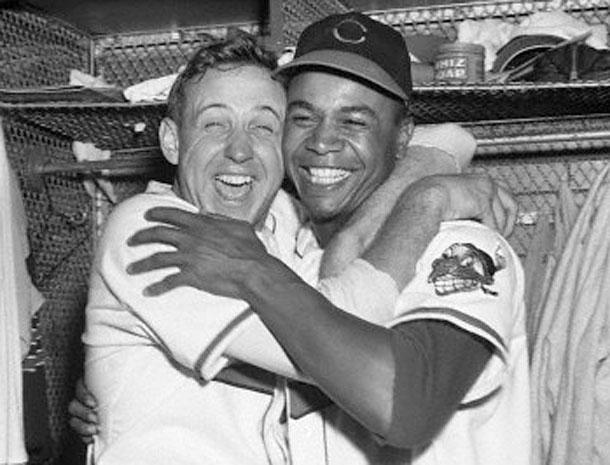
Steve Gromek (left) and Larry Doby

October 11, 1948: The Cleveland Indians defeat the Boston Braves behind "rookie" 30-year-old knuckleballer Gene Bearden, 4-3 at Braves Field, and take Game 6 and win the World Series. It is their 2nd title, the 1st coming in 1920.
Braves Field

Team owner Bill Veeck had built this team. Larry Doby and Satchel Paige thus become the 1st black players to play on a World Series winner. Doby became the 1st black player to hit a home run in a World Series game. And Lou Boudreau, age 31, both shortstop and manager, becomes the last player-manager to win a World Series, or even a Pennant. Bob Feller would join Veeck, Doby, Paige and Boudreau in the Baseball Hall of Fame, although he ended up as the losing pitcher in both games the Indians lost in the Series: Game 1, to Johnny Sain; and Game 5, to another Hall-of-Famer, Warren Spahn.
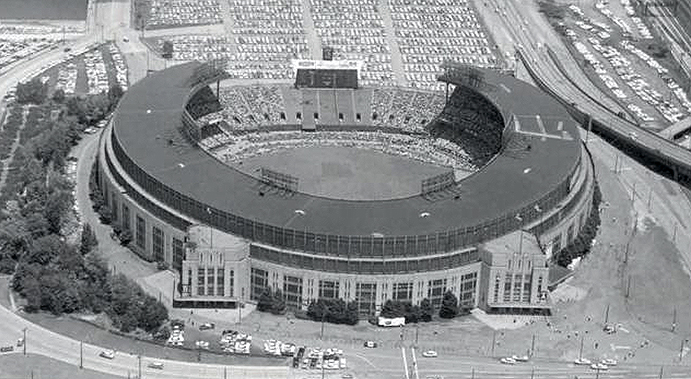
Cleveland Municipal Stadium

A photograph of Doby being hugged by a white teammate, pitcher Steve Gromek, circulated, and was considered another step forward in black and white players working together.

The team has never won another World Series. They have had some close calls, some of them truly agonizing. And they're not even called the Indians anymore: In 2021, after years of complaints about their Native American name and its racist implications, they announced that, for the following season and thereafter, they would be named the Cleveland Guardians.

But at least they're still in Cleveland, despite a number of fears of having to move in the 1960s, '70s and '80s. In contrast, despite all their success in the 19th Century and winning Pennants in 1914 and 1948, that 1948 World Series Game 6 was the last late-season meaningful game the Boston franchise of the National League would ever play. The Braves would be in Milwaukee by the next time they reached the Series, in 1957.

The Indians' Eddie Robinson was the last surviving player from the 1948 World Series, living until 2021, age 100, 73 years later. Clint Conatser was the last survivor of the '48 Braves, living until 2019, at 98.

UPDATE: The Guardians have a team Hall of Fame. From the 1948 World Champion Indians, they have honored Lou Boudreau, Bob Feller, Satchel Paige, Bob Lemon, Early Wynn, Mike Garcia, Joe Gordon, Larry Doby, Al Rosen, Ken Keltner, Jim Hegan, team owner Bill Veeck, scout Cy Slapnicka, and broadcasters Jack Graney and Jimmy Dudley. Feller and Hegan have also been elected to the Greater Cleveland Sports Hall of Fame.

*

October 11, 1948 was a Monday. This was also the day Thomas Merton publishes his memoir The Seven Storey Mountain. I have a separate entry for that event.

The baseball season had ended that day. Football was in midweek. And it was too soon for the NBA and NHL seasons. So there were no other scores on this historic day.

Friday, October 7, 2022

October 7, 1925: The Death of Christy Mathewson

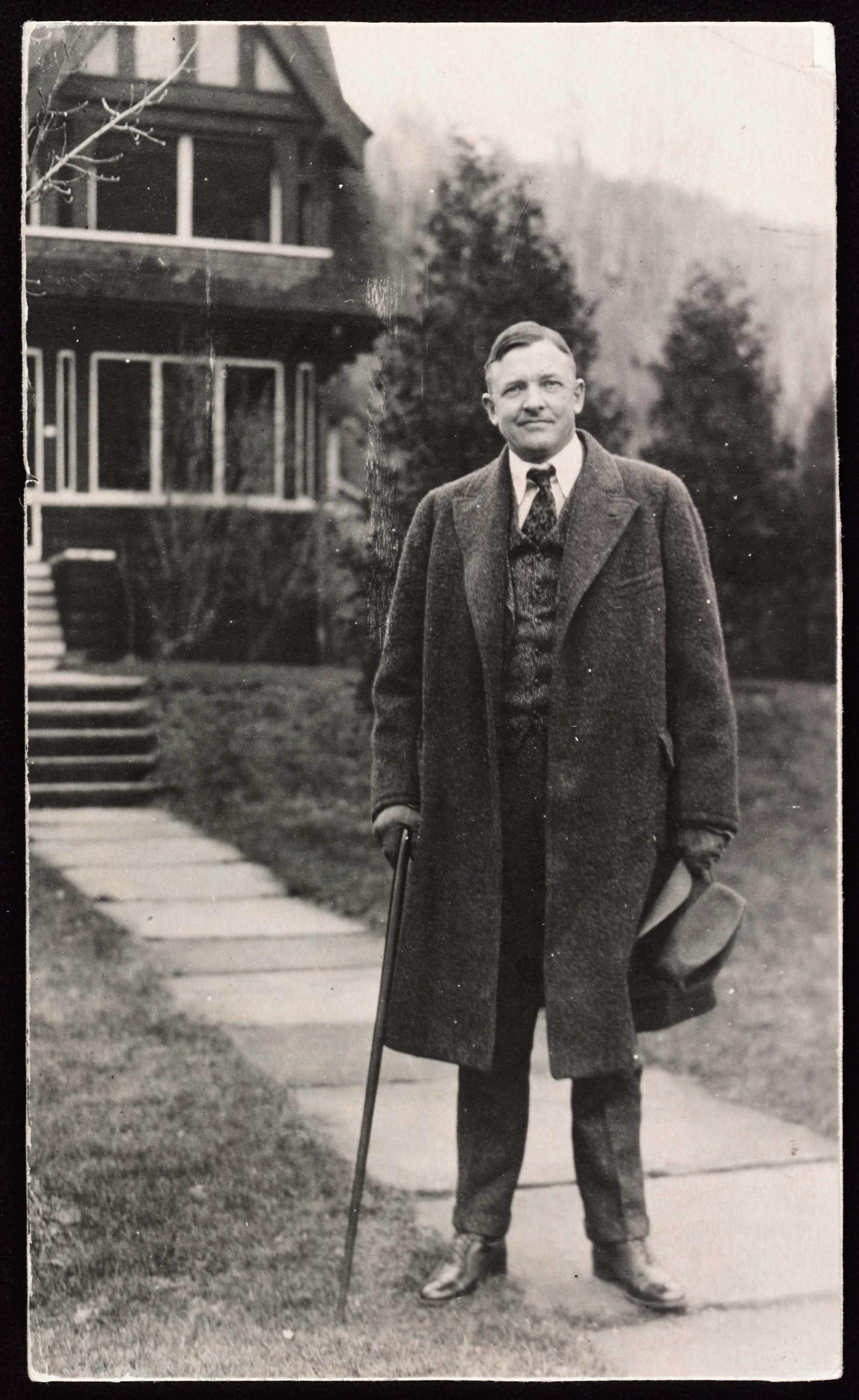
October 7, 1925: Christy Mathewson dies of tuberculosis at the health-spa town of Saranac Lake‚ New York‚ at the age of 45. At the time of his death, the Giant pitching legend was part owner and president of the Boston Braves.

A native of Factoryville, Pennsylvania, Mathewson had been the greatest pitcher in the National League, maybe in all of baseball, in a career lasting from 1900 to 1916, mostly with the New York Giants. A graduate of Bucknell University, whose football stadium is named for him, known as "the Christian Gentleman" for his demeanor, he proved to the nation at large, which had previously refused to believe it, that a man could play major league baseball and still be a good person.

But when his playing career came to an end, he volunteered for service in World War I, despite already being 36 years old. He rose to the rank of Captain, and was assigned to the U.S. Army's Chemical Weapons Division, serving alongside Captain Ty Cobb. The war ended before he could be sent off to combat. But a training exercise left him exposed to poison gas, and it ruined his lungs.

He also caught the Spanish Flu during the 1918-19 epidemic. And his lungs got a 3rd socking-to with tuberculosis. He went to Saranac Lake because of its health spa, in the hope that its methods, and the air of the Adirondack Mountains, would strengthen his lungs. It didn't work, and he died at the age of 45.

Later in the day, as word reaches Forbes Field in Pittsburgh, the flag is lowered to half-staff, and will remain so there and at Griffith Stadium in opposing Washington for the remainder of the Series. Commissioner Landis orders that black armbands be applied to both teams' uniforms, even though Mathewson had never been involved with either of the teams playing.

In 1936, along with Cobb, Babe Ruth, Honus Wagner and Walter Johnson, was 1 of the 1st 5 inductees into the Baseball Hall of Fame. In 1949, Ogden Nash, my grandmother's favorite poet, wrote "Line-Up for Yesterday" for Sport magazine, an alphabetical list of star players. For the letter M, he wrote: 

M is for Matty,
Who carried a charm
In the form of an extra
brain in his arm.

*

October 7, 1925 was a Wednesday. The only sporting event played was Game 1 of the World Series, in spite of the loss of Mathewson. The aforementioned Walter Johnson started for the defending World Champion Washington Senators, and "the Big Train" is aided by a home run by Joe Harris, as the Senators win, 4-1 over the Pittsburgh Pirates. Harold "Pie" Traynor, the 3rd baseman who will join Johnson in the Baseball Hall of Fame, hits a home run for the Pirates.

In 1961, the Senators moved to the Minneapolis area, and became the Minnesota Twins. Since this day in 1925, their World Series record has been 14-4 at home -- 8-0 since losing Game 7 in 1965 -- and 0-14 on the road.

October 7, 1911: The Story of Victory Faust

October 7, 1911: With just 1‚000 fans on hand at the Polo Grounds‚ and with the Pennant already clinched, Giant manager John McGraw finally listens to the appeals of Charles Victor "Victory" Faust, who'd told McGraw that a fortune teller in his home town of Marion, Kansas had told him that if he pitched for the Giants, they'd win the Pennant.

Faust was kept on the roster all season, as a good-luck charm. Now, 2 days short of his 31st birthday, he is sent to the mound in the 9th inning against the Boston Rustlers (named for their new owner, William H. Russell)‚ allowing a hit and a run in a 5-2 loss. Faust also hits‚ circling the bases for a score as the Rustlers, who are in on the joke, deliberately throw wildly.

Faust will reprise his act on October 12, in the regular season finale against Brooklyn: He allows a hit in his 1 inning; is hit by a pitch and then steals 2nd base and 3rd base‚ and scores on a grounder. In both cases, it was the 9th inning of games that the Giants were already losing.

On November 21, 1911, William H. Russell died. The team was purchased by James Gaffney, an officer in New York's Tammany Hall political organization. These officers are known as "Braves," and the team was renamed the Boston Braves.

The team carries the name to this day, although they are now in Atlanta. Braves Field is built in 1915, and one of the bordering streets is still named Gaffney Street. Boston University's Nickerson Field complex was built on the site, with the right-field pavilion of Braves Field still standing as the home stand. An NFL team named the Boston Braves will also play there, changing its name, to avoid confusion, to the Redskins. They will move to Washington in 1937. They became the Washington Commanders in 2022.

As for Charlie Faust, you may be thinking that he's the Rudy Roettiger of baseball. No, he wasn't: Rudy, at least, was good at football in high school. Faust was nothing but a joke. The laughter stopped: McGraw and Giants owner John T. Brush did not invite him to spring training in 1912, and his baseball career was over.

He told anyone who would listen that it wasn't, and in 1913, he was committed to a psychiatric hospital in Oregon, and then to another in Steilacoom, Washington, where he died of tuberculosis in 1915.

*

October 7, 1911 was a Saturday. These other baseball games were played that day:

* The Boston Red Sox beat the Washington Senators, 8-1 at the Huntington Avenue Grounds in Boston. Tris Speaker had to leave the game early due to an injury. The Red Sox moved into Fenway Park the next season.

* The Pittsburgh Pirates beat the Chicago Cubs, 5-0 at the West Side Grounds in Chicago. Honus Wagner goes 1-for-4.

* A doubleheader was split at Comiskey Park in Chicago. The Cleveland Naps won the 1st game over the Chicago White Sox, 4-3. George Kahler outpitched Ed Walsh, who was 27-18 on the season. The White Sox won the 2nd game, 4-1. Napoleon "Nap" Lajoie, the great 2nd baseman, great hitter, and not-so-great manager for whom the Indians-and-Guardians-to-be were named, went 1-for-8. Shoeless Joe Jackson went 3-for-4 with an RBI in the 1st game, and didn't play in the 2nd game.

* The Detroit Tigers beat the St. Louis Browns, 1-0 at Sportsman's Park in St. Louis. Ralph Works pitched a 3-hit shutout. Ty Cobb did not play.

* The St. Louis Cardinals were supposed to play the Cincinnati Reds at the Palace of the Fans in Cincinnati, but were rained out. It was made up as part of a doubleheader on October 9, since Sunday baseball was still illegal in Ohio. The Reds won the opener. The Cards won the nightcap. The score of each game was 6-2. The Reds would then demolish the fancy Palace of the Fans, and build Crosley Field on the site.

* The Brooklyn Dodgers and the Philadelphia Phillies were not scheduled to play.

* And the New York Highlanders, who became the Yankees in 1913, and the Philadelphia Athletics, had finished their season.

And there were college football games played, including these:

* Army beat Vermont, 12-0 on The Plain in West Point, New York.

* Harvard beat Holy Cross, 8-0 at Harvard Stadium in Boston.

* Princeton beat Villanova, 31-0 at Osborne Field in Princeton, New Jersey.

* Rutgers beat Haverford, 10-6 at Neilson Field in New Brunswick, New Jersey.

* Michigan beat Case, later Case Western Reserve, 24-0 at Ferry Field in Ann Arbor, Michigan.

* The University of Chicago beat Indiana, 23-6 at Marshall Field in Chicago.

* Vanderbilt, again the best team in the Southeast -- this was a long time ago -- beat Maryville College, 46-0 at Dudley Field in Nashville.

Thursday, October 6, 2022

October 6, 1948: The Phil Masi Game

Assuming Boudreau has hung onto the ball,
Masi looks out in this photo.

October 6, 1948: Game 1 of the World Series. For the 1st time in a career that dates back 12 years (but included nearly 4 years missed due to World War II), Bob Feller is pitching in the Fall Classic, pitching for the Indians against Johnny Sain of the Boston Braves at Braves Field.

As could be guessed with such great starting pitchers, the game was scoreless in the bottom of the 8th. But Feller walked catcher Bill Salkeld, and manager Billy Southworth (who was managing in his 4th World Series, having taken the Cardinals there in 1942, '43 and '44 -- but not '46, Eddie Dyer managed that one) pinch-ran Phil Masi, also a catcher, for him. Mike McCormick bunted him over to 2nd, and Feller walked Eddie Stanky intentionally to set up a double play. Southworth sent in another pinch-runner, Sibby Sisti.

Then Feller tried to pick Masi off 2nd, and Lou Boudreau, the Cleveland shortstop and manager, appeared to tag him out. But umpire Bill Stewart called him safe. Tommy Holmes singled Masi home, and the Braves won 1-0.

The next day, the picture taken by an Associated Press photographer showed that Masi was out. Now, there's no guarantee that the Braves wouldn't have won the game anyway -- after all, it was still scoreless at the time. But there was quite a to-do about Stewart's call. It would probably be remembered much more, along the lines of the Don Denkinger play in the 1985 World Series, if the Braves had gone on to win the Series, but they didn't. This game was the last time the Boston Braves led a World Series.

Masi was actually a pretty good player, a good-fielding catcher who batted a decent .264 and made 4 All-Star Games. He died on May 29, 1990 at the age of 74. Upon his death, his will revealed that he knew he really was out on the pick-off play. He deserves to be known for more than that.
As does Stewart, who really got a bum rap. He was one of the larger sports figures of his time. This was his 3rd World Series, and he would be assigned to a 4th, in 1953. He had also umpired in his 3rd All-Star Game in 1948, and was assigned to a 4th in 1954. He was also named crew chief for the 1951 Dodgers-Giants Playoff series. He had been behind the plate for Johnny Vander Meer's 2nd straight no-hitter in 1938. Following none of those games did the losing team question his calls.

And calling the Vander Meer achievement wasn't the biggest thing he did in 1938: The native of Fitchburg, Massachusetts, who had been a pro baseball and hockey player, coached the Chicago Blackhawks to the 1938 Stanley Cup, making him the 1st American-born coach to win it. He also refereed in hockey, and lived until 1964, age 70.

Feller would also start Game 5 of the 1948 World Series, but lose to fellow Hall-of-Famer Warren Spahn. The Indians won the Pennant again in 1954, but he did not appear in the World Series. So he never won a World Series game. But he won his most important fight, as did Spahn: Both men were decorated for their service in World War II.

*

October 6, 1948 was a Wednesday. There were no other scores on this historic day: Football was in midweek, and the NBA and NHL seasons hadn't started yet.  

October 6, 1911: Cy Young's Last Game

October 6, 1911: The New York Giants beat the Philadelphia Phillies, 10-5 at the Polo Grounds, and clinch the National League Pennant. They will play the other Philadelphia team, the Athletics, in the World Series.

Also on this day, Cy Young appears in his last major league game, starting for the Boston Rustlers (forerunners of the Braves, then named for their owner, William H. Russell). It doesn't go so well. The Brooklyn Dodgers win, 13-3, at Washington Park in Brooklyn. The old Cyclone, age 44, goes 6 1/3rd innings, giving up 11 hits. Here are the results of his last 8 at-bats: Triple, 4 straight singles, 3 straight doubles.

Young then retired, with all-time records for wins (511), losses (316), appearances by a pitcher (906), innings pitched (7,356), batters faced (29,565), starts (815), complete games (749), hits allowed (7,092), runs allowed (3,167), earned runs allowed (2,147 -- meaning, in those days of inadequate gloves, he allowed 1,020 unearned runs), and strikeouts (2,803). His records for appearances, runs (but not earned runs) and strikeouts have been broken. The rest still stand, 111 years later.

His ERA+ was 138, and his WHIP was 1.130, so he wasn't just a "compiler," lasting a long time amassing some big stats, an accusation that has been leveled against more recent pitchers like Nolan Ryan, Gaylord Perry and Don Sutton: He was great even by the standards of his own time.

Five hundred and eleven wins. The next-closest pitcher is Walter Johnson, with 417 -- 94 fewer. The winningest living pitcher is Greg Maddux with 355. Through the 2022 regular season, the winningest active pitcher is Justin Verlander with 235. So unless there's a change in baseball as radical as that of the Dead Ball Era to the Lively Ball Era in 1920, Young's 511 wins, and his other still-standing records, are as safe as records can be.

Grantland Rice, perhaps America's greatest sportswriter, known to write poetry about those he covered, wrote this about the man whose nickname was short for "Cyclone," which an early manager said it looked like had hit a fence Young had been pitching against:

Fame may be fleeting and glory made fade--
Life at its best is a breath on the glade.
One hero passes, another is made,
New stars arise as the old ones pale.
So when a stalwart steps out from the throng
On with the tribute, let garlands be flung--
He's to the king of them all, Denton True Young.

Young was born on March 29, 1867 in Gilmore, in east-central Ohio. He was elected to the Baseball Hall of Fame in its 2nd election, in 1937, and attended its opening ceremony in 1939. In 1945, he was interviewed by Chicago Daily News sports editor John P. Carmichael for his anthology My Greatest Day In Baseball. Young's choice was his 1904 perfect game for the Boston Americans (Red Sox).

He added, "In my last game, I was beaten 1-0 by a kid named Grover Cleveland Alexander." He was a little off: On September 7, 1911, he did lose 1-0 to Alexander, then a 24-year-old rookie with the Phillies, but he made 6 more appearances. He retired to a farm in Newcomerstown, Ohio, about 10 miles west of Gilmore, and died on November 4, 1955, at the age of 87.

The next year, baseball created the Cy Young Award for the best pitcher of the year. In 1993, a statue of him was dedicated at Northeastern University in Boston, at roughly the location of the pitcher's mound at the Huntington Avenue Grounds, the 1st home of the Red Sox. Newcomerstown dedicated Cy Young Memorial Park to him, complete with a baseball field and a historical marker.

In 1999, 88 years after his final major league appearance and 44 years after his death, editors at The Sporting News ranked him 14th on their list of the 100 Greatest Baseball Players, 4th among pitchers behind Johnson, Christy Mathewson and Alexander, and 1 of only 2 players who had played significant time in the 19th Century, the other being Willie Keeler. That same year, baseball fans far too young to have seen him pitch voted him onto the Major League Baseball All-Century Team.

In 1949, Ogden Nash, my grandmother's favorite poet, wrote "Line-Up for Yesterday" for Sport magazine, an alphabetical list of star players. For the letter Y, he wrote:

Y is for Young
The magnificent Cy;
People batted against him,
But I never knew why.

*

October 6, 1911 was a Friday. Also on this day, Wilfrid Laurier left the Prime Minister's office in Canada, after 15 years, his Liberal Party having lost an election to Robert Borden and his Conservative Party. The 1st French-Canadian to serve as Prime Minister, and considered one of the country's greatest, he is on the Canadian $5.00 bill.

These other baseball games were played that day:

* The Boston-Brooklyn game was the 2nd game of a doubleheader. The 1st game was a 1-0 Rustlers/Braves win. Ed Donnelly pitched a 6-hit shutout.

* The Giants' Pennant-clincher was also part of a doubleheader, the 1st game. The Giants also won the 2nd game, 5-4.

* The New York Highlanders lost to the Philadelphia Athletics, 5-4 at Shibe Park in Philadelphia. The Highlanders officially became the Yankees, in 1913, after they had been unofficially called that for a while.

* The Boston Red Sox beat the Washington Senators, 3-1 at at the Huntington Avenue Grounds in Boston. The next year, the Red Sox moved into Fenway Park.

* The St. Louis Browns beat the Detroit Tigers, 11-5 at Sportsman's Park in St. Louis. Ty Cobb did not play for the Tigers in this game.

* The Cleveland Indians were supposed to play the Chicago White Sox at Comiskey Park in Chicago, but were rained out. They will play a doubleheader the next day.

* The Chicago Cubs, the Cincinnati Reds, the Pittsburgh Pirates and the St. Louis Cardinals were not scheduled to play.

Sunday, October 2, 2022

October 3, 1873: Chief Kintpuash Is Executed

October 3, 1873: Kintpuash, the Chief of the Modoc tribe of Native Americans, is executed at Fort Klamath, Oregon. He is believed to have been about 36 years old, and is the only Native Chief to be executed for war crimes.

He is believed to have been born in 1837, around Tule Lake, California, near the Oregon State Line. In the Modoc language, "Kintpuash" means "Strikes the water brashly." In 1864, the U.S. government, wanting the fertile land in the area, forcefully removed the Modocs to the Klamath Reservation in southwest Oregon. The act itself was bad enough, but Klamath was already home to the Klamath tribe, their arch-rivals. There was a lot of fighting between them.

In 1865, Kintpuash, by then informally called "Captain Jack" by American colonizers, led a band of Modoc from the reservation back to their home in California. In 1869, the band were rounded up by the U.S. Army, and returned to the Klamath Reservation. Finding conditions had not improved, in April 1870, Kintpuash led the Modoc back to the Tule Lake area.

(He was not the first person in a leadership position in the Americas to be known as "Captain Jack," nor the last. At least one later Native Chief had the nickname. The Billy Joel song of the same title was about drugs, as Billy knew of a heroin dealer with the nickname.)

In 1872, U.S. troops were sent to capture Kintpuash's band, and force them back to the reservation. On November 29, while their surrender was being negotiated at the Lost River in Oregon, fighting broke out between a soldier and one of the Modoc warriors. The brief Battle of Lost River ensued, and Kintpuash was forced to retreat.

They found what is now the Lava Beds National Monument, a natural fortress. His warriors made use of its many caves and trenches in the lava beds for defensive fighting, and women and children could be sheltered. The Army launched an attack on January 17, 1873, but it backfired: They lost 35 men, while the Modoc suffered no casualties.

Kintpuash's advisers, not understanding differences between Modoc and Euro-American culture, suggested that the Army would leave if their warriors killed its leader, Major General Edward Canby. Kintpuash hoped for a peaceful solution that would allow his people to stay in their territory. He was challenged for leadership, and agreed to their plan.

On April 11, 1873, in what was supposed to be a peace conference at Tule Lake, he shot Canby. Another tribesman killed a minister, the Reverend Eleazar Thomas. Two other negotiators were wounded. This -- and the fact that George Armstrong Custer's General status during the Civil War was a brevet rank, and he was a Lieutenant Colonel when he was killed at the Little Bighorn -- made Canby the only U.S. General killed during the Indian Wars. The Kentucky native was 55 years old.

The Modoc fled to the lava beds. The Army brought in over 1,000 reinforcements, and attacked on April 14. The Modoc scattered, thinking they had a better chance of continued resistance if they were separated. But as time passed, Kintpuash's own men realized that it was just a matter of time, and turned him in. He surrendered on June 1, ceremonially laying down his rifle.

He and 3 others -- known as Black Jim, John Schonchin and boston Charley -- were tried by a military court, for the murders of General Canby and Reverend Thomas. They were all convicted, and were hanged on October 3, 1873.

*

October 3, 1873 was a Friday. The only professional team sport in North America at this point was baseball, and, while the National Association season was not over yet, there were no games scheduled for this day. The Boston Red Stockings, the team that would eventually become the Atlanta Braves, would go on to win the Pennant.

Monday, September 26, 2022

September 26, 1948: Israel Debuts Its National Soccer Team

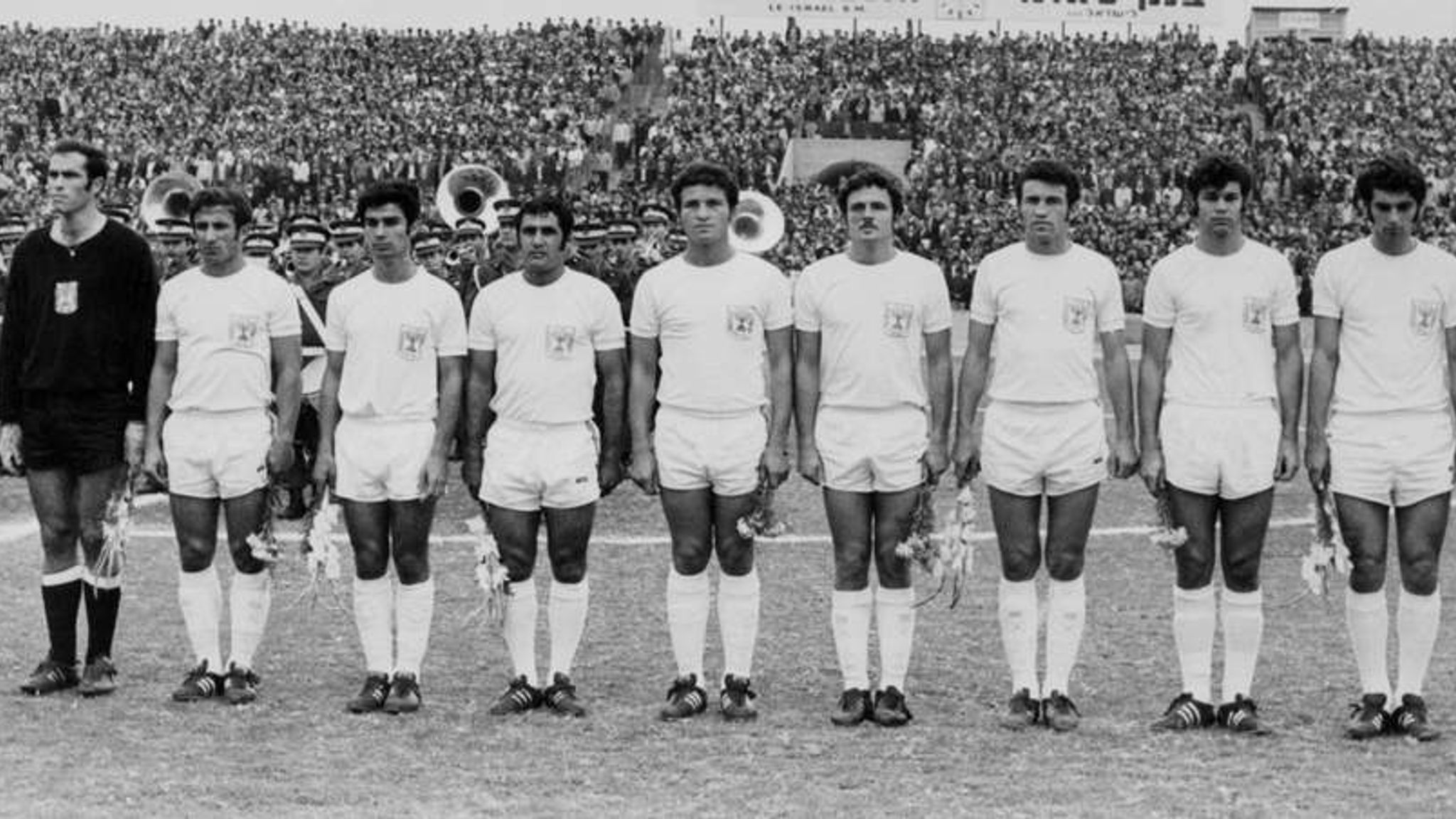
September 26, 1948: Israel debuts its national soccer team, 3 months after independence. They play the team that represented the U.S. at the recent Olympics in London, in front of 35,000 at the Polo Grounds in New York, the most Jewish city in the world outside of the new independent state.

Goalkeeper Avraham Bendori, right back Shalom Shalomzon, center half Yosef Mirmovich, and left half Eliyahu Fuchs came from Maccabi Tel Aviv FC. Left back Avraham Bogdanov, inside right Ernst Weinberger, and substitute defender Itzhak Schneor came from Beitar Tel Aviv FC. Right half Shmuel Den Dror and inside left Elieezer Spiegel came from Maccabi Petah Tikva FC. Outside right Israel Weiss, center forward Shimon Zimmerman, outside left Avraham Felman, and substitute winger Itzhak Rosenboim came from Hapoel Tel Aviv FC. Substitute midfielder Naftaly Schwalb came from Hapoel Ramat Gan FC.

Ed Souza opened the scoring for the U.S., in the 13th minute. Ben Dror equalized in the 20th. Ben McLaughlin took the lead back in the 44th, and Souza scored again in the 57th. The U.S. won, 3–1, due to the Boston-area and St. Louis players who, within 2 years, would shock England at the World Cup.

Because of anti-Semitism, and the refusal of many Asian countries to play them following the 1978 Camp David Accords, Israel must compete in European competitions for continental purposes. They have only qualified for the World Cup once, in 1970. But they did win the 1964 Asian Cup, and reached the Final of the 1974 Asian Games.

*

September 26, 1948 was a Sunday. Singer Olivia Newton-John was born. These baseball games were played that day:

* The Boston Braves beat the New York Giants, 3-2 at Braves Field in Boston, and clinch the National League Pennant. Bob Elliott, the previous season's NL Most Valuable Player, and not to be confused with the comedian of the same name who had already formed a famed comedy duo with Ray Goulding, hits a home run.

Despite the refrain of "Spahn and Sain and pray for rain," it is Vern Bickford who starts and wins the clincher. Bill Voiselle was also a pretty good starter, although not a Hall-of-Famer like Warren Spahn, or having a Cy Young Award-worthy season like Johnny Sain. (That award wouldn’t start until 1956, after Young himself died.)

This is the 14th Pennant won by the team then calling itself the Boston Braves, the 10th in the National League. It will turn out to be the last: They later won 2 in Milwaukee, and, in 2021, won their 7th in Atlanta.

* The Brooklyn Dodgers beat the Philadelphia Phillies, 5-1 at Shibe Park in Philadelphia. Ralph Branca outpitched Robin Roberts. Jackie Robinson went 1-for-4 with a stolen base. Roy Campanella hit a home run. Gil Hodges went 0-for-4, and Duke Snider did not play.

This was a transition year for the Dodgers, as the stars who led them to the 1941 and 1947 Pennants began to be traded away, like Dixie Walker, Eddie Stanky and Joe Hatten. Campanella and Carl Erskine had debuted in 1948, and they had traded for Preacher Roe and Billy Cox. The season before was the debut year of Robison and Snider, and the 1st full season for Hodges. The year before was the debut of Carl Furillo. The 1949 season would be the 1st for Don Newcombe. With holdover Pee Wee Reese as Captain, the team that became known as "The Boys of Summer" took shape, and, of the next 8 NL Pennants, won 5 and just missed 2 others.

* The New York Yankees beat the Boston Red Sox, 6-2 at Yankee Stadium. Tommy Byrne outpitched Mel Parnell. Ted Williams went 1-for-4. So did Joe DiMaggio, who also had an RBI. Tommy Henrich hit a home run.

* The Pittsburgh Pirates swept a doubleheader from the Cincinnati Reds, 8-6 and 8-5. Pirate slugger Ralph Kiner went 0-for-3 with a walk in the opener, but 2-for-5 with a home run and 4 RBIs in the nightcap.

* The Cleveland Indians beat the Detroit Tigers, 4-1 at Briggs Stadium (later Tiger Stadium) in Detroit. Bob Feller outpitched Hal Newhouser. The day's games left the Indians 1 game ahead of both the Yankees and the Red Sox, with each team having 5 games left. When the regular season was over, the Indians and Red Sox were tied, with the Yankees 1 game back. The Indians beat the Red Sox in a Playoff for the Pennant, thus preventing an All-Boston World Series. The Indians then beat the Braves in 6 games. Cleveland hasn't won a World Series since.

* The St. Louis Cardinals beat their arch-rivals, the Chicago Cubs, 5-2 at Wrigley Field in Chicago. Stan Musial went 1-for-4 with an RBI. He was wrapping up perhaps his finest season, stat-wise, with career highs in batting average, .376; on-base percentage, .450; slugging percentage, .702; OPS+, 200; total bases, 429; home runs, 39; and RBIs, 131. He fell 1 home run short of the Triple Crown, as Kiner and New York's Johnny Mize each hit 40; and won the MVP.

It was in this season that he began to be called "Stan the Man," after a reporter overheard a fan at Ebbets Field say, "Uh-oh, that man is back in town."

* The Chicago White Sox beat the St. Louis Browns, 3-0 at Sportsman's Park in St. Louis. Randy Gumpert pitched a 6-hit shutout.

* And the Philadelphia Athletics and the Washington Senators were not scheduled.

Only 2 games were played in the NFL. The Washington Redskins beat the Pittsburgh Steelers, 17-14 at Griffith Stadium in Washington. And the Chicago Bears beat the team that would become their arch-rivals, the Green Bay Packers, 45-7 at City Stadium in Green Bay, Wisconsin.

There were 3 games in the All-America Football Conference. The Baltimore Colts beat the football version of the Brooklyn Dodgers, 35-20 at Municipal Stadium in Baltimore. The Cleveland Browns beat the Chicago Rockets, 21-10 at Municipal Stadium in Cleveland. And the San Francisco 49ers beat the Buffalo Bills, 38-28 at Civic Stadium (later renamed War Memorial Stadium) in Buffalo.

All 3 games were won by teams that were admitted to the NFL in 1950. The Bills were not, but were reborn in the American Football League in 1960, and were admitted to the NFL in the merger.

Monday, August 15, 2022

August 15, 1926: The Dodgers Have Three Men On Base

Babe Herman

August 15, 1926: Legend has it that Babe Herman of the Brooklyn Dodgers tripled into a triple play.

The legend isn't quite true. Ring Lardner, the top baseball writer of the era, wrote, "Babe Herman did not triple into a triple play, but he doubled into a double play, which is the next best thing."

Also, the Dodgers weren't even officially called the Dodgers at this point. I'll get to that at the moment.

Floyd Caves Herman was born in 1903 in Buffalo, and grew up outside Los Angeles in Glendale, California. After starring in the Southern Association for the Atlanta Crackers, the Memphis Chicks and the Little Rock Travelers; in the Texas League for the San Antonio Missions, and the Pacific Coast League for the Seattle Rainiers, he was signed by the Brooklyn Dodgers.

In 1914, the Dodgers hired former star catcher Wilbert Robinson as their manager, and they changed their name to the Brooklyn Robins, in his honor. They won the National League Pennant in 1916 and 1920, and finished 2nd in 1924.

But by the time "Babe" Herman -- nicknamed for a boxer who was from Edmonton, where Herman played early in his career, not for Babe Ruth -- reached the major leagues in 1926, the Dodgers weren't so good anymore. They became known as "The Daffiness Boys." Around this time, a fan known as Abie the Truck Driver was heard to yell, over and over, "Come on, you bums!" and was thus credited with creating the nickname that would stick with the team, first in agreement, and later, as they became good, as a term of endearment: "Dem Bums." And this was despite having Charles Arthur "Dazzy" Vance, the fastest pitcher in baseball at the time, and a future member of the Baseball Hall of Fame.
Dazzy Vance

Like Grover Cleveland Alexander, Vance was a righthander from Nebraska with a great fastball. Unlike Alexander, he was not known to have had a drinking problem. Like Alexander, he debuted in the major leagues at age 24. Unlike Alexander, who was an immediate success, Vance had precious little control, and did not gain his 1st major league win until he was 31 years old.

That was in 1922. Starting that year, over the next 9 seasons, through 1930, he went 18-12, 18-15, 28-6, 22-9, 9-10, 16-15, 22-10, 14-13 and 17-15, mostly for weak Dodger/Robin teams. He led the NL in wins twice, earned run average 3 times, shutouts 4 times, strikeouts 7 times (all in a row, which remains an NL record), and, not that anybody knew what WHIP (Walks plus hits, divided by innings pitch) was at the time, that stat 3 times.

His 28 wins in 1924, when the Robins finished 2nd, remains the most for the Dodger franchise since the pitching distance became 60 feet, 6 inches in 1893. Don Newcombe won 27 in Brooklyn in 1956, and Sandy Koufax won 27 in Los Angeles in 1966. His 262 strikeouts in 1924 were the most in the NL between the 267 of Christy Mathewson in 1903 and the 269 of Koufax in 1961.

In a way, Vance was like Koufax, in that, once he found his control, he became the best pitcher in baseball. But, whereas Koufax was shaky in the 1st 1/3rd of his career, one of the best ever in the 2nd third, and didn't have the last 3rd, retiring just before he turned 31, Vance had half a career, starting at 31, and lasting until he was 44.

If the late 1920s and early 1930s Dodgers sound like a precursor to the 1960s expansion Mets, the last team that Casey Stengel managed, there are other parallels, including the fact that, in 1934, the Dodgers became the 1st team that Stengel managed. Come to think of it, in the off-season, Casey lived in Herman's hometown, Glendale. Certainly, the Daffiness Boys could, like the early Mets, have been called "lovable losers."

It would be unfair to compare Babe Herman to "Marvelous" Marv Throneberry. It true that Babe was known as a terrible fielder. While Marv's travails at 1st base were often seen on television, Babe's poor play in right field had to be seen at the ballpark. He always insisted that he was never hit on the head by a fly ball. A writer asked him if he'd ever been hit on the shoulder, and he said, "That doesn't count." With no TV to record his travails and tribulations, his poor fielding remains a legend.

But he was a heck of a hitter. He batted .324 for his career, including .381 in 1929 and .393 in 1930. Twice, he had at least 113 RBIs in a season; 5 times, he had at least 91. Phil Rizzuto, the eventual shortstop and broadcaster for the New York Yankees, grew up in Queens as a Dodger fan, and, even after getting into the Hall of Fame himself after a long wait, believed Herman should also have been elected.

But in his rookie year, no one would have suggested it. On August 15, 1926, the Robins hosted a Sunday doubleheader at Ebbets Field, against the Boston Braves. Vance started the 1st game, and before the 1st inning was over, there was already an unusual occurrence. Prior to striking out, Eddie Brown fouled off a Vance pitch, which hit umpire Eddie Quigley, and he had to leave the game with an injury. Since major league games then had only 3 umpires, this game was now down to 2.

(Quigley shook it off, and umpired behind the plate for the 2nd game. He umpired in the major leagues from 1913 to 1938, including 6 World Series. He was also a respected referee in college football and basketball, elected to the Basketball Hall of Fame. He served as athletic director for the University of Kansas, and the school's baseball complex is named for him.)

The game was scoreless until the top of the 6th, when the Braves scored. Then came the bottom of the 7th. Bear with me: This was complicated. Johnny Butler led off by singling to left. Hank DeBerry doubled to left, scoring Butler and tying the game.

With a runner on 2nd and nobody out, it was an easy choice for Robinson: He allowed Vance to bat for himself, and bunt DeBerry over. Except it turned out not to be a sacrifice: He beat it out. And starting pitcher Johnny Werts hit Chick Fewster with a pitch. The bases were loaded, and there was nobody out. Braves manager Dave Bancroft, a Hall of Fame shortstop, took Werts out, and replaced him with veteran hurler George Mogridge. He got Merwin Jacobson to pop up to him.

That brought Herman up. He hit a drive off the screen in right field. Under the ground rules at Ebbets Field, that meant that the ball was still in play. DeBerry scored easily, making it 2-1 Robins. Vance held up right after 2nd base, to see if the ball would be caught by right fielder Jimmy Welsh. It wasn't. Vance took off for 3rd base, and thought he could score. He probably would have.

But the Dodgers' 3rd base coach was Otto Miller, who had previously managed Herman in Atlanta. He saw Fewster coming in hard for 3rd base, and yelled, "Go back! Go back!" But, being a pitcher, Vance was not used to running the bases, and thought that Miller was telling him to go back to 3rd. So he did. Fewster apparently didn't hear Miller, and kept going, and ended up on 3rd. And so did Herman, who neither heard nor saw Miller. All three men were standing on third base.
Chick Fewster, earlier in his career,
with the Cleveland Indians

The Braves' 3rd baseman, Eddie Taylor, received the ball when it came in from the outfield, and, faced with an unprecedented situation in baseball, did the only thing he could think of: He tagged all 3 runners with the ball, even though each of them had a foot on the base, and thought of himself as safe.

The 2 remaining umpires, John "Beans" Reardon (so nicknamed because he was from Boston, a.k.a. "Beantown") and Charlie Moran, discussed the situation, and applied the correct ruling: Since Vance was the lead runner, he was the only one entitled to the base, so he was safe, and Fewster and Herman had been legitimately tagged out.

Thus, the 7th inning was over, and the Robins were leading, 2-1. Herman was credited with a double and an RBI -- the game-winning RBI, as it turned out. But it entered the public memory as "Babe Herman tripled into a triple play." (It couldn't have been, as there was already 1 out.)

The Robins scored 2 more runs in the top of the 8th, and won, 4-1. They also won the nightcap, 11-3. That success tends to get forgotten, due to the "daffiness." Over the 2 games, Herman went 4-for-8 with 4 RBIs.

But the play took on a life of its own. In those days, prior to regular radio broadcasting of baseball games in New York, the legend grew of a taxi driver who pulled up to the right field corner, at Bedford Avenue and Sullivan Place, and yelled up to a fan in the last row, "Hey, how are the Dodgers doing?"

"Great!" the fan yelled down. "They have three men on base!"

"Yeah?" the cabbie asked. "Which base?"

After the 1931 season, Robinson was fired, and, with the Robins name having never really caught on, the Dodger name, still used by most Brooklynites, was officially restored.

Herman was traded to the Cincinnati Reds, and he bounced around. He had rotten luck: The Chicago Cubs won the Pennant in 1932 and 1935, but he was only with them in 1933 and 1934. The Reds brought him back, but got rid of him in 1936, winning the Pennant 3 years later. The Detroit Tigers won Pennants in 1934 and 1935, and would win another in 1940, but Herman was only with them in 1937.

The Tigers released him in the middle of that season, shortly before his 34th birthday, even though he had batted .300 in 17 games for them. He spent the 1938 season with the Jersey City Giants of the International League, and then went back home to the Pacific Coast League, playing 6 seasons for the Hollywood Stars, batting at least .307 every year.

In 1945, desperate for players due to the manpower drain of World War II, the Dodgers brought him back, at age 42. Appearing in 37 games, mainly as a pinch-hitter, he batted .265, and that was it for him. Having previously played for the Dodgers before uniform numbers were worn, in that season, he wore the Number 4 that would later be retired for Duke Snider, and the Number 32 that would later be retired for Sandy Koufax.

Lawrence Ritter interviewed him for his book The Glory of Their Times, published in 1966. Of the play, Herman said, "If there was any justice, Vance would have been the one declared out because he's the one caused the traffic jam in the first place. But down through history, for some strange reason, it's all been blamed on me."

Who knows, maybe that one play is why Babe Herman is not in the Baseball Hall of Fame. He died in 1987. He outlived Robinson, who died in 1934, while Herman was still playing; Fewster, who died in 1945, during Herman's comeback; Moran, one of the remaining umpires, who died in 1949; Quigley, the umpire who was hurt and couldn't participate in the call, who died in 1960; Vance, who died in 1961; Miller, who died in 1962; and Reardon, the umpire who made the correct ruling, who died in 1984. Taylor, the 3rd baseman who tried to tag everybody out, lived until 1992.

My grandmother, growing up in Queens, was a Dodger fan, but while she told me this story when I was a boy, she wasn't quite old enough to remember it herself. Her favorite poet was Ogden Nash, even though he was a fan of the Dodgers' arch-rivals, the New York Giants. In 1949, Nash, wrote "Line-Up for Yesterday" for Sport magazine, an alphabetical list of star players. For the letter V, he wrote:

V is for Vance
The Dodgers' very own Dazzy;
None of his rivals
Could throw as fast as he.

*

August 15, 1926 was a Sunday. These other games were played in the major leagues that day:

* A doubleheader was split at Yankee Stadium. The New York Yankees won the opener, 4-2. The Boston Red Sox won the nightcap, 5-3. Over the 2 games, Babe Ruth went 4-for-5 with a home run, 3 walks and 2 RBIs; and Lou Gehrig went 2-for-8.

* The Washington Senators beat the Philadelphia Athletics, 5-3 at Griffith Stadium in Washington.

* A doubleheader was split at League Park in Cleveland. The St. Louis Browns won the 1st game, 11-7. The Cleveland Indians won the 2nd game, 6-4. George Sisler went 3-for-7 with 2 walks and an RBI, and Tris Speaker went 2-for-7 with a walk.

* The Cincinnati Reds beat the Philadelphia Phillies, 4-2 at Redland Field (later renamed Crosley Field) in Cincinnati.

* The Detroit Tigers and the Chicago White Sox were 0-0 after 5 innings at Comiskey Park in Chicago, when the game was called due to rain.

* The St. Louis Cardinals beat the Chicago Cubs, 7-2 at Sportsman's Park in St. Louis. Rogers Hornsby went 2-for-4.

* And the New York Giants and the Pittsburgh Pirates were not scheduled.

Wednesday, August 10, 2022

August 10, 1944: A 58-Pitch Complete Game Shutout

August 10, 1944: The Boston Braves beat the Cincinnati Reds, 2-0 at Crosley Field in Cincinnati. Red Barrett goes the distance and pitches a 2-hit shutout. He throws only 58 pitches, the fewest any pitcher has ever thrown in a complete game.

Brian Cashman will not be born until 1967, leaving him unable to appreciate his dream game at the time.

Charles Henry Barrett was born in 1915 in Santa Barbara, California. Known as Red for his hair, he started his career with the Reds in 1937, but was a marginal pitcher for them. Although he appeared for them in their Pennant-winning seasons of 1939 and 1940, he did not make the World Series roster in either season. He was traded to the Braves in 1943, and became one of several marginal players who became regulars due to the manpower drain of World War II.

In this game against the Reds, he outpitched Bucky Walters, the Reds' ace. Barrett gave up a single to Gee Walker with 1 out in the 1st inning, and a single to Eddie Miller leading off the 6th. But he stranded him both, and those were the only baserunners he allowed. He was supported by an RBI single from Dee Phillips in the 2nd, and an error that allowed a run in the 5th. The game lasted just 75 minutes.

He finished 9-16 that season. In 1945, he went 23-12, despite being traded in midseason, going 2-3 for the struggling Braves 21-9 for the mighty St. Louis Cardinals. He led the National League in wins, innings pitched, and complete games. He was selected for the All-Star Game, although that was canceled due to wartime travel restrictions. (That didn't stop the Midsummer Classic from being played in 1942, '43 or '44, though.) He finished 3rd in the NL's Most Valuable Player voting, and might have won the NL's Cy Young Award had there been one. On April 1, 1946, a photograph of him at the Cards' Spring Training camp in St. Petersburg, Florida appeared on the cover of Life magazine.
But with The War over, and the veterans returning to baseball, he was mainly a reliever. He did appear for the Cardinals in the World Series, which they won. He was traded back to the Braves the next year, appeared in another World Series in 1948, and last pitched in the majors the year after that. His career record was exactly .500: 69-69. He died in 1990.

*

August 10, 1944 was a Thursday. These other baseball games were played:

* The New York Yankees lost to the St. Louis Browns, 3-0 at Yankee Stadium. Denny Galehouse pitched a 6-hit shutout.

* The New York Giants lost to the Pittsburgh Pirates, 10-4 at Forbes Field in Pittsburgh. Mel Ott, by this point the Giants' manager, and still playing, did not put himself in the game.

* The Brooklyn Dodgers beat the Chicago Cubs, 6-4 at Wrigley Field in Chicago. Tommy Warren singled home the winning run in the top of the 10th inning.

* The Boston Red Sox beat the Chicago White Sox, 2-1 at Fenway Park in Boston.

* The Cleveland Indians beat the Philadelphia Athletics, 5-4 at Shibe Park in Philadelphia.

* The Detroit Tigers beat the Washington Senators, 3-2 at Griffith Stadium in Washington. Rudy York drove in the winning run with a sacrifice fly in the top of the 10th inning.

* And the St. Louis Cardinals beat the Philadelphia Phillies, 2-0 at Sportsman's Park in St. Louis. Mort Cooper pitched a 4-hit shutout. Stan Musial went 0-for-3 with a walk.

December 31, 1999 & January 1, 2000: The Millennium

December 31, 1999:  The Millennium arrives. The people of planet Earth survived. At a terrible cost. But we hadn't destroyed ourselves. ...