Showing posts with label benjamin harrison. Show all posts

Wednesday, December 28, 2022

December 29, 1890: The Wounded Knee Massacre

December 29, 1890: The Wounded Knee Massacre takes place near the creek and now town of the same name, in southwestern South Dakota. It is the last major action between the U.S. Army and Native Americans, and possibly the worst.

In 1876, the the Lakota Sioux fought the 7th Cavalry, under the command of Lieutenant Colonel George Armstrong Custer (who'd held the temporary, or brevet, rank of Brigadier General in the American Civil War), at the Battle of the Little Bighorn in Montana, and the Cavalry lost more than 1/3rd of its men, including Custer.

One of the chiefs leading the Lakota troops was Sitting Bull. For 5 more years, he managed to avoid capture by U.S. troops, until finally surrendering. He joined William F. "Buffalo Bill" Cody's Wild West Show, but returned to the Standing Rock Reservation in South Dakota, which had gained Statehood along with North Dakota on November 2, 1889.

In response to the many degradations the Natives faced, the "Ghost Dance" movement began, a nationalist movement similar to the later Black Panther Party and the Reconquista movement of Mexican-Americans.

Faced with a nonwhite people expressing pride in themselves and their traditions, white America's government did what it had done so many times, and would continue to do: It overreacted. In the tradition of "Cut off the head, and the body will die," the rebuilt 7th Cavalry went to arrest Sitting Bull. They arrived on December 15, 1890, and he refused to accept arrest, and was shot and killed. Although Native record-keeping made establishing his exact birthdate impossible, he was believed to be 59 years old.

The Cavalry, under the command of Colonel James W. Forsyth, moved on to Wounded Knee, 275 miles to the southwest. Arriving on December 28, they surrounded the Lakota camp. On the morning of the 29th, they went in to take the Lakota men's guns away. A Ghost Dance ritual was being conducted at the time. A man named Black Coyote refused to give up his rifle, citing the large amount of money he'd paid for it. What happened next is in dispute: Either Black Coyote fired, and a soldier grabbed his rifle, they struggled over it, and it went off.

What is not in dispute is what happened after that first gunshot: The Cavalry opened fire, and those few Lakota who still had their weapons returned what fire they could. More than 250 men, women and children were killed. That was nearly as many men as the 7th Cavalry lost at the Little Bighorn, but those were all trained soldiers. To put that in a modern perspective, it's nearly half again as many people as died in the Oklahoma City Bombing of 1995, and 1/8th as many as were killed on 9/11 -- and since the U.S. had about 1/4th as many people in 1890 as it had in 2001, it's proportionately about half as bad as 9/11.

The Cavalry lost 31 men. Twenty men were awarded the Congressional Medal of Honor. There was no honor in what they did.

At the time, the President of the United States was Benjamin Harrison. His grandfather, William Henry Harrison, had been President for one month in 1841, before dying of pneumonia. In 1811, William Henry Harrison defeated Native tribes at the Battle of Tippecanoe in Indiana. In 1813, his troops killed the Native chief Tecumseh at the Battle of the Thames near what's now Stratford, Ontario, Canada. Now, perhaps unwittingly, he had finished his grandfather's work. Of course, white men's attacks on the Native peoples of North America went all the way back to the Spanish settlement of St. Augustine, Florida in 1565, so it's not like "Old Tip" Harrison started it.

Wounded Knee is far from any major city. It's 104 miles southeast of Mount Rushmore, 350 miles northeast of Denver and over 400 miles northwest of Omaha. In fact, the Little Bighorn Battlefield is about 350 miles to the northwest, so it's closer to that than to Denver, the closest major league city.

*

December 29, 1890 was a Monday. Baseball and football seasons were over. Basketball wouldn't be invented for another year. There was a hockey league at the time, the Canadian Amateur Hockey Association, but no games were scheduled for this day. So, there were no scores on this historic day.

Monday, December 26, 2022

December 27, 1892: The Birth of Black College Football

A modern game between Livingstone (left) and Smith

December 27, 1892: A college football game is played in Salisbury, North Carolina. Livingston College hosts Biddle University, of Charlotte, North Carolina, 41 miles to the southwest.

Based on information currently available, this is believed to have been the 1st football game between two schools that would now be called "historically black colleges and universities," or HBCUs. It is known as "The Birth of Black College Football."

The game was set up between two friends, Charles Shute of Biddle and William J. Trent of Livingstone. The former school had been playing on what would now be called an intramural level for 2 years. When Shute learned that Livingston was starting a football team, he contacted Trent, and the game was set up.

A rare snowstorm had hit the Carolinas over the Christmas holiday, and the site chosen for the field, a converted cow pasture in what is now Livingstone's front campus, had to be cleared of 5 inches of snow.

Apparently, the experience mattered: Biddle won, 4-0. Under the scoring system in use at the time, that's one touchdown to none. Under today's scoring, presuming they made their extra point, it would be 7-0. The name of the scoring player was not recorded. Nor was an estimate of the attendance.

Biddle University was named for the Biddle family of Philadelphia, an "old-money" family involved in banking, which had donated money to start the school in 1867. In 1921 to 1922, Jane Berry Smith donated funds to the school, to build a theological dormitory, a science hall, a teachers' cottage, a memorial gate, and an endowment in memory of her late husband, Johnson C. Smith, a Pittsburgh businessman and a member of the Presbyterian Church, with which Biddle was affiliated. In 1923, in recognition of this, the school's board of trustees renamed the school Johnson C. Smith University.

Trent went on to become not just the president of Livingstone, but its longest-serving president, and the last surviving player from the game, on either side.

Livingstone College was founded in 1879, affiliated with the African Methodist Episcopal Church. It was founded in 1879 as Zion Wesley Institute, named for Zion, another name for Israel; and John Wesley, the founder of Methodism. In 1887, it was renamed for Dr. David Livingstone, the famous Victorian-era Scottish physician and missionary in Africa.

Both the Smith Golden Bulls and the Livingstone Blue Bears now compete in NCAA Division II. Their rivalry continues as fellow members of the Central Intercollegiate Athletic Association (CIAA), and their annual game is named the Commemorative Classic.

*

December 27, 1892 was a Tuesday -- then as now, an unusual day for a football game, at any level. There appear to have been no other scores on this historic day: For most college football teams, the season ended on Thanksgiving or earlier; baseball was out of season; hockey was all-amateur; and basketball had only been invented 1 year earlier.

Tuesday, December 20, 2022

December 21, 1891: The Invention of Basketball

December 21, 1891: Basketball is invented by Dr. James Naismith in Springfield, Massachusetts. Unlike baseball, football and hockey, we have definitive answers as to the invention of basketball: We know who, when, where, how... and even why.

For those of you born in the 21st Century: No, basketball was not invented by LeBron James. For those of you born in the 1990s: No, it was not invented by Kobe Bryant. For those of you born in the 1980s: No, it was not invented by Michael Jordan. Maybe Wilt Chamberlain re-invented it, but he did not invent it.

James Naismith (no middle name) was born on November 6, 1861 in Almonte (now part of Mississippi Mills), Ontario, outside the Canadian capital of Ottawa. He graduated from Montreal's McGill University, where he lettered in lacrosse, gymnastics, soccer, rugby, and the Canadian version of gridiron football. He was hired as McGill's athletic director in 1890, but, just a year later, he was hired by the Young Men's Christian Association International Training School in Springfield, Massachusetts, the facility that is now Springfield College.

The YMCA's directors asked him to invent a game that could be played indoors in the Winter, when baseball and football couldn't be played. It would not be volleyball, but that would be close. Literally: William G. Morgan invented that sport in 1895, just 4 years later, and only 10 miles away in Holyoke, Massachusetts. And he would use the Springfield school for its 1st demonstration.

Naismith knew he should start with a ball, but with a large, soft one, like a soccer ball; not a small, hard one like a baseball, which would be dangerous in the confined space of a gymnasium. Morgan would follow this suggestion, and so, to this day, a standard volleyball now resembles an old-time soccer ball more than does a current soccer ball, or a current basketball, for that matter.

Naismith noted that most of the rough action of a sport took place around its goal: The goal in soccer, hockey or lacrosse; the end zone in football or rugby; or home plate in baseball. So he thought he could reduce the danger by raising the height of the goal.

He asked the school's custodian, a Mr. Stubbins, to get him two boxes, which he could use as goals. He was ready to name his sport "boxball." The custodian could only find peach baskets. So Dr. Naismith had invented basketball instead. The date was December 21, 1891.

In his handwritten report, Naismith told of the first game. Teams were nine-a-side, as opposed to the eventual standard of five-a-side. A soccer ball was used, as there was, as yet, no such thing as a basketball. The peach baskets, which would eventually be replaced by netting, were secured to the inside of the railing of the gymnasium's gallery, about 10 feet from the floor, setting a standard which has never changed.

Naismith had written 13 rules, and put them on a bulletin board on the gym wall. He said that the class did not show much enthusiasm. He said that most of the fouls were called for running with the ball, and some for tackling the ballcarrier like in football. There was, as yet, no dribbling: The ball could only be moved up the court by passing. And after every goal (later to be called a basket), another jump ball was taken (a rule eliminated in 1938). 

Through the influence of the YMCA's worldwide organization, the word was spread. Naismith earned his medical degree, and in 1898 became the head coach at the University of Kansas, which became one of the great college basketball programs. He remained head coach until 1907, and continued to teach at their Lawrence campus until his death on November 28, 1939, at the age of 78.

Within the last 4 years of his life, he had seen the debut of sold-out doubleheaders involving national powers at Madison Square Garden, the debut of basketball as an official medal sport at the Olympic Games, and the foundation of the NIT and the NCAA Tournament.

One of Naismith's players at Kansas was Forrest "Phog" Allen, who later became their head coach, and for whom their Allen Fieldhouse is named. Allen's players included Adolph Rupp, who turned the University of Kentucky into a national power; and Dean Smith, who did the same at North Carolina. One of Smith's players, Roy Williams, became head coach at Kansas, and excelled there before going back to North Carolina and winning National Championships there.

It all goes back to 1891, and James Naismith in Springfield, Massachusetts. In 1968, on the campus of Springfield College, which had been the YMCA school, the first Basketball Hall of Fame building opened. It was, and remains officially, named the Naismith Memorial Basketball Hall of Fame. The growth of the sport required a new building in Springfield in 1985, and yet another in 2002.

There had been a Hall of Fame organization since 1959, prior to the construction of the first building. Naismith was one of the Hall's 15 charter inductees.

*

December 21, 1891 was a Monday. Baseball and football were out of season, which is why basketball was invented, anyway. Hockey was still all-amateur. So the only score of significance on this historic day is the score of that very first game of basketball.

And only one goal was scored: One of the intramural teams beat the other, 1-0. In 1896, the rule was changed so that a single basketball goal was credited with the now-familiar 2 points.

Sunday, November 27, 2022

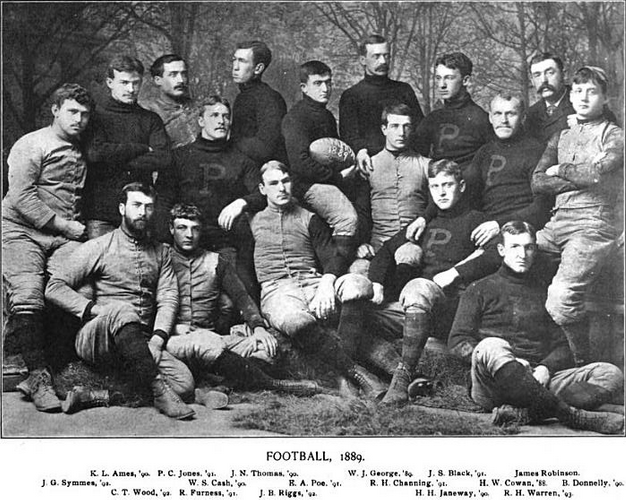
November 28, 1889: College Football's Game of the Century -- the 19th Century

The 1889 Princeton Tigers

November 28, 1889: Perhaps, for the 1st time, a college football game was hyped up to be considered "The Game of the Century." Except, this was the 19th Century.

The 1889 season was a bit of a step forward for a sport that still resembled the English game of rugby more than the game the world outside the United States calls "American football." A field goal was worth 5 points, making it worth more than a touchdown, which was 4 points, and a kicked point after touchdown (PAT) was 2 points. Scoring a safety, then as now, was 2 points. Not until 1909 would a field goal become the 3 points it has remained ever since, and a PAT 1 point. It would be 1912 before a touchdown became 6 points.

The field itself was different. There was no end zone until 1912, which was also when the field was shortened from 110 to 100 yards. That was also the year a team was given 4 downs to make a 1st down, instead of 3. And 1889 was also the year that a "touchdown" no longer had to be literally true: Until then, a player had to cross the goal line and touch the ball to the ground. From this year onward, just crossing the goal line would be enough.

The game was still mostly played in the Northeast, and was dominated by the schools that would later be collectively called, and would ultimately found, "The Ivy League": Harvard, Yale, Princeton, the University of Pennsylvania (or "Penn"), Columbia, Dartmouth, Brown and Cornell.

But  there were some schools playing in the Midwest. And the South was beginning to catch on, and the 1st college football game in the State of South Carolina was played on December 14: Wofford defeated Furman, 5-1 on Furman's campus in Greenville. Wofford is in Spartanburg. Both schools now play in the NCAA's Football Championship Subdivision, formerly known as Division I-AA.

On October 26, the University of Delaware played its 1st game, losing 74-0 away to the Delaware Field Club in Wilmington. On November 16, the University of Iowa played its 1st game, losing 24-0 away to Iowa College in Grinnell. On November 23, Syracuse University (which had been founded in 1870, thus making it younger than the sport) played its 1st game, losing 36-0 away to the University of Rochester. And, in the Pacific Northwest, the University of Washington played its 1st game on November 28, Thanksgiving Day. I'll get to that shortly.

One major change for the 1889 season was the legalization of low tackling. This led to a sharp decrease in open-field running, and an increase in heavy, concentrated line formations like the "Princeton V," where teams engaged in brutal momentum plays to drive the ball forward. Also known as the "flying wedge," Princeton (officially, still "The College of New Jersey" until 1896, but everybody called them "Princeton") had used it against Rutgers in the 1st 2 college football games ever played, in 1869, with each team winning a game.
Harvard players demonstrating the flying wedge, 1892

The flying wedge would prove to be dangerous, resulting in several injuries, and even some deaths. It would be eliminated as part of safety measures created by the newly-established National Collegiate Athletic Association (NCAA) in 1906. But, for now, Princeton, already known as the Tigers due to their black and orange striped socks, were able to use it with brutal effectiveness.

How brutal? Their 1st 8 games went as follows: A 16-0 win over Lehigh, at University Field on the Princeton campus in Princeton, Mercer County, New Jersey; a 16-4 win in a rematch against Lehigh in Bethlehem, Pennsylvania; a 49-0 home win over Stevens Institute of Technology; a 72-4 win over Penn at the University Athletic Grounds in Philadelphia; a 98-0 win over Wesleyan University at the Berkeley Oval in The Bronx; a 71-0 win over Columbia at the Berkeley Oval just 3 days later, meaning they played 2 games in 4 days at the same location, and won by a combined total of 169-0; a 41-15 win over Harvard at Jarvis Field in Cambridge, Massachusetts; and a 54-6 home win over the Orange Athletic Club of Orange, New Jersey, outside Newark. So Princeton played 8 games, won all 8, and outscored its opponents 417-29, or an average of 52-4.

Big deal, you say? Weak schedule, full of "weak sisters," "paper tigers," "cupcakes," "gimmes"? Going into their game with Princeton on November 15, Harvard were 9-0, and had outscored their opponents 404-6, and Princeton beat them, 41-15. After their season-opening "doubleheader" with Princeton, Lehigh played 11 games, and went 8-1-2, so, clearly, they weren't a bad team. And, while the Orange A.C. mainly played other amateur sides that were not affiliated with colleges, they went 6-3 that season.

And then there was Yale University of New Haven, Connecticut. If there was any doubt, going into November 15, that the best team in the country was not either Princeton or Harvard, it was Yale.  Walter Camp's Bulldogs were dogged, indeed: They beat Wesleyan at home, 38-0, then away, 63-5; Williams college at home, 36-0; Cornell at home, 56-6; Amherst College at home, 42-0; Trinity College away in Hartford, 64-0; Columbia away, 62-0; Penn away, 20-10; Stevens at Berkeley Oval, 30-0; the Crescent Athletic Club, one of the Orange A.C.'s other opponents, 18-0 at Washington Park in Brooklyn, then home of the baseball team that would become the Dodgers; Cornell away, 70-0; Amherst on their campus in Amherst, Massachusetts, 32-0; Williams on their campus in Williamstown, Massachusetts, 70-0 the very next day; and Wesleyan at Hampden Park in Springfield, Massachusetts, 52-0.

And then, on November 23, in what was already the biggest rivalry in college football, on Saturday afternoon, November 23, also at Hampden Park, named for the famed "football ground" in Glasgow, Scotland, in front of 15,000 paying customers, an enormous total for the time, Yale beat Harvard, 6-0.

That's 15-0, outscoring their opponents, 699-21, or an average of 47-1. And that's after outscoring their opponents 698-0 in 13 games the year before. I don't care what era you're playing in, or what your schedule is: That is mind-boggling.

So a showdown between Yale and Princeton was set up, at the Berkeley Oval, for November 28, Thanksgiving Day, which, thanks to high school football in the Northeastern U.S., was already a traditional day for big rivalry football games. A crowd of 25,000, probably a record for a college football game anywhere in the country at that point, saw the teams kick off at 2:30 PM.

Yale attempted a field goal, but it hit an upright, and bounced back onto the field. Under the rules of the time, a player from the defending team could retrieve the ball and try to advance it. A Princeton player picked up the loose ball, and punted it back upfield, getting the Tigers out of danger.

Later, Princeton missed a field goal attempt, and the ball skidding past the goal line. Still considered live, a Yale player picked it up, but before he could decide whether to run with it or kick it, he fumbled it, and it rolled into the stands. This allowed a Princeton player to go into the stands and claim a touchdown. Another Yale fumble, deep in their own territory, led to a 2nd Princeton touchdown.

Princeton erased all doubt as to who was the better team, defeating Yale, 10-0. To put that in perspective: The last time Yale was held scoreless was in the 1886 season finale, a 0-0 tie with Princeton. The last time they lost was on November 21, 1885 -- to Princeton. They were undefeated in their last 48 games: 47-0-1. They did not lose again until the next season's Harvard game.

Let me put this another way. Yale began playing football in 1872. Through the 1895 season, their combined record against Princeton and Harvard was 23-7-8. Against all other teams, their record was 163-1-3. That is not a typographical error: One hundred sixty-three wins, one loss, three ties. Yale were not the New York Yankees of college football, or the Boston Celtics, or the Montreal Canadiens: They were all three combined.

Yale were considered National Champions for 1872, 1874, 1876, 1877, 1879, 1880, 1881, 1882, 1883, 1884, 1886, 1887, 1888, 1891, 1892, 1893, 1894, 1895, 1897, 1900, 1901, 1902, 1905, 1906, 1907, 1909 and 1927 -- 27 times.

Princeton closed its season on December 7, defeating an all-star team from Washington, D.C., 57-0 at Capitol Park, the District's baseball park. They finished 10-0, outscoring their opponents 482-29, for an average of 48-3. They were the undisputed National Champions.

Princeton were considered National Champions for 1869, 1870, 1873, 1875, 1878, 1885, 1889, 1893, 1896, 1898, 1899, 1903, 1911, 1920, 1922, 1933, 1935 and 1950 -- 18 times. Harvard were considered National Champions for 1890, 1910, 1912, 1913 and 1919 -- "only" 5 times.

After the 1889 season, Caspar Whitney, a magazine editor who later served as President of the U.S. Olympic Committee, created one of American sports' earliest all-star teams, naming it the All-America Team. It became a postseason tradition. These were the initial selections:

* Ends: Amos Alonzo Stagg of Yale, Arthur Cumnock of Harvard. Between them, Stagg and Yale mentor Walter Camp did more to shape the sport of football in America than any other people.

* Tackles: Hector Cowan of Princeton, Charles Gill of Yale.

* Guards: Walter "Pudge" Heffelfinger of Yale, John Cranston of Harvard. In 1892, a Pittsburgh athletic club made Heffelfinger the 1st man to be openly paid to play American football.
Pudge Heffelfinger

* Center: William George of Princeton.

* Quarterback: Edgar Allan Poe of Princeton, also their team Captain, making him, effectively, also their head coach. He went on to be elected to the office of Attorney General of the State of Maryland, as had his father, John Prentiss Poe. The writer Edgar Allan Poe had married his first cousin, Virginia Clemm, which made him both the great uncle and the second cousin twice removed of the Princeton Edgar Allan Poe.
Edgar Allan Poe. That's a football he's holding,
not a tell-tale heart or a cask of Amontillado.

* Halfbacks: Roscoe Channing of Princeton and James P. Lee of Harvard.

* Fullback: Knowlton Ames of Princeton. It sure sounds like the name of an Ivy League football player, and like the name of a successful financier, and he was both. He also served as head football coach at Purdue University, and as the 1st head coach at Northwestern University.
Knowlton Ames

So the 1st All-American team consisted of 5 players from Princeton, 3 from Yale, and 3 from Harvard.

The Berkeley Oval was at West 179th Street and University Avenue. New York University built it there as part of its University Heights Campus. NYU built Ohio Field in 1901, and the Oval began to decline in use, and apartment buildings went up on the site in 1923.

But NYU would end up scheduling bigger games at the Polo Grounds and Yankee Stadium. In 1973, having long since scaled back their athletic program (they now play in NCAA Division III), NYU left the campus, and the City University of New York (CUNY) system -- ironically, the successor to NYU's former rivals, City College (CCNY), took over the campus, as Bronx Community College.

Although football is no longer played there, BCC maintains Ohio Field as an athletic facility. But the Berkeley Oval, 2 blocks to the south, was arguably the more important sports site, and yet there's no historical marker, or any other indication of that importance.

*

November 28, 1889 was a Thursday -- being, as I said, Thanksgiving Day. There were 6 other college football games played that day:

* Dartmouth beat the Stevens Institute of Technology, 18-5 at the St. George Cricket Grounds in Hoboken, Hudson County, New Jersey, which is where Stevens was, and still is, now playing as an NCAA Division III school. Stevens was founded by engineer Edwin Augustus Stevens, who owned the land on which the St. George Grounds were built.

Previously, the only St. George Cricket Grounds I knew of was on Staten Island, adjacent to the St. George Ferry Terminal, roughly where the Staten Island University Hospital Community Park is now, home of minor-league baseball's Staten Island FerryHawks, and formerly the Staten Island Yankees.

In 1889, the New York Giants baseball team used that St. George Cricket Grounds as a temporary home, because the City of New York decided to extend 111th Street through the original version of the Polo Grounds, between 5th and 6th Avenues, and so a new ballpark with that name was built at 155th Street and 8th Avenue in Upper Manhattan, but the Giants needed a temporary home. Despite this, they won the National League Pennant. 

* Cornell beat Lafayette, 24-0 at Syracuse, New York, making it more or less a home game for Ithaca-based Cornell.

* Wesleyan University beat the University of Pennsylvania, 10-2 at the Berkeley Oval in The Bronx, roughly halfway between the schools. Wesleyan, now a Division III school, is in Middletown, Connecticut; and Penn is in Philadelphia.

* Franklin & Marshall University beat Dickinson College, 22-0 at McGrann's Park in Lancaster, Pennsylvania. Both schools now play in NCAA Division III.

* Lehigh University beat the Naval Academy, 26-6 at the Academy's parade ground in Annapolis, Maryland.

* And, in the very first game in what would become a proud history, the University of Washington got off to a bad start, losing to a team of alumni of Eastern colleges who happened to be living in Seattle, 20-0, at the Jackson Street Baseball Park.

Friday, November 11, 2022

November 12, 1892: The 1st Pro Football Player

November 12, 1892: For the 1st time -- as far as is known today -- a is paid to play the sport of American football.

William Walter Heffelfinger was born on December 20, 1867 in Minneapolis. "Pudge" played baseball and football at Central High School in Minneapolis before making his way to Yale University in New Haven, Connecticut. Playing on both the offensive and defensive lines, Heffelfinger was named to Yale head coach Walter Camp's All-American Team 3 times.

Yale was a major football power during that time, and Heffelfinger helped lead the team to undefeated seasons in 1888 and 1891, accompanying one-loss seasons in 1889 and 1890. The 1888 team amazingly outscored their opponents 698-0 that season. Their biggest win was a 105-0 demolition of Wesleyan University of Middletown, Connecticut; their narrowest, a 28-0 win over the Crescent Athletic Club at Washington Park in Brooklyn, then the home of the baseball team that would become known as the Brooklyn Dodgers. Oddly, that season, Yale did not play the school already considered their arch-rivals, Harvard University.

At 6-foot-3 and 200 pounds. Heffelfinger was considered especially big for his time, and towered over his opponents. His size allowed him to wreak havoc on opposing lines, where it was said he would typically take out two to three players at a time. He also is credited with introducing the "pulling guard" play. In the 1920s, the great sportswriter Grantland Rice referred to Heffelfinger as the greatest guard of all time. "Pudge" also lettered in baseball, rowing, and track.

For many years, it was believed that the 1st game in which someone was paid to play American-style football occurred on September 3, 1895, in Latrobe, Pennsylvania, about 40 miles east of Pittsburgh. The Latrobe Athletic Association defeated the Jeannette Athletic Club, 12-0 (a touchdown was then worth 4 points, so this was three touchdowns to none), despite Jeannette having paid Joh Brallier $10 (about $355 in 2022 money) to play as their quarterback.

Latrobe were, however, so impressed with Brallier that they hired him as a player-coach, and he remained with them through 1907, his coaching record an amazing 36-3-4. He died in 1960, and was the earliest man to have admitted to being paid to play football.

But in the 1960s, Pittsburgh Steelers owner Art Rooney was presented with documents that proved an earlier man was paid to play the game. Pudge Heffelfinger was paid $500 (about $16,400 in 2022 money) to play one game for the Pittsburgh-based Allegheny Athletic Association on November 12, 1892, at Exposition Park, then the home of baseball's Pittsburgh Pirates. He helped Allegheny defeat its archrival, the Pittsburgh Athletic Club, 4-0, the one touchdown scored when Heffelfinger picked up a fumble and ran it in.

Heffelfinger soon began a career in coaching, where he made stops at the University of California, Lehigh University, and the University of Minnesota. He also frequently returned to Yale to help the football team prepare for contests against rivals Harvard and Princeton.

In the 1930s, he founded Heffelfinger Publications, which produced sales booklets for football and baseball equipment. He also spent time working for his father's shoe business, and later in real estate. He also went on to find success in politics. He was a Minnesota delegate to the Republican National Conventions in 1904 and 1908. He served as Hennepin County Commissioner (the County that includes Minneapolis) from 1924 to 1948, and ran unsuccessfully for Congress in 1930. (That was a bad year for Republicans, as it was the 1st Congressional election of the Great Depression.)

Despite his nickname, suggesting that he was overweight, "Pudge" maintained his playing shape throughout his life. Even in his 40s, it was common for him to return to Yale, where the coach would give him a jersey and let him play with the second team during practice. In the early 1920s, he played in a pro game against the Columbus Panhandles which featured the famous Nesser brothers. He continued as a regular in pro charity games up until his mid-60s. He played his last organized football game in a charity event in Minneapolis in 1933, at the age of 65.
He was inducted into the College Football Hall of Fame in 1951, and died on April 2, 1954 at the age of 86. He had never publicly discussed his role as a professional football pioneer, unlike Brallier. (As far as I can determine, the two men never met.) He was buried at the small Hawley Cemetery outside Blessing, Texas, where he was living at the time, near Houston.

*

November 12, 1892 was a Saturday. The only sport in action that day was college football, with these 9 games being played:

* Harvard beat the Boston Athletic Club, 16-12 in Boston.

* Cornell beat the Massachusetts Institute of Technology, 44-12 on MIT's campus in Cambridge, Massachusetts, outside Boston.

* Lafayette and Mount Hermon played to a tie, 12-12 on Mount Hermon's campus in Gill, Massachusetts.

* Amherst beat Trinity, 21-8 on Trinity's campus in Hartford, Connecticut.

* Bowdoin beat Brown, 8-0 on Brown's campus in Providence, Rhode Island.

* Yale beat the University of Pennsylvania, 28-0 at Manhattan Field, next-door to the Polo Grounds in Upper Manhattan.

* Lafayette beat the Orange Athletic Club, 30-0 in Orange, New Jersey, outside Newark.

* Michigan beat the University of Chicago, 18-10 at Olympic Park in Toledo, Ohio.

* And Northwestern Beat Lake Forest, 18-0 in Lake Forest, Illinois, outside Chicago.

Thursday, November 10, 2022

November 11, 1889: Washington Is Admitted As the 42nd State

November 11, 1889: Washington is admitted to the Union as the 42nd State. It is the only State named after a President, George Washington. It is also the only State with a green State Flag, and the only State with a State Flag with the face of a real person on it, rather than a representation of some principle or other.

Other States have been named after people, but not Presidents:

* Delaware: Thomas West, 3rd Baron De La Warr, a colonial administrator.
* Pennsylvania: William Penn, its founder.
* Georgia: King George II of England.
* Maryland: St. Mary, mother of Jesus.
* South Carolina and North Carolina: King Charles I of England.
* Virginia: Queen Elizabeth II of England, "the Virgin Queen."
* New York: James, Duke of York, brother of King Charles II of England. James succeeded his brother, becoming King James II.
* Louisiana: King Louis IX of France, a.k.a. St. Louis, "the Crusader King." The City of St. Louis, Missouri was also named for him.

Washington was in the Northwest. It had been acquired as part of the Oregon Treaty of 1846. It has become known for its rainy climate; but, when the weather is good, it is known for its outdoor activities: Bicycling, camping in its forests, climbing Mount Rainier, riding the ferry from Seattle (including to Victoria, the Provincial capital of British Columbia, Canada), skiing in the Winter.

Its largest city, Seattle, is particularly known for the U.S. Navy base in nearby Bremerton; the accompanying aviation industry, as the birthplace of aircraft manufacturer Boeing; the computer industry, as the birthplace of Microsoft; and the coffee industry, as the birthplace of Starbucks. The State Capitol is Olympia.

Politically, Washington tends to vote Democratic. However, as with neighboring Oregon, and fellow Pacific Coast State California, the further inland you get, the more conservative people get. This is particularly true of "The Palouse": Eastern Washington (including Spokane), Eastern Oregon, and Northern Idaho, the State's Panhandle. The highest-ranking politician produced by the State has been Thomas S. Foley, who was Speaker of the U.S. House of Representatives from 1989 to 1995.

That political divide is evident in the 2 major colleges with sports programs: The University of Washington, in Seattle, is generally thought of as liberal; while Washington State University, in Pullman, 288 miles to the east, is considered conservative. The annual Thanksgiving weekdn football game between "U-Dub" vs. "Wazzu" is known as the Apple Cup, named for the State's best-known agricultural product.

Seattle was home to the 1st American team to win the Stanley Cup, the 1917 Seattle Metropolitans. But after their league failed in 1926, the city, and therefore the State, didn't return to the major leagues until 1967, when the NBA expanded to include the Seattle SuperSonics. 

After decades with the Pacific Coast League, with teams called the Siwashes, the Turks, the Giants, the Purple Sox, the Indians, the Rainiers and the Angels, baseball tried the Seattle Pilots in 1969, but they were bankrupt and failed after 1 season. When the Kingdome opened in 1976, the NFL expanded to the Seahawks, and MLB expanded to the Mariners.

The Sonics won the 1979 NBA title, but were moved in 2008. There were new stadiums for the Mariners in 1999 and the Seahawks in 2002. The Seahawks won Super Bowl XLVIII in 2014. The Sounds won the MLS Cup in 2016 and 2019.

The Seattle Sounders played in the North American Soccer League from 1974 to 1983, and MLS expanded to include a new Sounders team in 2009. In 2021, the NHL expanded to include the Seattle Kraken, and the movement to bring in an expansion or moved team to become the new Sonics remains strong.

*

November 11, 1889 was a Friday. Baseball was out of season. Basketball was 2 years away from being invented. Hockey barely existed. There was 1 college football game on this day: Lehigh University beat Penn State, 106-0 at the Athletic Association's Grounds in South Bethlehem, Pennsylvania. Lehigh coach Jake Robeson mercifully offered to stop the game with 5 minutes left on the clock, and it remains the worst loss in Penn State football history.

This was a long time ago: Teams would sometimes play 2 games in less than 1 week, and Penn State had played Lehigh's nearby arch-rival, Lafayette, just 2 days before, and lost that, 26-0. They did play 2 other games that season, and win both, also against Pennsylvania teams, Swarthmore and Bucknell. Penn State was not yet the power that it would become, and, because of the diversion of the schools' footballing prowess, Penn State have not played Lehigh since 1942, and Lehigh haven't beaten them since 1936.

Monday, November 7, 2022

November 8, 1892: Cleveland vs. Harrison II

November 8, 1892: For the 1st time, a former President is returned to the office. Grover Cleveland, the 22nd President of the United States, becomes the 24th President (a ruling by the State Department has decided that he is designated as the 22nd and the 24th), defeating the man who, under dubious circumstances, defeated him 4 years earlier, the 23rd President, Benjamin Harrison.

It was a 3-way race, and, as a result, for the 3rd time, Cleveland finished 1st in the popular vote without getting a majority: He had 46 percent, Harrison 43 percent, and James B. Weaver of the Populist Party 8.5 percent. Cleveland won 277 Electoral Votes, Harrison 145, and Weaver 22. Weaver won 5 States, all in the West: Colorado Idaho, Kansas, Nevada and North Dakota.

In 1884, Cleveland had won with Thomas A. Hendricks as his running mate. He had been Governor of Indiana and a U.S. Senator, and had previously been nominated for Vice President with Samuel Tilden in 1876. In 1884, with Cleveland, he won, but he died before the 1st year of the Administration was out.

So in 1888, Cleveland's running mate was former Senator Allen Thurman of Ohio. In 1892, he turned to a former Congressman from Illinois, Adlai Stevenson. Cleveland, a former Governor of New York, chose well: His State, with its 36 Electoral Votes, and Stevenson's, with 24, were both very close. Had they gone the other way, Cleveland would still have led in Electoral Votes, 217-205, but would have fallen short of the 223 needed to win, and the election would have gone to the House of Representatives to decide.

The McKinley Tariff and the Sherman Silver Purchase Act, both passed in 1890, had hit the economy hard. Both were written by Ohio politicians: The Tariff by Representative William McKinley, and the Silver Purchase Act by Senator John Sherman, brother of General William Tecumseh Sherman. Sherman hung on to his seat, McKinley didn't -- and neither did Harrison.

But within weeks of Cleveland taking office, the economy was still shaky, and the stock market collapsed in the Panic of 1893. A depression set in, worse than any the nation had yet seen. It wasn't Cleveland's fault, but he didn't do much about it, and the Democrats paid for it: After gaining both houses of Congress in 1892, they lost both in 1894, in the biggest landslide in Congressional election history.

And McKinley was elected Governor of Ohio. In 1896, Cleveland chose not to run again, and McKinley was elected, defeating William Jennings Bryan -- and appointed Sherman as his Secretary of State.

In 1900, McKinley beat Bryan again, despite Bryan now having Stevenson as his running mate. Stevenson's grandson, Adlai Ewing Stevenson II, would be elected Governor of Illinois in 1948, and was nominated for President by the Democrats in 1952 and 1956.

UPDATE: In 2024, Donald Trump became the 2nd former President to receive another term for the office. Despite being fat, he is little like Cleveland. Cleveland valued honesty, while Trump is the biggest liar in American history. Cleveland prided himself on his hard work, while Trump is the laziest President ever. While Cleveland was from New Jersey but embraced New York State, Trump was from New York City and abandoned it for Florida. And while Trump savagely attacked all opponents, Cleveland was generous: When rain fell on Harrison's Inauguration in 1889, Cleveland held an umbrella over his head as he repeated the Oath of Office. Trump won't even hold an umbrella over his own wife's head.

*

November 8, 1892 was a Tuesday. Baseball season was over. Hockey was still all-amateur. Basketball had only been invented the preceding December. But there were college football games played, including by 5 of the teams that would one day make up the Ivy League:

* Harvard University played the Boston Athletic Association's football team in Cambridge, Massachusetts, and won, 16-12.

* Yale University went to New York City, and played the New York Athletic Club at Manhattan Field, next-door to the Polo Grounds, and won, 48-0.

* The College of New Jersey, which became Princeton University in 1896, went to the Orange Oval in East Orange, New Jersey, and beat the Orange Athletic Club, 23-0. (Rutgers College did not play that day.)

* The University of Pennsylvania hosted Lehigh University in Philadelphia, and won, 4-0 (under the scoring rules of the time).

* Cornell University hosted the University of Michigan in Ithaca, New York, and won, 44-0. It would take another few years for Michigan to legitimately become what its fight song has always claimed them to be, "the Champions of the West."

November 8, 1889: Montana Is Admitted As the 41st State

November 8, 1889: Montana is admitted to the Union as the 41st State.

Montana is in the Rocky Mountain States. The eastern part of it had been acquired as part of the Louisiana Purchase of 1803, the western part through the Oregon Treaty of 1846. It has become known for mining, cattle ranching, and fishing. While still a Territory, the Battle of the Little Bighorn was fought on June 25, 1876, in what is now the town of Crow Agency.

Montana has usually elected conservatives, even when they've been Democrats. But not always: Their most famous politician has been the liberal Mike Mansfield, the Senate Majority Leader from 1961 to 1977, the longest-serving Senator floor leader either major Party has ever had.

Montana is over 550 miles from east to west, and nearly 400 miles from north to south. Despite this vast size, Montana has only 1.1 million people, and has no city large enough to host a major league sports team. Only Alaska, Texas and California are larger States by area; but only Wyoming and Alaska are less densely populated States.

As a result, Montana's conservatism has always had a traditional Western style, with a libertarian "Leave me alone" edge. And all that empty space has allowed shady people a place to hide. In 1971, mathematics professor Theodore Kaczynski moved to a cabin without electric power or running water, near Lincoln, and became the terrorist known to the public as the Unabomber, mailing bombs to big-tech targets.

The "Montana Freemen" were a "Christian Patriot" militia group, based outside Jordan, calling their land "Justus Township" (as in, "Just us," not "Justice"). They considered themselves "sovereign citizens," and printed their own money -- making them guilty of counterfeiting and bank fraud. The FBI arrested both the Unabomber and the Freemen in 1996.

While Montana doesn't have major league teams, there are 4 minor-league baseball teams there, all in the Pioneer League, an independent but major-league-connected league, at roughly Class A, 3 levels below the majors. Those teams are the Billings Mustangs, the Glacier Range Riders of Kalispell, the Great Falls Voyagers, and the Missoula PaddleHeads.

The University of Montana is in Billings, and Montana State University is in Bozeman. Both teams compete in the NCAA Football Championship Subdivision (FCS, formerly known as Division I-AA), and while nobody outside the State cares about their rivalry, they are about it, a lot. The capital is Helena.

*

November 8, 1889 was a Tuesday. There were no games on this historic day: Baseball was out of season, football was in midweek, hockey barely existed, and basketball didn't, as it wouldn't be invented for another 2 years.

Sunday, November 6, 2022

November 6, 1888: Cleveland vs. Harrison I

November 6, 1888: Benjamin Harrison is elected the 23rd President of the United States. The former U.S. Senator from Indiana, and grandson of 9th President William Henry Harrison, wins 233 Electoral Votes, defeating incumbent President Grover Cleveland, who had 168.

But Cleveland won the popular vote, 48.6 percent to 47.8. Matthew Quay, Republican boss of Pennsylvania, practically came out and admitted that he had the State's 30 Electoral Votes stolen for Harrison. If true (and it probably is), then the vote should have been 203-198 in Harrison's favor. Meaning that, if 1 more State was "stolen," then Cleveland should have been re-elected.

Indeed, 4 years later, after a hard Presidency with recession and labor strife, Harrison lost his bid for re-election, and Cleveland became the only former President ever to regain the office. (UPDATE: Donald Trump became the 2nd, in 2024.)
Harrison statue, Indianapolis

Roy Gordon played Harrison in the 1952 film Stars and Stripes Forever.

Harrison and he and his grandfather are the only Presidents to have represented Indiana, although neither was born there: William Henry was born in Virginia, and Benjamin was born in Ohio. The closest Indiana has come to having a President born there is 3 Vice Presidents: Thomas R. Marshall, under Woodrow Wilson; Dan Quayle, under George H.W. Bush; and Mike Pence, under Donald Trump.

(Even the other Vice Presidents representing Indiana were born elsewhere: Schuyler Colfax, under Ulysses S. Grant, was from New York; and Ohio was the birth State for both Thomas Hendricks, under Grover Cleveland, and Charles Fairbanks, under Theodore Roosevelt.

The only Benjamin Harrison High School is in Cayey, Puerto Rico. A fictional school with that name was depicted in the MTV series Finding Carter.

Only one American ship has ever been named Benjamin Harrison, and it wasn't for the 23rd President. Rather, SS Benjamin Harrison was a Liberty ship named for his great-grandfather, William Henry's father, a Signer of the Declaration of Independence. It only lasted 1 year, from March 1942 to March 1943, when it was attacked and scuttled.

The last surviving member of Harrison's Cabinet was John Wanamaker, who served as Postmaster General, and lived until 1922.

*

November 6, 1888 was a Tuesday. The baseball season was over. Hockey was still all-amateur. And basketball hadn't been invented yet.

But there was one college football game played that day: Yale University beat the Brooklyn-based Crescent Athletic Club, at Washington Park, home of the team that would become the Brooklyn Dodgers. 

Tuesday, November 1, 2022

November 2, 1889: North Dakota and South Dakota Are Admitted to the Union

November 2, 1889: North Dakota and South Dakota are admitted to the Union, as the 39th State and the 40th State.

Both States were in what would now be called the Midwest, and had been acquired as part of the Louisiana Purchase in 1803. The Dakota Territory was created in 1861, out of the Nebraska Territory, and included all of the present-day States of North and South Dakota, plus most of what would become Montana, and the northern half of what would become Wyoming. In 1863, the Montana and Wyoming portions were carved out, as part of the new Idaho Territory.

Why did it become 2 separate States? Regionalist tensions between the Northern and the Southern parts of the territory were present since the beginning. The Southern part was always more populated: In the 1880 Census, the Southern part had a population of 98,268, two and a half times the Northern part's 36,909.

The Southern part also considered the North to be somewhat disreputable. According to Kimberly Porter, a history professor at the University of North Dakota, "The south half did not like the north half." In a 2016 article for Time magazine, she said that the South thought the North was "too much controlled by the wild folks, cattle ranchers, fur traders."

The coming of the railroads meant that the Northern and Southern parts were connected to different hubs: The northern part, via Fargo, which became North Dakota's largest city, and Bismarck, which became its State Capitol, became more closely tied to the "Twin Cities" of Minneapolis and St. Paul; while the Southern part became more closely tied to Sioux City, Iowa, and from there to Omaha, Nebraska. (Both Minneapolis and Omaha were major rail hubs by the standards of the time, due to the kinds of goods there, and the need to ship them out quickly.)

The Southern part was anxious for Statehood so they could have their own capital, and wouldn't have to deal with the politicians in Bismarck. They had already crossed the 60,000 population necessary for Statehood; so, they held a convention in September of 1883, drafted a State Constitution, and submitted it to the voters. It was approved by the electors and submitted to Congress.

A bill providing for Statehood of the Dakota Territory south of the 46th parallel of latitude was passed by the U.S. Senate in December 1884, but it failed to pass the U.S. House. A 2nd Constitutional Convention for South Dakota was held in September 1885, framing a new Constitution, and the people ratified it with an overwhelming vote.

By 1889, and the accession of Benjamin Harrison to the Presidency, North Dakota had 150,000 people, and South Dakota had 340,000 -- about a 2.2-to-1 ratio. Harrison was a Republican, and Congressional Republicans thought that accepting the North and the South as 2 separate States would mean 4 new Republican Senators. More often than not, that has been the case: With occasional exceptions, such as George McGovern and Tom Daschle, even the Democrats sent to the Senate by the Dakotas have tended to be centrist or even conservative.

North Dakota and South Dakota became States simultaneously on November 2, 1889. Harrison had the papers shuffled to obscure which one was signed first, and the order went unrecorded, although the U.S. Department of State now recognizes North Dakota as the 39th State and South Dakota as the 40th State. There would quickly be more States, as Montana was added 6 days later, Washington 3 days after that, and Idaho and Wyoming 6 months later.

While Rapid City turned out to be South Dakota's largest city, its Capitol became Pierre -- and that's pronounced like "Peer," not "Pee-YAIR," like the French version of "Peter."
According to the 2020 Census, North Dakota has about 780,000 people, fewer than any State except Alaska, Vermont and Wyoming. In contrast, South Dakota has about 880,000, so the gap between them is smaller than ever.

What is a far wider gap is in tourism. South Dakota, near Rapid City, has Mount Rushmore, with its giant faces of 4 Presidents: George Washington, Thomas Jefferson, Abraham Lincoln, and Theodore Roosevelt. TR was chosen because he was the 1st President to have spent any time in the American West, and greatly extolled its virtues. North Dakota's biggest tourist attraction is TR's cattle ranch, outside Medora. These attractions also exemplify the topography: North, a ranch, full of flat land; South, a mountain, in the Black Hills, sacred to the native Sioux people.

The highest-ranking politician ever to come from North Dakota has been Warren Christopher, the Secretary of State in President Bill Clinton's 1st term, 1993 to 1997. The highest-ranker born in South Dakota has been Hubert Humphrey, Vice President under Lyndon Johnson, 1965 to 1969, and narrowly missing being elected President himself in 1968. Since Humphrey lived his adult life in Minnesota, and represented it in the Senate, the closest any politician representing South Dakota has come to becoming President is Senator George McGovern, who was the Democratic nominee in 1972. But where Richard Nixon beat Humphrey in a squeaker, he beat McGovern in a landslide.

Both States are known for their wide-open rural space, and neither has a city large enough for major league sports. Their people tend to root for the Minnesota teams, except in the westernmost parts of the States, where they are closer to Denver and its teams.

In North Dakota, Fargo is home to the Fargo-Moorhead RedHawks of baseball's American Association, an independent league roughly equivalent to Class A ball, 3 levels below the major leagues; the Fargo Force of the United States Hockey League; and North Dakota State University, who have the only NCAA Football Bowl Subdivision (FBS, formerly known as Division I-A) team in the State.

The University of North Dakota, in Grand Forks, have one of the great college hockey programs, having won 8 National Championships. But their football team is in the Football Championship Subdivision (FCS, formerly named Division I-AA), and are thus a step below NDSU.

In South Dakota, Sioux Falls is home to the Sioux Falls Canaries of the American Association, the Sioux Falls Skyforce of the NBA G League, and the Sioux Falls Stampede of the USFL. The University of South Dakota, in Vermillion, and South Dakota State University, in Brookings, compete in NCAA Division I, but their football teams are in the FCS, on the same level as UND and a step below NDSU.

*

November 2, 1889 was a Saturday. Baseball was out of season. Basketball hadn't been invented yet. Hockey barely existed. There were college football games, but not as many as there could have been. The day before, Rutgers had beaten the Ridgefield Athletic Club, 18-0 in New Brunswick, New Jersey. Two days before that, Yale beat Penn, 20-10 in Philadelphia; and Lehigh had beaten Lafayette, 16-10 in Bethlehem, Pennsylvania.

Harvard beat a clearly exhausted Penn team, 35-0 in Cambridge, Massachusetts. Cornell beat Stevens Institute of Hoboken, New Jersey, 39-4 at Ithaca, New York. Lehigh came right back from their defeat of arch-rival Lafayette, and clobbered Columbia, 51-6 in Bethlehem.

And Princeton beat Wesleyan University by a whopping 98-0 in Middletown, Connecticut; and, in a Thanksgiving Day season-finale battle of unbeatens, 10-0 at the Berkeley Oval in The Bronx.

And in English soccer, Royal Arsenal Football Club, the team that would become Arsenal, played a London Senior Cup match, at home at Manor Field in Plumstead, Kent, now a part of South-East London, and beat Unity Football Club, 4-1.

Thursday, October 20, 2022

October 21, 1892: The Introduction of the Pledge of Allegiance to the Flag

October 21, 1892: The Pledge of Allegiance to the American Flag is introduced.

The first version of the Pledge written in 1885 by Captain George Thatcher Balch, a Union Army officer in the American Civil War, who later wrote a book on how to teach patriotism to children in public schools. In 1892, Francis Bellamy -- a Socialist, with retroactive irony -- revised Balch's verse as part of a magazine promotion surrounding the World's Columbian Exposition, a World's Fair in Chicago that celebrated the 400th anniversary of Christopher Columbus' arrival in the Americas.

Bellamy, the circulation manager for The Youth's Companion magazine, helped persuade then-President Benjamin Harrison to institute Columbus Day as a national holiday, and lobbied Congress for a national school celebration of the day. The magazine sent leaflets containing part of Bellamy's Pledge of Allegiance to schools across the country. On October 21, 1892, over 10,000 children recited the verse together.

Bellamy's version of the pledge, though his authorship of it is contested, is largely the same as the one formally adopted by Congress 50 years later, in 1942: "I pledge allegiance to my Flag and to the Republic for which it stands, one nation, indivisible, with liberty and justice for all."

In 1923, the words "my flag" were replaced with "the Flag of the United States." Quickly, in 1924, it was altered again, to "the Flag of the United States of America." And so, for 30 years, it read: "I pledge allegiance to the Flag of the United States of America and to the Republic for which it stands, one nation, indivisible, with liberty and justice for all."

The official name "The Pledge of Allegiance" was adopted in 1945. The most recent alteration of its wording came on Flag Day, June 14, in 1954, when the words "under God" were added. This is the version pretty much every American alive today has used, with spacing tending to make it sound like a poem, as follows:

I pledge allegiance
to the flag
of the United States of America,
and to the republic
for which it stands:
One nation
under God,
indivisible,
with liberty and justice for all.

The Pledge is accompanied by a salute. Originally, it was one suggested by Bellamy, based on one used in ancient Rome, and it became known as the Bellamy Salute. But in 1942, with the U.S. having entered World War II, it was deemed to be too close to the salutes used by Nazi Germany and Fascist Italy, and it was replaced by holding the right hand over the heart for civilians, the Boy Scout salute for Scouts, and a traditional military salute for the armed forces.

*

October 21, 1892 was a Friday. With the baseball season having ended a few days earlier, the only sport then in season in North America was college football, and these 4 games were played, with most of the games for that weekend being played the next day, Saturday:

* Princeton beat the New York Athletic Club, 40-0 at the 1890-1911 version of the Polo Grounds.

* The University of Pennsylvania beat Williams College, 50-0 at the University Athletic Grounds in Philadelphia.

* Lafayette College beat the Columbia Athletic Association, 10-0 at the Berkeley Oval in The Bronx.

* And the University of Illinois beat Washington University, 22-0 at the 1881-1898 version of Sportsman's Park in St. Louis.

December 31, 1999 & January 1, 2000: The Millennium

December 31, 1999:  The Millennium arrives. The people of planet Earth survived. At a terrible cost. But we hadn't destroyed ourselves. ...