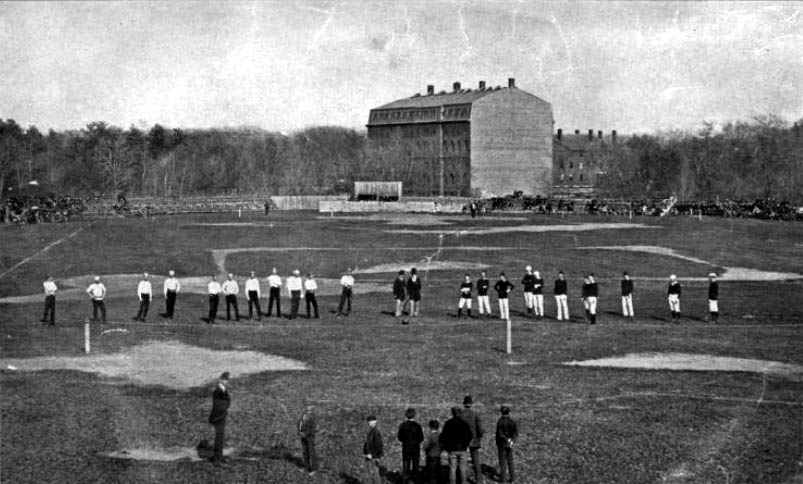
May 15, 1874: American football is invented.
What's that? You thought that happened on November 6, 1869, between Rutgers and Princeton? Well, that was the 1st football game played in America. But that was essentially a soccer game, 25-a-side. In 1870, these 2 schools in New Jersey were joined by Columbia University, of New York City.
In 1872 came another New Jersey school, the Hoboken-based Stevens Institute of Technology; and Yale University, of New Haven, Connecticut. In 1873 came Harvard University, of Cambridge, Massachusetts, across the Charles River from Boston; and the 1st game in the South, between Washington & Lee University and the Virginia Military Institute (VMI), which are practically next-door to each other in Lexington, Virginia.
So what happened on May 15, 1874?
Essentially, McGill University, in Montreal, Quebec, is Canada's answer to Harvard, right down to the use of Crimson red as the school color. Both Harvard's men and McGill's men believed themselves to be sporting gentlemen, in the tradition of the Victorian Era that was pretty much at its peak in the 1870s.
As citizens of the British Empire, McGill's men believed themselves to be honest, brave, and examples for the youth of the world to follow. The University's motto is Grandescunt Aucta Labore, Latin for "By work, all things increase and grow."
As citizens of the United States of America, Harvard's men believed the same things of themselves, with the added touch of being the inheritors of the American Revolution. The University's motto is simply Veritas, Latin for "Truth."
Having heard that Harvard had one the best football teams in America, McGill started its football program in 1874, and challenged Harvard to a game of "football." It would be the 1st-ever "football" game between American and Canadian teams. Wishing to maintain their appearance as honorable sportsmen, Harvard happily accepted.
But when the McGill men got to Harvard's Jarvis Field on May 14, they discovered that the game Harvard thought they'd been invited to play was soccer -- which got shortened to "assoc." and eventually to "soccer." The McGill men expected that they would be playing rugby (which has frequently been called "rugger").
Being "sportsmen" and "gentlemen," the team captains met to discuss the discrepancy with civility. There may have been tea involved, or perhaps a stronger beverage.
They came up with a compromise: They would play a game under Harvard's "Boston game" rules, and another game under the "code" of "rugby union," the version of football most familiar to Canada at the time. (Indeed, the predecessor to the CFL, the Canadian Football League, was the CRU, the Canadian Rugby Union.)
At least, that's the story I'd been led to believe. But, as Richard Hershberger, a historian who specializes in the post-Civil War period, points out, an article in The Boston Globe of May 11 suggests that the teams already knew ahead of time about the discrepancy, and that the compromise was worked out, by either mail or telegram. (The telephone was invented 2 years later, also in Boston. Note that, just as baseball was often spelled as 2 words at the time, or hyphenated, "base ball" or "base-ball," so, too, is "foot-ball" hyphenated here.)

On May 14, Harvard won the soccer game 3-0. The following day, they met for the rugby match, which ended 0-0. As Hershberger puts it:
This is the most important game in the history of American sport. I write this with no exaggeration. This is the game that converted Harvard to the rugby rules. Harvard then went forth and explained to the other schools that Harvard is Harvard and you other schools are not, so that is that. Next year, rugby will be adopted as for intercollegiate matches. From there they will immediately begin fiddling with the rules, and by 1880 will have distinctive features of American football. Most schools in 1874 favored a kicking game. Were it not for today's game, college football would be soccer, or something very close to it.
The Harvard men liked the rugby version, including the "try." Later in the year, their officials met with officials from the other football-playing schools, and the rules were combined with those of the soccer generally considered "football" in America, and carrying the ball was officially allowed, and the "try" became the "touchdown."

Like St. John's University in New York City's Queens, McGill used to call their team the Redmen. Despite the Indigenous heritage of Canada, it had nothing to do with the people then usually called "Indians": University founder James McGill, like many Scotsmen, had red hair. The name was used from 1927 to 2020, when it was changed to Redbirds.
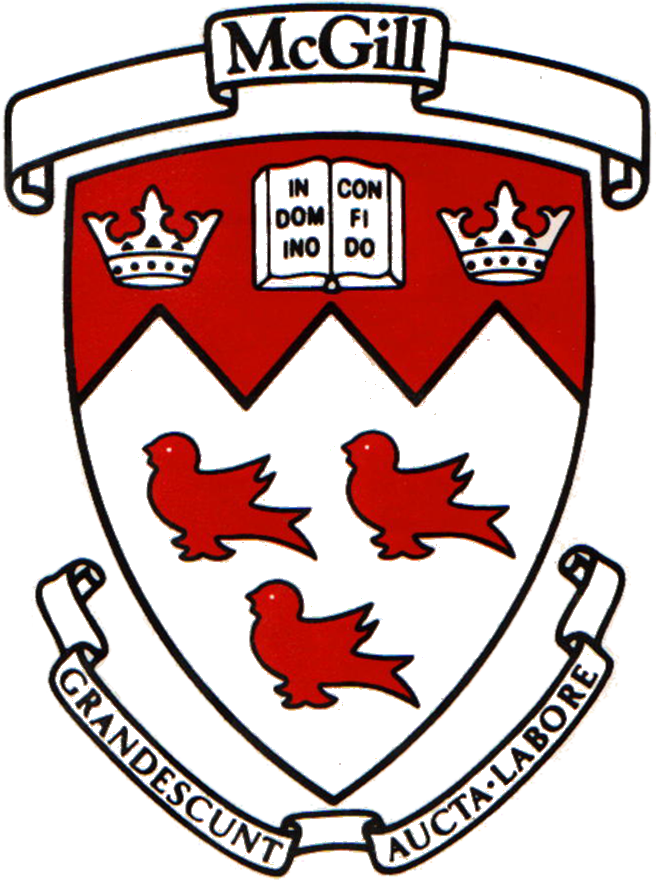
"Redbirds" was chosen as a match for the name for their women's teams, the Martlets. Their women's sports department was founded in 1976, and their women's teams were named for the birds shown on the McGill family crest.
*
May 15, 1874 was a Friday. There was another notable sporting event that day, a game played in the 1st professional baseball league, the National Association. The Boston Red Stockings beat the Brooklyn Atlantics, 8-2 at the Union Grounds in the Williamsburg section of Brooklyn.
Brooklyn remained a separate city from New York until 1898. By that point, the Atlantics had folded, and the Borough of Brooklyn was home to the team known today at the Los Angeles Dodgers. When the National League was founded in 1876, the Boston Red Stockings were admitted, and are known today as the Atlanta Braves.


