Showing posts with label bronko nagurski. Show all posts

Monday, December 26, 2022

December 26, 1943: Nagurski's Return Leads Bears to Title

Bronko Nagurski

December 26, 1943: The NFL Championship Game is played at Wrigley Field in Chicago. It features the 2 best teams in the League, based not just on recent history, but also on the fact that these are the 2 teams least affected by the manpower drain of World War II.

Sammy Baugh had debuted in the NFL in 1937, as the quarterback for the Washington Redskins, coached by Ray Flaherty. That year, they beat George Halas' Chicago Bears in the Championship Game. They faced each other again in the Championship Game in 1940, when the Bears won the biggest blowout in NFL history, 73-0; and in 1942, when the Redskins ruined an undefeated season for the Bears.

In 1943, Baugh did something never done before, nor since: He led the NFL in passing yards, interceptions by a defensive player, and punting yards. To put this into a more modern perspective: Imagine that, in the 2000s, Tom Brady, Ed Reed and Sean Landeta were one man doing what all three of those men did. That was "Slingin' Sammy": The 1st great quarterback, a great defensive back, and the best punter ever.

But the Bears had the era's other great quarterback, Sid Luckman. And an offense and a defense so mighty that they were nicknamed "The Monsters of the Midway." In addition to facing the Redskins in the title game in 1937, 1940 and 1942, they had also beaten the New York Giants in the title game in 1941.

What the Bears did not have was Halas, who was team founder, owner, general manager and, usually, head coach. But, having served in the U.S. Navy during World War I, he was called back to serve in World War II, overseeing the recreational needs of the Seventh Fleet, and eventually being discharged with the rank of Captain.

In his stead, his assistant coaches, Heartley "Hunk" Anderson and Luke Johnsos served as co-head coaches. Anderson had been a guard at Notre Dame on Knute Rockne's National Championship teams of 1919 and 1920, and had played for the Bears from 1922 to 1925. Johnson was a Chicago native who played end at Northwestern University, and helped the Bears win the NFL Championship in 1932 and 1933.

But the draft -- the U.S. Army's, not the NFL's -- had hit the Bears, too. While a deal was worked out to keep some players stateside, as long as they kept their jobs in defense plants, they lost other key players. They kept their great center and defensive tackle Clyde "Bulldog" Turner, but lost back Bill Osmanski. They needed help.

From 1930 to 1937, the Bears had Bronislau "Bronko" Nagurski. At 6-foot-2 and 230 pounds, he wouldn't be considered all that big today. But in the 1930s, he was considered huge, and was the prototype for the big bruising fullback, the progenitor of Marion Motley, Jim Brown, Larry Csonka, John Riggins, Jerome Bettis, etc.

The University of Minnesota didn't win anything while he was there, but, in the same backfield as Red Grange, he helped the Bears win the Championship in 1932 and 1933.

"Who would you pick to win a football game?" asked the great sportswriter Grantland Rice. "11 Jim Thorpes? 11 Glenn Davises? 11 Red Granges? Or 11 Bronko Nagurskis? The 11 Nagurskis would be a mop-up. It would be something close to murder and massacre. For the Bronk could star at any position on the field, with 216 pounds of authority to back him up."

Try 230, Mr. Rice. Otherwise, you're right. One year, Nagurski hurt his back, and, instead of sitting out and healing, accepted a switch to offensive tackle, and was great at it. He played defensive tackle. Oh yeah, he could also pass, pretty well by the standards of the time. Imagine Bettis throwing an option pass, and having it result in a touchdown: Nagurski did it. In an interview late in life, he said he'd probably be a linebacker, admitting he wouldn't be carrying the ball 30 times a game. I have no doubt that, with his speed, he would have excelled.

He was a professional wrestler in the off-season, because, at the time, it made him more money. He was the Heavyweight Champion of the World. And while pro wrestling was always a bit theatrical, it was not like today's WWE. He would have made mincemeat out of Hulk Hogan in the 1980s, Stone Cold Steve Austin in the 1990s, Dwayne "The Rock" Johnson (also a college football star) in the 2000s and John Cena today. And he would never have done Vince McMahon's bidding.

After the 1937 season, Nagurski quit football over a salary dispute with Halas. He kept wrestling, even though he had a bad back, and, once World War II came, it didn't make him as much money. In 1943, due to the manpower shortage, Halas sent a telegram to Anderson and Johnsos, telling them to offer Nagurski, now 35 and 6 years past his last down of football, $5,000 to come back. He took it.

In 1943, the Bears went 8-1-1. The season began with a 21-21 tie away to their arch-rivals, the Green Bay Packers. But they still had a shot at an undefeated season until their next-to-last game, when the Redskins beat them in Washington, 21-7.

The Redskins, by now coached by Dutch Bergman, had a bit more trouble. They started out 6-0-1, the only blot on their record a 14-14 tie with the Steagles in Philadelphia. Yes, the "Steagles": Because of the manpower drain, the 2 Pennsylvania teams, the Philadelphia Eagles and the Pittsburgh Steelers, joined forces for one season, playing 4 games at the Eagles' Shibe Park and 2 at the Steelers' Forbes Field.

But after beating the Bears, the Redskins dropped their last 3 games, 27-14 to the Steagles at Griffith Stadium, 14-10 to the Giants at the Polo Grounds, and then 31-7 to the Giants at home. This forged a tie with the Giants for the Eastern Division title. Under today's rules, the Giants would have won the Division, due to the head-to-head win. Under the rules of 1943, a Playoff game was needed, so the Giants and Redskins ended up playing 3 weeks in a row. Despite the Giants having home-field advantage, the Redskins won, 20-0.

So the NFL Championship Game was set for a week later than intended, on the day after Christmas. Since the game alternated between the Division titlists' homes, and it was the Western winner's turn to host, the game would be at Wrigley Field. Because of the weather, this became the 1st NFL game to earn the nickname "The Ice Bowl." After the 1967 NFL Championship Game, that name was retired, and nobody ever again used the name for the 1943 title decider.
Wrigley Field in its football configuration

There was no scoring in the 1st quarter. In the 2nd, Andy Farkas ran the ball in from 1 yard out to give the Redskins a 7-0 lead. That may have woken the Bears up: Later in the quarter, Luckman threw a 31-yard touchdown pass to Harry Clarke, and Nagurski ran the ball in from 3 yards, and it was 14-7 Chicago at the half.

The Bears dominated in the 2nd half as well. Luckman threw 2 touchdown passes to Dante Magnani in the 3rd quarter, 36 and 66 yards. On the 2nd of these, Bob Snyder missed the extra point, so it was 27-7 Bears. Baugh threw a 17-yard touchdown pass to Farkas, to give the 'Skins some hope as the quarter ran out, 27-14.

That hope ended quickly. Luckman threw touchdown passes to Jim Benton for 26 yards and Clarke for 10. Baugh threw one to Joe Aguirre for 25 yards, but it was small consolation. The Bears won, 41-21, and had their 3rd title in 4 seasons.

Nagurski retired again, returning to his farm in Minnesota in the Summer, and the pro wrestling circuit the rest of the year, until 1960. The University of Minnesota retired its Number 72 for him, and named its football facility the Gibson-Nagurski Football Complex. The Chicago Bears retired Number 3 for him. He was a charter inductee into the Pro Football Hall of Fame in 1963.

He was named to the NFL's 50th Anniversary Team in 1969, and its 75th Anniversary Team in 1994. Despite being named as a finalist, he was not named to the 100th Anniversary Team in 2019. The Sporting News ranked him 35th on their 100 Greatest Football Players in 1999. and the NFL Network's 100 Greatest Players in 2010, 73 years after he was a regular player, actually boosted him to 19th. In 2008, ESPN named ranked him 17th on their list of the Top 25 College Football Players of All Time. He died in 1990.

The 1944 season saw the continued decimation of the NFL. But by the start of the 1945 season, The War was over, and the players began to be discharged, and switch back from the battlefield to the football field. The Redskins reached the Championship Game again, losing to the Cleveland Rams, who then moved to Los Angeles for 1946. In that season, the Bears won another title, beating the Giants in the Championship Game. So it was 4 titles in 7 seasons.

The Bears would not reach another NFL Championship Game, under any name, until 1956; the Redskins, the 1972 season. The Bears would not win another title until the season of 1963; the Redskins, that of 1982.

*

December 26, 1943 was a Sunday. Baseball was out of season. The NBA hadn't been founded yet. There were 2 NHL games played on this day. The New York Rangers beat the Chicago Black Hawks, 7-6 at the old Madison Square Garden. For the Rangers, Bryan Hextall Sr. had 2 goals and 2 assists. For the Hawks. Bill Mosienko had 3 goals and an assist, while former Ranger Clint Smith had a goal and 3 assists.

And the Boston Bruins and the Detroit Red Wings played to a tie, 4-4 at the Olympia Stadium in Detroit.

The Montreal Canadiens and the Toronto Blue Jays were not scheduled. This strikes me as odd, since Canada was part of the British Empire, and December 26, the day after Christmas, is Boxing Day, a big day for the British, including major soccer games. But Canada's NHL teams didn't play on the day.

Sunday, December 18, 2022

December 18, 1932: The NFL Moves Indoors

December 18, 1932: A Playoff game is held to determine the Champion of the National Football League. Snow forces the young League indoors for the 1st time.

There had been controversies for the League title in 1921 and 1925, so having a definitive title game would have helped. This time, there would be no questions.

The Chicago Bears, owned and coached by NFL founder George Halas, and with the all-time greatest running back tandem of Red Grange and Bronko Nagurski, were the best team in the League. Their record was 6 wins, 1 loss... and 6 ties.

They began the season badly, not scoring at all in their 1st 4 games. Their 1st 3 games were all scoreless ties, away to the Green Bay Packers, away to New York's Staten Island Stapletons, and against the Chicago Cardinals. And then the Bears lost 2-0 at home to the Green Bay Packers, so they were 0-3-1.

For a reason I haven't been able to find, the Cardinals shared Wrigley Field with the Bears and baseball's Chicago Cubs for the 1932 season, instead of playing their home games at the White Sox' Comiskey Park like they usually did. So while the 0-0 tie between the Chicago teams was at Wrigley, it was officially a home game for the Cardinals.

The Bears snapped out of it. The Stapletons came into Wrigley, and the Bears beat them, 27-7. The Bears made an Eastern swing, and tied the Boston Braves (the team that would become the Washington Redskins) 7-7, and beat the New York Giants 28-8. With 3 straight home games, they tied the Portsmouth Spartans, 13-13; beat the football version of the Brooklyn Dodgers, 20-0, and beat the Cardinals, 34-0.

Portsmouth, Ohio, across the Ohio River from Portsmouth, Kentucky, about 100 miles east of Cincinnati, was one of those small Midwestern cities like the ones that founded the NFL: Green Bay, Wisconsin; Decatur, Illinois, from whence the Bears came; Muncie, Indiana; Canton, Ohio; Rochester, New York. Of those, only Green Bay survives today.

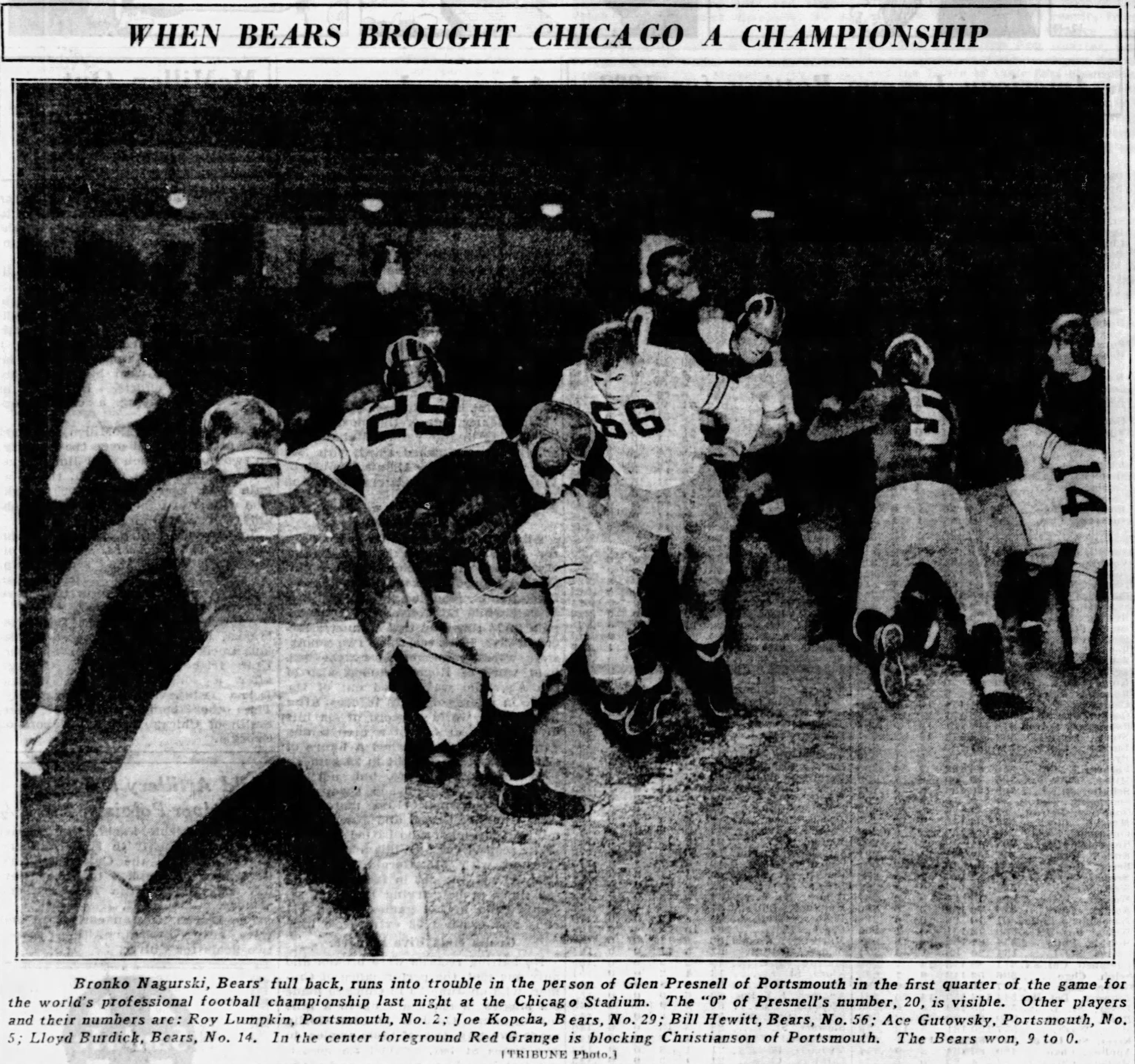
The Spartans began in 1930, and were 5-6-3. But under head coach George "Potsy" Clark, they started 1931 out at 8-0, before falling to 11-3, and finishing 2nd in the NFL to the Packers. With a backfield -- both offensive and defensive in those days -- of Earl "Dutch" Clark (no relation to Potsy), Glenn Presnell, LeRoy "Ace" Gutowski and Roy "Father" Lumpkin, they were 5-1-3 when they hosted the Bears at Universal Stadium on November 27, the Sunday after Thanksgiving. The game ended in a 7-7 tie.

The Spartans played just 1 more game, beating the Packers, 19-0 at home. The Bears played 2 more, both at Wrigley, beating the Giants 6-0 and the Packers 9-0. The Bears had finished 6-1-6, the Spartans 6-1-4. Under current rules, with winning percentage being the decider, and ties being counted as half a win and half a loss, the title would actually have gone to the Packers: Their 10-3-1 record gave them a winning percentage of .750, to the Bears' .692 and the Spartans' .636. Of course, under current rules, every team would have played the same number of games: The Packers had played 14, the Bears 13, the Spartans 11.

But ties weren't counted, and so the percentages were actually Bears .857, Cardinals .857, and Packers .769. After winning the NFL Championship in each of the preceding 3 seasons, Green Bay were out, and there was a tie for the title. So a Playoff game was set for Sunday, December 18, at Wrigley Field, since it had more seats than Universal Stadium. The Spartans did not object: Money from gate receipts mattered more than home-field advantage. It was the depth of the Great Depression, after all, between the electoral rejection of Herbert Hoover and the Inauguration of Franklin Delano Roosevelt.

But Chicago was hit by snow, and it stayed cold all week. It was impossible to play the game at Wrigley, or at Comiskey, or at Soldier Field, or at the University of Chicago's Stagg Field, or at Northwestern University's Dyche Stadium.

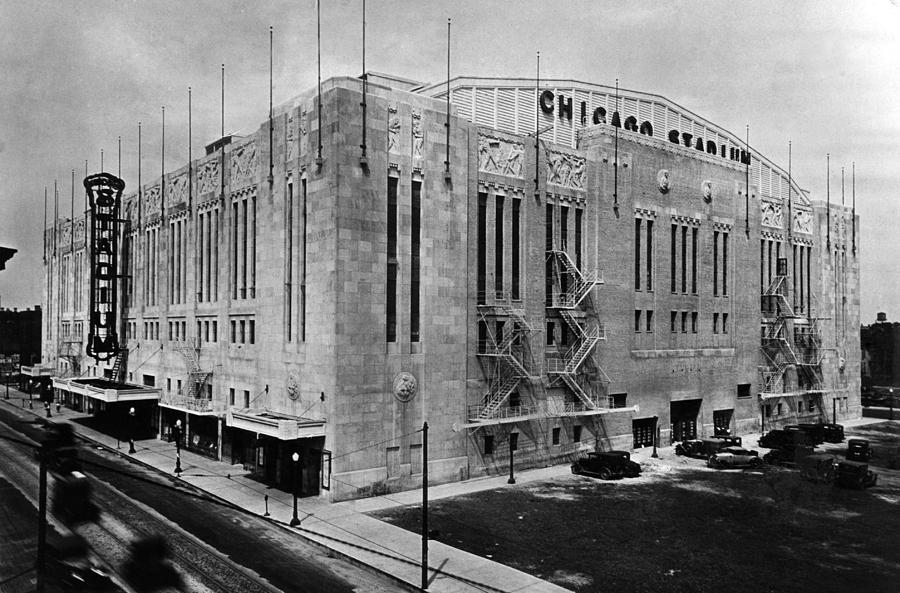
In 1929, the Chicago Stadium, on the West Side, opened as the new home of the NHL's Chicago Black Hawks. In 1930, the Bears and the Cardinals had played a postseason charity exhibition game indoors there. George Halas suggested to Potsy Clark that they move the Playoff game to the Stadium. Since the only other option was to wait until an outdoor stadium was available, by which point his team might have gotten stale in waiting, he agreed.
A week before the game, the concrete surface had tanbark, the bark of oak trees, placed atop it, for a Salvation Army-sponsored circus. Elephant manure that had seeped into the surface produced an odor that caused a Bears player to throw up on the field. And because of the limited dimensions of the indoor arena, special rules were adopted for the game:

  • The tanbark-covered field itself was only 80 yards long -- 60 yards between the goal lines -- and 45 yards wide, 10 yards narrower than the regulation width at the time.
  • The goalposts were moved from the endlines to the goal lines.
  • Every time a team crossed the 10-yard line, the ball was moved back 20 yards to allow for the shortened field.
  • For the first time, all plays started with the ball on or between the hash marks, which were 10 yards from the sidelines.
  • The forward pass, officially legal only from 5 yards behind the line of scrimmage, was legalized from anywhere behind the line of scrimmage.
  • Drop kicks (still relatively common) and field goals would not be used in the game, for fear of footballs going into the stands, and the referees running out of them.

The high temperature for that Sunday in Chicago was 20 °F, warmer than anticipated earlier in the week. Attendance was listed at 11,198 -- about half the heated Stadium's capacity, but probably more than would have braved the cold at Wrigley, had the snow been removed from the field to make playing a game there possible. The host Bears wore white jerseys, the Spartans purple.

With terrible footing on the mulch, limited room for the offenses to work, and the circumstances of the era making the NFL a defense-oriented league at the time, anyway, the defenses dominated the game's 1st 3 quarters, with the game remaining scoreless. Bears quarterback John Doehling's 1st pass flew into the stands, as did most punts and kickoffs, rendering the fear that caused the cancellation of dropkicks and field goals very real. One punt collided with a Black Hawks sign. Another hit Al Melgard, the Stadium's organist. Only 1 punt had the chance to be returned.
On one drive, the Spartans were in position to score when Presnell tripped before he could reach the end zone. In the 4th quarter, the Bears scored on a controversial touchdown: Carl Brumbaugh handed the ball off to Nagurski, who pulled up and threw to Grange in the end zone for the score. The Bears later scored a safety after the Spartans fumbled the ball out of their end zone, making the final score 9-0, and the Bears were Champions.

To eliminate the circumstances of the 1932 Playoff -- barring the weather, which, of course, even George Halas couldn't control, or at least buy control of -- the NFL got seriously revamped prior to the 1933 season. The liberalized passing rules required by the smaller field from the Playoff were written into the regular rules. So was the creation of hashmarks, to keep the ball closer to midfield, lengthwise. Putting the goalposts on the goal line was kept, until they were moved back to the end line in 1974. 

The League was divided into an Eastern Division and a Western Division, with each team playing each of its Division opponents home and away, no more, no less; and each Division winner facing the other in an NFL Championship Game, to determine a definitive title-winner.

The Western Division winner would host the Championship Game in odd-numbered years, the Eastern winner in even-numbered years. The Bears won the 1st such game, beating the Giants, 23-21 at Wrigley. The following year, the Giants beat the Bears at the Polo Grounds in New York.

All these changes, and a slimmer football that was introduced for the 1934 season, led to more scoring, and fewer ties, and helped increase the NFL's popularity. It was these changes that turned the NFL from what could still be called a minor league into a major league.

In 1934, Detroit radio executive George Richards bought the Spartans, and moved them, making them the Detroit Lions. They won the NFL Championship in 1935. The 8,500-seat Universal Stadium, the Spartans' former home, is one of the few remaining relics of the early NFL: It has been renamed Spartan Municipal Stadium, after both of the teams famous for playing there, the other being Portsmouth's Notre Dame High School.

Today, Portsmouth is home to about 18,000 people. It was the hometown of Major League Baseball stars Al Bridwell, Del Rice, Rocky Nelson, Al Oliver, Gene Tenace and Larry Hisle; baseball executive Branch Rickey; opera singer Kathleen Battle; Ohio Governor Ted Strickland; and "singing cowboy" Roy Rogers.

In 1968, the American Football League's Houston Oilers moved into the Astrodome. In 1970, with the rest of the AFL, they were merged into the NFL. On September 27, 1970, they played the NFL's 1st indoor regular-season game, losing to the Miami Dolphins, 20-10. In 2022, out of the NFL's 32 teams, 10 play under domes, 5 of them having retractable roofs, allowing both indoor and outdoor games. The Chicago Bears are not one of them, but the Detroit Lions, who used to be the Portsmouth Spartans, are.

*

December 18, 1932 was a Sunday. Baseball was out of season. The NBA hadn't been founded yet. There were 2 games in the NHL. Chicago Stadium was available because the Chicago Black Hawks were on the road, and played the New York Americans to a tie, 0-0 at Madison Square Garden. And the Detroit Red Wings, in their 1st season under that name, beat the Boston Bruins, 2-1 at the Olympia Stadium in Detroit.

Thursday, December 8, 2022

December 9, 1934: The Sneaker Game

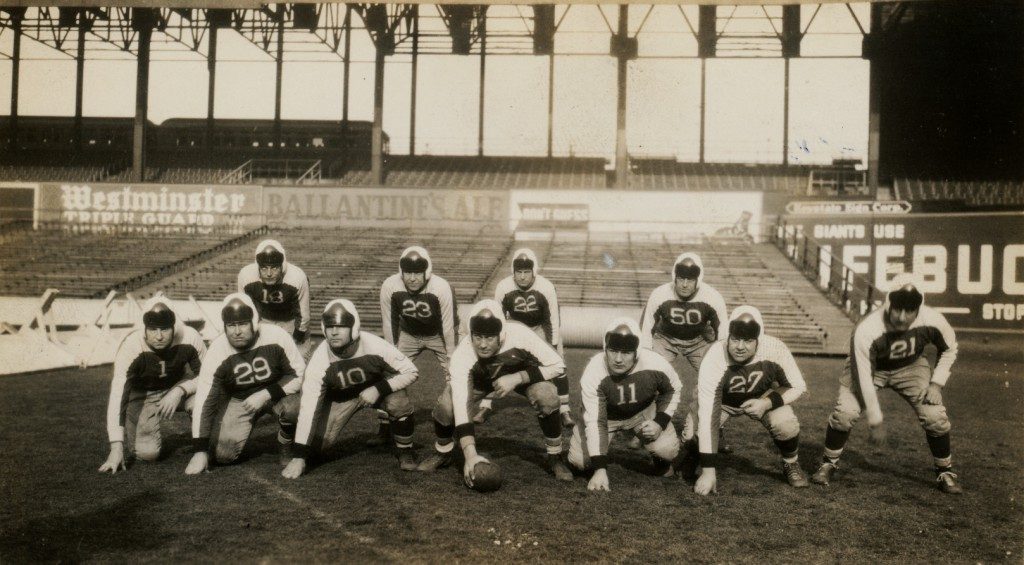
The starting offense of the 1934 New York Giants.
Back row, left to right: 18, Dale Burnett; 23, Bo Molenda;
22, Ed Danowski; and 50, Ken Strong.
Front row, left to right: 1, Ray Flaherty;
29, Red Badgro; 10, Potsy Jones; 7, Mel Hein;
11, Butch Gibson; 27, Bill Morgan; and 21, Ike Frankian.

December 9, 1934: For the 1st time, a New York football team wins a championship game. And they proved the old adage that revenge is a dish best served cold.

The New York Giants, named for the baseball team of the same name, were founded in 1925, and won the NFL Championship in 1927, at a time when the title went to the team that finished 1st in a single-division League. The Giants went 11-1-1, outpacing the Green Bay Packers at 7-2-1.

For the 1933 season, the NFL split into 2 Divisions, Eastern and Western. The Giants won the East, and the Chicago Bears won the West. While there had been a Playoff for the League title the season before, and the Bears had won it, 1933 was the year of the 1st official NFL Championship Game. It was played at Wrigley Field in Chicago, and the Bears came from behind to beat the Giants, 23-21.

The Giants won the East again in 1934, with an 8-5 record. The Bears won the West again, going 13-0, and riding a 17-game winning streak. With Red Grange and Bronko Nagurski, who would become charter members of the Pro Football Hall of Fame, the Bears were favorites.

In spite of a much more pedestrian record, the Giants were every bit as loaded as the year before. Center Mel Hein would also be a charter inductee in Canton, and would be joined by running back and kicker Ken Strong, and ends Red Badgro and Ray Flaherty. Each team's head coach would also be elected to the Hall of Fame: Steve Owen of New York and George Halas of Chicago. Each team's owner also would: Tim Mara and Halas.

As the Western winner hosted the Championship Game the year before, now it was the Eastern winner's turn to host. But the night before the game, a freezing rain hit New York, and when the Giants got to the Polo Grounds, they found the field frozen solid. The bad weather kept the crowd to 35,039, about 20,000 short of a sellout.
The Polo Grounds, looking more fit for football
than it ever did for baseball

Flaherty came up with an idea: The Giants should wear sneakers, to get a better footing on the field than the standard football cleats. But it was a Sunday: Sporting goods stores were closed. So Owen sent Abe Cohen, a tailor who served as the Giants' clubhouse attendant, to Manhattan College, 5 miles Uptown, to see if he could get some sneakers.

The athletic director -- contrary to legend, not the original Brother Jasper who founded Manhattan's athletic program and gave rise to the teams' name, the Jaspers, as he would have been long dead by this point -- gave Cohen the sneakers belonging to the basketball team, 9 pairs.

But by the time Cohen got back to the Polo Grounds, the 2nd half was already underway. Strong had opened the scoring with a field goal, but the Bears answered in the 2nd quarter with a Nagurski touchdown and a Jack Manders field goal. The Giants switched to the sneakers, but another Manders field goal made it 13-3 going into the 4th quarter.

But the sneakers did the trick. Ed Danowski threw a touchdown pass to Ike Frankian, making it 13-10 Chicago. The Bears could do nothing on their next drive. The Giants got the ball back, and Strong had enough footing to break away for a 42-yard touchdown run.

Strong scored another touchdown, this time from 11 yards out, as the Bears kept slipping, unable to keep up with the surer-footed Giants. Nagurski later said, "We immediately said something was wrong because they suddenly had good footing and we didn't... They just out-smarted us."

Danowski capped the game with a 9-yard quarterback keeper. The Giants won, 30-13, and their 27 points remain a record for the 4th quarter in an NFL championship game. (The New England Patriots scored 19 points in the 4th quarter of Super Bowl LI.) It became known as "The Sneaker Game." (It's never been called "The Sneaker Bowl.")

Beattie Feathers, a rookie running back out of the University of Tennessee, had become the 1st player to rush for over 1,000 yards in an NFL season. However, he was injured with 2 games remaining in the regular season. It probably wouldn't have mattered if he had been available to the Bears: He would have had to have helped them make up 3 touchdowns.

The Giants won another NFL Championship Game in 1938, but lost it in 1935, 1939, 1941, 1944 and 1946. In 1956, the Giants' 1st season playing their home games at the old Yankee Stadium, they again hosted the Bears in an NFL Championship Game. Again, the field was frozen solid. This time, with the legend of 1934 in mind, they had sneakers ready from the start, and it was no contest: The Giants won, 47-7.

Burned by it twice, Bears owner/coach and NFL co-founder George Halas talked the other owners into outlawing the sneaker tactic. The Giants would play on frozen fields in the NFL Championship Games of 1958 (at Yankee Stadium), 1961 (at Lambeau Field in Green Bay), 1962 (at Yankee Stadium again) and 1963 (at Wrigley Field in Chicago), and lost them all. 

Packer coach and general manager Vince Lombardi had been a Giants assistant in 1958, and had coached against them in 1961 and 1962. He knew that the cold weather of Green Bay made for a home-field advantage at Lambeau Field, but he didn't want a frozen field. So he had heating coils installed under the field, and it became known as "Lombardi's Electric Blanket." But on the morning of the 1967 NFL Championship Game, it was so cold, the machine keeping the coils heated broke, and the field froze. The game became known as the Ice Bowl, but the Packers won, anyway.

Since then, all natural-grass fields in the NFL have had similar heating systems. And, by the time the Giants made the Playoffs again, in 1981, many of the NFL's fields, including their own at Giants Stadium, were artificial. So while there have been many cold games in the NFL since, including a few at the Meadowlands, there has never been a frozen field since Lambeau became "the Frozen Tundra."

In 1999, The Sporting News released their list of the 100 Greatest Football Players. Mel Hein was ranked 38th. In 2010, the NFL Network released their list of the 100 Greatest Players. Hein was dropped to 96th.


*


December 9, 1934 was a Sunday. Actress Judi Dench and blues singer Junior Wells were born on this day.

This was the end of the football season, baseball was out of season, and there was no NBA yet. But there were 3 games played in the NHL that day:

* The New York Giants lost to the Chicago Black Hawks, 4-0 at the Chicago Stadium.

* The New York Americans and the Montreal Canadiens played to a tie, 2-2 at the old (then still relatively new) Madison Square Garden.

* And the Detroit Red Wings beat the St. Louis Eagles, 3-1 at the Olympia Stadium in Detroit. The Eagles had been the Ottawa Senators until this season, but the Great Depression did them in, and they folded at the end of the season. St. Louis would not return to the NHL until 1967, and Ottawa not until 1992.

* The Toronto Maple Leafs and the Montreal Maroons were not scheduled.

Tuesday, November 29, 2022

November 29, 1934: The 1st NFL Game On National Radio

Detroit in the dark (blue) jerseys, Chicago in the white

November 29, 1934: For the 1st time, an NFL game is broadcast nationwide on radio. In fact, that's why it's played at all: To sell radios.

George A. Richards owned Detroit radio station WJR, 760 on the AM dial, an affiliate of the NBC Blue Network, which later became ABC. He bought the NFL's Portsmouth Spartans, who had momentary success by reaching the 1932 NFL Championship Game, but losing it to the Chicago Bears. But they could never get fans in Southern Ohio.

So Richards bought the team, brought them to Detroit, and renamed them the Lions, to tie in with the city's baseball team, the Tigers, and because the lion is "the king of the jungle," and he wanted to build a team that would be "the king of the NFL."

At first, it worked. Their opener, on September 23, at the University of Detroit's Dinan Field, was a 9-0 win over the New York Giants, who had been in the 1933 NFL Championship Game. The Lions ended up winning their 1st 10 games, before losing on November 25 to the Green Bay Packers.

Next up, on Sunday, December 2, at Wrigley Field in Chicago, was a game against the team that had won the  last 2 NFL Championship Games, the previous year against the Giants and the year before against the Spartans/Lions. It was the Chicago Bears, with 2 legends in their backfield, Harold "Red" Grange and Bronislau "Bronko" Nagurski.

Richards knew that Thanksgiving was coming up, the ultimate family holiday. When everyone would be gathered around the radio. (No television in those days.) Maybe if there was a special program on the day, more radios would be sold, and Richards would make more money.

So he talked to Bears owner-coach George Halas about adding a game between the teams, on Thursday, in Detroit. (Up until 1940, Thanksgiving Day was always on the last Thursday in November. Since then, it's been the 4th Thursday in November, which is not necessarily the last Thursday of the month.) Halas, having played and coached in several Thanksgiving Day games over the years, and hardly opposed at the time to playing games so close together, liked the idea. He didn't care about selling radios. He did care about a visiting team's share of the gate receipts. And he certainly cared about selling the Bears (to fans, not to any one person) and selling the NFL. So he talked the other NFL owners into allowing it.

It worked like a charm: One of the biggest national audiences in radio history was tuned in, and over 26,000 fans crammed into the small stadium. And it looked like the Lions were living up to their responsibility, taking a 16-7 halftime lead, thanks to 2 touchdowns by LeRoy "Ace" Gutowsky.

But Jack Manders, so accurate he was known as "Automatic Jack," kicked 2 field goals in the 3rd quarter, enabling Chicago to close within 16-13. And in the 4th quarter, Joe Zeller intercepted a pass from Glenn Presnell and returned it to the Lions' 4-yard line. You wouldn't expect Nagurski to pass for a touchdown, but he did, to Bill Hewitt. Despite being held to 116 rushing yards, the Bears beat the Lions, 19-16.

Three days later, at Wrigley, the Bears beat the Lions again, 10-7. The Lions had started 10-0, but ended 10-3. In contrast, the Bears finished the season at 13-0, and as Western Division Champions. This time, though, they lost the Championship Game, to the Giants.

The Bears would go undefeated and then lose the Championship Game again in 1942. It would take until the 1972 season for a team to have an undefeated regular season and then win the NFL Championship, as the Miami Dolphins won Super Bowl VII.

But in spite of the 3-game collapse, the Lions turned Detroit on to pro football, after the failure of 3 different NFL teams: The Heralds (who changed their name to the Tigers for their 2nd season) in 1920 and '21, the Panthers in 1925 and '26, and the Wolverines in 1928. In 1935, the Lions were less impressive in the regular season, going 7-3-2, but beat the Bears on Thanksgiving, and then beat the Giants to win their 1st NFL Championship.

The Lions continued to play on Thanksgiving until 1938, playing the Bears each time, then resumed in 1945, and have played on the day every season since. Counting their 2021 loss to the Chicago Bears, a far more dire contest than the 1934 inaugural, they are 37-43-2 on T-Day. Of their 82 games, 21 have been against the Green Bay Packers, and 19 against the Bears.

*

November 29, 1934 was Thanksgiving, and therefore a Thursday. There were 2 other NFL games that day. The Chicago Cardinals beat the Packers, 6-0 at Comiskey Park in Chicago. And, in a football version of the great baseball rivalry (but different organizations in each case), the New York Giants beat the Brooklyn Dodgers, 27-0 at Ebbets Field.

Baseball was out of season, and the NBA wasn't founded yet. There were 2 NHL games, and Detroit and Chicago were involved, but not against each other. The Detroit Red Wings lost to the Montreal Maroons, 2-1 at the Montreal Forum. And the Chicago Black Hawks lost to the New York Americans, 2-0 at the old Madison Square Garden.

Of course, by 1942, both the Maroons and the Amerks would be out of business. In contrast, the Red Wings and the Blackhawks (they switched to writing it as 1 word in 1986) are still at it today. And it's a better Detroit vs. Chicago rivalry than Lions vs. Bears, or Tigers vs. White Sox, or even Pistons vs. Bulls.

Thursday, November 3, 2022

November 3, 1908: William Howard Taft Is Elected President

November 3, 1908: William Howard Taft, the U.S. Secretary of War, is elected the 27th President of the United States. The nominee of the Republican Party defeats William Jennings Bryan, who had been nominated by the Democratic Party for the 3rd time. Taft gets 51.6 percent of the popular vote, and wins the Electoral Vote 321 to 162.

Theodore Roosevelt chose not to run for what would have been a 3rd term, and chose Taft, who would really have preferred to have been named Chief Justice of the U.S. Supreme Court. TR warned Taft to not let the press take his picture on the golf course. Despite this warning, and his weight, which made him look ridiculous on the golf course, it happened, and TR called him onto the carpet.

Taft was a physical heavyweight, reaching a peak of 355 pounds, our heaviest President -- although Donald Trump may have broken this record. Taft was no lightweight intellectually, either: He was a graduate of Yale University, although he returned to his hometown to go to law school, at the University of Cincinnati. When TR read him the riot act over the golf pictures, Taft stood up for himself, and said, "Mr. President, you play tennis. That's a more elitist sport than golf!" TR said, "Yes, but I don't let the press take my picture while I do it!"

Taft won anyway, mainly because Bryan was running for the 3rd time, and the issue that had first vaulted him to prominence, the free coinage of silver, was no longer as effective when there wasn't a depression on, as there was when he first ran in 1896. One of the Taft slogans was, "Vote for Taft this time. You can vote for Bryan anytime."

The Democrats tried to suggest that Taft would be nothing but Roosevelt's puppet. That only helped him, as the Republicans made buttons and signs reading, "U-N-I, Ted." A campaign song was launched: "Get on the raft with Taft, boys, get in the winning boat!"

Taft is remembered largely for his, well, largeness. However, the story that he got stuck in a bathtub in the White House is not true. Nor is it true that, on Opening Day at the Washington Senators' American League Park (predecessor to Griffith Stadium) on April 14, 1910, he inadvertently invented the seventh-inning stretch, by getting up to stretch his legs, making everyone else stand out of respect to the President. That may have happened at some point in the game, but the stretch had been invented years earlier. What Taft did start that day was the tradition of the President throwing out the ceremonial first ball at the Washington team's home opener.

And while TR was known as "the trust buster," Taft actually broke up more monopolies than Roosevelt did. Nevertheless, Taft ended up running his Presidency as a conservative, far from the progressive vision that TR had expected.

As a result, TR tried to regain the office in 1912. But, as the incumbent, Taft controlled the party machinery. TR ran as a 3rd party candidate, and finished 2nd. They split the Republican vote, and Democrat Woodrow Wilson got elected as a plurality candidate. Wilson appointed Bryan his Secretary of State, but Bryan resigned in 1915, because he was a pacifist, Wilson seemed to be inching too closely to going to war.

Roosevelt and Taft patched things up, and Wilson's successor, Warren Harding, appointed Taft to be Chief Justice -- the only President to also have served on the Supreme Court. Today, "Teddy 26" and "Bill 27" are part of the Washington Nationals' "Racing Presidents."

Taft was the 1st President to be buried at Arlington National Cemetery, across the Potomac River from Washington, in Arlington, Virginia. Only John F. Kennedy has joined him. There are high schools named for Taft in New York (The Bronx), Chicago, San Antonio and Los Angeles. There's a William Howard Taft University in Denver, and a Taft Law School in the Los Angeles suburb of Santa Ana, California.
Statue of Taft as Chief Justice,
University of Cincinnati Law School

His father Alphonso Taft had served as U.S. Attorney General and Secretary of War. His son Robert Taft served as Senate Majority Leader, and ran for President in 1940, 1948 and 1952. Robert's son, Robert Taft Jr., served Ohio in both houses of Congress. And his son, Bob Taft, served as Governor.

Taft was played by Ross Durfee in The Winds of Kitty Hawk in 1978, Victor Buono in Backstairs at the White House in 1979, and Walter Massey in The Greatest Game Ever Played in 2005.

Henry L. Stimson served as Secretary of War under Taft, and later again under Franklin Roosevelt. He lived until 1950, making him last surviving member of Taft's Cabinet.

*

November 3, 1908 was a Tuesday. The baseball season -- one of the wildest ever, with 3-team races going down to the wire in both Leagues, including "Merkle's Boner" and its aftermath -- was over. Saturday had been standardized as the weekday for college football. Football barely existed on a professional level, and basketball and hockey were still all-amateur. So there were no scores on this historic day.

But there was an event on this day that would have an effect on sports: Bronislau Nagurski was born in Rainy River, Ontario. He grew in International Falls, Minnesota. "Bronko" wasn't big by today's standards, but, at 6-foot-3 and 230 pounds, he was enormous for his era. He could do it all: Block, run, catch, tackle, even throw every once in a while. He helped the Chicago Bears win the NFL Championship in 1932 and 1933, and, during the manpower shortage of World War II, came out of retirement to help them do it again in 1943.

He was a charter inductee into the Pro Football Hall of Fame in 1963. When John Madden named his "All-Madden All-Millennium Team" in 1999, the 1st 3 names he chose were Jim Thorpe, and the 1930-34 Chicago running tandem of Red Grange and Nagurski -- the prototypes, respectively, of the modern speedy halfback and the big, bruising fullback.

December 31, 1999 & January 1, 2000: The Millennium

December 31, 1999:  The Millennium arrives. The people of planet Earth survived. At a terrible cost. But we hadn't destroyed ourselves. ...