Showing posts with label washington redskins. Show all posts

Monday, December 26, 2022

December 26, 1943: Nagurski's Return Leads Bears to Title

Bronko Nagurski

December 26, 1943: The NFL Championship Game is played at Wrigley Field in Chicago. It features the 2 best teams in the League, based not just on recent history, but also on the fact that these are the 2 teams least affected by the manpower drain of World War II.

Sammy Baugh had debuted in the NFL in 1937, as the quarterback for the Washington Redskins, coached by Ray Flaherty. That year, they beat George Halas' Chicago Bears in the Championship Game. They faced each other again in the Championship Game in 1940, when the Bears won the biggest blowout in NFL history, 73-0; and in 1942, when the Redskins ruined an undefeated season for the Bears.

In 1943, Baugh did something never done before, nor since: He led the NFL in passing yards, interceptions by a defensive player, and punting yards. To put this into a more modern perspective: Imagine that, in the 2000s, Tom Brady, Ed Reed and Sean Landeta were one man doing what all three of those men did. That was "Slingin' Sammy": The 1st great quarterback, a great defensive back, and the best punter ever.

But the Bears had the era's other great quarterback, Sid Luckman. And an offense and a defense so mighty that they were nicknamed "The Monsters of the Midway." In addition to facing the Redskins in the title game in 1937, 1940 and 1942, they had also beaten the New York Giants in the title game in 1941.

What the Bears did not have was Halas, who was team founder, owner, general manager and, usually, head coach. But, having served in the U.S. Navy during World War I, he was called back to serve in World War II, overseeing the recreational needs of the Seventh Fleet, and eventually being discharged with the rank of Captain.

In his stead, his assistant coaches, Heartley "Hunk" Anderson and Luke Johnsos served as co-head coaches. Anderson had been a guard at Notre Dame on Knute Rockne's National Championship teams of 1919 and 1920, and had played for the Bears from 1922 to 1925. Johnson was a Chicago native who played end at Northwestern University, and helped the Bears win the NFL Championship in 1932 and 1933.

But the draft -- the U.S. Army's, not the NFL's -- had hit the Bears, too. While a deal was worked out to keep some players stateside, as long as they kept their jobs in defense plants, they lost other key players. They kept their great center and defensive tackle Clyde "Bulldog" Turner, but lost back Bill Osmanski. They needed help.

From 1930 to 1937, the Bears had Bronislau "Bronko" Nagurski. At 6-foot-2 and 230 pounds, he wouldn't be considered all that big today. But in the 1930s, he was considered huge, and was the prototype for the big bruising fullback, the progenitor of Marion Motley, Jim Brown, Larry Csonka, John Riggins, Jerome Bettis, etc.

The University of Minnesota didn't win anything while he was there, but, in the same backfield as Red Grange, he helped the Bears win the Championship in 1932 and 1933.

"Who would you pick to win a football game?" asked the great sportswriter Grantland Rice. "11 Jim Thorpes? 11 Glenn Davises? 11 Red Granges? Or 11 Bronko Nagurskis? The 11 Nagurskis would be a mop-up. It would be something close to murder and massacre. For the Bronk could star at any position on the field, with 216 pounds of authority to back him up."

Try 230, Mr. Rice. Otherwise, you're right. One year, Nagurski hurt his back, and, instead of sitting out and healing, accepted a switch to offensive tackle, and was great at it. He played defensive tackle. Oh yeah, he could also pass, pretty well by the standards of the time. Imagine Bettis throwing an option pass, and having it result in a touchdown: Nagurski did it. In an interview late in life, he said he'd probably be a linebacker, admitting he wouldn't be carrying the ball 30 times a game. I have no doubt that, with his speed, he would have excelled.

He was a professional wrestler in the off-season, because, at the time, it made him more money. He was the Heavyweight Champion of the World. And while pro wrestling was always a bit theatrical, it was not like today's WWE. He would have made mincemeat out of Hulk Hogan in the 1980s, Stone Cold Steve Austin in the 1990s, Dwayne "The Rock" Johnson (also a college football star) in the 2000s and John Cena today. And he would never have done Vince McMahon's bidding.

After the 1937 season, Nagurski quit football over a salary dispute with Halas. He kept wrestling, even though he had a bad back, and, once World War II came, it didn't make him as much money. In 1943, due to the manpower shortage, Halas sent a telegram to Anderson and Johnsos, telling them to offer Nagurski, now 35 and 6 years past his last down of football, $5,000 to come back. He took it.

In 1943, the Bears went 8-1-1. The season began with a 21-21 tie away to their arch-rivals, the Green Bay Packers. But they still had a shot at an undefeated season until their next-to-last game, when the Redskins beat them in Washington, 21-7.

The Redskins, by now coached by Dutch Bergman, had a bit more trouble. They started out 6-0-1, the only blot on their record a 14-14 tie with the Steagles in Philadelphia. Yes, the "Steagles": Because of the manpower drain, the 2 Pennsylvania teams, the Philadelphia Eagles and the Pittsburgh Steelers, joined forces for one season, playing 4 games at the Eagles' Shibe Park and 2 at the Steelers' Forbes Field.

But after beating the Bears, the Redskins dropped their last 3 games, 27-14 to the Steagles at Griffith Stadium, 14-10 to the Giants at the Polo Grounds, and then 31-7 to the Giants at home. This forged a tie with the Giants for the Eastern Division title. Under today's rules, the Giants would have won the Division, due to the head-to-head win. Under the rules of 1943, a Playoff game was needed, so the Giants and Redskins ended up playing 3 weeks in a row. Despite the Giants having home-field advantage, the Redskins won, 20-0.

So the NFL Championship Game was set for a week later than intended, on the day after Christmas. Since the game alternated between the Division titlists' homes, and it was the Western winner's turn to host, the game would be at Wrigley Field. Because of the weather, this became the 1st NFL game to earn the nickname "The Ice Bowl." After the 1967 NFL Championship Game, that name was retired, and nobody ever again used the name for the 1943 title decider.

There was no scoring in the 1st quarter. In the 2nd, Andy Farkas ran the ball in from 1 yard out to give the Redskins a 7-0 lead. That may have woken the Bears up: Later in the quarter, Luckman threw a 31-yard touchdown pass to Harry Clarke, and Nagurski ran the ball in from 3 yards, and it was 14-7 Chicago at the half.

The Bears dominated in the 2nd half as well. Luckman threw 2 touchdown passes to Dante Magnani in the 3rd quarter, 36 and 66 yards. On the 2nd of these, Bob Snyder missed the extra point, so it was 27-7 Bears. Baugh threw a 17-yard touchdown pass to Farkas, to give the 'Skins some hope as the quarter ran out, 27-14.

That hope ended quickly. Luckman threw touchdown passes to Jim Benton for 26 yards and Clarke for 10. Baugh threw one to Joe Aguirre for 25 yards, but it was small consolation. The Bears won, 41-21, and had their 3rd title in 4 seasons.

Nagurski retired again, returning to his farm in Minnesota in the Summer, and the pro wrestling circuit the rest of the year, until 1960. The University of Minnesota retired its Number 72 for him, and named its football facility the Gibson-Nagurski Football Complex. The Chicago Bears retired Number 3 for him. He was a charter inductee into the Pro Football Hall of Fame in 1963.

He was named to the NFL's 50th Anniversary Team in 1969, and its 75th Anniversary Team in 1994. Despite being named as a finalist, he was not named to the 100th Anniversary Team in 2019. The Sporting News ranked him 35th on their 100 Greatest Football Players in 1999. and the NFL Network's 100 Greatest Players in 2010, 73 years after he was a regular player, actually boosted him to 19th. In 2008, ESPN named ranked him 17th on their list of the Top 25 College Football Players of All Time. He died in 1990.

The 1944 season saw the continued decimation of the NFL. But by the start of the 1945 season, The War was over, and the players began to be discharged, and switch back from the battlefield to the football field. The Redskins reached the Championship Game again, losing to the Cleveland Rams, who then moved to Los Angeles for 1946. In that season, the Bears won another title, beating the Giants in the Championship Game. So it was 4 titles in 7 seasons.

The Bears would not reach another NFL Championship Game, under any name, until 1956; the Redskins, the 1972 season. The Bears would not win another title until the season of 1963; the Redskins, that of 1982.

*

December 26, 1943 was a Sunday. Baseball was out of season. The NBA hadn't been founded yet. There were 2 NHL games played on this day. The New York Rangers beat the Chicago Black Hawks, 7-6 at the old Madison Square Garden. For the Rangers, Bryan Hextall Sr. had 2 goals and 2 assists. For the Hawks. Bill Mosienko had 3 goals and an assist, while former Ranger Clint Smith had a goal and 3 assists.

And the Boston Bruins and the Detroit Red Wings played to a tie, 4-4 at the Olympia Stadium in Detroit.

The Montreal Canadiens and the Toronto Blue Jays were not scheduled. This strikes me as odd, since Canada was part of the British Empire, and December 26, the day after Christmas, is Boxing Day, a big day for the British, including major soccer games. But Canada's NHL teams didn't play on the day.

Saturday, December 24, 2022

December 24, 1994: The Rams and Raiders Abandon Los Angeles

December 24, 1994: The Kansas City Chiefs defeat their arch-rivals, the Los Angeles Raiders, 19-9, before 64,130 fans -- a big crowd, but hardly a sellout at the 93,000 seat Los Angeles Memorial Coliseum.

The Coliseum had been the home of the Raiders since moving from Oakland before the 1982 season, and the home of the Los Angels Rams from 1946 to 1979. The Rams had moved 38 miles southeast to Anaheim Stadium (now Angel Stadium of Anaheim). On this same day, they played there, and lost to the Washington Redskins, 24-21. The crowd was 25,705, a pathetically small one for a stadium whose football capacity was 69,000.
Before the next season opened, the Los Angeles metropolitan area dropped from 2 NFL teams to none: Al Davis took the Raiders back to Oakland, and Rams owner Georgia Frontiere took the team to her hometown of St. Louis. The Rams' move also killed the famous Los Angeles-San Francisco rivalry with the 49ers, whose run of success the preceding few years hurt the Rams as much as anything: For about 15 years before it, the Rams had dominated the division that became the NFC West.

It took the Rams a while to get going in St. Louis, building "The Greatest Show on Turf," winning Super Bowl XXXIV, and losing Super Bowl XXXVI, before falling apart again. After the 2015 season, with Stan Kroenke having bought the team from Mrs. Frontiere's estate, the Rams moved back to Los Angeles, playing 4 seasons at the Coliseum before Kroenke's SoFi Stadium was built in Inglewood, on the site of the Hollywood Park racetrack, across from The Forum. The NBA's Los Angeles Clippers have begun building their new arena, the Intuit Dome, on the same campus.

The Raiders' return to Oakland was shaky. They fell victim to the Tuck Rule Game in the 2001 season, then won the 2002 AFC Championship, but lost Super Bowl XXXVII. Al Davis died in 2011, and his son Mark Davis inherited the team. He never liked Oakland, and tried to go back to Los Angeles, before making a deal to move to Las Vegas for the 2020 season.

With the Raiders having balked in their negotiations, it was the San Diego Chargers who moved for the 2017 season, spending 3 season at Dignity Health Sports Park in suburban Carson, California, before moving into SoFi as tenants of the Rams.

*

December 24, 1994 was a Saturday. No college football bowl games were played. Baseball was out of season. The NBA had no games scheduled. And the NHL team owners were locking out the players. So the only games played on the day were in the NFL.

At the time, the NFL preferred not to play games on Christmas Day, even when it fell on a Sunday. That changed the next year. This time, the only game played on Sunday, December 25 was the Miami Dolphins' 27-20 win over the Detroit Lions at Joe Robbie Stadium (now Hard Rock Stadium) in Miami Gardens, Florida, and that was in prime time. The next night, on ABC Monday Night Football, the Minnesota Vikings beat the San Francisco 49ers, 21-14 at the Metrodome in Minneapolis. The rest of the NFL slate, including the 2 L.A. farewells, was played on the afternoon of Saturday, December 24:

* The New York Giants beat the Dallas Cowboys, 15-10 at Giants Stadium in the Meadowlands.

* The Atlanta Falcons beat the Arizona Cardinals, 10-6 at the Georgia Dome in Atlanta.

* The Green Bay Packers beat the Tampa Bay Buccaneers, 34-19 at Tampa Stadium.

* The New Orleans Saints beat the Denver Broncos, 30-28 at the Superdome in New Orleans.

* The New York Jets lost to the Houston Oilers, 24-10 at the Astrodome in Houston.

* The Cleveland Browns beat the Seattle Seahawks, 35-9 at Cleveland Municipal Stadium.

* The Cincinnati Bengals beat the Philadelphia Eagles, 33-30 at Riverfront Stadium in Cincinnati.

* The Indianapolis Colts beat the Buffalo Bills, 10-9 at the RCA Dome in Indianapolis.

* The New England Patriots beat the Chicago Bears, 13-3 at Soldier Field in Chicago.

* And the San Diego Chargers beat the Pittsburgh Steelers, 37-34 at Jack Murphy Stadium in San Diego.

Friday, December 16, 2022

December 16, 1945: The Cleveland Rams' Championship Farewell

Number 24 is Jim Gillette, who scored the winning touchdown.

December 16, 1945: The NFL Championship Game is played. The winning team... moves to another city.

You know how, when the Cleveland Browns announced during the 1995 season that they were moving, their fans had such a fit, and talked about how loyal they were? Well, at the time, they were averaging 66,772 fans per home game, which, given the capacity of Cleveland Municipal Stadium, was an average of about 14,000 empty seats.

The Cleveland Rams would have gladly taken that. Founded in 1936, they had hoped to use Municipal Stadium for their home games, but ticket demand was usually so low, instead, they played at 22,000-seat League Park, or the even smaller Shaw Stadium, a high school facility.

In 1945, Adam Walsh was named head coach. He was the center on Notre Dame's 1924 National Championship team, leading the line known as the Seven Mules, so named because they blocked for the backfield known as the Four Horsemen. He saw to it that they drafted UCLA quarterback Bob Waterfield.
Bob Waterfield. Teammate Fred Gehrke,
a graphic artist, invented the modern helmet logo
by painting rams' horns on the helmets in 1948.

And they went 9-1, their best season yet. They played all their home games at League Park, and averaged just 19,402 fans. Granted, a lot of would-be fans were still overseas, as the end of World War II did not mean that every serviceman went home at once. Still, their away games did better: A crowd of 46,219 saw them beat the New York Giants at the Polo Grounds, 40,017 saw them beat the Detroit Lions at Briggs Stadium (later renamed Tiger Stadium), and 38,149 saw their only loss, to the Philadelphia Eagles at Shibe Park.

Since it was the Western Division Champion's turn to host the NFL Championship Game, Rams owner Dan Reeves -- no relation to the later coach of the same name -- booked Municipal Stadium for it, hoping for a big crowd. Certainly, he got the right opponent: The Eastern Division Champions were the Washington Redskins, with superstar quarterback Sammy Baugh, in their 5th Championship Game in the last 9 seasons. (They'd won in 1937 and 1942, and lost in 1940 and 1943.)

But the weather did not cooperate: At kickoff time, it was 8 degrees below zero, the coldest NFL Championship Game ever to that point. (That temperature has only been exceeded once, and that once with an asterisk: The 1967 NFL Championship Game, "The Ice Bowl," was not the World Championship Game.)

As a result, in the football-mad State of Ohio, where Ohio State had played to 4 crowds of 69,000 or more that season, only 32,178 fans paid their way into the big stadium on the shore of Lake Erie. In contrast, playing in Griffith Stadium, which barely seated 35,000 with added seating for football, the Redskins drew more than 32,178 fans in 9 of their 10 regular-season games, home and away.

From 1933 to 1973, the goalposts were on the goal line, not the end line. In the 1st quarter of this game, Baugh faded back from his own 5-yard line, into the end zone, and made a bad throw, which hit the goal post. Under the rule of the time, this was a safety for the Rams, who now led, 2-0. It would matter. 
Sammy Baugh

Each team scored a touchdown in the 2nd quarter. Baugh left the game due to bruised ribs, and Frank Filchock came into replace him. The backup to Slingin' Sammy was called Flingin' Frank, and he threw a 38-yard touchdown pass to Steve "Jack Rabbit" Bagarus. Waterfield threw a 37-yard touchdown pass to Jim Benton, and it was 9-7 Cleveland at the half.

In the 3rd quarter, Waterfield threw a 44-yard touchdown pass to Jim Gillette. However, Waterfield, also the Rams' placekicker, missed the extra point, and it was 15-7. Early in the 4th quarter, Filchock threw an 8-yard touchdown pass to Bob Seymour. Joe Aguirre kicked the extra point, and it was 15-14 in the Rams' favor.
Joe Aguirre

But Aguirre, nicknamed "Hot-Toe," blew 2 chances to win the title, missing 2 field goals in the 4th quarter. The 15-14 score held, and the difference wasn't just Aguirre's toe going cold, it was Baugh's end-zone goof.

Redskins owner George Preston Marshall, who had been the driving force behind several notable rule changes, led the NFL to change the rule for the 1946 season: A forward pass that strikes the goal post would now be ruled an incomplete pass. That rule held until the posts were moved back to the end line for the 1974 season, making such a play impossible: It would have required crossing the end line, which has always been a safety.

Reeves lost $64,000 owning the Rams in the 1945 season. And, with the war over, a new league was being formed, the All-America Football Conference. And they would have a Cleveland team, soon to be named the Browns. Reeves knew that it would be folly to stay in Cleveland.

So he went to the previously untapped market of Los Angeles, and moved the Rams there. Since football is only played once a week, teams taking trains to the West Coast and back was the same kind of problem it would have been for baseball teams before jet travel made it easier. Over a decade before baseball's Brooklyn Dodgers moved there, the Los Angeles Rams became the toast of the town, reaching 4 NFL Championship Games between 1949 and 1955, winning in 1951.

Ironically, Joe Aguirre also went west in 1946, kicking for the AAFC's Los Angeles Dons. They did well at the box office, but couldn't outdraw the Rams, and folded with the league. Aguirre went to the Canadian Football League, and was its leading scorer in 1950 and 1954. But he never won a title in any league.

The Redskins got old in a hurry. And Marshall's policy of refusing to sign black players held the team back in the 1950s. Marshall's eventually fatal illness and incapacity held the team back in the 1960s. It would be 27 years before the team reached another championship game, under any name.

*

December 16, 1945 was a Sunday. Baseball was out of season. The NBA hadn't been founded yet. There were 2 games played in the NHL. The Boston Bruins beat the New York Rangers, 8-7 at the Boston Garden. And the Montreal Canadiens and the Chicago Black Hawks played to a tie, 4-4 at Chicago Stadium.

Tuesday, December 13, 2022

December 13, 1936: When Boston Didn't Care About Pro Football

Cliff Battles, Hall of Fame running back
for the Boston and Washington Redskins, 1932-37.

December 13, 1936: The NFL Championship Game is played, and it proved to be pivotal in the history of the league. The Green Bay Packers played the Boston Redskins… at the Polo Grounds in New York.

This game, 30 years before the 1st Super Bowl, was the first NFL title game, under any name, to be played at a neutral site. Redskins owner George Preston Marshall, having had small crowds for his home games at Fenway Park, decided that Boston didn't care about pro football, so it didn't deserve a pro football team.

The Redskins went 7-5 in 1936, though that was good enough to win the Eastern Division. They went 4-3 in home games. They got 15,000 fans for a 7-0 loss to the football version of the New York Giants on October 4, only 4,000 for a 17-7 win over the Philadelphia Eagles on October 18, 7,000 for a 13-10 win over the Chicago Cardinals on November 1, 11,220 (for some reason, they didn't settle for an estimate that time) for a 7-3 loss to the Packers on November 8, 12,000 for a 26-0 loss to the Chicago Bears on November 15, 5,000 for a 30-6 win over the football version of the Brooklyn Dodgers on November 22, and 7,000 for a 30-0 win over the Pittsburgh Pirates (who became the Steelers in 1940) on November 29. That's an average of 8,746 fans per home game.

Well, it was the Great Depression. And Boston is not exactly known for having nice weather in Autumn. However, Harvard University went 3-3-1 at home that season, and averaged 22,143 fans per home game. Boston College played 8 home games that season, going 5-1-2 in them. They averaged 10,833 fans for their 3 games at Alumni Field (predecessor to the current Alumni Stadium), and 16,720 for the 5 they played at Fenway.

One of those BC "home games" at Fenway was a 0-0 tie with Boston University, in front of 15,000. BU went 5-1-2 overall that season, but attendance records for their games are incomplete. The point is, the Depression and the weather didn't hurt Harvard, BC or BU as much as it hurt the Redskins.

So, since the Eastern Division Champion was the home team for NFL Championship Games played in even-numbered years, he asked NFL President Joe F. Carr for permission to move the game. Packers owner-coach Earl "Curly" Lambeau was in favor of it, since the visiting team would receive a share of the gate, and he wanted a bigger share.

Carr gave permission, and Marshall called up Horace Stoneham, owner of baseball's New York Giants and their ballpark, the Polo Grounds, and asked if he could rent it out. Stoneham was happy for the money, and he took it. (Football Giants owner Tim Mara had no say in it.)

The attendance at the Polo Grounds was 29,545, larger than for any home game that the Redskins had played in their 5-season history. In the 1st quarter, Arnie Herber threw a 48-yard touchdown pass to Don Hutson, the NFL's 1st great receiver, and the Packers went up, 7-0. In the 2nd quarter, Ernest "Pug" Rentner ran the ball in from 2 yards, but the Redskins missed the extra point, and it was 7-6 Green Bay at the half.

The Redskins did not score again. Herbert threw an 8-yard pass to Milt Gantenbein for a touchdown in the 3rd quarter, and Bob Monnett ran the ball in from 2 yards in the 4th quarter, making the final score Packers 21, Redskins 6.

Having moved his Championship Game to Boston, Marshall, who lived in Washington, D.C., moved his team there. (He had previously owned a pro basketball team, the Washington Palace Five.) The next year, 1937, the Redskins won the NFL Championship in their 1st year in the nation’s capital, and have been an enormous success ever since – frequently on the field, and always at the box office, even when the team hasn’t played well.

Marshall, whose innovations helped move the League forward, but whose prejudices held his team back, had a stroke in 1963, rendering him incapable of running the team from then until his death in 1969. The team got better in the 1970s, and were a perennial contender thereafter, reaching 4 Super Bowls, winning 3, in 9 years from 1983 to 1992. Its racist operations faded away, but the racist name stuck until 2020, when they became "The Washington Football Team" for 2 years, before settling on "Washington Commanders."

Boston would try its hand at pro football a few more times, never succeeding, until the American Football League set up the Boston Patriots in 1960. This team would eventually succeed, although it would take the AFL-NFL merger of 1970, a move out to the suburb of Foxborough, and a change of name to the New England Patriots.

Even so, into the 1980s -- especially in 1983 and '84, when Doug Flutie was quarterbacking BC -- there were times when the Patriots were only the 5th-most popular football team in Boston, behind BC, BU, Harvard, and Notre Dame. In those 2 seasons, BC played 5 home games at what was then named Sullivan Stadium, averaging 51,745. In contrast, the Patriots, not a bad team at 8-8 in '83 and 9-7 in '84, averaged 47,702. That included 2 games that wouldn't have sold out BC's Alumni Stadium, which then seated 32,000.

It would be interesting if the Commanders and Patriots ever played each other in a Super Bowl. Between them, they have played in 16 Super Bowls – counting the pre-Super Bowl era, 22 NFL Championship Games – but never against each other.

UPDATE: The Green Bay Packers have the largest team Hall of Fame of any team in the "Big Four" North American sports: The NFL, MLB, the NBA and the NHL. From their 1936 NFL Championship, they have inducted co-founder, owner, general manager and head coach Earl "Curly" Lambeau; co-founder George Whitney Calhoun; executives Frank Jonet, Gerald F. Clifford, Fred Leicht, Emil Fischer and Lee Joannes; backs Johnny "Blood" McNally, Arnie Herber, Hank Bruder, Clarke Hinkle, Bob Monnett, Joe Laws and Chester "Swede" Johnston; ends Milt Gantenbein and Don Hutson; tackle Charles "Buckets" Goldenberg; guards Mike Michalske, Len Evans, Paul "Tiny" Engebretsen and Russ Letlow; center George Svendsen; trainer Carl "Bud" Jorgensen and team doctor W. Webber Kelly; and the team's 1st broadcaster, Russ Winnie.

Lambeau, Herber and Hutson have also been inducted into the Wisconsin Athletic Hall of Fame.

*

December 13, 1936 was a Sunday. This was the only football game played that day, college or pro. Baseball was out of season. The NBA hadn't been founded yet. There were 2 games played in the NHL. The Boston Bruins beat the New York Americans, 4-3 at the old Madison Square Garden. And the Detroit Red Wings beat the Chicago Black Hawks, 2-1 at the Chicago Stadium. At the time, an entire 20-minute overtime period was played, regardless of whether anyone had scored, and Marty Barry scored the winning goal 7 minutes exactly into the overtime, with the remaining 13 minutes played.

Monday, December 12, 2022

December 12, 1937: A Rookie Quarterback Wins the NFL Championship

December 12, 1937: The National Football League has been holding Championship Games, under the name "NFL Championship Game" from seasons 1933 to 1965, and the name "Super Bowl" from seasons 1966 onward. Only twice has it been won by a team with a rookie starting quarterback.

Sammy Baugh nearly led Texas Christian University to the National Championship in 1935. In 1937, in their 1st season in the nation's capital after 5 ill-attended seasons in Boston, the Washington Redskins drafted him.

With team owner George Preston Marshall presenting the professional team in the same manner as a college team, complete with a marching band and a fight song, "Hail to the Redskins," and coach Ray Flaherty and Baugh leading the most-passing offense the NFL had ever seen, the Redskins did very well at the box office, and equally well on the field. They split their 1st 4 games, then won 6 of their last 7 to finish 8-3, winning the NFL Eastern Division.

The season before, in Boston, they had won the Division, but lost the NFL Championship Game to the Green Bay Packers. This time, they were playing the Chicago Bears, who had gone 9-1-1. They didn't have a notable passer, but they did have Bronko Nagurski, the man who became the model for all big, bruising fullbacks to follow. Since it was the Western Division Champions' turn to host the title game, it would be at Wrigley Field in Chicago.

The game kicked off at 1:15 PM Central Time (2:15 Eastern). Cliff Battles put the Redskins on the board first with a 7-yard touchdown run. The Bears' Jack Manders, also their main placekicker, ran it in from 10 yards, and caught a 37-yard touchdown pass from Bernard Masterson. At halftime, it was Chicago 14, Washington 7.

Baugh took to the air in the 2nd half, throwing a 55-yard touchdown pass to former Notre Dame end Wayne Millner to tie the game. But before the 3rd quarter ran out, the Bears retook the lead on a short pass from Masterson to Edgar "Eggs" Manske.

The Redskins owned the 4th quarter. Baugh threw a 78-yard touchdown pass to Millner and a 35-yard touchdown pass to Ed "Chug" Justice (no relation to later Washington running back Charlie "Choo Choo" Justice). Washington won, 28-21.

Baugh would lead the Redskins back to the NFL Championship Game in 1940. By that point, however, the Bears had retooled, drafting quarterback Sid Luckman, running the T formation on offense, and and boosting their defense. The Bears won by a reality-shaking 73-0. They won again in 1941, beating the New York Giants. In 1942, Baugh and the Redskins beat Luckman and the Bears.

In 1943, Baugh had the greatest season any individual player has ever had, leading the NFL in passing yards, punting yards, and interceptions by a defensive player. And he got the Redskins back into the Championship Game. But the Bears won. The Redskins got back into the Championship Game in 1945, losing to the Cleveland Rams. Their quarterback was Bob Waterfield, and he became the 2nd rookie quarterback to win an NFL Championship. There has never been a 3rd.

After that, the Redskins got old, and Baugh was soon the last remaining player from the 1937 and '42 title teams, retiring in 1952. The Redskins didn't reach the Playoffs at all -- not even the 2nd-place Bert Bell Benefit Bowl of the 1960s -- between 1945 and 1972. But they won the NFC Championship in 1972, and won 4 in a span of 10 years from 1982 to 1991, going 3-1 in Super Bowls.

Baugh lived to see them all: When he died in 2008, he was the last surviving charter inductee of the Pro Football Hall of Fame in 1963. Until recently, the Washington Football Team had a policy of not officially retiring numbers, only "unofficially retiring" them, with the exception of Baugh's Number 33.

From 1992 to 2021, under any name, the team now known as the Washington Commanders has made the Playoffs only 6 times, winning only 2 Playoff games.

The Commanders have a Ring of Honor, based on the Washington Wall of Stars that had been erected at Robert F. Kennedy Memorial Stadium. From the 1937 NFL Champions, it includes quaterback Sammy Baugh, running back Cliff Battles, and end Wayne Millner. The Washington DC Sports Hall of Fame has elected each of them, and also head coach Ray Flaherty.

Millner enlisted in the U.S. Navy after America entered World War II, so he was not there for the Redskins' return to the Championship in 1942, though Baugh was still quarterback, and Flaherty was still head coach. With The War over, Millner returned, and, with Baugh throwing to him and Dudley DeGroot as Washington coach, played in the 1945 NFL Championship Game, which, as I said, they lost to the Rams. No additional player from the 1945 team has been elected to either the Commanders Ring of Fame or the DC Sports Hall of Fame.

George Preston Marshall, the owner who brought the team to Washington, was elected to both, but was removed from both in 2020, over his racism. The monument to him that had been erected outside RFK Stadium was also removed, and put into storage.

It speaks to Marshall's mismanagement of the team from 1946 until the stroke that incapacitated him in 1963, leading to his death in 1969, that there were only 5 players from the 1950s elected to the Ring of Fame: Quarterback Eddie LeBaron; running backs "Bullet" Bill Dudley, Charlie "Choo-Choo" Justice and Dick James: and defensive end Gene Brito. From the 1960s, but not the 1972 NFC Championship, there have been 4: James, guard Vince Promuto, flanker Bobby Mitchell, and linebacker Sam Huff.

All of those men were also elected to the DC Sports Hall of Fame. So was Jim Gibbons, who broadcast for the team from 1943 to 1967.

*

December 12, 1937 was a Sunday. Singer Connie Francis was born on this day.

This was the 2nd and last season of one of several leagues with the name of the American Football League, and the Los Angeles Bulldogs beat the Cincinnati Bengals, 14-3 at Nippert Stadium in Cincinnati. The Bulldogs won the AFL Championship, then folded with the league. The team that debuted in the 1960s AFL in 1968 named themselves the Cincinnati Bengals after this team.

Baseball was out of season. The NBA hadn't been founded yet. There were 3 games played in the NHL:

* The New York Rangers beat the Detroit Red Wings, 5-2 at the Olympia Stadium in Detroit.

* The New York Americans and the Montreal Canadiens played to a tie, 4-4 at the old Madison Square Garden.

* The Chicago Black Hawks beat the Montreal Maroons, 3-2 at the Chicago Stadium. Paul Thompson scored the winning goal with 39 seconds left in overtime. The teams were going in opposite directions: The Hawks won the Stanley Cup in 1937-38, while the Maroons went out of business.

* And the Boston Bruins were not scheduled.

Thursday, December 8, 2022

December 8, 1940: Bears 73, Redskins 0

The starting offense of the 1940 Chicago Bears,
the Monsters of the Midway. Back row, left to right:
5, George McAfee; 9, Bill Osmanski; 42, Sid Luckman; and 25, Ray Nolting.
Front low, left to right: 4, Harry Clarke; 35, Lee Artoe; 16, George Musso;
66, Clyde "Bulldog" Turner; 7, Edgar "Eggs" Manske;
28, Chet Chesney; and 30, George Wilson.

December 8, 1940: A score that doesn't seem possible in a major league sports final happened. Even Bill Belichick and Tom Brady -- together or separately -- haven't been able to cheat their way to anything remotely resembling this. But this was all too real.

George Halas, founding owner, general manager and head coach of the Chicago Bears, had built a new T-formation offense, led by quarterback Sid Luckman. The T had been around for a while, but Halas put in some new features, from a friend, Stanford University head coach Clark Shaughnessy. They got off to a 6-1 start, then dropped 2 straight, away to the Detroit Lions and away to the Washington Redskins.

Redskins owner George Preston Marshall and head coach Ray Flaherty had the other great quarterback of the era, Sammy Baugh. When Baugh was a rookie in 1937, he led the Redskins to victory over the Bears in the NFL Championship Game. He remains the only rookie quarterback ever to win the NFL title, either before or during the Super Bowl era.

In 1940, the Redskins won their 1st 7 games, before losing to the football version of the Brooklyn Dodgers. On November 17, at Griffith Stadium in Washington, the Redskins beat the Bears, 7-3. In one of the earliest examples in sports of what would one day be called "trash-talking," Marshall let it loose with the Washington newspapers: "The Bears are a bunch of crybabies," "They're frontrunners. They can't take defeat," and "rulebook weepers" following an official's call that went against them. He punctuated it all by saying, "The Bears are quitters when the going gets tough."

Halas was a tough and proud man, and he didn't like that. He thought Marshall was a friend. Between the 2 of them, they had done more to make the National Football League what it was -- for good and for ill. But now, Halas was mad.

He put a couple of extra tweaks into the T, and they beat the Cleveland Rams 47-25 and the Chicago Cardinals 31-23, to clinch the NFL Western Division. The Redskins lost their next game, to the New York Giants, before winning their season finale against the Philadelphia Eagles. So they won the Eastern Division title.

The Bears were 8-3, the Redskins 9-2. But home-field advantage was not determined by better record at the time: Under the system then in use, since it was an even-numbered year, the Eastern Division Champions hosted the Championship Game. So it was a return trip to Washington, 3 weeks after Marshall said the Bears had "quit."

Marshall certainly didn't quit: He told the press that teams from the West were "definitely inferior to our brand of football." One of the titles of a newspaper article in the leadup to the game was, "Gutless Bears Hit Capitol."

Halas didn't waste his time talking to the press. He talked to Shaughnessy. Shaughnessy had looked at film of the Redskins, and noticed their linebacker shifts. He gave Halas ideas to counter them. Halas trusted Shaughnessy completely. Shaughnessy was in the process of becoming football's 1st real offensive coordinator, but it was totally unofficial: I don't think he and Halas even met face-to-face during the season.

As the Bears prepared for the rematch, Halas showed his team newspaper articles containing Marshall's comments, then said, "Gentlemen, this is what George Preston Marshall thinks of you. Well, I think you're a great football team! Now, go out there and prove it!"

They went out there, all right: Luckman said the team was so fired up that they broke down the locker room doors on their way to the field for kickoff.

Kickoff was 1:30 PM Eastern Time. The attendance was 36,034. That doesn't sound like much, but that's all that would fit into Griffith Stadium. And moving the game to a larger stadium was not an option: There was no larger stadium anywhere near the District of Columbia. (Georgetown and the University of Maryland had small stadiums at the time. Municipal Stadium in Baltimore seated 70,000, but that was too far away to be an advantage for the Redskins.) There was no television coverage, but the Mutual Broadcasting System sent it coast-to-coast over radio, with Red Barber as the announcer.

On the Bears' 2nd play from scrimmage, Bill Osmanski ran 68 yards for a touchdown. Baugh was unfazed, driving the Redskins to the Bears' 26-yard line. On the next play, he saw Charlie Malone uncovered in the end zone, and threw to him. But Malone dropped the pass that, presuming a successful extra point, would have made it 7-7.

Luckman didn't need a written invitation to capitalize on this gridiron faux pas by Washington. He drove the Bears back down the field, and scored himself on a 1-yard run. The Redskins could do nothing on their next drive, and before the 1st quarter ended, the Bears had a 21-0 lead, on a 42-yard touchdown run by Joe Maniaci.

The 2nd quarter was relatively quiet: The only score was a 30-yard touchdown pass from Luckman to Ken Kavanaugh. But, at 28-0 at the half, the game was pretty much over. Halas recognized that Marshall and his team had been punished enough, so he took his starters out.

But his reserves had their pride, too. Baugh threw 3 interceptions that the Bears returned for touchdowns in the 3rd quarter: Hampton Pool for 15 yards, George McAfee for 35, and Clyde "Bulldog" Turner for 20. And Ray Nolting ran 23 yards for a touchdown. All that was in a span of 14 minutes. Two missed extra points made it 54-0, instead of 56-0.

The reserves couldn't stop scoring. Harry Clarke scored on a 44-yard run, to make it 60-0, before another PAT attempt was missed. Now, referee Red Friesall made a request of Halas that no referee had ever had to ask of a coach before -- and, with this game in mind, provisions were made so that the request would never have to be made again: He told Halas that the officials were running out of footballs; so, in the event that they scored any more touchdowns, they should run or pass for the PAT, instead of kicking the ball into the stands. Halas, always with an eye on saving money, agreed.

And, at that point, it wasn't a ridiculous request. Gary Famiglietti scored on a 2-yard run. For the conversion, Solly Sherman threw a pass to Maniaci. (Sid Luckman and Solly Sherman: The 1940 Bears remain the only team in NFL history to have 2 Jewish quarterbacks play in a single game. Finally, Clarke scored another touchdown, on a 1-yard run.

The Bears had 501 yards of total offense, including 382 rushing yards. They intercepted Baugh 8 times. The final score was 73-0. That is not a typographical error: The Bears scored seventy-three points, and the Redskins scored none.

When Friesall fired his gun to signal the end of the game, a sportswriter yelled, "Marshall just shot himself!" Nevertheless, Marshall was man enough to face the press, and he said, "We needed a 50-man line against their power." 

Baugh also faced the media after the game. He was asked if the game would have been different if, when it was still only 7-0 Bears, Malone had not dropped a sure touchdown pass. Baugh said, "Sure. The final score would have been 73-7."

One more note about the game: Dick Plasman played in this game for the Bears, without a helmet. It was the last time an NFL player played without a helmet. Plasman played 4 more seasons, with a helmet, and eventually became one of the earliest recognized examples of football-related head injuries causing permanent damage, in his case both blindness and dementia. He died in 1981.

And Clark Shaughnessy's Stanford? They used the T formation to finish 9-0 and beat Nebraska in the Rose Bowl, to win the National Championship.

The Bears' 73-0 win was the biggest, most shocking win in NFL history. The biggest previous win in the League's history was a 64-0 win by the Philadelphia Eagles over the football version of the Cincinnati Reds on November 6, 1934. And it's worth repeating that the Bears' starters scored 28, and their reserves scored 45. The media, which had called the Bears all kinds of uncomplimentary things after their 7-3 loss to the Redskins, now gave them the nickname "The Monsters of the Midway."

John Siegal, a rookie that season, became a 3-time Pro Bowl end, and lived until 2015, making him the last surviving player from the 1940 NFL Championship Game.

The Bears won the NFL Championship again in 1941, defeating the Giants in the Championship Game. In 1942, they went undefeated during the regular season, but the Redskins got revenge in the Championship Game.

In 1943, Baugh had the single greatest season any player has ever had. He led the NFL in passing yards, interceptions by a defensive player, and punting yardage. He got the Redskins into another Championship Game. The Bears had lost several players to the World War II draft, but they had Bronko Nagurski, 35 years old and 6 years after a back injury led to his 1st retirement, coming back, and they beat the Redskins.

Neither team made it to the Championship Game in 1944. The Redskins made it in 1945, but lost to the Cleveland Rams, who still couldn't draw fans in a football city, and moved to Los Angeles the next season. In that 1946 season, the Bears won another title, beating the Giants.

From the 1940s Bears, Sid Luckman, George McAfee, Danny Fortmann, Bulldog Turner, George Musso, Joe Stydahar, Bronko Nagurski and George Halas were eventually elected to the Pro Football Hall of Fame. For the 1940s Redskins, Sammy Baugh, Wayne Millner, head coach Ray Flaherty and owner George Preston Marshall were elected -- although Flaherty was elected for his playing with the Giants.

There have been 2 other examples of an NFL team scoring 70 or more points in a game. On October 22, 1950, the Los Angeles Rams beat the Baltimore Colts, 70-27 at the Los Angeles Memorial Coliseum. The '50 Rams set a record for most points per game in an NFL season: 38.8. And the '50 Colts set a record for most points allowed per game in an NFL season: 38.5. Both of those records still stand, so we know what would happen if "the best offense in NFL history" met "the worst defense in NFL history," because it actually happened. No computer or video game simulation is necessary.

The Colts went 1-11, while the Rams -- coached by 1940s Bear Stydahar -- reached the NFL Championship Game, losing it to the Cleveland Browns, a loss they would avenge the following season, almost breaking their record for most points per game.

And on November 27, 1966, the Redskins beat the New York Giants, 72-41 at Griffith Stadium's successor, District of Columbia Stadium (now Robert F. Kennedy Stadium). Since then, the highest point total for a single team in a single game is 62, which has bene done on 5 occasions: By the 1972 Giants, the 1973 Atlanta Falcons, the 1985 New York Jets, the 1999 Jacksonville Jaguars and the 2011 New Orleans Saints.

The most points scored in an NFL Championship Game since? 59, by the 1957 Detroit Lions. The most in a Super Bowl? 55, by the 1989-90 San Francisco 49ers. Biggest margin of victory in an NFL Championship Game since 1940? 46, when the 1954 Cleveland Browns beat the Lions, 56-10. In the Super Bowl era? 45, when the aforementioned 49ers beat the Denver Broncos 55-10.

In 1981, John Thorn left his comfort zone, baseball, and published Pro Football's 10 Greatest Games. He included this game as one of them.

In 2019, in connection with their 100th Season (not their 100th Anniversary, which was the next year), the Bears did fan balloting for their 100 Greatest Players. From their 1940s title teams, they chose quarterback Sid Luckman, running backs Bill Osmanski and George McAfee, center Clyde "Bulldog" Turner; guards George Musso, Danny Fortmann and Ray Bray; tackle Joe Stydahar, and ends Ken Kavanaugh and Ed Sprinkle.

Also named, from the period between their 1946 and 1963 titles, were quarterbacks Johnny Lujack, George Blanda and Ed Brown; guard Dick Barwegen, and flankers Jim Dooley and Harlan Hill.

*

December 8, 1940 was a Sunday. This was the only NFL game played that day. There was a "rebel" league named the American Football League, playing that season and the next, but their season ended on November 24. Baseball was out of season. There was no NBA yet.

There were 2 games played in the NHL. The New York Rangers lost to the Detroit Red Wings, 3-1 at Madison Square Garden. And the Chicago Black Hawks beat the Boston Bruins, 3-2 at the Chicago Stadium. Carl "Cully" Dahlstrom scored the winner, 7:22 into overtime. (In that era, overtime was a full period, 20 minutes, unless somebody scored.) 

Monday, November 28, 2022

November 28, 1974: The Clint Longley Game

November 28, 1974: For the last time, a football game is played at Tiger Stadium in Detroit. The Detroit Lions lose, 31-27 to the Denver Broncos. The Lions' 2 remaining regular-season games will be on the road. They split them, to finish 7-7, but, even if they'd won both, they still wouldn't have qualified for the Playoffs, much less gotten a home Playoff game.

The next season, the Lions began playing out in the suburbs, at the Silverdome in Pontiac. They move back into the city in 2002, at the new Ford Field.

But this milestone game is quickly forgotten by everyone outside Michigan. What happened that day at Texas Stadium in the Dallas suburb of Irving, Texas is still talked about.

The rivalry between the Dallas Cowboys and the Washington Commanders -- known from 1937 to 2019 as the Washington Redskins, and in the 2020 and '21 seasons as "The Washington Football Team" began in 1960, with the Cowboys' debut. The reason was personal. It wasn't based on proximity, that's for sure: The distance between the teams' respective stadiums is currently 1,367 miles. No, essentially, it is personal. And it's mostly Washington's fault.

But when Clint Murchison, leading the group that owned the Cowboys franchise, wanted entry into the NFL, a unanimous vote of the owners was required to admit them. The Redskins' owner, George Preston Marshall, refused. He also owned the team's radio network. (The NFL was already negotiating TV rights separately.) As the Southernmost team in the League at the time, he was marketing the 'Skins as the South's team. The Redskins were also the last NFL team that hadn't yet racially integrated. These facts are connected. Marshall didn't want to give up his Southern status.

So Murchison pulled a dirty trick: He bought the rights to the fight song, "Hail to the Redskins." He told Marshall that if he wanted the right to ever play the song at his games again, he would have to vote to admit the Cowboys. Certainly, as an oilman, Murchison could not be bought with mere money. (Marshall was rich, but not that rich.) Not wanting to lose the NFL's best-known fight song (even more than "Bear Down, Chicago Bears,"), Marshall caved.

In 1971, George Allen was named head coach of the Redskins. He knew that, in the newly-merged-and-realigned NFL, the Cowboys were well-positioned to dominate the NFC East -- in which, at least geographically, they didn't even belong. And, as a former coach of the Los Angeles Rams, he was already sick of the Cowboys for their success since 1966. So he made it his mission to beat the Cowboys, more than to win a title.

He made his players hate the Cowboys as much as he did. As Cowboy defensive end Harvey Martin said in an interview about the rivalry -- with some irony, given that the Cowboys played in the city where John F. Kennedy was assassinated, and that the Redskins' stadium was now named for JFK's assassinated brother, Robert F. Kennedy, "When you go to play the Redskins, you better have your guns on." The apotheosis of this was the Redskins' win over the Cowboys on New Year's Eve 1972, in the NFC Championship Game.

The biggest individual rivalry within the matchup was Allen vs. Cowboys head coach Tom Landry. Landry was always described as stoic, never using his face to betray his emotions. Allen was one of the most emotional head coaches in NFL history. In contrast, Landry and Joe Gibbs, who went on to coach the Redskins to 3 Super Bowl wins, 2 of them before Landry was finally forced out of the Cowboys' job, had a healthy respect for each other.

In the 1974 NFL Draft, the Cincinnati Bengals drafted Howard Clinton "Clint" Longley, a quarterback from Abilene Christian University in Texas (now an NCAA FCS school). Seeking a backup to his All-Pro quarterback, Roger Staubach, Landry had the Cowboys trade for Longley.

The Cowboys went into their game on Thanksgiving Day 1974 at 6-5, while the Redskins went in at 8-3. Two Sundays earlier, the Redskins had beaten the Cowboys, 28-21 at RFK Stadium. In the Turkey Day rematch, the Redskins led 16-3 in the 3rd quarter, and Staubach, who already looked like he was headed to the Pro Football Hall of Fame (and he was), left the game with an injury. Longley had to step in. Redskin fans were feeling very confident.

Before that quarter could end, Longley threw a touchdown pass to Billy Joe DuPree, and led another drive that ended with a touchdown run by Walt Garrison, giving them a 17-16 lead.

The Redskins retook the lead in the 4th quarter, on a run by, oddly enough, Duane Thomas, who had been a Super Bowl hero for the Cowboys 3 seasons earlier, but had worn out his welcome. But with 28 seconds left, no timeouts remaining, and the ball on the Cowboys' 44-yard line, Longley made up a play in the huddle, something Landry would not allow Staubach to do. (Years later, in his media career, Pittsburgh Steeler quarterback Terry Bradshaw, who beat the Cowboys in 2 Super Bowls, proudly said that his head coach, Chuck Noll, allowed him to call his own plays, but Landry wouldn't let Staubach do that.)

Drew Pearson took off, and got through the Redskins' talented defensive backfield including Hall-of-Famer Ken Houston and All-Pros Brig Owens, Mike Bass and Pat Fischer. Longley threw long, and Pearson caught it, for a 56-yard touchdown. Efren Herrera kicked the extra point to win it: Cowboys 24, Redskins 23.

Having just made his professional debut, and having played just a quarter and a half, Longley threw for 203 yards -- 147 yards even without the last bomb. Like former Oakland Raiders All-Pro quarterback Daryle Lamonica, he became known as "The Mad Bomber." That nickname would also later be given to San Diego Chargers Hall-of-Famer Dan Fouts.

The Cowboys missed the Playoffs anyway, the only time they did so between 1966 and 1983. Longley started only 2 games in his career, the 1975 regular-season finale, to give Staubach a rest before the Playoffs; and a game in 1976. That start would not be for the Cowboys: In their 1976 training camp, after nearly 2 years of telling Cowboy management, and Staubach, that he, rather than Staubach, should be the starter, Longley sucker-punched Staubach. Longley was traded, that very day, to the Chargers, for draft picks, one of whom turned out to be Heisman Trophy-winning and eventual Hall-of-Fame running back Tony Dorsett. 

Longley played 8 games with the Canadian Football League's Toronto Argonauts in 1977, and was released. He was signed by the football version of the St. Louis Cardinals for 1978, but was cut in preseason camp. He played that season for the semi-pro Shreveport Steamer (no S on the end). He was not signed by anyone for the 1979 season. In 1980, he went back to Canada, signed by the Hamilton-Tiger Cats. They released him after 12 days.

Longley sat for an NFL Films interview with Steve Sabol about the Cowboys-Redskins rivalry in 1991, and talked about his sucker-punch of Staubach. Years after that, interviewed for an NFL Network special on "One-Shot Wonders," Sabol said that the last he'd heard of Longley, he was "selling carpet remnants out of the back of a van in Marfa, Texas," in the State's Big Bend region. As of November 28, 2022, all I can tell you about Longley's current situation is that he is listed as still being alive, at the age of 70.

*

November 28, 1974 was, like all Thanksgiving Days, a Thursday. This was also the day of the Elton John concert at Madison Square Garden where John Lennon made his last concert appearance, and I have a separate entry for this event.

The Cowboys' Drew Pearson had played at South River High School in New Jersey. Ironically, as a sophomore there, his quarterback was future Redskin Joe Theismann. South River played New Brunswick at Rutgers on Thanksgiving every year from 1919 to 1976, first at Neilson Field, and then at Rutgers Stadium. The schools no longer play each other, due to New Brunswick now having a much higher enrollment. My Alma Mater, East Brunswick, next-door to South River (and to New Brunswick), did not play on Thanksgiving in 1974.

Also, 1974 was the 1st year that the New Jersey State Interscholastic Athletic Association played State Playoffs, and this would end up breaking up several longstanding rivalries.

Baseball was in the off-season. In recent times, the NBA and the NHL avoid scheduling games on Thanksgiving, to avoid trying to compete with football for television viewers.

But there were 2 games in the NBA that day. The Cleveland Cavaliers beat the Philadelphia 76ers, 110-103 at The Coliseum in the Cleveland suburb of Richfield, Ohio. And the Portland Trail Blazers beat the Phoenix Suns, 88-85 at the Arizona Veterans Memorial Coliseum. And there was 1 game in the American Basketball Association: The Kentucky Colonels beat the Virginia Squires, 108-95 at The Scope in Norfolk, Virginia.

There was 1 game in the NHL: The Buffalo Sabres beat the Detroit Red Wings, 5-2 at the Buffalo Memorial Auditorium. There were 4 games in the World Hockey Association:

* The Vancouver Blazers beat the Toronto Toros, 6-2 at Maple Leaf Gardens in Toronto.

* The Quebec Nordiques beat the Indianapolis Racers, 7-5 at the Market Square Arena in Indianapolis.

* The Houston Aeros beat the Edmonton Oilers, 2-0 at the Sam Houston Coliseum in Houston.

* And the Chicago Cougars beat the San Diego Mariners, 3-2 at the San Diego Sports Arena (now the Pechanga Arena).

Sunday, November 27, 2022

November 27, 2007: The Death of Sean Taylor

November 27, 2007: Sean Taylor is shot and killed in his home in Miami. He was only 24 years old.

Sean Michael Maurice Taylor was born on April 1, 1983 in Florida City, Florida, about 30 miles southwest of Miami. He grew up in the bigger city, and played football, basketball and track in high school. He played free safety as a sophomore on the University of Miami's 2001 National Championship team, and was a sprinter on their track team. As a senior in 2003, he led the country with 10 interceptions, returning one for a touchdown against Rutgers.

The Washington Redskins made him the 5th pick in the 2004 NFL Draft, the 1st defensive player taken, behind Eli Manning, Robert Gallery, Larry Fitzgerald and Philip Rivers; and ahead of such players as Kellen Winslow II, Roy Williams, DeAngelo Hall, Ben Roethlisberger, Jonathan Vilma, Steven Jackson and Chris Snee.

He made an immediate impact, and was named to the Professional Football Writers Association's All-Rookie Team. He wore Number 36 that season, and, when Number 21, which he'd worn in high school became a available, he switched to it. (He had worn Number 26 in college.) In 2005, he helped the Redskins reach the Playoffs.

In 2006, his 3rd season, he had 111 combined tackles, 86 solo tackles, 6 pass deflections, 3 forced fumbles, and an interception, and was named to the Pro Bowl. Gregg Williams, the Redskins' defensive coordinator, called him the best athlete he had ever coached. This says something: Williams had been defensive coordinator for the Houston Oilers/Tennessee Titans franchise in the 1990s, and head coach of the Buffalo Bills. Prior to the start of the 2007 season, Sports Illustrated named him the hardest-hitting player in the NFL.

In 2007, the Redskins were 5-6, but Taylor, despite missing the last 2 games with a knee injury, was tied for the most interceptions in the NFC. He was having another season that would see him elected to the Pro Bowl.

On November 26, a day after the Redskins lost to the Tampa Bay Buccaneers on Monday Night Football, and 2 days before Thanksgiving, Taylor was at home in Miami, with his fiancée, Jackie García, and their 18-month-old daughter, Jackie. He heard noises in the house and, while investigating the cause, he was shot in the upper leg by an intruder. His femoral artery was severed, causing extensive blood loss, and he died the next day.

On November 30, 4 men were charged with felony first-degree murder, armed burglary, and home invasion robbery with a firearm. Confessions were given. The actual gunman was only 17 years old, so the death penalty was not sought. A 5th man was later charged. All were convicted. As of November 27, 2022, all 5 are still alive and in prison in Florida.

The NFL placed Number 21 decals on the backs of all players' helmets during the next week's games. A moment of silence was held before each game that week. Players on other teams were given the option to continue wearing the decals in subsequent weeks. (There had been controversy about that in the past.)

The Redskins had the Number 21 painted on the field, and wore it on shoulder patches. They began their next game with 10 men, with the free safety spot unoccupied, much as the New York Yankees left the catcher's position empty when they took the field in their 1st game after Thurman Munson's death in a plane crash in 1979. Now named the Washington Commanders, the team retired his number, and named one of the access roads into FedEx Field Sean Taylor Road.

Taylor became the 1st player posthumously voted to the Pro Bowl. The NFC team also opened the game with the free safety spot unmanned. His Washington teammates named to that team, Chris Cooley, Chris Samuels and Ethan Albright all wore Number 21 in the game. The jerseys were auctioned off, and the proceeds were donated to a trust fund that the Redskins had set up for daughter Jackie Taylor.

*

November 27, 2007 was a Tuesday. Baseball was out of season. Football was in midweek. There were 7 games played in the NBA:

* The New Jersey Nets lost to the Memphis Grizzlies, 110-103 at the Izod Center at the Meadowlands. Vince Carter scored 32 points in defeat.

* The Miami Heat beat the Charlotte Hornets, 110-90 at the American Airlines Arena (now the Kaseya Center) in Miami.

* The Cleveland Cavaliers beat the Boston Celtics, 109-104 in overtime at the Quicken Loans Arena (now the Rocket Arena) in Cleveland. LeBron James scored 38 points.

* The Chicago Bulls beat the Atlanta Hawks, 90-78 at the United Center in Chicago.

* The Philadelphia 76ers beat the Milwaukee Bucks, 114-99 at the Bradley Center in Milwaukee.

* The Indiana Pacers beat the Denver Nuggets, 112-110 at the Pepsi Center (now the Ball Arena) in Denver.

* And the Los Angeles Lakers beat the Seattle SuperSonics, 106-99 at the Staples Center (now the Crypto.com Arena) in Los Angeles. Kobe Bryant scored 35 points.

And there were 3 games played in the NHL:

* In an "Original Six" matchup, the Montreal Canadiens beat their arch-rivals, the Toronto Maple Leafs, 4-3 in a shootout at the Air Canada Centre (now the Scotiabank Arena) in Toronto.

* The Detroit Red Wings beat the Calgary Flames, 5-3 at the Joe Louis Arena in Detroit.

* And the Vancouver Canucks beat the Anaheim Ducks, 4-0 at General Motors Place (now the Rogers Arena) in Vancouver.

November 27, 1966: The Highest-Scoring Game in NFL History

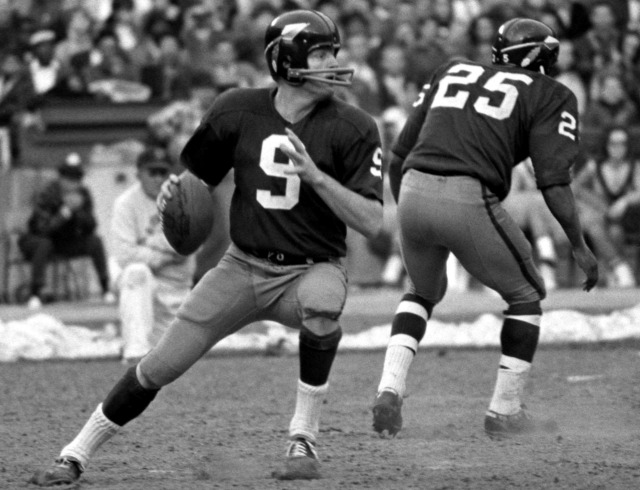
Sonny Jurgensen

November 27, 1966: The highest-scoring game in NFL history is played.

On December 8, 1940, the Chicago Bears won the NFL Championship Game, walloping the Washington Redskins, 73-0. That remains the most points by one team in a professional football game in America. The Redskins almost matched it, 26 years later.

On October 22, 1950, we received the answer to this question: What would have happened if the team with the best offense in NFL history played the team with the worst defense -- in each case, in terms of points per game? The Los Angeles Rams beat the Baltimore Colts, 70-27, and those 97 points were a new pro football record for most points for both teams, combined.

On December 22, 1963, the Oakland Raiders beat the Houston Oilers, 52-49, for a total of 101 points, a new pro football record. But that was in the American Football League, not the NFL.

From 1956 to 1963, the New York Giants reached the NFL Championship Game 6 times in 8 seasons, although they only won the 1st one. And the Washington Redskins hadn't made one since 1945, or won one since 1942. But by 1966, they were going in opposite directions: The Giants had gotten old and collapsed, while the Redskins had rebuilt, largely because, as the last NFL team that hadn't racially integrated, they had finally done so, with players like receivers Bobby Mitchell and Charley Taylor. Quarterback Sonny Jurgensen was a big acquisition as well.

And when they played each other at District of Columbia Stadium -- renamed Robert F. Kennedy Memorial Stadium in 1969 -- on November 27, the Sunday of Thanksgiving weekend, a new record was set.

At first, the game wasn't all that remarkable, except for the placekickers being brothers: Charlie Gogolak of the Redskins, and Pete Gogolak of the Giants. They were Hungarian immigrants, and, as Europeans, Pete was the 1st "soccer-style kicker" in the NFL, starting from the side and kicking the football with his instep, instead of kicking straight on with his toes; and Charlie was the 2nd.
Charlie Gogolak

A.D. Whitfield scored 2 touchdowns in the 1st quarter, one on a short pass from Jurgensen, the other on a 63-yard run. Charlie Gogoloak missed the extra point after the 1st touchdown. That would be the only one he would miss on this day.

There would be a lot more scoring in the 2nd quarter. Safety Brigman "Brig" Owens returned a fumble 62 yards for a touchdown, putting the 'Skins up 20-0. Allen Jacobs ran for a touchdown, putting the Giants on the board. But the Redskins got a 3rd touchdown from Whitfield, and one from Joe Don Looney. Gary Wood scored on a quarterback sneak to close the Giants to within 34-14 at the half. Early in the 3rd quarter, Wood threw a 41-yard touchdown pass to Joe Morrison, closing the Giants to within 34-21.

But that was as close as the G-Men would get. Jurgensen threw a 32-yard touchdown pass to Taylor. Wood threw a 50-yard touchdown pass to Homer Jones to close the Giants to within 41-28. But Jurgensen threw a 74-yard touchdown pass to Taylor, and it was 48-28 Washington after 3 quarters.

Rickie Harris returned a punt 52 yards for a touchdown, and it was 55-28. Owens returned an interception 60 yards for a touchdown, and it was 62-28. He thus became the 4th player to have returned both a fumble and an interception for a touchdown in the same game. The 1st was Champ Seibold of the Chicago Cardinals in 1942. There have now been 16 players to do it, 1 in the AFL. Oddly, not only did Seibold, the 1st, play on the losing side of the game in question, but so did probably the best player ever to do it: Aeneas Williams, also of the Cardinals, then in Phoenix, in 1993.
Brig Owens

The Giants switched quarterbacks, to Tom Kennedy, and he threw a touchdown pass to Aaron Thomas, making it 62-34. Kennedy led Big Blue down the field again, and Dan Lewis ran it in for a touchdown, and it was 62-41.

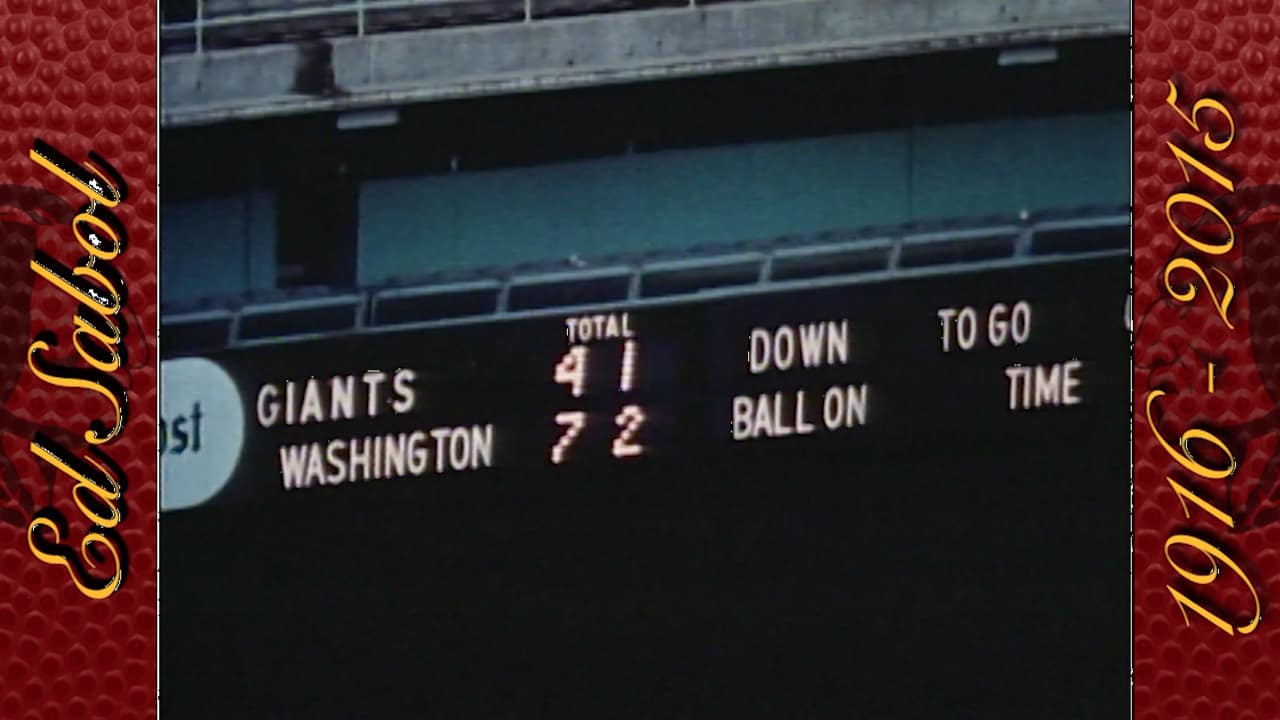
But Mitchell broke off a 45-yard run, and the Redskins had their 10th touchdown of the game. As time ran out, knowing that it wouldn't change much of anything, Redskin coach Otto Graham, once the great quarterback of the Cleveland Browns, ordered a field goal. Charlie Gogolak kicked it from 29 yards out. Final score: Redskins 72, Giants 41.
It was 1 point short of the most that any single team had scored. Combined, it was 113 points, a new American professional football record. Or, to put it another way: The Giants scored 41 points on the road, which would normally be something to be proud of... and didn't even come close to winning the ballgame.

Still, the Redskins struggled. The finally got to another title game in the 1972 season, winning the NFC Championship, but losing Super Bowl VII. From 1982 to 1991, 10 seasons, they reached 4 Super Bowls, winning 3. They have not been back to the NFC Championship Game since.

The Giants had their good moments over the next few years, including a 62-10 win over the Philadelphia Eagles in 1972. But they didn't make the Playoffs again until 1981. They have since been to 5 Super Bowls, winning 4 of them.

The highest-scoring NFL game since this one came 38 years later, almost to the day: On November 28, 2004, the Cincinnati Bengals beat their arch-rivals, the Cleveland Browns, 58-48 at what's now named Paycor Stadium in Cincinnati, for a total of 106 points.

*

November 27, 1966 was a Sunday. These other games were played in the NFL that day:

* The Los Angeles Rams beat the Baltimore Colts, 23-7 at Memorial Stadium in Baltimore.

* The Chicago Bears beat the expansion Atlanta Falcons, 23-6 at Wrigley Field in Chicago.

* The Green Bay Packers beat the Minnesota Vikings, 28-16 at Metropolitan Stadium in the Minneapolis suburb of Bloomington, Minnesota.

* The football version of the St. Louis Cardinals beat the Pittsburgh Steelers, 6-3 at the new Busch Memorial Stadium in St. Louis.

* Three days earlier, on Thanksgiving Day, the San Francisco 49ers beat the Detroit Lions, 41-14 at Tiger Stadium in Detroit.

* That was also the 1st time the Dallas Cowboys played at home on Thanksgiving, beating the Cleveland Browns, 26-14 at the Cotton Bowl in Dallas.

* And, with the arrival of the Falcons, but not yet the New Orleans Saints until the next season, there being an odd number of teams in the NFL (15), it was the Philadelphia Eagles' turn to have the bye week.

In the American Football League: 

* The New York Jets lost to the Kansas City Chiefs, 32-24 at Shea Stadium.

* The Boston Patriots beat the expansion Miami Dolphins, 20-14 at the Orange Bowl in Miami.

* The Denver Broncos beat the San Diego Chargers, 20-17 at Bears Stadium in Denver. (It was renamed Mile High Stadium in 1968.)

* The Buffalo Bills beat the Oakland Raiders, 31-10 at the new Oakland-Alameda County Coliseum.

* And, with the arrival of the Dolphins, but not yet the Cincinnati Bengals until the 1968 season, there being an odd number of teams in the AFL (9), it was the Houston Oilers' turn to have the bye week.

Baseball was in the off-season. No games were scheduled for the NBA that day. There were 2 NHL games played. The New York Rangers beat the Toronto Maple Leafs, 5-0 at the old Madison Square Garden. And the Chicago Black Hawks beat the Boston Bruins, 5-4 at the Boston Garden. The Montreal Canadiens and the Detroit Red Wings were not scheduled.

December 31, 1999 & January 1, 2000: The Millennium

December 31, 1999:  The Millennium arrives. The people of planet Earth survived. At a terrible cost. But we hadn't destroyed ourselves. ...