Showing posts with label grover cleveland alexander. Show all posts

Monday, October 10, 2022

October 10, 1926: Grover Cleveland Alexander vs. Tony Lazzeri

October 10, 1926: For the 1st time, Yankee Stadium hosts a Game 7 of the World Series. The Yankees trail the St. Louis Cardinals 3-2 in the bottom of the 7th inning, but Cardinal starter Jesse Haines, a future Hall-of-Famer, develops a blister on his hand, and can’t pitch any further.

Rogers Hornsby, the great-hitting 2nd baseman who doubles as the Cardinal manager, brings in another future HOFer, Grover Cleveland Alexander. Old Alex (also nicknamed "Pete") had pitched and won Game 6 the day before, but celebrated afterward, and legend has it that he was really hungover.

Even if he wasn't, he had gone the distance the day before. And he was 39 years old, and an alcoholic, and also suffered from epilepsy, and was troubled by what he had seen in World War I (which, along with his epilepsy, he tried to treat with his drinking.)

He was, and nearly 100 years later he remains, one of the greatest pitchers of all time. He would retire with a total of 373 victories, tied for 3rd all-time with Christy Mathewson (sharing 1st all-time in National League wins, as Walter Johnson's 417 were all in the American League and Cy Young's 511 were split between both Leagues). But in the Autumn of 1926, he was a shadow of his former self.

And he comes in with a 1-run lead, the bases loaded, and a dangerous hitter at the plate, Tony Lazzeri. Although just a rookie at the major-league level, the nearly 23-year-old native of San Francisco had hit 60 home runs in a Pacific Coast League season, and would have been the American League's Rookie of the Year had the award existed in 1926.

Italians in New York loved how his hits would "push up" baserunners, and, in their accent, he became known as "Poosh-em-Up Tony." Aside from Babe Ruth, he was probably already the 2nd-most popular player on the Yankees, ahead of Lou Gehrig. (He would not remain so, as Gehrig's 1927 season allowed him to surpass all ballplayers except Ruth in popularity.)

Lazzeri hits a long drive down the left-field line, but just foul. That brings the count to 0-and-2.  Alexander fires in, and Lazzeri swings and misses. He's out.

It is the most famous strikeout in baseball history -- unless you want to count the one by "the mighty Casey" in Ernest Thayer's poem "Casey At the Bat" -- and, according to legend, it ended the World Series, turning Alexander into a bigger hero than ever.

Except it didn't end the game. There were 2 more innings to play. Alexander got through the 8th, and with 1 out to go in the 9th, he walked Babe Ruth. Then, for reasons known only to him -- Yankee manager Miller Huggins said he hadn't given him the signal to try -- the Babe tried to steal 2nd base. Catcher Bob O’Farrell threw in, and Hornsby slapped the tag on him.

The Babe was out, the game was over, and for the 1st time in 40 years -- since the Cardinals, then known as the Browns, won the 1886 American Association Pennant and defeated the Chicago team now known as the Cubs in a postseason series -- a St. Louis baseball team was World Champions.

This was also the 1st time the Yankees had played a Game 7 of a World Series, and they lost it. Actually, the Yankees' record in World Series Game 7s isn't especially good. They've won in 1947, 1952, 1956, 1958 and 1962; and they've lost in 1926, 1955, 1957, 1960, 1964 and 2001, for a record of 5-6. At home at the old Yankee Stadium, it was even worse: 1-3. But they've still won more World Series in a Game 7 than all but 6 franchises have won Series regardless of how long they've gone – and the number drops to 4 if you only count the Series they've won in their current cities.

Alexander was a hero all over again. But it was a last stand. He helped the Cards back into the World Series in 1928, but, that time, the Yankees knocked him around. He spent much of his retirement walking into bars, and trading his story of how he struck out Lazzeri for drinks.

In 1945, interviewed for John P. Carmichael’s book My Greatest Day In Baseball, he told of meeting Lazzeri on the street in New York, and telling him, "Tony, I'm getting tired of fanning you." And Lazzeri told him, "Perhaps you think I'm not." Alexander's health problems killed him in 1950, aged only 63.

Incredibly, he outlived Lazzeri. Poosh-em-Up Tony would rebound from this strikeout to help the Yankees win 5 World Series, bridging the 1920s Ruth-Gehrig Yankees to the 1930s Gehrig-DiMaggio Yankees. But he, too, had epilepsy. In 1946, he suffered a seizure at his home, fell down the stairs, and broke his neck. He was just 43.

And, unlike Alexander, he did not live long enough to see his election to the Baseball Hall of Fame. He was finally elected in 1991, 53 years after Alexander was so honored. Sadly, for all each man did, each had a hard life, and each is still best remembered for that one at-bat.

This is due in large part to the 1952 film The Winning Team, starring Ronald Reagan as Alexander, Doris Day as his wife Annie, and Frank Lovejoy as Hornsby.
Reagan as Alexander

Bob Lemon, still in the middle of a Hall of Fame career as a pitcher at that point, played Jesse Haines. Also playing players were real-life players Harry "Peanuts" Lowery, George "Catfish" Metkovich, Irv Noren, Hank Sauer, Al Zarilla, and future managing star Gene Mauch. But the actor playing Lazzeri is not credited.

In 1949, Ogden Nash, my grandmother's favorite poet, wrote "Line-Up for Yesterday" for Sport magazine, an alphabetical list of star players. For the letter A, he wrote:

A is for Alex
The great Alexander;
More Goose eggs he pitched
Than a popular gander.

The last survivor from the 1926 World Champion St. Louis Cardinals was infielder George "Specs" Toporcer -- so nicknamed because he was one of the few players to wear glasses on the field in that era -- a Manhattan native who died in 1989 on Long Island, age 90.

UPDATE: The Cardinals have a team Hall of Fame. From their 1926 World Champions, they have inducted team owner Sam Breadon, general manager Branch Rickey, 2nd baseman and manager Rogers Hornsby, 1st baseman Jim Bottomley, left fielder Charles "Chick" Hafey and pitcher Jesse Haines -- but, oddly, through the 2025 season, not pitcher Grover Cleveland Alexander.

Bottomley and Hornsby were elected to the St. Louis Sports Hall of Fame. Rickey and Hornsby were elected to the Missouri Sports Hall of Fame.

Tony Lazzeri is in the Baseball Hall of Fame, but has never been honored with a Plaque in Monument Park at Yankee Stadium. When the Yankees began wearing uniform numbers, he was given 6. The Yankees have retired that number, but for later manager Joe Torre.

*

October 10, 1926 was a Sunday. Obviously, this was the only baseball game of the day. And basketball and hockey were out of season. These NFL games were played that day:

* The New York Giants lost to the Chicago Bears, 7-0 at Wrigley Field in Chicago.

* The Brooklyn Lions beat the Hartford Blues, 6-0 at Ebbets Field.

* The Providence Steam Roller (for some reason, never written with an S on the end) beat the Columbus Tigers, 19-0 at the Providence Cycledrome.

* The Pottsville Maroons beat the Dayton Triangles, 24-6 at Minersville Park in Pottsville, Pennsylvania.

* The Akron Indians and the Canton Bulldogs, neighbors and arch-rivals, played to a 0-0 tie at League Park in Akron.

* The Detroit Panthers beat the Kansas City Cowboys, 10-0 at Navin Field in Detroit. (It was renamed Briggs Stadium in 1938, and Tiger Stadium in 1961.)

* The Duluth Kelleys beat the Hammond Pros, 26-0 at Turner Field in Hammond, Indiana, outside Chicago.

* The Milwaukee Badgers beat the Racine Tornadoes, 13-2 at Horlick Field in Racine, Wisconsin.

* The Chicago Cardinals beat the Green Bay Packers, 13-7 at Green Bay City Stadium.

This was also the season of the 1st league to be named the American Football League. But it only played 2 games on this day:

* The Brooklyn Horsemen lost to the Los Angeles Wildcats, 23-0 at Commercial Field in Brooklyn. Both teams were named for their star players: The Horsemen had Harry Stuhldreher and Elmer Layden, two of "The Four Horsemen of Notre Dame"; while the Wildcats had George "Wildcat" Wilson, star back of the University of Washington.

* And the Rock Island Independents, formerly a team in the NFL, beat the 1st sports team named the Chicago Bulls, 7-3 at Browning Park in Moline, Illinois. Moline and Rock Island, Illinois and Davenport and Bettendorf, Iowa, on opposite sides of the Mississippi River, are known as the Quad Cities. After this season, it became clear that the Quad Cities, even all put together, were way too small to host a major league sports team -- even if the NFL wasn't really "major league" at this point, and the original AFL certainly wasn't.

That year, there were 22 teams in the NFL, and 9 teams in the AFL. The market was overestimated, and saturated: It was too much, even in the prosperous "Roaring Twenties." A total of 31 professional football teams wouldn't be matched again until 1999.

Sunday, October 9, 2022

October 9, 1915: The 1st President at a World Series Game

Woodrow Wilson. Edith Galt is under his left arm.

October 9, 1915: Game 2 of the World Series is played at Baker Bowl in Philadelphia. President Woodrow Wilson becomes the 1st incumbent President to attend a World Series game, and the 1st to throw out a ceremonial first ball at one. He is accompanied by his fiancée, Edith Galt.

The Philadelphia Phillies, in the National League since 1883, had won their 1st Pennant, managed by Pat Moran. Their pitching staff allowed the fewest runs in the NL, led by Grover Cleveland Alexander, who, though no one thought of the term at the time, won "the Triple Crown of Pitching": Leading the NL in wins (going 31-10), strikeouts (241) and earned-run average (ERA, 1.22). And right fielder Clifford Carlton "Gavvy" Cravath, the NL's top slugger in that "dead ball" decade, led it in home runs with 24 and RBIs with 115.
Baker Bowl

The Boston Red Sox, World Champions in 1912, were back, managed by Bill Carrigan, led by center fielder Tris Speaker, and a starting rotation of Smoky Joe Wood, George "Rube" Foster, Ernie Shore, Hubert "Dutch" Leonard, and a rookie lefthander named George Herman "Babe" Ruth, who was 18-8 with a 2.44 ERA. Had there been a Rookie of the Year award at the time, he surely would have won the AL's award.

At the time, home-field advantage in the World Series was decided by a coin flip, which the Phillies won. William F. Baker, their owner, who had renamed the ballpark for himself, chose to have Games 1 and 2 at home. The Phillies won Game 1, 3-1, with Alexander outpitching Shore. Ruth pinch-hit for Shore in the 9th inning, and grounded to 1st. It would be his only appearance in the Series.

No one knew it at the time, but the Phillies would not win another World Series game for 65 years.

Wilson threw out the first ball for Game 2, and Foster not only went the distance for Boston, but singled home the winning run in the top of the 9th. The Red Sox won, 2-1.

The season before, when the Boston Braves won the NL Pennant, they were in the process of building Braves Field to replace the small, antiquated South End Grounds, and the Red Sox offered them the use of the larger Fenway Park. They won the World Series. This time, with the even larger Braves Field opened, the Braves returned the favor, and the Red Sox played their World Series home games there in 1915, 1916 and 1918, instead of a mile to the east at Fenway.

They felt right at home on Commonwealth Avenue: They won Game 3, 2-1, with Leonard beating Alexander; Game 4, 2-1, with Shore outpitching George Chalmers; and Game 5, 5-4, with Harry Hooper hitting 2 home runs, aiding Foster as he outpitched Eppa Rixey to clinch the title.

The Red Sox won again in 1916, beating the Brooklyn Dodgers. Carrigan then resigned, and remains the only manager to lead a Boston team to back-to-back World Series wins. Under Ed Barrow, they won again in 1918.

Pat Moran had been a catcher, and had retired after the previous season to become the Phils' manager. He was fired after the 1918 season, was immediately hired by the Cincinnati Reds, and led them to win the 1919 World Series. Rixey would later pitch for him on the Reds, and reach the Hall of Fame.

Shortly before the 1924 season began, while still officially the Reds' manager, he died at the age of 48, of nephritis, a kidney ailment known as Bright's disease -- treatable with antibiotics today, but, at the time, a death sentence within 5 years. Boxer Billy Miske, who had fought Jack Dempsey for the Heavyweight Championship of the World, had just died from it. So did Wilson's 1st wife, Ellen, in 1914. So did Theodore Roosevelt's 1st wife, Alice, in 1884. And so did former President Chester Arthur, in 1886.

In 1978, the Phillies instituted the Philadelphia Baseball Wall of Fame, electing a Phillies figure every year since, and a Philadelphia Athletics figure every year until 2003. From the 1915 Pennant winners, the Phils have elected only Grover Cleveland Alexander and Gavvy Cravath.

It says something about the quality of the Phillies' 1st 90 years of existence that, of the players who played for them from their founding in 1883 until 1914, but not on the 1915 Pennant winners, the only ones elected to that Wall of Fame have been Sam Thompson, Billy Hamilton, Ed Delahanty and Sherry Magee. And that, of the players who played for them from 1916 to 1949, but not on the 1915 or the 1950 Pennant winners, the only ones have been Cy Williams and Chuck Klein.

Thompson, Delahanty, Alexander, Cravath, Williams, Klein and Bucky Walters -- Walters mainly because he was from Philadelphia but excelled elsewhere, with the Cincinnati Reds -- have also been elected to the Philadelphia Sports Hall of Fame.

*

October 9, 1915 was a Saturday. Author Belva Plain was born on this day. So was Clifford Hansen, who served as the 1st President of the University of Nebraska system, and as U.S. Secretary of Agriculture from 1969 to 1971.

Among the college football games played that day were these:

* Army beat Gettysburg College, 22-0 on The Plain at West Point, New York.

* Navy lost to the University of Pittsburgh, 47-12 at Worden Field in Annapolis, Maryland.

* Harvard beat the post-Jim Thorpe Carlisle Indian School, 29-7 at Harvard Stadium in Boston.

* Penn State beat the University of Pennsylvania, 13-3 at the original Franklin Field in Philadelphia.

* Notre Dame beat Haskell Indian Institute, 34-0 at Cartier Field in South Bend, Indiana. Now the Haskell Indian Nations University, they compete in the NAIA, essentially NCAA Division IV.

* The University of Chicago beat Northwestern, 7-0 at Northwestern Field in the Chicago suburb of Evanston, Illinois.

* Colorado Agricultural College beat the University of Colorado, 23-6 at Gamble Field in Boulder, Colorado. CAC became Colorado A&M in 1935, and Colorado State University in 1957.

* And in New Jersey, Rutgers beat Rensselaer Polytechnic Institute (RPI), 96-0 at Neilson Field in New Brunswick; while Princeton beat Syracuse, 3-0 at Palmer Stadium in Princeton.

And in English soccer, North London team Arsenal went to Hertfordshire, and lost to Watford FC, 1-0 at Cassio Road in Watford.

Monday, May 23, 2022

May 23, 1918: The "Work Or Fight" Order

Major General Enoch Crowder

May 23, 1918: With U.S. troops now in combat in World War I, the U.S. Department of War issues what becomes known as the "Work or Fight" order. It was ordered by the Secretary of War, Newton D. Baker, and implemented by the Provost Marshal of the Army, Major General Enoch Crowder.

As of July 1, those of draft age engaged in unproductive industries, or found "loafing around a poolroom," would be liable to be called up for military service, even if they had previously been exempted for other reasons.

The categories of "unproductive industries" included restaurant staff, doormen and elevator operators, the entire entertainment industry excluding actors, servants, and store clerks.

Exemptions could be provided for night shift workers, if it were found that the only replacements available for their jobs would be women. Notably not exempted were baseball players. The 1918 season would ultimately be cut short by several weeks as a result.

More importantly, the Work Or Fight order had clear racial implications. One circuit court clerk in Maryland estimated that 90 percent of those who ran afoul of the "anti-loafing" laws were black.  Throughout the South, States eagerly enforced the Work or Fight rule to supplement existing Jim Crow vagrancy laws. Throughout the country, many of the occupations specifically targeted by the rule were predominantly black.

And since, with limited exceptions, black soldiers were not allowed to fight, the Work or Fight rule essentially amounted to a forced labor program for black men -- what became known as "slavery by another name." In some cases, however, particularly among hotel waitstaff, young white men were replaced with black men outside of draft age.

Back to baseball. The season was cut short, but the War Department (renamed the Department of Defense in 1947) allowed them to play the World Series in September, with nobody having any idea of when they would start again. In World War II, it would be different: There was a Commissioner, a former federal Judge, who asked the President what he should do: Play the 1942 season and beyond, or suspend operations. The President wrote what became known as "The Green Light Letter." But there was no such letter in 1918.

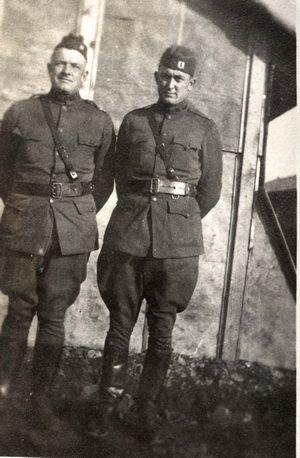
Some players served. The great pitcher Grover Cleveland Alexander was already a heavy drinker, and the heavy shelling damaged his hearing, instigated the epilepsy that would plague him for the rest of his life, and accelerated his alcoholism.

Christy Mathewson, Ty Cobb and George Sisler were made officers -- Captain, Captain and Lieutenant, respectively -- and assigned to the Army's Chemical Warfare Service (now the Chemical Corps), under the command of Major Branch Rickey, not yet the man who invented the farm system and reintegrated the game, but already having served as a major league catcher, head coach at the University of Michigan, and the general manager of both St. Louis teams, the Cardinals and the Browns.

Big Six, the Georgia Peach and Gorgeous George were training soldiers in preparation for the war's notorious chemical attacks by exposing them to gas chambers in a controlled environment. But it wasn't "controlled" well enough: Mathewson got a lungful of gas, and it damaged his lungs. Strike one. Then he got hit with the Spanish Flu. Strike two.
Captain Christopher Mathewson and Captain Tyrus R. Cobb,
U.S. Army, Chemical Warfare Division

His lungs already weakened twice over, in an age before antibiotics, he contracted tuberculosis. He was treated at the famed Adirondack Cottage Sanitarium at Saranac Lake in upper New York State, tried to return to baseball as a coach with the Giants and an executive with the Braves, but had to go back. After years of "fouling pitches off," it was strike three. He died in 1925, just 45 years old.

Failure to join up, or resisting the draft, made you a "slacker," and that was worse, at the time, than being called a Communist. Bernie Morris, who had helped the Seattle Metropolitans become the 1st U.S.-based Stanley Cup winners in 1917, was arrested on the eve of the 1919 Finals for draft dodging. He was convicted, and sentenced to 2 years in prison. He appealed, and got the charges dropped in time for him to be allowed to play for the Metropolitans in the 1920 Playoffs.

Jack Dempsey won the Heavyweight Championship of the World in 1919, but he hadn't served in World War I. In 1920, a photo was produced showing Dempsey working in a shipyard, which should have ended the controversy right there. But someone noticed that he was wearing patent leather shoes in the photo, making some people think the photo was staged to take the curse off him.

Soon, evidence came to light that he had tried to enlist, but, despite being a very strong man for his size (he'd be classified as a cruiserweight today), the Army had classified him "4-F": "Registrant not acceptable for military service." This classification is nearly always applied to a person who fails either the physical or the psychological examination upon enlistment or reporting for the draft.

But some people still weren't satisfied. This became especially controversial in 1921, when he defended his title against the Light Heavyweight Champion, Georges Carpentier, a French pilot who had been awarded the Croix de Guerre and the Médaille Militaire. The contrast between the much-decorated Carpentier and the "slacker" Dempsey was staggering. Dempsey knocked Carpentier out in the 2nd round. It wasn't until Dempsey was "robbed" in the "Long Count" fight of 1927 that he became a near-universal hero.

What about Babe Ruth? He played for the Red Sox all the way through that 1918 World Series. Indeed, the war has been credited with moving him from the position of pitcher to right field, because the manpower drain had taken Sox pitchers. This made him an everyday player and an everyday hitter, setting him up to become the greatest baseball player who ever lived.

How did he respond to the Work Or Fight order? Until the World Series was over, he didn't respond to it at all. He kept on playing, exposing himself to the draft -- which he had every legal right to do. Once it ended, he gained exemption from the draft by accepting a nominal position with a Pennsylvania steel mill. The end of the war in November set Ruth free to play baseball without such contrivances.

I will leave it to the individual reader to decide whether Ruth's method of avoiding military service, while completely legal, was moral. However, unlike with what Dempsey did in 1917 and 1918, and unlike Mickey Mantle, who was exempt from service in the Korean War of the early 1950s because of his osteomyelitis, nobody ever called Ruth a "slacker" or a "coward."

Alvin Crowder, later to be an All-Star pitcher for the Washington Senators and the Detroit Tigers, was nicknamed "General" Crowder in remembrance of Enoch, who lived until 1932. Newton Baker died in 1937.

*

May 23, 1918 was a Thursday. These baseball games were played that day:

* The New York Giants beat the St. Louis Cardinals, 6-4 at Robison Field in St. Louis. Art Fletcher doubled home the winning run in the top of the 14th inning. Ross Youngs, George Burns (not the entertainer), Heinie Zimmerman and Lew McCarty each got 3 hits for the Giants. Rogers Hornsby singled as a pinch-hitter.

* The Brooklyn Robins (as the Dodgers were known while Wilbert Robinson managed them from 1914 to 1931) lost to the Chicago Cubs, 5-0 at Weeghman Park in Chicago. (It was renamed Cubs Park in 1920 and Wrigley Field in 1926.) Harry Weaver pitched a 4-hit shutout. Zack Wheat went 0-for-4.

* The Cleveland Indians beat the Boston Red Sox, 1-0 at Fenway Park in Boston. The Indians; Tris Speaker went 1-for-4 against his former team. The only run came in the top of the 4th inning, when Robert "Braggo" Roth doubled Ray Chapman home off Sad Sam Jones. Guy Morton allowed just 1 hit, a single by Amos Strunk in the bottom of the 7th.

* The St. Louis Browns beat the Washington Senators, 3-2 at American League Park (later Griffith Stadium) in Washington. An Earl Smith triple and a Les Nunamaker single in the top of the 9th inning gave the Browns a come-from-behind win. George Sisler went 2-for-4.

* The Philadelphia Phillies beat the Pittsburgh Pirates, 3-2 at Forbes Field in Pittsburgh.

* The Boston Braves beat the Cincinnati Reds, 4-3 at Redland Field in Cincinnati. (It was renamed Crosley Field in 1934.)

* The New York Yankees and the Chicago White Sox were rained out at the Polo Grounds. The game was made up as part of a doubleheader on July 9. The Yankees won the opener, 6-4. The White Sox won the nightcap, 4-3, when John "Shano" Collins singled Charles "Swede" Risberg home with the winning run in the top of the 10th inning. 

Over the 2 games, Eddie Collins -- Hall of Fame 2nd baseman, and no relation to Shano -- went 2-for-7 with a walk, a stolen base and 2 RBIs. "Shoeless" Joe Jackson was observing the Work Or Fight order by working in a shipyard.

* And the Philadelphia Athletics and the Detroit Tigers were rained out at Shibe Park in Philadelphia. The game was also made up as part of a doubleheader on July 9. The A's won the 1st game, 3-1. The Tigers won the 2nd game, 5-4. Over the 2 games, Ty Cobb went 4-for-8 with a stolen base.

December 31, 1999 & January 1, 2000: The Millennium

December 31, 1999:  The Millennium arrives. The people of planet Earth survived. At a terrible cost. But we hadn't destroyed ourselves. ...