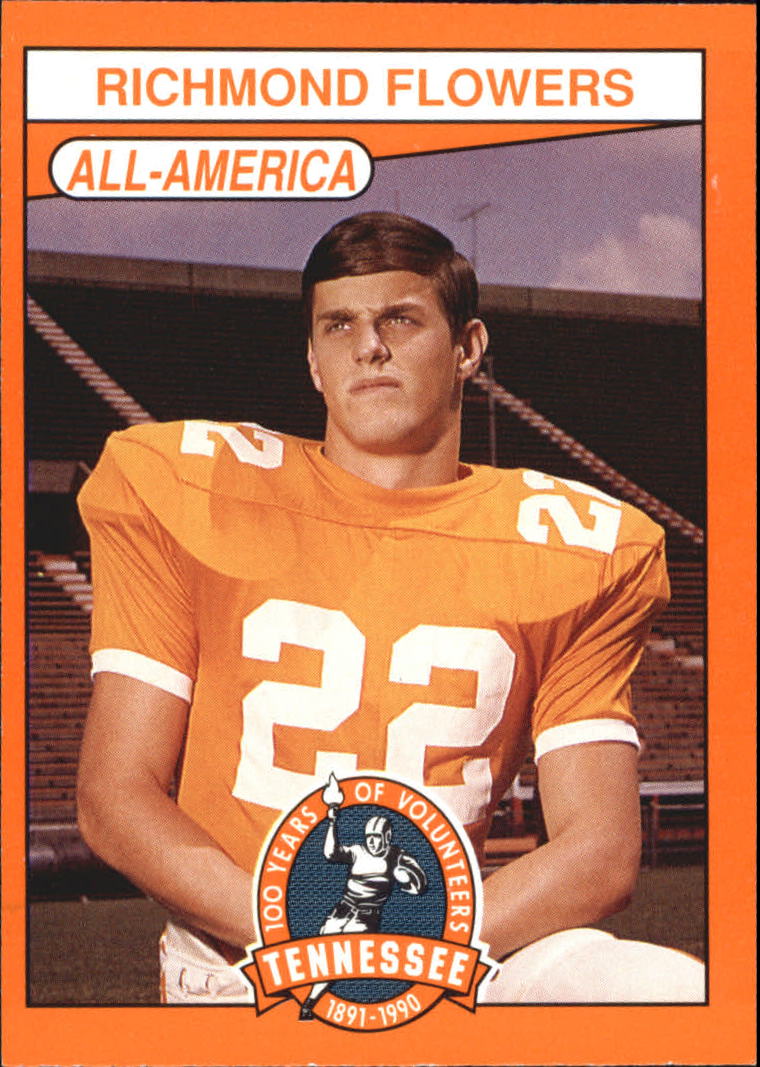
Richmond Flowers was from Dothan, Alabama. He got his undergraduate degree from Auburn University and his law degree from the University of Alabama -- making him a War Eagle and a Roll Tide. He enlisted in the U.S. Army in World War II, rose to the rank of Captain, and served on General Douglas MacArthur's special staff during the occupation of Japan.
In 1954, he was elected to the Alabama State Senate. In 1962, he ran for the office of State Attorney General, and won -- in the same election in which George Wallace was first elected Governor. Unlike Wallace, whose inaugural address promised, "Segregation now, segregation tomorrow, and segregation forever!" Flowers was a genuine 1960s-style liberal.

Richmond Flowers Sr.
He argued a landmark case before the U.S. Supreme Court: Reynolds vs. Sims, announced on June 15, 1964. It struck down discriminatory State legislature district-drawing, which was almost entirely done in Southern States, to give white rural areas provenance over cities with black people in them; and ruled that districts for State legislatures must be roughly equal in population. These cases established the concept of "One man, one vote." (Now known as, "One person, one vote.")
Flowers also fought to aid the application of the federal law requiring public school desegregation, and successfully prosecuted members of the Ku Klux Klan, which was previously considered legally untouchable. Unused to challenges to their authority, they threw bricks through his house's windows, and burned crosses on his lawn on multiple occasions. He became known as "the most hated white man in Alabama."
At the time, the Constitution of the State of Alabama stated that the Governor could not succeed himself. So Wallace put his wife Lurleen up in the Primary. To fight this effort to have Lurleen be a puppet for her husband, Flowers ran. So did former Governors James Folsom and John Patterson. Unfortunately, this split the anti-Wallace vote, and Lurleen won. She died in mid-term, but George won again in 1970, after having run for President on a 3rd-party ticket in 1968.
The Klan's allies in the State government, no longer facing a State Department of Justice controlled by Flowers, got their revenge. He was indicted for extortion, trying to get payments from companies seeking licenses to do business in Alabama while he was Attorney General. To the end of his life, he insisted he was innocent.
His son, Richmond Flowers Jr., was a high school football and track star. Alabama coach Paul "Bear" Bryant wanted him at Alabama. Lots of people wanted him at Alabama. He refused, because of the way his home State treated his father. He went to the University of Tennessee, because his preferred sport was track, and while Alabama then had a decisive edge in football, Tennessee had an even more pronounced one in track.
He still played both sports, and helped to, pardon the pun, turn the tide of the football games in Tennessee's favor. He quit football after the 1967 season, so he could concentrate on making the U.S. Olympic team as a hurdler. But an injury ruined his chances of making the 1968 Olympics, where the U.S. track team included record-breakers Jim Hines, Lee Evans, Dick Fosbury, Al Oerter, Wyomia Tyus, and the great rebels Tommie Smith and his race's Bronze Medalist, John Carlos.
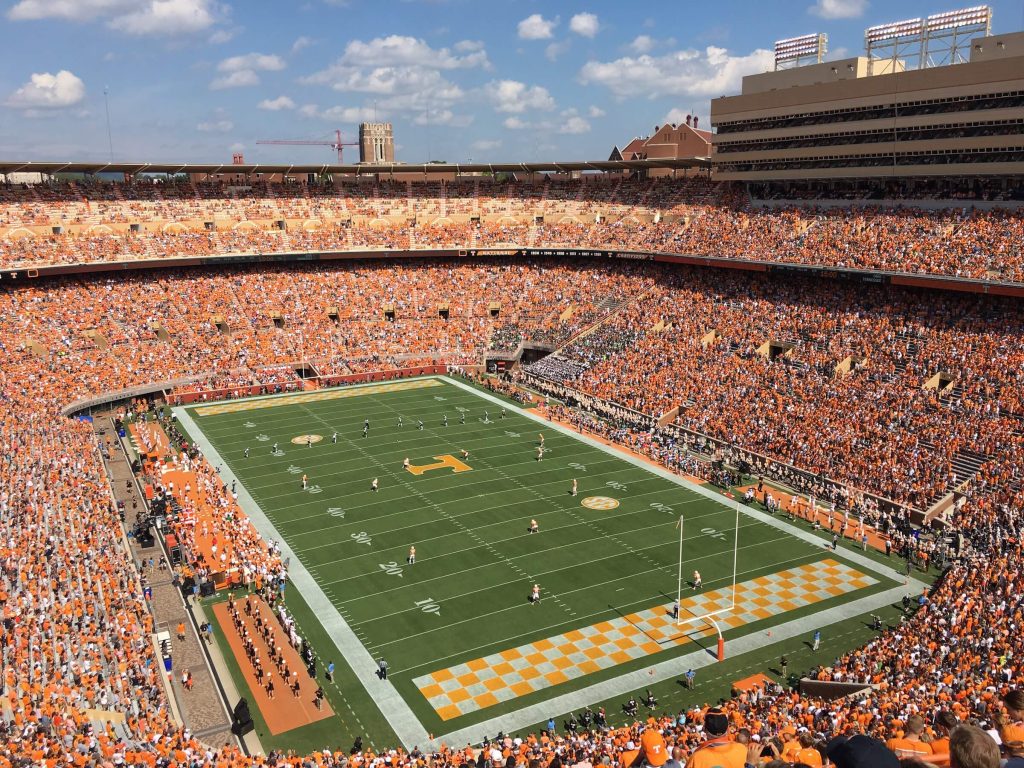
Tennessee coach Doug Dickey welcomed Richmond Jr. back onto the football team. Every year, "The Third Saturday In October," is when Tennessee plays neighboring Alabama. That will include this coming Saturday, when they will meet at Neyland Stadium in Knoxville. Alabama leads the series 58-38-8.
On October 19, 1968, they played in Knoxville. Awaiting trial, Richmond Sr. was escorted by FBI agents, and wearing handcuffs, into Neyland Stadium, to watch his son play. Richmond Jr., a receiver, caught a pass for the game's only touchdown. Tennessee won, 10-9.
The Vols' glory would be short-lived: Three weeks later, they lost to Auburn in Birmingham, costing them the Southeastern Conference title. They did get invited to the Cotton Bowl in Dallas, where they lost to Texas.
The following year, Richmond Sr. was convicted -- as if there was any doubt that a jury of 12 white Alabamians would put him away. He was sentenced to 8 years, but was paroled after 16 months. In 1978, President Jimmy Carter, former Governor of Georgia, pardoned him.
He returned to his hometown of Dothan, and taught history and criminal justice at a community college there -- ironically named George C. Wallace State Community College, named for the father of his political rival. In 1989, CBS aired the TV-movie Unconquered, written by Pat Conroy, author of The Lords of Discipline and The Prince of Tides. Richmond Sr. was played by Peter Coyote, and Richmond Jr. by Dermot Mulroney. Richmond Flowers Sr. died in 2007, at age 89.
Richmond Flowers Jr. was drafted by the Dallas Cowboys in 1969, and was used as a safety and a kick returner. In 1971, he became a New York Giant, and intercepted 4 passes in the 1972 season. He got hurt in 1973, and played in the World Football League in 1974 before retiring.

He finally went to the University of Alabama, getting his law degree there as his father did before him. He practiced law, got involved in commodities trading, and is now retired. Sadly, he supports Donald Trump, thus betraying everything his father stood for.
His son, Richmond Flowers III, followed his father into hurdling, college football, and the Cowboys. He became an assistant coach, and is now an agent for football coaches.

He returned to his hometown of Dothan, and taught history and criminal justice at a community college there -- ironically named George C. Wallace State Community College, named for the father of his political rival. In 1989, CBS aired the TV-movie Unconquered, written by Pat Conroy, author of The Lords of Discipline and The Prince of Tides. Richmond Sr. was played by Peter Coyote, and Richmond Jr. by Dermot Mulroney. Richmond Flowers Sr. died in 2007, at age 89.
Richmond Flowers Jr. was drafted by the Dallas Cowboys in 1969, and was used as a safety and a kick returner. In 1971, he became a New York Giant, and intercepted 4 passes in the 1972 season. He got hurt in 1973, and played in the World Football League in 1974 before retiring.
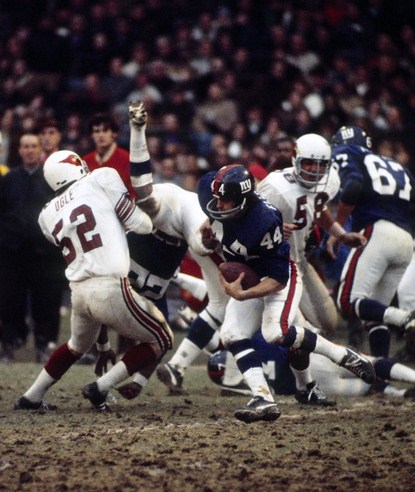
Richmond Flowers Jr.,
playing for the New York Giants at Yankee Stadium
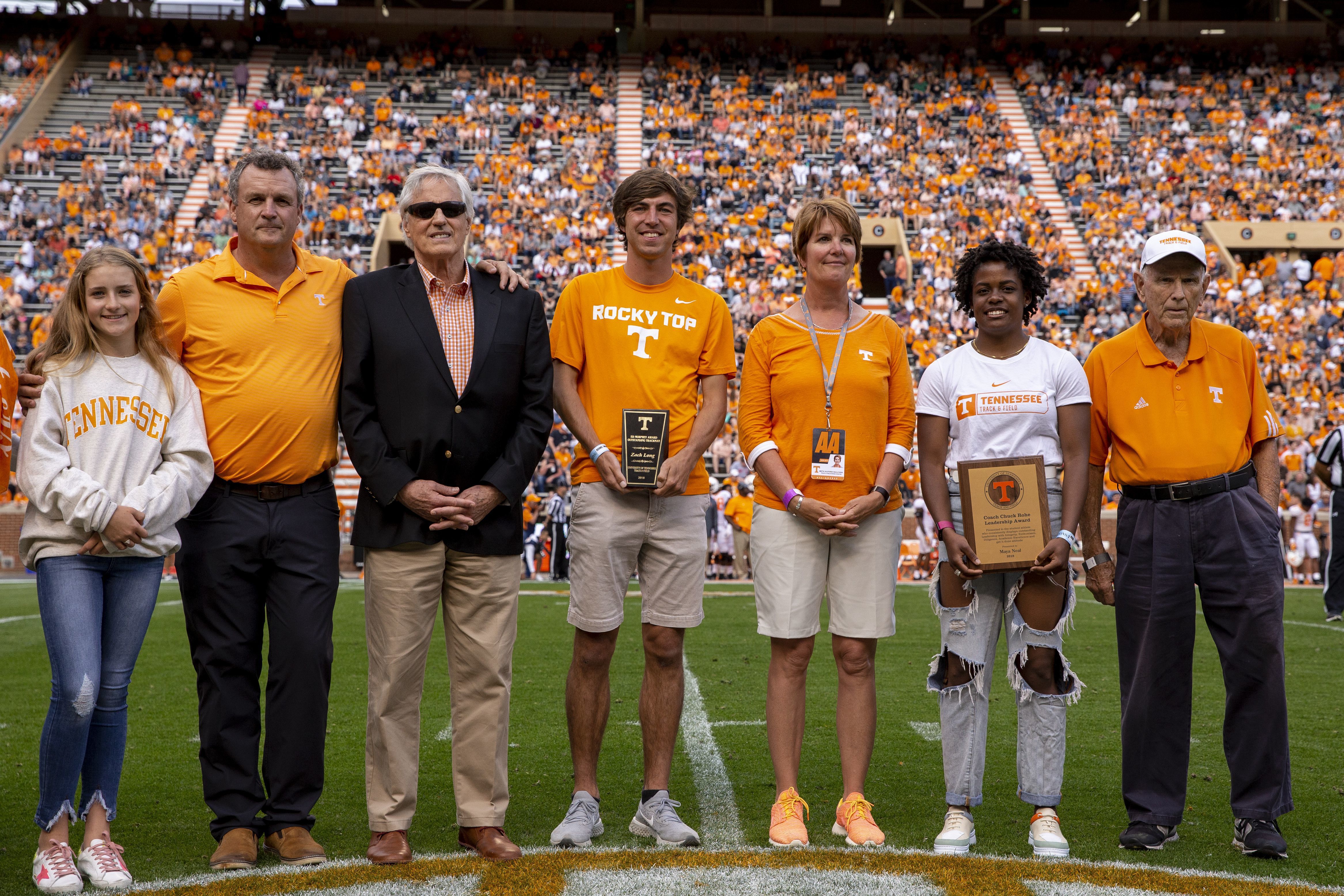
The Flowers family, honored on the 50th Anniversary of the game,
at Neyland Stadium in Knoxville, 2018.
Richmond Jr. is in the shades, 3rd from left.
Richmond III, right, with Los Angeles Rams head coach Sean McVay
*
October 19, 1968 was a Saturday. Among the other college football games played that day:
* Number 1 Southern California beat Washington, 14-7 at the Los Angeles Memorial Coliseum. USC won the Pacific-Eight Conference title, led by Heisman Trophy-winning running back O.J. Simpson.
* Number 2 Ohio State beat Northwestern, 45-21 at Ohio Stadium in Columbus. Ohio State won the Big Ten Conference title, then beat USC in the Rose Bowl for the National Championship.
* Number 3 Penn State had the week off. They finished the season undefeated.
* Number 4 Kansas beat Oklahoma State, 49-14 at Memorial Stadium in Lawrence, Kansas. Kansas won the Big Eight Conference title, but lost the Orange Bowl to Penn State. Penn State thought they deserved the National Championship as much as Ohio State did. This was the 1st time Joe Paterno's Nittany Lions thought they'd gotten robbed by the voters. It would not be the last.
* Number 5 Purdue beat Wake Forest, 28-27 at Ross-Ade Stadium in West Lafayette, Indiana. Purdue had already blown their shot at Big Ten and national honors the week before, losing their Number 1 ranking by losing to Ohio State.
* Number 6 Notre Dame beat Illinois, 58-8 at Notre Dame Stadium in South Bend, Indiana. Notre Dame had already blown their chance at national honors by losing to Purdue, and would later lose to Michigan State, although they did hold USC to a tie at the Coliseum on Thanksgiving Saturday.
* Number 7 Florida were upset by North Carolina, 22-7 at Kenan Stadium in Chapel Hill, North Carolina.
* Number 9 Arkansas were upset by Number 17 Texas, 39-29 at Memorial Stadium in Austin, Texas. This game decided the Southwest Conference title, and sent Texas to the Cotton Bowl, where, as I said earlier, they beat Tennessee. The Texas-Arkansas game would be even bigger the next season, one of those occasional "Games of the Century."
* Number 10 Georgia beat Vanderbilt, 32-6 at Sanford Stadium in Athens, Georgia. Georgia won the Southeastern Conference Championship.
* Number 13 Nebraska were upset by Number 20 Missouri, 16-14 at Memorial Stadium in Lincoln, Nebraska.
* Number 18 Michigan beat Number 19 Indiana, 27-22 at Seventeenth Street Stadium (now Memorial Stadium) in Bloomington, Indiana.
* Army beat Rutgers, 24-0 at Rutgers Stadium in Piscataway, New Jersey.
* Navy beat Pittsburgh, 17-16 at Navy-Marine Corps Memorial Stadium in Annapolis, Maryland.
* Air Force beat Colorado State, 31-0 at Hughes Stadium in Colorado Springs.
* Columbia lost to Yale, 29-7 at the Yale Bowl in New Haven, Connecticut.
* And Princeton lost to Colgate, 14-7 at Palmer Stadium in Princeton, New Jersey.
The baseball season had ended 10 days earlier, when the Detroit Tigers beat the St. Louis Cardinals in Game 7 of the World Series.
There were 6 games played in the NBA:
* The New York Knicks lost to the Los Angeles Lakers, 118-96 at the new Madison Square Garden. Wilt Chamberlain had 29 points and 23 rebounds.
* The Philadelphia 76ers beat the Baltimore Bullets, 124-121 at the Baltimore Civic Center (now the CFG Bank Arena).
* The Atlanta Hawks beat the Milwaukee Bucks, 125-107 at the Alexander Memorial Coliseum (now the McCamish Pavilion) in Atlanta.
* The Cincinnati Royals beat the Detroit Pistons, 127-115 at Cincinnati Gardens.
* The Boston Celtics beat the Chicago Bulls, 106-96 at the Chicago Stadium.
* And the San Francisco Warriors beat the Seattle SuperSonics, 107-95 at the Seattle Center Coliseum. Nate Thurmond had 41 points and 27 rebounds.
There was 1 game in the American Basketball Association: The Oakland Oaks beat the Kentucky Colonels, 134-113 at Freedom Hall in Louisville. Rick Barry had 46 points and 14 rebounds.
There were 4 games played in the NHL that day:
* The Chicago Black Hawks beat the Toronto Maple Leafs, 3-1 at Maple Leaf Gardens in Toronto.
* The Boston Bruins beat the Pittsburgh Penguins, 5-1 at the Civic Arena in Pittsburgh.
* The Minnesota North Stars beat the Los Angeles Kings, 4-1 at the Metropolitan Sports Center in the Minneapolis suburb of Bloomington, Minnesota.
* The St. Louis Blues beat the Oakland Seals, 4-1 at the St. Louis Arena.
* And the New York Rangers, the Montreal Canadiens, the Detroit Red Wings and the Philadelphia Flyers were not scheduled.
In high school football, the school that would become my alma mater, East Brunswick, defeated Edison High School, 26-7 at Matthew J. Drwal Stadium in Edison Township, Middlesex County, New Jersey.
Also, the soccer team I would one day support, Arsenal F.C. of North London, lost to West Bromwich Albion, 1-0 at The Hawthorns in West Bromwich, near Birmingham.