Showing posts with label astrodome. Show all posts

Thursday, December 15, 2022

December 15, 1996: The End of the Houston Oilers

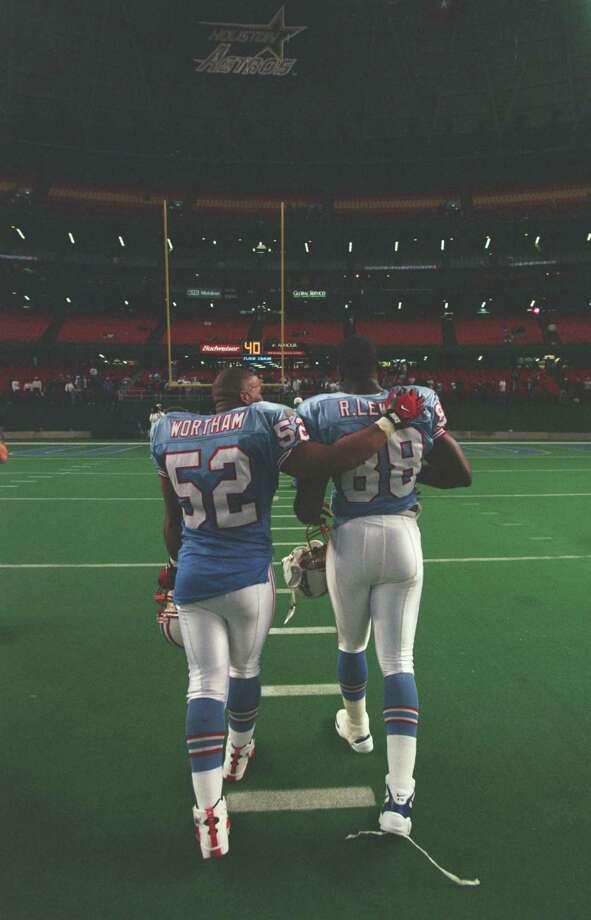
Barron Wortham and Reggie Lewis, after the last game at the Astrodome

December 15, 1996: The Cincinnati Bengals beat the Houston Oilers, 21-13 before just 15,131 fans at the Astrodome. Team founder/owner Bud Adams had already announced the team's move to Tennessee, and the fans took it out on him by not going.

The following Sunday, December 22, 1996, they played their final game as the Houston Oilers, beating the Ravens, 24-21 at Memorial Stadium in Baltimore.

Kenneth Stanley Adams Jr. was a 36-year-old executive with Phillips Petroleum in Oklahoma when he became a charter team owner in the American Football League, taking the Houston Oilers. They won the 1st 2 AFL Championships, in 1960 and 1961, and lost the AFL Championship Game in 1962 and 1967. They went into a down period that included the 1970 merger with the NFL, but by 1978, they were a Playoff team again, turning home games at the Astrodome into nationally-televised parties.

A.O. "Bum" Phillips, Oilers head coach from 1975 to 1980, compared the Oilers to the much more nationally-popular Dallas team, and said, "The Cowboys are America's Team, but the Oilers are Texas' Team."

But they couldn't get past the Pittsburgh Steelers and the Oakland Raiders into the Super Bowl, and the team was broken up. In 1987, Adams told the Houston city government that he would move the Oilers to Jacksonville if they didn't improve the Astrodome, including raising seating capacity and putting in more of what the place practically invented: Luxury boxes. He got his wish: In 1990, it was expanded from 50,000 to 62,439 seats, including 65 luxury boxes, and the Oilers stayed.

The expansion did not improve the lousy sightlines: The seats near the 50-yard line were the furthest from the playing field, while the closest ones were in the end zone. And as the Astros were the stadium's primary tenant, whenever there was a scheduling conflict, or any dispute between the Astros and the Oilers, the Astros would always win out. Hard to believe, considering that Texas is the football State.

By 1995, the Oilers' radio network, which had been statewide, had been reduced to 1 station in Houston. As a result, Harris County, owners of the Astrodome, agreed to let the Oilers out of their lease, to enable the move to Tennessee after the 1996 season, instead of 1997 as had been planned.

In 2002, the Houston Texans debuted. In the interim, the Tennessee Titans went to a Super Bowl, but lost. Since then, the Texans have been contenders more regularly than the Titans, so maybe Houston was better off.

Adams died in 2013, the next-to-last of the original AFL owners still involved with his team. (Ralph Wilson of the Buffalo Bills was the last, and died the next year.)

UPDATE: The Oilers had a team Hall of Fame. From their 1960 and '61 AFL Champions, they have inducted founding owner Kenneth "Bud" Adams, quarterback George Blanda, and safety and punter Jim Norton. From their 1967 AFL Finalists: Adams, Blanda, Norton, and safety Ken Houston.

From their 1978 and '79 AFC Finalists: Adams, head coach O.A. "Bum" Phillips, running back Earl Campbell, receiver Billy "White Shoes" Johnson, defensive end Elvin Bethea, and linebacker Robert Brazile.

From their teams that made the AFC Playoffs every season from 1987 to 1993: Adams, executives Mike Holovak and Floyd Reese, quarterback Warren Moon, guard Mike Munchak, and tackle Bruce Matthews. The franchise now known as the Tennessee Titans has also honored coach Jeff Fisher, quarterback Steve McNair, running back Eddie George, and tight end Frank Wycheck, who were with the team at the time of the move.

Adams, Phillips, Campbell, Bethea, Brazile, Moon, Munchak, Matthews have also been inducted into the Texas Sports Hall of Fame. So have 1970s receiver Mike Renfro and 1980s and '90s defensive lineman Ray Childress.

Running back Ken Hall, "The Sugar Land Express," of Texas A&M, quarterback Don Trull and receiver Larry Elkins of Baylor University, and defensive tackle Lewis "Bud" McFadin of the University of Texas were also elected, and played for the Oilers in their founding days of the 1960s. Jack Pardee starred as a linebacker for Texas A&M, the Los Angeles Rams and the Washington Redskins, before serving as a head coach in Houston, for both the USFL's Gamblers and the Oilers.

*

December 15, 1996 was a Sunday. Ukrainian soccer player Oleksandr Zinchenko was born.
 
These other games were played in the NFL:

* The New York Giants lost to the New Orleans Saints, 17-3 at Giants Stadium in the Meadowlands.

* The Carolina Panthers beat the Baltimore Ravens, 27-16 at Ericsson Stadium (now Bank of America Stadium) in Charlotte.

* The St. Louis Rams beat the Atlanta Falcons, 34-27 at the Georgia Dome in Atlanta.

* The Jacksonville Jaguars beat the Seattle Seahawks, 20-13 at Jacksonville Municipal Stadium (now EverBank Stadium).

* The San Francisco 49ers beat the Pittsburgh Steelers, 25-15 at Three Rivers Stadium in Pittsburgh.

* The Green Bay Packers beat the Detroit Lions, 31-3 at the Silverdome in the Detroit suburb of Pontiac, Michigan.

* The Minnesota Vikings beat the Tampa Bay Buccaneers, 21-10 at the Metrodome in Minneapolis.

* The Indianapolis Colts beat the Kansas City Chiefs, 24-19 at Arrowhead Stadium in Kansas City.

* The Dallas Cowboys beat the New England Patriots, 12-6 at Texas Stadium in the Dallas suburb of Irving, Texas.

* The Denver Broncos beat the Oakland Raiders, 24-19 at Mile High Stadium in Denver.

* The Arizona Cardinals beat the Washington Redskins, 27-26 at Sun Devil Stadium (now Mountain America Stadium) in the Phoenix suburb of Tempe, Arizona.

* The day before, the New York Jets lost to the Philadelphia Eagles, 21-20 at Giants Stadium.

* Also the day before, the Chicago Bears beat the San Diego Chargers, 27-14 at Soldier Field in Chicago.

* And the night after, on ABC Monday Night Football, the Miami Dolphins beat the Buffalo Bills, 16-14 at Pro Player Stadium (now Hard Rock Stadium) in Miami Gardens, Florida.

Baseball was out of season. There were 4 games in the NBA:

* The Detroit Pistons beat the Boston Celtics, 99-89 at The Palace in the Detroit suburb of Auburn Hills, Michigan.

* The Phoenix Suns beat the Vancouver Grizzlies, 103-84 at the America West Arena (now the Mortgage Matchup Center) in Phoenix.

* The Washington Wizards beat the Golden State Warriors, 110-102 at the San Jose Arena (now the SAP Center). The Warriors played there that season, while the Oakland Coliseum Arena was being renovated. Latrell Sprewell scored 43 points in defeat for them.

* And Houston fared better in the NBA that day: The Houston Rockets beat the Portland Trail Blazers, 99-89 at the Rose Garden (now the Moda Center) in Portland.

And there were 6 games in the NHL:

* The Philadelphia Flyers beat the Boston Bruins, 6-0 at the new CoreStates Center (now the Xfinity Mobile Arena) in Philadelphia.

* The Florida Panthers beat the Edmonton Oilers, 6-0 at the Miami Arena.

* The Dallas Stars beat the Ottawa Senators, 4-0 at the Corel Centre (now the Canadian Tire Centre) in Ottawa.

* In an "Original Six" matchup, the Detroit Red Wings beat the Toronto Maple Leafs, 3-1 at the Joe Louis Arena in Detroit.

* The Chicago Blackhawks beat the Pittsburgh Penguins, 2-1 at the United Center in Chicago.

* And the Vancouver Canucks beat the St. Louis Blues, 8-0 at the Kiel Center (now the Enterprise Center) in St. Louis.

Saturday, November 26, 2022

November 26, 1982: Holmes vs. Cobb: The Bloodbath That Changed Boxing

November 26, 1982: Larry Holmes wins a unanimous decision over Randall "Tex" Cobb at the Astrodome in Houston, and retains the Heavyweight Championship of the World.

This fight was broadcast live on ABC on the night after Thanksgiving, meaning families may have been watching it together. It was 13 days after Korean boxer Kim Duk-koo was fatally injured in a live televised fight with Lightweight Champion Ray "Boom-Boom" Mancini.

Between them, these 2 fights led to changes in boxing. The maximum of 15 rounds was reduced to 12. A standing eight-count for any knockdown was required. And any fighter knocked out automatically had his license suspended for 45 days, for his own safety.

Howard Cosell, for years ABC's lead boxing announcer, called the Holmes-Cobb fight. He was so appalled by the beating the Cobb took that he vowed never to broadcast another professional prizefight. He kept that vow, as the only fights he broadcast thereafter were the amateur ones, with tighter rules, in the 1984 Olympics in Los Angeles. Upon hearing that Cosell was quitting boxing, Cobb said, "I can do my sport no greater service."

As of November 26, 2022, Holmes and Cobb are both still alive. As far as I know, neither has been mentally impaired due to boxing.

*

November 26, 1982 was a Friday: As I said, the day after Thanksgiving. Baseball was out of season. The NFL was in midweek. There were 2 college football games that day, both of them major rivalries, and both clashes between highly-ranked teams. Number 2 Penn State beat Number 5 University of Pittsburgh, 19-10 at Beaver Stadium in State College, Pennsylvania. And Number 3 Nebraska beat Number 11 Oklahoma at Memorial Stadium in Lincoln, Nebraska.

Penn State was then an independent, and thus had no Conference Championship to win. Nebraska clinched the Big Eight Conference title. Penn State went to the Sugar Bowl in New Orleans, which became a de facto National Championship game, because they were playing the Southeastern Conference Champions, Number 1 Georgia. Nebraska went to the Orange Bowl in Miami, and played Number 13 Louisiana State University.

The games were being played at the same time, the Orange Bowl on NBC and the Sugar Bowl on ABC, and Nebraska's only hope of winning the National Championship was to blow LSU out, and hope that Penn State beat previously undefeated Georgia in a dull game. Instead, it was a very good game, although for those of us who don't like Penn State, it was a bad result: The Nittany Lions won, 27-23. And the Tigers held the Cornhuskers to another classic, with Nebraska winning, 21-20. So Penn State got the National Championship.

There were 8 games in the NBA:

* The New Jersey Nets lost to the Phoenix Suns, 110-99 at the Arizona Veterans Memorial Coliseum.

* The Boston Celtics beat the Utah Jazz, 137-103 at the Boston Garden.

* The Philadelphia 76ers beat the Cleveland Cavaliers, 120-102 at The Coliseum in the Cleveland suburb of Richfield, Ohio.

* The Detroit Pistons beat the Portland Trail Blazers, 132-118 in overtime at the Silverdome in the Detroit suburb of Pontiac, Michigan.

* The Washington Bullets beat the Indiana Pacers, 87-85 at the Market Square Arena in Indianapolis.

* The San Antonio Spurs beat the Chicago Bulls, 122-120 at the HemisFair Arena in San Antonio. George Gervin led all scorers on the day with 44 points.

* The Los Angeles Lakers beat the San Diego Clippers, 117-115 at the San Diego Sports Arena (now the Pechanga Arena). Magic Johnson scored 32 points.

* And the Seattle SuperSonics beat the Denver Nuggets, 127-106 at the Seattle Center Coliseum.

And there were 6 games in the NHL:

* The New Jersey Devils and the Vancouver Canucks played to a tie, 4-4 at the Pacific Coliseum in Vancouver.

* The Chicago Black Hawks beat the Hartford Whalers, 4-3 at the Hartford Civic Center (now the PeoplesBank Arena).

* The Washington Capitals beat the Toronto Maple Leafs, 5-3 at the Capital Centre in the Washington suburb of Landcover, Maryland.

* The Buffalo Sabres beat the St. Louis Blues, 8-6 at the Buffalo Memorial Auditorium.

* The Pittsburgh Penguins and the Minnesota North Stars played to a tie, 6-6 at the Metropolitan Sports Center in the Minneapolis suburb of Bloomington, Minnesota.

* And the Edmonton Oilers beat the Winnipeg Jets, 6-5 at the Winnipeg Arena.

Sunday, November 20, 2022

November 20, 1978: The Earl Campbell Game

November 20, 1978: ABC Monday Night Football airs a game between the Houston Oilers and the Miami Dolphins, at the Astrodome in Houston.

The Oilers had drafted Earl Campbell, who had won the Heisman Trophy the year before, at the University of Texas, nearly leading them to the National Championship. He became perhaps the greatest fullback the NFL had seen since Jim Brown, knocking over much bigger men trying to tackle him. In this game, he ran for 199 yards and 4 touchdowns, and the Oilers beat the Dolphins, 35-30 in front of 50,000 rapturous fans, many of them waving pom-poms of the Oilers' powder blue.

This was the "Luv Ya Blue" era, where Oail Andrew "Bum" Phillips, a native of Orange, in the southeastern corner of Texas, was the head coach and the general manager. He built a team led by quarterback Dan Pastorini. Joining Campbell in the backfield was former USC star Anthony Davis. They had 3 good receivers in Billy "White Shoes" Johnson, Ken Burrough (known as "Double-O," because he was the last NFL player to wear Number 00), and Mike Renfro. The defense had end Elvin Bethea, tackle Curley Culp, and linebacker Robert Brazile.

But Campbell was the key. Phillips said, "I don't know if he's in a class by himself, but I do know that when that class gets together, it sure don't take long to call the roll." When asked about Earl's inability to finish a one-mile run in training camp, he said, "When it's first and a mile, I won't give it to him."

And, at the height of the Dallas Cowboys' self-proclaimed "America's Team" era, South Texas fans couldn't get enough of them. Phillips said, "The Cowboys may be America's Team, but the Oilers are Texas' team." (Ironically, at least for this game, the song they sang had been stolen from the Dolphins: "We're the Houston Oilers, Houston Oilers, Houston Oilers, Number 1... ")

But the Oilers were victims of geography and NFL alignment. They had been placed in the AFC Central Division, the same as the Pittsburgh Steelers, who were at the height of their powers. Phillips coined a saying that has since been adapted to fit other teams: "The road to the Super Bowl runs through Pittsburgh. Sooner or later, you've got to go to Pittsburgh."

In 1978, the Oilers went 10-6, and got to the AFC Championship Game, but lost to the Steelers at Three Rivers Stadium in Pittsburgh. In 1979, they went 11-5, and got to the AFC Championship Game, but lost at Three Rivers again. In 1980, Phillips traded Pastorini to the Oakland Raiders for Ken Stabler, who was more his kind of quarterback. The Oilers went 11-5 again, and had a home Playoff game with the Raiders. What happened? Pastorini had gotten hurt, and replaced by Jim Plunkett, who led the Raiders all the way to the Super Bowl. The Steelers finally got old, and the Oilers couldn't take advantage. Campbell was named NFL Offensive Player of the Year all 3 times, but they didn't get to the Super Bowl.

Oilers owner Bud Adams fired Phillips, and the team went into decline. They were a Playoff team again from 1987 to 1993, then fell apart again. After the 1996 season, Adams moved them, making them the Tennessee Titans. They finally reached the Super Bowl in the 1999 season. The Houston Texans began play in 2002, and while they've made the Playoffs a few times, they've never gotten to the AFC Championship Game.

The Oilers had won the AFL Championship in its 1st 2 seasons, 1960 and 1961; and Houston has hosted the Super Bowl 3 times. But that 1978 Monday Night Football game remains the signature moment in the history of Houston professional football; and Campbell, more than the Oilers' 1960s quarterback George Blanda and the Texans' 2010s defensive end J.J. Watt, remains their signature player.

Campbell and Phillips would be reunited when Phillips was named head coach of the New Orleans Saints, but they couldn't win together there, either. Campbell, Bethea, Culp, Brazile and Stabler went on to be elected to the Pro Football Hall of Fame.

*

November 20, 1978 was, as stated, a Monday. Baseball was in the off-season. There were no games in the NBA or the World Hockey Association, and only 1 in the NHL: The Los Angeles Kings beat the Chicago Black Hawks, 4-3 at The Forum outside Los Angeles in Inglewood, California. Apparently, by this point, the leagues had learned not to try to compete with Monday Night Football for TV viewers.

Tuesday, November 8, 2022

November 8, 1973: The Flop of Millennium '73

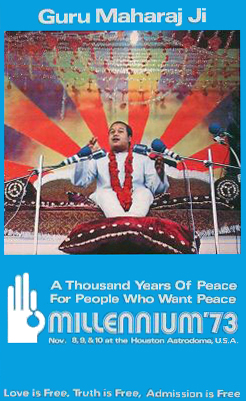
November 8, 1973: Millennium '73, a three-day festival, begins at the Astrodome in Houston, held by the Divine Light Mission (DLM). It featured Prem Rawat, then known as Guru Maharaj Ji, a 15-year-old guru and the leader of DLM, then a fast-growing new religious movement.

Organizers billed the festival as the most significant event in human history which would usher in a thousand years of peace.

What's that, you've never heard of it? I guess they didn't succeed.

Rennie Davis, a prominent anti-war activist and member of the Chicago Seven, helped draw attention to the event as a spokesman for the DLM. Notable journalists attended, some of them acquaintances of Davis from the New Left.

Attendance was estimated from 10,000 to 35,000, compared to the projected 100,000. Many scholars and journalists generally depicted the event as a disappointment. That, along with other factors including a large debt, led to changes in the DLM's structure, management and message.

The following year the movement split into branches headed by Maharaj Ji in the West, and his mother and brother Bal Bhagwan Ji in India.

Prem Rawat's marriage at the age of 16 to a non-Indian severed his relationship with his mother. At that point, the Indian branch of DLM controlled by his mother split from DLM everywhere else. At that point, it was established in 55 countries.

In the early 1980s, he began to discard references to religion in his speeches and closed the ashrams. The name of the DLM was changed to Elan Vital. Since that time, Prem Rawat has continued to travel extensively, speaking about peace to large and select audiences worldwide. On several occasions he has received recognition for his work and message of peace.
Rawat in 2018

In 2001, he established The Prem Rawat Foundation (TPRF) to support his work and humanitarian efforts. Its Peace Education Program is licensed and utilized by correctional facilities and other service organizations around the world.

*

November 8, 1973 was a Thursday. Why they held this thing on a Thursday, only they knew. David Muir, ABC News anchorman, was born. So was Edgardo Alfonzo, the greatest 2nd baseman in New York Mets history.

Baseball season was over. Football was in midweek. There were 3 games in the NBA:

* The New York Knicks lost to the Boston Celtics, 94-84 at Madison Square Garden.

* The Detroit Pistons beat the Atlanta Hawks, 129-115 at The Omni in Atlanta. Lou Hudson scored 33 in defeat for the Hawks.

* And the Chicago Bulls beat the Golden State Warriors, 112-111 at the Oakland Coliseum Arena.

One game was played in the American Basketball Association: The New York Nets lost to the Utah Stars, 124-109 at the Salt Palace in Salt Lake City, Utah. This turned out to be a preview of the 1974 ABA Finals, but the Nets won that in 5 games.

There was 1 game in the NHL: The Boston Bruins beat the Montreal Canadiens, 2-1 at the Boston Garden.

And there was 1 game in the World Hockey Association: The Edmonton Oilers beat the Quebec Nordiques, 4-3 at the Colisée de Québec.

Saturday, October 15, 2022

October 15, 1986: The Mets-Astros Death Struggle

October 15, 1986: Desperate to win Game 6 of the National League Championship Series at the Astrodome, the Mets do not want to face Houston pitcher Mike Scott – a Met-killer both as a Met and an Astro – in a Game 7, especially in the Astrodome, where Scott is far better than he is on the road.

The Mets use that sense of desperation to score 3 runs in the top of the 9th to force extra innings. In the 14th, the Mets make their first bid to win. After Gary Carter opens with a single, a walk to Darryl Strawberry puts 2 runners on with nobody out. After Knight forces Carter at 3rd, Wally Backman drives a single to right. When Kevin Bass' throw to the plate sails high over Alan Ashby's head to the screen, Strawberry scores.

But with 1 out in the bottom of the 14th, and the Houston fans with their heads in their hands, Billy Hatcher shocks everyone with a line-drive home run off the left field foul pole. It was the 1st earned run allowed by the Mets bullpen in the entire series. Hatcher went 3-for-7 in the game, and his homer meant the Astros would be kept alive for at least one more inning. (This presages his heroics in the 1990 World Series.)

Both teams fail to score in the 15th, and the game goes to the 16th inning, the most innings in baseball's postseason history at that time. The Mets appear to take control of the game once again, this time coming up with 3 runs in the top half of the inning. The rally begins with Strawberry receiving a gift double when Hatcher and Bill Doran misplay his towering fly ball with 1 out. When Knight follows with a single to right, a poor throw to the plate by Bass allows the tiebreaking run to score, just as it had in the 14th. Jeff Calhoun then relieves Aurelio Lopez and uncorks a walk, two wild pitches, and a single by Lenny Dykstra to bring in 2 more runs, putting the Mets up 7–4.

But as they had in the 14th, the Astros refuse to go down without a fight in the bottom of the 16th. Jesse Orosco strikes out Craig Reynolds to open the inning, but a walk and 2 singles later, Houston has a run in and the tying run on base. Orosco induces Denny Walling to hit into a force play at 2nd for the 2nd out, but Glenn Davis singles home another run, bringing the Astros within 7-6.

The tying run is on 2nd, the winning run on 1st – a run that Met fans do not want to allow to score. So damned smug all season long, Met fans are now are freaking out over the possibility of facing Scott in the Dome in Game 7, and their magnificent 108-win season, their "inevitable" World Championship, going down in flames.

But Orosco strikes out Bass, ending the game. He throws his glove in the air, foreshadowing the end of the World Series. As the pitcher of record when the Mets took the final lead, he is was awarded the victory, marking the 1st time in postseason history that a reliever won 3 games in a series.

Despite a .189 batting average, the lowest average ever recorded by a winning team in a postseason series to that point, the Mets have their 3rd National League Pennant. Until 2015, it was the only one they'd clinched on the road.

My Grandma watched Major League Baseball for about 75 years, first as a Dodger fan in Queens and Newark, then as a Met fan in the New Jersey towns of Belleville, Nutley and Brick. I asked her once what her favorite game of all time was. This is the one she chose, without hesitation.

I can't say that I blame her. It wasn't a "heavyweight title fight," with big punches going back and forth. It was more like a middleweight or welterweight fight, with lots of jabs, until finally one fighter finished off a "death of a thousand cuts" and the other fell. It was an epic.

How epic was it? In 2010, the MLB Network listed this game at 5th on their list of MLB's 20 Greatest Games -- limited in scope, due to the availability of surviving videotape, to 1975 onward.

*

October 15, 1986 was a Wednesday. The same day, after being down 3 games to 1 in the ALCS, the Red Sox complete one the greatest comebacks in Playoff history by defeating the California Angels 8-1 to win the American League Pennant.

The game caps yet another heartbreaking failure for Angels skipper Gene Mauch‚ who in Game 5 was 1 strike away from reaching his 1st World Series in 25 seasons as a major league manager. He had previously been a part of the Phillies' collapse in 1964, a tough last-weekend Division loss for the Montreal Expos in 1980, and the Angels' 2-games-to-none choke against the Milwaukee Brewers in 1982. No manager ever managed longer without winning a Pennant. After the game‚ 2nd baseman Bobby Grich retired after a fine career with the Orioles and Angels.

The Angels' inability to win a Pennant was beginning to be called "The Curse of the Cowboy." Gene Autry, Western movies' "Singing Cowboy," was their 1st owner, and still owned the team at this point. There seemed to be no reason why he would put a curse on his own team, but maybe he was the one who was cursed.
In the midst of the illness that would end his life the next year, Autry sold the Angels to the Walt Disney Company in 1997. Disney changed the team's name to the Anaheim Angels. The team finally won their 1st Pennant in 2002, and then won the World Series, ending the curse. But maybe they've started a new one: They've been to the Playoffs a few times since, but still have only the 1 Pennant.
The Mets and Red Sox winning Pennants on the same day -- with the Sox having beaten the Yankees out for the Division en route to doing so. This was a bad day to be a Yankee Fan, and the Yankees weren't even directly involved. Over the next 12 days, it would get worse.
Football was in midweek. The NBA season hadn't started yet. But 5 games were played in the NHL:

* In an "Original Six" matchup, the New York Rangers and the Chicago Blackhawks played to a 5-5 tie at the Chicago Stadium.

* The New Jersey Devils beat the Vancouver Canucks, 3-2 at the Brendan Byrne Arena at the Meadowlands. Mel Bridgman scored at 11:54 of the 3rd period to win it.

* The Montreal Canadiens and the Buffalo Sabres played to a 0-0 tie at the Buffalo Memorial Auditorium.

* The Los Angeles Kings beat the Detroit Red Wings, 4-3 at the Joe Louis Arena in Detroit. Bernie Nicholls scored with 19 seconds left in overtime.

* And the Edmonton Oilers beat the Quebec Nordiques, 5-2 at the Northlands Coliseum in Edmonton.

Sunday, October 9, 2022

October 9, 1999: Todd Pratt's Walkoff & the End of the Astrodome

October 9, 1999: The New York Mets win a postseason series. Stop laughing.
They defeat the Arizona Diamondbacks‚ 4-3 at Shea Stadium‚ in Game 4 of the National League Division Series, on backup catcher Todd Pratt's 10th inning home run. Pratt is in the game for starter Mike Piazza‚ who is unable to play because of a thumb injury. John Franco gets the victory in relief for the Mets.
On the same day, the Atlanta Braves score 5 runs in the 6th inning, and beat the Houston Astros 7-5. The Braves win their NLDS, 3-1. It is the last major sporting event at the Astrodome, as the Astros are moving into what's now Minute Maid Park next April, the Oilers left for Tennessee in 1997, and the Texans' approval by the NFL was dependent on a new stadium, which was built next-door to the Astrodome, and is now named NRG Stadium. In defeat, Ken Caminiti hit the Dome's last home run.
The Astrodome was home to the Astros from 1965 to 1999, the Oilers (in the AFL for the 1st 2 seasons, the NFL thereafter) from 1968 to 1996, the Houston Texans of the World Football League in 1974, the Houston Gamblers of the USFL in 1984 and 1985, the University of Houston football team from 1965 to 1997, the Bluebonnet Bowl from 1968 to 1987, the Houston Bowl in 2000 and 2001, the Houston Rockets for some home games from 1971 to 1975, the Houston Stars of the North American Soccer League in 1967 and 1968, the Houston Hurricane of the NASL from 1978 to 1980, the UH vs. UCLA basketball "Game of the Century" in 1968, the Billie Jean King vs. Bobby Riggs "Battle of the Sexes" tennis match in 1973, and an Elvis Presley concert in 1971.
But what was originally billed as "the Eighth Wonder of the World" was done. In one of the newspaper articles for its farewell in 1999, a writer compared it to the remaining structures for the 1964-65 New York World's Fair, calling them "relics from a future that never came to pass." When NRG Stadium opened as Reliant Stadium in 2002, it not only had more amenities than the Astrodome, but was noticeably larger, covering more space and a bit taller. In the end, the Astrodome was no more special than any of the other, less remarkable, concrete ovals that were built to host professional sports in the 1960s and '70s.
The Astrodome's finest hour came in 2005, when it housed refugees from Hurricane Katrina's devastation of New Orleans. Since then, it has been vacant. Various plans have been floated as to what to do with the Astrodome, but nothing has been approved. So it just sits there, waiting... for something. Anything, even demolition, but nobody can even agree on how to do that.
*
October 9, 1999 was a Saturday. On the same day, the New York Yankees defeated the Texas Rangers‚ 3-0 at The Ballpark (now Choctaw Stadium) in the Dallas suburb of Arlington, Texas‚ to sweep the American League Division Series. Roger Clemens hurled 7 shutout innings for the win‚ as Darryl Strawberry’s 3-run homer in the 1st provided all the runs in the game.
This was the 1st time the Yankees and the Mets had both clinched anything on the same day, so it was kind of appropriate that one of the heroes was Darryl, who played for both teams.
In the other ALDS, the Boston Red Sox, down 2 games to none, beat the Cleveland Indians, 9-3 at Fenway Park, launching a comeback to take the series. The Yankees then beat them for the Pennant, the Braves beat the Mets, and the Yankees swept the Braves in the World Series.
The NBA season didn't start until November 2, but there were 9 NHL games played:
* The New Jersey Devils beat the Tampa Bay Lightning, 1-0 at the Continental Airlines Arena at the Meadowlands. Another shutout for Martin Brodeur, and Brian Rolston scored the game's only goal at 7:06 of the 2nd period.
* The Philadelphia Flyers and the Boston Bruins played to a tie, 1-1 at the FleetCenter (now the TD Garden) in Boston.
* The Los Angeles Kings and Washington Capitals played to a tie, 2-2 at the MCI Center (now the Capital One Arena) in Washington.
* The Buffalo Sabres and the Atlanta Thrashers played to a tie, 5-5 at the Philips Arena (now the State Farm Arena) in Atlanta.
* The Detroit Red Wings and the Florida Panthers played to a tie, 2-2 at the National Car Rental Center (now the Amerant Bank Center) in the Miami suburb of Sunrise, Florida.
* In the opener of CBC's doubleheader of Hockey Night In Canada, the Ottawa Senators beat their arch-rivals, the Toronto Maple Leafs, 4-3 at the Corel Centre in the Ottawa suburb of Kanata, Ontario. (It's now the Canadian Tire Centre. The town was absorbed into Ottawa proper in 2001.)
* The St. Louis Blues beat the Edmonton Oilers, 4-2 at the Skyreach Centre (as the Northlands Coliseum was then known) in Edmonton.
* The Dallas Stars beat the San Jose Sharks, 3-2 at the San Jose Arena (now the SAP Center).
* And in the nightcap of Hockey Night In Canada, the Vancouver Canucks beat the Montreal Canadiens, 4-1 at General Motors Place (now the Rogers Arena) in Vancouver.
Also on this day, there was college football. Virginia Tech came to Rutgers with their much-hyped lefthanded-throwing, crazy-running quarterback Michael Vick. He lit RU's defense up like a pinball machine.
My father and I were at this game, at Rutgers Stadium (now SHI Stadium) in Piscataway, New Jersey, and I was more impressed with the Hokie defense that head coach Frank Beamer built, led by defensive end Corey Moore. I'd never seen an amateur defense that was so fast.
Tech won 58-20, and took the Number 5 ranking they had in that game and got it up to Number 2, receiving a date with Number 1 Florida State in the Sugar Bowl for the National Championship. But the Seminoles gave them a taste of their own medicine, winning 46-29.
Moore ended up not playing much in the NFL, only for the Buffalo Bills in 2000. Vick would become a pro sensation, getting the Atlanta Falcons to the 2003 NFC Championship Game, before his life took a turn for the worse.
Among the other college games played that day:
* Number 1 Florida State beat Number 19 Miami, 31-21 at Doak Campbell Stadium in Tallahassee.
* Number 2 Penn State beat Iowa, 31-7 at Kinnick Stadium in Iowa City.
* Number 3 Michigan were upset by Number 11 Michigan State, 34-31 at Spartan Stadium in East Lansing.
* Number 4 Nebraska beat Iowa State, 49-14 at Memorial Stadium in Lincoln.
* Number 6 Tennessee beat Number 10 Georgia, 37-20 at Neyland Stadium in Knoxville, Tennessee.
* Number 7 Georgia Tech beat North Carolina, 31-24 at Bobby Dodd Stadium in Atlanta.
* Number 8 Florida beat Louisiana State, 31-10 at Tiger Stadium in Baton Rouge.
* Number 9 Kansas State beat their arch-rivals, Kansas, 50-9 at KSU Stadium (now Bill Snyder Family Stadium) in Manhattan, Kansas.
* Number 13 Texas A&M beat Baylor, 45-13 at Kyle Field in College Station, Texas.

* Number 16 East Carolina were upset by Southern Mississippi, 39-22 at Dowdy-Ficklen Stadium in Greenville, North Carolina.
* Number 17 Purdue were upset by Number 21 Ohio State, 25-22 at Ohio Stadium in Columbus.
* Number 20 Wisconsin beat Number 25 Minnesota, 20-17 at the Metrodome in Minneapolis, to win Paul Bunyan's Axe.
* Number 22 Southern California were upset by Arizona, 31-24 at Arizona Stadium in Tucson.
* Number 23 Texas beat Oklahoma, 38-28 at the Cotton Bowl in Dallas.
* Notre Dame beat Arizona State, 48-17 at Notre Dame Stadium in South Bend, Indiana.
* Air Force beat Navy, 19-14 at Navy-Marine Corps Memorial Stadium in Annapolis, Maryland. Army had played 2 nights earlier, beating Louisville, 59-52 in overtime at Michie Stadium in West Point, New York.
* And Princeton lost to Brown, 53-30 at Brown Stadium in Providence, Rhode Island.

October 9, 1986: The Fox Network Premieres

October 9, 1986: The Fox television network premieres. The sitcom Married... with Children becomes its signature program, full of stereotyping and gross-out humor. This would be followed by many animated shows that upped that ante, although it's hard to say that Homer Simpson of The Simpsons and Peter Griffin of Family Guy were less cartoonish than MWC's Al Bundy. Certainly, when it came to height of hair, MWC's Peg Bundy gave Marge Simpson of The Simpsons a run for her money.

In 1994, Fox Sports was developed. Although its Fox NFL Sunday pregame, halftime and postgame shows will be a lot of fun, their baseball broadcasting has always been terrible, and their hockey experiment flopped, in part due to a special effect called the "glow-puck." It was supposed to make the puck easier to find on the TV screen, but it backfired: Grownups found it distracting, and kids would wonder why the puck wasn't glowing when they were taken to live games.

In 1996, Fox News began, with a Sunday-morning program to compete with those of the big three (ABC, CBS and NBC) and CNN, a 24-hours news channel to compete with CNN, and the perennial dual lie that it was "fair and balanced."

The network claimed to stand for conservative values and traditional morality. And yet, it broadcast shows like Married... with Children and Temptation Island; and had news personalities like Bill O'Reilly and Tucker Carlson. 

*

October 9, 1986 was a Thursday. Football was in midweek. It was too soon for the NBA and NHL seasons to begin. And the American League Championship Series was on a travel day. The Boston Red Sox would beat the California Angels in 7 games.

So there was only 1 score on this historic day, and that was in Game 2 of the National League Championship Series, at the Astrodome in Houston. The New York Mets beat the Houston Astros, 5-1. Bob Ojeda outpitched Nolan Ryan.

After the Mets had foolishly traded him away after the 1971 season, Ryan put together one of the greatest careers any pitcher has ever had. Yet, after helping the Mets win the 1969 World Series, his postseason record was not very good, and this game was another example. The Mets would win the series in 6 games, and then the World Series over the Red Sox in 7.

Tuesday, October 4, 2022

October 4, 1968: Old Iron Pants

George Wallace (left) and Curtis LeMay

October 4, 1968: Former (and future) Governor George Wallace of Alabama, running for President on a 3rd-party ticket, selects his Vice Presidential nominee: Former Air Force General Curtis LeMay. This would prove to be a big mistake.

Born in 1906 in Columbus, Ohio, LeMay graduated from Ohio State University, and joined the U.S. Army Air Corps. Rising through the ranks, he was known for relentlessly training the men under his command, believing that they would only perform their duties properly in combat if they were second nature to them. The men called him "Old Iron Pants" and, for his smoking, "The Big Cigar." He didn't mind either nickname.

He determined that a difference in weather meant that the kind of bombing that was done to Nazi Germany wasn't working on Imperial Japan, and changed the tactics. He led Operation Meetinghouse, the B-29 firebombing of Tokyo, describing it as follows: "The U.S. had finally stopped swatting at flies and gone after the manure pile." (That was for his official report. I suspect that, privately, he used a word other than "manure.")

Upon hearing his announcement as Wallace's running mate, Robert McNamara, who had recently resigned as Secretary of Defense to become Chairman of the World Bank, released a statement, saying of LeMay, "He was the finest combat commander of any service I came across in war. But he was extraordinarily belligerent, many thought brutal."

The U.S. Air Force was separated from the Army in 1947. LeMay became a full 4-star General in 1951, during the Korean War, and retired in 1965, early in the Vietnam War. Early in 1968, conservatives in California wanted him to challenge Senator Thomas Kuchel in the Republican Primary, but he declined. Kuchel was subsequently beaten in the Primary by Max Rafferty, the State's Superintendent of Schools, who then lost the general election to Democrat Alan Cranston, formerly the State's Controller.

Initially, LeMay supported Nixon in the 1968 election. Wallace had served under LeMay in 1947, and asked him to be his running mate. Twice, LeMay turned him down. Wallace's history as a segregationist didn't faze LeMay: He simply wanted Nixon to win, and thought Wallace would pull votes from him.

Wallace also asked FBI Director J. Edgar Hoover, who shared his beliefs about Communists and civil rights. Hoover turned him down. He also asked former Governor John Connally of Texas, a conservative Democrat who would later switch to the Republican Party. Connally also turned him down. At this point, instead of realizing that he, himself, might be the problem, Wallace asked LeMay a 3rd time, and he accepted.

At a press conference in Pittsburgh on October 4, Wallace announced LeMay as his running mate. LeMay spoke for 7 minutes, and undid all the work Wallace had put in to build himself up over the last 4 years. He said, "We seem to have a phobia about nuclear weapons." He added:

I think there are many times when it would be most efficient to use nuclear weapons. However, the public opinion in this country and throughout the world throw up their hands in horror when you mention nuclear weapons, just because of the propaganda that's been fed to them. I don't believe the world would end if we exploded a nuclear weapon.

He also said, of the North Vietnamese, that American firepower could "bomb them back to the Stone Age." This was just 4 years after Senator Barry Goldwater of Arizona was nominated for President by the Republicans, and scared the voters by saying that the tactical use of nuclear weapons in Vietnam should be considered. And he was accused of racism, for voting against the Civil Rights Act of 1964. Voters thought him too extreme, and he got just 37 percent of the vote, the lowest total for a Republican nominee between 1936 and 1992.

Now, LeMay was making Wallace look like the "mad bomber" that Goldwater really wasn't, when Wallace was already the racist that Goldwater really wasn't. Just as Goldwater tried to qualify his remarks with, "I don't think we would ever use them," LeMay tried to backtrack a few days later, saying, "I never said we should bomb them back to the Stone Age. I said we had the capability to do it." It didn't help.

Many people who were supporting the populist, racist stances of Wallace were realizing that this ticket simply wasn't acceptable. The Democratic nominee, Vice President Hubert Humphrey, started calling Wallace and LeMay "the Bombsy Twins." (As opposed to literary figures the Bobbsey Twins.) Nixon said nothing: He knew, contrary to what LeMay suspected, that, as long as Wallace was in the race, he would take more votes from Humphrey than from Nixon.

On October 24, Wallace headlined the 1st political rally at the new Madison Square Garden in New York, which had replaced "The Old Garden" the preceding February 11. The Garden, hosting George Wallace? Anything for a buck, I suppose. There were protesters, but they should have ignored Wallace, to let his campaign die of silence, and then have gone after Richard Nixon. It might, almost literally, have made all the difference in the world.

On November 5, Nixon won 301 Electoral Votes, with 43.4 percent of the popular vote. Humphrey won 191 Electoral Votes, with 42.7 percent of the vote. Wallace won 5 States -- Alabama, Arkansas, Georgia, Louisiana and Mississippi, plus 1 Electoral Vote in South Carolina -- for 46 Electoral Votes, with 13.5 percent of the vote.

Wallace did not win the following States, but almost certainly threw them from Humphrey to Nixon: Alaska, California, Delaware, Florida, Illinois, Kentucky, Missouri, New Jersey, North Carolina, Ohio, South Carolina, Tennessee and Wisconsin. That's 197 Electoral Votes. If Humphrey had gotten even 40 percent of those, 79, he would have won, 270-222-46. 
LeMay probably didn't cost Wallace a single State. But did he, more than Wallace himself, throw any States from Humphrey to Nixon? Who knows.

LeMay never ran for office again, and died in 1990.

*

October 4, 1968 was a Friday. Baseball was between Games 2 and 3 of the World Series, which the Detroit Tigers would win in 7 games. And it was too early for the NBA, ABA and NHL seasons. But there was one score on this historic day, in college football: The University of Houston, then ranked Number 12 in the country, beat the University of Cincinnati, 71-33 at the Astrodome in Houston. Yes, that's in football, not basketball.

Tuesday, September 20, 2022

September 20, 1973: Tennis' Battle of the Sexes

September 20, 1973: A made-for-TV spectacle is held at the Astrodome in Houston: A tennis match labeled "The Battle of the Sexes."

This was also the day that singer Jim Croce was killed in a plane crash. I have a separate entry for that story.

Bobby Riggs was a great tennis player once. The Los Angeles native wasn't big and strong, but he was quick, and relied on a speed game. He once won Wimbledon and the U.S. Open, and reached the Final of the French Open, all in the same year.

That year was 1939. In 1941, he won the U.S. Open again. After serving in the U.S. Navy during World War II, he won the U.S. Pro title in 1946, '47 and '49. (Professionals were barred from the "Grand Slam" tournaments -- Wimbledon and the U.S., French and Australian Opens -- until 1968.)

Bobby had to turn professional, because he was a compulsive gambler. He always needed money. He became known as a hustler, a man who would do anything for money, and, remarkably, could usually do it. Indeed, after what I'm about to talk about was all over, this was spoofed on an episode of the TV show The Odd Couple. He had a massive ego, but, like his contemporary Dizzy Dean and later baseball star Reggie Jackson, he could usually back it up.

As early as 1951, he challenged one of the top female tennis players, Pauline Betz -- an ex-girlfriend of his. She won the U.S. Open in 1942, 1943 and 1944, and both the U.S. Open and Wimbledon in 1946. They were on tour, and played each other in a series of matches, as the warmup act before a series of matches between pro stars Jack Cramer and Pancho Segura. In 1967, he was elected to the International Tennis Hall of Fame.

If that had been the end of the story, he might be mostly forgotten today -- but most of those who would, today, have been familiar with his story would have thought better of him. That was not the end of the story.

In 1973, he was 55 years old, well past the age where he could make money playing tennis -- or so it seemed. But the sport was as big then as it has ever been. It was the high tide of feminism, and, in this sport as in few others, the women were stars as big as the men.

Whether he actually liked that, only he knew for sure. But he played the part of a proud male chauvinist pig. Bobby Riggs claimed that women's tennis was inferior, and that not even a top female player could beat him, not even at his age. Most tennis fans under the age of 40 said, "Who the hell is Bobby Riggs?"

They soon found out. He challenged the top female player of the time, Billie Jean King. In 1972, she had nearly won the Grand Slam: Winning Wimbledon, the U.S. Open and the French Open. (British player Virginia Wade won the Australian Open, beating Australian player Evonne Goolagong in the Final.) More than that, she was an advocate for making tennis tournaments give their female players prize money equal to male players. It wasn't happening quickly, but it was happening, one by one.

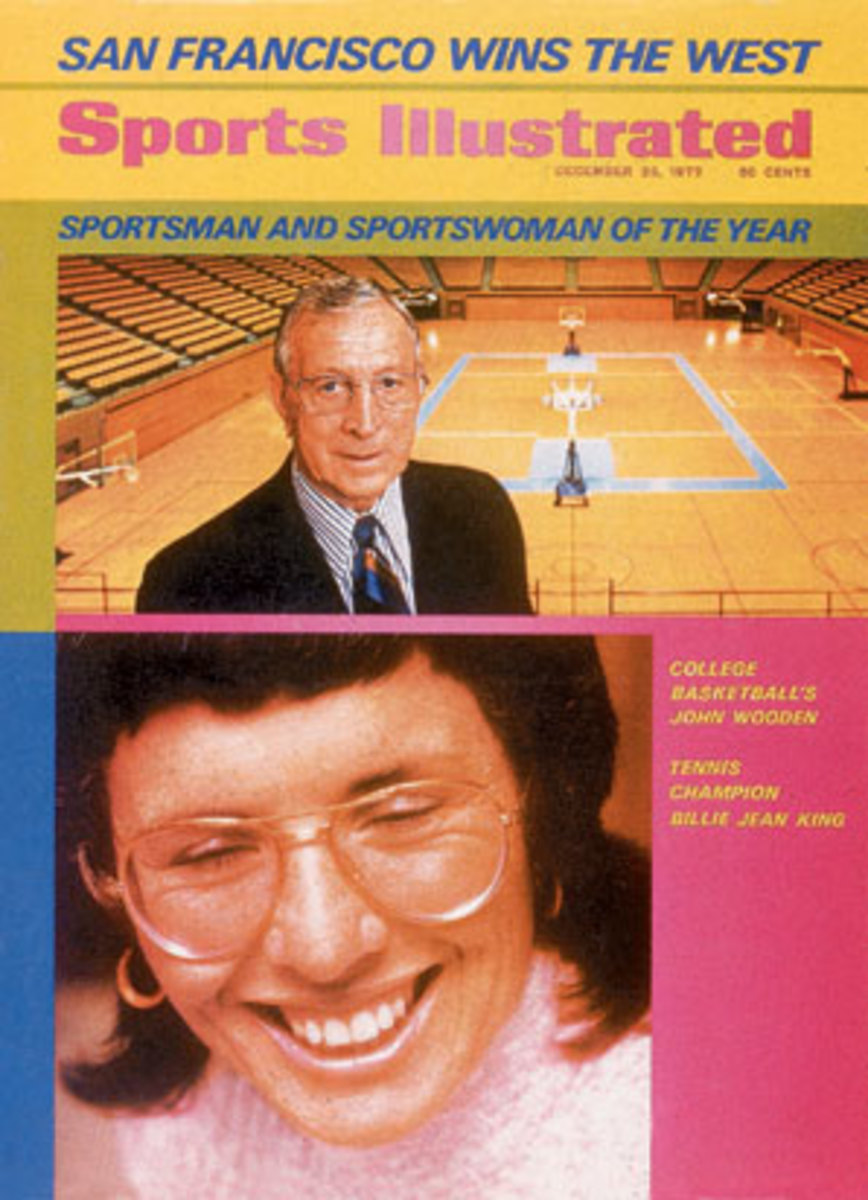
Sports Illustrated recognized that she had a social value on top of her competitive achievements, and made her the 1st female "Sportsman of the Year" -- but made her share the award with UCLA basketball coach John Wooden, the 1st time the award had been split.
Like Riggs, she was from Los Angeles -- or, more accurately, from adjoining Long Beach, California. Like him, she was known for wearing horn-rim glasses. Unlike him, she did not look like the popular comedian Arte Johnson. But she did consider his challenge a joke, and rejected it.

So he challenged another major women's star, the Australian Margaret Court. They played each other on May 13 -- Mother's Day, and Court was then one of the few women to have returned to a star level in tennis after having children -- in the San Diego suburb of Ramona, California. He was 55, she was 30. It should have been a mismatch.

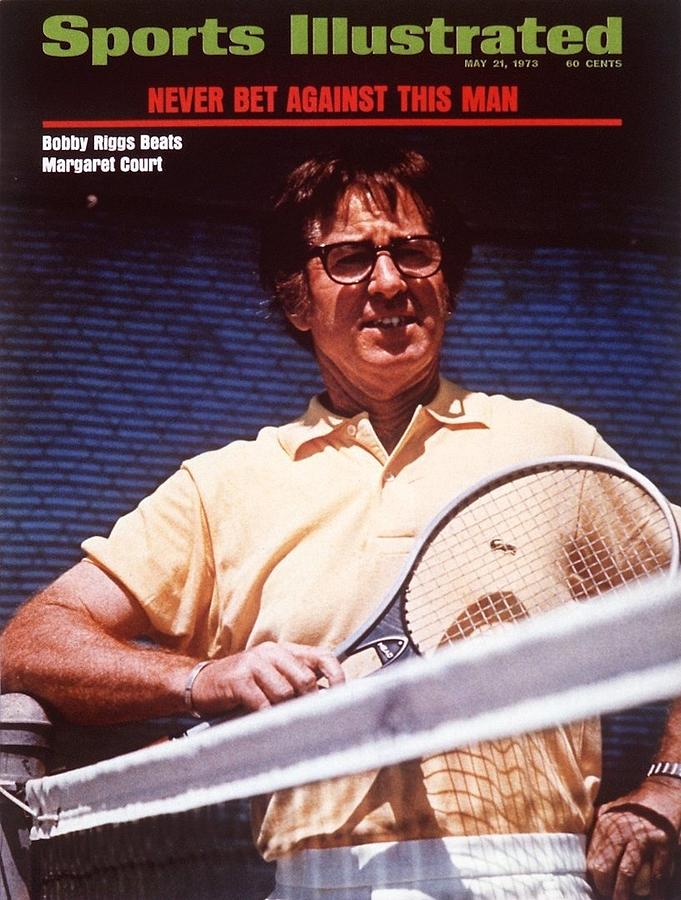
It was -- the other way. He got into her head, and won 6-2, 6-1. It was known as the Mother's Day Massacre. It got him on the cover of both Time and its sister publication Sports Illustrated, the latter carrying the headline, "NEVER BET AGAINST THIS MAN." And his insults to women's tennis, and to women in general, got bigger than ever. And male chauvinists loved it. (Shades of Donald Trump, but only nasty, not criminal in nature.)
Now, brimming with confidence, he challenged King again. Everyone told Billie Jean that she had to accept, for womankind, and for the sake of sportsmanship, because Bobby was a pig first, and a male chauvinist pig second.

The match would be held at the Astrodome in Houston, televised live on ABC -- meaning that it would be anchored by one of the few figures in sports more polarizing than Riggs: Howard Cosell. (Give Riggs credit for this: He had better hair than Cosell. Not better than too many others, but better than Cosell.) The prize was winner-take-all: $100,000. (About $658,000 in today's money.)

The opening ceremonies were a farce. No pair of boxers ever entered the ring like this, and no such pair has since, not even in a Rocky movie. Professional wrestlers may have learned a thing or two from it. King entered first, carried in on a feather-adorned litter by four bare-chested bodybuilders, making her look like Cleopatra and them like her slaves. She had a look on her face suggesting, "I can't believe I agreed to this."
Did you think I was kidding?

Riggs was no less ridiculous: He came in seated in a rickshaw, drawn by busty models. He presented King with a giant lollipop -- a Sugar Daddy. She countered by giving him a piglet, pointing out that he was a "pig." The piglet was squealing, suggesting that at least one living thing less wanted to be in the Astrodome than she did. But she knew she had to do it.

Entrenchment vs. The Future. The Astrodome. Howard Cosell. So much hype. And I'm not sure Riggs didn't end the night in a leisure suit at a disco. The only way this could have been a more Seventies event was if Billie Jean had an Afro and Evel Knievel had jumped over the court.

Did Riggs really think he could win? One fact suggests that he didn't: Tootsie Roll, makers of the Sugar Daddy, gave him $50,000, half of what he stood to win upon winning the match, to wear a tracksuit jacket with the Sugar Daddy logo on it. He took it off midway through the 1st set.

Again, Bobby was 55. Billie Jean was 29. Still, knowing what he had done to Margaret Court, Las Vegas oddsmakers made him the favorite. Indeed, he jumped out to a 3-2 lead after breaking Billie Jean's serve in the 1st set.

But, now into the actual match and able to take things seriously, she came right back and broke his serve in the next game. He played his usual game (at this stage of his career), dropping lobs and making soft shots. She countered these effectively, and made him use his old legs. It was the tennis version of jujitsu: She turned his fighting style against him.

She won the 1st set, 6-4. She won the 2nd set, 6-3. Even today, women's tennis is best-2-out-of-3 sets, while the men's version is best-3-out-of-5. This was to be best-3-out-of-5, and that was another reason the oddsmakers favored Riggs: In spite of King's age advantage, they thought women couldn't handle 5 sets.

She didn't need to: She won the 3rd set, 6-3. After match point, Riggs, quite spry for 55, jumped over the net as if he'd won, and shook her hand.

Riggs' relevancy was over. King's was just beginning. By the time she was done, she had won 12 women's singles titles at majors: Wimbledon 6 times, in 1966, '67, '68, '72, '73 and '75; the U.S. Open 4 times, in 1967, '71, '72 and '74; the Australian Open in 1968; and the French Open in 1972. Throw in 16 women's doubles titles from 1961 to 1979 -- 18 years apart -- and 11 mixed doubles titles from 1967 to 1976, and that's a total of 39 majors. An average of 2 a year.

But beyond the victories: Along with Babe Ruth, Joe Louis, Jackie Robinson and Muhammad Ali, she is 1 of the 5 most important American athletes of the 20th Century, because of how she raised the profile, and the prize money, of women's sports. And, with Ali's death in 2016, she's the only one of those still alive.

To put it into a baseball perspective: She had Hank Aaron's talent, Curt Flood's drive to make the sport more fair, and Andy Messersmith's success at that endeavor, and took as much heat for it as all 3 put together.

In 1975, Seventeen magazine polled its readers, and they named Billie Jean their most admired woman. Not just their most admired female athlete, their most admired woman in any field. Then again, these were the days when The Weekly Reader polled grade school kids, and the biggest "hero" of both genders was O.J., Simpson, ahead of Moon lander Neil Armstrong.

The fact that she did all of this while staying in the closet until she no longer could, and then accepted her role as a gay rights icon as well as a feminist icon and a sports icon, makes her even more remarkable.

She is a member of the International Tennis Hall of Fame, and the National Tennis Center at New York's Flushing Meadow-Corona Park is named for her. (The main stadium is named for Arthur Ashe, but the entire complex is named for Billie Jean.) In 2009, President Barack Obama awarded her the nation's highest civilian honor, the Presidential Medal of Freedom.

To put her work in perspective: The men's and women's winners from Wimbledon in 2022 -- Novak Djokovic and Elena Rybakina respectively -- each got $2.4 million.

Today, Billie Jean King is 78 years old, and still promoting tennis, and women's sports in general, wherever she can. She and Riggs actually became friends, and when he died in 1995, she spoke at his funeral.

In 2017, it was alleged that Riggs had bet heavily on King and then thrown the match, to pay off his gambling debts. This was denied by most people who knew him. It really was a ridiculous idea: Had he won, not only would he have taken home the $100,000 prize, but the endorsement deals he would have gotten would have more than paid off any debts he had.

The story has been filmed twice. In 2001, ABC aired a TV-movie, When Billie Beat Bobby, starring Holly Hunter and Ron Silver, in a rare mustache-less role for him. In 2017, the feature film Battle of the Sexes was released, staring Emma Stone and Steve Carell. Unlike the ABC TV-movie, this film did look at King's struggle to hide being gay. It was also made into a Broadway play, Balls, in 2018.
Billie Jean King, flanked by the stars of Balls:
Donald Corren and Ellen Tamaki,
wearing copies of each player's outfit in the match.

Born Billie Jean Moffitt, her brother is former San Francisco Giants pitcher Randy Moffitt. From 1965 to 1987, Billie Jean was married to Larry King. Not the talk-show host: Unlike the late Lawrence Henry Zeiger, King is his real name. He was a sports promoter, and helped her promote the women's tennis tour. She was told that, if she came out as gay, it would ruin the women's tour. Finally, for legal reasons, she did. It didn't.

They split when Billie Jean fell in love with her doubles partner, Ilana Kloss, a Jewish South African. They have been together ever since, and were married in 2018. They are now a part of Magic Johnson's group that owns the Los Angeles Dodgers, the Lakers, and the WNBA's Sparks; and are among the owners of Angel City FC, the L.A. team in the National Women's Soccer League.

*

September 20, 1973 was a Thursday. It was early in the NFL season, but midweek, and no games were played that night. The NBA, the ABA, the NHL and the WHA were working their way up to starting new seasons. But there were Major League Baseball games played:

* The Houston Astros and the San Diego Padres, meant to play at the Astrodome on this day, instead had their game moved up as part of a doubleheader the day before, September 19 -- because the promoters of the Battle of the Sexes wanted the Dome for their event. The Astros won the 1st game 8-5, and the Padres won the 2nd game 6-3.

* The New York Yankees, the Boston Red Sox, the Cleveland Indians and the Milwaukee Brewers were not scheduled. I checked: There was no notation in any of the teams' remaining schedules saying that a game scheduled for this date was made up later, due to rain or any other reason.

* The New York Mets beat the Pittsburgh Pirates, 4-3 at Shea Stadium, across Roosevelt Avenue from Flushing Meadow-Corona Park, where the U.S. Open would be moved from Forest Hills, also in Queens, in 1978.

This was "The Ball Off the Wall Game." There was a 5-way dogfight for the National League Eastern Division title. Going into the game, the Pirates were in 1st place, the Montreal Expos were 1 game back, the Mets and the St. Louis Cardinals both a game and a half back, and the Chicago Cubs 4 games back. Even so, the Pirates, winners of the 1971 World Series and the last 3 NL East titles, struggling all year after the death of Roberto Clemente in a plane crash the previous New Year's Eve, were the only team above .500, at 75-74. It seemed like no one wanted to win that Division.

But the Metropolitans and Buccos sure played this game like they both wanted to win it. The game's only home run was hit by Pirate (and future Met) Richie Hebner in the 7th inning, but the Mets tied it 2-2 in the 8th. Both teams scored in the 9th to make it 3-3 and send it to extra innings.

It went to the top of the 13th inning. With 1 out, Richie Zisk singled off Ray Sadecki. Manny Sanguillen flew to right for the 2nd out. Dave Augustine, a 23-year-old center fielder from West Virginia in only his 5th major league game, hit one deep to left. It looked like a home run.

Except it hit the top of the fence, and, instead of bouncing over for a homer, it bounced back, right into Cleon Jones' glove. That's a hit. But Jones pivoted, and fired to Wayne Garrett (playing shortstop instead of his usual 3rd base). Garrett saw that Zisk was trying to score, and threw home to catcher Ron Hodges. Zisk was out at the plate.

The bottom of the 13th began with walks drawn by John Milner and Ken Boswell. Don Hahn popped up to 1st base. But Hodges singled to left, scoring Milner with the winning run. The Mets went on to win the Division, by a game and a half over the Cardinals, 2 1/2 over the Pirates, 3 1/2 over the Expos and 5 over the Cubs. (Although he was on the Mets roster for this game, Willie Mays, soon to announce his retirement, did not play.)

* The Philadelphia Phillies beat the Cardinals, 6-5 at Veterans Stadium in Philadelphia.

* The Baltimore Orioles beat the Detroit Tigers, 9-0 at Tiger Stadium in Detroit. Jim Palmer pitched a 5-hit shutout.

* The Cubs beat the Expos, 5-4 at Wrigley Field in Chicago.

* A doubleheader was split at Arlington Stadium in the Dallas suburb of Arlington, Texas. The California Angels won the 1st game, 6-4. Richie Scheinblum won it with a single in the top of the 11th inning. The Texas Rangers won the 2nd game, 8-3. Closing in on a new record for strikeouts in a season, with 383, Nolan Ryan did not pitch in either game for the Angels.

* The Kansas City Royals beat the Chicago White Sox, 10-3 at the new Royals Stadium in Kansas City. (It was renamed Kauffman Stadium in 1993.)

* The Minnesota Twins swept a doubleheader from the Oakland Athletics at Metropolitan Stadium in the Minneapolis suburb of Bloomington, Minnesota. The Twins won the opener, 4-3. Steve Brye hit a walkoff single in the bottom of the 9th. The Twins also won the nightcap, 5-4. Reggie Jackson appeared only once in the twinbill, as a pinch-hitter in the 1st game, and did not get on base. The A's bounced back from this, and from a hundred other indignities, and won the World Series anyway.

* The Los Angeles Dodgers beat the Atlanta Braves, 5-3 at Dodger Stadium in Los Angeles. Davey Lopes won it with a home run in the bottom of the 12th inning. Hank Aaron went 3-for-5 with 2 RBIs, but while he hit 2 doubles, he did not hit any home runs. With 5 games left in the season, he had 711 career home runs, 3 behind the record held by Babe Ruth.

* And the San Francisco Giants beat the Cincinnati Reds, 7-5 at Candlestick Park in San Francisco. 
December 31, 1999 & January 1, 2000: The Millennium

December 31, 1999:  The Millennium arrives. The people of planet Earth survived. At a terrible cost. But we hadn't destroyed ourselves. ...