Showing posts with label park central hotel. Show all posts

Friday, November 4, 2022

November 4, 1928: Arnold Rothstein Is Rubbed Out

November 4, 1928: Arnold Rothstein is rubbed out. "The Brain," who led the Mob's fix of the 1919 World Series, was also the guy who figured out that Prohibition was the way to turn organized crime in America into big business, while Al Capone was still an up-and-comer.

But, like drug dealers who got hooked on their own product, the lure of his original line of work, gambling, proved too much for "The Big Bankroll." He lost $320,000 (about $5.47 million in 2022 money) in a 3-day high-stakes poker game. He said (O the irony) that the game was fixed, and refused to pay up.

He was shot at the Park Central Hotel in Midtown Manhattan (known as the Park Sheraton from 1948 until reverting to its original name in 1984), where a man then a rising star, Albert Anastasia, would see his reign as "the Boss of All Bosses" come to a similar end in 1957. It took Rothstein 2 days to die, and he refused to rat his killer out, telling the police, "You stick to your trade, I'll stick to mine." One source says that his last words were, "My mother did it."

He was 46, and he always knew he would come to such an end: A favorite saying of his was, "The odds on everything in life, including life itself, are six to five against."

A man was arrested for the murder, but was acquitted for lack of evidence, and they may have gotten the wrong guy anyway.

Rothstein was played by Robert Lowery (who played Batman in a 1949 film serial) in The Rise and Fall of Legs Diamond in 1960, future Fugitive star David Janssen in The Big Bankroll in 1961, Michael Lerner in Eight Men Out in 1988, F. Murray Abraham in Mobsters in 1991, and Michael Stuhlbarg on
Boardwalk Empire in the early 2010s.

In the 1974 film The Godfather Part II, Mario Puzo had Hyman Suchowsky, the character based on Meyer Lansky (played at that age by John Megna, when older by Lee Strasberg), give himself the "street name" Hyman Roth because he admired Rothstein.

In The Great Gatsby, F. Scott Fitzgerald used Rothstein as a character, giving him the name Meyer Wolfsheim, a man who managed to "play with the faith of 50 million people." The character does not appear in the 1926 and 1949 film versions, but was played by Howard Da Silva in 1974, and by Indian film superstar Amitabh Bachchan in 2013.

*

November 4, 1928 was a Sunday. Baseball was out of season. The NBA hadn't been founded yet. And the NHL season wouldn't start for another 11 days. But these NFL games were played:

* The football version of the New York Giants and the Frankford Yellow Jackets, based in Northeast Philadelphia, played to a tie, 0-0 at the Polo Grounds.

* The football version of the New York Yankees lost to the Chicago Bears, 27-0 at Wrigley Field in Chicago.

* The Providence Steam Roller beat the Detroit Wolverines, 7-0 at the Cycledrome in Providence, Rhode Island. The Steam Roller (they officially wrote it as 2 words, no S on the end) went on to win the NFL Championship that season, but the Great Depression knocked them out of business in 1931.

* The Green Bay Packers beat the Pottsville Maroons, 26-14 at Minersville Park in Pottsville, Pennsylvania.

* The Chicago Cardinals, the Dayton Triangles were not scheduled to play that weekend.

I have no way of knowing of Arnold Rothstein had bets on any of these games.

Tuesday, October 25, 2022

October 25, 1957: Albert Anastasia Is Killed

October 25, 1957: Albert Anastasia, the founder of what became New York's Gambino crime family, is killed. Murdered. Hit. Rubbed out. Whacked. Taken care of. Whichever expression you want to use.

It may have been revenge for the failed attempt to kill Frank Costello earlier in the year, although it did scare Costello into doing something mobsters rarely did: He retired from "the life." He lived until 1973.

Anastasia was one of the most powerful mob bosses ever, known as Il Capo di Tutti Capi -- The Boss of All Bosses. But, on this day, he entered the barbershop of the Park Sheraton Hotel, at 870 7th Avenue at 56th Street in New York. Organized crime legend Arnold Rothstein had been killed there in 1928. In the hotel's ballroom, Jackie Gleason staged and filmed The Honeymooners. In 1984, the hotel reverted to its original name, the Park Central Hotel.

Anastasia's bodyguard parked the car in an underground garage and then, most conveniently, perhaps with a little financial incentive from one of Anastasia's enemies, decided to take a little stroll.

As Anastasia relaxed in the barber chair, 2 men, with scarves covering their faces, rushed in, shoved the barber out of the way, and fired at Anastasia. After the 1st volley of bullets, Anastasia allegedly attempted to lunge at his killers. However, the stunned Anastasia had actually attacked the gunmen's reflections in the wall mirror of the barber shop. The gunmen resumed firing, and Anastasia fell to the floor, dead. He was 55 years old.
His murder remains officially unsolved, although it's easy to imagine that the NYPD wasn't exactly exerting itself to find the killers. It is widely believed that the contract was given to Joe Profaci, the boss of another of New York's "Five Families," who passed it on to "Crazy Joe" Gallo from Brooklyn, who then performed the hit with one of his brothers. Gallo, himself later the victim of an infamously unsolved rubout (in 1972, on his 43rd birthday, no less), was the subject of Bob Dylan's song "Joey."

Joe Profaci died of cancer in 1962, and Joseph Colombo took over, and the family bears his name today. The other "families" are known as the Gambino, the Genovese, the Bonnano and the Lucchese.

The American Mafia has been governed by "The Commission" since in 1931, when it was established by Charles "Lucky" Luciano, the originator of the family on which Genovese later put his name. The Castellamarese War, the biggest civil war in the history of American organized crime, had just ended, and Luciano figured this was the best way to keep the peace -- a criminal "League of Nations" that turned out to settle interfamily disputes better than the original League did between countries.

The members have always consisted of the boss of New York's Five Families, and the boss of the Chicago Outfit. Like the United Nations has come to do, they have assigned its other seats based on apparent merit, and the bosses of families in Philadelphia and Detroit have often been members. In 1957, Joseph "Joe the Barber" Barbara, the boss of Buffalo crime, was a member.

On November 14, America's organized crime bigwigs met at Barbara's home in Apalachin, New York, near Oswego and Binghamton, to discuss what to do with Anastasia's empire. The meeting was called by Vito Genovese, who now imagined himself as the big boss of it all.

The locals got suspicious when fancy cars with out-of-State license plates arrived in the small town, so they called the police, who raided the meeting, arresting 60 underworld figures.

It was a blow from which the American Mafia has never fully recovered, despite the work of such later bosses as Sam Giancana of Chicago, Nicky Scarfo of Philadelphia and John Gotti of New York's Gambino family.

Budd Schulberg, screenwriter of the 1954 film On the Waterfront, took a big chance in basing the character of Johnny Friendly, played by Lee J. Cobb, on Anastasia. But, today, Anastasia is best known for the way he died.

In a 1975 episode of M*A*S*H, "Soldier of the Month," Hawkeye Pierce (Alan Alda - real name Alphonse D'Abruzzo) sees a sleeping soldier, and says, "Ah, Albert Anastasia's doorman." In a 1976 episode, "Out of Sight, Out of Mind," temporarily blinded, a blindfolded Hawkeye feels around an empty chair by the door and jokingly says, "Ah, Albert Anastasia's bodyguard." Each of these is an anachronistic error, as the Korean War ended in 1953, 4 years before the Anastasia murder.

In a 2002 episode of The West Wing, "Holy Night," the question of when Anastasia was killed comes up, and White House Communications Director Toby Ziegler (Richard Schiff) asks his visiting father, former Murder, Incorporated officer Julius (a.k.a. Julie, Jerry Adler), when it happened. Julie says, "October, 1957." He later tells Toby that he should know things like that, as part of his heritage, and Toby tells him that he does know, that he knows all about Julie's Mob activities back then. Julie's attempt to admonish is ironic, since he gave the year and the month, but not the day.

In an episode of The Sopranos, Uncle Junior (Dominic Chianese) says that he wishes the Mob were like they were in the Fifties, "when it was peaceful." Tony (James Gandolfini) says he remembers seeing the picture of Anastasia in a pool of blood on the barbershop floor. Tony was born in 1959, 2 years after it happened, but he could have seen the photo at any time. I guess even nostalgia ain't what it used to be.
This is probably the photo that Tony saw.

Anastasia's murder came a month after the Brooklyn Dodgers and the New York Giants played their last games before moving to California. That was considered a major change in the life of New York City. But this other kind of "hit" carried with it another major change: For all the harm they caused over the last 50 years, the Mafia protected the neighborhoods they controlled from crime committed by others, in some cases better than the police could. Who was a thug who thought himself a rising tough guy going to be more afraid of? The Police Commissioner? The District Attorney? Or "The Boss of All Bosses"?

So "The Law of Unintended Consequences" kicked in: Without Anastasia, and with the Mob further weakened by Costello's retreat and the Apalachin arrests, that protection weakened. And the mobsters of other ethnicities -- mainly Irish and Jewish -- that the Italians worked with or even controlled found themselves with less support, as the Italians, by necessity, had to be more focused on taking care of their own.

(The Jewish Mob was done for, anyway, and for the best of reasons. In 1999, New York Daily News columnist Sidney Zion wanted to find out what happened, and asked one of the last survivors, long since out of "the life." The ex-gangster pointed out that, unlike the Italians and the Irish, the Jews sent their kids to college. He used a baseball analogy: "We lost our farm system.")

What is now thought of as the crime wave that overtook New York and other cities might have happened anyway, due to the proliferation of drugs, and the way drugs prey on society. But with the loosening of the Mafia's control of the drug trade, things got out of control. It would take the Crime Bill of 1994 before America's cities began to become safe again.

I'm not saying Anastasia was a good person. I am saying that it might have been better to let him live until he came to a natural death.

*

October 25, 1957 was a Friday. So while it was during the NFL season, there were no NFL games. Baseball had wrapped up its season 15 days earlier, when the Milwaukee Braves beat the New York Yankees in Game 7 of the World Series at Yankee Stadium in New York. The NHL season was just underway, but no games were scheduled for this day.

The NBA season was also just underway, but only 1 game was played. At the Onondaga County War Memorial Arena in Syracuse, New York -- now known as the Upstate Medical University Arena -- the Syracuse Nationals beat the Philadelphia Warriors, 103-85. Johnny "Red" Kerr of the Nats and Neil Johnston of the Warriors each scored 22 points, to lead all players.

After the 1961-62 season, the Warriors moved to San Francisco, becoming the San Francisco Warriors, and changing their name to the Golden State Warriors in 1971 when they moved across the Bay to Oakland. Although they returned to the San Francisco side in 2019, they have kept the Golden State name. Just 1 year after their move, Philadelphia got a replacement team, the Nats, who became the Philadelphia 76ers.

Also, actress Nancy Cartwright was born. She provided the voice of Bart Simpson on The Simpsons.

Saturday, October 1, 2022

October 1, 1955: "The Honeymooners" Premieres

Left to right: Jackie Gleason, Audrey Meadows, Art Carney and Joyce Randolph.

October 1, 1955: A new show premieres on CBS. Well, sort of: The Honeymooners had been a sketch on The Jackie Gleason Show, but now it becomes a standalone half-hour situation comedy, perhaps the greatest "sitcom" in history.

Like the variety show that spawned it, the sitcom was filmed before a live audience, in the ballroom of the Park Sheraton Hotel. In 1928, Mob financier Arnold Rothstein had been killed in his room at that hotel. In 1957, Albert Anastasia, "the Boss of All Bosses," was killed in the hotel's barber shop. In 1984, it returned to its original name, the Park Central Hotel.

The 1st episode, appropriately enough, discusses television itself: It is titled "TV Or Not TV," and shows what happens when Brooklyn bus driver Ralph Kramden (Gleason) and sewer worker, upstairs neighbor and best friend Ed Norton (Art Carney) go halfsies on a television set, because neither one can afford their own. (Ralph has never had one, because he's cheap. Ed's 1st one just broke down.)

Ralph's wife, Alice Kramden (Audrey Meadows), wants a TV set, but she doesn't think this arrangement will work. Interestingly, unless you count Alice's groan over a tricky sink, Ed's wife, Thelma "Trixie" Norton (Joyce Randolph), has the 1st line in the show's history: "Hiya, Alice!"

Ralph was always yelling at Alice. Today, we would call that "verbal abuse." And one of the things he yelled at her was threats. "You are gonna get yours." "You're going to the Moon!" "Hoo-hoo, would I like to... " "Oh-ho... Oh-ho... Bang! Zoom!"

And, just once in the "Classic 39" episodes -- he used this one a lot more when it was just a sketch on his earlier Jackie Gleason Show -- "One of these days, one of these days, pow! Right in the kisser!" As comedian Bill Maher put it, Ralph was always threatening to graduate from verbal to physical abuse, and mainstream America was fine with this, and thought it was funny.

You know how many times Ralph actually hit Alice onscreen in those 39 episodes? Zero. Because Alice wouldn't have put up with it. No, she couldn't have beaten Ralph in a genuine fight -- Gleason was 5-foot-10, and was usually around 240 pounds but peaked at 285 -- but if she so much as slapped him just once, he would have been so shocked that the woman he loved had done that to him, that he would have backed down. For all his "king of the castle" bluster, Ralphie Boy was whipped.

Sure, Ralph would get in Alice's face and berate her, but she was just as likely to get into his. Check out this exchange, from the aforementioned 1st episode, after she accused him of being cheap, leading to the lack of amenities in their apartment (and 328 Chauncey Street, which is a real address, was actually in the Bushwick section of Brooklyn, not in Bensonhurst like was so often said onscreen):

Ralph: When we got married, you said, "Ralph, I'd be happy to live in a tent with you!"
Alice: I'm still willing. I think it'd be an improvement.
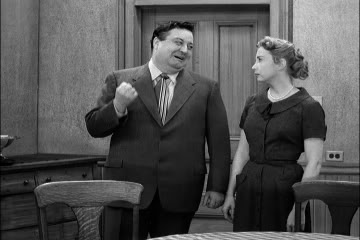
Ralph, shaking his fist in her face: You wanna go to the Moon? Do ya wanna go to the Moon?
Alice: That would be an improvement, too!

Look at this picture. Ralph has his fist balled up. Is Alice intimidated? Hell, no: She's standing her ground, ramrod straight, and giving Ralph a death stare.
She was from Brooklyn, too, you know: Alice Gibson Kramden was one tough redhead. She gave as good as she got, and, while Ralph would frequently continue the verbal thrust-and-parry, just as often, he would back down, and make that big sad moon face, and be contrite, and apologize.

And she would forgive him. Because, deep down, she loved him as much as he loved her. And he would acknowledge just how good a fit she was for him, say, "Baby, you're the greatest!" and grab her and bend her over and kiss her like in romantic movies -- a much better "Pow, right in the kisser." For all his big talk, he was a romantic and a sentimentalist.
Lucille Ball may have been the first woman with any power in television production, but Audrey Meadows was TV's first feminist.

The show had the occasional sports reference. In "The Golfer," Ralph tries to learn how to play golf to impress a bus company official. In "Here Comes the Bride," Ralph notes that Alice's sister, finally getting married, has been a bridesmaid so often, she caught her own bouquet. Alice said her foot slipped, and Ralph compares her to Willie Mays, saying, "If my foot could slip like that, I'd be playing center field for the New York Giants!"

In "Young At Heart," Ralph wears a varsity football letter sweater. The letter is V, although the name of his school is never revealed. (There is a Martin Van Buren High School in New York, but it's in Queens, and is unlikely to have been Ralphie Boy's alma mater.) And in the last episode, "A Man's Pride," Ralph runs into a high school nemesis at a boxing card at the old Madison Square Garden.

Gleason died in 1987, Meadows in 1996, Carney in 2003. As of October 1, 2022, Randolph is not only the last survivor of the main cast, she may be the last surviving castmember, period. Even the actors who played the kids on the show have died. (UPDATE: Randolph died in 2024, 9 months before she would have turned 100.)

In 2005, a film re-imagining The Honeymooners was released, directed by John Schultz, and set in the present day. Reflecting the current demographics of Brooklyn, it was a mostly-black cast. Ralph was played by Cedric the Entertainer, Alice by Gabrielle Union, Ed by Mike Epps, and Trixie by Regina Hall. Eric Stoltz and John Leguizamo also appear, in a plot based around, as original Alice would have put it, one of Ralph's "crazy harebrained schemes" to get rich quick.

The film flopped: Original Honeymooners fans didn't warm up to the reboot, though that may have been due less to race than to the casting of anyone other than the classic actors; and fans of the particular actors didn't take to it, either. The film cost $25 million to make, cheap by recent standards, but only grossed half that, making it as big a flop as one of Ralph's crazy harebrained schemes. Whoever suggested it was a good idea had a BIIIIIIIIG MOUUUUUUUUTH!

*

October 1, 1955 was a Saturday. In real life in Brooklyn, Game 4 of the World Series was played at Ebbets Field. The New York Yankees took a 2-0 lead on the Brooklyn Dodgers, including a home run by Gil McDougald. But the Dodgers came roaring back, with home runs from Roy Campanella, Gil Hodges and Duke Snider, and beat the Yankees 8-5.

Clem Labine was the winning pitcher. Don Larsen was the losing pitcher: Larsen would have his day in the October Sun, and it would be against the Dodgers, but this would not be it. The Dodgers tied the Series, and won it at Yankee Stadium in Game 7 on October 4.

The starts of the NBA and NHL seasons were a few weeks away. However, in spite of it being a Saturday, there was 2 NFL games played on the day:

* The Washington Redskins beat the Philadelphia Eagles, 31-30 at Connie Mack Stadium in Philadelphia.

* And the Baltimore Colts beat the Detroit Lions, 28-13 at Memorial Stadium in Baltimore.

Also, Arsenal beat Aston Villa, 1-0 at Highbury in North London.

December 31, 1999 & January 1, 2000: The Millennium

December 31, 1999:  The Millennium arrives. The people of planet Earth survived. At a terrible cost. But we hadn't destroyed ourselves. ...