Showing posts with label frank capra. Show all posts

Tuesday, December 20, 2022

December 20, 1946: "It's a Wonderful Life" Premieres

December 20, 1946: It's a Wonderful Life premieres. Like many of the films directed by Frank Capra, it's homey, and corny, earning those films the nickname "Capra Corn." But it is one of the most beloved films ever made.

It wasn't a success at first. Indeed, it turned out to be the only motion picture that Liberty Films ever made, dragging the studio into bankruptcy. But a legal loophole put it into the public domain in 1974, and allowed anyone who wanted to show it on television to do so, as it was cheap to do so. That made it a Christmas classic.

George Bailey lives in Bedford Falls, somewhere in New York State. In 1919, when they are boys, he saves the life of his brother, Harry, but loses the hearing in one ear in the process. A girl named Mary Hatch has a childhood crush on him that doesn't go away once they grow up (with adult George played by James Stewart -- that's how he was billed in every movie, but everybody tended to call him "Jimmy Stewart" -- and adult Mary by Donna Reed).

George's father Peter (Samuel S. Hinds) and his uncle Billy (Thomas Mitchell) run the Bailey Brothers Building & Loan. The father dies right after George graduates from high school in 1928, and the Building & Loan's board of directors votes to make George, despite his youth, the new chairman, as Uncle Billy is an alcoholic, and not all that bright when he's sober.

George refuses, and is told by the board that if he refuses, the board will elect Henry Potter (Lionel Barrymore) the new chairman. Potter is the richest and meanest man in town, and if he runs the Building & Loan, he'll close it, meaning that the entire town will be at his mercy. George hates Potter, so he accepts. This means that he has to stay in town, and the money that was going to send him to college instead sends brother Harry to college.

The Great Depression soon follows, and there's a run on the banks on the day in 1932 that George and Mary get married. They use the $2,000 that they were going to spend on their honeymoon to save their customers, as Potter's bank is offering only 50 cents on the dollar. They just barely make it. (In the sequence, $242 then would be $5,169 in 2022; $20 would be $427.23; $17.50 would be $373.83; and the $2.00 the Baileys ended up with would be $42.72.

George and Mary become well-respected in town, and the parents of 4 children. When World War II arrives, Harry enlists in the U.S. Navy, and, as a pilot, shoots down planes attacking a troop ship, saving hundreds of lives. (The movie doesn't say whether the enemy planes were German or Japanese). But because of his bad ear, George is classified 4-F, and "fights the Battle of Bedford Falls," running drives for things the war effort needs, like scrap metal, rubber, and food.

On Christmas Eve, December 24, 1945, a party is being set up for the returning hero Harry. But, at the bank, Uncle Billy loses $8,000 meant for the firm's accounts -- about $171,000 in today's money. Unable to come up with the money, George runs into one awful occurrence after another (and, let's be honest, behaves very badly in response to them), and wishes he'd never been born.

All this is told by the angel Joseph (voiced by Joseph Granby), who has been hearing the prayers for George by the people of Bedford Falls. Joseph assigns George's case to an angel named Clarence Goodbody (Henry Travers), so that Clarence can finally "earn his wings." Clarence shows George  what the world would have been like if he had never been born. The results are shocking:

* Potter became the director of the Building & Loan, and closed it down. Now, he owned everything in town, and he changed its name to Pottersville.

* The major businesses in town low-class joints: Dive bars, burlesque houses, casinos that the Potter-controlled police looked the other way on.

* Without George, Bailey Park, the housing development he built through the Building & Loan, was never built, so people living in town had no alternative but to live in "Potter's slums."

* Mr. Gower (H.B. Warner), the pharmacist, spent time in prison, because George wasn't there to stop him from making a mistake with pills in 1919, which led to a local boy's death. He's now a homeless alcoholic.

* Giuseppe Martini (Bill Edmunds), operator of Martini's bar, a nice establishment, and a resident of Bailey Park, is neither. He isn't even in the alternate sequence: There is no Bailey Park, and Nick (Sheldon Leonard), who had been the head bartender at Martini's, now owns the place, naming it Nick's, and isn't nearly as friendly without Martini's influence.

* Mary is "an old maid," never married (at age 38, that was a big deal at the time), and works in the local library -- which, surprisingly, Potter didn't have shut down. Still, she's better off than most people in town.

* Worst of all, while Billy was born on time in 1911, none of the other kids who were with George that day in 1919 was able to save him from falling into the ice, and he died. So he wasn't there to save that troop transport during The War, and every American serviceman on that ship died. Clarence never says whether this affects the outcome of the war: For all we know, at Christmas '45, the war could still be going on, and the Allies could even be losing.

George changes his mind, and wants to live again. He gets his wish, goes home to face the music, and finds that all the people he'd selflessly helped over the years have come to pay him back. There's a big basket of cash, which ends up being more than the $8,000 he needs. They show him that, in the way that matters, he's "the richest man in town."

As of December 20, 2022, there are 4 surviving castmembers from It's a Wonderful Life: Ronnie Ralph, who played George's friend Sam Wainwright as a child; Carol Coombs, George & Mary's daughter Janie Bailey; Karolyn Grimes, George & Mary's daughter Zuzu Bailey; and Jimmy Hawkins, George & Mary's son Tommy Bailey.

*

December 20, 1946 was a Friday. Several celebrities were born on this day: Illusionist Uri Geller, TV producer Dick Wolf, actor John Spencer, and Sonny Perdue, who was elected Governor of Georgia as a Republican, and then served as Secretary of Agriculture under Donald Trump.

Baseball was out of season. The NFL Championship Game had been played 5 days earlier, with the Chicago Bears beating the New York Giants, 24-14 at the Polo Grounds in New York. And no games were scheduled in the NHL.

There was one score on this historic day. The NBA was in its 1st season, under the name of the Basketball Association of America. One game was played that night: The Toronto Huskies beat the New York Knicks, 74-70 at Maple Leaf Gardens in Toronto. On the preceding November 1, the league's 1st-ever game was played between the same teams in the same arena, but the Knicks won it.

Wednesday, December 14, 2022

December 14, 1936: “You Can’t Take It With You” Premieres

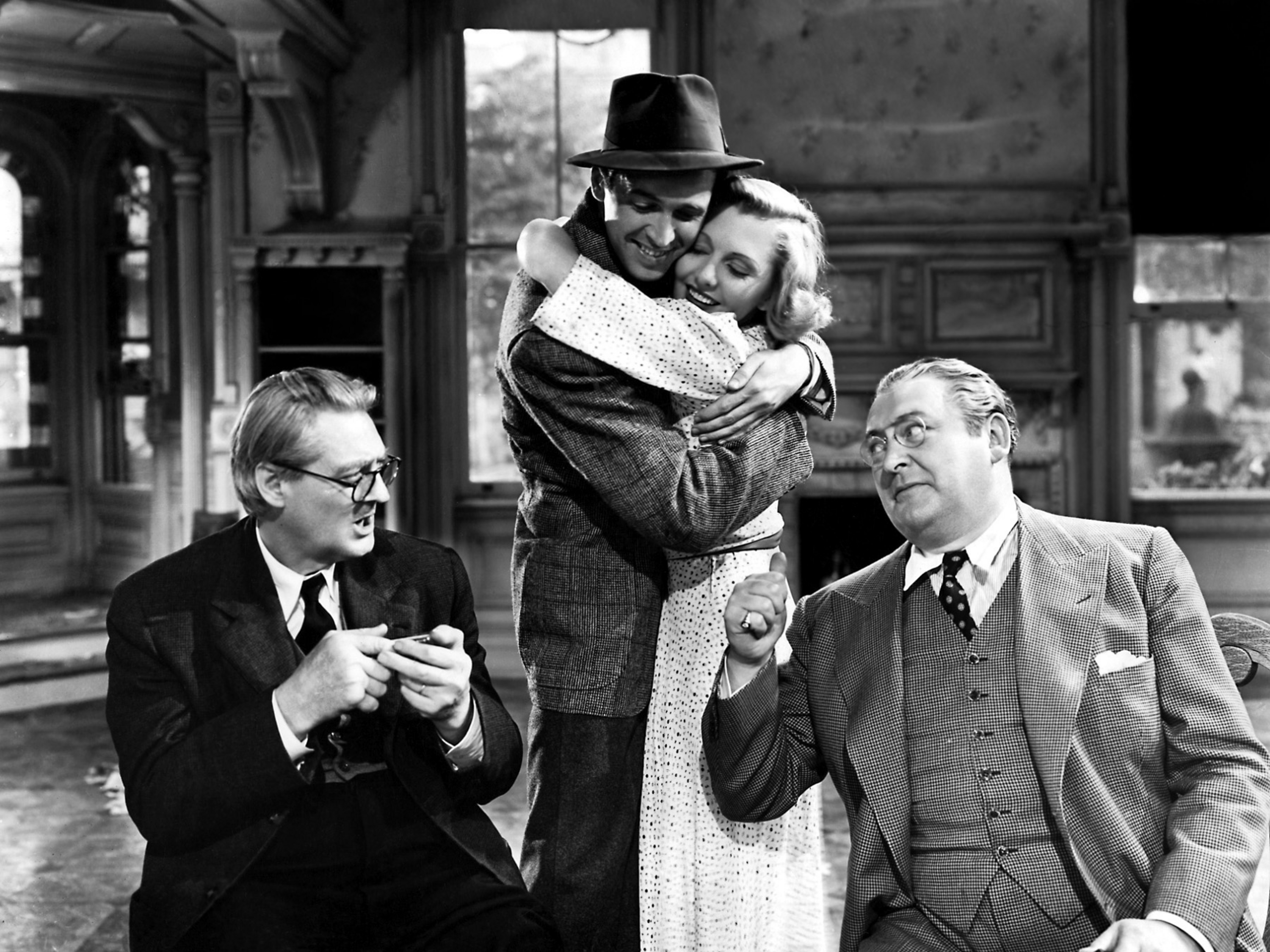
Scene from the 1938 film version

December 14, 1936: You Can't Take It With You, a play by George S. Kaufman and Moss Hart, premieres at the Booth Theatre, which still stands at 222 West 45th Street. It is directed by Kaufman, and stars Henry Travers as Martin Vanderhof, a.k.a. Grandpa, and becomes one of the biggest comedies in Broadway history.

It was filmed in 1938, with Lionel Barrymore, Jimmy Stewart, Jean Arthur, Spring Byington, Ann Miller, Mischa Auer, Eddie Anderson (Jack Benny's "Rochester"), and, uncredited, dance icon Arthur Murray. It won Best Picture, and Best Director for Frank Capra, who in 1945 would direct It's a Wonderful Life, including Stewart, Barrymore and Travers (Clarence the angel -- and who also appeared in "The Bells of St. Mary's," which was showing at the Bedford Falls Bijou in IAWL).

I saw a version on CBS in 1979, with several veterans of the network: Art Carney, Jean Stapleton, Blythe Danner, Harry Morgan, Robert Mandan, Barry Bostwick, Howard Hesseman, and Alice castmembers Polly Holliday (Flo) and Beth Howland (Vera). CBS tried to make it a series in 1987, with Morgan as Grandpa, but set it in the present day, so that, instead of never having paid income taxes (the 16th Amendment had only passed 23 years before the play's debut), he hadn't paid any since 1962.

*

December 14, 1936 was a Monday. Baseball was out of season. Football season was over, except for the New Year's Day bowl games. The NBA hadn't been founded yet. And the NHL had no games scheduled. So there were no scores on this historic day.

Monday, October 17, 2022

October 17, 1939: "Mr. Smith Goes to Washington" Premieres

October 17, 1939: Mr. Smith Goes to Washington premieres, at Constitution Hall in Washington, D.C. It was the 2nd of the 3 films that were directed by Frank Capra and starred James Stewart. The 1st was You Can't Take It With You in 1938. The 3rd was It's a Wonderful Life in 1946, which became the defining Frank Capra film and the defining Jimmy Stewart film.

U.S. Senator Sam Foley -- his State is never identified, but is said to be in the West -- dies in office. The Governor Hubert "Happy" Hopper (played by Guy Kibbee) appoints Jefferson Smith (Stewart) to replace him, thinking the young activist will be easy to manipulate. Senator Joseph Paine (Claude Rains), a friend of Smith's late father, mentors him, and Smith takes a liking to the Senator's daughter, Susan (Jean Arthur).

The Washington press take advantage of Smith's naïveté, and he ends up looking like a dim country bumpkin. He comes up with a bill to authorize a federal government loan to buy some land in his home State for a national boys' camp, to be paid back by youngsters across America. It sounds like a typical Franklin Roosevelt-style New Deal bill, and the public likes it, with donations pouring in immediately. However, the proposed campsite is already part of a dam-building graft scheme included in an appropriations bill framed by the the political machine of the State's party boss, Jim Taylor (Edward Arnold), and supported by Paine.

Unwilling to politically destroy Smith so that their graft plan will go through, Paine tells Taylor he wants out, but Taylor reminds him that Paine is in power primarily through Taylor's influence. Paine then advises Smith to keep silent about the matter. The following day, when Smith speaks out about the bill at Senate, the machine, through Paine, accuses Smith of trying to profit from his bill, by producing fraudulent evidence that Smith already owns the land in question. Smith is too shocked and angry by Paine's betrayal to defend himself, and runs away.

Saunders, who looked down on Smith at first, but has come to believe in him, talks him into launching a filibuster, to postpone the appropriations bill and prove his innocence on the Senate floor just before the vote to expel him. In his last chance to prove his innocence, he talks non-stop for about 25 hours, reaffirming the American ideals of freedom and disclosing the dam scheme's true motives. Yet none of the other Senators are convinced.

Newspapers and radio stations in Smith's home State, on Taylor's orders, refuse to report what Smith has to say, and even distort the facts against the Senator. The Boy Rangers' effort to spread the news in support of Smith results in vicious attacks on the children by Taylor's gangsters.

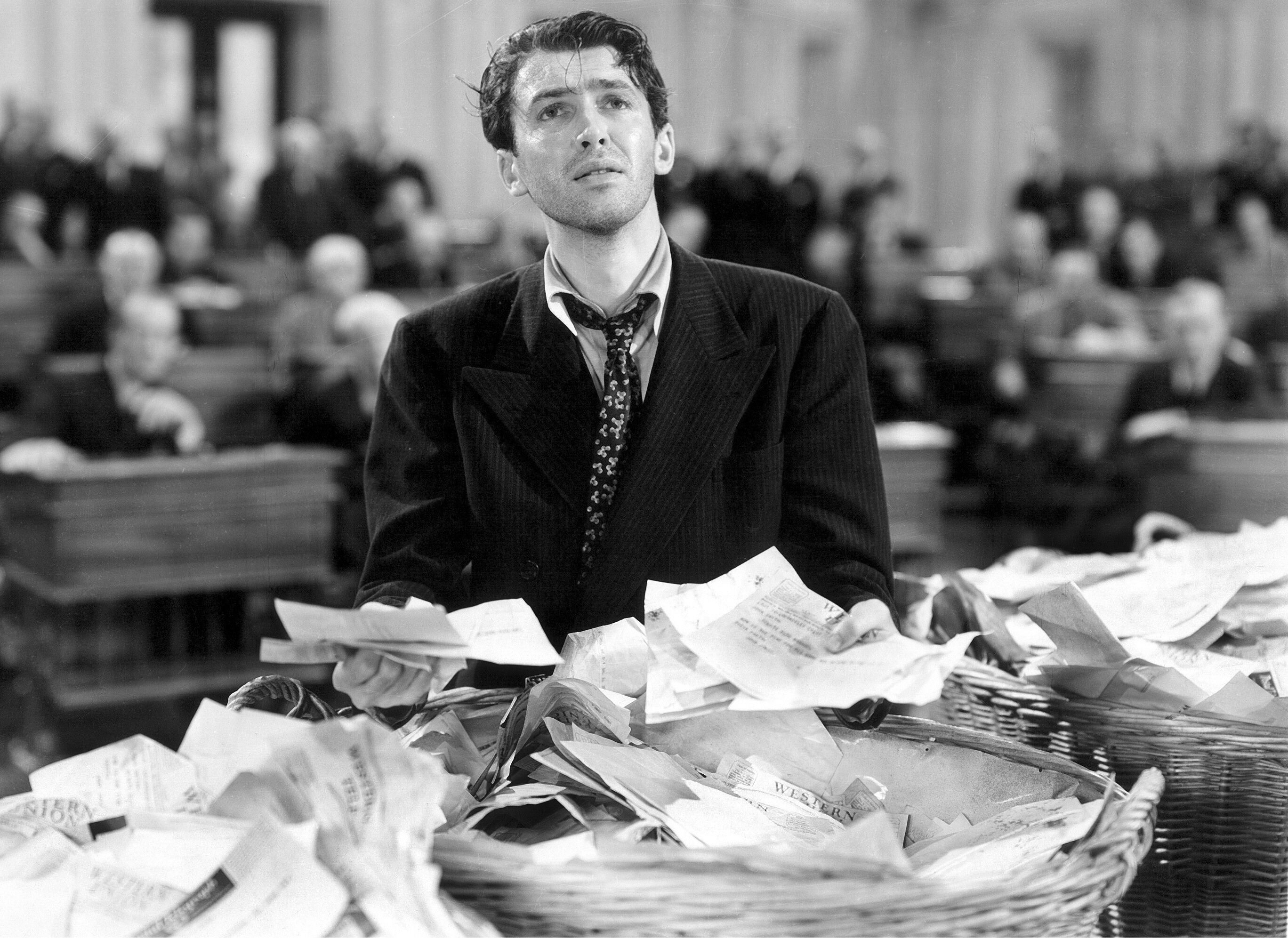
Although all hope seems lost, the Senators begin to pay attention as Smith approaches utter exhaustion. Paine has one last card up his sleeve: He brings in bins of letters and telegrams from the home State, purportedly from average people demanding his expulsion. Nearly broken by the news, Smith finds a small ray of hope in a friendly smile from the President of the Senate. Smith vows to press on until people believe him, but immediately collapses in a faint.

Overcome with the pangs of remorse, Paine leaves the Senate chamber, and attempts to commit suicide by gunshot, but is stopped by onlooking Senators. He then bursts back into the Senate chamber, shouting a confession to the whole scheme. The reformed Paine further insists that he must be expelled from the Senate, and affirms Smith's innocence.

Because the film even suggested that the American federal government might harbor corruption, it was slammed as anti-American and pro-Communist. Senator Alben Barkley of Kentucky, the Majority Leader (and later Vice President under Harry Truman), called the film "a grotesque distortion."

Joseph P. Kennedy, the U.S. Ambassador to Britain (and later father to 3 U.S. Senators, 1 of whom became President), wrote to Harry Cohn, head of Columbia Pictures, the film's distributor, and urged that it be withdrawn from European release, because it would damage America's prestige in Europe. He needn't have worried: The major Fascist dictators -- Adolf Hitler in Germany, Benito Mussolini in Italy, and Francisco Franco in Spain -- all banned it in their countries. It wasn't shown in the Soviet Union until 1950.

Since World War II, the words "Mr. Smith goes to Washington" have become code for a "citizen legislator" getting himself elected and fighting the entrenched interests in Congress. Many such candidates have proven to have been already bought by special interests before they got there.

*

October 17, 1939 was a Tuesday. Baseball season had just ended, with the New Yankees sweeping the Cincinnati Reds in the World Series. The NBA hadn't been founded yet. And the NHL season didn't start for another 2 weeks. There was one score on this historic day, and it was in college football: William & Mary and VPI played to a 6-6 tie at City Stadium in Richmond, Virginia.

"VPI" was the abbreviation for what was known from 1896 to 1944 as the Virginia Agricultural and Mechanical College and Polytechnic Institute; and from 1944 to 1970 as simply the Virginia Polytechnic Institute. Since 1970, it has been Virginia Tech University.

Saturday, April 30, 2022

April 30, 1948: The Film “State of the Union” Premieres

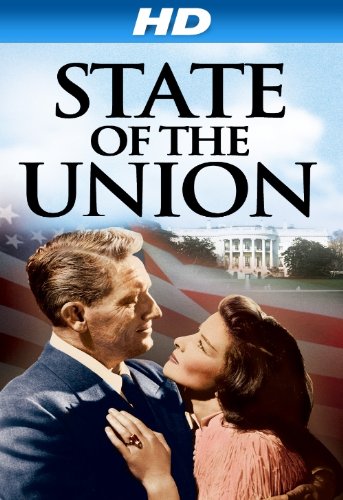
April 30, 1948: The film State of the Union premieres, directed by Frank Capra. Spencer Tracy plays a business lord who runs for President with absolutely no previous political experience. He cheats on his wife, and his wife knows it. The media is in his back pocket. He makes speeches that unnecessarily alienate people.

But the similarities to Donald Trump end there. He is repentant. He knows he is not meant to be president. He is not a bigot. And his hair is normal.

Ironically, Tracy's real-life mistress, Katharine Hepburn, plays the wronged wife. The mistress is played by Angela Lansbury, and she will try again to unduly influence a Presidential election, in 1962, in The Manchurian Candidate.

Despite seeming to favor underdog figures in his films, Capra was a lifelong conservative Republican who supported GOP candidates from Calvin Coolidge to Ronald Reagan. Despite directing populist films often associated with New Deal, liberal ideals, Capra personally despised Franklin D. Roosevelt, opposed government intervention, and admired certain right-wing figures.

Tracy, Hepburn and Lansbury were Democrats. Adolphe Menjou, who played a Republican strategist, was a staunch Republican in real life as well. Also appearing in the film were Margaret Hamilton, the Wicked Witch of the West in The Wizard of Oz; and a now-grown Carl Switzer, the former Alfalfa of Our Gang, as a bellboy.

*

April 30, 1948 was a Friday. MC5 guitarist Wayne Kramer and hockey coach Pierre Pagé were born. This was also the day the 1st Land Rover was produced. I have a separate entry for that event.

These baseball games were played that day:

* The New York Yankees beat the Boston Red Sox, 6-0 at Fenway Park in Boston. Stephen "Bud" Souchock wasn't a Yankee for long, but, on this day, the 1st baseman hit 2 home runs. Joe DiMaggio went 1-for-4. Ted Williams went 0-for-3 with a walk.

* The New York Giants lost to the Boston Braves, 7-2 at the Polo Grounds. Johnny Sain went the distance for the win, while Giant starter Ray Poat didn't get out of the 3rd inning.

* The Brooklyn Dodgers beat the Philadelphia Phillies, 11-2 at Shibe Park in Philadelphia. Erv Palica went the distance for the win, while Phils starter Emil "Dutch" Leonard didn't get out of the 2nd inning. Johnny "Spider" Jorgenson went 3-for-6 with an RBI. Jackie Robinson went 1-for-5 with a walk and an RBI.

* The Philadelphia Athletics beat the Washington Senators, 3-1 at Griffith Stadium in Washington.

* The St. Louis Cardinals beat the Cincinnati Reds, 13-7 at Crosley Field in Cincinnati. It was just another day at the office for Stan Musial: Stan the Man went 5-for-6 with a home run and 4 RBIs.

* The Chicago White Sox beat the Detroit Tigers, 5-4 at Briggs Stadium (later Tiger Stadium) in Detroit.

* The Pittsburgh Pirates beat the Chicago Cubs, 10-4 at Wrigley Field in Chicago. Ralph Kiner went 3-for-5 with a walk and 2 RBIs.

* And the Cleveland Indians and the St. Louis Browns were rained out at Sportsman's Park in St. Louis. The game was made up a part of a doubleheader on August 11. The Indians won the opener, 7-5. Bob Lemon was the winning pitcher, helping his own cause by going 2-for-4, with Satchel Paige getting the save. The Browns won the nightcap, 12-4.

Over the 2 games, for the Tribe, shortstop and manager Lou Boudreau went 4-for-9 with 2 RBIs, Dale Mitchell went 6-for-10, Joe Gordon went 3-for-7 with a home run and 2 RBIs, Larry Doby went 2-for-8 with 2 walks and 3 RBIs, Jim Hegan went 3-for-6 with a walk.

For the Browns, Hank Arft went 5-for-9 with a walk and 6 RBIs, Dick Kokos went 5-for-8 with a walk and 3 RBIs, and Al Zarilla went 3-for-8 with a walk and an RBI.

Tuesday, February 22, 2022

February 22, 1934: “It Happened One Night” Premieres

February 22, 1934: It Happened One Night premieres. This film seemed to be doomed to disaster. Instead, it became one of the most beloved movies of its time.

The story was based on Night Bus, a short story by Samuel Hopkins Adams, published in Collier's magazine in August 1933. Robert Riskin wrote a screenplay around it for Columbia Pictures. Studio boss Harry Cohn assigned it to Frank Capra, who had only directed a few light comedies to that point. But his most recent film, Lady for a Day, had also been from a Riskin screenplay. That film was nominated for the Academy Award for Best Picture, and Capra was nominated for Best Director.

By this point, Clark Gable had become one of Metro-Goldwyn-Mayer's biggest stars, but he and the studio couldn't agree on his next project. Studio head Louis B. Mayer was, essentially, paying him $2,000 a week to do nothing. (This was in the middle of the Great Depression. The figure works out to about $45,000 a week in 2022 money, or $2.34 million a year.)

So Mayer lent him to Cohn for $2,500 a week, making a $500 weekly profit. Gable was not Capra's 1st choice to play newspaper reporter Peter Warne. Capra wanted Robert Montgomery, but he thought the script was poor. (Montgomery is not well-remembered today, and giving up this movie may be why.) A rumor got around that this movie was a punishment for Gable's turning down of another role, but it wasn't true: MGM simply didn't have anything for him.

Gable had already done some films with Myrna Loy, and would do more. But this would not be one of them. Loy was the 1st actress offered the role of spoiled heiress Ellen "Ellie" Andrews, but, like Montgomery, she didn't like the script, and later noted that the final story, as filmed, bore little resemblance to it.

Margaret Sullavan was offered the part next. She also turned it down. Next was Constance Bennett. She wanted to produce the film herself, but there was no way Cohn, one of the meanest and most hated studio bosses ever, would have allowed a woman to do that. Bette Davis, then working her way into stardom, wanted it, but Jack L. Warner, head of Warner Brothers, wouldn't let her leave his studio, even for a few weeks, to film it.

Interestingly, the next actress offered the role was Carole Lombard, who had recently divorced actor William Powell, who was about to join with Loy to play married amateur detectives Nick and Nora Charles in The Thin Man, starting a movie franchise. And in 1939, Lombard married Gable. She was signed to Paramount Pictures in 1933, but was filming Bolero for them, and the schedules conflicted, preventing her from filming.

Loretta Young turned it down as well. In 1935, Young would be paired with Gable for Call of the Wild. Married to someone else and 12 years her senior, Gable seduced Young, and she became pregnant. After a long subterfuge, she announced that she had adopted a daughter, Judy. But as Judy grew older, her resemblance to Gable was undeniable. It was only in her final years, when Young learned of the term "date rape," that she realized that this was what Gable had done to her.

Finally, Cohn told Capra to take Claudette Colbert. Her 1st film, in 1927, was a silent picture, For the Love of Mike, which Capra had directed. The experience was rotten for both, and neither wanted to work with the other again. Colbert agreed, on 2 conditions: That she be paid $50,000, and that filming would be done in 4 weeks, as she had a vacation planned. So Capra was making a movie he didn't want to make, with a male lead he didn't want and vice versa, and a female lead he didn't want and vice versa.

And neither star liked the script. Desperate to not have to look for yet another replacement for either role, Capra let Riskin rewrite it. Capra later said Colbert "had many little tantrums, motivated by her antipathy toward me."

For perhaps the film's best-remembered scene, after Peter is unable to use his thumb to hitch a ride -- including thumbing his nose at a passing driver, which would soon be a no-no under the Hays Code -- the script called for Ellie to hitch up her skirt and stick her leg out, causing a driver to slam on his brakes and let them in. Colbert refused to do it, saying it was "unladylike." So Capra hired a chorus girl for a body double. Apparently, she wasn't enough of a double, because Colbert saw her and said, "Get her out of here! I'll do it! That's not my leg!"

As for the story: Against the wishes of Alexander Andrews, her wealthy father, Ellie Andrews has eloped with King Westley, a pilot and a fortune-hunter. ("King" is his name, not a title.) Alexander wants to have the marriage annulled. So Ellie runs away in Florida, and boards a Greyhound bus to New York, to reunite with him.

One of the passengers is newly-fired newspaper reporter Peter Warne. He recognizes her from her picture in the papers, and offers her a deal: An exclusive on her story, in exchange for helping her reunite with her husband; or he tells her father where she is. She accepts the deal/blackmail.

As they go through several adventures, Ellie loses her initial disdain for Peter and they begin to fall in love. When the bus breaks down and they begin hitchhiking, they fail to secure a ride until Ellie displays a shapely leg to Danker, the next driver. When they stop en route, Danker tries to steal their luggage but Peter chases him down and seizes his Ford Model T.

Near the end of their journey, Ellie confesses her love to Peter. The owners of the motel in which they stay notice that Peter's car is gone, and then expel Ellie. Believing Peter has deserted her, Ellie telephones her father, who agrees to let her marry Westley. Meanwhile, Peter has obtained money from his editor to marry Ellie, but he just misses her on the road. Although Ellie no longer has any desire to be with Westley, she believes that Peter has betrayed her for the reward money, and so agrees to have a second, formal wedding with Westley.

On the wedding day, she finally reveals the whole story to her father. When Peter comes to Ellie's home, Andrews offers him the reward money, but Peter insists on being paid only his expenses, a paltry $39.60 (about $865 in 2022 money) for items that he had been forced to sell to buy gasoline. When Andrews presses Peter for an explanation of his odd behavior and demands to know if he loves her, Peter first tries to dodge the questions, but then admits that he loves Ellie, and storms out.

Westley arrives for his wedding via an autogyro, but at the ceremony, Andrews reveals to his daughter Peter's refusal of the reward money, and tells her that her car is waiting by the back gate, in case she changes her mind. At the last minute, just before she says "I do," she decides not to go through with the wedding. Ellie dumps Westley at the altar, bolts for her car, and drives away as the newsreel cameras crank.

A few days later, Andrews is working at his desk when Westley calls to tell him that he will take the financial settlement and not contest the annulment. His executive assistant brings him a telegram from Peter: "What's holding up the annulment, you slowpoke? The walls of Jericho are toppling!" That is a reference to a makeshift wall made of a blanket hung over a rope that was tied across the rooms separating the beds they had slept in, in order to give them each privacy while traveling together. With the annulment in hand, Andrews sends the reply, "Let 'em topple."

The last scene has Peter's battered Model T parked in a motor court in Glen Falls, Michigan. The mom-and-pop owners talk and wonder why, on such a warm night, the newlyweds (he had seen the marriage license) wanted a clothesline, an extra blanket, and the little tin trumpet that he had gotten for them. As they look at the cabin, the toy trumpet sounds a fanfare, the blanket falls to the floor, and the lights in the cabin go out.

The film was a smash. Gable and Colbert, already known dramatic stars, were embraced as comedy stars, too. The film was nominated for 5 Academy Awards, winning all of them: Best Picture, Best Director for Capra, Best Actor for Gable, Best Actress for Colbert, and Best Screenplay for the final draft by Riskin. It was the 1st nonmusical comedy to win Best Picture, and the 1st film to sweep those 5 Oscars. The only ones since have been One Flew Over the Cuckoo's Nest in 1975 and The Silence of the Lambs in 1991.

There was a scene in which Gable takes of his shirt, revealing a bare chest. It Happened One Night is credited for hurting the undershirt industry, because men who wanted to be like Gable stopped buying them. Between that and the implication at the end that Peter and Ellie were about to have sex, this was one of the films cited by the Legion of Decency as a reason why the censors had to get tougher, resulting in the rewriting of the Hays Code.

Gable went on to make many more classics, including Gone with the Wind, and died in 1960. His last film was also Marilyn Monroe's last film: The Misfits. Colbert appeared in Cleopatra in 1934, setting the standard for the role for nearly 30 years until Elizabeth Taylor, remained one of the highest-paid actresses into the 1940s, and lived until 1996.

In addition to the aforementioned You Can't Take It With You, Capra would direct "everyman" films like Mr. Deeds Goes to Town, Meet John Doe, Mr. Smith Goes to Washington, and It's a Wonderful Life. He also directed the Why We Fight documentaries for the U.S. Department of War during World War II. He lived until 1991.

Riskin wrote the screenplays for Mr. Deeds Goes to Town and You Can't Take It With You, and a few others, before a stroke debilitated him in 1950. He died in 1955. Cohn died in 1958, and just about everybody in Hollywood attended his funeral. This led comedian Red Skelton to say, "It proves what Harry always said: Give the public what they want, and they'll come out for it."

The musicals Eve Knew Her Apples in 1945 and You Can't Run Away From It in 1956 are considered remakes, but no one has ever tried a direct remake of It Happened One Night. It's just as well: These days, an heiress simply wouldn't be a sympathetic character, not even if she were as beautiful as Claudette Colbert.

*

February 22, 1934 was a Thursday. Baseball and football were out of season. And the NBA hadn't been founded yet. But the entire NHL was in play that night:

* The New York Rangers beat the Detroit Red Wings, 3-1 at the old Madison Square Garden.

* The New York Americans played the Chicago Black Hawks to a tie, 0-0 at the Chicago Stadium.

* The Montreal Maroons beat the Montreal Canadiens, 1-0 at the Montreal Forum.

* And the Ottawa Senators beat the Boston Bruins, 3-1 at the Boston Garden.

December 31, 1999 & January 1, 2000: The Millennium

December 31, 1999:  The Millennium arrives. The people of planet Earth survived. At a terrible cost. But we hadn't destroyed ourselves. ...