Showing posts with label martin luther king. Show all posts

Thursday, December 1, 2022

December 1, 1955: Rosa Parks Holds Her Seat

December 1, 1955: Rosa Parks is told to get up and move. She says, "No." In so, doing, she made history.

As historian Laurel Thatcher Ulrich said, "Well-behaved women rarely make history."

Let the record show that Rosa Parks was not the first woman to make this kind of history. In 1943, 17-year-old Bernice Delatte was arrested for defying segregation rules on a bus in New Orleans. In 1944, a U.S. Army Lieutenant was told to go to the back of a bus, to make room for a lower-ranking soldier. He refused. He got court-martialed. He was acquitted. His name was Jack Roosevelt Robinson. Yes, that Jackie Robinson. And in 1953, a 6-day boycott got the buses in Baton Rouge, Louisiana desegregated.

On March 2, 1955, Claudette Austin was arrested in Montgomery, the capital of Alabama, for refusing to give up her seat to a white woman on a crowded, segregated bus. The National Association for the Advancement of Colored People had been waiting for a chance to challenge a "send the blacks to the back of the bus" law, in line with the decision the year before, by the U.S. Supreme Court, in Brown v. Board of Education of Topeka, Kansas, that accommodations that were officially "separate but equal" was unconstitutional.

But Claudette was 15 years old, unmarried, and pregnant. Parks later said, "If the white press got ahold of that information, they would have a field day. They'd call her a bad girl, and her case wouldn't have a chance." The NAACP would need a more sympathetic defendant. Nine months later -- perhaps an appropriate time period -- they found one: Parks herself.

Rosa Louise McCauley was born on February 4, 1913 in Tuskegee, Alabama, and grew up in Pine Level, outside Montgomery. She was bullied by white children, and never forgot it. In 1932, she married Raymond Parks, a barber who worked with the NAACP. She joined the Montgomery chapter in 1943, and was elected its secretary. During World War II, she rode on an integrated trolley at Maxwell Air Force Base in Montgomery. She later said, "You might just say Maxwell opened my eyes up."

On November 27, 1955, Rosa Parks was attending Dexter Avenue Baptist Church in Montgomery, whose pastor was 26-year-old Dr. Martin Luther King Jr. He had invited T.R.M. Howard, head of the Regional Council of Negro Leadership in Mississippi, to speak of the recent murder of Emmett Till, and the acquittal of the 2 men who did it.

It was still on her mind 4 days later, on December 1. At around 6:00 PM, she boarded a Montgomery City Lines bus downtown. Eventually, all of the White-only seats in the bus filled up. The bus reached the third stop, in front of the Empire Theater, and several White passengers boarded. The driver, James F. Blake, noted that two or three White passengers were standing, as the front of the bus had filled to capacity.

Blake moved the "colored" section sign behind Parks, and demanded that four Black people give up their seats in the middle section, so that the White passengers could sit. Three of them complied. Parks said, "I thought of Emmett Till, a 14-year-old African American who was lynched in Mississippi in 1955, after being accused of offending a White woman in her family's grocery store, whose killers were tried and acquitted – and I just couldn't go back." In her autobiography, she said:
People always say that I didn't give up my seat because I was tired, but that isn't true. I was not tired physically, or no more tired than I usually was at the end of a working day. I was not old, although some people have an image of me as being old then. I was forty-two. No, the only tired I was, was tired of giving in.
When Parks refused to give up her seat, Blake took to his radio, and called the police. When she was arrested, she asked the officer, "Why do you push us around?" She remembered him saying, "I don't know, but the law's the law, and you're under arrest."

She was charged with a violation of Chapter 6, Section 11, segregation law of the Montgomery City code. Edgar Nixon, president of the Montgomery chapter of the NAACP and leader of the Pullman Porters Union, and her friend Clifford Durr bailed Parks out of jail that evening.

On Sunday, December 4, plans for the Montgomery bus boycott were announced at Black churches in the area, and a front-page article in the Montgomery Advertiser helped spread the word. At a church rally that night, those attending agreed unanimously to continue the boycott until they were treated with the level of courtesy they expected, until Black drivers were hired, and until seating in the middle of the bus was handled on a first-come-first-served basis.

The next day, Parks was tried on charges of disorderly conduct and violating a local ordinance. The trial lasted 30 minutes. After being found guilty and fined $10, plus $4 in court costs -- the total of $14 worth about $155 in 2022 money -- she appealed her conviction, and formally challenged the legality of racial segregation.

It rained that day, but the Black community persevered in their boycott. Some rode in carpools, while others traveled in Black-operated cabs that charged the same fare as the bus, 10 cents. Most of the remainder of the 40,000 Black commuters walked, some as far as 20 miles.

The boycott lasted for an entire year. On December 20, 1956, the federal ruling Browder v. Gayle took effect, declaring the Alabama and Montgomery laws that segregated buses were unconstitutional. All the seats on all the buses were now open to all.

In 1957, Rosa and Raymond Parks moved to Detroit, living with her brother and sister-in-law. She became a fair housing activist, helped John Conyers get elected to Congress in 1964, and served as his secretary until 1988. She participated in the Selma-to-Montgomery march in 1965. Her husband and brother died within weeks of each other in 1977, and she stepped back from civil rights activities thereafter to care for her mother, who died in 1979.
She then returned to the struggle, adding Planned Parenthood to her causes. In 1994, she was robbed and assaulted in her Detroit home. Mike Ilitch, founder of Detroit-based pizza chain Little Caesars, and owner of baseball's Detroit Tigers and hockey's Detroit Red Wings, bought her an apartment in a high-rise riverfront condo.
The following year, in commemoration of the 40th Anniversary of her seated stand, President Bill Clinton invited her to the State of the Union Address. He said, "She's sitting down with the First Lady tonight, and she may get up, or not, as she chooses." Acknowledging a standing ovation, she briefly stood.
She died on October 24, 2005, at the age of 92, after years of ill health and cognitive decline. Although often called "the mother of the Civil Rights Movement," she had no children of her own. She became the 1st woman, the 2nd black person, and the 1st private citizen to lie in state under the Rotunda of the U.S. Capitol Building in Washington.
A statue of her stands in Montgomery, roughly where she was arrested. In her adopted hometown of Detroit, the bus terminal is named for her. The bus on which she was arrested was also moved to Detroit, to the Henry Ford Museum in adjoining Dearborn, where it is on display along with the limousine in which President John F. Kennedy was assassinated, and the Ford's Theatre chair in which President Abraham Lincoln was sitting when he was assassinated.
As has been said, Rosa Parks sat, so that Martin Luther King could march, so that Barack Obama could run.
Bernice Delatte, the 1943 New Orleans protestor, lived until 2010. Claudette Austin became a nurse, married, and took the name Claudette Colvin. As of December 1, 2022, she is still alive. (UPDATE: She died in 2026.)

*

December 1, 1955 was a Thursday. Baseball was out of season. Football was in midweek. Two games were played in the NBA. The New York Knicks lost to the Minneapolis Lakers, 97-90 at the Minneapolis Auditorium. And the Philadelphia Warriors beat the St. Louis Hawks, 115-98 at the Philadelphia Civic Center.

And 1 game was played in the NHL: The Montreal Canadiens beat the Boston Bruins, 2-1 at the Boston Garden.

Wednesday, October 26, 2022

October 26, 1960: The Kennedys Save Dr. King -- and Their Own Election

October 26, 1960: There are 13 days left before the Presidential election. Martin Luther King Jr. is arrested for protesting at a whites-only snack bar in his hometown of Atlanta.

Terrified that he might be beaten, or even killed, while in a Southern jail, his wife, Coretta Scott King, calls the campaign of the Republican nominee for President, Vice President Richard Nixon, for help. She gets none.

So she calls the campaign of the Democratic nominee for President, Senator John F. Kennedy of Massachusetts. Whoever she reached got word to JFK. He calls his brother and campaign manager, Robert F. Kennedy, and asks him to see what he can do. RFK calls Governor Ernest Vandiver of Georgia. Together, they work on Oscar Mitchell, the judge who had ordered MLK's arrest. He is released.

Prior to this, the King family (not to be confused with the soon-to-be-popular white singing family of the same name) were Republicans, because the Republican Party was the party of Abraham Lincoln; while, being Southern blacks, they knew the Democratic Party not as the party of Franklin D. Roosevelt, but as the party of slavery and segregation.

After this, MLK's father, Dr. Martin Luther King Sr., told people, "If I had a million votes, I would give them to Jack Kennedy."

For all we know, the Kennedy brothers' action to free MLK may just have swayed 1 million black votes to JFK, who had not previously been seen as noticeably friendly to civil rights. On Election Day, November 8, JFK won New Jersey (with Newark) by 22,000 votes, Missouri (with St. Louis and Kansas City) by 10,000, and Illinois (with Chicago) by 9,000.

Had Nixon won those States, Nixon would have won the Electoral Vote, even if he had still lost the popular vote, and would have won the election. So if you're a Republican, and are looking for a reason why Nixon lost, don't look at Mayor Richard J. Daley and any shenanigans he might have pulled in Chicago: Look at Nixon himself. He could have saved Dr. King, and, in so doing, saved his campaign. He chose not to. JFK chose to help himself by helping Dr. King.

*

October 26, 1960 was a Wednesday. Baseball season ended 13 days earlier, with Bill Mazeroski's home run in the bottom of the 9th inning of Game 7 giving the Pittsburgh Pirates the World Series over the New York Yankees. Football was in midweek.

There was 1 game played in the NBA: The Detroit Pistons beat the Cincinnati Royals, 131-117 at Cobo Hall (now Huntington Place) in Detroit. For the Pistons, Gene Shue (later to coach the Washington Bullets to the 1978 NBA Championship) scored 30 points, and Bailey Howell scored 23. For the Royals, Jack Twyman scored 33, and Oscar Robertson scored 25.

And there was 1 game in the NHL: The New York Rangers beat the Detroit Red Wings, 4-3 at the old Madison Square Garden. Andy Hebenton scored 2 goals for the Broadway Blueshirts.

Thursday, September 15, 2022

September 15, 1963: The Birmingham Church Bombing

A recent photo of the restored 16th Street Baptist Church

September 15, 1963: A bomb goes off at the 16th Street Baptist Church in Birmingham, Alabama, killing what became known as the "Four Little Girls."

Dr. Martin Luther King Jr., who preached in Montgomery, the State capital of Alabama, from 1954 to 1960, had called Birmingham, the State's largest city, "probably the most thoroughly segregated city in the United States." Whether he was correct or not, the city did little to convince people otherwise: It had no black police officers, and no black firefighters.

On January 14, 1963, George Wallace was sworn in as Governor of Alabama. the State's Governors are sworn in on a star on the floor of the front of the State House, where Jefferson Davis had been sworn in as President of the Confederate States of America. And in his Inaugural Address, Wallace promised, "Segregation now, segregation tomorrow, and segregation forever!"

On April 3, Dr. King began the Birmingham Campaign, and on April 12, he was arrested. On April 16, he wrote what's become known as the Letter from Birmingham Jail, saying, "Injustice anywhere is a threat to justice everywhere." He was soon bailed out by Walter Reuther, president of the United Auto Workers, who had been working for racial equality since Dr. King and his contemporaries were children, and could see how important the Birmingham Campaign was.

On May 2, people walked out of the 16th Street Baptist Church, intending to march to Birmingham's City Hall, to talk to the Mayor, Albert Boutwell. The Mayor didn't want that. Theophilus Eugene "Bull" Connor had been Commissioner of Public Safety from 1937 to 1952, and had been again since 1957. Boutwell called Connor, and by the end of the day, 959 children were arrested. Nearly one thousand children.

The next day, the march was even bigger, and Connor ordered the use of attack dogs, German shepherds. He ordered the use of fire hoses -- "water cannons," powerful enough to cause internal injuries. These actions were caught on film, and broadcast on the evening news.

Bombings at the homes of black people, and at black-run institutions, had occurred 21 times in Birmingham between 1955 and 1963, earning the city the nickname "Bombingham." Despite the destruction, there had not yet been any deaths.

On June 11, Wallace stood in the doorway of Foster Auditorium, then both the main indoor athletic facility and the registration building for the University of Alabama, in Tuscaloosa. The purpose was to deny the registration of the school's 1st black students. Two were making the attempt: James Hood and Vivian Malone. He said, as Governor, he had to "denounce and forbid this unwarranted and illegal action by the central government!"

It was not illegal: The Supreme Court had ruled segregation illegal in 1954, so Wallace was the one breaking the law. And it was not unwarranted.

President John F. Kennedy knew beforehand that Wallace was going to do this, and wanted his Attorney General and brother Robert F. Kennedy to do something about it. So RFK sent his Deputy, Nicholas Katzenbach, and federal marshals to Tuscaloosa. Katzenbach showed Wallace a federal warrant for his arrest, and essentially told him, "Get your sorry scrawny ass out of that door, or you will be handcuffed and arrested, and exposed as a federal criminal on national television."

Everybody remembers Wallace's Stand In the Schoolhouse Door. Most people forget that he backed down, because he didn't want to go to jail. Martin Luther King was willing to go to jail to challenge a law he believed was unjust. George Corley Wallace was not.

On August 28, the March On Washington for Jobs and Freedom was held. About 300,000 people attended an assembly at the Lincoln Memorial. Dr. King was not even considered the main speaker going in: A. Philip Randolph, a longtime union leader, who had first proposed such a march in 1941, and had gone through with it this time, was. But with his "I Have a Dream" speech, he made himself an American legend.

Finally, the white supremacists could take no more. On September 15, a bomb was placed under the front steps of the 16th Street Baptist Church -- a building specifically targeted, for its role in the Birmingham Campaign. At 10:22 AM, a phone call was placed to the church. Carolyn Maull, just 14 years old, and one of the children who had been hit by the water cannons, picked up the phone. A male voice said just 2 words before hanging up: "Three minutes."

It wasn't three minutes. It was less than one minute before the bomb went off. In a basement bathroom, five girls were changing into choir robes for the day's service. One, Sarah Collins, 12, barely survived, was badly cut, and lost the use of an eye. Four others were killed: Sarah's sister, Addie Mae Collins, 14; Carole Robertson, also 14; Cynthia Wesley, also 14; and Carol Denise McNair (usually listed as "Denise"), only 11.
Plaque at the church

No one else was killed, but the explosion was powerful enough that it knocked over a passing car, and the driver was thrown from it, sustaining some injuries. The total number of injuries may have been as high as 22.

If the bombers thought that this would intimidate the Civil Rights Movement, they guessed wrong: If anything, it was emboldened. On July 2, 1964, President Lyndon Johnson signed the Civil Rights Act of 1964 into law. On March 7, 1965, a march from Selma, Alabama to Montgomery began. While the police brutally broke it up, it was finished, and it inspired LBJ to demand a Voting Rights Act. He signed that into law on August 6, 1965.

Dr. King kept pressing for more advancements until his assassination on April 4, 1968. That turned out to be the turning point the white supremacists hoped for: The Movement began to lose steam, although it has never really gone away.

In 1965, the FBI, then run by Director J. Edgar Hoover, who was no friend of the Movement, foolishly thinking it run by Communists, concluded that the bombing was committed by 4 known members of the Ku Klux Klan: Thomas Blanton, Herman Cash, Robert Chambliss and Bobby Frank Cherry. But the Bureau refused to prosecute any of them. They refused to do their job.

It took years, but State prosecutors finally took action. On November 18, 1977, Chambliss was convicted of the murder of Denise McNair. He was only charged with one murder, in case he was acquitted, so that the prosecution could then move on to one of the other three. 

On February 7, 1994, Herman Cash died, having never been prosecuted. He was the only one who got away with it for the rest of his life. On May 1, 2001, Blanton was convicted of his role in all 4 murders. On May 22, 2002, Cherry was convicted of his role in all 4 murders. All 3 surviving defendants died in prison: Chambliss on October 29, 1985; Cherry on November 18, 2004; and Blanton on June 26, 2020.

In 2017, Doug Jones, the prosecutor of Blanton and Cherry, won a special election for U.S. Senator from Alabama, as a Democrat. It seemed to be an affirmation that the system works. In 2020, he was defeated in his bid for a full term, by Tommy Tuberville, a far-right idiot who had failed as head football coach at Auburn. So much for justice.

Carolyn Maull McKinstry, who took the phone call at the church warning about the bomb, survived a 2nd bomb, that destroyed a large portion of her home in 1964. She went on to graduate from Fisk University in Nashville, and received a Master of Divinity Degree from Samford University’s Beeson Divinity School. She has written several books about the civil rights experience, and is still alive as of September 15, 2022.

*

September 15, 1963 was, as I said, a Sunday. It was the opening week of the NFL season.

* The New York Giants beat the Baltimore Colts, 37-28 at Memorial Stadium in Baltimore.

* The Philadelphia Eagles and the Pittsburg Steelers played to a 15-15 tie, at Franklin Field in Philadelphia.

* The Cleveland Browns beat the Washington Redskins, 37-14 at Cleveland Municipal Stadium.

* The Chicago Bears beat their arch-rivals, the Green Bay Packers, 10-3 at Green Bay City Stadium. This was the replacement for the previous City Stadium, renamed Lambeau Field in 1965, after team founder Earl "Curly" Lambeau died.

* The Minnesota Vikings beat the San Francisco 49ers, 24-20 at Kezar Stadium in San Francisco.

* The day before, the football version of the St. Louis Cardinals beat the Dallas Cowboys, 34-7 at the Cotton Bowl in Dallas.

* Also the day before, the Detroit Lions beat the Los Angeles Rams, 23-2 at the Los Angeles Memorial Coliseum.

The AFL season started the week before. However, the New York Jets, in their 4th season, but their 1st after dropping the New York Titans name, had the week off. So did the Kansas City Chiefs, who had been the Dallas Texans in the AFL's 1st 3 seasons.

* The Oakland Raiders beat the Buffalo Bills, 35-17 at Frank Youell Field in Oakland.

* The day before, the San Diego Chargers beat the Boston Patriots, 17-13 at Balboa Stadium in San Diego. This was a preview of the AFL Championship Game, and the Chargers won that in a blowout.

* Also the day before, the Houston Oilers beat the Denver Broncos, 20-14 at Jeppesen Stadium in Houston.

And there were Major League Baseball games played on the day:

* The New York Yankees beat the Minnesota Twins, 2-1 at Metropolitan Stadium in the Minneapolis suburb of Bloomington, Minnesota. Whitey Ford went the distance to advance to 23-7 on the season, and backed by a 2-RBI single by Clete Boyer in the 2nd inning.

The Yankees had clinched the American League Pennant by beating the Twins 2 days earlier, so there was no reason to risk Mickey Mantle, who'd missed 2 months in the middle of the season, for another injury.

* The New York Mets got swept in a doubleheader at the Polo Grounds, by their 1962 expansion brethren, the Houston Colt .45s. The Astros-to-be won the opener 5-4, and the nightcap 5-0. Chris Zachary pitched 6 innings, allowing 3 hits, and Hal Woodeshick went the last 3, hitless, completing the shutout.

* The Philadelphia Phillies beat the Los Angeles Dodgers, 6-1 at Connie Mack Stadium, in Philadelphia.

* The San Francisco Giants beat the Pittsburgh Pirates, 13-5 at Forbes Field in Pittsburgh. Willie Mays went 2-for-4 with a home run and 4 RBIs for the Giants. Roberto Clemente went 0-for-4 for the Pirates. This was the day all 3 Alou brothers played in the outfield at the same time, with Mays having been taken out late. I have a separate entry for that event.

* The Baltimore Orioles beat the Detroit Tigers, 2-1 at Tiger Stadium in Detroit.

* The Cincinnati Reds beat the Chicago Cubs, 3-1 at Wrigley Field in Chicago.

* The St. Louis Cardinals swept a doubleheader from the Milwaukee Braves at the 1st Busch Stadium in St. Louis, formerly named Sportsman's Park. The Cards won the 1st game 3-2, and the 2nd game 5-0. Ray Sadecki pitched a 5-hit shutout.

In his last month as an active player, Stan Musial went 0-for-4 in the doubleheader, appearing only as a pinch-hitter in the nightcap. Hank Aaron went 2-for-7 with a home run and 2 RBIs.

* The Boston Red Sox beat the Kansas City Athletics, 5-3 at Kansas City Municipal Stadium.

* And the Cleveland Indians beat the Los Angeles Angels, 6-3 at Dodger Stadium in Los Angeles, where the Angels played before their stadium in suburban Anaheim opened.

Sunday, August 28, 2022

August 28, 1963: The March On Washington

August 28, 1963: The March On Washington for Jobs and Freedom is held at the Lincoln Memorial. A crowd usually listed as 250,000 or 300,000 attends.

It is organized by A. Philip Randolph, the leading figure of the black wing of America's labor movement, who had canceled a similar march in 1941, after getting concessions from President Franklin D. Roosevelt; and Bayard Rustin, who had organized the anti-segregation Freedom Rides in 1961.

Mahalia Jackson, then America's greatest living singer of gospel music, sang "How I Got Over." Marian Anderson, who had sung at the Lincoln Memorial in an Easter concert before 75,000 in 1939, sang "He's Got the Whole World in His Hands."

Joan Baez sang "We Shall Overcome," Bob Dylan sang, "Only a Pawn in Their Game," and, then a couple, together they sang Bob's song "When the Ship Comes In." Peter, Paul and Mary sang "If I Had a Hammer" and Bob's song "Blowin' in the Wind." Odetta sang "I'm On My Way."

Other celebrities on hand: Singers Josephine Baker, Harry Belafonte, Sammy Davis Jr., Diahann Carroll, Lena Horne, Judy Garland and Bobby Darin; actors Sidney Poitier, Marlon Brando, Burt Lancaster, James Garner, Robert Ryan, Rita Moreno, married couple Ossie Davis and Ruby Dee, married couple Paul Newman and Joanne Woodward, and, surprising many people only old enough to remember him as a conservative and a gun-rights advocate, Charlton Heston; novelist James Baldwin; and baseball trailblazer Jackie Robinson.

The speakers were, in order: Randolph; Walter Reuther, the President of the United Auto Workers (UAW), who'd been bringing black leaders into the labor movement since the 1930s; Roy Wilkins, the Executive Director of the National Association for the Advancement of Colored People (NAACP); John Lewis, the Chairman of the Student Nonviolent Coordinating Committee (SNCC); Daisy Bates, a journalist in Little Rock, Arkansas, who had aided the Little Rock Nine in 1957; Dr. Eugene Carson Blake, of the United Presbyterian Church and the National Council of Churches; Floyd McKissick, the National Director of the Congress of Racial Equality (CORE); Whitney Young, President of the National Urban League; and the Rev. Dr. Martin Luther King Jr., Chairman of the Southern Christian Leadership Conference (SCLC).

Dr. King's speech lasted 17 minutes, and turned out to be the highlight of the demonstration. Already famous since his role in the Montgomery Bus Boycott in Alabama in 1955 and '56, he had written Letter from Birmingham Jail earlier in the year, so his speech was highly anticipated.

Early in his speech, he said some things that many white Americans did not want to hear -- and probably still don't, because they are largely still true:

In a sense, we have come to our Nation’s Capital to cash a check. When the architects of our great republic wrote the magnificent words of the Constitution and the Declaration of Independence, they were signing a promissory note to which every American was to fall heir.
This note was a promise that all men, yes, black men as well as white men, would be guaranteed the inalienable rights of life, liberty, and the pursuit of happiness.
It is obvious today that America has defaulted on this promissory note insofar as her citizens of color are concerned. Instead of honoring this sacred obligation, America has given its colored people a bad check, a check that has come back marked "insufficient funds."
But we refuse to believe that the bank of justice is bankrupt. We refuse to believe that there are insufficient funds in the great vaults of opportunity of this nation. So we have come to cash this check, a check that will give us upon demand the riches of freedom and security of justice.
A little later, he said, confronting the differing challenges of South and North:
We cannot be satisfied as long as a colored person in Mississippi cannot vote, and a colored person in New York believes he has nothing for which to vote.
No, no, we are not satisfied, and we will not be satisfied until justice rolls down like waters and righteousness like a mighty stream.
It sounded pretty radical then. In some places in this country, it would be radical now.
When he seemed to be wrapping up, Mahalia Jackson remembered a speech he had given a few weeks earlier, at Cobo Hall in Detroit, in which he spoke of a dream he had. She said, "Martin, tell them about the dream." He did:
I still have a dream. It is a dream deeply rooted in the American dream. I have a dream that, one day, this nation will rise up and live out the true meaning of its creed: "We hold these truths to be self-evident that all men are created equal."
I have a dream that, one day, out in the red hills of Georgia, the sons of former slaves and the sons of former slaveowners will be able to sit down together at the table of brotherhood.

I have a dream that, one day, even the state of Mississippi, a State sweltering with the heat of oppression, will be transformed into an oasis of freedom and justice.


I have a dream that my four little children will, one day, live in a nation where they will not be judged by the color of their skin but by the content of their character. I have a dream today.

He went on a little longer with this point. And his closing was unforgettable: 

And if America is to be a great nation, this must become true. So let freedom ring from the hilltops of New Hampshire. Let freedom ring from the mighty mountains of New York. Let freedom ring from the heightening Alleghenies of Pennsylvania. Let freedom ring from the snow-capped Rockies of Colorado. Let freedom ring from the curvaceous slopes of California.

But, not only that, let freedom ring from Stone Mountain of Georgia. Let freedom ring from Lookout Mountain of Tennessee. Let freedom ring from every hill and molehill of Mississippi.

"My country, 'tis of thee, sweet land of liberty, of thee I sing. Land where my fathers died. Land of thy pilgrims' pride. From every mountainside, let freedom ring."

When we let freedom ring, when we let it ring from every tenement and every hamlet, from every State and every city, we will be able to speed up that day when all of God’s children, black men and white men, Jews and Gentiles, Protestants and Catholics, will be able to join hands and sing in the words of the old spiritual, "Free at last, free at last. Thank God Almighty, we are free at last."

Watching the speech on television, President John F. Kennedy told the others in the room, "He's damn good." Afterward, Dr. King was among the figures from the demonstration invited to meet him at the White House. Despite everything revolving around JFK, from his civil rights work to his Cold War ups and downs to his assassination, it would be MLK who was named Time magazine's Man of the Year, making him the 1st black person, of any nationality, so designated.

Martin Luther King was assassinated in 1968. Walter Reuther was killed in a plane crash in 1970, which may have been the result of sabotage, and thus also an assassination. Whitney Young lived until 1971, A. Philip Randolph until 1979, Roy Wilkins until 1981, Eugene Carson Blake until 1985, Floyd McKissick until 1991, and Daisy Bates until 1999.

The last survivor among the speakers was John Lewis. Among the victims of the police attack on civil rights demonstrators in Selma, Alabama in 1965, he was elected to Congress from an Atlanta-based district in 1986, and led anniversary celebrations at the Lincoln Memorial and at Selma's Edmund Pettus Bridge for as long as he could, until he made his march to Heaven in 2020.

In another speech, Dr. King said, "The arc of the moral universe is long, but it bends toward justice." Some of his dream has come true. This nation is the better for it. But hardly all of it. And, in many ways, the nation still suffers for that.

The comedy team of Key & Peele starred in a 2013 episode of the YouTube series Epic Rap Battles of History, with Keegan-Michael Key playing Gandhi, and Jordan Peele playing Gandhi's most famous follower, Martin Luther King Jr. One would think they wouldn't have been rivals, but, as Gandhi, Key started with, "You want to battle wits? So who's the better pacifist? I fought the caste system, but you still cannot touch this!" And, as King, Peele said, "I admire the way you broke the British power, but I have a dream that, one day, you'll take a shower!"

*

I don't know why this demonstration was scheduled for a Wednesday afternoon, instead of a weekend. There were baseball games scheduled for this day, and these were the results:

* The New York Yankees beat the Boston Red Sox, 4-1 at Yankee Stadium. The Yankees hit no home runs. The only Boston run came on a homer by Dick Stuart, the slugging 1st baseman whose fielding was so bad, he was known as "Dr. Strangeglove."

Whitey Ford pitched a complete game, outpitching Earl Wilson. In spite of the Red Sox' poor record on race relations, a year earlier, pitching for them, Wilson became the 1st black pitcher to throw a no-hitter in the American League. (The 1st in the National League was Sam Jones of the Chicago Cubs, in 1959. Like an earlier white Yankee pitcher named Sam Jones, he was known as Sad Sam.)

* The New York Mets lost to the Pittsburgh Pirates, 7-2 at Forbes Field in Pittsburgh.

* The Baltimore Orioles beat the Kansas City Athletics, 3-1 at Memorial Stadium in Baltimore.

* The Chicago White Sox swept a doubleheader from the Cleveland Indians at Cleveland Municipal Stadium, winning the 1st game 8-3, and the 2nd game 3-1.

* The Detroit Tigers beat the Los Angeles Angels, 2-1 at Tiger Stadium in Detroit.

* The Philadelphia Phillies beat the Chicago Cubs, 8-7 at Wrigley Field in Chicago.

* The Milwaukee Braves beat the Houston Colt .45s (who became the Astros in 1965), 9-1 at Colt Stadium in Houston.

* The Cincinnati Reds beat the Los Angeles Dodgers, 9-5 at Dodger Stadium.

* And the San Francisco Giants beat the St. Louis Cardinals, 5-3 at Candlestick Park in San Francisco. 

Monday, August 22, 2022

August 22, 2011: The Martin Luther King Jr. Memorial Opens

August 22, 2011: The Martin Luther King, Jr. Memorial is dedicated in Washington, D.C. It is in West Potomac Park, adjacent to the National Mall, between the memorials for President Franklin D. Roosevelt and the Korean War veterans.

The statue is 30 feet high. Though the likeness is excellent, it's made of white marble -- not "Caucasian," but, literally, white -- and Dr. King looks angry. Most people, if they were to design a statue for the most familiar figure of the 20th Century's Civil Rights Movement, would not make it look like an angry white man.

The sculptor was Lei Yixin, a Chinese man who had previously been known for statues of Mao Zedong. Perhaps another bad choice: While Dr. King was alive, his enemies tried to tie him to "the worldwide Communist conspiracy."

But the message was right. The inspiration for the memorial design is a line from King's 1963 speech to the March On Washington, nearby at the Lincoln Memorial. Not, "I have a dream," but, "Out of the mountain of despair, a stone of hope." And the mailing address was right: 1964 Independence Avenue Southwest, commemorating the Civil Rights Act of 1964, which was also the year that King was awarded the Nobel Peace Prize.

A dedication ceremony was set for the following Sunday, August 28, the Anniversary of that March. But Hurricane Irene postponed it, and it was held on October 16.

*

August 22, 2011 was a Monday. These Major League Baseball games were played that day:

* The New York Mets lost to the Philadelphia Phillies, 10-0 at Citizens Bank Park in Philadelphia. Cliff Lee pitched 7 innings of 3-hit shutout ball, with David Herndon completing the 5-hit shutout.

* The Washington Nationals beat the Arizona Diamondbacks, 4-1 at Nationals Park in Washington, 2 1/2 miles southeast of the MLK Memorial.

* The Detroit Tigers beat the Tampa Bay Rays, 5-2 at Tropicana Field in St. Petersburg, Florida.

* A doubleheader was spilt at PNC Park in Pittsburgh. The Milwaukee Brewers won the 1st game, 8-1. The Pittsburgh Pirates won the 2nd game, 9-2.

* The Seattle Mariners beat the Cleveland Indians, 3-2 at Progressive Field in Cleveland.

* The Atlanta Braves beat the Chicago Cubs, 3-0 at Wrigley Field in Chicago. It took 4 Braves pitchers to pitch a 9-hit shutout.

* The Baltimore Orioles beat the Minnesota Twins, 4-1 at Target Field in Minneapolis.

* The Los Angeles Dodgers beat the St. Louis Cardinals, 2-1 at Busch Stadium in St. Louis.

* The Texas Rangers beat the Boston Red Sox, 4-0 at Rangers Ballpark (now Choctaw Stadium) in the Dallas suburb of Arlington, Texas.

* The Colorado Rockies beat the Houston Astros, 9-5 at Coors Field in Denver.

* And the New York Yankees, the Chicago White Sox, the Cincinnati Reds, the Florida Marlins, the Kansas City Royals, the Los Angeles Angels, the Oakland Athletics, the San Diego Padres, the San Francisco Giants and the Toronto Blue Jays were not scheduled.

Monday, August 15, 2022

August 15, 1968: The NBA's Civil Rights Game & Telethon

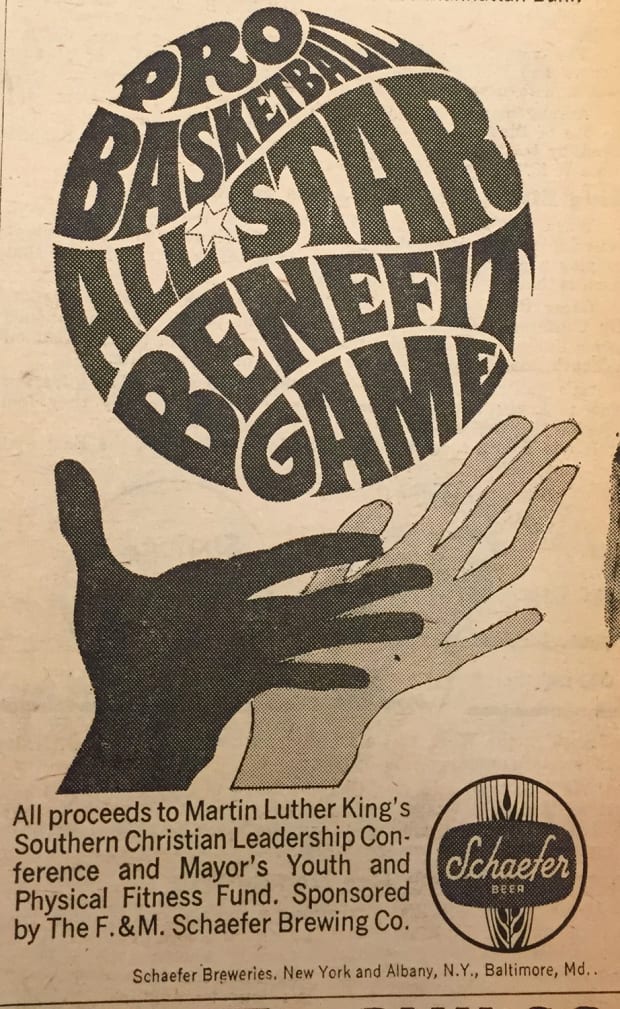
August 15, 1968: A charity basketball game is played by NBA stars, in memory of Dr. Martin Luther King Jr., who had been assassinated 4 months earlier.

The game was played outdoors, at the Singer Bowl, built in Flushing Meadow-Corona Park as one of the venues of the 1964-65 New York World's Fair. Proceeds would be split between Dr. King’s Southern Christian Leadership Conference and New York City Mayor John Lindsay’s Youth and Physical Fitness Fund.
The game became a telethon: Organizer Oscar Robertson of the Cincinnati Royals was the president of the players' union, the NBA Players Association. He and Larry Fleisher, the union's director, handling legal matters, convinced New York's WPIX-Channel 11 to broadcast it. On the site, they had operators working a battery of telephones, and, instead of commercial breaks, entertainment personalities appeared on screen to collect pledges throughout the night.
Wilt Chamberlain, newly traded to the Los Angeles Lakers, played on the West team. The East team was captained by Robertson, and featured 2 hometown players, New York Knicks Willis Reed and Walt Bellamy. The West won, 77-61. The game raised $85,000 -- about $715,000 in 2022 money.

“It was the kind of show men of good will or all creeds could appreciate,” Norm Miller wrote in the New York Daily News.

Robertson has said he’s proud to see how players have continued using their platforms: "I think players today are more informed about what's going on, and also they have a great advantage of getting their voices out to people because of the social media and whatnot. I'm so glad that the NBA and the players association have gotten together to try to confront all these issues."

Officially, NBA players began participating in games that were scheduled to celebrate and honor the life of Dr. Martin Luther King Jr. in 1986, when the federal holiday commemorating the civil-rights leader was observed for the first time.

Robertson knows the tradition dates back long before that: "What happened years ago with Dr. King is still part of our social fiber."

The Singer Bowl became Louis Armstrong Stadium, part of the National Tennis Center, site of the U.S. Open. It was torn down, and in 2018 was replaced on the same site with a new Louis Armstrong Stadium, with a retractable roof.

*

August 15, 1968 was a Thursday. These baseball games were played that day:

* The New York Yankees lost to the Oakland Athletics, 4-3 at the Oakland Coliseum. John "Blue Moon" Odom outpitched Mel Stottlemyre. Mickey Mantle, in his final season, hit his 533rd career home run. Reggie Jackson, with the A's and in his 1st full season, hit his 23rd. Mickey would finish with 536, all with the Yankees; Reggie would finish with 563, 144 of them with the Yankees.

* The Boston Red Sox beat the Chicago White Sox, 3-0 at Fenway Park in Boston. Gary Bell pitched a 4-hit shutout. Carl Yastrzemski went 1-for-3 with a walk and 2 RBIs.

* The Houston Astros beat the Philadelphia Phillies, 3-2 at Connie Mack Stadium in Philadelphia.

* The Pittsburgh Pirates beat the San Francisco Giants, 2-0 at Forbes Field in Pittsburgh. Steve Blass pitched a 4-hit shutout. Roberto Clemente did not play. Willie Stargell went 0-for-3 with a walk. Willie Mays went 0-for-4.

* The St. Louis Cardinals beat their arch-rivals, the Chicago Cubs, 8-0 at Wrigley Field in Chicago. Nelson Briles pitched a 7-hit shutout. Ernie Banks did not get any of those hits, going 0-for-4. Mike Shannon went 3-for-5 with a home run and 5 RBIs.

* A doubleheader was split at Metropolitan Stadium in the Minneapolis suburb of Bloomington, Minnesota. The Baltimore Orioles won the opener, 4-3. The Minnesota Twins won the nightcap, 2-1.  Harmon Killebrew did not play in either game. Rod Carew went 1-for-3 with an RBI in the opener, and pinch-hit into a fielder's choice with an RBI in the nightcap. Brooks Robinson hit a solo home run in the opener, but went 1-for-8 overall. Frank Robinson did not play in the opener, and in the nightcap, went 0-for-2 with a walk and an RBI on a fielder's choice.

* The California Angels beat the Washington Senators, 3-1 at Anaheim Stadium (now Angel Stadium of Anaheim).

* And the New York Mets, the Atlanta Braves, the Cincinnati Reds, the Los Angeles Dodgers, the Cleveland Indians, and the team that would go on to win the World Series that season, the Detroit Tigers, were not scheduled to play.

Saturday, July 2, 2022

July 2, 1964: The Civil Rights Act Becomes Law

July 2, 1964: President Lyndon B. Johnson signs the Civil Rights Act of 1964 into law. Among those attending the signing ceremony is Dr. Martin Luther King Jr., then the nation's leading civil rights activist.

Angry over various events holding African-Americans back, President John F. Kennedy gave a nationally-televised speech on June 10, 1963, asking Congress for a bill that would ban racial and religious discrimination "in facilities which are open to the public: Hotels, restaurants, theaters, retail stores, and similar establishments."

There were 3 key hurdles to the bill's passage. Many Congressional committees were then chaired by powerful Southern Democrats, unwilling to help civil rights. The bill had to pass the House Judiciary Committee. Fortunately, it was then chaired by Emmanuel Celler, a Jewish New Yorker, who got it through. The next step was being passed by the House Rules Committee, then chaired by Howard W. Smith, a racist from Virginia.

And before that could happen, Kennedy was assassinated on November 22, 1963. Johnson, his Vice President and a Texan who favored the bill, became President, and demanded that the bill pass.

Smith knew the rules of the U.S. House of Representatives as well as anyone. But so did Celler, who had a plan: He filed a petition to discharge the bill from the Rules Committee, and move it directly to the House floor, for a vote by the full House. That required the support of a majority of House members.

When the Winter recess began, Celler was 50 votes short, but letters, telegrams and phone calls were coming in to members on the fence. Smith "read the room," and realized that he would be utterly humiliated if the bill was discharged, so he told the Rules Committee members they could vote their conscience, and it passed.

On February 10, 1964, the full House voted 290-130 to pass it. It went on to the Senate, and Southern Democrats filibustered it for 54 days. But Northern and Western Democrats, and Republicans who were conservative but believed that civil rights could be good for business, worked on breaking the filibuster.

In particular, 2 Senators led the way: Hubert Humphrey of Minnesota, the Democrats' "Whip"; and Everett Dirksen of Illinois, the Republicans' Leader. Each man's personal popularity was enough. Indeed, it was Humphrey, as Mayor of Minneapolis and a 1st-time candidate for the Senate, who had addressed the 1948 Democratic Convention, and said the Party should move on from States' rights to protecting human rights.

On June 19, 1964, the Senate passed the bill. The vote was 73-27. The Senators who voted No:

* Democrats: Lister Hill and John Sparkman of Alabama, William Fulbright and John McClellan of Arkansas, Spessard Holland and George Smathers of Florida, Richard Russell and Herman Talmadge of Georgia, Allen Ellender and Russell Long of Louisiana, James Eastland and John Stennis of Mississippi, Sam Ervin and Everett Jordan of North Carolina, Strom Thurmond and Olin Johnston of South Carolina, Albert Gore and Herbert Walters of Tennessee, Harry Byrd and Willis Robertson of Virginia, and Harry's cousin Robert Byrd of West Virginia. So, 21 "Dixiecrats."

* Republicans: Norris Cotton of New Hampshire, Bourke Hickenlooper of Iowa, Edwin Mechem of New Mexico, John Tower of Texas, Milward Simpson of Wyoming... and Barry Goldwater of Arizona.

The only Southern Senator of either Party to vote for the bill was Ralph Yarborough of Texas, an ally of LBJ's, who was with him in the car behind the one carrying JFK, Governor John Connally, and their wives when JFK was assassinated in Dallas. One of the reasons JFK went to Dallas in the first place was because, after Tower won LBJ's Senate seat, becoming the 1st Republican Senator in the South since Reconstruction, Texas' Democrats were split between factions led by Yarborough (a liberal) and Connally (a conservative who would later switch to the Republicans).

Robert Byrd, the Senate Majority Leader from 1977 to 1988, had belonged to the Ku Klux Klan during World War II, more for its opposition to Communism than its hatred of blacks, Catholics and Jews. He later called joining the KKK "the greatest mistake I ever made."

In his last book, the 2008 Letter to a New President -- he knew that fellow Senator Barack Obama was a rising star, but did not yet suspect that he would become said new President -- he wrote, "I know now I was wrong. Intolerance had no place in America. I apologized a thousand times... and I don't mind apologizing over and over again. I can't erase what happened."

Ervin never renounced his anti-civil rights votes, but redeemed himself somewhat with his Chairmanship of the Select Committee investigating Watergate in 1973 and '74.

Thurmond had been Governor of South Carolina in 1948, and briefly left the Democratic Party to run for President on the ticket of the States' Rights Party, all former Democrats. From that point onward, Southern Democrats who opposed civil rights were known as "Dixiecrats." Thurmond launched a filibuster designed to stop the Civil Rights Act of 1957, lasting a little over 24 hours, setting a record previously held by Huey Long of Louisiana, Russell's father. When the CRA of 1964 became law, Thurmond became the 1st major Democratic official in the South to switch to the Republican Party.

Gore was running for re-election, and was, by his own later admission, afraid to vote for the bill. He had previously voted for the Civil Rights Acts of 1957 and 1960. His re-election secure, he went on to vote for the Voting Rights Act of 1965, the confirmation of Thurgood Marshall as the 1st black Justice on the U.S. Supreme Court, and the Fair Housing Act of 1968. He lost his next bid for re-election in 1970, but that's been attributed to his opposition to the Vietnam War, rather than to his pro-civil rights votes. His son, usually known as Al Gore, would also be elected to both houses of Congress, serve as Bill Clinton's Vice President, and be the Democratic nominee for President in 2000.

Robertson was the father of Marion G. "Pat" Robertson, the Virginia Beach-based televangelist who ran for the Republican nomination for President in 1988, and has been a major figure in "Christian" conservatism ever since, often on the back of various forms of bigotry. (UPDATE: Pat died in 2023.)

Cotton -- no relation to current Republican Senator Tom Cotton of Arkansas -- also ended up voting for every other Civil Rights Act from 1957 to 1968, including the Voting Rights Act of 1965, as well as the 24th Amendment, banning poll taxes. (Gore was not present for the vote on that Amendment.) He voted against the Civil Rights Act of 1964, he said, on the grounds that part of it was unconstitutional.

Goldwater, like Cotton, claimed the bill was unconstitutional. Although he was the conservative movement's favorite son at the time, he had never previously been accused of racism. Indeed, in Arizona, a State then with few Black people, he had been praised by Hispanics and Native Americans for his efforts on their behalf.

Hickenlooper was the great-uncle of John Hickenlooper, now a Senator from Colorado, previously that State's Governor and Mayor of Denver -- and a Democrat. Simpson was the father of a later Senator from Wyoming, Alan Simpson.

The bill the Senate passed was slightly different from the one passed by the House, so the House had to approve it again. That took until July 2, and the vote was 289-126. Now, it headed to the President's desk, and LBJ wasted no time: He called in the media, and he called in key figures, including Dr. King, and the Attorney General, who was also the previous President's brother, Robert F. Kennedy.

It was Johnson who began the tradition of the President using a different pen to sign each letter of his name, including the period after the middle initial B. This way, he could give out 15 ceremonial pens -- 6 for "Lyndon," 2 for "B.," and 7 for "Johnson" -- and 15 different people could truthfully say, "I have the pen that made this bill a law."

On the film, he can be heard telling RFK to give pens to his deputies, Nicholas Katzenbach and Burke Marshall, as well as to take one for himself. The best-known photograph of the ceremony, shown above, shows LBJ giving a pen to MLK.

A generous gesture, given that LBJ and RFK couldn't stand each other, for reasons that don't matter here. RFK resigned as Attorney General on September 3 -- he probably would have if his brother lived, anyway, to run the re-election campaign -- and ran for a U.S. Senate seat from New York. He won it -- but won by a smaller margin than Johnson did in the State.

By this point, Goldwater had already secured the Republican nomination for President, beating out pro-civil rights candidates like Governors Nelson Rockefeller of New York and William Scranton of Pennsylvania, and former Senator Henry Cabot Lodge of Massachusetts.

But people who cared about civil rights -- for or against -- didn't care why Goldwater voted against the Act, only that he did. Southerners who would never have voted for the nominee of "the Party of Lincoln" before this voted for Goldwater, because he voted the way they wanted. And Midwesterners and Westerners that would have normally voted Republican went for Johnson.

On Election Day, November 3, Johnson won 61.0 percent of the national popular vote, still an all-time record, while Goldwater got just 38.4 percent. Johnson won 44 States with 486 Electoral Votes, Goldwater 6 with 52. Goldwater won Mississippi, Alabama, South Carolina, Louisiana and Georgia, all in the South; and his home State of Arizona, barely, with 50.4 percent, a winning margin of 4,782 votes.

He came close in some other Southern States. He got 48.8 percent in Florida, 46.1 in Virginia, and was the 1st Republican in the 20th Century to top 40 percent in Tennessee, Oklahoma, North Carolina and Arkansas.

He also got 49.1 percent in Idaho, 47.4 in Nebraska, 45.1 in Utah and 45.0 in Kansas. But if he had won every State where he got at least 45 percent, that still would have given him only 98 Electoral Votes. Even if he had won every State where he got at least 40 percent, including California (40.8, then with 40 EVs) and Illinois (40.5, 26), he still would have had only 199, well short of the necessary majority of 270.

To be fair, the false perception that Goldwater was racist was not the only reason he lost. But it didn't help. As no less than Jackie Robinson, a Republican who had worked for Rockefeller, put it, "It would make everything I worked for meaningless if baseball were integrated, but America's political parties were segregated."

Johnson knew it, too: "I think we have just given the South to the Republican Party for a generation." It's now been 3 generations. There have been blips since, but:

* Virginia has voted for the Democratic nominee for President in every election since 2008. But, before that, it hadn't voted for one since 1976, Jimmy Carter; and not for a non-Southern Democratic nominee since 1948, Harry Truman.

* Georgia voted for Joe Biden in 2020. Other than that, they haven't voted for the Democratic nominee since Bill Clinton in 1992.

* Florida last voted for the Democratic nominee in 2012, Barack Obama.

* North Carolina last voted for the Democratic nominee in 2008, Obama. Other than that, they haven't voted for the Democratic nominee since 1976; and not for a non-Southern Democratic nominee since 1948.

* Arkansas, Tennessee and Louisiana last voted for the Democratic nominee in 1996, Bill Clinton. Arkansas last voted for a non-Southern Democratic nominee in 1956, Adlai Stevenson; Louisiana in 1952, Stevenson; and Tennessee in 1948. Tennessee didn't even vote for native son Al Gore in 2000, although that's been attributed to guns as much as to race. This is also the case for West Virginia, which was a reliably Democratic State until 2000.

* Texas, Mississippi, Alabama and South Carolina last voted for the Democratic nominee in 1976, and haven't voted for a non-Southern Democratic nominee since 1960, John F. Kennedy.

Oklahoma last voted for the Democratic nominee in 1976, and hasn't voted for a non-Southern Democratic nominee since 1948.

We will never know how many of the 21 Democrats who voted against the Civil Rights Act of 1964 would have done so if they weren't afraid of their respective electorates dumping them for more racist candidates in Democratic Primaries, or switching to Republican candidates. The two Mississippians, Eastland and Stennis, were true believers in segregation. Thurmond, however, did begin to hire black staffers in 1971.

What we do know is that racism, like all other forms of bigotry, is an inherently conservative trait, and the American Southeast remains conservative. And when conservatism meant switching from Democratic to Republican, they did, and have stayed as such.

And what has voting Republican gotten them? Extended poverty and lousy services.

Neil Young may be Canadian, and didn't gain American citizenship until 2020, specificially so he could vote against Donald Trump, but he was right: "Southern man, better use your head." And Lynyrd Skynyrd were wrong: A Southern man does need him around, anyhow.

The last serving Senator who voted for the Civil Rights Act of 1964 was Ted Kennedy, brother of Jack and Bobby, who died in office in 2009. The last surviving Senator who voted for it was Birch Bayh of Indiana, who lived until 2019. The last serving and the last surviving Senator who voted against it was Robert Byrd, who died in office in 2010.

*

July 2, 1964 was a Thursday. Scandal-ridden baseball star Jose Canseco, and his identical but far less successful twin brother Ozzie, were born on this day.

It was the off-season for the NFL, the AFL, the NBA and the NHL. But nearly a full slate of Major League Baseball games was played, with every team except the Chicago White Sox and the Washington Senators scheduled:

* The New York Yankees beat the Kansas City Athletics, 4-3 in 15 innings at Yankee Stadium. Despite the game's length, only 1 home run was hit, and not by somebody you might expect, like Mickey Mantle, Roger Maris or Joe Pepitone. It was Bobby Richardson. (Mantle and Maris did both get 2 hits in the game.)

Richardson led off the bottom of the 15th with a groundout. But Mantle hit a triple to left field. With the winning run on 3rd, and 1st and 2nd open, the A's intentionally walked Tom Tresh and then Pepitone, hoping for a forceout at any based, preferably an infield-to-home-to-1st double play. Instead, Hector Lopez -- appropriately for the day, both Black and Hispanic -- singled to left to bring Mantle home with the winning run. Rollie Sheldon started for the Yankees, but the winning pitcher was Steve Hamilton.

* The New York Mets lost to the Houston Colt .45s, 7-1 at Colt Stadium in Houston. The next season, the Colts moved into their new home, the Astrodome, and changed their name to the Houston Astros.

* The Minnesota Twins beat the Boston Red Sox, 15-9 at Fenway Park in Boston. Harmon Killebrew went 2-for-5. He didn't hit a home run, but Tony Oliva, Rich Rollins and Don Mincher did. For the Red Sox, Carl Yastrzemski went 3-for-4 with an RBI. Boston homers were hit by Felix Mantilla and Dick Williams -- who, 3 years later, would manage the Sox to the "Impossible Dream" Pennant, led by Yastrzemski's Triple Crown and Most Valuable Player performance.

* The Los Angeles Angels beat the Baltimore Orioles, 10-6 at Memorial Stadium in Baltimore. In defeat, Jackie Brandt hit 2 home runs, and Brooks Robinson went 1-for-5.

* The Cincinnati Reds beat the Chicago Cubs, 7-0 at Crosley Field in Cincinnati. Jim Maloney pitched a 4-hit shutout. Marty Keough hit a home run, Frank Robinson went 1-for-2 with 2 walks and 2 RBIs, and Pete Rose went 3-for-4 with 2 RBIs. For the Cubs, Ernie Banks went 1-for-4.

* The Detroit Tigers beat the Cleveland Indians, 9-1 at Tiger Stadium in Detroit. Al Kaline went 2-for-3.

* The St. Louis Cardinals beat the Milwaukee Braves, 4-3 at Milwaukee County Stadium. Hank Aaron went 1-for-4, and Joe Torre went 0-for-4.

* The Philadelphia Phillies beat the Los Angeles Dodgers, 3-2 at Dodger Stadium in Los Angeles.

* And the San Francisco Giants beat the Pittsburgh Pirates, 6-5 at Candlestick Park in San Francisco. Willie Mays drew a walk and scored in the 1st inning, but was injured, and had to leave the game. Roberto Clemente went 1-for-3.

Tuesday, June 7, 2022

June 7, 1966: The Shooting of James Meredith

June 7, 1966: Civil rights activist James Meredith is shot during his March Against Fear. It is part of the backlash against the successes of the Civil Rights Movement.

One of those successes had been the integration of the University of Mississippi in 1962, by Meredith, with the assistance of President John F. Kennedy federalizing the Mississippi National Guard, making Meredith a civil rights icon and a national figure. He graduated, and went to New York to attend Columbia University School of Law.

On June 6, 1966, in the wake of the Voting Rights Act of 1965, Meredith planned a March Against Fear, from Memphis, Tennessee, to Jackson, the capital of Mississippi, to encourage voter registration. He said he did not want major civil rights organizations involved. He believed he would not be killed, saying, "I had always felt that I could stop a mob with the uplift of a hand, Because of my divine responsibility to advance human civilization, I could not die."

Unlike his predecessor, Ross Barnett, who did everything he could to prevent Meredith from enrolling at "Ole Miss," the current Governor of Mississippi, Paul Johnson, allowed the March, and offered State Police protection.

It didn't work. On the 2nd day, 28 miles into his walk down U.S. Route 51, outside Hernando, Mississippi, Meredith was shot by Aubrey James Norvell, a 40-year-old unemployed member of the Ku Klux Klan. (Apparently, the Klan wasn't willing to find him a job.) Meredith was hit by over 60 shotgun pellets, all over his body. He yelled, "Oh, my God, is anybody going to help me?" They did. He was quickly taken to a hospital, and survived, as his wounds turned out to be superficial.

Martin Luther King of the Southern Christian Leadership Conference, Roy Wilkins of the NAACP, Whitney Young of the Urban League, Stokely Carmichael of the Student Nonviolent Coordinating Committee and Floyd McKissick of the Congress of Racial Equality, all having some measure of differences with each other, united, and went to see Meredith in the hospital. They asked him for permission to carry on the march in his name. He assented, and 20 marchers set out to finish his 220-mile journey.

Just a day out of Jackson, the demonstrators were joined by Marlon Brando, Sammy Davis, Jr., the comedian Dick Gregory, and a recovered Meredith. On June 25, he led the column into the State Capitol.

The demonstrators registered over 4,000 black Mississippians in 18 days. Nevertheless, a 15,000-strong crowd that gathered for a rally in Jackson oh June 26 epitomized the now-overt conflict in the movement. The King faction shouted, "Freedom now!" The faction led by Carmichael and McKissick shouted "Black power!"

The FBI quickly caught Norvell, who pleaded guilty to battery and assault with intent to kill, and was sentenced to 5 years in prison. He served only a year and a half. He died in 2016. True to his belief, Meredith did not die, and, as of June 7, 2022, is still alive, at the age of 89.
King was assassinated in 1968, only 39 years old. Young drowned in 1971, just 49. Wilkins died in 1981, at 80. McKissick died of cancer in 1991, at 69. Carmichael, having adopted the name Kwame Ture and moved to Africa, also died of cancer, in 1998, at 57. Meredith outlived them all.

*

June 7, 1966 was a Tuesday. This was also the day the New York Mets selected Steve Chilcott with the 1st pick in the baseball amateur draft, with the Kansas City Athletics picking Reggie Jackson 2nd. I have a separate entry for that event.

These Major League Baseball games were played:

* The New York Yankees beat the Cleveland Indians, 7-2 at Cleveland Municipal Stadium. Fritz Peterson went the distance for the win. Bobby Richardson and Joe Pepitone hit home runs. Mickey Mantle went 2-for-4 with a walk and 2 RBIs. Roger Maris went 2-for-5 with an RBI.

* The New York Mets lost to the Atlanta Braves, 11-6 at Shea Stadium. Hank Aaron went 2-for-4 with a walk and 2 RBIs. He did not hit a home run for the Braves, but Joe Torre did. Dick Stuart, the power-hitting but horrible-fielding 1st baseman known as "Dr. Strangeglove," homered for the Mets.

* The Philadelphia Phillies beat the Cincinnati Reds, 5-1 at Connie Mack Stadium in Philadelphia. Jim Bunning went the distance, allowing 1 run on 3 hits, no walks and 14 strikeouts. He beat Milt Pappas, whom the Reds had traded Frank Robinson to get. The only Reds run came on a home run by Leo Cárdenas. Pete Rose went 0-for-3.

* The Baltimore Orioles beat the Washington Senators, 6-5 at Memorial Stadium in Baltimore. The Senators scored 2 runs in the top of the 12th inning, but in the bottom half, the O's scored 3, winning on an RBI single by Frank Robinson, who went 4-for-6. Brooks Robinson went 0-for-4 with a walk.

* The Pittsburgh Pirates beat the St. Louis Cardinals, 9-1 at Forbes Field in Pittsburgh. Don Cardwell outpitches Bob Gibson. Roberto Clemente went 3-for-5 with a home run and 3 RBIs. Willie Stargell went 2-for-5. Lou Brock went 1-for-4.

* The Detroit Tigers beat the Boston Red Sox, 2-1 at Tiger Stadium in Detroit. Mickey Lolich outpitched Bob Sadowski. The only Sox run came on a home run by Tony Conigliario. Carl Yastrzemski went 0-for-3 with a walk. Al Kaline went 0-for-3.

* The Los Angeles Dodgers beat the Chicago Cubs, 8-6 at Wrigley Field in Chicago. Fergie Jenkins relieves Bob Hendley in the 5th inning, but gives up back-to-back home runs to Jim Lefebvre and Al Ferrara leading off the top of the 10th. It was Ferrara's 2nd homer of the game. Phil Regan is the winning pitcher, in relief of rookie Don Sutton. Ernie Banks went 2-for-4 with a walk and an RBI.

* The Minnesota Twins beat the Kansas City Athletics, 6-1 at Metropolitan Stadium in the Minneapolis suburb of Bloomington, Minnesota. Harmon Killebrew went 2-for-4.

* The Houston Astros beat the San Francisco Giants, 10-9 at the Astrodome in Houston. Willie Mays doubled, then left the game with an injury. His pinch-runner was Jesús Alou, who went to right field and went 3-for-4 with an RBI, as Ollie Brown moved from right to center.

* And the California Angels beat the Chicago White Sox, 3-2 at Anaheim Stadium (now Angel Stadium of Anaheim).

December 31, 1999 & January 1, 2000: The Millennium

December 31, 1999:  The Millennium arrives. The people of planet Earth survived. At a terrible cost. But we hadn't destroyed ourselves. ...