Showing posts with label 1950 world cup. Show all posts

Saturday, July 16, 2022

July 16, 1950: Maracanazo

July 16, 1950: The last game -- officially, not a "Final," since this edition was not a knockout tournament in the traditional sense -- of the World Cup is played at the Estádio do Maracanã in Rio de Janeiro, Brazil. Given the goal difference, all that hosts Brazil had to do was gain a draw, and they would be World Champions on home soil. Uruguay, on the other hand, had to win.

This was the 1st World Cup after World War II. Of the 3 main Axis nations, Germany and Japan were still banned; and Italy, allowed in the tournament, were still recovering from the Superga crash the year before, when most of the Torino team, and thus a big part of the national side, were killed. This tournament also featured the U.S.' upset of England. But the true shock, as far as the hosts were concerned, was in the last game.

The 1st half ended scoreless. Shortly after play resumed, Albino Friaça put Brazil on the board. The gigantic crowd of 199,854 was ecstatic. Being 1-0 up in the 2nd half made it look like the tremendous pre-tournament and pre-game hype and confidence had been worth it.

But Uruguay's Captain, Obdulio Varela, was smart: He went to the referee, an Englishman named George Reader, and disputed the validity of the goal. Varela didn't speak English, and Reader didn't speak Spanish. An interpreter was found, and Reader learned Varela's objection: He believed (or said he did) that Friaça was offside. Reader called the linesman over, and the linesman denied it. Reader made his decision final: The goal stood.

Varela didn't get everything he wanted, but he got a big thing that he wanted: He stopped Brazil's momentum. They were standing around, waiting for play to be allowed to resume. Their fans had calmed down a bit. The home-field advantage had been dented. Reader handed the ball to Varela, who took it to the center of the field, and shouted to his teammates, "Now, it's time to win!"

And they did as he wanted: They attacked. Brazil didn't have a defense as good as their offense, and, in the 66th minute, Pepe Schiaffino equalized for Uruguay. That didn't matter much: If that 1-1 score had held, Brazil would still be World Champions.

In the 79th minute, Alcides Ghiggia ran down the right sideline, and fired a low shot that went under Brazilian goalkeeper Moacir Barbosa. It was Uruguay 2, Brazil 1. Every Brazilian -- on the pitch, in the stadium, and listening on the radio -- was in shock. Brazil attacked the rest of the way, but couldn't find the all-important equalizer. The home crowd was quiet.
Alcides Ghiggia

Shortly after 5:00, Reader blew his whistle to end the match. Uruguay had now won 2 of the 1st 4 World Cups. Brazil had lost the world championship of their national sport, in their national stadium.

In that stadium, 3 fans died from heart attacks. Another, who had brought a gun in, killed himself.

There was no public ceremony after the game. FIFA President Jules Rimet wisely chose to present the trophy that would later bear his name to Uruguay in their locker room. Brazil manager Flavio Costa had to leave the stadium in disguise -- as a nanny. Yes, like some deposed dictators have done, he left in drag, so as not to be recognized.

The loss was a blow to the national psyche of Brazil, so often wrapped up in this sport of soccer. It is known as Maracanazo in Spanish, Maracanaço in Portuguese: "The Agony of Maracanã." The 1950 World Cup was supposed to be a statement for Brazil, showing the world that it was a modern country, worthy of respect and admiration around the postwar world. This was the country's coming-out party, and it was ruined.

Minister of Sport Aldo Rebelo said, "Losing to Uruguay in 1950 not only impacted on Brazilian football, it impacted on the country's self-esteem." Instead of hating Uruguay for the ruination, Brazilians blamed themselves.

Brazil have gone on to win the World Cup a record 5 times: Beating Sweden in the Final in Sweden in 1958, beating Czechoslovakia in the Final in Chile in 1962, avenging their defeated to Uruguay in the Semifinal and then beating Italy in the Final in Mexico City in 1970, beating Italy in the Final again in the Rose Bowl in 1994, and beating Germany in Japan in 2002. They have also lost the Final to France in Paris in 1998.

You will notice that none of those 5 wins have been in Brazil. The World Cup has returned to that country only once, in 2014, and Brazil got to the Semifinal, but had an even more stunning loss at the Maracanã. It wasn't that they lost to Germany, who then beat Argentina in the Final. It wasn't even that they were looking forward to beating Argentina in the Final in the Maracanã themselves. The truly shocking part was the score: Germany beat Brazil, in the Maracanã, by a score of 7-1.
The Maracanã is 1 of 2 stadiums to have hosted 2 World Cup Finals, along with the Estadio Azteca in Mexico City. And it's 1 of 4 stadiums to have hosted a World Cup Final and be the main stadium for the Olympic Games. The Azteca is not 1 of the other 4: Although it was used during the 1968 Olympics, it was not the main stadium for those games. The others are the old Wembley Stadium in London, and the Olympiastadions in Berlin and Munich. In 2024, the Stade de France outside Paris will make it 5.

Much as the 1980 and 2008 World Series wins have not fully erased the humiliation of the blown 1964 National League Pennant for Philadelphia Phillies fans, Brazilians still have not gotten over Maracanazo after 72 years, despite winning 5 World Cups and the admiration of the rest of the world.

Because of the soccer connection, it remains the most famous building on the entire continent. It is home to Rio’s 2 biggest teams, Flamengo and Fluminense, and "the Fla-Flu Derby" is the event of the year in Rio. (Aside from that whole Carnival business.)

Outside of soccer, in 1980, it hosted the largest crowd ever to watch a volleyball match, 95,000 to see the national teams of Brazil and the Soviet Union. It hosted the preaching of Billy Graham in 1960 and 1974, and Pope John Paul II in 1980, 1987 and 1997.

Frank Sinatra sang before 175,000 in 1980, and "Rock In Rio" brought more than that for Sting in 1987, Tina Turner in 1988, Paul McCartney in 1990, a-ha in 1991, Madonna in 1993, and the Rolling Stones in 1995.

In 1966, the stadium was officially renamed Estádio Jornalista Mário Filho, for a sportswriter who had just died, but everybody still calls it the Maracanã. A conversion to all-seater and renovations for the 2014 World Cup and the 2016 Olympics has reduced capacity to 78,838, making it still the largest stadium in South America.

UPDATE: An article for ESPN.com, published after the 2026 World Cup, ranking all 23 tournaments, rated this one tied for 8th, suggesting that the upsets overcame the comparative lack of star power.

*

July 16, 1950 was a Sunday. It was the off-season for the NFL, the NBA and the NHL. But, being a Sunday, a full slate of Major League Baseball games was played. as was the custom at the time, there were even doubleheaders:

* The New York Yankees split a doubleheader with the Chicago White Sox at Yankee Stadium. The Yankees won the opener 2-1. Gene Woodling's 2nd inning double allowed Vic Raschi to outpitch Billy Pierce. The White Sox won the nightcap 5-2, with Bob Cain outpitching Allie Reynolds.

* The New York Giants got swept in a doubleheader by the Cincinnati Reds at Crosley Field in Cincinnati. The Reds won the 1st game 16-4. The 2nd game went back and forth. The Giants jumped out to a 3-0 lead in the top of the 1st, but the Reds scored 4 in the bottom of the 1st. The Giants led 8-4 going to the bottom of the 5th, and 10-5 going to the bottom of the 6th. But the Reds tied it in the bottom of the 7th. An error by Hank Thompson gave the Reds the win in the 12th, 11-10.

* The Brooklyn Dodgers beat the St. Louis Cardinals, 10-2 at Sportsman's Park in St. Louis. Chris Van Cuyk was not one of the Dodgers' more prominent pitchers, but he got the win in this game, backed by home runs from Jackie Robinson and Duke Snider.

* A doubleheader was split at Fenway Park in Boston. The Boston Red Sox won the opener 13-10, and the Cleveland Indians won the nightcap 8-4. Ted Williams was injured, and did not play in either game.

* A doubleheader was split at Shibe Park in Philadelphia. The Philadelphia Athletics won the 1st game 5-2, and the Detroit Tigers won the 2nd game 7-6.

* A doubleheader was split at Griffith Stadium in Washington. The Washington Senators won the 1st game 5-1, and the St. Louis Browns won the 2nd game 10-8.

* A doubleheader was split at Forbes Field in Pittsburgh. The Boston Braves won the 1st game 9-5, and the Pittsburgh Pirates won the 2nd game 6-5.

* The Chicago Cubs swept a doubleheader with the Philadelphia Phillies at Wrigley Field in Chicago. They won the opener 8-0, and the nightcap 10-3. 

Wednesday, June 29, 2022

June 29, 1950: The Miracle On Grass

June 29, 1950: The U.S. national soccer team beats England, 1-0 at Estádio Independência in Belo Horizonte, Brazil, in the 1950 World Cup.

The England team had some of the greatest players in the world, including Stanley Matthews, "the Wizard of Dribble." But Matthews was kept out of this game, and that may have made the difference. Among England stars who did play in this game were Matthews' Blackpool teammate Stan Mortenson, Jackie Milburn of Newcastle United, Billy Wright of Wolverhampton Wanderers, Laurie Hughes of Liverpool, Tom Finney of Preston North end, Wilf Mannion of Middlesbrough, and goalkeeper Ted Ditchburn of Tottenham Hotspur.

Counting Bill Nicholson of Tottenham, who was much more honored for his managing of that team than for his playing, 6 of the players -- the others being Wright, Milburn, Matthews, Finney and Mannion -- would have statues dedicated outside their teams' stadiums.

The U.S. team was taken from various clubs in the top league in the country at the time, the American Soccer League. There was nothing like a "first division" as in European or South American countries. And none of them was still in college, although they weren't over the hill: One player was 38, the rest were between the ages of 21 and 31, coming from ASL clubs.

The U.S. got off to a good start in their 1st game, against Spain, scoring in the 17th. But the defense collapsed late, allowing 3 goals between the 81st and 89th minutes, and Spain won, 3-1. For the England game, Frank Borghi was in goal. In front of him were the fullbacks, Harry Keough on the right, Joe Maca on the left. In front of them were the halfbacks: Right to left, Ed McIlvenny, Charlie Colombo and Walter Bahr. Then the forwards: Right to left, Frank Wallace, Gino Pariani, Joe Gaetjens, John Souza and Ed Souza. Bahr was usually the Captain of this team, but, since he was British, McIlvenny was chosen as Captain for this game.

* 1 Goalkeeper: Frank Borghi, born April 9, 1925 in St. Louis, played for St. Louis team Simpkins-Ford.
* 2 Right Back: Harry Keough, born November 15, 1927 in St. Louis, played for St. Louis McMahon, later known as St. Louis Kutis.
* 3 Left Back: Joe Maca, born September 28, 1920 in Brussels, Belgium, played for Brooklyn Hipsano.
* 4 Right Halfback, Ed McIlvenny, born October 21, 1924 in Greenock, Scotland, played for Philadelphia Nationals.
* 5 Center Halfback: Charlie Colombo, born July 20, 1920 in St. Louis, played for Simpkins-Ford.
* 6 Left Halfback: Walter Bahr, born April 1, 1927 in Philadelphia, played for Philadelphia Nationals.
* 7 Outside Right: Frank Wallace, born July 15, 1922 as Frank Valicenti in St. Louis, played for Simpkins-Ford.
* 8 Inside Right: Gino Pariani, born February 21, 1928 in St. Louis, played for Simpkins-Ford.
* 9 Center Forward: Joe Gaetjens, born March 19, 1924 in Port-au-Prince, Haiti, played for New York team Brookhattan.
* 10 Inside Left: John Souza, born July 12, 1920 in Fall River, Massachusetts. Played for Ponta Delgada, which was named after one of the Azores, off the coast of Portugal, and was staffed by Portuguese immigrants and their sons from Fall River and nearby New Bedford. Early in their history, to get around Massachusetts' "blue law" prohibiting playing professional sports on Sundays, teams like Ponta Delgada and the New Bedford Whalers would go just over the State Line, and play at St. Mark's Stadium in Tiverton, Rhode Island.
* 11 Outside Left: Ed Souza, born September 22, 1921 in Fall River. Played for Ponta Delgada, although was believed to not be related to John Souza. "Souza" and its variant "Sousa" are common names in Portugal: The most famous American of Portuguese descent has been "March King" John Philip Sousa.

So, aside from the fact that there were no Spanish speakers, this was a typical U.S. starting soccer XI, with 3 foreign-born players who nonetheless qualified for the U.S. team under the rules then in place: A Scot, a Belgian, and a Haitian. And all but Keough and Bahr were sons of immigrants.

The U.S. team's manager was William Jeffrey, born on August 3, 1892 in Edinburgh, Scotland. Since 1927, he had been the head coach of the soccer team at Pennsylvania State University (a.k.a. Penn State).

As a British citizen familiar with the English game, as well as that of the country he had adopted, Jeffrey told the press, "We have no chance," and called his team "sheep ready to be slaughtered." One of the English national newspapers, the Daily Express, wrote, "It would be fair to give the U.S. three goals of a start." Indeed, England's 1st half attack was so fierce that, if even half of their attempts had gone in, they would have been up at least 4-0.

Then came the 37th minute. McIlvenny made a throw-in. Bahr took it, and shot from 25 yards out. Williams moved to his right to get it. But before he could, Gaetjens threw himself forward, and headed it in to Williams' left.
Joe Gaetjens

One-nil to the Stars and Stripes. Years, later Bahr said, "The overwhelming majority was Brazilians, but they rooted for us the entire time. We didn't realize why until after. They were hoping we would beat England and that Brazil would not have to play England in the final game." (In hindsight, this may have been counterproductive, as Brazil also suffered a tremendous upset, losing the Final to neighboring Uruguay.)

The Americans' confidence had been seriously boosted, and they came out for the 2nd half like a house afire. They had another scoring chance in the 54th, but couldn't do anything with it. In the 59th, Generoso Dattilo, the Italian referee, awarded England a direct free kick, but Borghi saved Mortensen's shot. England was dominant for a while, and it wasn't until the 74th minute that the U.S. could get another shot.

In the 82nd minute, soccer history hung in the balance. Mortensen drove toward the penalty area, and Charlie Colombo brought him down. The way Keough described it, it sounds like Colombo should have been sent off. (No red and yellow cards in those days, but a player could be sent off for an egregious foul.) But the film cameras didn't get the foul into the highlights, so there's no way to know for sure.

England pleaded for the awarding of a penalty, but Dattilo didn't buy it, saying the foul was outside the area. He awarded a free kick. Ramsey took it, and Mullen headed it toward the goal. Borghi tipped it away. Again, the England players appealed to Dattilo, saying the ball had gone in, but he ruled that it hadn't crossed the line.

In the 85th, Peewee Wallace managed to draw Williams out of position, giving himself an empty net. But Ramsey managed to get in and clear his shot off the line.

Without much stoppage time, Dattilo blew his whistle. Final score: America 1, England 0. Or, as would be said in soccer circles, England 0-1 USA. No "Man of the Match" was given. Clearly, it was Borghi, who kept it from being about 7-1 in England's favor.

No one could believe it. Contrary to what we would expect today, not only was the game not broadcast live to the U.K. on BBC television, it wasn't even broadcast around the world on BBC radio. When the BBC reporter delivered the final score that night (it would have been around 10:00 PM, London time), many people remembered hearing it, and thinking it was an error: That it must have been England that won 1-0.

And in America? It was barely reported at all. Since 5 players were from St. Louis, Dent McSkimming of the St. Louis Post-Dispatch wanted to cover it. He couldn't talk the paper into covering his expenses. So he applied for "vacation" time, paid his own way, and, when he got there, he discovered that he was the only American reporter at the game.

Soccer was so low on the totem pole of American sports at the time, the Post-Dispatch was one of the few papers to report the result at all. Not only had The New York Times refused to send a reporter, but, when they got the result from the Associated Press wire report, they refused to print it, figuring the report of the upset was a hoax.

The World Cup went on. On July 2, the Americans were knocked out of the tournament, losing 5-2 to Chile in Recife. And England fell to Spain 1-0 at the Estadio Maracanã in Rio de Janeiro. Spain thus won Group 2, and only the 4 Group winners advanced to a knockout round.

The 1-0 win over England has been nicknamed "The Miracle Match." In a nod to the U.S. hockey upset over the Soviet Union at the 1980 Winter Olympics, known as "The Miracle On Ice," this game has been called "The Miracle On Grass." Given how many shots Borghi had to stop, Belo Horizonte '50 was much closer to being a miracle than was Lake Placid '80.

The U.S. and England have played only 1 World Cup match since, a 1-1 draw in Bloemfontein, South Africa in 2010.

The Miracle On Grass was hardly seen then, and it has hardly been seen since. But it might just be the greatest upset in American sports history. Not the most satisfying -- that remains the Miracle On Ice -- but the greatest.

Gaetjens eventually returned to Haiti. In 1964, he was one of thousands of people arrested by the government of dictator François "Papa Doc" Duvalier. He was never seen again, nor has his body ever been found, but it is presumed that he was executed in jail. So there is no known final resting place for the man who may still be America's greatest soccer hero.

Jeffrey died in 1966, Wallace and Ed Souza in 1979, Maca in 1982, Colombo in 1986, McIlvenny in 1989, Pariani in 2007, Keough and John Souza in 2012, and Borghi in 2015. Bahr was the last survivor, living until 2018. He was also the father of Matt and Chris Bahr, Super Bowl-winning placekickers.

*

June 29, 1950 was a Thursday. It was the off-season for the NFL, the NBA and the NHL. There wasn't quite a full slate of Major League Baseball games played that day:

* The New York Yankees lost to the Washington Senators, 12-7 at the old Yankee Stadium. The Yanks jumped out to a 5-1 lead in the 1st inning, including a home run by Cliff Mapes. But the Senators scored 6 runs in the 4th, including a home run by Irv Noren, whom the Yankees would later acquire. Joe DiMaggio went 0-for-3 with a walk. Joe Ostrowski was the Yanks' starting pitcher, and didn't get out of the 2nd inning, while Tom Ferrick didn't make it out of the 4th.

* In what was then baseball's biggest rivalry, the New York Giants beat the Brooklyn Dodgers, 11-5 at Ebbets Field. Eddie Stanky hit a home run, and Hank Thompson got 3 hits. The Dodgers got 2 home runs from Jackie Robinson and 1 from Billy Cox, neither really a home run hitter. But the Giants scored 4 in the 8th and 3 in the 9th to take it. 

* Boston played Philadelphia in each League. In the National League, the Boston Braves beat the Philadelphia Phillies, 3-2 at Braves Field in Boston.

* In the American League, a football score developed. The Boston Red Sox beat the Philadelphia Athletics 22-14 at Shibe Park in Philadelphia. Here's the damage: It was 6-4 Sox after 1 inning, 14-7 after 2, 15-7 after 4, 16-8 after 5, 18-9 after 6, 20-12 after 7, 20-14 after 8 and 22-14 after 9. As you might guess, Ted Williams hit a home run for the Sox, going 2-for-6 with 6 RBIs. Matt Batts had 4 RBIs, and Bobby Doerr 3.

The A's didn't hit any home runs, but Bob Dillinger, their leadoff hitter and 3rd baseman went 5-for-6 with 3 RBIs. As far as I know, "Duke" was no relation to Depression-era gangster John Dillinger, but he was a thief: In each of the previous 3 seasons, he led the AL in stolen bases, and batted .306 over 6 major league seasons. Elmer Valo and Billy Hitchcock also had 3 RBIs for the A's.

* The Chicago White Sox beat the Detroit Tigers, 7-3 at Briggs Stadium (later renamed Tiger Stadium) in Detroit.

* In another arch-rivalry game, the Chicago Cubs beat the St. Louis Cardinals, 6-1 at Wrigley Field in Chicago.

* The Cleveland Indians beat the St. Louis Browns, 4-1 at Sportsman's Park in St. Louis.

* And the Cincinnati Reds and the Pittsburgh Pirates were not scheduled for the day.

Saturday, June 25, 2022

June 25, 1950: The Korean War Begins

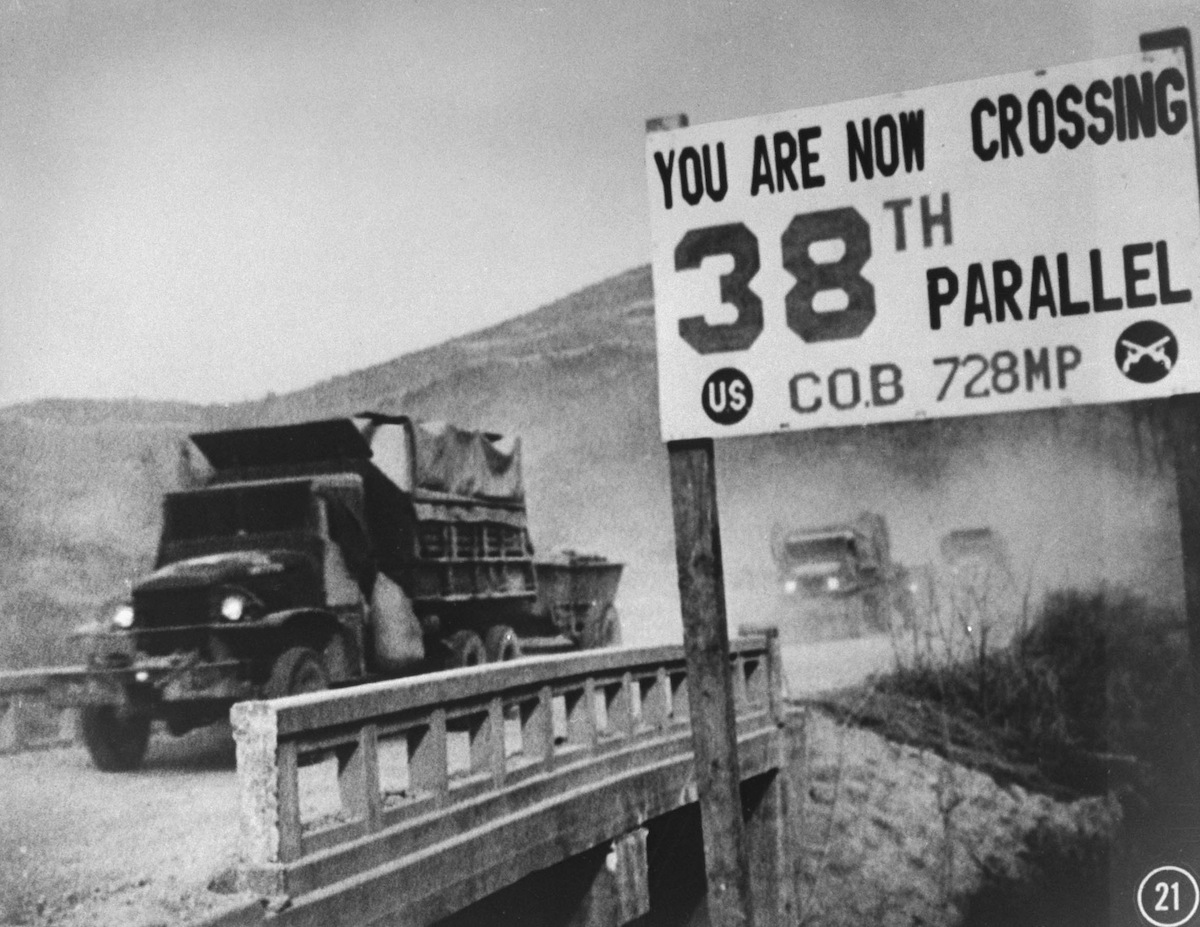
June 25, 1950: Troops of the Democratic People's Republic of Korea -- a.k.a. North Korea, a Communist nation, and by no means was it democratic or a republic -- cross the parallel of 38th degrees north latitude, and invade the Republic of Korea -- a.k.a. South Korea, which is capitalist, but hardly free.

Two days later, President Harry S Truman announced that American and other NATO forces would come to the aid of South Korea. The next day, North Korean troops took the South Korean capital of Seoul. A total of 15 United Nations countries came to the South's aid: America, Canada, Britain, France, Belgium, the Netherlands, Luxembourg, Greece, Turkey, Colombia, Ethiopia, South Africa, the Philippines, Thailand, Australia and New Zealand.

On September 15, Korea had its "D-Day," as General of the Army Douglas MacArthur, despite being 70 years old, personally led an amphibious landing at Inchon. Within weeks, not only was Seoul liberated, but the North's troops were backed up to the Yalu River, separating the Korean peninsula from the People's Republic of China.

That country then intervened on behalf of its Communist "little brother." The war became a stalemate, lasting 3 years. Truman ended up relieving MacArthur of duty in April 1951, for disobeying orders, replacing him with Matthew Ridgeway. He commanded UN troops in Korea until May 1952, when he was transferred to command U.S. troops in Europe. He was replaced as UN commander by Mark Clark, who held that role until the Armistice was signed on July 27, 1953.

About 327,000 Americans served in the conflict, and 36,574 were killed, with another 103,000 wounded but surviving.

Kim Il-Sung, the founder of the DPRK, remained in power until his death in 1994. His son, Kim Jong-Il, was then in charge until his own death in 2011. And his son, Kim Jong-Un, is now in charge, and is every bit as bad as his father and his grandfather. The military is well-supplied, but the civilians are poor, and many are starving.

Not that Syngman Rhee, the founder of the ROK, was a saint. South Korea may have been capitalist, but it was hardly democratic. He remained in power until being deposed in 1960, and died in 1965. South Korea's path to democracy has been difficult, including the assassination of President Park Chung-hee over fears he was bringing dictatorship back in 1979; and the impeachment and removal of his daughter, President Park Geun-hye, on corruption charges in 2017.

MacArthur died in 1964, Eisenhower in 1969, Truman in 1972, Clark in 1984, and Ridgeway in 1993. South Korea's leading General, Chung Il-kwon, served as Prime Minister from 1964 to 1970, and lived until 1994. Kim Il-Sung operated as his own commanding General.

Coming between the epic of World War II and the more recent national trauma of the Vietnam War, Korea became "the forgotten war." Even the TV series M*A*S*H, running on CBS from 1972 to 1983, didn't help much, as details were frequently gotten wrong.

A memorial to the American troops of the Korean War opened in 1995 on the National Mall in Washington, across from a counterpart to the Vietnam War, between the Washington Monument and the Lincoln Memorial. Surviving veterans are now age 87 and up.
The Korean War Veterans Memorial, Washington

U.S. forces remain on South Korean soil. These included an engineering unit to which my father was assigned in 1967 and 1968.

*

June 25, 1950 was a Sunday. It was the off-season for the NFL, the NBA and the NHL. But, being a Sunday, not only was a full slate of Major League Baseball games played, but there were some doubleheaders:

* The New York Yankees split a doubleheader with the Detroit Tigers at Briggs Stadium in Detroit, which was renamed Tiger Stadium in 1961. In the opener, Joe DiMaggio and Hank Bauer supported Eddie Lopat with home runs, allowing him to beat Hal Newhouser, and the Yankees won, 8-2. In the nightcap, Tommy Henrich hit a home run, but Vic Raschi allowed a 3-run homer by Hoot Evers in the 8th inning, and the Tigers won, 6-3.

* The New York Giants got swept by the Cincinnati Reds in a doubleheader at the Polo Grounds. The Reds won the 1st game 6-3, and the 2nd game 6-4.

* The Brooklyn Dodgers played only 1 game, and, apparently, it was a football game. They lost to the Pittsburgh Pirates, 16-11 at Ebbets Field. Don Newcombe didn't get out of the 3rd inning for the Brooks, and Vernon Law, winner of the Cy Young Award and the World Series 10 years later, only went 4. Gil Hodges hit a home run for Dem Bums, but Ralph Kiner hit 2 and Ted Beard 1 for the Buccos.

* The Boston Braves beat the St. Louis Cardinals, 4-0 at Braves Field. Vern Bickford pitched a 5-hit shutout.

* A doubleheader was split at Shibe Park in Philadelphia. The Chicago Cubs won the 1st game 11-8, and the Philadelphia Phillies won the 2nd game 2-1.

* A doubleheader was split at Cleveland Municipal Stadium. The Cleveland Indians won the 1st game 7-6, and the Washington Senators won the 2nd game 5-3.

* A doubleheader was split at Comiskey Park in Chicago. The Chicago White Sox won the 1st game 7-6, and the Philadelphia Athletics won the 2nd game 13-4.

* And the Boston Red Sox swept a doubleheader from the St. Louis Browns at Sportsman's Park in St. Louis. The Sox won the 1st game 11-5, and the 2nd game 8-2.

This invasion took place during the World Cup in Brazil. In Group Stage games:

* America lost to Spain, 3-1 at Estádio Vila Capanema in Curitiba.

* England beat Chile, 2-0 at Estádio Maracanã in Rio de Janeiro. 

* Sweden beat Italy, 3-2 at Estádio do Pacaembu in São Paulo.

* And Yugoslavia beat Switerland, 3-0 at Estádio Independência in Belo Horizonte.

December 31, 1999 & January 1, 2000: The Millennium

December 31, 1999:  The Millennium arrives. The people of planet Earth survived. At a terrible cost. But we hadn't destroyed ourselves. ...