Showing posts with label rendezvous with destiny. Show all posts

Thursday, October 27, 2022

October 27, 1964: Ronald Reagan Delivers "The Speech"

October 27, 1964: The Republican Party runs a half-hour program promoting the candidacy of their nominee for President, Senator Barry M. Goldwater of Arizona. It is titled Rendezvous with Destiny -- ironically, a phrase associated with Franklin D. Roosevelt, the great liberal President of the 1930s and '40s -- and it is hosted by actor Ronald Reagan, who had delivered a speech like it elsewhere that fall, under the title A Time for Choosing. Which, ironically, echoed one of the Goldwater slogans: "A Choice, Not an Echo."

Reagan had supported Roosevelt 4 times, and Harry Truman in 1948. But he began his shift to the right by seeing -- or thinking he was seeing -- Communist influence in American labor unions, including one he was once elected by his peers to lead, the Screen Actors Guild. It's the only thing he ever should have been President of.

In 1947, he and actress Jane Wyman were divorced. Contrary to a later myth, it wasn't over politics: Wyman was a Republican, and supported his runs for office. In 1949, he met another actress, Nancy Davis, and married her in 1952. Nancy had been guided toward arch-conservatism by her stepfather, a Chicago neurosurgeon named Loyal Davis, and he and Ron got on so well that Ron accepted his views as well.

By the 1950s, he was hosting the TV show General Electric Theater, and going around the country, giving right-leaning speeches on behalf of GE, and speaking to other corporations, denouncing high taxation and government regulation. He made disparaging remarks about John F. Kennedy in the 1960 campaign. But it was only in 1962 that he actually changed his party registration from Democratic to Republican.

Seeing an opportunity to help Goldwater, who was badly struggling against the Democratic incumbent, Lyndon B. Johnson, California Republicans asked Reagan to use his speaking ability to assist Goldwater with a televised speech. He accepted with one stipulation: That he give the address in front of a live audience, as he had grown accustomed to doing.

Reagan spent weeks tweaking and practicing the speech. It was scheduled to air on October 27, 1964, from an NBC studio in Los Angeles, as part of a pre-taped TV program called Rendezvous with Destiny. An unnamed announcer said, "Ladies and gentlemen, we take great pride in presenting a thoughtful address by Ronald Reagan." Those who would later criticize Reagan as one of the least thoughtful political figures of their time might find that introduction laughable. He began:

I have spent most of my life as a Democrat. I recently have seen fit to follow another course. I believe that the issues confronting us cross party lines.
Now, one side in this campaign has been telling us that the issues of this election are the maintenance of peace and prosperity. The line has been used, "We've never had it so good."
But I have an uncomfortable feeling that this prosperity isn't something on which we can base our hopes for the future. No nation in history has ever survived a tax burden that reached a third of its national income. Today, 37 cents out of every dollar earned in this country is the tax collector's share, and yet our government continues to spend 17 million dollars a day more than the government takes in.
We haven't balanced our budget 28 out of the last 34 years. We've raised our debt limit three times in the last twelve months, and now our national debt is one and a half times bigger than all the combined debts of all the nations of the world. We have 15 billion dollars in gold in our treasury. We don't own an ounce. Foreign dollar claims are 27.3 billion dollars. And we've just had announced that the dollar of 1939 will now purchase 45 cents in its total value.
And this idea that government is beholden to the people, that it has no other source of power except the sovereign people, is still the newest and the most unique idea in all the long history of man's relation to man.
All this ignored the fact that all this taxation meant that the economy was, in fact, booming, and that, yes, to that point, the American people really had never had it so good. He went on:
Not too long ago, two friends of mine were talking to a Cuban refugee, a businessman who had escaped from Castro, and in the midst of his story one of my friends turned to the other and said, "We don't know how lucky we are."
And the Cuban stopped and said, "How lucky you are? I had someplace to escape to." And in that sentence he told us the entire story. If we lose freedom here, there's no place to escape to. This is the last stand on earth...
This is the issue of this election: Whether we believe in our capacity for self-government, or whether we abandon the American revolution and confess that a little intellectual elite in a far-distant capitol can plan our lives for us better than we can plan them ourselves.
You and I are told increasingly we have to choose between a left or right. Well, I'd like to suggest there is no such thing as a left or right. There's only an up or down: Up, man's old, old-aged dream, the ultimate in individual freedom consistent with law and order; or down, to the ant-heap of totalitarianism. And regardless of their sincerity, their humanitarian motives, those who would trade our freedom for security have embarked on this downward course.
Reagan made references to a pair of LBJ cronies: Billie Sol Estes, who, in 1962, while LBJ was Kennedy's Vice President, had paid off U.S. Department of Agriculture officials for grain storage contracts, and eventually served, on different charges, 8 and later 4 more years in prison; and Bobby Baker, who became what would now be called LBJ's chief of staff while he was Senate Minority Leader, and had also bribed government officials, and later served a year and a half in prison for tax evasion.
Reagan gave lip service to Social Security, something the Republicans had opposed since its proposal and passage in 1935, but trashed LBJ's "Great Society" as a whole: "No government ever voluntarily reduces itself in size. So governments' programs, once launched, never disappear. Actually, a government bureau is the nearest thing to eternal life we'll ever see on this earth."
He closed as follows:
You and I know, and do not believe, that life is so dear, and peace so sweet, as to be purchased at the price of chains and slavery. If nothing in life is worth dying for, when did this begin -- just in the face of this enemy? Or should Moses have told the children of Israel to live in slavery under the pharaohs? Should Christ have refused the cross? Should the patriots at Concord Bridge have thrown down their guns and refused to fire the shot heard 'round the world? The martyrs of history were not fools, and our honored dead who gave their lives to stop the advance of the Nazis didn't die in vain.
Where, then, is the road to peace? Well it's a simple answer after all. You and I have the courage to say to our enemies, "There is a price we will not pay." "There is a point beyond which they must not advance." And this, this is the meaning in the phrase of Barry Goldwater's "peace through strength."
Winston Churchill said, "The destiny of man is not measured by material computations. When great forces are on the move in the world, we learn we're spirits, not animals." And he said, "There's something going on in time and space, and beyond time and space, which, whether we like it or not, spells 'duty.'"
You and I have a rendezvous with destiny. We'll preserve for our children this, the last best hope of man on earth, or we'll sentence them to take the last step into a thousand years of darkness.
We will keep in mind and remember that Barry Goldwater has faith in us. He has faith that you and I have the ability and the dignity and the right to make our own decisions and determine our own destiny. Thank you very much.

Today, conservatives refer to this address as "The Speech," and tell us that it rallied support for Goldwater all over the country, and that it launched Reagan on the path to becoming the next great conservative politician in America. Washington Post reporter (and later columnist) David S. Broder called the speech "the most successful national political debut since William Jennings Bryan electrified the 1896 Democratic Convention with his 'Cross of Gold' speech."

(I guess Broder, a Chicago native, had forgotten another Democratic Convention speech delivered in Chicago: Adlai Stevenson's acceptance speech in 1952: "Let's talk sense to the American people." And Hubert Humphrey's "human rights" speech at the 1948 Convention in Philadelphia.)

In fact, the speech was a complete flop. Pretty much the only people who watched it were Republican loyalists. It raised over $1 million for Goldwater's campaign -- about $9.4 million in 2022 money -- but if that money's use won any State for Goldwater, it saved his home State of Arizona. Other than that, he only won 5 Southern States, which were angry at LBJ for getting the Civil Rights Act passed. So the speech did next to nothing for the candidate it was meant to support.

But it did wonders for Reagan: It made him the front-runner for the Republican nomination for Governor of his adopted home State of California in 1966, and he won. He was re-elected in 1970, and, while the State Constitution then allowed Governors to serve a 3rd term, he chose not to run again in 1974, so he could concentrate on his 1976 run for President. He didn't get the Republican nomination that time, but got it in 1980, and the rest is history -- and myth.

*

October 27, 1964 was a Tuesday. Mary T. Meagher, who won 3 Gold Medals in swimming at the 1984 Olympics, was born. This was also the day that Albert DeSalvo was arrested, and confessed to being the serial killer then known to the public only as "The Boston Strangler." I have a separate entry for that event.

Baseball season had ended 12 days earlier, when the St. Louis Cardinals beat the New York Yankees in Game 7 of the World Series. Football was in midweek.

There were 3 games played in the NBA that night, including a doubleheader at the old Madison Square Garden. The Philadelphia 76ers beat the St. Louis Hawks, 100-81. Then, the Boston Celtics, unaware of the arrest made back home, beat the New York Knicks, 131-103. And the San Francisco Warriors beat the Baltimore Bullets, 101-90 at the San Francisco Civic Auditorium (now the Bill Graham Civic Auditorium).

One game was played in the NHL: The Toronto Maple Leafs beat the Chicago Black Hawks, 3-2 at the Chicago Stadium.

Wednesday, July 27, 2022

July 27, 1936: FDR & a Rendezvous With Destiny

July 27, 1936: The Democratic National Convention is held at the Philadelphia Civic Center's Convention Hall. (A hospital is on the site now.) President Franklin D. Roosevelt and Vice President John Nance Garner are nominated for a 2nd term.

For the 1st time, the Democrats needed only a majority of their Delegates to officially nominate a President and a Vice President. The previous rule required two-thirds of the Delegates, and basically gave Southern States a veto over a potential nominee.

One candidate whose Convention bid was derailed by the 2/3rds rule was Champ Clark of Missouri, Speaker of the House, who ran in 1912. His son, Senator Bennett Champ Clark, said at the 1936 Convention that the abolition of the rule meant that "the Democratic Party is no longer a sectional party, it has become a great national party."

But Southern Democrats considered it a slap in the face, and while FDR managed to keep them as part of his coalition, they began to break away, starting with the "Dixiecrat" walkout in 1948. At this convention Senator Ellison Smith of South Carolina walked out when he saw that a black minister, Rev. Marshall L. Shepard, was going to deliver the invocation.

That was all indoors. Outdoors, at the University of Pennsylvania's Franklin Field (which is still in use), FDR was being led to the podium to give his acceptance speech. He "walked" by using a can in one hand, and having his other arm held by an aide, usually his son, James. With people packed around him, it looked from a distance like he was walking, and that, while it was known that he once had polio, it hadn't affected him much. In fact, he was, for the most part, paralyzed from the waist down, so this illusion of walking was necessary.

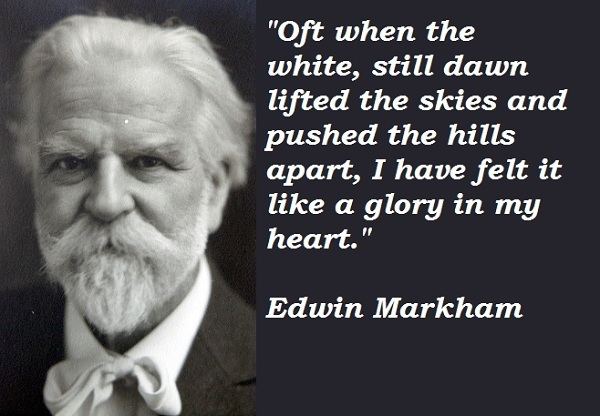
Among those in attendance on this day was poet Edwin Markham, best known for his 1898 poem "The Man With the Hoe," making him popular with farmers and other working men. In 1914, his contribution to the nonfiction book Children In Bondage helped to end child labor in America. As an editor, he popularized for the 20th Century the works of John Keats, Edgar Allan Poe, John Greenleaf Whittier and Henry Wadsworth Longfellow. In 1922, he published the poem "Lincoln, Man of the People," and a recording of him reciting it became one of the earliest sound film.
Markham was a great fan of FDR's, and walked up to shake his hand. But, 84 years old, he tripped, and knocked FDR over.

Markham was terribly embarrassed. FDR was not hurt, and was quickly picked up so that the audience couldn't really see what has happened. But the pages of his speech were scattered. (No teleprompters in those days.) So he had to put them back together. He said:

Here, and in every community throughout the land, we are met at a time of great moment to the future of the Nation. It is an occasion to be dedicated to the simple and sincere expression of an attitude toward problems, the determination of which will profoundly affect America.
I come not only as a leader of a party, not only as a candidate for high office, but as one upon whom many critical hours have imposed and still impose a grave responsibility...
America will not forget these recent years, will not forget that the rescue was not a mere party task. It was the concern of all of us. In our strength we rose together, rallied our energies together, applied the old rules of common sense, and together survived.
In those days we feared fear. That was why we fought fear. And today, my friends, we have won against the most dangerous of our foes. We have conquered fear.
But I cannot, with candor, tell you that all is well with the world. Clouds of suspicion, tides of ill-will and intolerance gather darkly in many places. In our own land we enjoy indeed a fullness of life greater than that of most Nations. But the rush of modern civilization itself has raised for us new difficulties, new problems which must be solved if we are to preserve to the United States the political and economic freedom for which Washington and Jefferson planned and fought...
Out of this modern civilization, economic royalists carved new dynasties. New kingdoms were built upon concentration of control over material things. Through new uses of corporations, banks and securities, new machinery of industry and agriculture, of labor and capital, all undreamed of by the fathers, the whole structure of modern life was impressed into this royal service...
Throughout the Nation, opportunity was limited by monopoly. Individual initiative was crushed in the cogs of a great machine. The field open for free business was more and more restricted. Private enterprise, indeed, became too private. It became privileged enterprise, not free enterprise.
An old English judge once said: "Necessitous men are not free men." Liberty requires opportunity to make a living—a living decent according to the standard of the time, a living which gives man not only enough to live by, but something to live for.
For too many of us the political equality we once had won was meaningless in the face of economic inequality. A small group had concentrated into their own hands an almost complete control over other people's property, other people's money, other people's labor, other people's lives. For too many of us life was no longer free; liberty no longer real; men could no longer follow the pursuit of happiness.
Against economic tyranny such as this, the American citizen could appeal only to the organized power of Government. The collapse of 1929 showed up the despotism for what it was. The election of 1932 was the people's mandate to end it. Under that mandate it is being ended...
These economic royalists complain that we seek to overthrow the institutions of America. What they really complain of is that we seek to take away their power. Our allegiance to American institutions requires the overthrow of this kind of power. In vain they seek to hide behind the Flag and the Constitution. In their blindness, they forget what the Flag and the Constitution stand for. Now, as always, they stand for democracy, not tyranny; for freedom, not subjection; and against a dictatorship by mob rule and the over-privileged alike.
The brave and clear platform adopted by this Convention, to which I heartily subscribe, sets forth that Government in a modern civilization has certain inescapable obligations to its citizens, among which are protection of the family and the home, the establishment of a democracy of opportunity, and aid to those overtaken by disaster...
We are poor indeed if this Nation cannot afford to lift from every recess of American life the dread fear of the unemployed that they are not needed in the world. We cannot afford to accumulate a deficit in the books of human fortitude...
Governments can err. Presidents do make mistakes. But the immortal Dante tells us that divine justice weighs the sins of the cold-blooded and the sins of the warm-hearted in different scales. Better the occasional faults of a Government that lives in a spirit of charity than the consistent omissions of a Government frozen in the ice of its own indifference.
There is a mysterious cycle in human events. To some generations much is given. Of other generations much is expected. This generation of Americans has a rendezvous with destiny.
In this world of ours in other lands, there are some people, who, in times past, have lived and fought for freedom, and seem to have grown too weary to carry on the fight. They have sold their heritage of freedom for the illusion of a living. They have yielded their democracy.
I believe in my heart that only our success can stir their ancient hope. They begin to know that here in America we are waging a great and successful war. It is not alone a war against want and destitution and economic demoralization. It is more than that; it is a war for the survival of democracy. We are fighting to save a great and precious form of government for ourselves and for the world.
I accept the commission you have tendered me. I join with you. I am enlisted for the duration of the war.
FDR knew what he was doing with that closing: Within the last year, Italy's Fascist dictator Benito Mussolini had invaded and annexed Ethiopia, Somaliland and Eritrea, and created the colony of Italian East Africa, as the start of a new version of the Roman Empire; Fascists led by Francisco Franco began the Spanish Civil War, to overthrow the leftist Second Republic; Nazi Germany's Fascist dictator Adolf Hitler had occupied the Rhineland, violating the terms of the Treaty of Versailles that finalized the results of World War I; and Japan had increased its aggressiveness toward China. The clouds of war were forming.

But that phrase, "a rendezvous with destiny," would echo through the ages. Later Presidents John F. Kennedy and Ronald Reagan would use it. And in his speech announcing the independence of India in 1947, Prime Minister Jawaharlal Nehru would say that his new nation's people had "a tryst with destiny."

*

July 27, 1936 was a Monday. These 4 baseball games were played:

* The New York Yankees lost to the Detroit Tigers, 9-1 at Navin Field (later renamed Briggs Stadium and Tiger Stadium) in Detroit. Lynwood "Schoolboy" Rowe not only outpitched Vernon "Lefty" Gomez, but, in his own cause, went 2-for-4 with a home run and 4 RBIs. Hank Greenberg had been injured early in the season, and missed the rest, including this game.

* The Brooklyn Dodgers beat the Pittsburgh Pirates, 6-3 at Ebbets Field. Paul Waner went 0-for-4. Lloyd Waner went 1-for-5 with an RBI.

* The Philadelphia Athletics beat the Chicago White Sox, 15-8 at Comiskey Park in Chicago. All the A's got at least 1 hit, including pitcher Harry Kelley; and all but Kelley got at least 2 hits. Lou Finney went 5-for-6 with an RBI. Pinky Higgins went 4-for-6 with 2 RBIs. Frankie Hayes went 3-for-5 with a walk and 2 RBIs. Wally Moses went 3-for-6 with 2 RBIs. Chubby Dean (no relation to Dizzy and Daffy) went 3-for-6 with 1 RBI. Bob Johnson went 2-for-6 with 4 RBIs.

Zeke Bonura went 4-for-5 with 2 RBIs for the South Siders. In spite of a combined 23 runs, no home runs were hit by either team.

* And the St. Louis Browns beat the Boston Red Sox, 7-5 at Sportsman's Park in St. Louis. Jimmie Foxx went 3-for-4 with an RBI.

December 31, 1999 & January 1, 2000: The Millennium

December 31, 1999:  The Millennium arrives. The people of planet Earth survived. At a terrible cost. But we hadn't destroyed ourselves. ...