Showing posts with label university of minnesota. Show all posts

Wednesday, November 9, 2022

November 9, 1935: The Floyd of Rosedale Trophy

November 9, 1935: One of college football's greatest rivalry trophies has its origin.

Ask longtime fans of the University of Iowa, and they'll say the Hawkeyes' real arch-rival isn't Iowa State, or the University of Nebraska. It's the University of Minnesota. And ask longtime fans of the University of Minnesota, and they'll say the Golden Gophers' real arch-rival isn't the University of Wisconsin, or the University of Michigan. It's the University of Iowa.

The neighboring States' State universities had been playing each other since 1891, and in 1934, things turned nasty over the rough treatment of Ozzie Simmons, a black halfback for Iowa.

The rhetoric got really threatening for the 1935 game, and even the Governors got in on it, with Clyde Herring of Iowa saying the Iowa City crowd wouldn't stand for any rough stuff by the Minnesota players. He got accused of inciting a riot by Minnesota's Attorney General, Harry Peterson. Peterson's boss, Governor Floyd Olson, decided to lighten the mood, with what is, as far as I can tell, the first friendly bet between politicians representing opposing teams: A Minnesota "prize hog" against one from Iowa. Herring took the bet.

The game was played in Iowa City, at Iowa Stadium, renamed Kinnick Stadium in 1972, in memory of Nile Kinnick, Iowa's 1939 Heisman Trophy winner who was killed in a World War II flight training accident in 1943.

There was no incident at the game, either on the field or in the stands. Both teams played cleanly. Simmons walked off the field, receiving handshakes rather than injuries from the Minnesota players. Minnesota won, 13-6, and won their 3rd straight Big Ten Conference Championship, and their 2nd of 3 straight National Championships.

Herring contacted Rosedale Farms outside Fort Dodge, Iowa, and sent the pig to Olson, naming it Floyd of Rosedale, for Olson and the farm. (Had Iowa won, there could have been a trophy named Clyde of Minnetonka.) Olson then commissioned a trophy to be given annually to the winner of the game, because a 98-pound trophy is easier to move than a several-hundred-pound live pig.
Governor Clyde Herring of Iowa (left)
and Governor Floyd Olson of Minnesota,
with the original Floyd of Rosedale, 1935

Herring, a Democrat, was elected to the U.S. Senate in 1936, but lost in 1942, and died in 1945. Olson, a member of the Farmer-Labor Party, a kind of Socialist party that Hubert Humphrey later merged with the State Democratic Party, wasn't so lucky: He was already dying of cancer at the time of the bet, and passed away 9 months later.

Going into their meeting on November 19, 2022, Minnesota lead Iowa, 62-51-2, despite Iowa having won the last 7 games, and 17 of the last 21. Minnesota's lead is partly due to having won the 1st 12 games, from 1891 to 1916. Since the trophy (counting the original pig) was first awarded in 1935, Iowa lead, 43-42.

Iowa also play Iowa State for the Cy-Hawk Trophy (Cyclones vs. Hawkeyes), and Nebraska for the Heroes Trophy. Minnesota also play Wisconsin for Paul Bunyan's Axe, and Michigan for the Little Brown Jug. But both teams would rather win The Pig: Floyd of Rosedale.

*

November 9, 1935 was a Saturday. Among the other college football games played that day were these:

* A doubleheader was held at the Los Angeles Memorial Coliseum. Stanford beat Southern California, 3-0. And Southern Methodist beat UCLA. Stanford won the Pacific Coast Conference title, and SMU the Southwest Conference title. They were on a collision course, and Stanford upset heavily favored SMU in the Rose Bowl on New Year's Day 1936, 7-0. However, Minnesota were awarded the National Championship.

* Tennessee beat Mississippi, 14-13 at Crump Stadium in Memphis. Although the game was in Tennessee's State, the game was much closer to the campus of Ole Miss, 84 miles to 392. This didn't help Ole Miss, though, and the loss cost them the Southeastern Conference title. They did, however, get invited to the Orange Bowl.

* The Catholic University of America, based in Washington, D.C., beat West Virginia Wesleyan, 19-6 at Brookland Stadium in Washington. CUA then beat Ole Miss in the Orange Bowl on New Year's Day. CUA suspended its football program for World War II, and didn't restart it until 1977, at the NCAA Division III level. The 1936 Orange Bowl remains their sports program's greatest moment. West Virginia Wesleyan now compete in NCAA Division II.

* Louisiana State beat Mississippi State, 28-13 at Tiger Stadium in Baton Rouge, Louisiana. LSU won the Southeastern Conference title.

* The night before, Texas Christian University beat Loyola University, 14-0 at Loyola University Stadium in New Orleans. TCU, of Forth Worth, led by quarterback Sammy Baugh, were on a collision course with Dallas arch-rivals SMU for the Southwest Conference title. SMU won, the only loss inflicted upon TCU all season. TCU were invited to the Sugar Bowl, and beat LSU. (The Cotton Bowl didn't start until the next season.)

* Among the service academies, Navy beat Penn, 13-0 at Franklin Field in Philadelphia; but Army lost to the University of Pittsburgh, 29-6 at Pitt Stadium in Pittsburgh.

* New York University beat their arch-rivals, City College of New York, 45-0 at Yankee Stadium. NYU's team included running back Ed Smith, who made money on the side as a male model. He modeled for sculptor Frank Eliscu. It was only when a film crew, making a documentary about the Heisman Trophy for its 50th Anniversary, contacted him that Smith realized that he had been the model for the trophy. He thought he was just posing in his football uniform for a friend who happened to be an artist. The Downtown Athletic Club, caretakers of the Trophy, gave him a copy. He did play in the pros, for the Boston Redskins in 1936 and the Green Bay Packers in 1937.

* Across the Harlem River, at the Polo Grounds, a New York vs. California matchup took place. Fordham and St. Mary's, of Moraga in the East Bay region, played to a 7-7 tie. This game attracted 55,000 fans, while, at Yankee Stadium, NYU vs. CCNY attracted only 6,000.

* And among New Jersey teams, Rutgers beat Boston University, 12-6 at Fenway Park in Boston; and Princeton beat Harvard, 35-0 at Palmer Stadium in Princeton. Princeton went 9-0, but the days when a team in what had recently been unofficially dubbed "the Ivy League" could be awarded the National Championship were over. (It became an official league in 1954.)

Baseball season was over. And the NBA hadn't been founded yet. One NHL game were played that day: The New York Americans and the Toronto Maple Leafs played to a 5-5 tie at Maple Leaf Gardens in Toronto.

And in English soccer, Arsenal and East Midlands side Derby County played to a 1-1 draw at Highbury in North London.

Also, Bob Gibson, the Hall of Fame pitcher for the St. Louis Cardinals, was born on this day.

Sunday, October 30, 2022

October 31, 1903: The Little Brown Jug

October 31, 1903: The University of Michigan football team comes to Minneapolis to play the University of Minnesota. Michigan coach Fielding Yost, while a football genius, was a bit paranoid, and thought opposing fans might poison his water. So he sent student manager Thomas B. Roberts to buy something and bring it to him. He went to a local variety store and spent 30 cents on a 5-gallon earthenware jug. The game, at Northrop Field, ended in a 6-6 tie.

Afterward, Minnesota custodian Oscar Munson discovered, in his Scandinavian accent, "Yost left his yug." Supposedly, they contacted Yost and said, "Come and win it back." Michigan didn't even try until 1909, when they did win it back.

Ever since, the jug -- which is not little and not brown -- has been painted maize & blue with Michigan's winning scores on one side, and maroon & gold with Minnesota's winning scores on the other, and gone to the winner. Michigan dominates the rivalry 75-25-3, including the battle for the Little Brown Jug 71-23-2.

This rivalry means little to Michigan, because they have absolutely dominated it. Michigan went 18-2-1 from 1895 to 1932, 14-2-1 from 1943 to 1959, and has gone 44-4 since 1968, including 18 straight from 1987 to 2004. Minnesota won 9 straight from 1934 to 1942.

Henry L. Williams, who had been a star halfback at Yale, coached at Minnesota from 1900 to 1921, winning 8 titles in the league that became the Big Ten Conference, and has been retroactively awarded the 1904 National Championship. He went 136-33-11 at Minnesota, but only 1-5-1 against Michigan. Minnesota's arena, opening in 1928, was named Williams Arena in his honor. He died in 1931.

In contrast, Yost, for whom Michigan's 1923 arena (formerly hosting basketball, and now hockey) was named, coached Michigan from 1901 to 1926, going 165-29-10, including 9-1-1 against Minnesota. He won 10 Conference Championships and 6 National Championships. He died in 1946.

UPDATE: In 2026, the University of Minnesota renamed Williams Arena, nicknamed "The Barn," as "The Barn by Blue Cross and Blue Shield." Other than getting sponsorship money, there was no reason to remove Williams' name: There was no revelation of bigotry or a posthumous sex scandal that would have force the University's hand.

*

October 31, 1903 was a Saturday. This was also the day that Hampden Park, Scotland's national stadium, opened in Glasgow. I have a separate entry for that event.

Baseball season was over. Basketball barely existed, and hockey hadn't yet turned professional. These other noteworthy games were played in college football:

* Army beat Vermont, 32-0 on The Plain in West Point, New York.

* Penn State beat Navy, 17-0 at Worden Field in Annapolis, Maryland.

* Yale beat Columbia, 25-0 at the Polo Grounds.

* Harvard beat the Carlisle Indian School, 12-11 at Soldier's Field in Boston. Jim Thorpe was too young to play on the Carlisle varsity, but they almost didn't need him. Two weeks later, on November 14, Harvard Stadium opened, and Harvard lost to Dartmouth. They still play there today.

* The University of Pennsylvania beat Bucknell, 47-6 at Franklin Field in Philadelphia. A new stadium by that name would be built on the same site in 1922.

* Lafayette beat New York University, 8-6 at Ohio Field in The Bronx.

* Princeton beat Cornell, 44-0 at University Field in Princeton, New Jersey.

* And Rutgers beat Stevens Institute, 36-6 at Neilson Field in New Brunswick, New Jersey.

* One game that was meant to be played, but was not, was between Indiana University and Purdue University, on IU's campus in Bloomington. The Purdue Wreck led to its cancellation. I have a separate entry for that event.

Monday, August 1, 2022

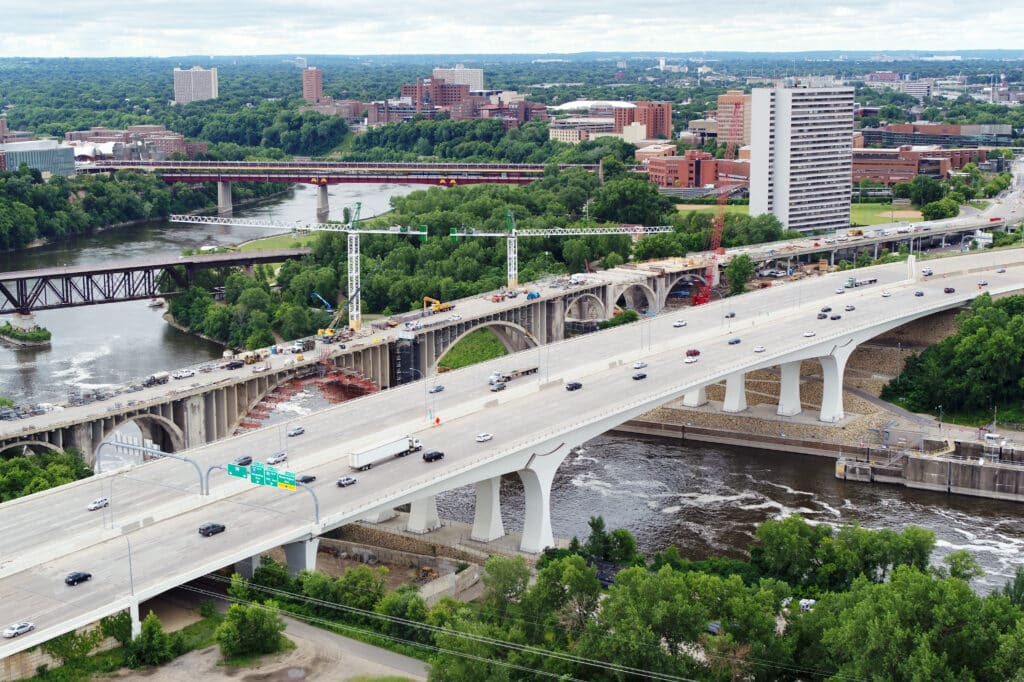
August 1, 2007: The Minneapolis Bridge Collapse

Looking southbound. The bridge to the left is
the 10th Avenue Bridge.

August 1, 2007: The Interstate 35W Mississippi River Bridge in Minneapolis collapses into the River around 6:05 PM -- rush hour, Central Time, making it 7:05 Eastern -- killing 13 people and injuring 145.

The bridge opened in 1967, and connected an area east of downtown to the Northeast Minneapolis neighborhood that includes the main campus of the University of Minnesota.

The replacement, known as the Saint Anthony Falls Bridge (always written with "Saint" spelled out, never abbreviated as "St."), was built in less than a year, and opened to traffic on September 18, 2008, 3 months ahead of schedule.
When the collapse happened, my father -- who designed highways and their improvements for the New Jersey Department of Transportation, but never bridges -- told me that 1 out of every 4 bridges in this country needed to be replaced. We figured, with only a year and change to go before a new President was going to be elected, America was finally ready to talk about infrastructure.

With a few exceptions -- New York City and New Jersey among them -- we were very wrong. This was despite the fact that, a little more than a year later, the Republican Convention would open in nearby St. Paul. And we would remain wrong until 2021, when President Joe Biden signed the Infrastructure Investment and Jobs Act.

*

August 1, 2007 was a Wednesday. These Major League Baseball games were played:

* The Minnesota Twins lost to the Kansas City Royals, 5-3 at the Metrodome in Minneapolis. Despite being only 8/10ths of a mile from the bridge collapse, and scheduled to start only an hour later, the game was not postponed. Alex Gordon hit a 2-run home run in the top of the 10th to win the game for the Royals.

* The New York Yankees beat the Chicago Whit Sox, 8-1 at Yankee Stadium. Andy Pettitte was the winning pitcher. Jorge Posada hit 2 home runs, and 1 each was hit by Derek Jeter, Robinson Canó and Shelley Duncan.

* The New York Mets beat the Milwaukee Brewers, 8-5 at Miller Park (now American Family Field) in Milwaukee. Óliver Pérez allowed 5 runs in the 1st 2 innings, but hung on for 6, striking out 11. The Mets came back thanks in part to home runs by Ramón Castro, Marlon Anderson and Shawn Green.

* The Boston Red Sox beat the Baltimore Orioles, 5-4 at Fenway Park in Boston.

* The Washington Nationals beat the Cincinnati Reds, 7-2 at Robert F. Kennedy Stadium in Washington.

* The Atlanta Braves beat the Houston Astros, 12-3 at Turner Field (now Center Parc Stadium) in Atlanta.

* The Florida Marlins beat the Colorado Rockies, 4-3 at Dolphin Stadium (now Hard Rock Stadium) in Miami Gardens, Florida.

* The Tampa Bay Devil Rays beat the Toronto Blue Jays, 6-2 at Tropicana Field in St. Petersburg, Florida.

* The Pittsburgh Pirates beat the St. Louis Cardinals, 15-1 at PNC Park in Pittsburgh. Ronny Paulino went 2-for-5 with a grand slam.

* The Texas Rangers beat the Cleveland Indians, 9-6 at Jacobs Field (now Progressive Field) in Cleveland. An error by Cleveland pitcher Jensen Lewis doomed the Tribe to a 3-run Ranger inning in the top of the 10th.

* The Chicago Cubs beat the Philadelphia Phillies, 5-4 at Wrigley Field in Chicago.

* The Arizona Diamondbacks beat the San Diego Padres, 905 at Petco Park in San Diego. The D-backs scored 4 runs in the top of the 11th, including a 3-run homer by Chad Tracy.

* The Los Angeles Dodgers beat their arch-rivals, the San Francisco Giants, 6-4 at Dodger Stadium in Los Angeles. The Dodgers scored 4 runs in the bottom of the 8th, including a 2-run homer by former Boston star Nomar Garciaparra.

*  The Oakland Athletics beat the Detroit Tigers, 3-2 at the Oakland Coliseum (then named the McAfee Coliseum).

* And the Seattle Mariners beat the Los Angeles Angels, 8-2 at Safeco Field (now T-Mobile Park) in Seattle. The Halos scored 3 runs in the top of the 9th to tie the game, Yuniesky Betancourt singled Adrián Beltré home with the winning run in the bottom of the 12th.

December 31, 1999 & January 1, 2000: The Millennium

December 31, 1999:  The Millennium arrives. The people of planet Earth survived. At a terrible cost. But we hadn't destroyed ourselves. ...