Showing posts with label shea stadium. Show all posts

Thursday, December 29, 2022

December 29, 1968: The New York Jets Win the AFL Championship

December 29, 1968: The American Football League Championship Game is played at Shea Stadium in Flushing Meadow, Queens, New York City. By any objective measure, it was a better game than the Super Bowl that was held 2 weeks later.

The Oakland Raiders had won the AFL Championship the year before, and were back in the Championship Game. The New York Jets were in it for the 1st time. Earlier in the season, on November 17, in Oakland, The Jets blew a lead with a little over 1 minute to play, and the Raiders scored 2 touchdowns. Most of the country didn't see it, though, as NBC cut away at 7:00 PM Eastern Time, to show the children's movie Heidi, infuriating millions of TV viewers. "The Heidi Bowl" was a sign that the AFL had finally achieved a place in the American sports firmament, alongside the established NFL.

Quarterbacked by Joe Namath, who had already earned the nickname "Broadway Joe" for his showmanship, the Jets finished the season 11-3. The Raiders, with a quarterback named Daryle Lamonica, known as "The Mad Bomber," and with a devastating, often dirty, defense, were 12-2. Each team won its Division.

Since it was an even-numbered year, it was the Eastern Division Champion's turn to host the Championship Game. And so, Shea Stadium, also the home of baseball's New York Mets, hosted a football championship before it hosted a postseason game in baseball. A crowd of 62,627 was on hand, the biggest in AFL history.

A short punt led to Namath passing to Don Maynard for a touchdown to open the scoring. The Raiders stalled on their next drive, and George Blanda hit the crossbar on a field goal attempt. Jim Turner kicked a field goal to put the Jets up 10-0 at the end of the 1st quarter.

The Raiders got off the deck, and Lamonica threw a 29-yard touchdown pass to Fred Biletnikoff. Turner kicked another field goal, and Blanda kicked one right before the half, to close the Raiders to within 13-10.

Blanda tied the game with a field goal in the 3rd quarter, but Namath took the Jets downfield, and just before the quarter ended, he threw a touchdown pass to Pete Lammons, putting New York up, 20-13.

Early in the 4th quarter, George Atkinson intercepted a Namath pass, and took it to the Jets' 5-yard line. Pete Banaszak ran it in on the next play, and for the 1st time, the Raiders led, 23-20. But Namath needed just 3 passes -- 10 yards to George Sauer, 52 to Maynard, and 6 to Maynard -- to put the Jets up, 27-23.

With a little over 5 minutes left, with the Raiders having the ball on the Jets' 26-yard line and 4th & 10, head coach John Rauch decided to go for the 1st down. It didn't work, as Verlon Biggs sacked Lamonica. On their next drive, Lamonica got to the Jets' 24, but he made a bad throw that was ruled a fumble, and Ralph Baker recovered for the Jets. With 1 last chance, the Raiders had the ball on their own 22 with 42 seconds left, but could only get to midfield before the clock ran out. The Raiders had outgained the Jets, 443 total yards to 400, but the Jets had won, 27-23.

In the off-season, Rauch decided he'd had enough meddling by Raiders owner Al Davis, and resigned. Davis promoted the linebackers coach to head coach: John Madden. Madden's legend was just beginning, while Namath's was about to reach the stratosphere.

And a storybook period for New York sports had begun: In a span of 17 months, the Jets had won the AFL Championship, the Jets would pull off one of the greatest upsets in sports history by becoming the 1st AFL team to win a Super Bowl, the Mets would win a "Miracle" World Series, and the Knicks would win their 1st NBA Championship.

*

December 29, 1968 was a Sunday. The NFL Championship Game was played the same day, and the Baltimore Colts, 13-1 on the regular season, avenged their only defeated annihilating the Cleveland Browns, 34-0 at Cleveland Municipal Stadium. (As with the AFL, home-field advantage was determined on a rotating basis, not by best record. The merged NFL wouldn't start doing it that way until 1975.)

There were 4 games played in the NBA:

* The New York Knicks beat the Seattle SuperSonics, 120-112 at Madison Square Garden. Willis Reed scored 34 points.

* The Atlanta Hawks beat the Baltimore Bullets, 101-99 at the Alexander Memorial Coliseum (now the McCamish Pavilion) in Atlanta.

* The Chicago Bulls beat the Milwaukee Bucks, 102-97 at the Milwaukee Arena. In 1974, it was renamed the Milwaukee Exposition, Convention Center and Arena, or "The MECCA." Since 2014, it has been named the UW-Panther Arena.

* And the Los Angeles Lakers beat the Detroit Pistons, 111-108 at The Forum outside Los Angeles in Inglewood, California. Jerry West scored 34 points, Elgin Baylor scored 24, and Wilt Chamberlain scored 22 and had 25 rebounds.

There were 5 games in the American Basketball Association:

* The New York Nets lost to the Kentucky Colonels, 118-116 in overtime at the Long Island Arena in Commack, New York. Ron Perry scored 36 in defeat for the Nets.

* The Miami Floridians beat the New Orleans Buccaneers, 107-106 at the Miami Beach Convention Center.

* The Houston Mavericks beat the Los Angeles Stars, 93-83 at the Sam Houston Coliseum in Houston.

* The Oakland Oaks beat the Minnesota Muskies, 120-99 at the Metropolitan Sports Center in the Minneapolis suburb of Bloomington, Minnesota.

* The Denver Nuggets beat the Dallas Chaparrals, 102-92 at the Denver Auditorium Arena.

And there were 4 games in the NHL:

* The New York Rangers beat the Montreal Canadiens, 3-1 at Madison Square Garden.

* The Oakland Seals beat the Philadelphia Flyers, 2-1 at The Spectrum in Philadelphia.

* The Boston Bruins and the Detroit Red Wings played to a tie, 3-3 at the Olympia Stadium in Detroit.

* And the Chicago Black Hawks beat the Los Angeles Kings, 4-1 at the Chicago Stadium.

Friday, December 16, 2022

December 16, 1973: The O.J. 2,000 Game

December 16, 1973: O.J. Simpson sets the NFL's single-season rushing yards record, becoming the 1st player to rush for 2,000 yards in a season.

In 1934, Beattie Feathers of the Chicago Bears became the 1st NFL player to rush for 1,000 yards in a season. His 1,004 yards stood as the record until 1947, when Steve Van Buren of the Philadelphia Eagles raised it to 1,008. In 1949, Van Buren broke his own record, with 1,146.

Jim Brown played 9 seasons in the NFL, 1957 to 1965, all with the Cleveland Browns, and led the League in rushing yards in 8 of them. Jim Taylor of the Green Bay Packers led in 1962. In 1958, Brown broke Van Buren's record by plenty, with 1,527. In 1963, with the schedule having been increased from 12 to 14 games, he raised the record to 1,863. In 2 years, he had increased the record by 33 percent; within 8 years, by 62 percent.

Simpson arrived in professional football in 1969, with the Buffalo Bills, having won the Heisman Trophy the year before and led USC to the National Championship the year before that. But his 1st 3 seasons were a bit of a struggle. In 1972, he rushed for 1,251 yards, leading the NFL, and the most by any player in 7 years, since Brown in his last season.

The Bills began the 1973 season in a new stadium, in the Buffalo suburb of Orchard Park, New York. It was then named Rich Stadium, and is now named Highmark Stadium. Simpson started off as well as anyone could have hoped for, rushing for 250 yards.

This broke the single-game record of 247, then held by Willie Ellison of the Los Angeles Rams in a 1971 game. In 1976, Simpson would raise that record to 273, but it was broken a year later when Walter Payton rushed for 275. Today, the record is 296, set by Adrian Peterson of the Minnesota Vikings in 2007.

Simpson ran for 103 yards in Week 2, 123 in Week 3, 171 in Week 4, and 166 in Week 5. But in Week 6, he was held to 55 yards by the defending Champion Miami Dolphins and their "No-Name Defense." In Week 7, against a Kansas City Chiefs defense that had once been great but was now aging, Simpson ran for 157. That gave him 1,025 for the season, at the halfway mark. Brown's record of 1,863 and even 2,000 now seemed within reach.

Then Simpson went into a slump. He only got 79 yards in Week 8 and 99 in Week 9. He bounced back in Week 10, getting 120. In Week 11, he got 124. In Week 12, he got 137. That got him 1,584. And in Week 15, he got 219. That gave him 1,803. So, in the season's final game, he needed 61 for a new record, and 197 for 2,000.

Fortunately for Simpson and the Bills, they were playing the New York Jets. Unfortunately, it would be at Shea Stadium, in cold air, with snow falling, on a frozen field. But the Bills were used to that kind of weather back home, so it didn't bother them much -- even if Simpson himself was a San Francisco native who'd made his name at USC, in the steady warm weather of Los Angeles, on the pristine grass field at the Los Angeles Memorial Coliseum.

The result was not really in doubt. The game was 7-7 at the end of the 1st quarter, by which point Simpson had already surpassed Brown's single-season record, needing just 8 carries to do it. The Bills pulled ahead to 21-7 by the half, including a touchdown run by Simpson.

The Bills led 28-7 after 3 quarters, and the final was 34-14. In case you're a Jet fan who is wondering: For the Jets, who finished 4-10, Joe Namath completed 13 out of 30 passes, for 206 yards, 2 touchdowns and no interceptions. But he also got sacked 3 times.

With 5 minutes left, Bills quarterback Joe Ferguson handed off to Simpson, and he ran up the middle, gaining 7 yards. It gave him 200 yards even for the day, and 2,003 yards for the season. The Bills carried him off the field, and a crowd of 47,740, mostly Jet fans, gave him a standing ovation.

This turned out to be the last game as an NFL head coach for the Jets' Wilbur "Weeb" Ewbank. He had led the Baltimore Colts to the NFL Championship in 1958 and '59. It had been only 5 seasons since he and Namath had led the Jets to win the Super Bowl, but it now seemed very far away.

The Bills also became the 1st NFL team to rush for over 3,000 yards in a season. At a postgame press conference, Simpson -- because of his initials, sometimes called "Orange Juice" or just "Juice" -- introduced each member of the offensive line, who called themselves "The Electric Company," because, "We make the Juice flow."

Let the record show that they were: Left tackle Dave Foley, left guard Reggie McKenzie, center Mike Montler, right guard Joe DeLamielleure, and right tackle Donnie Green. DeLamielleure would eventually join Simpson in the Pro Football Hall of Fame. (Montler died in 2018, Green in 2019. As of the 2022 NFL season, Foley, McKenzie and DeLamielleure are still alive.)

The following season, their 1st season with the "charging" buffalo on their helmets instead of the standing one they'd had since their 1960 inception, the Bills made the Playoffs. Although he caught a touchdown pass in the AFC Divisional Playoff, the Bills lost to the Pittsburgh Steelers, in what turned out to be the only Playoff game Simpson ever appeared in.

In a way, Simpson was unlucky: For all his personal success, as a player, an actor, and a commercial pitchman, he arrived in Buffalo just as the Dolphins were becoming the team that would dominate the AFC Eastern Division, which they remained until the mid-1980s, by which point Simpson was in the Hall of Fame, a sideline analyst for NFL games on NBC, and still doing commercials, especially for Hertz Rent-a-Car, sometimes with golf legend Arnold Palmer.

And he was popular. Still good-looking. Charming. For a lot of people, including myself, O.J. Simpson had been a hero for all or most of their lives.

And if he, rather than his ex-wife Nicole Brown Simpson and her friend Ronald Goldman, had died on June 12, 1994, it would have been a shock, but not the greater shock that we all got. Though it's likely that the awful things he had already done by that point would have come out eventually.

The film The Dark Knight featured Aaron Eckhardt as fictional District Attorney Harvey Dent, who said, "You either die a hero, or you live long enough to see yourself become the villain." And he went on to prove it.

The film The Sandlot featured Art LaFleur as the ghost of Babe Ruth, saying, "Heroes get remembered, but legends never die."

O.J. Simpson was a hero. He is a legend. But it's worth remembering that not all legends are heroic ones, or have happy endings.

The O.J. 2000 Game remains considerably more memorable than the one in which the record O.J. set was broken, by Eric Dickerson of the Los Angeles Rams. How much more memorable? This much: I had to look up not only the date, but the year that it happened. And I was just short of my 15th birthday at the time, so I remember it having happened, though I wasn't watching as it happened.

It was December 9, 1984: The Rams beat the Houston Oilers, 27-16 at Anaheim Stadium (now Angel Stadium), and, with 215 yards, Dickerson surpassed Simpson, finishing the game with 2,007. There was 1 more week to play, and in the season finale, he ran for 98, finishing the year with 2,105.

This remains the NFL record. In 1985, Herschel Walker ran for 2,411 yards for the New Jersey Generals of the United States Football League. But, just as Dickerson needed a 15th game to surpass Simpson (O.J. still holds the record for most rushing yards in the 1st 14 games of a season), Walker played an 18-game season. What's more, the USFL was not highly regarded. Dickerson himself said, "The difference is, I did it in the majors, and he did it in the minors." The next year, Walker came to the NFL, with the Dallas Cowboys. His peak total in the NFL was 1,514 yards, in 1988.

There have now been 8 2,000-yard rushing seasons in NFL history. Since Simpson and Dickerson: Barry Sanders had 2,053 for the 1997 Detroit Lions, Terrell Davis had 2,008 for the 1998 Denver Broncos, Jamal Lewis had 2,006 for the 2003 Baltimore Ravens, Chris Johnson had 2,006 for the 2009 Tennessee Titans, Adrian Peterson had 2,097 for the 2012 Vikings, and Derrick Henry had 2,027 for the 2020 Titans.

(UPDATE: Saquon Barkley had 2,005, in a 17-game season in which he was held out for the 17th game to protect him from injury, for the 2024 Philadelphia Eagles. Counting the Playoffs and the Super Bowl, he had 2,504, an all-time record, breaking the 1998 mark of Davis, 2,468.)

Oddly, while Lewis and Peterson would both eventually break (and Peterson still holds) the record for most rushing yards in a game, neither did it in the season in which they rushed for over 2,000 yards. Simpson did (in 1973) -- and didn't (in 1976, when he raised the single-game record).

For comparison's sake: Jim Brown's highest single-game total was 237; Walter Payton, the 1st man to rush for more yards in a game than Simpson (275), and eventually the NFL's all-time rushing leader, topped out at 1,852 yards in a season; and Emmitt Smith, who surpassed Payton and remains the all-time rushing leader, topped out at 237 for a game and 1,773 for a season.

*

December 16, 1973 was a Sunday. These other games were played in the NFL:

* The New York Giants lost to the Minnesota Vikings, 31-7 at the Yale Bowl in New Haven, Connecticut. (This was after the old Yankee Stadium was renovated, but before Giants Stadium was completed.)

* The Baltimore Colts beat the New England Patriots, 18-13 at Memorial Stadium in Baltimore.

* The Washington Redskins beat the Philadelphia Eagles, 38-20 at Robert F. Kennedy Stadium in Washington.

* The Atlanta Falcons beat the New Orleans Saints, 14-10 at Atlanta Stadium. (It was renamed Atlanta-Fulton County Stadium in 1975.)

* The Miami Dolphins beat the Detroit Lions, 34-7 at the Orange Bowl in Miami.

* The Green Bay Packers beat the Chicago Bears, 21-0 at the old Soldier Field in Chicago.

* The Dallas Cowboys beat the football version of the St. Louis Cardinals, 30-3 at Busch Memorial Stadium in St. Louis.

* The Kansas City Chiefs beat the San Diego Chargers, 33-6 at Arrowhead Stadium in Kansas City.

* The Cincinnati Bengals beat the Houston Oilers, 27-24 at the Astrodome in Houston.

* The Los Angeles Rams beat the Cleveland Browns, 30-17 at the Los Angeles Coliseum.

* The Pittsburgh Steelers beat the San Francisco 49ers, 37-14 at Candlestick Park in San Francisco.

* The Oakland Raiders beat the Denver Broncos, 21-17 at the Oakland Coliseum.

* And there was no Monday Night Football game that week.

There were 4 games played in the NBA:

* The Kansas City-Omaha Kings beat the Detroit Pistons, 105-104 at the Kansas City Municipal Auditorium.

* The Boston Celtics beat the Los Angeles Lakers, 115-110 at The Forum outside Los Angeles in Inglewood, California.

* The Milwaukee Bucks beat the Portland Trail Blazers, 121-98 at the Portland Memorial Coliseum.

* And the Phoenix Suns beat the Seattle SuperSonics, 113-109 at the Seattle Center Coliseum.

There were 3 games played in the American Basketball Association:

* The New York Nets beat the Utah Stars, 129-109 at the Nassau Coliseum.

* The San Antonio Spurs beat the Memphis Tams, 85-80 at the Mid-South Coliseum in Memphis.

* And the Kentucky Colonels beat the San Diego Conquistadors, 106-101 at the San Diego Sports Arena. (It's now named the Pechanga Arena.)

There were 7 games in the NHL:

* The New York Rangers lost to the Chicago Black Hawks, 6-1 at Madison Square Garden.

* The New York Islanders lost to the Philadelphia Flyers, 4-0 at The Spectrum in Philadelphia.

* The Boston Bruins beat the California Golden Seals, 5-3 at the Boston Garden.

* The St. Louis Blues beat the Buffalo Sabres, 5-2 at the Buffalo Memorial Auditorium.

* The Pittsburgh Penguins beat the Atlanta Flames, 2-1 at The Omni.

* The Detroit Red Wings beat the Vancouver Canucks, 7-5 at the Olympia Stadium in Detroit.

* The Montreal Canadiens, the Toronto Maple Leafs, the Los Angeles Kings and the Minnesota North Stars were not scheduled.

And there were 6 games in the World Hockey Association:

* The Edmonton Oilers beat the Jersey Knighs, 7-6 at the Cherry Hill Arena in the Philadelphia suburb of Cherry Hill, Camden County, New Jersey.

* The Chicago Cougars beat the New England Whalers, 3-2 at the Boston Garden.

* The Quebec Nordiques beat the Toronto Toros, 4-3 in overtime at Maple Leaf Gardens in Toronto.

* The Cleveland Crusaders and the Houston Aeros played to a tie, 2-2 at the Sam Houston Coliseum in Houston.

* The Minnesota Fighting Saints beat the Winnipeg Jets, 3-2 at the Winnipeg Arena.

* The Los Angeles Sharks beat the Vancouver Blazers, 5-3 at the Los Angeles Sports Arena.

Saturday, December 10, 2022

December 10, 1983: Farewell to Bradshaw, and to the NFL In New York City

December 10, 1983: For the last time, so far, a National Football League game is played within the Five Boroughs of the City of New York. It does not go well for the home team.

The New York Jets had been playing home games at Shea Stadium in Flushing Meadow-Corona Park in Queens since it opened in 1964. But the City's Department of Parks, which owned it (and also owned Yankee Stadium in the South Bronx), gave scheduling priority in September, the month when the NFL regular season begins, to the Major League Baseball team for whom it was really built, the New York Mets.

As a result, the Jets often had too many away games at the start of the season. Not only did this mean they often got off to bad starts, but it meant more home games later in the season. This was not as much of an advantage as you think: Shea was a wind tunnel, and could get very cold.

What's more, once the baseball season ended, the City tended to cut down on maintenance, leaving things messier, and various things to break down more often and stay broken down longer. Worst of all, from the Jets organization's point of view, lease at Shea was bad.

Team owner Leon Hess was an oil company boss, and could afford it. But that wasn't the point: The lease terms the Mets and the Yankees had with the City; the terms the New York Giants, the New Jersey Nets and the New Jersey Devils had with the State of New Jersey at the Meadowlands Sports Complex; and the terms the New York Islanders had with the County of Nassau at the Nassau Coliseum were all better. Throw in the fact that the Madison Square Garden Corporation owned the New York Knicks and the New York Rangers, so those teams had no lease at all at The Garden, and the Jets had easily the worst lease in the New York Tri-State Area.

So Hess made a deal with the New Jersey Sports and Exposition Authority, operator of the Meadowlands Complex. Starting in 1984, the Jets would play home games at Giants Stadium. This led to other problems, but it was still better than at Shea, not least because Giants Stadium then had 16,000 more seats than Shea did in its football configuration.

In this last game at Shea, the Jets hosted the Pittsburgh Steelers. Most of the stars of the Steeler teams that won 4 Super Bowls in 6 seasons from 1974 to 1979 had retired, or were now too far along in their careers, or too injured, to be significant contributors.

One such player was their quarterback, Terry Bradshaw. He had missed the 1st 14 weeks of the season with a bad elbow. But he said he was ready to come back for the season's last 2 games, and hopefully one more Playoff run.

The weather wasn't especially bad: 45 degrees at kickoff, with the wind at 12 miles per hour. A crowd of 53,996, about 6,000 short of a sellout, came out to watch the end of 2 eras, even though they only knew for sure about 1. At one point, the scoreboard operator had some fun, turning "N.Y. JETS" into "N.J. JETS."

At first, it looked like Bradshaw had turned back the clock. In the 1st quarter, he threw a 17-yard touchdown pass to Gregg Garrity. In the 2nd quarter, he threw a 10-yard touchdown pass to Calvin Sweeney. That made it 14-0 Steelers.

But on that pass to Sweeney, he felt something pop in his elbow. He had reaggravated the injury. He walked off the field, and never played another down.

Cliff Stoudt took over at quarterback, and put together 2 drives that ended in field goals by Gary Anderson, making it 20-0 Steelers at the half. He threw a touchdown pass to Bennie Cunningham in the 3rd quarter, and it was 27-0.

Finally, late in the 3rd quarter, Pat Ryan threw a 27-yard touchdown pass to Johnny "Lam" Jones, and the Jets were on the board. But in the 4th quarter, Stoudt threw to Sweeney, and it was another touchdown. Final score: Steelers 34, Jets 7.

Thousands of fans stormed the field, tore down the goalposts, ripped up the field, and took other souvenirs. The grounds crew had 4 months to get the field ready for the Mets.

The win clinched the AFC Central Division title and a Playoff berth for the Steelers, who went on to lose to the Los Angeles Raiders in the Divisional Round. The Jets finished 7-9, 5th and last in the AFC Eastern Division, out of the Playoffs.

In 2004, a stadium was proposed for the West Side of Manhattan, between Pennsylvania Plaza (including Penn Station and Madison Square Garden) and the Hudson River. It was to seat 85,000, and be a new home for the Yankees and the Jets, bringing the NFL back to New York City proper, the NFL back to Manhattan for the 1st time since the Giants left the Polo Grounds in 1955 (the Jets had played at the Polo Grounds from 1960 to 1963, in the AFL), and the Yankees back to Manhattan for the 1st time since they left the Polo Grounds in 1922.

It would have a retractable roof, allowing it to host Super Bowls, a college football bowl game called the Big Apple Bowl, and the NCAA Final Four. What's more, it would be the centerpiece of New York's bid to host the 2012 Olympics.

City officials, especially Mayor Mike Bloomberg, wanted it badly. Nobody else seemed to want it. The Yankees turned it down, preferring to build a new Yankee Stadium across 161st Street from the old one. The Mets didn't want it, either, preferring to build Citi Field next-door to Shea Stadium. The baseball teams seemed to want to keep their respective identities in The Bronx and Queens, respectively.

The real killer for the stadium was the realization of Woody Johnson, the pharmaceutical executive who had bought the Jets from Leon Hess' heirs, that the Jets would still be second-class citizens in this stadium. So he negotiated a deal with the Giants and the New Jersey Sports & Exposition Authority to build what became MetLife Stadium, next-door to Giants Stadium.

It would be owned 50-50 by the 2 New York NFL teams, and they would share the maintenance costs, and, not having to worry about whether a baseball team in the same stadium might make the Playoffs and mess up the schedule, would agree on open dates before each season started.

On June 6, 2005, the New York State Public Authorities Control Board voted West Side Stadium down. A month later, the International Olympic Committee voted on a site for the 2012 Olympics. New York finished 4th, behind London, Paris and Madrid, but ahead of Moscow. London ended up hosting the games, with the stadium eventually hosting soccer team West Ham United, and Major League Baseball's London Series, starting in 2019, with the Yankees playing the Boston Red Sox.

In 2010, the New Meadowlands Stadium, later renamed MetLife Stadium, opened. It pretty much guaranteed that no NFL game would be played within the City of New York for the majority of the 21st Century.

*

December 10, 1983 was a Saturday. One other NFL game was played that day, before all of the rest, except the Monday night game, were played the next day: The Miami Dolphins beat the Atlanta Falcons, 31-24 at the Orange Bowl in Miami.

It was a little early for college football bowl games, but one was played: The Independence Bowl, at Independence Stadium in Shreveport, Louisiana. The U.S. Air Force Academy, ranked Number 16 in the nation, beat the University of Mississippi, a.k.a. Ole Miss, 9-3.

There were 7 games played in the NBA:

* The Boston Celtics beat the Atlanta Hawks, 104-87 at The Omni in Atlanta.

* The Cleveland Cavaliers beat the Chicago Bulls, 101-95 at the Chicago Stadium.

* The Kansas City Kings beat the Indiana Pacers, 119-103 at the Kemper Arena (now the Hy-Vee Arena) in Kansas City.

* The Utah Jazz beat the Houston Rockets, 128-121 at The Summit in Houston. (The arena has since been converted into the Central Campus of the Lakewood Church, Dr. Joel Osteen's "megachurch.")

* The San Antonio Spurs beat the Washington Bullets, 125-120 at the HemisFair Arena in San Antonio.

* The Phoenix Suns beat the San Diego Clippers, 109-93 at the Arizona Veterans Memorial Coliseum in Phoenix.

* And the Dallas Mavericks beat the Golden State Warriors, 126-123 in overtime at the Oakland Coliseum Arena. Mark Aguirre scored 40 points for the Mavs.

And there were 9 games played in the NHL that day:

* The New Jersey Devils lost to the Philadelphia Flyers, 8-2 at the Brendan Byrne Arena.

* The New York Islanders beat the Minnesota North Stars, 4-2 at the Metropolitan Sports Center in the Minneapolis suburb of Bloomington, Minnesota.

* The Buffalo Sabres beat the Boston Bruins, 4-2 at the Boston Garden.

* The Hartford Whalers played the Winnipeg Jets to a tie, 5-5 at the Hartford Civic Center (now the PeoplesBank Arena).

* The Washington Capitals beat the Montreal Canadiens, 2-0 at the Capital Centre in the Washington suburb of Landover, Maryland.

* The Toronto Maple Leafs played the Calgary Flames to a tie, 3-3 at Maple Leaf Gardens in Toronto.

* The St. Louis Blues beat the Detroit Red Wings, 8-3 at the St. Louis Arena.

* The Quebec Nordiques beat the Los Angeles Kings, 6-4 at The Forum outside Los Angeles in Inglewood, California.

* And the Vancouver Canucks beat the Edmonton Oilers, 3-2 at the Pacific Coliseum in Vancouver. 

Thursday, October 27, 2022

October 27, 1986: The Mets Win the World Series

October 27, 1986: The New York Mets win the World Series. I was not happy about this.

They have not done so since. I am very happy about that.

After escaping from the nether regions of the National League with a 2nd-place finish in the Eastern Division in 1984, and nearly winning the Division in 1985, Met fans began to treat the winning of the 1986 World Series as inevitable: They bragged to Yankee fans that the would win the '86 Series, even before the '85 Pennants were decided.

The Mets, celebrating their 25th season with an anniversary patch, began the 1986 regular season 2-3, then rattled off an 11-game winning streak to the end of April, lost 1, then won another 7 in a row. So they went 17-1 from April 18 to May 10, at which point they already led the NL East by 5 games over the Montreal Expos. Already, anybody who couldn't stand the Mets was sick of the commercials used to drum up ticket sales, with the "Baseball Like It Oughta Be" and "We got the teamwork to make the dream work" songs.

A 10-1 run from June 6 to 16 put them up by 11 1/2 games over the Expos. Around this time, I was at the Woodbridge Center Mall in Woodbridge, Middlesex County, New Jersey, and The Sports Corner, a store that sold sports memorabilia, and also served as a Ticketron outlet (Ticketmaster bought them out in 1991). One of the items they were selling was a T-shirt that read, "New York Mets, 1986 World Series Champions." The World Series was still 4 months away.

Come the All-Star Break on July 13, they were 13 1/2 in front of the Expos. Pitcher Dwight Gooden, catcher Gary Carter, 1st baseman Keith Hernandez and right fielder Darryl Strawberry were all voted in as starters for the National League in the All-Star Game at the Astrodome in Houston. Pitcher Sid Fernandez was selected as a reserve. But the game turned out to be a minor embarrassment for the Mets: Lou Whitaker of the Detroit Tigers hit a home run off Gooden, and the American League won, 3-2.

By August 23, the Mets were 20 games ahead of the Philadelphia Phillies. On September 6, I had been invited to attend a game at Shea Stadium, my 1st live National League game. The Mets trailed the San Diego Padres, 3-2 going into the bottom of the 8th, but Carter hit his 2nd home run of the game, and the Mets won, 4-3. They led the Phillies by 20 1/2.

"The inevitable" began to take shape on September 17. The Mets beat the Chicago Cubs 4-2 at Shea, and clinched the Division title with 17 games to go. It was their 1st postseason berth in 13 years. Gooden went the distance for the win. The fans rushed the field, and one was already in fair territory before the final out reached Hernandez's 1st baseman's mitt. The field was ripped to shreds, and the Mets had a day game scheduled for just 16 hours later. Somehow, the grounds crew got the field in playable shape, not that a forfeit would have mattered.

After what the British would call "pitch invasions" at Met clinchers in 1969, 1973, and this night, and Yankee clinchers in 1976, 1977, 1978 and 1981, Mayor Ed Koch, invoking the City's ownership of both ballclubs' stadiums, ordered mounted police to come on the field and surround the field at each clincher, and announced that punishments for charging the field would be more severe.

The Mets needed a walkoff home run from Lenny Dykstra to win Game 3 of the NL Championship Series. They led the series, 3 games to 2, but the 2 losses were to Mike Scott, an ex-Met who found success with the split-fingered fastball, and they had to avoid facing him in Game 7 in the Astrodome. So Game 6 was a death struggle, going back and forth for 16 innings before the Mets finally won it to take the Pennant. It was on the road, so fans charging the field was not an issue.

The World Series was against the Boston Red Sox. There were 3 men in uniform who had been in uniform for the Mets' previous World Series win, in 1969: Manager Davey Johnson had been the 2nd baseman for the Baltimore Orioles, and had made the last out; '69 shortstop Bud Harrelson was now the Mets' 3rd base coach; and former Met ace Tom Seaver was playing out the string with the Red Sox, unable to pitch in this Series due to injury, but got a huge ovation when introduced before Game 1.

The Red Sox stunned the Mets in the 1st 2 games of the World Series, leading the New York Daily News to reference Boston's nickname of "Beantown" with the headline "BEANS!" The Mets won Games 3 and 4 in Fenway Park, but lost Game 5 there. So they had to win Games 6 and 7 at Shea to win. Game 6 was an epic, with the Red Sox taking a 5-3 lead in the top of the 10th inning. With 2 outs in the bottom of the 10th, a message on the Shea scoreboard congratulated the Sox. Sox pitcher Bruce Hurst was named the Series' Most Valuable Player. Then came the comeback/collapse of all time, and the Mets won, 6-5.

Game 7 was pushed back a day by rain. In its place, NBC aired the baseball-themed movie The Natural, as part of its usual NBC Sunday Night Movie show. Despite airing on a Monday night, when another New York team, the Giants, were playing on ABC Monday Night Football at the same time, this game got more TV viewers than any Major League Baseball game ever: 60 million people.

The Red Sox actually seemed to be shaking off the historical, hysterical Game 6 loss. They led the Mets, 3-0 in the bottom of the 6th inning. Hurst, with an extra day's rest, was doing just fine. The Sox chased Ron Darling. Sid Fernandez relieved him. The Sox were just 12 outs away from their 1st World Championship in 68 years after all.

But these were the pre-steroid Boston Red Sox, and they couldn't hold it. The Mets tied it up in the 6th. Manager John McNamara brought in Calvin Schiraldi, who choked in the 10th the night before, to pitch the 7th, and Ray Knight led off with a home run. The Mets made it 6-3 by the inning's end.

The Sox made it 6-5 in the top of the 8th, so there was still hope. But Al Nipper served one up to Strawberry, and he hit it out, and took a leisurely stroll around the bases. NBC could have run a commercial.

The Mets let reliever Jesse Orosco bat for himself, and he drove in another run, and he got the last out by striking out Marty Barrett. Mets 8, Red Sox 5. Orosco hurled his glove high into the Flushing air.

The bullpen gate was opened, and mounted policemen came onto the field. The fans stayed in the stands. They had obeyed the Mayor. No New York clincher since has seen a pitch invasion. So I guess we should thank Koch for that.

The Mets had won their 1st World Championship on October 16, 1969. It took them 17 years and 11 days, but they had now won their 2nd World Championship. Anyone then thinking that they wouldn't win their 3rd World Championship for at least another 36 years would have been asked what he was smoking.

But, tonight, exactly 36 years later, more than one-third of a century, the Mets are still looking for that 3rd World Championship. They've won just 2 more Pennants and just 2 more World Series games since that night -- 1 in 2000, and 1 in 2015. To make matters worse, following the 1st of those Pennants, they went on to lose to the Yankees in the World Series, 1 of 5 the Yankees have won since 1986.

UPDATE: The Red Sox have a team Hall of Fame. From their 1986 Pennant, they have inducted left fielder Jim Rice, right fielder Dwight Evans, 2nd baseman Marty Barrett, 3rd baseman Wade Boggs, left fielder Mike Greenwell, catcher Rich Gedman; pitchers Roger Clemens, Bruce Hurst and Bob Stanley; owner Jean Yawkey, general manager Lou Gorman, executive Haywood Sullivan, scout George Digby, executives Edward Kenney and Dick Bresciani, farm system director Ben Mondor, groundskeeper Joe Mooney, guest relations director Al Green, public address announcer Sherm Feller; broadcasters Ken Coleman, Ned Martin, Jerry Remy and Joe Castiglione; and longtime vendor Arthur D'Angelo. They have not, as yet, inducted manager John McNamara.

From between their 1986 Pennant and their 1999 ALCS appearance, they have inducted manager Joe Morgan, 1st baseman Mo Vaughn and left fielder Ellis Burks.

*

October 27, 1986 was a Monday. And another New York Tri-State Area team won: On ABC Monday Night Football, the New York Giants beat the team then known as the Washington Redskins, 27-20 at Giants Stadium, in the Meadowlands of East Rutherford, New Jersey.

The NBA season wouldn't start for another 4 days. And only 1 NHL game was scheduled for that night: The Montreal Canadiens beat the Los Angeles Kings, 6-5 at the Montreal Forum. Chris Nilan, better known as an enforcer, scored the winner for Les Habitantes with 7:36 left in regulation.

And Jon Niese, who would pitch for the Mets from 2008 to 2016, including in the 2015 World Series, was born on this day. 

Wednesday, October 26, 2022

October 27, 1904: The New York Subway Opens

October 27, 1904: The 1st Subway line opens in New York. It runs from City Hall to Grand Central Station (roughly today's 4, 5 and 6 Trains), then turns onto 42nd Street (today's S, or Times Square-Grand Central Shuttle), then up Broadway to 207th Street (today's 1 Train) before making one final curve into the Bronx to Bailey Street (this part is part of today's A Train). The fare is 5 cents -- $1.52 in today's money.
The Polo Grounds of the time, and its 1911 successor, were served by the 155th Street station that opened on this day. It was supposedly on this line in 1908 that Jack Norworth, a songwriter, saw a sign saying, "Baseball To-Day, Polo Grounds," inspiring him to write the lyrics to "Take Me Out to the Ballgame."
It would be 1918 before "34th St.-Penn Station" opened to service the 1910-built Pennsylvania Station, and thus to the successor station and the "new" Madison Square Garden built on the site. The 34th Street station on the 8th Avenue side of Penn Station opened in 1932, as did the 42nd Street station that serves the Port Authority Bus Terminal that opened in 1950, and the 50th Street station that served the old Garden from 1932 until its closing in 1968.
The current 4 Train station at 161st Street and River Avenue opened in 1917, and began serving Yankee Stadium at its opening in 1923. The D Train station there opened in 1933, probably to coincide with the opening of the nearby Bronx County Courthouse. The Prospect Park station now used by the Q Train became part of the City Subway in 1920, and was used to get to games at Ebbets Field.
The station now served by the 7 Train opened in 1939 for the 1939-40 New York World's Fair, well predating the 1964-65 World’s Fair and the opening of Shea Stadium and the National Tennis Center. It was named "Willets Point Blvd." from 1939 to 1964 and "Willets Point-Shea Stadium" from 1964 to 2008, and has been renamed "Mets-Willets Point," as the MTA did not want to use the name "Citi Field" due to CitiGroup's role in the 2008 financial crisis.
*
October 27, 1904 was a Thursday. Poet Dylan Thomas was born in Swansea, Wales. He would die in New York in 1953.

There were no scores on this historic day: The baseball season was over, professional football was in its infancy, it was a Thursday so there were no college football games, and there was no professional basketball or professional hockey.

October 26, 2000: Yankees Have Scoreboard for All Time

October 26, 2000: Major League Baseball's 1st All-New York World Series in 44 years -- a "Subway Series" -- comes to what should have been its inevitable conclusion: As Yankee broadcaster John Sterling said: "Ballgame over! World Series over! Yankees win! Theeeeeeee Yankees win!"

Remember: It's not a "Subway Series" unless it's a World Series. Nobody ever called regular-season games between the New York Giants and the Brooklyn Dodgers a "Subway Series."

There had been exhibition games between the Yankees and the Mets from the Mets' 1962 debut onward. There had been preseason games, and the midseason "Mayor's Trophy" games. But they didn't count. Met fans thought they did. They didn't. In 1997, Interleague Play began, and the New York media called it a "Subway Series," but who was kidding who?

The 1985 season was the 1st time the Yankees and the Mets both stayed in their Divisional races until the last week of the regular season. The 1999 season was the 1st time that both made the Playoffs. Lots of people in New York, New Jersey and Connecticut were sure that was going to be it. The Yankees held up their end of the bargain. The Mets didn't hold theirs up.

Now, after 39 years of hoping, wishing, praying for a chance to beat the Yankees in a World Series, Met fans finally had that chance. And they were sure they were going to win it.

After all, Al Leiter was going to start Games 1 and 5, and Mike Hampton was going to start Games 2 and 6. And, as everybody knows, "The Yankees can't hit lefthanded pitching. Especially in the postseason." I guess Met fans, whom I nicknamed "the Flushing Heathen," hadn't noticed how the Yankees beat all pitchers, left and right alike, in winning the Series in 1996, '98 and '99, and winning another Pennant to put them in this Series.

Still, Met fans always wanted this chance. In the immortal words of Leonard Nimoy -- who, being a Bostonian, probably knew just how illogical baseball can be -- "You may find that having is not so pleasing a thing, after all, as wanting."

*

October 21, 2000: Game 1 of the 1st Subway Series since 1956 is played at the original Yankee Stadium. Billy Joel, who was the first singer to sell out the Stadium, and later played the last concert at Shea, sang the National Anthem. Don Larsen threw out the ceremonial first ball to Yogi Berra, evoking memories of that 1956 Series, when the Yankees beat the Brooklyn Dodgers, including Larsen's perfect game in Game 5, and Yogi's 2 homers in Game 7.

Game 1 of the 2000 World Series came on the 25th Anniversary of the Carlton Fisk Game, and on the 20th Anniversary of the Philadelphia Phillies' 1st World Series win. It turns out to be, quite possibly, the greatest game I've ever seen. At the least, it was the most nerve-wracking game I've ever seen.

(Note: I realize I'm going back and forth between using present tense and past tense. As I've already alluded to, baseball is often illogical, and so is writing.)

Leiter outpitches Andy Pettitte, but 4 baserunning blunders by the Mets leave the score 3-2 in the Mets' favor entering the bottom of the 9th. Still, to be able to take Game 1 at Yankee Stadium would be a huge boost to the Mets.

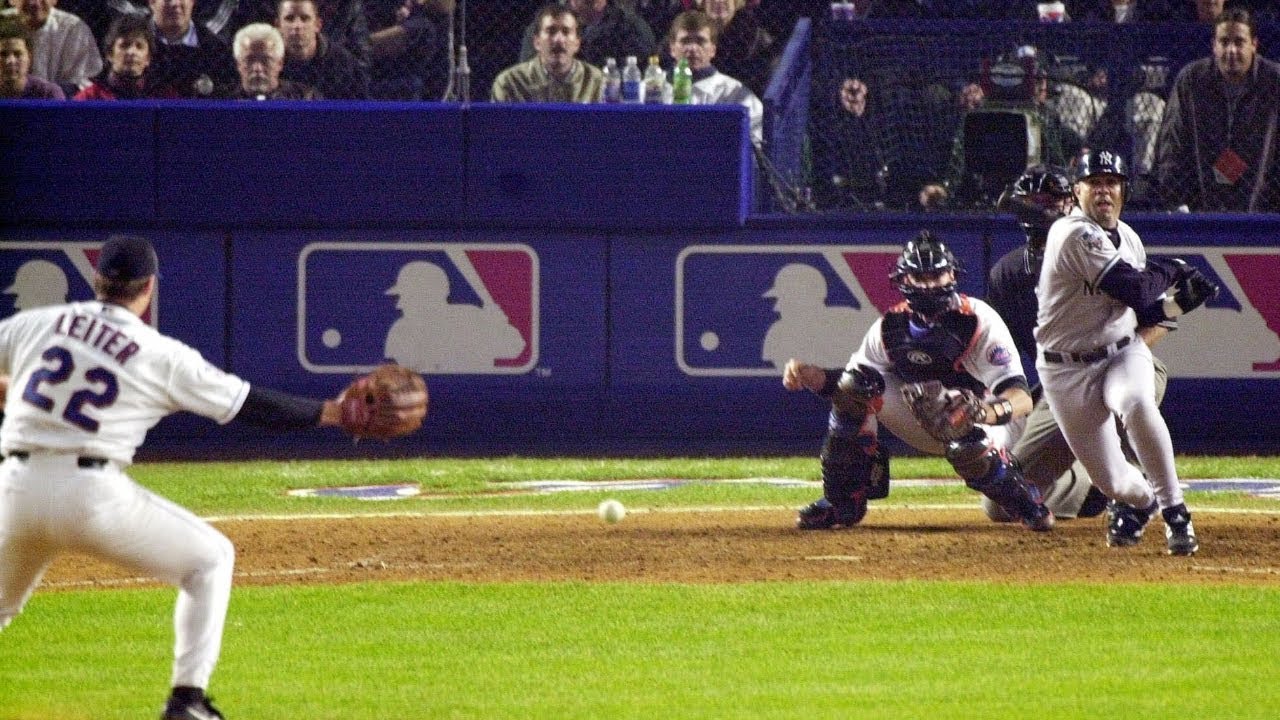
Manager Bobby Valentine brings in his closer. Unfortunately for him, it's Armando BenítezPaul O’Neill fouls off pitch after pitch, and finally draws the most clutch walk in baseball history. The Yankees bring him around to score on DH Chuck Knoblauch's sacrifice fly, and the game goes into extra innings.

It goes to the bottom of the 12th, and to 1:04 AM. With 1 out, Tino Martinez singles off Turk Wendell. Jorge Posada doubles, but Tino doesn't run well, and has to hold at 3rd. O'Neill is walked again, this time intentionally, to set up the double play. Luis Sojo pops up. And a Met castoff, José Vizcaino, playing 2nd base because Knoblauch is not fielding well, singles home the winning run.

José Vizcaino

Yankees 4, Mets 3. Essentially, the World Series that Met fans had waited their whole lives for has been decided in Game 1. Had the Mets won this game, the Series would have been very, very different.

Maybe the Yankees would have been shaken by the events of Game 1, and instead of just holding the Mets off in Game 2, 6-5, they would have fully blown that lead. The Mets won Game 3, and their idiot fans would have been thinking sweep.

Would the Yankees still have won Game 4? It was pretty shaky in the 5th inning. Would they still have won Game 5? It was tied in the 9th. Would they have won a Game 6? Would they have completed the ultimate comeback in Game 7, 4 years before the Red Sox did it to them?

*

October 22, 2000: Game 2 is one of the most bizarre contests in baseball history. It begins with Robert Merrill, the Brooklyn-born singer for the Metropolitan Opera Company whose recording of "The Star-Spangled Banner" had been the one the Yankees had used since 1967, singing it in person. (He died in 2004.) 

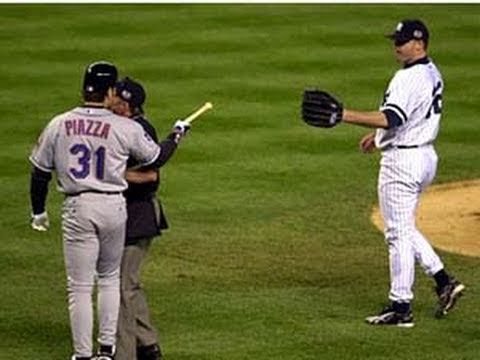
In the top of the 1st, with 2 out and a man on, Mike Piazza bats for the Mets against Roger Clemens of the Yankees. Piazza had hit some long home runs off Clemens, and in July, in an Interleague game also at Yankee Stadium, Clemens had nailed Piazza on the helmet with a fastball, giving him a concussion.

This time, Piazza hits a foul ball, and breaks his bat. The barrel of the bat comes back to Clemens, and... he throws the jagged-edged bat barrel across the 1st-base foul line. Right in Piazza's path, and Piazza almost steps into it.

We may never know what was going on in the head of the Rocket, but what's going on in the head of Piazza is rage. He thinks Clemens was throwing the sharp object at him. Piazza moves toward Clemens, and both benches empty. For one of the few times in his career, there's an on-field controversy with Clemens on the field, and Clemens is not the most insane man involved.
The umpires restore order, and Clemens finishes the at-bat by getting Piazza to ground to 2nd. He pitches 8 strong innings, and the Yankees pound Mike Hampton, and take a 6-0 lead into the 9th.

But the bullpen can't hold it, and the Mets come to within 6-5, including home runs by Piazza (the 1st-ever World Series homer for the alleged "greatest-hitting catcher ever") and Jay Payton, before Joe Torre has enough and brings in the Hammer of God, Mariano Rivera, to slam the door and keep it 6-5. The Yankees take a 2-games-to-0 lead in the Series, which now heads across town to Shea.

Clemens will be fined $50,000 for his what-the-hell moment. But Met fans have never gotten this into their thick skulls: Clemens was not throwing the bat at Piazza. If there's one thing that Roger Clemens made perfectly clear many times in his playing career, it's this: If he wants to throw something at someone with the intention of hitting him, that person will get hit. If he wanted to throw the bat at
Piazza, that bat would have hit Piazza.

And now, the question needs to be asked: Which of these men was on steroids, warping their perceptions of what was happening? Was it Clemens? Was it Piazza? Was it both? Until either man, or both men, decide to change their stories, we may never know for sure.

As it turned out, both men played their last game in 2007, meaning that both became eligible for the Baseball Hall of Fame in the election of January 2013. Piazza was elected in 2016. Clemens is still waiting. That did, however, avoid what would have been the most awkward induction ceremony in the Hall's history.

*

October 24, 2000: The World Series moves to Shea Stadium for Game 3. NSYNC sing the National Anthem. The Mets defeat the Yankees‚ 4-2‚ behind the pitching of Rick Reed and their bullpen. Benny Agbayani's 8th inning double is the key hit for the Mets as they cut the Yankees Series lead to 2-games-to-1.

Orlando "El Duque" Hernández strikes out 12, a Series record for a Yankee pitcher, but loses a postseason game for the 1st time after 8 wins. John Franco, the senior Met, is the winning pitcher.
Benítez, having blown Game 1, saves Game 3.

The loss ends the Yankees' record streak of 14 consecutive wins in World Series action. This would be the last World Series game won by the Mets until Game 3 in 2015.

*

October 25, 2000: Bobby Valentine chooses Bobby Jones as the Mets' Game 4 starter, and he's not especially good. However, the Yankees will have to choose between an aging and struggling David Cone, a struggling Denny Neagle, and Andy Pettitte on 3 days' rest.

This bodes well for the Mets, and if they win this one, then the Series is tied, and they've really got momentum. In Game 5, also at Shea, Al Leiter can outpitch Pettitte as he did in Game 1, and maybe this time the bullpen won't blow it; after all, after blowing the save in Game 1, Armando Benítez got it in Game 3.

Then the Mets only have to win 1 of 2 at Yankee Stadium to win the Subway Series, and reclaim New York from the Yankees. The Yanks will start Roger Clemens in Game 6, and after the bat-throwing incident in Game 2, the Mets will be loaded for bear, and Mike Hampton can't possibly have as bad a start in Game 6 as he had in Game 2, right? And if it still goes to Game 7, it'll be Rick Reed against Orlando Hernández again, and Reed showed in Game 3 he could outpitch "El Duque."

So, at this point, if you're a Met fan, you don't have a lot of reason to be confident of ultimate victory. But your position is quite defensible, your team is hardly in deep trouble following the Game 3 win, and, as the one man who has ever managed both these teams to Pennants, Yogi Berra, has said, "It ain't over 'til it's over." This World Series is far from over, and if you're a Met fan, at this point, you do have some reason to be optimistic.

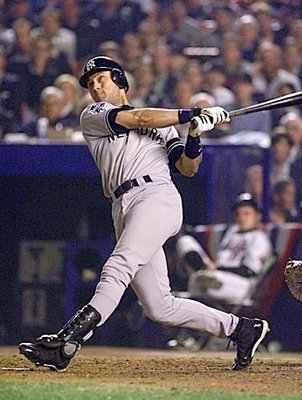
Sheryl Crow sings the National Anthem, Game 4 begins, and that reason lasts all of one pitch. The 1st pitch of the game is from Jones to Derek Jeter, who knocks it over the left-field fence for a home run. The kind of hit that, once he was named team Captain in 2003, earned him the nickname "Captain Clutch."
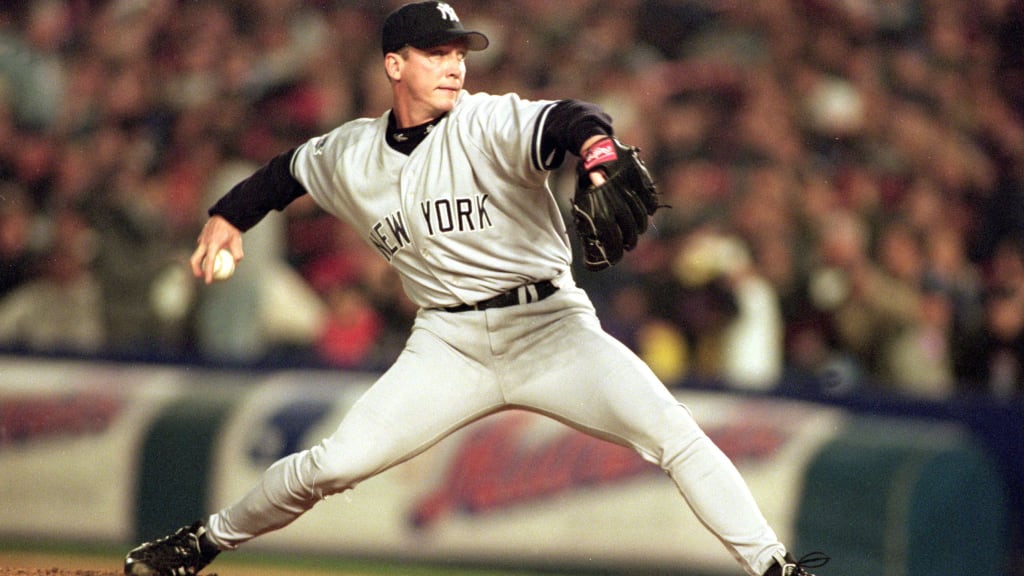
Neagle struggles in the 5th, and manager Joe Torre plays a huge hunch, bringing Cone, once a superb Met starter, out of the bullpen to face the dangerous Mike Piazza with the bases loaded. I have to admit, I was sure he was going to either walk a run home, or serve up a gopher ball for a grand slam.

Instead, Cone gets Piazza to pop up, ending the threat. Cone never throws another postseason pitch, and he never throws another pitch for the Yankees. But he got the job done. (Dwight Gooden, back with the Yankees, had appeared in the ALCS, but was left off the World Series roster, and got a nice hand at Shea went introduced. He then retired.)
David Cone

The Yankees hang on to win the game, 3-2, and take a 3 games to 1 lead in the Series. They can wrap it up tomorrow night. Met fans, who began the day feeling like it was still possible, are no longer using Tug McGraw’s old rallying cry of "Ya Gotta Believe!" Now, they're using another familiar rallying cry, that of "Yankees Suck!"

But all is not good news in Yankeeland. Darryl Strawberry, who was introduced to stardom and drug as a Met, and has been one of George Steinbrenner's reclamation projects, is arrested and jailed, after leaving a treatment center following a weekend drug binge.

*

October 26, 2000: The Euro, the currency of the European Union, which had started, on January 1, 1999, at $1.10 in comparison to the American dollar, drops to 83 cents. This remains its all-time low. Its all-time high is $1.60, achieved on July 15, 2008.

More importantly for me, on this day, Game 5 of the World Series is played at Shea Stadium. Marc Anthony, a New Yorker of Puerto Rican descent and a Met fan, sang the National Anthem. Jeter and Bernie Williams homer off Al Leiter. Pettitte and Leiter give it their all. The game is tied 2-2 in the top of the 9th. Two outs. Posada on 2nd, Scott Brosius on 1st. Not great speed on the basepaths. 

Luis Sojo, playing 2nd base because Knoblauch's fielding difficulties limited him to DH status, is coming up to bat. Leiter had thrown 141 pitches. A number that would not have caused Catfish Hunter and Tom Seaver to flinch, but by the standards of the 1990s and 2000s, a lot.

Met Manager Bobby Valentine's choices are not good:

* A: Stick with an exhausted Leiter. He would be pitching on brains, courage and fumes, and pray that he gets the out that sends it to the bottom of the 9th still tied.
* B: Put in Armando Benítez. He led the National League in saves that year and saved Game 3, but also blew Game 1 for Leiter, and also blew a Division Series game against the Giants (which the Mets ended up winning anyway), and had previously messed up 2 ALCS games against the Yankees for the Orioles (including the Jeffrey Maier Game). Or...
* C: Put in John Franco. He was the winning pitcher in Game 3, and also pitched well in Game 4, but would be pitching for the 3rd day in a row. And he was 39: There was a reason Valentine had taken the closer's job from Franco and given it to Benítez.

Valentine decided a tired Leiter was better than an aging, potentially tired Franco or an inconsistent, unreliable Benítez. Although I frequently accused Valentine of overmanaging, and sometimes outright stupidity, I can't fault him for this choice. If he had put in the very popular New York native Franco and lost anyway, he might have gotten away with it. But if he had put in the already suspicious Benítez and he blew yet another game, Valentine would have been run out of Flushing on the Long Island Railroad.


Leiter throws his 142nd pitch to Sojo. He knocks it up the middle. A Met fan once told me that Rey
Ordóñez would have stopped this grounder. This Met fan was a fool: Ordóñez would not have gotten it. Mike Bordick was the shortstop that night, and he was a good shortstop, and he couldn't quite get it.
Base hit for Sojo. Posada comes around 3rd. Center fielder Jay Payton's throw... never makes it to Mike Piazza at the plate, instead hitting Posada in the back and getting away, toward the backstop. This enables not only Posada to score the tiebreaking run, but also Brosius to score an insurance run as well. Yankees 4, Mets 2.
Bottom of the 9th. Two out. The Mets get a man on. Piazza comes up to the plate. If you're a Met fan, this is the man you want up: The best offensive player the Mets have ever had (cough-steroids-cough), one of the best fastball hitters of his time, power hitter against power pitcher, Mariano Rivera.

But if you're a Yankee Fan, there’s no one you'd rather have on the mound, and there's no one you’d rather get as the final out. It was similar to the final matchup of the 1978 Boston Tie Party, with Carl Yastrzemski, one of the greatest fastball hitters ever, and the most beloved player in his franchise's history (remember, Sox fans didn't always love Ted Williams), coming up to try to save his club against one of the fastest and most fearsome pitchers ever, Rich "Goose" Gossage.

Yaz popped up to end that game in victory for the Yankees; 22 years later, Piazza gets considerably better wood on his pitch, and hits one deep to straightaway center field.

For a moment, many of us, including myself -- and, years later, on the YES Network broadcast of a Yanks-Mets regular-season game, the entire announcing team of Michael Kay, Paul O'Neill and David Cone -- think, "Uh-oh!" Translation, at least in my case: "No! Tie game! The Mets will go on to win it, and take the next 2 in The Bronx, and the Yanks will have choked it away!"

Because we had grown up with the Mets as the team that won and the Yanks as the team that fell short. We had the arrogance of Yankee Fans of old, but deep down, in places we don't like to talk about at parties, we had the fears that came so easily to fans of the team then known as the Cleveland Indians, the pre-2004 Red Sox, the pre-2007 Phillies, the pre-2016 Cubs -- and the post-2006 Mets.

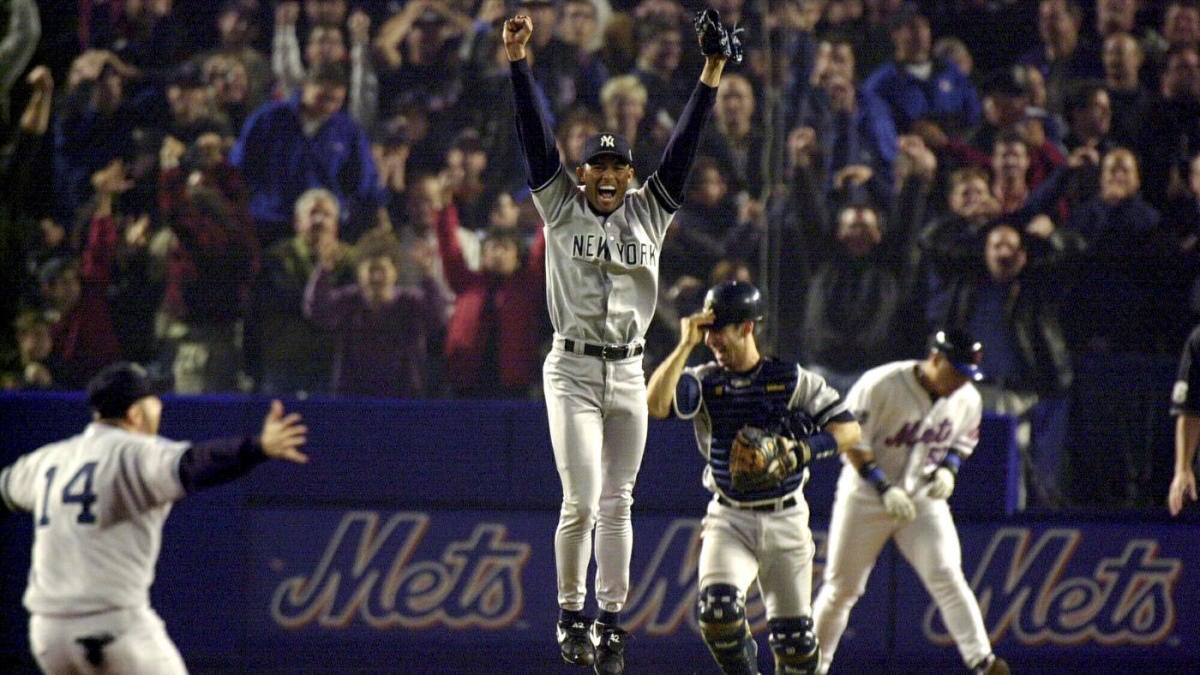
But Piazza had juuuust gotten under it. The ball has too much height and not enough distance. As the clock strikes 12:00 Midnight, Bernie stands on the warning track, settles under it, makes the easy catch, and it's over.
Jeter becomes the 1st player ever to be named Most Valuable Player of the All-Star Game and the World Series in the same season. Still, he would never be named MVP of a regular season. At the site of his 1st game as a manager, 23 years earlier, Torre is picked up by his grateful players, and carried off the field.
There were 25,000 people at Shea chanting "Let's Go Yankees!" and "We're Number 1!" Eventually, the owner came out to talk to the press, and he and the announcers couldn't talk, because the Yankee Fans were so loud, chanting "Thank you, George!" Imagine that, thousands of people saluting George Steinbrenner at Shea Stadium.

I loved it. October 26, 2000 – actually, the final out came just before Midnight, so it was really October 27 that we celebrated – remains my favorite moment as a sports fan.

For the 1st time, the Mets had the chance -- their first, their best, maybe their last -- to beat the Yankees in a Subway Series, and to irrevocably "take over New York." And while they had their chances and fought hard, in the end, the better team won.

The Yankees have beaten the Mets in a World Series. The other way around has never happened. And it never will. Never, never, never. Or, in the words of Flushing's own Fran Drescher, "It begins with an N and ends with an A: Nev-a."

This was the 26th World Championship. And for those of us who grew up as Yankee Fans during the Mets' "glory" years of 1984 to 1990, the Dynasty That Never Was -- or, as Michael Wilbon of The Washington Post and ESPN's Pardon the Interruption would say, a Dynasty of One -- and had to deal with the unearned arrogance of Met fans, delusional that their 2 titles outweighed our 22 (until 1996; now 27), damn fools to believe that the 1986 Mets could have beaten the Yankees of 1927, 1938, 1941, 1953, 1961 and 1978, and eventually even the 1998 juggernaut... for us, this was the greatest, sweetest moment of them all.

We beat the Mets. And it wasn't close. All 5 games were close, so it wasn't domination. But winning in 5 games is definitive, beyond any question. And we clinched at their place, on their field, at the William A. Shea International Airport, at the Flushing Toilet.


After all, we could have had worse luck, and it would have been all our own fault. We could have chosen to be Met fans. We chose Yankees. We chose greatness. Or, to put it another way: No matter how bad the 2004 ALCS was, losing the 2000 World Series to the Mets would have been 10 times worse.

As we saw in 2015, we don't have to live around very many Red Sox fans with their cheated-for arrogance, but we do have to live around Met fans with their unearned arrogance.

How arrogant are Met fans? Some insist that 2000 and the other World Series the Yankees have won since 1978 don't count, because they used steroids; therefore, the count since 1986 is 1 to 0, and the count since 1962 is 2-2. These fans are idiots: We have more evidence against the 2000 Mets (Piazza) than we do against the 1996-2009 Yankees. So if 1996, 1998, 1999, 2000 and 2009 don't count for the Yankees, then 2000 doesn't count for the Mets, either.

For the moment, the count remains 27 to 2, and 5 to 0 since 1986.

This was the 13th World Series game played at Shea. An unlucky 13th. It was also the last, which no one (not even a wiseass Yankee Fan like me) could have predicted at the time.

I once saw a Met fan with a cap that had the 2000 World Series logo on the side, but razored off, with some of the stitching still visible. That's how much it bothers them. It should bother them: It basically erased their team's reason to exist.

As we've seen, the Yankees are (depending on your point of view: again, or still) the better team now. And let us not pretend that any Met World Series win -- be it 1969, 1986, or any future win -- is better than all of the Yankees' World Series wins.

Most of all, winning the 2000 World Series means that, as Paul Louis, a Yankee Fan and a Facebook Friend who was my age, said at the time, "The Yankees have scoreboard over the Mets for all time."

For all time.

*

October 26, 2000 was a Thursday. There was 1 college football game played that night: Brigham Young University beat Wyoming, 19-7 at Cougar Stadium in Provo, Utah. At the end of the season, BYU head coach LaVell Edwards retired after 19 Conference Championships and the 1984 National Championship, and the school renamed the facility LaVell Edwards Stadium.

The NBA season started 5 days later, on Halloween. There were 4 games in the NHL:

* The New York Rangers lost to the Philadelphia Flyers, 3-0 at the First Union Center (now the Xfinity Mobile Arena) in Philadelphia.

* The Boston Bruins beat the Washington Capitals, 4-1 at the FleetCenter (now the TD Garden) in Boston.

* The Colorado Avalanche beat the Chicago Blackhawks, 2-0 at the United Center in Chicago.

* And the St. Louis Blues beat the Calgary Flames, 4-3 at the Savvis Center (now the Enterprise Center) in St. Louis.

Tuesday, October 25, 2022

October 25, 1986: The Bill Buckner Game

October 25, 1986: Dave Henderson steps to the plate at 11:59 PM, and hits a home run off Rick Aguilera, to give the Boston Red Sox a 4-3 lead over the New York Mets in the top of the 10th inning of Game 6 of the World Series.

By the time he crosses the plate, it's 12:00 midnight, October 26. The Red Sox will extend their lead to 5-3 before their half of the inning is over. All they need now is 3 more outs in the bottom of the 10th.

They get the 1st 2. You know the rest. But do you really remember? Red Sox pitcher Calvin Schiraldi, an ex-Met, allows a single to Gary Carter. Then he allows a single to Kevin Mitchell. Carter to 2nd. Then he allows a single to Ray Knight. Carter scores, Mitchell to 2nd, 5-4 Red Sox. Then Sox manager John McNamara pulls Schiraldi, and calls on Bob Stanley, once a very good reliever, but by this point in his career a lost cause.

Stanley faces William Hayward "Mookie" Wilson, and gets to 2 strikes. There were 13 separate pitches that could have ended this game in victory and a 1st World Championship in 68 years for the Red Sox. The 13th of these almost hits Mookie in the ankle. He jumps out of the way, and it rolls to the backstop. Wild pitch. Mitchell scores, Knight to 2nd, 5-5 tie.

For the Mets and their fans, Christmas had come 2 months early: The Red Sox had given them the game. They had royally blown it. According to Dan Shaughnessy, the Boston Globe columnist, in his book The Curse of the Bambino, somebody later calculated that the odds of the Red Sox blowing a 2-run, 2-out, 2-strike lead at that point were 320-1.

Three hundred and twenty to one. Think about that for a moment: A baseball regular season lasts 162 games. So if you had those conditions every single game -- 2 outs, 2 strikes on the batter, and you're up by 2 runs in the bottom of the 9th inning, or later -- the odds are that you would win every single game in a season, and nearly every single game in a 2nd season, up to Game 158 of that 2nd season, before you would lose one.

Another source said that the Mets' chances of winning the World Series were:

* 5 percent when the bottom of the 10th began;
* 0.8 percent when they were down to their last strike
* 2 percent after Carter's single;
* 5 percent after Mitchell's single;
* 11 percent after Knight singled home Carter;
* and 35 percent after Stanley's wild pitch tied the game.

In other words, even after the lead was fully blown and the game was tied, there was still a better than 2-to-1 chance that the Red Sox would win the World Series.

Well, some teams have meltdowns that last 2 months, like the 1978 Red Sox, the 1969 Cubs, and the 1995 California Angels. Some teams have meltdowns that last 1 month, like the 2011 Red Sox, the 2007 Mets and the 1951 Dodgers. Some teams have meltdowns that last 2 weeks, like the 1964 Philadelphia Phillies. Some teams have meltdowns that last 1 week, like the 1987 Toronto Blue Jays. Some teams have meltdowns that last less than a week, like the 2004 and 2012 Yankees. The 1986 Red Sox had a meltdown that lasted 10 minutes.

You'll notice that there's a name I haven't mentioned yet: That of Red Sox 1st baseman Bill Buckner. The Red Sox had already blown a lead that is the closest any team, in any of the 4 major league sports, had ever been to winning a World Championship without actually getting it. Even the Bayern Munich soccer team that allowed goals in the 91st minute to Teddy Sheringham and in the 93rd to Ole Gunnar Solskjær to blow the 1999 UEFA Champions League Final didn't come that close to winning before losing.

The Sox had blown what should have been an insurmountable lead, and Bill Buckner had absolutely nothing to do with it.

Then Stanley threw Mookie another pitch. It was, as Los Angeles Dodger broadcaster Vin Scully, leading the broadcast team for NBC, described, a "little roller up along first." It remains the most famous defensive miscue in the history of sports, over Fred Snodgrass' 1912 "$30,000 Muff," over Mickey Owen's 1941 passed ball, over any missed tackle in football, over any goalie's mistake in hockey or soccer, over any hockey or soccer player's own goal.

Buckner had injuries on both legs, and, as Yogi Berra might have said, even when he could run, he couldn't run. He was not going to beat Mookie to the bag, and Stanley hadn't run over to 1st to cover the base and take a throw. Mookie would have made it to 1st, and the bases would have been loaded. Granted, the next batter was light-hitting shortstop Rafael Santana, but, at that point, no one would have bet against the Mets. Scully was right: "If one picture is worth a thousand words, we have seen about a million words tonight!"

In spite of how much many Yankee Fans already hated them, it would take the Nomar/Pedro/Papi Era, 1998 to the present, for the Red Sox to truly become The Scum. But, retroactively, they deserved The Buckner Game.

In 1975, the Red Sox won a World Series Game 6 that was a game for the ages. But for 36 years now, you can say the words "Game Six" in New England, or to a New Englander wherever he might be, and, instead of bringing a smile to his face, you would bring him to say, "Which one?"

At least now, with his death in 2019, Buckner will never have to face any more questions about it.

In 2010, the MLB Network listed this game at 3rd on their list of MLB's 20 Greatest Games -- limited in scope, due to the availability of surviving videotape, to 1975 onward.

*

October 25, 1986 was a Saturday. It was a college football gameday. These notable games were played:

* Number 6 Penn State beat Number 2 Alabama, 23-3 at Bryant-Denny Stadium in Tuscaloosa, Alabama. The Nittany Lions went undefeated, and were Number 2 going into the Fiesta Bowl to play Number 1 Miami, who were idle on October 25. Penn State beat Miami to finish Number 1 in the final poll, relegating Miami to Number 2.

* Number 3 Nebraska lost to Colorado, 20-10 at Folsom Field in Boulder, Colorado. They finished at Number 5.

* Number 4 Michigan beat Indiana, 38-14 at Memorial Stadium in Bloomington, Indiana. Despite a stumble at home to Minnesota, they won the Big Ten Conference by beating Ohio State in Columbus, before losing the Rose Bowl to Arizona State, finishing at Number 8.

* Number 5 Oklahoma beat Iowa State, 38-0 at Cyclone Stadium (later Jack Trice Stadium) in Ames, Iowa. They would go on to win the Big Eight Conference and the Orange Bowl, and finish at Number 3.

* Number 9 Arizona State beat Number 15 USC, 29-20 at the Los Angeles Coliseum. They would go on to win the Pacific-Ten Conference and the Rose Bowl, and finish at Number 4.

* Number 10 Texas A&M beat Rice University, 45-10 at Kyle Field in College Station, Texas. They would go on to win the Southwest Conference, but lose the Cotton Bowl to Ohio State, finishing at Number 13.

* Number 12 Louisiana State beat North Carolina, 30-3 at Tiger Stadium in Baton Rouge, Louisiana. LSU would go on to win the Southeastern Conference, but lose the Sugar Bowl to Nebraska, finishing at Number 10.

* Notre Dame was not scheduled.

* Rutgers beat Army, 35-7 at the old Rutgers Stadium in Piscataway, New Jersey.

* And Princeton beat Harvard, 14-3 at Palmer Stadium in Princeton, New Jersey.

The NBA season wouldn't open for another 6 days. But there were 7 NHL games, including all 3 New York Tri-State Area teams being in action:

* The New Jersey Devils lost to the Washington Capitals, 2-1 at the Capital Centre in the Washington suburb of Landover, Maryland. Pat Verbeek scored a power-play goal in the last minute of the 1st period, but Bobby Gould scored in the 2nd and Larry Murphy in the 3rd, to give the Caps the win. Scott Stevens, then just 22 years old, assisted on Gould's goal.

* The New York Rangers played the Montreal Canadiens to a tie, 3-3 at the Montreal Forum.

* The New York Islanders beat the Los Angeles Kings, 4-3 at the Nassau Coliseum. Brent Sutter scored the winner, 1:44 into the 2nd period.

* The Quebec Nordiques beat the Toronto Maple Leafs, 4-3 at the Colisee de Quebec.

* The Hartford Whalers beat the Buffalo Sabres, 3-2 at the Hartford Civic Center (now the PeoplesBank Arena).

* The Pittsburgh Penguins beat the Philadelphia Flyers, 4-2 at the Civic Arena in Pittsburgh.

* And the Detroit Red Wings beat the St. Louis Blues, 3-1 at the St. Louis Arena.

At the time, I was a senior in at East Brunswick High School in Middlesex County, New Jersey. On this day, our football team lost a game it should have won, 20-17 to Perth Amboy, at Albert G. Waters Stadium in Perth Amboy. I say, "should have won," not just because our team had more talent, but because the officiating was atrocious, especially in regard to not getting pass interference calls we should have gotten.

The English soccer team I would one day support, Arsenal, beat Chelsea 3-1 at Highbury in North London.

December 31, 1999 & January 1, 2000: The Millennium

December 31, 1999:  The Millennium arrives. The people of planet Earth survived. At a terrible cost. But we hadn't destroyed ourselves. ...