Showing posts with label battle of iwo jima. Show all posts

Wednesday, December 14, 2022

December 14, 1949: “Sands of Iwo Jima” Premieres

December 14, 1949: Sands of Iwo Jima premieres, cementing John Wayne as the toughest guy the U.S. Marine Corps never actually had.

It uses footage from an earlier documentary about the battle, which ran from February 19 to March 26, 1945, and re-enacts the famous flag-raising of February 23. The 3 men then believed to be the survivors among the 6 actual flag-raisers – Rene Gagnon, Ira Hayes and John Bradley – appear as extras. (Michael Strank, Harlon Block and Franklin Sousley never made it off the island alive. Harold Schultz, misidentified as Bradley, was, ironically, the last survivor, living just past the 50th Anniversary, in 1995.)

Wayne's starring role in this film, as Sergeant John M. Stryker, indelibly linked him with the U.S. military effort in World War II, and with the Marines in particular, even though he hadn't served in the war: He was classified 3-A, meaning he had a deferment as his family's sole means of support. In the Vietnam War era, Wayne despised draft dodgers, but while he didn't serve himself, it should be noted that he did not dodge: He simply wasn't drafted.

In spite of all the characters killed, including Stryker -- usually the hero, Wayne rarely died in his films -- Sands of Iwo Jima became the greatest propaganda the Marine Corps had ever had, at least until the 1970s, when they began filming recruitment commercials: "Maybe you can be one of us: The few, the proud, the Marines."

*

December 14, 1949 was a Thursday. Bill Buckner was born.

Baseball was out of season. Football's regular season was over, with only the college bowl games and the NFL Championship Game (which the Philadelphia Eagles won over the Los Angeles Rams) remaining. There were 5 games played in the NBA:

* The New York Knicks beat the Minneapolis Lakers, 94-84 at the old Madison Square Garden. Carl Braun led the Knicks with 26 points. Braun's contribution to NBA lore is that, when practicing free throws, if one went through, hitting "nothing but net," he would imitate the sound it made, saying, "Swish!" Knicks broadcaster Marty Glickman picked it up, and popularized it. For a later generation, New York sportscaster Warner Wolf used it.

For the defending, and soon to be again, Champion Lakers, George Mikan scored 38 points, but no other player scored more than 8. The Lakers moved to Los Angeles in 1960.

* The Washington Capitols beat the St. Louis Bombers, 79-61 at the Uline Arena (later the Washington Coliseum). The Bombers folded at the end of this 1949-50 season, while the Caps lasted 1 more season.

* The Syracuse Nationals beat the Fort Wayne Pistons, 96-83 at the State Fair Coliseum in Syracuse, New York. The Pistons moved to Detroit in 1957, and the Nats became the Philadelphia 76ers in 1963.

* The Tri-Cities Blackhawks beat the Chicago Stags, 73-68 at the Wharton Field House in Moline, Illinois. The Stags folded at the end of the 1949-50 season.

Moline and Rock Island, Illinois, formerly the home of a charter NFL franchise, the Rock Island Independents, and Davenport, Iowa, right across the Mississippi River, had called themselves the "Tri-Cities" since World War I.

In the 1930s, East Moline, Illinois had grown to the point that the term "Quad Cities" began to be used, but it wasn't fully accepted. In 1948, Alcoa opened a plant in Bettendorf, Iowa, and the city grew to the point where the term "Quint Cities" began to be used. That didn't catch on, but Bettendorf could no longer be ignored, so Moline, Rock Island, Davenport and Bettendorf are the "Quad Cities."

In 1951, the Blackhawks moved, becoming the Milwaukee Hawks. They moved again, becoming the St. Louis Hawks in 1955, and the Atlanta Hawks in 1968. Today, the Quad Cities metropolitan area is home to about 475,000 people, much too small for a major league sports franchise.

The Quad Cities River Bandits are a Class A baseball team (3 steps below the major leagues) playing in Davenport, and the Quad City Thunder were a minor-league basketball team, playing at the Blackhawks' old venue, the Wharton Field House, which still stands.

* And the Philadelphia Warriors beat the Waterloo Hawks, 73-70 at the McElroy Auditorium in Waterloo, Iowa. The Hawks -- not to be confused with the Blackhawks-turned-Hawks -- folded in 1951, and remain the only major league sports team Iowa have ever had. The Warriors moved to San Francisco in 1962, taking on the name "Golden State Warriors" in 1971.

And the NHL's entire "Original Six" were in action:

* The New York Rangers lost to the Chicago Black Hawks, 5-3 at the Chicago Stadium.

* The Detroit Red Wings beat the Boston Bruins, 5-2 at the Boston Garden.

* And the Montreal Canadiens and the Toronto Maple Leafs played to a tie, 2-2 at Maple Leaf Gardens in Toronto.

Wednesday, February 23, 2022

February 23, 1945: The Flag Raising On Iwo Jima

February 23, 1945: Six U.S. Marines raise a flag at the peak of Mount Suribachi, the highest point on the formerly Japanese-held island of Iwo Jima. It is photographed by Joe Rosenthal, and becomes the most famous photograph of World War II.

In the "Pacific Theater" of World War II, U.S. troops had been "island hopping," getting an island closer to the Japanese "home islands," an island closer, an island closer. Iwo Jima, which has an airstrip, is 8.1 square miles, 750 miles southeast of the capital of Tokyo. Still a little too far to launch an aerial attack. But it was still one step closer, and it was also being used as an early warning station for the home islands: If the U.S. could take it, it would eliminate that warning ability. So it was still a viable target.

The Japanese Empire forcibly evacuated all civilians the year before, and, ever since, the island has been home only to military personnel stationed there. Officially, it is governed through the Tokyo Prefecture, Japan's equivalent of what Americans call a State.

The Imperial Japanese Army (IJA) positions on the island were heavily fortified, with a dense network of bunkers, hidden artillery positions, and 11 miles of tunnels. The American ground forces were supported by extensive naval artillery, and had complete air supremacy provided by U.S. Navy and Marine Corps aviators throughout the battle. The five-week battle saw some of the fiercest and bloodiest fighting of the Pacific phase of The War. (As my grandmother, who lived through it, reminded me: Always, Capital T, Capital W.)

The battle began on February 19. Four days later, the Marines had fought their way to the top of Mount Suribachi. A 54-by-28-inch flag -- 4-foot-6 by 2-foot-8 -- was attached to an iron water pipe they'd found, and was planted at 10:30 AM local time.

But Colonel Chandler Johnson decided that the flag wasn't big enough to be seen by all the troops on the island -- on both sides. He wanted a bigger one. He wanted the Japanese soldiers to see it, as a blow to their morale. One was found from a nearby ship: 96-by-56-inch, or 8-foot-even by 4-foot-8, taller than the first flag was long.

Six men raised it. From left to right in the photo, they were:

* Private 1st Class Ira Hayes, 22, a member of the Gila River tribe, from Sacaton, Arizona.

* Private 1st Class Harold Schultz, 20, from Detroit.

* Sergeant Michael Strank, 24, born in what is now Jarabina, Slovakia, and raised in Franklin, in Western Pennsylvania.

* Private 1st Class Franklin Sousley, 19, from Hill Top, Kentucky.

* Private 1st Class Harold Keller, 23, from Brooklyn, Iowa. And...

* Corporal Harlon Block, 20, from Weslaco, Texas.

Corporal René Gagnon was one of the men who carried the flag up to Mount Suribachi. He was long believed to be one of the men in the photograph. In 2019, an investigation revealed that the raiser previously thought to be Gagnon was actually Keller. And Navy Pharmacist's Mate Second Class John Bradley was another misidentified as one of the flag-raisers. In 2016, the figure thought to be Bradley was determined to be Sousley.

In addition to the photo by Rosenthal, a 33-year-old native of Washington, D.C., working for the Associated Press, a color film of the raising was made by Marine Sergeant Bill Genaust, 38, from Minneapolis.

Bill Genaust

But the battle was not over. Indeed, of the 6 men who raised the flag, 3 did not make it off the island alive: Strank was hit, probably by "friendly fire," an American artillery shell, on March 1; Block was killed by an enemy mortar shell later that same day; Genaust was killed 2 days later, trying to flush some enemy soldiers out of a cave; and Sousley was shot in the back by a Japanese sniper on March 21.

Michael Strank

When the Japanese finally surrendered on March 26, only 216 of the 21,000 men they started with had lived long enough to be taken prisoner. Of the 110,000 Americans to take part in the battle, 6,762 died -- more in 1 month on this one small island than died in the entire 8 years of the Iraq War.

Harlon Block

The next step was Okinawa, which was even bloodier. That was supposed to be the final stop before the invasion of the home islands, which might have been the deadliest battle in human history. It was prevented by the atomic bombs on Hiroshima and Nagasaki, and Japan's subsequent surrender.

Franklin Sousley

Rosenthal's photo of the 2nd flag raising was published 2 days later, and became one of the iconic images in the history of warfare. It was used as the basis for the Marine Corps National Memorial, erected at Arlington National Cemetery in 1954.

In 1949, John Wayne made the film Sands of Iwo Jima, indelibly linking him with the U.S. military effort in World War II, and with the Marines in particular, even though he hadn't served in the war: He was classified 3-A, meaning he had a deferment as his family's sole means of support.

In the Vietnam War era, Wayne despised draft dodgers, but while he didn't serve himself, it should be noted that he did not dodge: He simply wasn't drafted, with what the Army thought was a good reason. Hayes, Gagnon and Bradley, then believed to be the 3 flag-raisers who survived the battle, were among the veterans who were cast as witnesses to the film's version of the flag-raising.

Ira Hayes

Hayes suffered from what was then called "shell shock" or "battle fatigue," what's now known as "post-traumatic stress disorder." He dealt with it by drinking, and a night of excess killed him in 1955, only 32 years old. In 1965, as part of a concept album of songs about Native Americans, Johnny Cash sang "The Ballad of Ira Hayes."

Keller became a fireman in his Iowa hometown, and died of a heart attack in 1979.

Harold Keller

Gagnon, who knew he wasn't one of the six flag-raisers, and never claimed he was one, became a travel agent in his native New Hampshire, and also died of a heart attack in 1979. Bradley, who admitted he had little to do with the flag-raising, also suffered from PTSD, became a mortician, and lived until 1994. Schultz moved to Los Angeles and became a postal worker. He was the last survivor of the six, falling victim to a heart attack on May 16, 1995, having lived just long enough to see the 50th Anniversaries of the flag-raising, and of V-E Day, though not of V-J Day.

Harold Schultz

Rosenthal outlived them all, dying in 2006, at the age of 94.

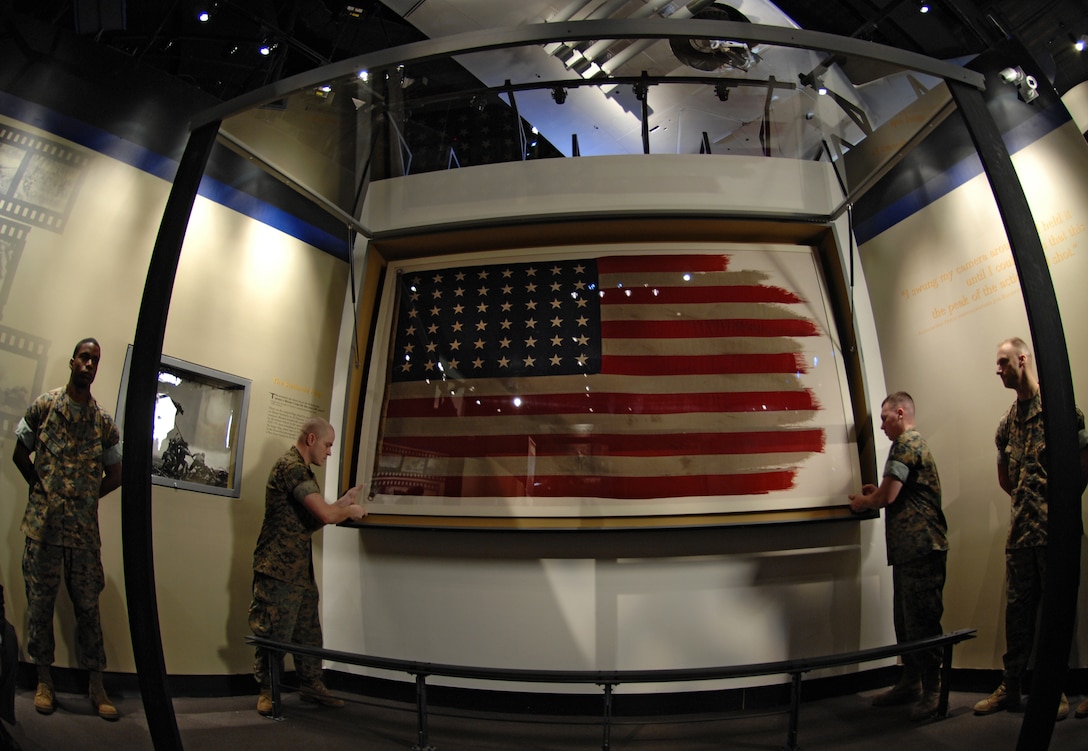
The U.S. kept control of Iwo Jima until 1968, at which point it returned control of the island to Japan. The 48-star, 13-stripe flag from the photo has been on display in the National Museum of the U.S. Marine Corps in Quantico, Virginia since 2006.
It's probably the most famous flag in the world, of any kind, along with the Fort McHenry flag that became immortalized in "The Star-Spangled Banner," on September 14, 1814 in Baltimore. Since 1964, the 15-star, 15-stripe Fort McHenry flag, which had long since been reduced by souvenir-hunters from its original size of 30 by 42 feet (now 30 by 34), has been on display at the National Museum of American History, part of the Smithsonian Institution, on the National Mall in Washington.
The Fort McHenry Flag

*

February 23, 1945 was a Friday. This was also the day of another act of American heroism in the Pacific Theater of World War II, the Raid on Los Baños. I have a separate entry for that event.

Baseball and football were out of season. The NBA hadn't been founded yet. And there were no games scheduled in the NHL. So there were no scores on this historic day -- except for the one that truly matters: Freedom 1, Tyranny 0.

December 31, 1999 & January 1, 2000: The Millennium

December 31, 1999:  The Millennium arrives. The people of planet Earth survived. At a terrible cost. But we hadn't destroyed ourselves. ...