Showing posts with label chiang kai-shek. Show all posts

Tuesday, October 18, 2022

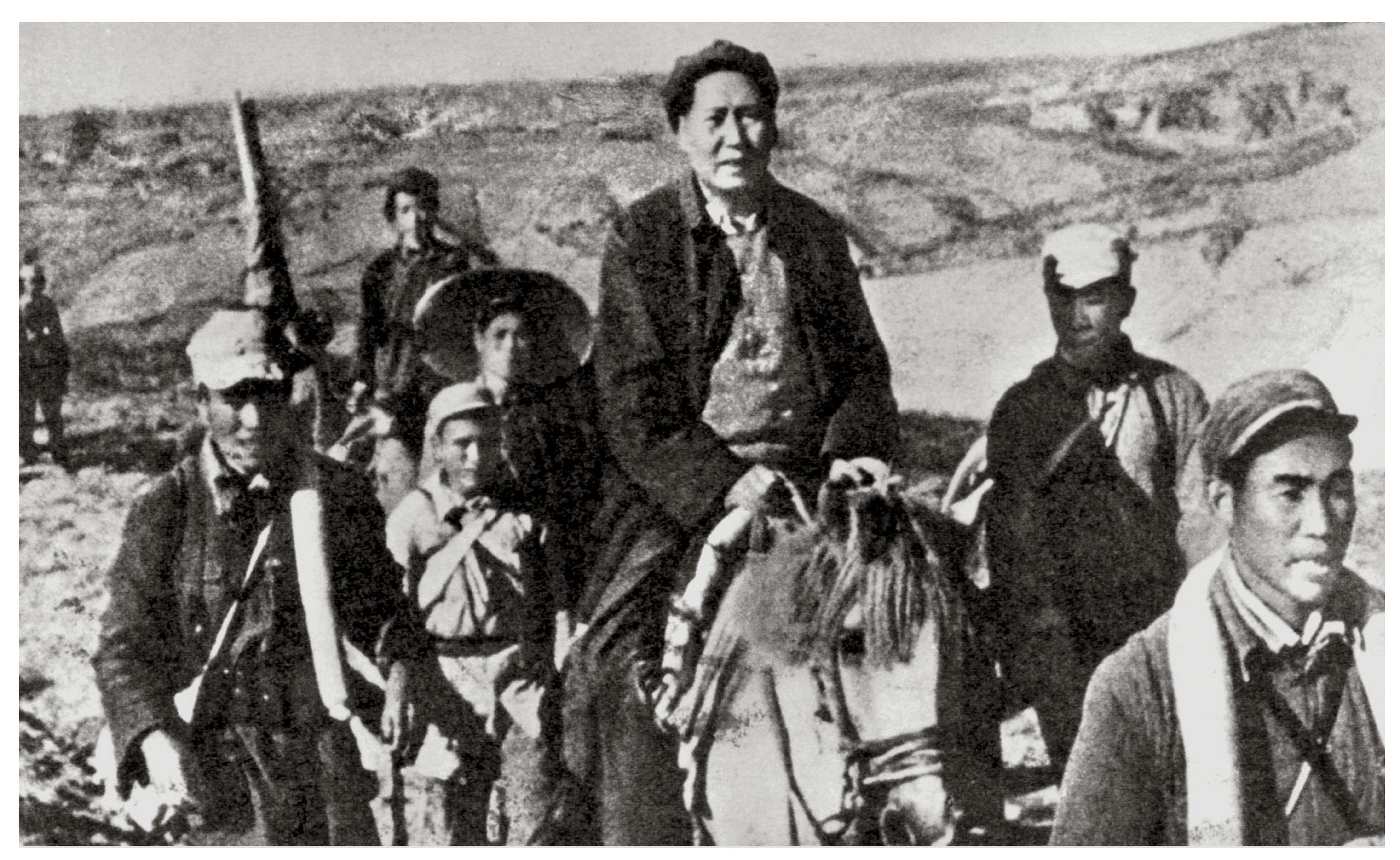
October 19, 1935: Mao Zedong's Long March

October 19, 1935: Mao Zedong's troops unite, ending their "Long March." It had lasted over a year.

The Long March was a military retreat during the Chinese Civil War, undertaken by the Communist Red Army, in order to evade continuous pursuit by advancing Nationalist forces. Several different Red Army forces took different routes from different Chinese Communist Party (CCP) strongholds being encircled by the Kuotmintang (KMT) National Revolutionary Army, with their concurrent retreats taking place over more than a year, traveling thousands of miles through western and central China, in order to convene at the new Communist base of operations in Yan'an, located in the northwestern province of Shaanxi.

The most famous of these marches was undertaken by the First Red Army, under Mao himself: Departing from their headquarters in the southern province of Jiangxi on October 16, 1934, the First Army marched over 5,600 miles in a large clockwise arc through the western frontiers of the country, ultimately meeting with Communist forces in Yan'an on October 19, 1935.

The circuitous route required the First Army to pass through some of the most difficult terrain in the country while avoiding destruction by the Nationalists: At first, the NRA under Chiang Kai-Shek, and later by local cliques of Nationalist-aligned warlords. Ultimately, fewer than 8,000 people traveling with the First Red Army would survive the march, out of a force of more than 65,000 that had set out the year prior. It was an attrition rate more devastating than Napoleon Bonaparte's retreat from Moscow in 1812. Over the following year, the Second and Fourth Red Armies would continue to navigate and face resistance, with the meeting of the three armies in Yan'an only taking place on October 22, 1936.

Upon arrival, the leadership that Mao, 40 years old when the March began, had demonstrated during the retreat, with the troops seeing that he had shared their suffering, afforded him immense prestige and support among many within the otherwise-shattered Communist Party.

The March would achieve mythical status in China and throughout the world as one of the most famous events of the war, for its immense hardship and implausible perseverance in the face of what appeared to be near-certain annihilation. It ultimately marked the beginning of Mao's long ascent to primacy within the CCP, and would be featured heavily in his public image, through the founding of the People's Republic in 1949.

*

October 19, 1935 was a Saturday. Baseball season had ended 12 days earlier, when the Detroit Tigers beat the Chicago Cubs in the World Series. The NBA had not been founded yet. The NHL season didn't start for another 19 days. But there were college football games, including these:

* Minnesota beat Tulane, 20-0 at Memorial Stadium in Minneapolis. Minnesota went 8-0, and won the Big Ten Conference title. They did not however, go to a bowl game. Then again, bowl games were still a new thing: The Orange and Sugar Bowls were in only their 2nd season, and the Cotton Bowl did not debut until the following season.

* Louisiana State University beat Arkansas, 13-7 at State Fair Stadium (now Independence Stadium) in Shreveport, Louisiana. LSU went on to win the Southeastern Conference title.

* Nebraska and Kansas State played to a tie, 0-0 at Memorial Stadium in Manhattan, Kansas. Not to be confused with many other Memorial Stadiums, including Nebraska's own, KSU's version would be replaced in 1968 by what's now known as Bill Snyder Family Stadium, although it is still used. In spite of this tie, Nebraska went on to win the Big Six Conference title.

* UCLA beat Stanford, 7-6 at Stanford Stadium in the San Francisco suburb of Palo Alto, California. This was the only game Stanford lost that season, as they won the Pacific Coast Conference title.

* Southern Methodist University beat Rice University, 10-0 at Ownby Stadium in Dallas.

* Texas Christian University beat Texas A&M, 19-14 at Amon G. Carter Stadium in Fort Worth, Texas. TCU lost to their Dallas arch-rivals, Southern Methodist University, thus losing the Southwest Conference title to SMU. But TCU were invited to play LSU in the Sugar Bowl, and won. In contrast, SMU were invited to play Stanford in the Rose Bowl, and lost.

* The Catholic University of America beat the University of Detroit, 13-7 at Titan Stadium in Detroit.

* The University of Mississippi beat the University of Florida, 27-6 at Hemingway Stadium (now Vaught-Hemingway Stadium) in Oxford, Mississippi. "Ole Miss" were invited to play in the Orange Bowl, but lost to Catholic University.

* Army beat Harvard, 13-0 at Michie Stadium in West Point, New York.

* Navy lost to Yale, 7-6 at the Yale Bowl in New Haven, Connecticut.

* At a time when all of Philadelphia's later-named "Big Five" schools had football programs, Villanova beat La Salle, 20-0 at Villanova Stadium in Villanova, Pennsylvania.

* Rivalry: Washington beat Washington State, 21-0 at Rogers Field in Pullman, Washington.

* Rivalry: Princeton beat Rutgers, 29-6 at Palmer Stadium in Princeton.

And in English soccer, North London team Arsenal went to Hampshire, and lost to Portsmouth, 2-1 at Fratton Park.

Saturday, October 1, 2022

October 1, 1949: Red China

October 1, 1949: The People's Republic of China, a Communist state, is declared by Mao Zedong. This brings the 37-year-old Republic of China, and the 22-year-old Chinese Civil War between each side's respective forces, to an end.

As American conservatives said, 600 million people were suddenly hurled into slavery. But then, as with Cuba 9 years later, "Nationalist China," led by Chiang Kai-shek and now limited to the island of Formosa (which was renamed Taiwan), was not a particularly free country. Certainly, it was not a wealthy one.

Those conservatives supported Chiang because of his stand against Communism. In particular, Henry Luce, co-founder and now sole operator of Time magazine, who had been born to American missionaries in China and retained affection for the country, admired Chiang, and his wife, Soong Mei-ling, known throughout the world as "Madame Chiang."

She rallied support for his regime, even as he got more and more corrupt: The leading American General assisting Nationalist China, "Vinegar Joe" Stilwell, called him "Peanut" and "Generalissimo Cash My Check." Luce called the Chiangs Time's "Man and Wife of the Year for 1937." It was the 1st time he'd given the distinction to more than one person.
Still, when American conservatives asked, "Who lost China?" they expected the American people to answer, "The Democrats." Or, perhaps specifically, President Harry S Truman. Or his Secretary of State, Dean Acheson. Or his former Secretary of State, now Secretary of Defense, George C. Marshall. Or General Stilwell. Or Harry Dexter White, a State Department official involved with China, suspected of being a Communist spy, hounded into suicide in 1948.

The truth was this: China was lost by Chiang Kai-shek, even more than it was won by Mao Zedong. Chiang ruled Taiwan until his death in 1975; Mao, the People's Republic, until his death the following year. With his son from his 1st marriage, Chiang Ching-kuo, taking over as dictator of Taiwan, Madame Chiang lost her influence on the island, and moved to New York, living their until her death in 2003, at the age of 105. The younger Chiang ended martial law on Taiwan in 1987, and died the next year.

Today, "Red China" is home to 1.4 billion people, more than any country on Earth, although India may surpass it in the next 20 years. After its "reopening" in the 1970s, it became a sports power, and moved toward becoming an economic power as well. It remains totalitarian in practice, but mostly in official name is it still Communist.

American conservatives still consider China to be a threat. They are not: They know that any overt attack on America would be national suicide, economically as well as militarily. They're not stupid.

*

October 1, 1949 was a Saturday. This was the day of the plane crash that killed singer Buddy Clark. I have a separate entry for that event.

There would be National Football League and All-America Football Conference games the next day. The National Basketball Association and the National Hockey League were preparing to start new seasons in the coming weeks.

And the Major League Baseball season was reaching its climax: The next day would be the last day of the regular season, and it would turn out to be the only time in the single-division era, 1901 to 1968, that both League's Pennants remained unclinched at the final day began.

* The New York Yankees beat the Boston Red Sox, 5-4 at the original Yankee Stadium. It was Joe DiMaggio Day, since the Red Sox included Joe's brother Dom, and the rest of their family could participate as well.

Joe told the crowd of 69,551, "I'd like to thank the Good Lord for making me a Yankee." The Good Lord only knows what George Weiss, then the Yankees' general manager and the farm director who had approved Joe's signing in 1934, thought about that.

The Yankees trailed the Red Sox by 1 game going into these last 2 games, and had to win both of them in order to win the American League Pennant. Allie Reynolds did not have his best stuff, and the Sox took a 4-0 lead in the 3rd inning. Joe Page, one of the earliest great relief pitchers, had to pitch more than 6 innings. The Yankees came back, knocking Mel Parnell out in the 5th inning, and tied it up. In the bottom of the 8th, left fielder Johnny Lindell hit a home run off Joe Dobson, and the Yankees won. 

The next day, Vic Raschi held the Sox off long enough to gain a 5-3 win and the Pennant, the 1st under manager Casey Stengel.

* The Brooklyn Dodgers lost to the Philadelphia Phillies, 6-4 at Shibe Park in Philadelphia. Del Ennis, Andy Seminick and Willie "Puddin' Head" Jones hit home runs for the Fightin' Phils, 

* The Chicago Cubs beat the St. Louis Cardinals, 3-1 at Wrigley Field in Chicago. What that meant was, on the last day, a Dodger win or a Cardinal loss would give the Dodgers the National League Pennant. The next day, the Dodgers won, 9-7, on 10th inning RBI singles by Duke Snider and Luis Olmo -- bookending an intentional walk to Jackie Robinson -- so it didn't matter that the Cardinals also won their finale, 13-5.

* The New York Giants lost to the Boston Braves, 3-0 at Braves Field in Boston. Vern Bickford -- one of the pitchers the Braves relied on when they couldn't start Warren Spahn or Johnny Sain and knew it would do no good to pray for rain -- allowed 8 hits 6 walks, but still pitched a shutout.

* The Philadelphia Athletics beat the Washington Senators, 7-4 at Griffith Stadium in Washington.

* The Cleveland Indians beat the Detroit Tigers, 4-0 at Briggs (later Tiger) Stadium in Detroit. Mike Garcia allowed 7 hits and 4 walks, but still pitched a shutout.

* And the St. Louis Browns beat the Chicago White Sox, 8-6 at Sportsman's Park in St. Louis.

As I said, it was a Saturday. Notable college football games played that day included Number 1 Michigan winning at Stanford 27-7, Notre Dame winning by the same score against Washington, and Oklahoma beating Texas A&M 33-13.

As for New Jersey's teams, Rutgers lost to Temple, 14-7 at Temple Stadium in Philadelphia; and Princeton lost to Navy, 28-7 at Municipal Stadium in Baltimore, which was later converted into Memorial Stadium, home of the Orioles and Colts.

New York City still had something of a college football following. NYU went to Lewisburg, Pennsylvania and lost 14-0 to Bucknell. City College played at home at Lewisohn Stadium, and lost 20-14 to Colby College of Maine. (CCNY only played 1 more season before dropping its football program.) And Fordham didn't open its season for another week.

This was also the day that the George R. White Memorial Stadium opened in Boston. White Stadium would be the longtime home of high school football in the city. It opened with these games:

* Boston Technical High School beat Boston College High School, 12-6.
* Dorchester High School beat Boston Trade High School for Boys, 18-0.
* The English High School beat Roxbury Memorial High School, 12-6.
* And the Boston Latin School beat Boston High School of Commerce, 33-6.

The Boston Latin School is America's oldest high school, having opened in 1635, and while the term "magnet school" wasn't coined until 1968, it has always been one. Commerce closed in 1960. Roxbury Memorial closed the same year. Boston Tech moved into its building, and in 1994 was renamed The John D. O'Bryant School of Mathematics and Science, for a longtime black educator in the city who had recently died. Boston Trade, also in Roxbury, closed in 1970. BC High is actually across the city from the BC campus, on the Boston campus of the University of Massachusetts, across from the John F. Kennedy Presidential Library and Museum. Dorchester High closed in 2003.

And, in English soccer, Arsenal beat East Midlands team Derby County, 2-1, at the Arsenal Stadium, a.k.a. Highbury, in North London. 

December 31, 1999 & January 1, 2000: The Millennium

December 31, 1999:  The Millennium arrives. The people of planet Earth survived. At a terrible cost. But we hadn't destroyed ourselves. ...