Showing posts with label milwaukee braves. Show all posts

Monday, October 10, 2022

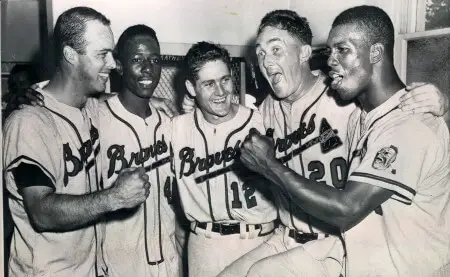
October 10, 1957: The Milwaukee Braves Win the World Series

Left to right: Eddie Mathews, Hank Aaron,
Bob Hazle, Don McMahon and Wes Covington.

October 10, 1957: Game 7 of the World Series. Warren Spahn, the only remaining Brave from the 1948 Boston Pennant winners, is the intended starter for the Milwaukee Braves, but he's got the flu. So manager Fred Haney turns to Lew Burdette on 2 days' rest.

Lew comes through, notching his 3rd win and 2nd shutout of the Series, as the Braves beat the Yankees 5-0. A 4-run 3rd inning does the job, including a double by Eddie Mathews, followed by a single by Hank Aaron. The last out, in front of a stunned 61,207 at Yankee Stadium, is Skowron grounding to Mathews, who steps on 3rd base for a force play.

It was stunning because most people outside the Upper Midwest -- the Braves' "territory" at the time included Wisconsin, the Upper Peninsula of Michigan, and States that would later belong to the Minnesota Twins, such as Minnesota, North Dakota, South Dakota and even northern Iowa -- didn't give the Braves a chance. Some Yankees had actually called Milwaukee "Bushville" for the way they'd reacted to their team, after having been a minor-league town for half a century.

Many years later, in 2012, John Klima would title his book about the '57 Braves Bushville Wins! The Wild Saga of the 1957 Milwaukee Braves and the Screwballs, Sluggers, and Beer Swiggers Who Canned the New York Yankees and Changed Baseball. It's a wonder he had room for the actual book.

Burdette, a 30-year-old righthander from West Virginia, is named the Series MVP, having tossed 24 consecutive scoreless innings -- longest in Series play to that point except for Babe Ruth's 29 2/3rds -- and posted a 0.64 ERA in his 3 Fall classic victories. Oh yeah: The losing pitcher in Game 7 was the previous season's Series hero, Don Larsen.

At the time, the Yankees were criticized for having traded Burdette to the Braves in 1951, for All-Star pitcher Johnny Sain. However, Sain helped the Yankees win 3 World Series; the Braves won just 1 with Burdette.

Amazingly, considering how long their careers lasted, this was the only World Championship won by either Aaron or Spahn. But it was the 2nd for Red Schoendienst, Del Rice and Nippy Jones, who had been on the 1946 St. Louis Cardinals. And Mathews would win another, closing his career with the 1968 Detroit Tigers.

This remains the only World Series ever won by a Milwaukee team, 65 years later. Despite all that talent, the Braves lost the Series in 1958, and never got back into the Series until 1991. From 1914 (in Boston) to 1995 (in Atlanta), this was the only World Series they won in a span of 81 years.

*

October 10, 1957 was a Thursday. This was the day that Ayn Rand's novel Atlas Shrugged was published. I have a separate entry for that event.

I don't know if Rand paid attention to sports. She probably just shrugged at it. She had, she believed, more important things to be concerned with.

Game 7 of the World Series was the only baseball game played. Football was in midweek. The NBA season wouldn't start for another 12 days.

There were 2 games played in the NHL. The New York Rangers beat the Detroit Red Wings, 3-2 at the Olympia Stadium in Detroit. And the Montreal Canadiens beat the Chicago Black Hawks, 5-1 at the Montreal Forum. The Toronto Maple Leafs and the Boston Bruins were not scheduled.

Tuesday, October 4, 2022

October 4, 1958: France Establishes Its Fifth Republic

October 4, 1958: France adopts a new Constitution, beginning its Fifth Republic. Charles de Gaulle demanded it, and Michel Debré did most of the writing. In the new government established in the new Republic, de Gaulle served as President, head of state; and Debré as Prime Minister, head of the government.

The First Republic was founded on September 21, 1792, when the French Revolution overthrew the monarchy of King Louis XVI. Napoleon Bonaparte brought it to an end when he declared the First Empire on May 18, 1804. That Empire lasted until April 11, 1814, and was restored briefly from March 20 to July 7, 1815.

The Bourbon Restoration lasted until February 23, 1848, when France's branch of the European Revolutions of 1848 established the Second Republic. That ended on December 2, 1852, when Napoleon's grandnephew, Louis-Napoleon Bonaparte, proclaimed the Second Empire, and himself as Emperor Napoleon III. (He considered Napoleon's son, who never actually reigned, to be Napoleon II.)

The Second Empire fell on September 4, 1870, after Napoleon III was captured in the Battle of Sedan 2 days earlier, costing France the Franco-Prussian War. The Third Republic lasted through the Dreyfus Affair, World War I and the Great Depression, until falling to the Nazis on July 10, 1940.

After de Gaulle's provisional government following the Liberation of Paris on August 25, 1944, the Fourth Republic began with the adoption of its Constitution on October 13, 1946. It was basically a resumption of the Third Republic. But it suffered from a lack of political consensus, a weak executive, and governments forming and falling in quick succession.

Finally, the Algieria Crisis of 1958 forced the government's hand. On June 1, it voted to return de Gaulle to power. He had offered himself as the savior of the nation. It was not the first time, and it would not be the last.

Many opposed him. Writer-philosopher Jean-Paul Sartre, publicly known to be a militant atheist in the mold of a new Voltaire, said, "I would rather vote for God." de Gaulle himself said, "Who honestly believes that, at age 67, I would start a career as a dictator?" Many did. But, as has so often been the case, a people's desire for stability topped all other concerns. de Gaulle once again turned out to be the right man for the job... for the moment.

On June 3, de Gaulle called for a new constitution. On September 28, the nation's voters approved it. It took effect on October 4, and de Gaulle was elected President on December 21, taking office on January 9, 1959. On its issue dated 5 days earlier, January 5, Time magazine named de Gaulle its Man of the Year for 1958.

The 1958 constitution also replaced the French Union with the French Community, similar to the British Empire transitioning to the British Commonwealth. Over the course of calendar year 1960, 14 French colonies in Africa declared their independence. Finally, Algeria was allowed to become independent on July 5, 1962. This kept France stable until the "May Days" of 1968, when de Gaulle sent troops in to settle things. France has not even approached the need for a Sixth Republic since then.

The Constitution of the Fifth Republic has been amended 24 times, most recently in 2008.

So, to recap. Chronologically:

1792-1804: First Republic
1804-1815: First Empire
1815-1848: Bourbon Restoration
1848-1852: Second Republic
1852-1870: Second Empire
1870-1940: Third Republic
1940-1944: Third Reich
1944-1946: Provisional Government
1946-1958: Fourth Republic
1958-present: Fifth Republic

By time: Third Republic, 70 years; Fifth Republic, 64 years and counting as of October 4, 2022; Bourbon Restoration, 33 years; Second Empire, 18 years; Fourth Republic, 12 years; First Republic, 11 years; First Empire, 11 years; Second Republic, 4 years; Third Reich, 4 years; post-WWII provisional government, 2 years.

*

October 4, 1958 was a Saturday. Game 3 of the World Series was played at Yankee Stadium, and the New York Yankees beat the Milwaukee Braves, 4-0. Don Larsen was not perfect, as he was 2 years earlier, but effective enough to combine with reliever Ryne Duren for a 6-hit shutout. Hank Bauer hit a home run. Mickey Mantle went 0-for-2 with 2 walks. Hank Aaron went 0-for-3 with a walk. The Yankees went on to win the Series in 7 games.

There was college football played that day, including the following games:

* Number 1 Oklahoma beat Oregon, 6-0 at Owen Field in Norman, Oklahoma. Oklahoma went on to win the Big Seven Conference (it became the Big Eight when Oklahoma State joined in 1960). The next week, they lost to Texas in the Cotton Bowl, which would be their only loss of the season.

* Number 2 Auburn beat Chattanooga, 30-8 at Cliff Hare Stadium (now Jordan-Hare Stadium) in Auburn, Alabama.

* Number 3 Ohio State beat the University of Washington, 12-7 at Ohio Stadium in Columbus.

* Number 4 Michigan State and Number 16 Michigan played to a 12-12 tie at Spartan Stadium in East Lansing, Michigan.

* Number 5 Army beat Penn State, 26-0 at Michie Stadium in West Point, New York. Army had the season's Heisman Trophy winner, running back Pete Dawkins.

* Number 6 Mississippi beat Trinity College, 21-0 at Alamo Stadium in San Antonio. Trinity now play in NCAA Division III.

* Number 7 Notre Dame beat Number 17 Southern Methodist (SMU), 14-6 at the Cotton Bowl in Dallas. In those days, Notre Dame didn't accept invitations to bowl games, so they did not go on to play in the Cotton Bowl game, or any other.

* Number 8 Iowa were held to a 13-13 tie by the Air Force Academy, at Iowa Stadium (now Kinnick Stadium) in Iowa City. Iowa still won the Big 10 Conference title.

* Number 9 Wisconsin beat cross-State Marquette, 50-0 at Camp Randall Stadium in Madison. Marquette, a participant in the 1st-ever Cotton Bowl (losing to Texas Christian on New Year's Day 1937), dropped its football program after the 1960 season.

* Number 10 Clemson beat Maryland, 8-0 at Byrd Stadium (now SECU Stadium) in the Washington suburb of College Park, Maryland. Clemson went on to win the Atlantic Coast Conference title.

* Number 11 Mississippi State were upset by Tennessee, 13-8 at Crump Stadium in Memphis. Although the venue was in Tennessee's State, it was much closer to MSU's campus.

* Number 13 Louisiana State beat Hardin-Simmons, 20-6 at Tiger Stadium in Baton Rouge, Louisiana. LSU went on to win the Southeastern Conference title, and beat Clemson in the Sugar Bowl, to win the National Championship.

* Number 15 Navy beat Boston University, 28-14 at Nickerson Field in Boston.

* The University of California beat Washington State, 34-14 at California Memorial Stadium in the San Francisco suburb of Berkeley. Neither team was then ranked. Cal went on to win the title of the American Association of Western Universities (AAWU, a precursor to the league now known as the Pacific-12 Conference), but lost the Rose Bowl to Iowa.

* Holy Cross beat Syracuse, 14-13 at Fitton Field in Worcester, Massachusetts. Neither team was then ranked. This would be the only game that Syracuse lost in the regular season, and they advance to the Orange Bowl, but were beaten by Oklahoma.

* Texas Christian beat Arkansas, 12-7 at Amon G. Carter Stadium in Fort Worth, Texas. Neither team was then ranked. TCU went on to win the Southwest Conference title, and beat Air Force in the Cotton Bowl.

* Among New Jersey's teams, Rutgers beat Colgate, 21-7 at Colgate Athletic Field (now Andy Kerr Stadium) in Hamilton, New York; while Princeton beat Columbia, 43-8 at Palmer Stadium in Princeton.

The NHL season began 4 days later; the NBA season, 11 days after that. In English soccer, Arsenal beat Birmingham-area team West Bromwich Albion, 4-3 at the Arsenal Stadium, a.k.a. Highbury. France? Like most countries on the European continent, they traditionally play soccer on Sundays.
October 4, 1957: Sputnik, Little Richard, and "Leave It to Beaver"

October 4, 1957: The Soviet Union launches Sputnik 1, the world's 1st artificial satellite. This terrifies Americans into thinking, not so much that the Communists are ahead of us in any prestigious "space race," but that, soon, they will be able to attack us from space.
Well, it's been 65 years, and they've never attacked us from anywhere. (Spy-on-spy crime excepted, of course.) Time magazine had named Khruschchev its Man of the Year for 1957.
The Space Age has begun. Particularly related to this is satellite technology that allows us to see sporting events from anywhere in the world.
The launch of Sputnik 1 was seen by rock and roll pioneer Richard Penniman, a.k.a. Little Richard. This was only 3 days after a flight between the Australian cities of Melbourne and Sydney, where he saw the plane's red-hot engines and thought "angels were holding it up." He saw the launch after his Sydney concert, and described it as "a bright red fireball flying across the sky," and said he was "deeply shaken."
He took it as "a sign from God" to repent from his wild life and secular music. According to one legend, he threw all his jewelry into Sydney Harbour. He went home, gave a farewell concert at New York's Apollo Theater, and went into the ministry. He was determined to only perform gospel music from then on, and no less a practitioner of that art than Mahalia Jackson said he "sang gospel the way it shouldn't be sung."
It didn't take. By 1962, he was singing rock and roll again, touring Europe, and The Beatles opened for him. They copied his trademark "Woo!" on songs like "She Loves You" and "Please Please Me." With Paul McCartney singing lead, they covered his "Long Tall Sally," and that ended up being the last song in their last concert, at Candlestick Park in 1966. He was a charter inductee into the Rock and Roll Hall of Fame in 1986, and lived until 2020.
Also on this day, Leave It to Beaver premieres on ABC. Somebody once pointed out that the show was a lot less naive than it first appeared, and that the worries of Theodore "Beaver" Cleaver, played by Jerry Mathers, mirrored those of the times; that the show premiered on the day Sputnik 1 was launched, and aired its last episode on June 20, 1963, right after President John F. Kennedy stared down George Wallace over integration at the University of Alabama and proposed the Nuclear Test Ban Treaty, 2 months before Martin Luther King spoke at the March On Washington, and 5 months before Kennedy was assassinated.
Jerry Mathers, then 9 years old, as The Beaver
Mathers eventually enlisted in the U.S. Air Force. He was never stationed outside the country, but a rumor went around that he was killed in action in Vietnam. Instead, he served his hitch without a scratch, graduated from the University of California, made money in real estate, became a disc jockey in Anaheim, and brought together the surviving members of the cast to produce The New Leave It to Beaver from 1983 to 1989 – as many seasons as the original show ran.
Since 2008, he has limited his acting to stage productions, frequently alongside his TV brother Tony Dow, with whom he ran a production company until Dow's death on July 27, 2022, at the age of 77. At that point, Mathers was 74.
*
October 4, 1957 was a Friday. It was a travel day between Games 2 and 3 of the World Series, which the Milwaukee Braves would win over the Yankees in Game 7. Football was in midweek. The NHL season didn't begin until October 8. And the NBA season didn't begin until October 22. So there were no scores on this historic day.
One note, tangentially connected to sports: Bill Fagerbakke, who played assistant coach Michael "Dauber" Dybinski on the ABC sitcom Coach, was born on this day.

Sunday, October 2, 2022

October 2, 1957: "The Bridge on the River Kwai" Premieres

October 2, 1957: The film The Bridge On the River Kwai premieres, directed by David Lean, and based on the 1952 novel by Pierre Boulle. Boulle went on to write Planet of the Apes in 1963.

The film is set in 1943, at a Japanese prison camp in Thailand. William Holden plays one of the prisoners, U.S. Navy Commander Shears. (No first names are used in the film.) A group of British prisoners arrive, commanded by Lieutenant Colonel Nicholson, played by Alec Guinness. They arrive whistling "The Colonel Bogey March," a British song from World War I. The song, previously unfamiliar in America, because legendary because of this scene.

The camp is commanded by Colonel Saito, played by Sessue Hayakawa, who had been the 1st actor of Asian ancestry to make it big in Hollywood. Saito tells the prisoners that they -- including the officers -- will work to build a railway bridge over the River Kwai, to connect Bangkok, the capital of Thailand, with Rangoon, the capital of Burma. (The country's name is now Myanmar, and the city's name is now Yangon.)

Nicholson reminds Saito that the Geneva Convention exempts officers from manual labor. After the enlisted men are marched to the bridge site, Saito threatens to have the officers shot, until Major Clipton, the British medical officer, warns Saito there are too many witnesses for him to get away with murder. Saito leaves the officers standing all day in the intense heat. That evening, the officers are placed in a punishment hut, while Nicholson is beaten and locked in an iron box. Shears escapes, eventually reaching the British colony of Ceylon (now the nation of Sri Lanka).

Work on the bridge proceeds badly, due to both the faulty Japanese engineering plans and the prisoners' slow pace and deliberate sabotage. Saito is expected to commit ritual suicide if he fails to meet the rapidly approaching deadline. Desperate, he uses the anniversary of Japan's 1905 victory in the Russo-Japanese War as an excuse to save face: He announces a general amnesty, releasing Nicholson and his officers, and exempting them from manual labor.

Nicholson is shocked by the poor job being done by his men, and orders the building of a proper bridge, intending it to stand as a tribute to the British Army's ingenuity for centuries to come. Clipton objects, believing this to be collaboration with the enemy. Nicholson's obsession with the bridge eventually drives him to allow his officers to volunteer to engage in manual labor.

Shears is enjoying his hospital stay in Ceylon, unwittingly within a commando school of Britain's Special Operations Executive (SOE). Major Warden (played by Jack Hawkins) of SOE invites him to join a commando mission to destroy the bridge just as it is completed.

Warden, Shears, and two other commandos, Chapman and Joyce, parachute into Thailand. Chapman dies after falling into a tree, and Warden is wounded in an encounter with a Japanese patrol and must be carried on a litter. Under cover of darkness, Shears and Joyce plant explosives on the bridge towers. A train carrying important dignitaries and soldiers is scheduled to be the first to cross the bridge the following day, and Warden wants to destroy both.

By dawn, however, the river level has dropped, exposing part of the wire connecting the explosives to the detonator. Nicholson spots the wire, and brings it to Saito's attention. As the train approaches, they hurry down to the riverbank to investigate. Joyce, manning the detonator, breaks cover and stabs Saito to death. Nicholson yells for help, while attempting to stop Joyce from reaching the detonator. Japanese gunfire wounds Joyce. Shears swims across the river, but is himself shot. Recognizing Shears, Nicholson exclaims, "What have I done?"

Warden fires a mortar, killing Shears and Joyce and fatally wounding Nicholson. Dying, Nicholson stumbles toward the detonator and falls on the plunger, blowing up the bridge. The explosion sends the train hurtling into the river.

This was not the first film "based on a true story" to be full of baloney. While the Japanese did force prisoners of war to build a railroad bridge to connect Bangkok and Rangoon, the conditions under which it was built were too harsh to be allowed onscreen by American film's Hays Code.

Julie Summers, in her book The Colonel of Tamarkan, writes that Boulle, who had been a prisoner of war in Thailand, created the fictional Nicholson character as an amalgam of his memories of collaborating French officers. And on the BBC show Timewatch, a former prisoner at the camp states that it is unlikely that a man like the fictional Nicholson could have risen to the rank of Lieutenant Colonel; and, if he had, due to his collaboration, he would have been "quietly eliminated" by the other prisoners.

As for the real bridge, it was bombed by Allied planes, and rebuilt after the war. It is still in use, 79 miles west of Bangkok, and 467 miles southeast of Yangon. Thailand now calls the river the Khwae Yai.
The Bridge On the River Kwai was the highest-grossing film released in 1957, a year that also included Peyton Place, Old Yeller, Pal Joey, Gunfight at the O.K. Corral, and 2 Elvis Presley films, Loving You and Jailhouse Rock. It was nominated for 8 Academy Awards, winning 7, including Best Picture, Best Director for Lean, and Best Actor for Guinness.

Hayakawa and Hawkins died in 1973, Holden in 1981, Lean in 1991, Boulle in 1994, and Guinness in 2000.

*

October 2, 1957 was a Wednesday. There was only one score on this historic day, and it came in Game 1 of the World Series. The New York Yankees beat the Milwaukee Braves, 3-1 at Yankee Stadium. A pair of future Hall-of-Fame lefthanders started the game, and Whitey Ford outpitched Warren Spahn. Mickey Mantle went 2-for-4.

Hank Aaron, the Braves' star young right fielder, went 1-for-4. Years later, he said the Braves weren't intimidated by the Yankees, the defending World Champions, who were seeking their 18th World Series win; it was Yankee Stadium that intimidated them. Well, they must have overcame it: They ended up beating the Yankees in the Series, clinching 5-0 in Game 7 at Yankee Stadium.

Thursday, September 29, 2022

September 29, 1959: The 1st Western Pennant

September 29, 1959: Game 2 of the National League Playoff, at the Los Angeles Memorial Coliseum. Only 36,528 fans come out to the 93,000-seat bowl on the edge of South Central, by the campus of the University of Southern California. The Milwaukee Braves, winners of the last 2 Pennants, and the Los Angeles Dodgers finished in a tie, with the San Francisco Giants 3 games behind them. The Dodgers won Game 1, 3-2 in Milwaukee.

Like in 1946, but not in 1951, the Dodgers made sure the Playoff series didn't go to a Game 3. Unlike both of those times, it ended in their favor. They scored 3 runs in the bottom of the 9th to send the game to extra innings. With 2 outs in the 12th, 1st baseman Gil Hodges drew a walk, catcher Joe Pignatano singled, and right fielder Carl Furillo singled home Hodges with the Pennant-winning run, 6-5.

The Dodgers had won the 1st Pennant by any team west of St. Louis. The City of Milwaukee has had just 1 Pennant winner in the 63 years since, the 1982 Brewers; and the Braves wouldn't win another Pennant for 32 years, and by that point they were in their 26th season in Atlanta.

This '59 Pennant, and the subsequent World Series win, for the Los Angeles edition of the Dodgers must have felt like a gut-punch for the fans the team left behind in Brooklyn. Especially since some of their Brooklyn heroes were still there: Hodges, Furillo, center fielder Duke Snider, 2nd baseman Jim Gilliam, left fielder Sandy Amoros, and pitchers Carl Erskine, Clem Labine and Johnny Podres. Former Captain Harold "Pee Wee" Reese and former manager Charlie Dressen were on manager Walter Alston's coaching staff. (Sandy Koufax and Don Drysdale were already on the team before the move, but they hadn't yet become heroes when the team left Brooklyn.)

*

September 29, 1959 was a Tuesday. This was also the day the Long Island Expressway opened. I have a separate entry for this event. The LIE (the acronym is fitting) was designed to serve the massive growth of suburbs on Long Island that the post-World War II housing boom created. That boom was one of the factors in the Dodgers leaving Brooklyn.

Football was in midweek. And it was too soon for the NBA and NHL seasons. So there were no other scores on this historic day.

September 29, 1959: The Long Island Expressway Opens

September 29, 1959: The Long Island Expressway opens, running 71 miles from the Queens-Midtown Tunnel in New York City to Calverton, in Riverhead, Sussex County. Bannered as Interstate 495, it is the most important east-west traffic artery on Long Island, consisting of Nassau County to the west and Suffolk County in the east. Although Suffolk County is far larger in area, they have roughly the same population.

The LIE -- and reports of traffic moving well on it are often a lie -- helped to make possible the Island's tremendous growth after World War II.

Other noteworthy east-west highways on Long Island are New York State Routes 25 (the Jericho Turnpike), 25A (known as Northern Boulevard in Queens) and 27 (the Sunrise Highway and, further east, the Montauk Highway); and the Southern State Parkway, which is not bannered as a New York State Route.

The LIE's exits start with 13, in the Hunters Point section of Queens, for the Pulaski Bridge into Brooklyn. Exits 13 to 32 are in Queens, 33 to 48 are in Nassau, and 49 to 73 are in Suffolk. Exits 22A (the Grand Central Parkway) and 22B (the Van Wyck Expressway) can be used to access the New York Mets' Citi Field and La Guardia Airport. Exit 22B can also be used to access John F. Kennedy International Airport, which is the southern terminus of the Van Wyck.

Exit 31 can be used for the Cross Island Parkway, leading to Belmont Park Racetrack and the New York Islanders' new UBS Arena. Exit 39 can be used for the Northern State Parkway, which flows into the Meadowbrook Parkway and leads to the Nassau Coliseum and Hofstra University. However, the LIE stops before the forking of Long Island, and well short of the resort towns known as "The Hamptons."

There have been plans for crossings of Long Island Sound that would have involved the LIE:

* Oyster Bay in Nassau County with Rye in Westchester County.
* Glen Cove in Nassau with Rye.
* Asharoken in Suffolk County with Norwalk, Connecticut.
* Shoreham in Suffolk with New Haven, Connecticut.
* East Marion in Suffolk with Old Saybrook, Connecticut.
* A long bridge from Orient Point, the tip of the North Fork, across Plum Island to Little Gull Island, to Fishers Island, to Napatree Point in Rhode Island.
* Most ambitious of all, a really long bridge from Montauk Point, the tip of the South Fork, across Block Island in Rhode Island, to Point Judith on the Rhode Island mainland.

For now, the only crossings of the Sound are the Bridgeport & Port Jefferson Ferry, and the Cross Sound Ferry from Orient to New London, Connecticut.

*

September 29, 1959 was a Tuesday. There was only one score on this historic day, but it was a significant one. It was Game 2 of the National League Playoff, at the Los Angeles Memorial Coliseum. I have a separate entry for this event.

Only 36,528 fans came out to the 93,000-seat bowl on the edge of South Central, by the campus of the University of Southern California. Like in 1946, but not in 1951, the Los Angeles Dodgers made sure the Playoff series didn't go to a Game 3. Unlike both of those times, it ended in their favor. They scored 3 runs in the bottom of the 9th to send the game to extra innings. With 2 outs in the 12th, 1st baseman Gil Hodges drew a walk, catcher Joe Pignatano singled, and right fielder Carl Furillo singled home Hodges with the Pennant-winning run, 6-5.

Friday, September 23, 2022

September 23, 1957: Hank Aaron Walks a Pennant Off

Aaron with his 1957 MVP award

September 23, 1957: Hank Aaron hits the 109th home run of his career. He would later say it was the most important.

In hindsight, it probably was his most important home run, as it gave his team the Pennant. But the qualifier "probably" needs to be used, since he would go on to hit 755 home runs, and the 715th was also very important.

But no one could have foreseen that on this night. All anyone knew then was that Aaron was the defending National League batting champion, and that he had power, too, going into the game with 42 home runs on the season. He was the favorite for the NL's Most Valuable Player award, and did win it. Teammate Warren Spahn was awarded the Cy Young Award.

Managed by Fred Haney, and with an attack that also included Eddie Mathews, Joe Adcock, Del Crandall, Red Schoendienst, Wes Covington, Bill Bruton and Frank Torre, the Braves were in their 5th season in Milwaukee, after having moved from Boston. They had finished 1 game behind the Brooklyn Dodgers the season before. Now, with the Dodgers aging and in transition, it was the Braves' year.

The St. Louis Cardinals began the day 5 games behind the Braves, with 6 games to go, including the next 3 against each other at Milwaukee County Stadium. One more Braves win, or one more Cards loss, and the Braves had the Pennant. Before the Braves moved in, the minor-league version of the Milwaukee Brewers won the American Association Pennant in 1913, 1914, 1936, 1943, 1944, 1945, 1947 and 1951. This would be the city's 1st major league Pennant.

But this game wouldn't be easy. The Braves got a run on an error in the bottom of the 2nd inning. Alvin Dark singled 2 runs home for the Cards in the top of the 6th. Mathews doubled Schoendienst home in the 7th. (Schoendienst had starred for the Cardinals in the 1940s, would manage them to 2 Pennants in the 1960s, and remained in their organization until his death in 2018.)

The game went to extra innings. Lew Burdette pitched 10 innings for the Braves, before Gene Conley pitched the top of the 11th. Billy Muffett took the mound for the Cardinals in the bottom of the 11th. He got Schoendienst to fly to center, but allowed a single to Johnny Logan. (Logan, the Braves' shortstop, was once told that something that appeared in the newspaper was "a typographical error." Without thinking, his hitter's instinct kicked in, and he said, "The hell it was! It was a clean base hit!")

Muffett got Mathews to fly to center. But that brought Aaron up. He hit a drive into the center field bleachers, and the Braves were 4-2 winners. They weren't called "walkoff" home runs at the time, but a full house of 40,926 at County Stadium seemed to run out of the stands and onto the field.

Stan Musial went 3-for-4 in a losing cause for the Cardinals.

The Braves would face the New York Yankees in the World Series. Years later, Aaron said that the Braves weren't intimidated by the Yankees, but that they were intimidated by Yankee Stadium. They must have gotten over it, because they won Game 7 there, 5-0, and became World Champions.

The Green Bay Packers had won 6 NFL Championships by this point. The title of the National Basketball League had been won by the Oshkosh All-Stars in 1941 and 1942, and the Sheboygan Red Skins in 1943. And the University of Wisconsin had had some athletic success. So the State of Wisconsin had won titles before. But this was the 1st major league championship won by a Milwaukee team. They have been few and far between since.

*

September 23, 1957 was a Monday. The film The Three Faces of Eve premiered on this day. I have a separate entry for this event.

There were 3 other games in the major leagues that day:

* The Boston Red Sox beat the Washington Senators, 9-4 at Griffith Stadium in Washington. Frank Malzone hit a home run for the Red Sox. Ted Williams went 1-for-1... with 3 walks. Harmon Killebrew hit a home run as a pinch-hitter.

* The Cleveland Indians beat the Detroit Tigers, 5-4 at Cleveland Municipal Stadium. Dick Brown singled Billy Harrell home with the winning run in the bottom of the 11th inning. Cal McLish -- in full, Calvin Coolidge Julius Caesar Tuskahoma McLish -- went the distance for the win. Hitting home runs for the Indians were Brown, Rocky Colavito, and a rookie named Roger Maris. It is interesting that, on a night when Aaron hit a major home run, Maris -- who, like Aaron, would break a home run record set by Babe Ruth -- also hit a home run. For the Tigers, Al Kaline went 3-for-4 with 2 walks and 2 RBIs.

* And the Kansas City Athletics beat the Chicago White Sox, 6-5 at Kansas City Municipal Stadium.

There was another notable sporting event: Carmen Basilio won a split decision over Sugar Ray Robinson to win the Middleweight Championship of the World at Yankee Stadium. They would have a rematch 6 months later, at Chicago Stadium on March 23, 1958. It was another split decision, awarded to Robinson. 

Thursday, September 15, 2022

September 15, 1958: The Newark Bay Rail Disaster

September 15, 1958: A commuter train derails off a bridge, and plunges into Newark Bay, killing 48 people, and injuring 48 more. Among the dead was a former Yankee star.

George Henry Stirnweiss was born on October 26, 1918 in Manhattan, and grew up in The Bronx. He remains the closest thing to a Yankee Legend who grew up in the Bronx Bombers' home Borough. Lou Gehrig grew up in Manhattan; Willie Keeler, Waite Hoyt and Willie Randolph in Brooklyn; and Phil Rizzuto and Whitey Ford in Queens. 

His father had been a respected taxi driver, but got caught up in criminal activity, disgracing the family while George was a baseball, football and basketball star at Fordham Preparatory School. This may have been why, when he received scholarship offers, he didn't stay in The Bronx and go to Fordham University, but went south, to the University of North Carolina at Chapel Hill.

At Chapel Hill, he won the school's highest athletic honor, the Patterson Medal, which is awarded based on "athletic ability, sportsmanship, morale, leadership and general conduct." In 1940, the NFL's Chicago Cardinals drafted him. But, as with later University of Mississippi quarterback Jake Gibbs, the Yankees made him an offer, and he abandoned football for baseball.

It's not clear when, or why, George Stirnweiss first got the nickname "Snuffy." Maybe, playing in the South, either at UNC or for the Norfolk Tars, a Yankee farm team, he picked up the habit of chewing tobacco or using its nasal cousin, snuff. He certainly didn't resemble the rural comic strip character Snuffy Smith.

In 1943, defending American League Most Valuable Player Joe Gordon was called up into World War II. Snuffy was not. That led the Yankees to bring him to the major league roster as the starting 2nd baseman, giving him uniform Number 1. The Yankees won the World Series, although Snuffy was not a major contributor that season. But in 1944, he batted .319 and fielded brilliantly, finishing 4th in the MVP voting. In 1945, he batted .309, and that was enough to win the batting title and finish 3rd in the MVP voting.
With The War ending, there was a question of whether Snuffy had bulked up his stats on weakened pitching. Gordon returned as the starting 2nd baseman in 1946, and it looked like Snuffy's day in the Sun was over. But after that season, the Yankees traded Gordon to the Cleveland Indians for pitcher Allie Reynolds. This was a brilliant trade for both teams: Gordon helped the Indians win the World Series in 1948, while the Yankees essentially got 2 players: Reynolds, their pitching ace through 1954, and the "return" of Stirnweiss.

He helped the Yankees win the World Series again in 1947, getting 7 hits and drawing 8 walks in the 7 games. But by the time of their 1949 title, he had been replaced as starting 2nd baseman by Jerry Coleman. He was traded to the St. Louis Browns in 1950 and the Indians in 1951, and retired after the 1952 season.

Snuffy managed in the minor leagues, with the Philadelphia Phillies' Class AA team, the Schenectady Blue Jays; then for the Yankees' team in the same league, the Binghamton Triplets. But he didn't like managing, and it didn't pay well, and he had a wife and 6 children to support. He worked for a bank, but had a heart attack in 1957, and never returned to work for them.

Instead, he went to work for Caldwell & Company, a manufacturer of light fixtures, in Manhattan. Every morning, he would go to the Central Railroad of New Jersey station near his home in Red Bank, Monmouth County, and take the train up the Raritan Bayshore, past Newark Airport, and over Newark Bay, to the Communipaw Terminal in Jersey City, where he would take a ferry across the Hudson River into The City.

On September 15, 1958, he got on CRRNJ train #3314 in Red Bank, but the train never made it to Communipaw. The Newark Bay lift bridge was left open, and at 10:01 AM, the train went straight through signals, and 2 of the cars fell into the Bay. George H. "Snuffy" Stirnweiss was 1 of 48 people killed. He was just short of turning 40.
The locomotive crew were among those killed, so there was no one to interview about the cause of the crash. The investigation turned up nothing. No one was charged.

Increased car sales, the building of the New Jersey Turnpike (particularly the Newark Bay Extension in 1956) and the Garden State Parkway, and a 2nd and 3rd tube for the Lincoln Tunnel meant that the Jersey Central had already begun to decline, and it pretty much abandoned the bridge by 1967. Conrail took over the railroad's operations in 1976, stopped passenger service in 1978, and demolished the bridge in 1980.

The spot where Snuffy Stirnweiss and the others fell to their deaths is a few feet from the Jersey Gardens Mall in Elizabeth, Union County. He was buried in Mount Olivet Cemetery, across the Navesink River from Red Bank, in Middletown. Legendary football coach Vince Lombardi is also buried there, because Red Bank was his wife Marie's hometown.

*

September 15, 1958 was a Monday. It was before the NBA and the NHL started their seasons. The NFL season wouldn't start for another 2 weeks, and there was no Monday Night Football in those days, anyway. And, as Monday is often a travel day in Major League Baseball, only 2 of a possible 8 games were played:

* The Philadelphia Phillies beat the St. Louis Cardinals, 6-2 at Connie Mack Stadium in Philadelphia. Robin Roberts outpitched Wilmer "Vinegar Bend" Mizell. Jim Hegan got 3 hits for the Phils; Richie Ashburn, Bob Bowman and Ted Kazanski 2 each. (That's Ted Kazanski, not Ted Kaczynski, the future Unabomber.) The only home run of the game was hit by the Cards' Irv Noren, a former Yankee, playing left field in place of Stan Musial, who did not get into the game.

* And the Milwaukee Braves beat the Los Angeles Dodgers, 8-3 at Milwaukee County Stadium. Joe Adcock hit a home run. Hank Aaron did not, but did go 2-for-3 with an RBI. John Roseboro hit a home run in defeat for the Dodgers, in their 1st season in L.A. Gil Hodges 2-for-4, but Duke Snider did not play.

The Braves, defending World Champions, would win the Pennant again, but the Yankees -- who did not add a black armband to their left sleeves in memory of Stirnweiss -- would avenge their loss to the Braves in the 1958 World Series.

Wednesday, July 27, 2022

July 27, 1953: The Korean War Armistice

July 27, 1953: The Korean Armistice Agreement is signed at Panmunjom, just on the South side of the newly-established border between the Republic of Korea, a.k.a. South Korea; and the Democratic People's Republic of Korea, a.k.a. North Korea. It ends the Korean War, which had begun over 3 years earlier, on June 24, 1950.

As stated in the final episode of the TV show M*A*S*H, airing 30 years later, the Armistice was signed at 10:01 AM local time, and the guns fell silent at 10:00 PM, 12 hours later -- 8:00 AM, U.S. Eastern Time.

The signatories were:

* For the United Nations, including the United States and South Korea, Lieutenant General William Kelly Harrison Jr.

* For North Korea, Minister of Foreign Affairs Nam Il.

* For the People's Republic of China, Marshal Peng Dehuai.
Deaths in the war: For the U.S., 36,574; for South Korea, 162,000 military, and nearly 1 million civilians; for North Korea, no one knows for sure, but including civilians, it may be over 1.5 million.

Peng died in 1974, Nam Il in 1976, and Harrison was the last surviving, living until 1987.

*

July 27, 1953 was a Monday. It was the off-season for the NFL, the NBA and the NHL. And Monday is often a travel day in Major League Baseball. As a result, there was only one game played that day.

The Milwaukee Braves beat the New York Giants, 13-0 at Milwaukee County Stadium. It was only 1-0 Braves going into the bottom of the 4th inning, when the Braves scored 8 runs. Eddie Mathews hit 2 home runs. Warren Spahn allowed 7 hits, but kept his shutout.

The best-known players on each team were not in this game. Hank Aaron was still in the minor leagues, on the way up. He debuted on the Braves' next Opening Day, April 13, 1954. And Willie Mays was in the U.S. Army, serving in the Korean War. Fortunately for him, he was kept stationed stateside, and never went into combat, and rejoined the Giants in Spring Training 1954.

In 1970, Aaron became the 1st player to collect 3,000 hits with 500 of them being home runs. He beat Mays to this distinction by 2 months. 

Saturday, July 2, 2022

July 2, 1963: Warren Spahn vs. Juan Marichal

Marichal (left) and Spahn after the game

July 2, 1963: Former Sports Illustrated writer Jim Kaplan, who has written many books on baseball, wrote a dual biography of the opposing pitchers in the game played at Candlestick Park in San Francisco on this day, focusing on this game. He titled his book The Greatest Game Ever Pitched: Juan Marichal, Warren Spahn, and the Pitching Duel of the Century.

Spahn, 42 years old and a native of Buffalo, New York, was a lefthanded pitcher, and had been decorated for his service in the Battle of the Bulge in World War II. He had helped the Braves win National League Pennants in Boston in 1948, and in Milwaukee in 1957 and 1958, winning the 1957 World Series. He would finish his career with 363 wins, the most of any lefthanded pitcher ever, and the most of any pitcher of either hand in the post-1920 Lively Ball Era.

Marichal, 25 and from the Dominican Republic, was righthanded, but was already building a career that would make him the all-time winningest pitcher among Latin Americans, with 243. (He has since been surpassed by Dennis Martínez and Bartolo Colón.) He had helped the San Francisco Giants win the 1962 Pennant. He didn't seem to have much in common with Spahn, outside of talent. But each man was known for a windup with a very high leg-kick.

Marichal allowed a single to Frank Bolling in the 1st inning. Also, an error by 3rd baseman Harvey Kuenn allowed Del Crandall to reach 2nd base in the 2nd. In the 4th, he walked Norm Larker, and allowed singles to Mack Jones and Crandall, but Larker tried to score on Crandall's single, and Willie Mays threw him out at the plate.

He walked Lee Maye in the 5th, and Maye stole 2nd, but was stranded there. Denis Menke singled and stole 2nd in the 6th, but was stranded. In the 7th, Crandall led off the 7th with a single, but was caught stealing. Spahn took matters into his own hands, and doubled, but was stranded. Marichal walked Aaron in the 8th, but stranded him.

In the 2nd, Spahn allowed a single to Orlando Cepeda, who stole 2nd and advanced to 3rd on a flyout. He allowed a single to Willie McCovey in the 4th. In the 7th, he allowed singles to Cepeda and Ed Bailey, but they couldn't score. The Giants had a chance to win it in the bottom of the 9th, when Felipe Alou singled with 2 outs, but Cepeda popped up. Both Spahn and Marichal had pitched shutouts, and it was on to extra innings.

In the bottom of the 10th, Ernie Bowman bunted his way onto 1st base, but Spahn stranded him. Neither pitcher allowed a baserunner in the 11th or the 12th. The pitchers had the opposite motivation: Spahn said he didn't want a kid to beat him, and Marichal said he didn't want an old man to beat him.

Frank Bolling singled with 2 out in the top of the 13th, but was stranded. Bowman led off the bottom of the 13th with a single, but Spahn picked him off 1st base. In the top of the 14th, Marichal walked Larker, but stranded him. Spahn ran into real trouble in the bottom of the 14th. Kuenn led off with a double. With 1st base open, Mays was intentionally walked -- his run meant nothing. Spahn got Willie McCovey to pop up, and Felipe Alou to fly out. Cepeda grounded to Menke at 3rd, but he made an error, loading the bases. But Spahn got Bailey to fly out.

Both pitchers went 1-2-3 in the 15th inning. With 2 outs in the top of the 16th, Menke singled, but Marichal got Larker to ground back to him. In the bottom of the 16th, Spahn got Kuenn to fly to center. Maybe he should have walked Mays intentionally again, because, at 12:31 AM on July 3, Mays hit a long home run to left field.
Giants 1, Braves 0. There's no record of how many pitches each man threw, but Marichal faced 59 batters, Spahn 56. Marichal had 10 strikeouts, Spahn only 2; however, Spahn walked only 1 batter, Marichal 4; Marichal allowed 8 hits, Spahn 9. For the game, Spahn had a WHIP -- Walks plus Hits, and that total divided by Innings Pitched -- of 0.652, while Marichal's was 0.750. Spahn's ERA for the game was 0.56, while Marichal's, of course, was 0.00.

The game lasted 4 hours and 10 minutes. It wasn't well-reported outside of the West Coast, because it ended at 2:30 AM Pacific Time, 5:30 Eastern Time. But as both men's reputations grew, so did that of the game.

It was 30 years to the day after New York Giants starter Carl Hubbell pitched 18 innings for a 1-0 win over the St. Louis Cardinals. Cards starter Tex Carleton pitched 16 innings as well.

Spahn won 202 games during the 1950s, making him the winningest pitcher of the decade. Marichal won 191 games during the 1960s, more than any other pitcher, including Sandy Koufax, Don Drysdale and Bob Gibson.

*

July 2, 1963 was a Tuesday. Marvel Comics published X-Men #1 on this day. I have a separate entry for that event.

These other baseball games were played that day:

* The New York Yankees beat the Chicago White Sox, 3-0 at Yankee Stadium. Al Downing allowed just 1 hit, a single to Cam Carreon in the 7th inning. He also walked 6 batters, but struck out 10. Hector Lopez hit a home run. Roger Maris went 1-for-3. Mickey Mantle was injured. Yogi Berra, in his last full season as a player, also did not play.

* The New York Mets lost to the Chicago Cubs, 4-1 at Wrigley Field in Chicago. Ernie Banks went 1-for-3 with a walk for the Cubs. Duke Snider did the same for the Mets.

* The Pittsburgh Pirates beat the Philadelphia Phillies, 3-2 at Connie Mack Stadium in Philadelphia. Roberto Clemente went 1-for-3 with a walk and an RBI.

* The Baltimore Orioles beat the Los Angeles Angels, 4-3 at Memorial Stadium in Baltimore. Brooks Robinson went 1-for-4.

* The Washington Senators beat the Kansas City Athletics, 7-2 at District of Columbia Stadium in Washington. D.C. Stadium was renamed Robert F. Kennedy Memorial Stadium in 1969.

* The Boston Red Sox beat the Cleveland Indians, 6-1 at Cleveland Municipal Stadium. Carl Yastrzemski went 2-for-4 with a walk and 2 RBIs.

* The Minnesota Twins beat the Detroit Tigers, 7-4 at Tiger Stadium in Detroit. Harmon Killebrew went 1-for-4 with a walk. Al Kaline went 2-for-3 with a home run, a walk and an RBI.

* The Cincinnati Reds beat the Houston Colt .45s, 6-4 at Colt Stadium in Houston. Frank Robinson did not play for the Reds, but rookie Pete Rose did, and went 3-for-5. The Colts became the Houston Astros in 1965.

* And the Los Angeles Dodgers beat the St. Louis Cardinals, 1-0 at Dodger Stadium in Los Angeles. Don Drysdale pitched a 5-hit shutout, outpitching Curt Simmons. Stan Musial, in his final season, got a hit as a pinch-hitter.

Thursday, May 26, 2022

May 26, 1959: The Harvey Haddix Game

May 26, 1959: Harvey Haddix puts on the greatest pitching performance of all time. And loses.

In 1981, baseball historian John Thorn published Baseball's 10 Greatest Games. He included this game as one of them. He began the chapter on it by referring to Game 3 of the 1951 National League Playoff and Game 5 of the 1956 World Series, saying, "Fate can be cruel, as it was to Ralph Branca; or it can be kind, as it was to Don Larsen. Today, it will be both to Harvey Haddix."

Haddix, a native of Medway, Ohio, outside Dayton, arrived in the major leagues with the St. Louis Cardinals in 1952. Like his teammate, Harry Brecheen, he was a lefthanded pitcher. Brecheen was nicknamed The Cat, so Haddix was nicknamed The Kitten. He wasn't just a protégé: He made the National League All-Star Team in 1953, '54 and '55.

On the night of May 26, 1959, a crowd of 19,194, a good crowd for a Tuesday night in that era, filed into Milwaukee County Stadium, and saw the 33-year-old Haddix take the mound for the Pittsburgh Pirates against the Milwaukee Braves. His fastball and breaking ball were both very sharp: He later said, "I could have put a cup on either corner of the plate, and hit it." Bill Mazeroski, often called the greatest-fielding 2nd baseman of all time, said, "Usually, you have one or two great or spectacular defensive plays in these no-hitters. Not that night: It was the easiest game I ever played in."

The problem was, the Pirates weren't scoring, either. Their starter, Lew Burdette, who won 3 games in the 1957 World Series, was also really on his game. At the end of 9 innings, the Pirates had 9 hits, the Braves none -- but the score was 0-0. Haddix hadn't allowed a single baserunner. He had pitched not just a no-hitter, but a perfect game. Indeed, he had been a baserunner: He had singled off Burdette. And yet, he hadn't won. The game continued.

Pirate 3rd baseman Don Hoak singled in the top of the 10th. He couldn't score. Haddix kept the perfecto going. Shortstop Dick "Ducky" Schofield singled to lead off the top of the 11th. But for the 3rd time in the game, Burdette induced a ground ball that was turned into a double play. Haddix kept his end going, becoming, still, to this day, the only man to go through the 1st 11 innings of a game without allowing a hit, and he still hadn't allowed a baserunner.

Mazeroski singled in the top of the 12th, but was stranded. Haddix still didn't budge in the bottom of the 12th: 36 men up, 36 men down. It had never happened before, and it has never happened since. Schofield singled again in the top of the 13th, to no avail. Haddix took the mound for the bottom of the 13th. It was still 0-0. He still hadn't allowed a baserunner.

Félix Mantilla led off for the Braves. He hit a bouncer to Hoak at 3rd, but Hoak bobbled it, lost his composure, and made a bad throw to 1st base. Mantilla was safe. An error. The perfect game was gone. But the no-hitter still had a chance.

Eddie Mathews, one of the best sluggers in the game, bunted Mantilla over to 2nd. With 1st base open and 1 out, the next batter was Hank Aaron. Pirate manager Danny Murtaugh ordered Haddix to intentionally walk him. It was the 39th batter of the game for Haddix, and his 1st walk. But it did set up an inning-ending double play.

There would be no double play. Joe Adcock was the next man up, and he hit the ball over the right-center field fence, into the bleachers, for a game-winning home run.

Or so everyone thought. With less than 2 outs, Aaron didn't know whether the ball would be caught, so he was stuck between 1st and 2nd base. He later said he thought the ball landed in front of the fence, so he got to 2nd base, and the next thing he knows, Adcock has passed him. National League President Warren Giles ruled that Adcock was out, since only Aaron was entitled to the base, and ruled that the final score was Braves 1, Pirates 0.

It didn't matter to Haddix: He had pitched 12 perfect innings, only to lose the perfect game, the no-hitter, the shutout, and the win. For his valiant effort, he walked away with only a loss.

God, or "the baseball gods," or Fate, or whatever you want to ascribe it to, made it up to Haddix: He became the winning pitcher for the Pirates in Game 7 of the 1960 World Series, the Bill Mazeroski Game. (John Thorn included that game in his book, too.) He finished his career in 1965, with a record of 136-113, an ERA of 3.63, 1,575 strikeouts, 3 Gold Gloves, and a World Series ring.

Haddix later became a pitching coach. In 1991, Major League Baseball officially redefined a "no-hitter" as "a game in which a pitcher or pitchers complete a game of nine innings or more without allowing a hit." This retroactively disqualified Haddix: Despite his having thrown more perfect innings than anyone in a single game, his achievement was taken off the lists of perfect games and no-hitters. He said, "It's okay. I know what I did." So did everybody else. He died in 1994, at the age of 68.

*

May 26, 1959 was a Tuesday. Ed Walsh, who pitched a no-hitter for the Chicago White Sox in 1911, and was on the losing side of Addie Joss' 1908 perfect game despite striking out a then-record 15 batters, died that day. These other baseball games were played:

* The New York Yankees lost to the Boston Red Sox, 12-2 at Yankee Stadium. The Red Sox did this without Ted Williams, who did not play. Tom Brewer outpitched Bob Turley. Mickey Mantle went 2-for-3 with a walk and an RBI. Yogi Berra went 0-for-3.

* The Baltimore Orioles beat the Washington Senators, 6-5 at Memorial Stadium in Baltimore. Brooks Robinson did not play for the Orioles. Harmon Killebrew went 0-for-4 with a walk for the Senators.

* The Cincinnati Reds beat the Philadelphia Phillies, 2-1 at Crosley Field in Cincinnati. Frank Robinson went 1-for-4. The winning pitcher was former Brooklyn Dodger ace Don Newcombe.

* The Cleveland Indians beat the Chicago White Sox, 3-0 at Comiskey Park in Chicago. Don Ferrarese (6 2/3rds innings) and Jim Perry combined for a 4-hit shutout.

* The Detroit Tigers beat the Kansas City Athletics, 9-5 at Kansas City Municipal Stadium. Al Kaline went 3-for-5 with an RBI. Roger Maris was on the A's roster, but did not play in this game. But future managing great Dick Williams hit a home run, and another, Whitey Herzog, went 3-for-4.

* The San Francisco Giants beat their arch-rivals, the Los Angeles Dodgers, 6-4 at Seals Stadium in San Francisco. Sandy Koufax, not yet the superstar that he would become, started for the Dodgers, but ran out of gas in the bottom of the 9th, allowing a game-winning grand slam to Leon Wagner. Willie Mays went 1-for-2 with 2 walks.

* And the Chicago Cubs and the St. Louis Cardinals, arch-rivals, having wrapped up a series the day before, were not scheduled.

Friday, March 18, 2022

March 18, 1953: Baseball On the Move

Milwaukee County Stadium, as it appeared during the Braves' tenure

March 18, 1953: For the 1st time in 50 years, a major league baseball team moves from one city to another. And it does so right on the heels of a new season.

For years, several cities in "the high minors" had tried to get the major leagues to put a team there. Milwaukee, where the Boston Braves had their top farm team, was the first to break through. Moving there meant that they already owned the rights to have a major league team there, and wouldn't have to pay someone else a territorial indemnification fee.

The case for the Braves staying in Boston was actually stronger than you might think. They had won the National League Pennant as recently as 1948. They still had Warren Spahn, a Hall of Fame pitcher. They had Eddie Mathews, who turned out to be a Hall of Fame 3rd baseman, coming off a good rookie season. They had Hank Aaron, who turned out to be a Hall of Fame right fielder, in their farm system. Many of the other players who would win Pennants in Milwaukee in 1957 and '58 were also in their farm system.

In contrast, the American League's Boston Red Sox had one bankable star: Ted Williams. At the end of the 1952 season, Williams was in the U.S. Marine Corps, flying a jet in the Korean War. He wouldn't be back until late 1953 -- and no one knew that would be the case in the preceding Winter. For all they knew, he could have ended up missing all of '53, '54, and so on... maybe even retire.

The Red Sox had Fenway Park. But Fenway wasn't considered special in the early Fifties. Its Fenway's age (40 years old) didn't make it special: 8 of the other 13 major league ballparks (2 of them having 2 teams sharing) opened in April 1912 or earlier. Nor did the other things that are now considered to make Fenway "special": Other parks had big, close walls, and most had a hand-operated scoreboard. The CITGO sign? Didn't go up until 1965. The bleachers on top of the Green Monster? 2002.

No, the Red Sox weren't special because of their players, or their ballpark, or their history. They hadn't won the World Series since 1918, and as for their 1946 Pennant, well, the Braves had won one more recently. Neither team was a glamour team, but the Braves were, at the least, not far behind the Sox by that measure.

If the Braves had just hung on in Boston one more season, they would have had Mathews' 47 home runs (or thereabouts; Braves Field was roughly as hitter-pitcher balanced as Milwaukee County Stadium), and the attendance would have gone up. One more, and Aaron would have arrived. The team was getting better.

Despite the manpower shortage of World War II, and having a really inadequate ballpark in Borchert Field (it was older than any major league park, and its dimensions were similar to those of the Polo Grounds), the minor-league version of the Milwaukee Brewers drew rather well.

This was mainly because they were winning. They won the American Association Pennant in 1943, '44 and '45. They also had success because their owner was Bill Veeck, and this was where he became the king of the baseball promotion. This included starting games at 8:00 in the morning so people working the overnight shift at Milwaukee-area defense plants could come to a ballgame right from work.

But Veeck and his Brewers proved that Milwaukee could support a major league team. So the County of Milwaukee began building a stadium, confident that they could get a team. By then, Veeck had owned the Cleveland Indians, and was owning the St. Louis Browns, and intended to move them to Milwaukee. There was also a group trying to buy the St. Louis Cardinals from Fred Saigh, who had to go to prison and sell the team due to tax fraud, and move them to Milwaukee.

So if the Braves hadn't exercised their option before the 1953 season, some major league team would surely have been playing home games at Milwaukee County Stadium in April 1954. But the Braves, literally and figuratively, made their move. Gussie Busch bought the Cardinals, keeping them in St. Louis. Veeck tried to move the Browns to Baltimore, but MLB voted that the move could only go forward with another owner, so he sold them, and they became the Baltimore Orioles.

Milwaukee was a good market. The Braves ended up bringing in more fans in their 1st 13 home games in Milwaukee in 1953, 312,936, than they did in all 77 games in Boston in 1952, 281,281. In 1954, they set an NL record for highest attendance, and did it again in 1957. O'Malley got jealous of the attendance and the parking spaces, and the rest is history.
Downtown Milwaukee, circa 1957

Oddly, the Braves made their move during Spring Training, with 45 days before the regular season opened. On April 14, 1953, they played, interestingly enough, the Cardinals, and beat them, 3-2 in 10 innings. Spahn went the distance, and Billy Bruton hit a home run off Gerry Staley to win it.

The Braves broke the ice:

* 1953-54: The St. Louis Browns moved, becoming the Baltimore Orioles.
* 1954-55: The Philadelphia Athletics moved, becoming the Kansas City Athletics.
* 1957-58: The Brooklyn Dodgers moved, becoming the Los Angeles Dodgers. Horace Stoneham, owner of the New York Giants, was preparing to move his team to Minneapolis, where they had their top farm team. But, needing a reasonably close team to cut down on travel costs, Dodger owner Walter O'Malley talked him into San Francisco instead.
* 1960-61: The Washington Senators moved to Minneapolis, becoming the Minnesota Twins. The AL expanded, creating a new Washington Senators, and the Los Angeles Angels.
* 1961-62: The New York Mets and the Houston Colt .45s began play. In 1965, the Colt .45s changed their name to the Houston Astros.
* 1965-66: The bloom had come off the rose for the Braves, who moved to Atlanta.
* 1967-68: After threatening to move to Dallas and Louisville, Charlie Finley moves the Kansas City Athletics to Oakland.
* 1969: Another expansion creates the Kansas City Royals, the Seattle Pilots, the Montreal Expos and the San Diego Padres.
* 1969-70: After a disastrous first season in Seattle, the Pilots move, becoming the Milwaukee Brewers. The Chicago White Sox had been threatening to move to Milwaukee.
* 1971-72: The "new" Washington Senators move to the Dallas area, where they became the Texas Rangers. The White Sox threaten to move to Denver.
* 1973-74: The Padres nearly move to Washington, before they are sold.
* 1975-76: The White Sox again threaten to move, this time to Seattle, before being sold and kept in Chicago.
* 1976-77: The San Francisco Giants nearly move to Toronto, leading to the creation of 2 new expansion teams, the Toronto Blue Jays and the Seattle Mariners.
* 1977-78: Finley nearly moves the A's to Denver.
* 1978-79: Finley nearly moves the A's to New Orleans. He sells them in 1980.

The Tampa Bay nearly got the White Sox for 1989 and the Giants for 1993, before last-minute moves kept those teams where they were. Denver and Miami finally got teams in 1993, the Colorado Rockies and the Florida Marlins (later the Miami Marlins). In 1998, the Tampa Bay Rays and the Arizona Diamondbacks were created. In 2004-05, the Expos moved, becoming the Washington Nationals.

Mathews played until 1968, making him the last active former Boston Braves. Catcher Del Crandall was the last living former Boston Brave, living until May 5, 2021.

UPDATE: The Atlanta Braves have a team Hall of Fame. The Boston Braves they've inducted into it are Harry Wright, Kid Nichols, Herman Long, Hugh Duffy, Fred Tenney, Rabbit Maranville, Wally Berger, Johnny Sain, Tommy Holmes and Warren Spahn. The Milwaukee Braves they've inducted are Spahn, Hank Aaron, Eddie Mathews, Del Crandall, Joe Adcock and Joe Torre.

Aaron, Spahn, Mathews and Braves broadcaster Earl Gillespie have been elected to the Wisconsin Athletic Hall of Fame.

*

March 18, 1953 was a Wednesday. As I said, baseball was in Spring Training. Football was out of season. One game was played in the NBA: The Indianapolis Olympians beat the Milwaukee Hawks, 74-69 at the Milwaukee Arena. In 1974, it was renamed the Milwaukee Exposition, Convention Center and Arena, or "The MECCA." Since 2014, it has been named the UW-Panther Arena.

Ironically, just 2 years after getting the Braves, and only 4 years after getting the Hawks, Milwaukee would lose the Hawks: They moved to St. Louis in 1955, and then to Atlanta in 1968, the year Milwaukee got a new NBA team, the Bucks.

There were 2 games in the NHL. The Boston Bruins beat the New York Rangers, 2-1 at the old Madison Square Garden. And the Toronto Maple Leafs beat the Chicago Black Hawks, 4-3 at Maple Leaf Gardens in Toronto. The Montreal Canadiens and the Detroit Red Wings were not scheduled.

December 31, 1999 & January 1, 2000: The Millennium

December 31, 1999:  The Millennium arrives. The people of planet Earth survived. At a terrible cost. But we hadn't destroyed ourselves. ...