Showing posts with label oslo. Show all posts

Monday, October 24, 2022

October 24, 1945: The Execution of Vidkun Quisling

October 24, 1945: Vidkun Quisling is executed by firing squad in the Norwegian capital of Oslo. He was 58 years old. The only man ever to be leader of the National Union Party, in 1931 he was named Norway's Minister of Defense, serving until 1933. On February 1, 1942, after the Nazis conquered Norway, he was appointed Minister President.

He held the office until May 9, 1945, a day after V-E Day, when, knowing the game was up, he turned himself in. On V-E Day, he had written:

I know that the Norwegian people have sentenced me to death, and that the easiest course for me would be to take my own life. But I want to let history reach its own verdict. Believe me, in ten years' time I will have become another Saint Olav. 

Olaf II was King of Norway from 1015 to 1028, and was known as Olaf the Holy. He is his country's patron saint, and deserves to be remembered as more than just the namesake of the fictional hometown of the Golden Girls character Rose Nylund.

Quisling was wrong. Even while still in power, "quisling" became a word synonymous with "traitor." He is remembered as a traitor, and a willing sender of Norwegian Jews to die in the Holocaust.

*

October 24, 1945 was a Wednesday. Also on this day, the Charter of the United Nations was ratified by the original 5 permanent members of the United Nations Security Council: America, Britain, France, China and the Soviet Union, and by a majority of the other signatories. I have a separate entry for this event. And Gene Monahan, trainer for the New York Yankees from 1973 to 2011, was born.

The baseball season had ended 14 days before, when the Detroit Tigers beat the Chicago Cubs in Game 7 of the World Series. Football was in midweek. The NBA wasn't founded until the next year.  

The National Hockey League played its 1st peacetime game since April 16, 1939, with World War II beginning for Canada, as part of the British Empire, the following September 3. Although it had continued to operate for the duration, Canada's membership in the Empire had led to a serious manpower drain in the League.

Some teams were affected more than others. The New York Americans had to suspend operations after the 1941-42 season, and never started up again. The New York Rangers had won the Stanley Cup in 1940 and finished 1st overall in 1942, but went into a tailspin, and only reached the Stanley Cup Finals once in the next 30 years.

The Boston Bruins' entire "Kraut Line" -- Milt Schmidt centering Bobby Bauer and Woody Dumart -- all Canadians of German descent, helped them win the Cup in 1939 and 1941, and losing the Finals in 1943, dropped off after that, not winning another Cup until 1970, going 0-5 in Finals from 1941 to 1970.

The Bruins were the hosts in this peacetime puck-dropper, but lost to the Chicago Black Hawks, 5-4 at the Boston Garden. The Bruins would make the Finals in 1945-46, but lose to the Montreal Canadiens. 

Friday, July 22, 2022

July 22, 2011: The Utøya Massacre

July 22, 2011: Anders Breivik kills 8 people, and injures over 200 others, with a bomb targeting government buildings in Oslo, the capital of his homeland of Norway. The bomb was placed inside a van next to the tower block housing the office of the Prime Minister, then Jens Stoltenberg, leader of the country's center-left Labour Party. He was not present, so was not among those injured.

Breivik, 32 years old, then put on a homemade police uniform, complete with false identification, went to a Workers' Youth League camp on the island of Utøya, 24 miles to the west, and shot and killed 69 people, 33 of them under age 18. Stoltenberg was scheduled to speak there the next day, suggesting that Breivik got his scheduled mixed up.

Breivik was a right-wing extremist, who emailed a manifesto on the day of his attacks, titled "2083: A European Declaration of Independence." He blamed Islam and feminism for what he called a "European cultural suicide." He called for the deportation of all Muslims from Europe, and cited a quotation attributed to Napoleon Bonaparte: "He who saves his country, violates no law."

He was diagnosed with narcissistic personality disorder, and convicted of 77 counts of murder. As of July 22, 2022, he remains in Ringerike Prison in Tyristrand, Norway, and will for the rest of his life. While there, he wrote of his support for Vladimir Putin and Donald Trump.

*

July 22, 2011 was a Friday. These Major League Baseball games were played:

* The New York Yankees beat the Oakland Athletics, 17-7 at Yankee Stadium. Yes, that's a baseball game, not football. The Yankees scored 5 runs in the 2nd inning and 9 in the 3rd, but Phil Hughes still couldn't finish the 5th inning, so Héctor Noesi ended up as the winning pitcher.

Surprisingly, the Yankees only got 2 home runs, from Mark Teixeira, who had 4 RBIs, and Nick Swisher, who had 5. Derek Jeter went 2-for-3 with a walk and 3 RBIs.

* The New York Mets beat the Florida Marlins, 7-6 at Sun Life Stadium (now Hard Rock Stadium) in Miami Gardens, Florida.

* The Boston Red Sox beat the Seattle Mariners, 7-4 at Fenway Park in Boston. David Ortiz went 1-for-3 with a walk and an RBI. Jacoby Ellsbury hit a home run. Ichiro Suzuki went 2-for-5 with 2 stolen bases.

* The Philadelphia Phillies beat the San Diego Padres, 3-1 at Citizens Bank Park in Philadelphia. Cole Hamels was the winning pitcher.

* The Los Angeles Angels beat the Baltimore Orioles, 6-1 at Camden Yards in Baltimore.

* The St. Louis Cardinals beat the Pittsburgh Pirates, 6-4 at PNC Park in Pittsburgh.

* The Chicago White Sox beat the Cleveland Indians, 3-0 at Progressive Field in Cleveland. Gavin Floyd pitched 7 2/3rds innings of 4-hit shutout ball, and 2 relievers completed the 5-hit shutout.

* The Atlanta Braves beat the Cincinnati Reds, 6-4 at Great American Ball Park in Cincinnati.

* The Chicago Cubs beat the Houston Astros, 4-2 at Wrigley Field in Chicago.

* The Detroit Tigers beat the Minnesota Twins, 8-2 at Target Field in Minneapolis.

* The Kansas City Royals beat the Tampa Bay Rays, 10-4 at Kauffman Stadium Kansas City.

* The Texas Rangers beat the Toronto Blue Jays, 12-2 at Rangers Ballpark (now Choctaw Stadium) in the Dallas suburb of Arlington, Texas.

* The Colorado Rockies beat the Arizona Diamondbacks, 8-4 at Chase Field in Phoenix.

* The Washington Nationals beat the Los Angeles Dodgers, 7-2 at Dodger Stadium in Los Angeles.

* And the Milwaukee Brewers beat the San Francisco Giants, 4-2 at AT&T Park (now Oracle Park) in San Francisco.

Friday, January 21, 2022

January 22, 1892: The Origin of Edvard Munch's "The Scream"

January 22, 1892: Norwegian painted Edvard Munch, in Nice on the French Riviera, writes this in his diary:
One evening I was walking along a path, the city was on one side and the fjord below. I felt tired and ill. I stopped and looked out over the fjord – the sun was setting, and the clouds turning blood red. I sensed a scream passing through nature; it seemed to me that I heard the scream. I painted this picture, painted the clouds as actual blood. The color shrieked. This became The Scream.
He later described his inspiration for the image:
I was walking along the road with two friends – the sun was setting – suddenly the sky turned blood red – I paused, feeling exhausted, and leaned on the fence – there was blood and tongues of fire above the blue-black fjord and the city – my friends walked on, and I stood there trembling with anxiety – and I sensed an infinite scream passing through nature.
Munch (pronounced like "moonk") was born on December 12, 1863 in Ådalsbruk, Norway, a country which was then under Swedish control; and grew up in Kristiana, which became the national capital under the name Oslo upon breaking from Sweden in 1905. By that point, his place in art history was assured.

Tuberculosis killed his mother when he was 3 years old, and his sister when he was 13. His father, a doctor, was so deeply religious that Edvard thought him mentally ill, writing, "From him I inherited the seeds of madness. The angels of fear, sorrow, and death stood by my side since the day I was born." 

Although he did well in college, he dropped out to attend an art school, against his father's protest that art was "an unholy trade." He was first inspired by the Impressionists, but when he saw the work of Paul Gaugin (and the as-yet-largely-unknown Vincent van Gogh), he became, like them, a Post-Impressionist. The Scream definitely shows a use of color that van Gogh, had he lived beyond 1890, would have understood as being influenced by his own.

Munch's 1886 painting The Sick Child was a tribute to his dead sister Johanne Sophie. In 1889, he painted his surviving sister in Inger on the Beach. Later that year, his father died, and, rather than feeling relief that his harshest critic was gone, he fell into a depression: "I live with the dead -- my mother, my sister, my grandfather, my father… Kill yourself and then it's over. Why live?"

In 1891, his painting Melancholy was displayed at the Autumn Exhibition in Oslo. The following year, having already been inspired to paint The Scream, he was invited to be the first artist to have a one-man exhibition at the Union of Berlin Artists. It stirred up such emotion, some positive, some negative, that it closed after one week: "Never have I had such an amusing time. It's incredible that something as innocent as painting should have created such a stir."
In 1889, at the Universal Exposition in Paris, the World's Fair that introduced the Eiffel Tower, a mummy from Peru was on display. Its hands raised to its head, and its open jaw, may have been seen by Munch, and served as the inspiration for the pose of the figure in The Scream.

As for the intensity of the red: Since Munch wrote, "One evening... " without specifying a year, the evening could have been in 1883 or 1884, after the world's skies had been darkened by the eruption of the volcano Kraktoa, in the Dutch East Indies, now Indonesia. Enough ash was thrown into the air to create a "volcanic winter." Temperatures all over the world dropped in 1883 and 1884. It also created more rainfall than the world was used to: The California cities of Los Angeles and San Diego received the most rain in their respective histories.

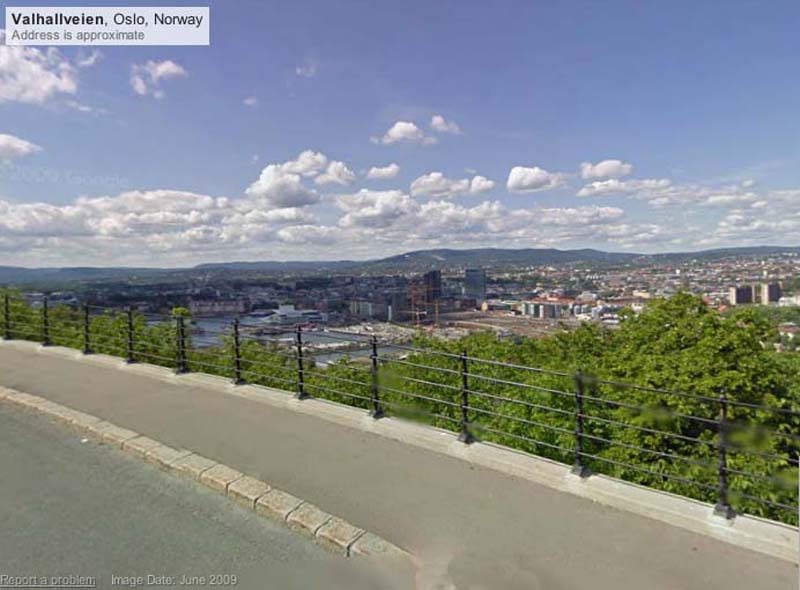
The location is believed to be an overlook on the side of a road called "Valhallveien," on a hill above Oslo. The hill is known as Ekeberg Hill, about 2 miles southeast of downtown. The winding road up to the park on the top of Ekeberg Hill was a popular place for citizens of Oslo to view the city. The hill and park were also popular places for Oslo artists to paint.
A recent photo

The painting has been called a symbolization of the anxieties of humanity in the 19th Century: It had seen the Napoleonic Wars; frequent revolutions; wars of colonialism in which the European powers had conquered "backward" natives of Africa and Asia, but still took the occasional shocking defeat from them, as Britain did at Meerut in India in 1857, Isandlwana in South Africa in 1879, and Khartoum in the Sudan in 1885; the unifications of Italy in 1860 and Germany in 1871, which upset many social orders; a worldwide "Long Depression" caused by the American stock market's Panic of 1873, and lasted until 1879; the aforementioned eruption of Krakatoa, and the environmental issues it caused; and the Industrial Revolution, which was making some men rich (or richer), but making the lives of poor people miserable, through brutally hard jobs or eliminating altogether the jobs they already had.

The painting was indicative of Munch's work from then on, including his series Frieze of Life -- A Poem about Life, Love and Death, which he began in 1893, after The Scream was first exhibited. He wrote, "No longer should interiors be painted, people reading and women knitting: there would be living people, breathing and feeling, suffering and loving."

In 1897, he returned to Oslo, where he was celebrated. He had a mental breakdown in 1908, and this caused him to give up drinking, and to paint more optimistic images. He survived both World War I (writing, "All my friends are German but it is France I love") and a bout with the Spanish Flu epidemic at its end, but not the Nazi takeover of Norway in 1940: He died at his house in Ekely, near Oslo, on January 23, 1944, at age 80.

Journalist Arthur Lubow called The Scream "A Mona Lisa for our time." Like Leonardo da Vinci's 1506 Mona Lisa, it has been endlessly parodied and homaged. Pop psychologist Arthur Janov put it on the cover of his 1970 book The Primal Scream. Macaulay Culkin's screaming pose in the 1990 film Home Alone has been compared to it. The Ghostface mask from the Scream movies that began in 1996 is a direct homage. So is the Internet's "scream emoji": 😱 

Munch painted 4 versions of The ScreamToday, the original version is in Norway's National Gallery. Another is in the Munch Museum. Both are in Oslo.

*

January 22, 1892 was a Friday. Baseball and football were out of season. Hockey was still all-amateur. And the sport of basketball had been invented only 1 month earlier. So there were no scores on this historic day.

December 31, 1999 & January 1, 2000: The Millennium

December 31, 1999:  The Millennium arrives. The people of planet Earth survived. At a terrible cost. But we hadn't destroyed ourselves. ...