Wednesday, November 30, 2022

December 1, 1898: The 1st Professional Basketball League

The 1900 Trenton Nationals

December 1, 1898: The 1st professional basketball league debuts. It is called the National Basketball League. The 1st game is played at Textile Hall, in the Kensington section of Philadelphia. The Trenton Nationals beat the Hancock Athletic Association, 21-19. Attendance was estimated at 900.

The 1898–99 season saw 6 teams in the league. Three were in Philadelphia: The aforementioned Hancock A.A., the Clover Wheelmen, and the Germantown Nationals. Three were in New Jersey: The aforementioned Nationals, the Camden Electrics, and the Millville Glass Blowers. Two of the Philly teams folded within days, but the other 4 teams finished the season.
Trenton went 18-2-1, to win the title. Their starting five averaged 5-foot-10, 161 pounds. Needless to say, there was no dunking. No one even took a jump shot or, God forbid, a skyhook. They hadn't been invented yet.
The following season was more stable for the new league. The season was divided into 2 halves. Teams in the first half were the Nationals, the Electrics, the New York Wanderers, the Pennsylvania Bicycle Club, the Bristol Pile Drivers, and the Chester Basketball Club of Chester, Pennsylvania. Chester dropped out, and were immediately replaced by the Millville Glass Blowers, who had originally elected not to participate that season. Trenton and Millville provided the best teams in the loop, with Trenton gaining a disputed championship, in which the team won both halves of the season.
The Masonic Temple, in downtown Trenton, converted its 3rd-floor banquet hall into a home court. The court was ringed by a 12-foot, chain-link "cage" separating players from fans. "The Trentons had conceived the idea that a cage would make the game faster by stopping all out-of-bounds delays," wrote Marvin Riley, the referee at that historic game. "That cage was an object of both interest and sarcasm for a long time. It was called 'Trenton's monkey cage.'"

By the 1920s, the cage had been phased out of the game. Still, headline writers fell in love with the word as a synonym for basketball, and players are sometimes still called "cagers."

When introduced, the cage made pro basketball a rough sport, as players engaged in hockey-style body checks against the wire. Frenzied fans would stick hatpins and lit cigars through the cage and into opposing players' flesh.
The NBL began the 1900–01 season with 7 teams and an expanded schedule of 32 games. The Nationals, the Glass Blowers, the Pile Drivers, the Wanderers and the Penn B.C. stayed. So did the Electrics, although they changed their name to the Camden Skeeters. Only the newest team, from Burlington, New Jersey, failed to complete the season. With the split season dropped, no playoffs were necessary, and the New York Wanderers captured the League title by 3 games.
The 1901–02 season may have been the most successful year of the NBL in terms of stability, with six strong franchises, namely the Bristol, New York, Trenton, Camden, Millville, and Philadelphia teams from the previous year. The schedule expanded once again, to 40 games. Every game save one was played as scheduled, no teams dropped out, and there was only one really weak team in the league. Camden finally became more than a .500 team, and lost the league crown to the Pile Drivers by only 3 games.
In 1902-03, the NBL went back to a split-season format. There were 8 1st-half teams: The Camden Electrics (back to the old name), the New York Wanderers, the Bristol Pile Drivers, the Philadelphia Phillies (named for the baseball team), the Trenton Potters (replacing the Nationals), Conshohocken, and the Burlington Shoe Pegs. The 2nd half of the season saw only 6 teams: Camden, Burlington, Trenton, New York, Conshohocken, and the Delaware-based Wilmington Peaches.
Burlington did so poorly that its owner-coach, Frank Reber, fired his entire team, purchased the Bristol franchise, and used Bristol's players to represent Burlington. Phillies manager and future member of the Basketball Hall of Fame, Frank Morgenweck, disbanded his Phillies team to purchase the Wilmington team. Camden, coached by Billy Morgenweck (Frank's brother), cruised to 36 wins against only 9 defeats, a winning percentage of .800.
Things did not go very well during the offseason in 1903. Only 5 teams elected to play that year. More importantly, New York, Burlington, and Wilmington, all with experienced owners and coaches, failed to return. The league began the season with only the Camden Electrics, the Trenton Potters, Conshohocken, the Millville Glass Blowers, and St. Bridget's Biddies.
Trenton dropped out on December 26, 1903, and Camden left on December 31. The National Basketball League was disbanded on January 4, 1904, not without controversy, and at least one lawsuit followed its demise. Billy Morgenweck was subsequently sued by investors in the Camden Electrics.
*

December 1, 1898 was a Thursday. If any games were played in the NBL other than the Trenton-Hancock lid-lifter, I can find no record of them. Baseball was out of season. Football was in midweek. And hockey was still all-amateur. So, as far as I can tell, Trenton 21, Hancock 19 was the only score on this historic day.

December 1, 1869: "War and Peace" Is Published

December 1, 1869: Having been serialized in magazines for the past 4 years, Leo Tolstoy's War and Peace is published in full, in book form. Voyna i mir becomes the byword for great Russian literature, but also for a very long book. Eventually, people would say, "What's taking you so long? What are you doing, reading War and Peace?" or "I could have read War and Peace in the time it took for you to (do whatever it was you did)!"

Set during the Napoleonic Wars, the work comprises both a fictional narrative and chapters in which Tolstoy discusses history and philosophy. An early version was published serially beginning in 1865, after which the entire book was rewritten and published in 1869. It is regarded, with his 1878 novel Anna Kareninaas Tolstoy's finest literary achievement, and it remains an internationally praised classic of world literature.

From the reign of Empress Catherine II, a.k.a. Catherine the Great, from 1762 to 1796, French had been the main language of the Russian imperial court, and thus French became the country's second language. This may have been a partial inspiration for Napoleon Bonaparte, who took power in 1799 and crowned himself Emperor in 1804, to invade Russia in 1812. This failed invasion, and the heroic resistance to it, provides the centerpiece of the novel.

In 1882, Pyotr Ilyich Tchaikovsky would add to the art of Russian resistance to Napoleon with his 1812 Overture. Of course, in the years to come, Russia would ally itself with France, and Britain, in the Triple Entente, and, like those nations, ally itself against Germany.

Tolstoy died on November 20, 1910, of pneumonia, at the age of 82. Indeed, 1910 was a bad year for writing, as Tolstoy, Mark Twain, Jules Renard, William James and Julia Ward Howe all died. Tolstoy had lived to see Russia's defeat by Japan in 1905, but would not live to see the nation shattered by World War I and the Bolshevik Revolution.

Bernard Montgomery, who would become Britain's top military leader of World War II, would write, "Rule 1, on page 1 of The Book of War, is: 'Do not march on Moscow.' Various people have tried it, Napoleon and Hitler, and it is no good. That is the first rule. I do not know whether your Lordships will know Rule 2 of War. It is: 'Do not go fighting with your land armies in China.' It is a vast country, with no clearly defined objectives."

*

December 1, 1869 was a Friday. There were no scores on this historic day: It was too cold for baseball, the first college football season in America had already ended, English soccer was still all-amateur, and basketball and ice hockey hadn't yet been invented.

November 30, 2013: Kick Six In the Iron Bowl

November 30, 2013: The Iron Bowl is played at Jordan-Hare Stadium, in the City of Auburn, in the State of Alabama.

The annual football game between the University of Alabama, in Tuscaloosa, and Auburn University is called the Iron Bowl because of the iron and steel production in Alabama. The State's largest city, Birmingham, and 2 others, Leeds and Sheffield, are steel production cities, and were named after steel production cities in England, all of them in love with a game they call football, but which Americans call soccer.

Football became a way of life in Alabama. and the University of Alabama, the Crimson Tide, built a great program in the 1920s. Auburn's took longer to get going, with coach Ralph "Shug" Jordan (and that's pronounced JUR-din, not JOHR-din) leading them to a share of the 1957 National Championship with Ohio State.

Paul "Bear" Bryant, who had played on 'Bama's 1934 National Championship team, became their head coach in 1958, and, for many people, even outside the South, became the college football coach. He won more games than any coach before him, and more than most coaches since him. He won 6 National Championships, probably should have been awarded at least 1 more, made his houndstooth hat an icon of American sports, and inspired this joke: "In Alabama, an atheist is someone who doesn't believe in Bear Bryant."

In the 1980s, as Bryant retired and died, Pat Dye rebuilt the Auburn program. The Alabama Sports Hall of Fame in Birmingham features a statue of three men: A generic football player, who by his facial features could be either black or white, with Bryant and Dye standing on either side of him, each with a hand on the player's shoulder pads.

Nick Saban, son of AFL Championship-winning Buffalo Bills coach Lou Saban, had won a National Championship at Louisiana State in 2003, and Alabama hired him in 2007. He won National Championships in 2009, 2011 and 2012. He went into the 2013 Iron Bowl 11-0, ranked Number 1 in the country. He had won away to Texas A&M when they were ranked Number 6, and that was the only team to come close to beating 'Bama to that point. He also beat his former team, LSU, when they were ranked Number 10.

Gus Malzahn became Auburn's head coach in 2013, after having been an assistant to Gene Chizik, including on Auburn's National Championship team of 2010. He got the Tigers to a 10-1 record, losing only to LSU, then ranked Number 6, away. Auburn went into the Iron Bowl ranked Number 4. But they were a 10-point underdog to Alabama.

It was understandable: Alabama was in the 1st tier of great college football programs, Auburn in the 2nd tier at best; and Alabama's glories, and their fans' teasing of Auburn as a rural "cow college" gave them an inferiority complex. To put it another way: Alabama hate losing to Auburn mainly because they hate losing, period; whereas Auburn could go 0-10 before the Iron Bowl, but if they win it, that makes it a successful season.

And so the 2013 Iron Bowl was set. Alabama came in ranked Number 1 in the country; Auburn, Number 4. The winner of the game would win the Southeastern Conference Western Division Championship, go to the SEC Championship Game, and have a good shot at the National Championship.

Auburn led 7-0 after the 1st quarter, but Alabama led 21-14 at the half. At the time, under Saban, 'Bama's record when leading at the half was 73-3. But Auburn tied it 21-21 after 3 quarters. Three times, once on a block, 'Bama missed field goals. But in the 4th quarter, Auburn downed a punt at the 'Bama 1-yard line, and A.J. McCarron threw a 99-yard touchdown pass to Amari Cooper. With 2:41 left, it was 28-21 Alabama.

With 32 seconds left, Nick Marshall threw a 39-yard touchdown pass to Sammie Coates. Deciding that tying it and trying to win in overtime would be easier than attempting a 2-point conversion now, Malzahn had the extra point kicked, and it was 28-28.

Alabama had 1 more chance. With 7 seconds left, T.J. Yeldon advanced the ball to the Auburn 38, and the clock ran out. Saban asked for a replay review, saying the clock hadn't run out before Yeldon went out of bounds. The replay proved him right. Saban called for a field goal attempt, from 57 yards out.

According to the rules, if a field goal is missed, and the opposing team recovers it, it can be advanced. So Malzahn's defensive coordinator, Ellis Johnson, suggested putting a receiver in the end zone. Malzahn chose the team's main punt returner, Chris Davis.

Cade Foster, who had once kicked a 53-yard field goal, had missed 3 attempts in this game, 1 of them blocked. So Adam Griffith was sent in to try the 57-yarder. It was on target, but a little short, and Davis caught it, 9 yards deep in the end zone.

He started running straight ahead, then turned to his left, and ran down the sideline. Saban had made a critical mistake: Except for the kicker and the holder, the field goal unit was made up of all offensive linemen. No one had enough speed to catch him. He ran 109 yards, into the end zone. Final score: Auburn 34, Alabama 28.

(In NCAA history, only 1 other player had ever done that -- and it was earlier that year, for LSU, by future pro receiving star Odell Beckham Jr.)

Rod Bramblett had the call for Auburn's radio network:

Chris Davis is going to drop back into the end zone in single safety. Well, I guess if this thing comes up short, he can field it and run it out.

Alright, here we go. 56-yarder, it's got, no, it does not have the leg. And Chris Davis takes it in the back of the end zone. He'll run it out to the 10, 15, 20, 25, 30, 35, 40, 45, 50, 45! There goes Davis! (His partner, former Auburn quarterback Stan White, shouts "Oh my God! Oh my God!") Davis is going to run it all the way back! Auburn's gonna win the football game! AUBURN'S GONNA WIN THE FOOTBALL GAME! He ran the missed field goal back! He ran it back 109 yards!

[fans streaming onto the field] They're not gonna keep them off the field tonight! Holy Cow! Oh, my God! Auburn wins! Auburn has won the Iron Bowl! Auburn has won the Iron Bowl in the most unbelievable fashion you will ever see! I cannot believe it! 34–28! And we thought "A Miracle in Jordan-Hare" was amazing! Oh, my Lord in Heaven!' Chris Davis just ran it 109 yards and Auburn is going to the Championship Game!

The crowd reaction registered on seismographs across the state of Alabama, in a manner similar to activity registered during the 1988 "Earthquake Game," a 7-6 LSU win over Auburn.

As returning an interception for a touchdown is known as a pick six, this became known as the Kick Six. It rivals California vs. Stanford, another nasty rivalry, and "The Play" in 1982, for the honor of the most famous kick return in football history. Certainly, no pro kick return is on this level, not even the Tennessee Titans' 2000 "Music City Miracle."

Auburn beat Missouri in the SEC Championship Game, but lost to Florida State in the National Championship Game.

Chris Davis played for the San Diego Chargers in 2014, and the San Francisco 49ers in 2015 and '16, but injuries cut short his playing career. He has since joined the coaching staff at an Alabama high school.

Adam Griffith received death threats for missing that kick. Death threats? It was 57 yards! On real grass, not artificial turf. And he was a freshman. It was hardly his fault he missed. How about blaming everybody else on offense for not getting into his range? Or for having 109 yards in which to stop the return and not stopping it? How about blaming Nick Saban for not warning about the possibility?

That game reminded a lot of people of why they loved football. But those threats are a reminder of how sick some people can be.

In 2014, Griffith kicked a game-tying field goal against LSU on the last play of the 4th quarter. Alabama won in overtime, 20–13. In 2015, he kicked a career-long 55-yard field goal against LSU. Later that season, he went 5-for-5 in the Iron Bowl, as Alabama beat Auburn, 29–13. And in that season's National Championship Game, against Clemson, he made a perfectly placed onside kick, to help the Crimson Tide achieve a 45–40 victory. Still, he was not selected in the NFL Draft, and went into the construction business in South Carolina.

*

November 30, 2013 was a Saturday. Other noteworthy college football games played that day:

* Rivalry: Number 2 Florida State beat Florida, 37-7 at Ben Hill Griffin Stadium in Gainesville, Florida.

* Rivalry: Number 3 Ohio State won a thriller against Michigan, 42-41 at Michigan Stadium in Ann Arbor, Michigan.

* Number 5 Missouri beat Number 19 Texas A&M, 28-21 at Faurot Field in Columbia, Missouri.

* Number 8 Stanford beat Number 25 Notre Dame, 27-20 at Stanford Stadium in Palo Alto, California.

* Number 9 Baylor beat Texas Christian (TCU), 41-38 at Amon G. Carter Stadium in Fort Worth, Texas.

* Rivalry: Number 10 South Carolina beat Number 6 Clemson, 31-17 at Williams-Brice Stadium in Columbia, South Carolina.

* Number 11 Michigan State beat Minnesota, 14-3 at Spartan Stadium in East Lansing, Michigan.

* Rivalry: Number 13 Arizona State beat Arizona, 58-21 at Sun Devil Stadium in Tempe, Arizona.

* Number 14 Wisconsin lost to Penn State, 31-24 at Camp Randall Stadium in Madison, Wisconsin.

* Rivalry: Number 22 UCLA beat Number 23, USC at the Los Angeles Memorial Coliseum.

* Rivalry: Number 24 Duke beat North Carolina, 27-25 at Kenan Stadium in Chapel Hill, North Carolina.

* Rivalry: Indiana beat Purdue, 56-36 at Memorial Stadium in Bloomington, Indiana.

* And Rutgers lost to Connecticut, 28-17 at Rentschler Field in East Hartford, Connecticut.

There were 7 games played in the NBA that day:

* The Brooklyn Nets beat the Memphis Grizzlies, 97-88 at the FedEx Forum in Memphis.

* The Washington Wizards beat the Atlanta Hawks, 108-101 at the Verizon Center (now the Capital One Arena) in Washington.

* The Cleveland Cavaliers beat the Chicago Bulls, 97-93 at the Quicken Loans Arena (now the Rocket Arena) in Cleveland.

* The Milwaukee Bucks beat the Boston Celtics, 92-85 at the Bradley Center in Milwaukee.

* The Minnesota Timberwolves beat the Dallas Mavericks, 112-106 at the American Airlines Center in Dallas.

* The Houston Rockets beat the San Antonio Spurs, 112-106 at the AT&T Center (now the Frost Bank Center) in San Antonio. James Harden led all scorers on the night with 31 points.

* The Utah Jazz beat the Phoenix Suns, 112-104 at the US Airways Center (now the Mortgage Matchup Center) in Phoenix.

And there were 11 games played in the NHL:

* The New York Rangers beat the Vancouver Canucks, 5-2 at Madison Square Garden.

* The New York Islanders lost to the Washington Capitals, 3-2 at the Nassau Coliseum. Alexander Ovechkin won it with 2:53 left in overtime.

* The New Jersey Devils beat the Buffalo Sabres, 1-0 at the Prudential Center in Newark. Steve Bernier won it with 41 seconds left in overtime.

* In the opener of CBC's Saturday Hockey Night In Canada doubleheader, the Montreal Canadiens beat their arch-rivals, the Toronto Maple Leafs, 4-2 at the Bell Centre in Montreal.

* The Boston Bruins beat the Columbus Blue Jackets, 3-1 at the TD Garden in Boston.

* The Pittsburgh Penguins beat the Florida Panthers, 5-1 at the BB&T Center (now the Amerant Bank Arena) in the Miami suburb of Sunrise, Florida.

* The Philadelphia Flyers beat the Nashville Predators, 3-2 in a shootout at the Bridgestone Arena in Nashville.

* The Colorado Avalanche beat the Minnesota Wild, 3-2 in a shootout at the Pepsi Center (now the Bell Arena) in Denver.

* The Chicago Blackhawks beat the Phoenix Coyotes, 5-2 at the Jobing.com Arena (now the Desert Diamond Arena) in the Phoenix suburb of Glendale, Arizona.

* In the 2nd half of the HNIC doubleheader, the Calgary Flames beat the Los Angeles Kings, 2-1 at the Staples Center (now the Crypto.com Arena) in Los Angeles.

* The San Jose Sharks beat the Anaheim Ducks, 4-3 in a shootout at the SAP Center in San Jose.

And in English soccer, whose Football Association includes 5 "member clubs' from adjoining Wales, North London team Arsenal beat Cardiff City, 3-0 at Cardiff City Stadium.

November 30, 1979: Pink Floyd Release "The Wall"

Left to right: Roger Waters, Nick Mason
David Gilmour and Rick Wright

November 30, 1979: British "progressive rock" band Pink Floyd release their concept album The Wall. It exceeds their 1973 album Dark Side of the Moon, a concept album about mental illness and greed, as their signature work.

(Alecia Moore, the singer known as Pink, was born a few weeks before The Wall was released. Although she has written some deeply emotional songs, she has never suggested that Pink Floyd has been an influence on her work.)

Given that it was released in the year when an election put a Conservative Party government led by right-wing icon Margaret Thatcher into power in the band's home country of Great Britain, a fan hearing this album for the first time could be excused for thinking it's about Thatcher's policies and the effects they were already having. In fact, the source of the album's themes of alienation and hopelessness predated that election by 2 years.

In 1977, touring for their album In the Flesh, bass guitarist and singer-songwriter Roger Waters began to feel that the audience was not listening. The band was now big enough to play multipurpose sports stadiums, where some fans were sitting so far away, Waters though they couldn't see the band. This was before rock concerts began to use giant video screens. He said, "It became a social event rather than a more controlled and ordinary relationship between musicians and an audience." In July 1977, on the tour's final date, at the Olympic Stadium in Montreal, a group of noisy and excited fans near the stage irritated Waters so much that he spat on one of them. Rock fans expected that from punk groups like the Sex PIstols, but not from Pink Floyd.

The Wall is a rock opera that explores abandonment and isolation, symbolized by a wall. The songs create an approximate storyline of events in the life of the protagonist, Pink, a character based on a combination of Waters himself and original band member Syd Barrett, who had to be phased out in 1968 due to his advancing mental illness. 

Waters' father was killed while fighting in World War II, so that was written into the protagonist's story, so that it was where he starts to build a metaphorical wall around himself, resulting in the song "Another Brick in the Wall, Part 1." His teachers are physically and verbally abusive, and that inspires the most famous lines in the entire Floyd canon, from "Another Brick in the Wall, Part 2," which hit Number 1 in America in March 1980:

We don't need no education.We don't need no thought control.No dark sarcasm in the classroom.Teacher, leave them kids alone.
Hey! Teacher! Leave them kids alone!All in all, it's just another brick in the wall!All in all, you're just another brick in the wall!
He grows up to become a rock star, and gets married, but, while he's on the road, he cheats on his wife, and she cheats on him. With "Another Brick in the Wall, Part 3," his wall is complete: No feelings reach him, and no people reach him. He quickly realizes that this was a mistake, leading to the song "Hey You." He becomes catatonic, and his handlers have to give him a drug to make him stageworthy. This leads to the song "Comfortably Numb," is based on Waters' taking an injection of a muscle relaxant to fight the effects of hepatitis during the aforementioned tour.

But the drug makes him hallucinate that he's a fascist dictator, telling ethnic minorities to "Run Like Hell." He puts himself on trial, and his "inner judge" orders him to tear down the wall, where he finally rejoins the outside world.

Backing vocalists included Bruce Johnston of The Beach Boys and Toni Tennille of The Captain & Tennille. Jazz drummer Joe Porcaro played instead of Nick Mason on "Bring the Boys Back Home," and his son Jeff Porcaro, one of rock's top session drummers in the 1970s, played them on "Mother." The kids singing on "Another Brick in the Wall, Part 2" were the Chorus of Islington Green School in North London, now named City of London Academy Islington.

The album was a huge success, and launched a new tour. On that tour, as the band played, a wall was gradually built between them and the audience, until it reached a height of 40 feet. The tour was not a big success, losing £400,000 -- almost $1 million then, and about $3.37 million in 2022 money. The bandmembers were getting sick of each other: Waters and lead guitarist David Gilmour were barely on speaking terms, and keyboardist Rick Wright left afterward. Waters left for a solo career in 1985.

Pink Floyd occasionally reunited until Wright died in 2008. Those reunions never included Barrett, who became a recluse, gaining income by selling paintings, and died in 2006. As of November 30, 2022, Waters is 79, Mason is 78, and Gilmour is 76.

I can't stand Pink Floyd. In the 1980s, I had a girlfriend who was the youngest of 3 sisters, and the middle sister played The Wall over and over again. I found it depressing as hell, and I was already pretty depressed. What I didn't know at the time was that the sisters (there were 3 of them) were watching their parents' marriage dissolve, and the middle sister took it the hardest. All 3 eventually recovered, but, unlike some other bands I didn't like at that age, including AC/DC and Judas Priest, I never came around to liking Pink Floyd.

A little more than a year after the album came out, Ronald Reagan was elected President, and cut spending on education so much that it seemed like he really did believe we didn't "need no education." And Thatcher governed like she agreed. The result was a generation that, in both countries, bought the conservative movement's lies. Gee, thanks, Roger Waters.

UPDATE: It took me until 2024 to think of this, but the 1970s were Schrödinger's Decade. There was too much overwrought music, and, at the same time, not enough of it.

*

November 30, 1979 was a Friday. Baseball was out of season.  Football was in midweek. There were 9 games played in the NBA:

* The New York Knicks lost to the Boston Celtics, 100-97 at the Boston Garden.

* The New Jersey Nets beat the Denver Nuggets, 127-118 at the Rutgers Athletic Center (now the Jersey Mike's Arena) in Piscataway, New Jersey. Mike Newlin scored 39 points for the Nets.

* The Philadelphia 76ers beat the San Diego Clippers, 104-101 at The Spectrum in Philadelphia.

* The Indiana Pacers beat the Washington Bullets, 99-91 at the Capital Centre in the Washington suburb of Landover, Maryland.

* The Houston Rockets beat the Atlanta Hawks, 106-95 at The Summit in Houston. (The arena has since been converted into the Central Campus of the Lakewood Church, Dr. Joel Osteen's "megachurch.")

* The San Antonio Spurs beat the Portland Trail Blazers, 107-100 at the HemisFair Arena in San Antonio.

* The Seattle SuperSonics beat the Kansas City Kings, 107-102 in overtime at the Kemper Arena (now the Hy-Vee Arena) in Kansas City. Gus Williams scored 37 for the defending NBA Champion Sonics.

* The Chicago Bulls beat the Los Angeles Lakers, 107-100 at The Forum outside Los Angeles in Inglewood, California.

* The Utah Jazz beat the Golden State Warriors, 112-104 at the Oakland Coliseum Arena. Adrian Dantley scored 39 points.

And there were 3 games in the NHL:

* The Hartford Whalers beat the Pittsburgh Penguins, 7-5 at the Springfield Civic Center (now the MassMutual Center) in Springfield, Massachusetts, 26 miles north of their usual home, the Hartford Civic Center (now the XL Center) in Hartford, Connecticut, which was being rebuilt after snow caved in the roof in 1978.

Mark Howe scored 2 goals, the 214th and 215th of his major league career (if you count the World Hockey Association, from whence the Whalers came, as a major league; and his father, 51-year-old Gordie Howe, scored 1, the 969th of his career, his 795th in NHL play.

* The Edmonton Oilers beat the New York Islanders, 5-3 at the Northlands Coliseum in Edmonton. Wayne Gretzky scored "only" 1 goal for the Oilers, while Duane Sutter scored 2 for the Isles.

* And the Chicago Black Hawks and the Vancouver Canucks played to a tie, 1-1 at the Pacific Coliseum in Vancouver.

November 30, 1974: The Anthony Davis Game

November 30, 1974: The University of Southern California hosts the University of Notre Dame in football at the Los Angeles Memorial Coliseum.

USC vs. Notre Dame is the biggest inter-sectional rivalry in American college football, and has been since it was established in 1926. No other pair of traditional rivals has as many National Championships, or as many Heisman Trophy winners. Notre Dame has had more 1st-round picks in the NFL Draft than any other school, and USC is 2nd in that regard. And both teams' fans are regarded as insufferable by pretty much everyone who hasn't bought into the schools' respective myths.

In odd-numbered years, the game is played at Notre Dame Stadium in South Bend, Indiana, in mid-to-late October, when the leaves are changing. In even-numbered years, the game is played at the Los Angeles Memorial Coliseum, on the Saturday of Thanksgiving weekend, when it would be too cold to play it in the Midwest.

It had been 10 years since USC had upset Notre Dame to end their National Championship hopes. Since then, Ara Parseghian had led Notre Dame to the National Championship in 1966 and 1973, and John McKay had led USC to it in 1967 and 1972, and were both still in charge.

Notre Dame went into the game at 9-1. Their only loss had been at home to Purdue. Their only ranked opponent was Number 17 University of Pittsburgh, whom they beat at home. Nevertheless, being Notre Dame, they were still the media darlings, and were ranked Number 5.

USC came in at 8-1-1. They lost their opener away to Number 20 Arkansas. But they beat Pitt, who were then ranked Number 8, away. They were held to a tie by the University of California at home. The week before, they beat UCLA to clinch the Pacific-Eight Conference title, and were ranked Number 8 coming in. As usual, ABC broadcast the game nationally.

Notre Dame took a 24-0 lead in the 2nd quarter. In 2021, for a USC-themed website, Trojan linebacker Kevin Bruce wrote:

The entire game was the typical uber-physical and nasty play on the field. Lots of punching, poking, grabbing and chippy-yacking after most plays. It was only the vague deep-down stirring of playing disciplined football just in case we could claw our way back into this game that prevented a fullout bar fight on the field in the first, as had happened several times in the last few years.

USC scored a touchdown before the end of the half, but the extra point was blocked: 24-6. McKay told his team at intermission that they still had a very good chance to win if they just calmed down, focused on scoring on their opening drive of the 2nd half, and executed better on defense.

(McKay liked to use the word "execution." In 1976, he left USC to become the 1st coach of an NFL expansion team, the Tampa Bay Buccaneers. He went from 3 National Championships to an 0-26 start. When asked what he thought of his team's "execution," he said, "I'm for it.")

Bruce again:

I'm delighted to be able to tell you as an eyewitness and active participant what really happened on that magical day in November 1974. This was the day that Sports Illustrated called "17 minutes that shook LA." This was an earthquake that was very selective. Only Notre Dame was damaged by it, which I for one, think is a best practice. The only thing missing was Traveler stomping on that annoying little green leprechaun. 

In the 1961 Rose Parade in Pasadena, a USC events director saw Richard Saukko riding his white horse, Traveler. Saukko was talked into riding his horse around the Coliseum track at USC football games. The tradition has continued. The rider is often called Tommy Trojan, like the famous on-campus statue, but the character does not have an official name. The rider continues to ride a horse named Traveler around the field before every game, after every win, and following every touchdown, although the Coliseum's 1995 renovation has removed the track.

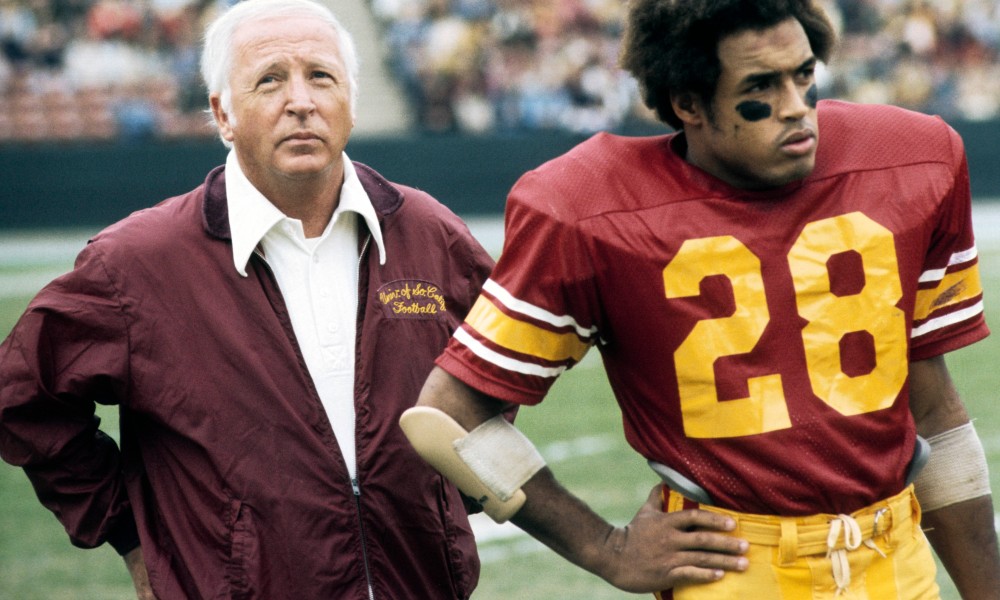
Notre Dame kicked off to start the 2nd half, and Anthony Davis returned the ball 102 yards for a touchdown. He scored twice more, as USC put up 49 points in 16 minutes and 31 seconds of game time, to win going away, 55-24.

Davis later said that, on his last run into the end zone, he saw a nun waving a crucifix at him, saying, "You must be the Devil! Nobody does that to Notre Dame!" Well, Anthony Davis did that to Notre Dame.
John McKay and Anthony Davis

Joe Jares, the Sports Illustrated writer quoted above by Bruce, said that the loss was "the worst disaster for the Irish since the potato famine." This was the final regular season game for Notre Dame's Hall of Fame head coach Ara Parseghian, who announced his retirement after the year. Parseghian was sick over what transpired and reportedly said "he was damn tired" of seeing Traveler running around the track every time USC scored.

USC fans call it "The Comeback." Notre Dame fans call it "That Game," or worse. USC had already clinched the title in the league then known as the Pacific-Eight Conference the week before, beating intra-city rival UCLA.

Davis finished 2nd in the Heisman Trophy voting, to Ohio State running back Archie Griffin. He played in 4 different professional football leagues: The World Football League (WFL), with the Southern California Sun in 1975; the Canadian Football League (CFL), with the Toronto Argonauts in 1976; the NFL, with McKay's Tampa Bay Buccaneers in 1977, the Houston Oilers in 1978, and the Los Angeles Rams, back at the Coliseum and again with Haden as quarterback, later in 1978; and the United States Football League (USFL), with the Los Angeles Express, again at the Coliseum, in 1983.

He later became a successful real estate developer, but, like so many other football players, his head-on collisions led to CTE and brain impairment. As of November 30, 2022, he is still alive.

*

November 30, 1974 was a Saturday. These other notable college football games were played that day:

* Rivalry: Number 1 Oklahoma beat Oklahoma State, 44-13 at Owen Field in Norman. The Sooners won the Big Eight Conference title, and were undefeated at 11-0. However, they were on probation, due to recruiting violations, and were not eligible for the UPI coaches' poll National Championship, or a bowl game appearance, or even a television appearance. Nevertheless, the AP sportswriters' poll awarded them their National Championship.

* Number 16 Baylor beat Rice, 24-3 at Baylor Stadium (later Floyd Casey Stadium) in Waco, Texas. Baylor clinched the Southwest Conference title.

* Rivalry: Navy beat Army, 19-0 at John F. Kennedy Stadium in Philadelphia.

* Rivalry: Boston College beat Holy Cross, 38-6 at Alumni Stadium outside Boston in Chestnut Hill, Massachusetts.

* Rivalry: Georgia Tech beat Georgia, 34-14 at Sanford Stadium in Athens.

* Rivalry: Florida beat Miami, 31-7 at Florida Field in Gainesville.

* Rivalry: Heavily favored Tennessee were held to a tie by Vanderbilt, 21-21 at Dudley Field (now FirstBank Stadium) in Nashville.

* Mississippi (Ole Miss) beat Tulane, 26-10 at Tulane Stadium in New Orleans. This was Tulane's last game at their old stadium. The following season, they moved into the Superdome.

* Louisiana State (LSU) beat Utah, 35-10 at Tiger Stadium in Baton Rouge, Louisiana. I have no idea why this one was set up: It sounds more like a bowl game.

* Rivalry: Arizona beat Arizona State, 10-0 at Arizona Stadium in Tucson.

* And Rutgers lost to Hawaii, 28-16 at Honolulu Stadium. Hawaii played 1 more game there, losing to Arizona State the next week, and opened the new Aloha Stadium the next season.

* The day before, Number 2 Alabama beat Number 7 Auburn, 17-13 at Legion Field in Birmingham. 'Bama won the Southeastern Conference title.

* Also the day before, Number 17 Texas upset Number 8 Texas A&M, 32-3 at Memorial Stadium in Austin.

* And the day before that, Thanksgiving, Number 10 Penn State beat Number 18 Pittsburgh, 31-10 at Three Rivers Stadium in Pittsburgh. Penn State went on to beat Baylor in the Cotton Bowl.

* Number 8 Nebraska were idle, having lost a game, and the Big 8 title, to Oklahoma the week before. They beat Florida in the Sugar Bowl.

* Number 3 Ohio State were idle, having beaten then-Number 2 Michigan for the Big Ten Conference title. USC, with Davis, went on to beat Ohio State, with Griffin, in the Rose Bowl. With Number 1 Oklahoma (through their own fault) and Number 5 Michigan (through a dumb Big 10 rule) both ineligible for a bowl, and Number 2 Alabama and Number 3 Ohio State both losing their bowl games, the latter to Number 5 Ohio State, UPI named USC its National Champion.

Notre Dame went on to beat Alabama in the Orange Bowl. It was Parseghian's last game: He retired, and joined ABC's broadcast crew. Dan Devine succeeded him as head coach. A year after that, McKay left for Tampa Bay, and was succeeded by John Robinson.

Baseball was out of season. There were 6 games in the NBA:

* The New York Knicks beat the Buffalo Braves, 118-111 at Madison Square Garden. Bob McAdoo scored 36 points and grabbed 18 rebounds in defeat for the Braves.

* The Washington Bullets beat the Seattle SuperSonics, 122-90 at the Capital Centre in the Washington suburb of Landover, Maryland.

* The Milwaukee Bucks beat their arch-rivals, the Chicago Bulls, 101-99 in double overtime at the Milwaukee Exposition, Convention Center and Arena, or "The MECCA." Since 2014, it has been named the UW-Panther Arena.

* The Phoenix Suns beat the Houston Rockets, 112-100 at the Arizona Veterans Memorial Coliseum in Phoenix.

* The Golden State Warriors beat their arch-rivals, the Los Angeles Lakers, 128-118 at the Oakland Coliseum Arena. Rick Barry scored 43 points.

* And the Portland Trail Blazers beat the New Orleans Jazz, 117-85 at the Portland Memorial Coliseum.

There were 4 games in the American Basketball Association:

* The Virginia Squires beat the Indiana Pacers, 121-120 at the Hampton Coliseum outside Norfolk in Hampton, Virginia. George McGinnis scored 38 in defeat for the Pacers.

* The Kentucky Colonels beat the San Diego Conquistadors, 109-100 at Freedom Hall in Louisville, Kentucky.

* The Utah Stars beat the San Antonio Spurs, 110-103 at the HemisFair Arena in San Antonio.

* And the Denver Nuggets beat the Spirits of St. Louis, 128-109 at the Denver Auditorium Arena.

There were 7 games in the NHL:

* The New York Islanders lost to the Vancouver Canucks, 3-0 at the Pacific Coliseum in Vancouver.

* The Montreal Canadiens beat the St. Louis Blues, 7-1 at the Montreal Forum.

* The Toronto Maple Leafs beat the Washington Capitals, 7-1 at Maple Leaf Gardens in Toronto.

* The Buffalo Sabres and the Pittsburgh Penguins played to a tie, 5-5 at the Civic Arena in Pittsburgh.

* The Minnesota North Stars beat the Chicago Black Hawks, 5-3 at the Metropolitan Sports Center in the Minneapolis suburb of Bloomington, Minnesota.

* The Detroit Red Wings beat the Kansas City Scouts, 1-0 at the Kemper Arena (now the Hy-Vee Arena) in Kansas City.

* The Los Angeles Kings beat the Boston Bruins, 2-0 at The Forum outside Los Angeles in Inglewood, California.

* And the New York Rangers, the Philadelphia Flyers, the California Golden Seals and the Atlanta Flames were not scheduled.

There were 2 games in the World Hockey Association. The Chicago Cougars beat the Minnesota Fighting Saints, 7-5 at the St. Paul Civic Center in St. Paul, Minnesota. And the Cleveland Crusaders beat the Houston Aeros, 5-4 at the Sam Houston Coliseum in Houston.

And in English soccer, Arsenal beat Yorkshire team Middlesbrough, 2-0 at the Arsenal Stadium, a.k.a. Highbury, in North London.

November 30, 1971: "Brian's Song" Premieres

James Caan as Brian Piccolo (left)
and Billy Dee Williams as Gale Sayers

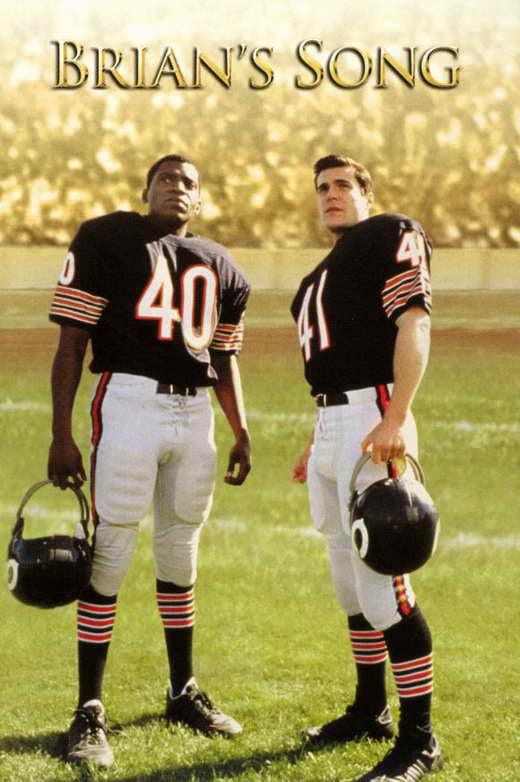
November 30, 1971: The ABC Tuesday Night Movie airs the film Brian's Song. Billy Dee Williams plays African-American Chicago Bears running back Gale Sayers, and James Caan plays his white teammate Brian Piccolo.

While some dramatic license was taken, the story is mostly true: The two men overcome their respective biases and form a bond of friendship, first with Piccolo helping Sayers, the best running back in the game in the late 1960s, return from a devastating knee injury; then with Sayers helping Piccolo deal with the cancer that struck him, and ultimately brought his life to a close on June 16, 1970.

The film made stars of both Williams and Caan, and is often regarded as the first movie that allowed tough guys to cry.

A remake was made, airing on ABC almost exactly 30 years later, on December 2, 2001. The additional 30 years of changing sensibilities allowed some things to be filmed that couldn't be put on TV for the original. Sayers was played by Mekhi Phifer, and Piccolo by Sean Maher.
Phifer and Maher in the remake

By a coincidence, Sayers wore uniform Number 40, and Piccolo Number 41. Thus, they were given lockers next to each other. Both numbers were retired by the team.

*

November 30, 1971 was a Tuesday. Actress Jessalyn Gilsig was born. So was Kristi Noem, elected Governor of North Dakota as a Republican. (UPDATE: Donald Trump appointed her Director of Homeland Security for his 2nd term.)

Baseball was out of season. Football was in midweek. There were 6 games played in the NBA that night:

* The New York Knicks lost to the Seattle SuperSonics, 110-109 at Madison Square Garden.

* The Cincinnati Royals beat the Baltimore Bullets, 118-103 at the Baltimore Civic Center (now the CFG Bank Arena).

* The Houston Rockets beat the Buffalo Braves, 115-101 at the Buffalo Memorial Auditorium.

* The Chicago Bulls beat the Atlanta Hawks, 86-85 at the Chicago Stadium.

* The Golden State Warriors beat the Milwaukee Bucks, 106-103 at the Milwaukee Arena. In 1974, it was renamed the Milwaukee Exposition, Convention Center and Arena, or "The MECCA." Since 2014, it has been named the UW-Panther Arena. Kareem Abdul-Jabbar had 30 points and 24 rebounds, but the Warriors had a more balanced attack. Four players had at least 20 points, led by Joe Ellis, who didn't even start, with 25.

* And the Phoenix Suns beat the Portland Trail Blazers, 121-111 in overtime at the Portland Memorial Coliseum.

There were 4 games played in the American Basketball Association:

* The Virginia Squires beat the Pittsburgh Condors, 134-129 at the Civic Arena in Pittsburgh. Charlie Scott led all scorers on the night with 46 points for the Squires.

* The Indiana Pacers beat the Memphis Pros, 114-88 at the Mid-South Coliseum in Memphis.

* The Denver Rockets beat the Dallas Chaparrals, 106-91 at the Denver Auditorium Arena. The Chaps became the San Antonio Spurs in 1973, and the Rockets, anticipating entering the NBA where there was already a Houston Rockets, became the Denver Nuggets in 1974.

* And the Utah Stars beat the Miami Floridians, 127-114 at the Salt Palace in Salt Lake City.

There were 2 games played in the NHL that night. The St. Louis Blues beat the California Golden Seals, 5-2 at the St. Louis Arena. And the Vancouver Canucks beat the Chicago Black Hawks, 4-2 at the Pacific Coliseum in Vancouver. 

November 30, 1965: Ralph Nader Publishes “Unsafe At Any Speed”

November 30, 1965: Ralph Nader, then 31 years old, publishes Unsafe At Any Speed: The Designed-In Dangers of the American Automobile. It accused car manufacturers of resistance to the introduction of safety features, like seat belts, and their general reluctance to spend money on improving safety.

In particular, the book profiled the Chevrolet Corvair. As the name suggested, it was a combination of the sporty Corvette and the full-size Bel Air. It was produced for the model years 1960 to 1969. Like the Volkswagen Beetle, it had a rear engine. This, along with rear swing axles, seemed to make it, as the title of Nader's book suggested, unsafe at any speed. For the 1970 model year, Chevy replaced it with the Vega.
1965 Chevrolet Corvair

The book resulted in the creation of the U.S. Department of Transportation in 1966, and the predecessor agencies of the National Highway Traffic Safety Administration in 1970. Along with the gas crisis of 1973-74, it also led to the national speed limit of 55 miles per hour, which lasted from 1974 to 1995.

Ralph Nader did a lot of good with this book. The consumer-advocacy group he led, nicknamed Nader's Raiders, did some more good. A pity his ego led him to run for President in 2000, causing the Administration of George W. Bush, the most un-Nader-like President we've ever had.

As of November 30, 2022, Nader is still alive.

*

November 30, 1965 was a Tuesday. Actor Ben Stiller was born, the son of the husband & wife comedy team of Jerry Stiller & Anne Meara.

Baseball was out of season. Football was in midweek. No games were scheduled in the NHL. There were 3 in the NBA:

* The New York Knicks beat the St. Louis, Hawks, 138-119 at the old Madison Square Garden. Dick Barnett scored 36 points.

* The Baltimore Bullets beat the Philadelphia 76ers, 129-108. Despite the loss, Wilt Chamberlain scored 41 points and grabbed 33 reboounds.

* And the Cincinnati Royals beat the Los Angeles Lakers, 126-120 at the Cincinnati Gardens. Oscar Robertson matched Wilt with 41 points.

November 30, 1951: The New Jersey Turnpike Opens

November 30, 1951: The New Jersey Turnpike opens, mostly. For the moment, it runs from Exit 1 in Penns Grove, near the newly-opened Delaware Memorial Bridge, to Exit 11 in Woodbridge, an interchange with U.S. Route 1, U.S. Route 9, State Route 440, and, by 1956, the Garden State Parkway. (On that road, that interchange will be Exit 129.)

Like the later Garden State Parkway, the Turnpike was the brainchild of Governor Alfred E. Driscoll. He set a November 30, 1951 deadline, and there were delays that suggested they wouldn't make it. They did.

The Turnpike was extended to its full 117-mile length the next year, connecting with New York City via the Lincoln Tunnel (Exit 16) and the George Washington Bridge (Exit 18). One notable problem was the Pulaski Skyway, which has carried Routes 1 and 9 from Newark to Jersey City since 1932. If they built the Turnpike under the Skyway, there might not be enough room for trucks to fit. If they built the Turnpike over the Skyway, there would be room, but construction would take a lot more time and money. They decided to build under, and no truck has ever gotten stuck under it. Just in case, a few years ago, a big construction project was undertaken, and it lowered the roadway.

In 1956, the Newark Bay Extension opened at Exit 14, near Newark International Airport. This includes the Newark Bay Bridge, and 3 new exits in Jersey City: Exit 14A for Bayonne, Exit 14B for downtown, and Exit 14C for the Holland Tunnel into New York.

That same year, an extension was built from Exit 6 to the new Delaware River-Turnpike Toll Bridge, connecting the New Jersey Turnpike with the Pennsylvania Turnpike. It is named the Pearl Harbor Memorial Turnpike Extension. From here on north, the New Jersey Turnpike is bannered as part of Interstate 95.

In 1970, the Western Spur was opened, designed to aid travelers going around New York City to New England (taking the Tappan Zee, now Mario Cuomo, Bridge to the New England Thruway). It was also meant to access the planned Meadowlands Sports Complex in East Rutherford. The new exits were labeled 15W, 16W and 18W; while the former Exits 15, 16 and 18 were relabeled 15E, 16E and 18E. In 2005, the newest exit opened: Exit 15X, for the Secaucus Junction Rail Station.

The Turnpike has become not just a great method for getting people from one point in New Jersey to another, or from New York to points south and west (or vice versa) without having to go through Philadelphia, but it's become a cultural icon. Chuck Berry, The Mamas & the Papas, Paul Simon and Bruce Springsteen have all written songs mentioning it. And the opening montage of The Sopranos showed James Gandolfini as Tony Soprano, driving out of the Lincoln Tunnel and down the Turnpike.

Of course, for a lot of people not from New Jersey, the Turnpike is all they see of the State: Things like the Meadowlands' stadiums and swamps, the Skyway, the Airport, the big oil refinery in Linden, and vast swaths of not much of anything taking up the space south of Trenton. These people never see the nice parts of New Jersey, and never understand why it's called "The Garden State."

The Turnpike's exit numbers are sequential, not by milepost as the Parkway's will be. As a result, when new exits need to be built, they require letters. Between Exit 7 in Bordentown Township and Exit 8 in East Windsor is Exit 7A in Robbinsville; and between Exit 8 and Exit 9 in East Brunswick is Exit 8A in Monroe.

If the exits were by mileposts, they would be, as follows: 

* Exit 1, Penns Grove, Salem County, connecting with Interstate 295, U.S. Routes 40 and 130, New Jersey Route 49 and the Delaware Memorial Bridge: Exit 0, or Exit 1.

* Exit 2, Woolwich, Gloucester County, U.S. Route 322 and the Commodore Barry Bridge: Exit 13.

* Exit 3, Runnemede, Camden County, N.J. Route 168 and, by extension, the Atlantic City Expressway and the Walt Whitman Bridge to Philadelphia: Exit 26. Oddly, despite the access to the Expressway, this exit, unlike Exits 7A and 11, is not labeled "Shore Points."

* Exit 4, Mount Laurel, Burlington County, N.J. Route 73 and, by extension, the Ben Franklin Bridge to Philadelphia: Exit 34.

* Exit 5, Westampton, Burlington County, County Route 541: Exit 44.

* Exit 6, Mansfield, Burlington County, Interstate 95 and, by extension, Interstate 276 and the Pennsylvania Turnpike: Exit 51.

* Exit 7, Bordentown Township (surrounding Bordentown City), Burlington County, U.S. Route 206: Exit 53.

* Exit 7A, Robbinsville, Mercer County, Interstate 195: Exit 60. This exit can be used for both the State capital of Trenton and the Six Flags Great Adventure theme park. For drivers going north on the Turnpike, this exit is labeled "Shore Points," due to the access to I-195.

* Exit 8, East Windsor, Mercer County, N.J. Routes 33 and 133: Exit 67.

* Exit 8A, Monroe, Middlesex County, N.J. Route 32 for access to U.S. Route 130 and County Route 535: Exit 74. For me, growing up in East Brunswick in the 1970s and '80s, this was the exit we used for southbound points like Philadelphia, Washington and Virginia.

* Exit 9, East Brunswick, Middlesex County, N.J. Route 18 for access to U.S. Route 1: Exit 83. This was the exit we used for North Jersey and New York City. East Brunswick's main bus terminal was here, and, from 1991 to 2020, I lived 1 mile away, for relatively easy access to The City.

* Exit 10, Edison, Middlesex County, Interstate 287 and N.J. Route 440, and, by extension, the Outerbridge Crossing into Staten Island, New York City: Exit 88.

* Exit 11, Woodbridge, Middlesex County, the Garden State Parkway, U.S. Routes 1 and 9: Exit 91. For drivers going south on the Turnpike, this exit is labeled "Shore Points," due to the Parkway access.

* Exit 12, Carteret, Middlesex County, County Route 602: Exit 96.

* Exit 13, Elizabeth, Union County, Interstate 278 and the Goethals Bridge into Staten Island: Exit 99.

* Exit 13A, Elizabeth, Union County, N.J. Route 81 and, by extension, Newark Liberty International Airport and Elizabeth Seaport: Exit 101. It also provides access to the Jersey Gardens Mall and that big IKEA store visible from the road.

* Exit 14, Newark, Essex County, Interstate 78, U.S. Routes 1, 9 and 22, with access to the Airport and the Newark Bay Extension: Exit 104.

* Exit 15E, Newark, Essex County, U.S. Routes 1 and 9, and thus the Pulaski Skyway toward Jersey City: Exit 107.

* Exit 15W, Kearny, Hudson County, Interstate 280: Exit 108. Theoretically, any of Exits 14, 15E or 15W can be used for downtown Newark and the Prudential Center arena. For Red Bull Arena, Exit 15W is the most convenient.

* Exit 15X, Secaucus, Hudson County, the Secaucus Junction Rail Station: Exit 110.

* Exit 16E, Secaucus, Hudson County, N.J. Routes 3 and 495, accessing the Lincoln Tunnel into Manhattan: Exit 112.

* Exit 16W, East Rutherford, Bergen County, N.J. Route 3 and the Meadowlands Sports Complex: Exit 112.

* Exit 18E and Exit 18W, Carlstadt, Bergen County, Interstates 80 and 95, U.S. Routes 1, 9 and 46: Exit 114.

*

November 30, 1951 was a Friday. Baseball was out of season. There were 3 college football games played that night:

* The University of Richmond beat George Washington University, 20-19 at Griffith Stadium in Washington.

* The University of Miami beat Nebraska, 19-7 at Burdine Stadium (later renamed the Orange Bowl) in Miami. This would happen a few more times in the decades to come.

* And the University of Houston beat North Texas State University (now the University of North Texas), 20-14 at Eagle Field in Denton, Texas.

There was only 1 game played in the NHL that night, at the Montreal Forum, and the Montreal Canadiens and the Toronto Maple Leafs played to a 0-0 tie. There were 3 games played in the NBA that night:

* In a rematch and a reverse of the previous season's NBA Finals, the New York Knicks beat the Rochester Royals, 79-74 at the old Madison Square Garden.

* The Philadelphia Warriors beat the Syracuse Nationals, 81-78 at the Philadelphia Arena. When the Warriors moved to San Francisco in 1962, the Nationals replaced them a year later, as the Philadelphia 76ers.

* And the Washington Capitols beat the Boston Celtics, 85-81 at the Boston Garden. Ironically, the Celtics had just hired a former Capitols coach, who quit because he didn't have the team owner's backing to acquire what he thought were the necessary players. With Walter Brown, owner of the Garden, the Celtics and the Bruins, and making more money on the Ice Capades than on the rest of it combined, paid for the players his new coach wanted.

That new coach was a native of Brooklyn, but went to George Washington University, and seemed at first to be a natural to coach the Caps. And, for the rest of his life, despite being involved with the Celtics in one capacity or another, he kept his home in Washington. He was Arnold Jacob "Red" Auerbach.

November 30, 1935: The Game That Made Texas Football

November 30, 1935: If, as they say, football is a religion in the State of Texas, then this was their moment of evangelism, when they spread their gospel throughout the land.

Dallas is the largest city in North Texas. Fort Worth is the 2nd-largest. Dallas is home to Southern Methodist University. Fort Worth is home to Texas Christian University, affiliated with a different Protestant sect, the Disciples of Christ. SMU's Ownby Stadium and TCU's Amon G. Carter Stadium are just 40 miles apart, making their schools among the closest major rivals in college football. (For comparison's sake, in the State's biggest football rivalry, Texas and Texas A&M are 104 miles apart.)

Ownby Stadium was named for its benefactor, Jordan C. Ownby. Amon G. Carter was the publisher of the city's largest newspaper, the Fort Worth Star-Telegram, a.k.a. the Startle-gram. Left his fortune, his daughter Ruth Carter Stevenson spent much of it to found Fort Worth's Amon Carter Museum Museum of American Art, the most popular museum dedicated to art about the American West.

As with any other pair of big cities that are relatively close -- such as Minneapolis and St. Paul, Tampa and St. Petersburg, San Francisco and Oakland, etc. -- Dallas and Fort Worth don't like each other, despite all that they have in common. Fort Worthers think Dallasites are stuck-up, what with their nouveau riche money in oil, banking and insurance. Dallasites point to the fact that Fort Worth is known for its stockyards, and think of Fort Worthers as their country cousins, bumpkins.

From 1916 to 1921, interrupted by serving in World War I, Leo Robert Meyer, nicknamed Dutch because he was of German descent and people tended not to be able to tell the difference between "Dutch," from the Netherlands, and "Deutsch," the Germans' name for themselves, played end for TCU.

In 1923, he was named an assistant coach for them. In 1934, he was named head coach, and would remain so until 1952. He also coached baseball there, on and off, from 1926 to 1957; and basketball from 1934 to 1937. He was also their athletic director from 1950 to 1963, and lived until 1982, age 84.

In 1981, TCU graduate Dan Jenkins, the college football expert for Sports Illustrated, wrote an article for their College Preview Issue about growing up in Fort Worth as a TCU fan. He was just about to turn 7 when this game was played, but seemed to remember it well. He also claimed to remember Dutch Meyer once telling his players, "Football is a game played by men! Not by a bunch of damn sissies and city slickers from Dallas!"

And how did the "men" play for the Horned Frogs of TCU in 1935? Pretty well: They came into the game 10-0, their defeated opponents including Texas, Texas A&M and Arkansas. They were led by a quarterback named Sammy Baugh. Slingin' Sammy was the greatest passer Texas had ever seen -- maybe the greatest anybody had ever seen to that point.

And how did the "bunch of damn sissies and city slicers from Dallas" play for the Mustangs of SMU that year? Equally well: They came into the game 10-0, their defeated opponents including Texas, Arkansas, and UCLA at the Los Angeles Memorial Coliseum. They had a game at Texas A&M yet to come. Their best player was halfback Bob Wilson.

They were coached by William Madison "Matty" Bell, who had also played end, although not at the school he was coaching now, but at Centre College in Kentucky. He had been TCU's head coach from 1923 to 1928, with Meyer on his staff. So perhaps Meyer was taking this personally.

So the rivals came into the game undefeated, with the championship of the Southwest Conference on the line. It could have even been for the National Championship, because the Rose Bowl was talking about inviting the winner. Four weeks earlier, Notre Dame had beaten Ohio State in a game that was called "The Game of the Century" by some people. But in Texas, this game was called "The Game of the Century." NBC decided to broadcast it live on radio to the entire country. A crowd of 36,000 packed into Carter Stadium to watch it in person.

The only scoring in the 1st quarter was an SMU touchdown. The Mustangs scored again early in the 2nd quarter. But Baugh led the Frogs on a touchdown drive, and the half ended 14-7 SMU. It remained that way through the 3rd quarter, but Baugh led a touchdown drive early in the 4th quarter, and the game was tied.

With 9 minutes left to play, and a 4th down and long to go, Bob Finley faked a punt and threw to Wilson, who took the ball in for a touchdown. The extra point was missed, so SMU's lead was 20-14, giving TCU fans hope of winning, 21-20.

With the clock winding down, Baugh took the Horned Frogs down the field, and got to the SMU 35-yard line. But on the final play, he threw into the end zone, and his receiver was too well-covered, and SMU's 20-14 lead held. SMU's band played "California, Here I Come."

Grantland Rice, the nation's leading syndicated sports columnist, covered the game, called it "one of the greatest football games ever played." It is credited with elevating the Southwest Conference to the college football equivalent of "major league" status. In 2017, The Dallas Morning News ranked it the greatest game ever played between the 2 rivals. However, having taken place in the age of radio, it tends to get passed over in "Game of the Century" discussions in Texas, in favor of the nationally-televised 1969 game between Texas and Arkansas.

SMU still had to play Texas A&M, but beat them, after which they were, indeed, invited to the Rose Bowl. But they lost it to Stanford. TCU went to San Francisco to play their last scheduled regular-season game, beating Santa Clara University. They were invited to the Sugar Bowl in New Orleans, and beat Louisiana State.

TCU, in spite of their loss to SMU, were named National Champions by the Williamson System. SMU, in spite of their loss to Stanford, were named National Champions by the Dickinson System, the Houlgate System, and, retroactively, by the Berryman System and the Sagarin Ratings. The University of Minnesota were selected as National Champions by United Press (UP, forerunners of United Press International or UPI), the Billingsley Report, the Boand System, the Helms Athletic Foundation, the Litkenhous System, the Poling System, and retroactively by the College Football Researchers Association and the National Championship Foundation.

This system didn't work too well. For the 1936 season, the Associated Press (AP) began polling the sportswriters who covered college football. Usually, they got it right. UP/UPI, which polled the nation's head coaches, usually named a National Champion, and it usually matched the AP's selection. On the occasions when it didn't, their selection was usually justifiable, if not the better choice. Still, this system proved unsatisfying. The Bowl Championship Series made things better, and the current College Football National Playoff system better still, but there have been flaws in every system yet tried.

Baugh went on to a great career with the NFL's Washington Redskins, and was a charter inductee into the College and Pro Football Halls of Fame. TCU won a legitimate National Championship in 1938, with another great quarterback, Heisman Trophy winner Davey O'Brien. But for the rest of the 20th Century, they tended to struggle, before a revival in the early 21st Century.

None of SMU's players did much in the pros, but they had a better record over the next few decades than TCU. In 1982, they nearly won the National Championship with their "Pony Express" backfield of Eric Dickerson and Craig James. But their cheating on top of cheating led them to become the 1st, and still the only, college football program ever to receive the NCAA's "death penalty," in 1986. They started play again in 1989, and they've been what college basketball fans call a "mid-major" school ever since. But then, so have TCU.

Carter Stadium still stands, with significant modernization. Ownby Stadium was demolished in 1998, and Gerald J. Ford Stadium was built on the site. Again, the new stadium was named for its funder. He was not related to Gerald R. Ford, the 38th President of the United States -- although that Gerald Ford was an All-American football player in 1935, a center at the University of Michigan.

*

November 30, 1935 was a Saturday. Comedian and director Woody Allen was born on this day.

These other notable college football games were played that day:

* Army beat Navy, 28-6 at Franklin Field in Philadelphia.

* Georgia Tech beat Georgia, 19-7 at Grant Field in Atlanta.

* Mississippi beat Mississippi State, 14-6 at Hemingway Stadium (now Vaught-Hemingway Stadium) in Oxford, Mississippi.

* Louisiana State beat Tulane, 41-0 at Tulane Stadium.

* Washington University beat crosstown rivals Saint Louis University, 26-0 at Walsh Memorial Stadium.

* Columbia beat Dartmouth, 13-7 at Baker Field in Manhattan.

* And Princeton beat Yale, 38-7 at the Yale Bowl in New Haven, Connecticut.

Actually, most of the big rivalries that weekend were played 2 days earlier, on Thanksgiving Day: Fordham beat New York University 21-0 in front of 72,000 at Yankee Stadium, Pittsburgh and next-door neighbors Carnegie Tech (now Carnegie-Mellon) played to a 0-0 tie, Kentucky beat Tennessee, Missouri and Kansas played to a 0-0 tie, Oklahoma beat Oklahoma State, and Utah and Utah State played to a 14-14 tie.

And, most important from the Lone Star State's perspective, for if football is a religion there, then this is its holy war: Texas A&M beat Texas, 20-6 at Kyle Field in College Station.

Baseball was out of season. The NBA hadn't been founded yet. There were 3 NHL games played that day:

* The New York Americans beat the Boston Bruins, 2-1 at the old (but then still relatively new) Madison Square Garden.

* The Montreal Maroons beat the Detroit Red Wings, 3-2 at the Montreal Forum.

* And the Toronto Maple Leafs beat their arch-rivals, the Montreal Canadiens, 8-3 at Maple Leaf Gardens in Toronto.

And in English soccer, North London team Arsenal went to Yorkshire, and played Huddersfield Town to a draw, 0-0 at Leeds Road in Huddersfield.

December 31, 1999 & January 1, 2000: The Millennium

December 31, 1999:  The Millennium arrives. The people of planet Earth survived. At a terrible cost. But we hadn't destroyed ourselves. ...