Showing posts with label joe namath. Show all posts

Thursday, December 29, 2022

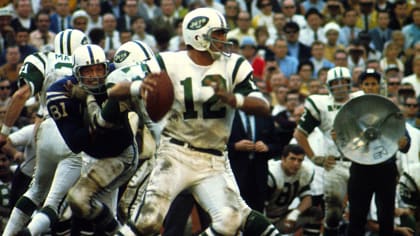
December 29, 1968: The New York Jets Win the AFL Championship

December 29, 1968: The American Football League Championship Game is played at Shea Stadium in Flushing Meadow, Queens, New York City. By any objective measure, it was a better game than the Super Bowl that was held 2 weeks later.

The Oakland Raiders had won the AFL Championship the year before, and were back in the Championship Game. The New York Jets were in it for the 1st time. Earlier in the season, on November 17, in Oakland, The Jets blew a lead with a little over 1 minute to play, and the Raiders scored 2 touchdowns. Most of the country didn't see it, though, as NBC cut away at 7:00 PM Eastern Time, to show the children's movie Heidi, infuriating millions of TV viewers. "The Heidi Bowl" was a sign that the AFL had finally achieved a place in the American sports firmament, alongside the established NFL.

Quarterbacked by Joe Namath, who had already earned the nickname "Broadway Joe" for his showmanship, the Jets finished the season 11-3. The Raiders, with a quarterback named Daryle Lamonica, known as "The Mad Bomber," and with a devastating, often dirty, defense, were 12-2. Each team won its Division.

Since it was an even-numbered year, it was the Eastern Division Champion's turn to host the Championship Game. And so, Shea Stadium, also the home of baseball's New York Mets, hosted a football championship before it hosted a postseason game in baseball. A crowd of 62,627 was on hand, the biggest in AFL history.

A short punt led to Namath passing to Don Maynard for a touchdown to open the scoring. The Raiders stalled on their next drive, and George Blanda hit the crossbar on a field goal attempt. Jim Turner kicked a field goal to put the Jets up 10-0 at the end of the 1st quarter.

The Raiders got off the deck, and Lamonica threw a 29-yard touchdown pass to Fred Biletnikoff. Turner kicked another field goal, and Blanda kicked one right before the half, to close the Raiders to within 13-10.

Blanda tied the game with a field goal in the 3rd quarter, but Namath took the Jets downfield, and just before the quarter ended, he threw a touchdown pass to Pete Lammons, putting New York up, 20-13.

Early in the 4th quarter, George Atkinson intercepted a Namath pass, and took it to the Jets' 5-yard line. Pete Banaszak ran it in on the next play, and for the 1st time, the Raiders led, 23-20. But Namath needed just 3 passes -- 10 yards to George Sauer, 52 to Maynard, and 6 to Maynard -- to put the Jets up, 27-23.

With a little over 5 minutes left, with the Raiders having the ball on the Jets' 26-yard line and 4th & 10, head coach John Rauch decided to go for the 1st down. It didn't work, as Verlon Biggs sacked Lamonica. On their next drive, Lamonica got to the Jets' 24, but he made a bad throw that was ruled a fumble, and Ralph Baker recovered for the Jets. With 1 last chance, the Raiders had the ball on their own 22 with 42 seconds left, but could only get to midfield before the clock ran out. The Raiders had outgained the Jets, 443 total yards to 400, but the Jets had won, 27-23.

In the off-season, Rauch decided he'd had enough meddling by Raiders owner Al Davis, and resigned. Davis promoted the linebackers coach to head coach: John Madden. Madden's legend was just beginning, while Namath's was about to reach the stratosphere.

And a storybook period for New York sports had begun: In a span of 17 months, the Jets had won the AFL Championship, the Jets would pull off one of the greatest upsets in sports history by becoming the 1st AFL team to win a Super Bowl, the Mets would win a "Miracle" World Series, and the Knicks would win their 1st NBA Championship.

*

December 29, 1968 was a Sunday. The NFL Championship Game was played the same day, and the Baltimore Colts, 13-1 on the regular season, avenged their only defeated annihilating the Cleveland Browns, 34-0 at Cleveland Municipal Stadium. (As with the AFL, home-field advantage was determined on a rotating basis, not by best record. The merged NFL wouldn't start doing it that way until 1975.)

There were 4 games played in the NBA:

* The New York Knicks beat the Seattle SuperSonics, 120-112 at Madison Square Garden. Willis Reed scored 34 points.

* The Atlanta Hawks beat the Baltimore Bullets, 101-99 at the Alexander Memorial Coliseum (now the McCamish Pavilion) in Atlanta.

* The Chicago Bulls beat the Milwaukee Bucks, 102-97 at the Milwaukee Arena. In 1974, it was renamed the Milwaukee Exposition, Convention Center and Arena, or "The MECCA." Since 2014, it has been named the UW-Panther Arena.

* And the Los Angeles Lakers beat the Detroit Pistons, 111-108 at The Forum outside Los Angeles in Inglewood, California. Jerry West scored 34 points, Elgin Baylor scored 24, and Wilt Chamberlain scored 22 and had 25 rebounds.

There were 5 games in the American Basketball Association:

* The New York Nets lost to the Kentucky Colonels, 118-116 in overtime at the Long Island Arena in Commack, New York. Ron Perry scored 36 in defeat for the Nets.

* The Miami Floridians beat the New Orleans Buccaneers, 107-106 at the Miami Beach Convention Center.

* The Houston Mavericks beat the Los Angeles Stars, 93-83 at the Sam Houston Coliseum in Houston.

* The Oakland Oaks beat the Minnesota Muskies, 120-99 at the Metropolitan Sports Center in the Minneapolis suburb of Bloomington, Minnesota.

* The Denver Nuggets beat the Dallas Chaparrals, 102-92 at the Denver Auditorium Arena.

And there were 4 games in the NHL:

* The New York Rangers beat the Montreal Canadiens, 3-1 at Madison Square Garden.

* The Oakland Seals beat the Philadelphia Flyers, 2-1 at The Spectrum in Philadelphia.

* The Boston Bruins and the Detroit Red Wings played to a tie, 3-3 at the Olympia Stadium in Detroit.

* And the Chicago Black Hawks beat the Los Angeles Kings, 4-1 at the Chicago Stadium.

Thursday, November 17, 2022

November 17, 1968: The Heidi Bowl

November 17, 1968: A professional football game was played, and it had a stunning ending. People who saw this ending live in the Oakland-Alameda County Coliseum: An official paid attendance of 53,318. People who saw it on television: Zero.

"What do you mean, Uncle Mike?" you may ask. "Wasn't the game on television?" Yes, it was -- but not in its entirety. And it wasn't zero: Viewers in the Pacific Time Zone saw it live.

The New York Jets were playing the Oakland Raiders. The Raiders had won the American Football League Championship the season before, but lost Super Bowl II to the Green Bay Packers. They were 8-2 coming into this game. The Jets were 7-3. 

Each team had a notable quarterback: The Raiders had Daryle Lamonica, known as the Mad Bomber; while the Jets had Joe Namath, coming off a season in which he became the 1st pro quarterback to pass for 4,000 yards in a season. The Raiders, especially defensive end Ben Davidson (later an actor) always targeted him for dirty hits: Davidson had broken Namath's jaw in the Raiders' win the season before.
Broadway Joe Namath

With the Playoffs for both the AFL and the NFL expanded for this season, this was seen as a possible Playoff preview -- correctly, as it turned out.

And while the owners of the original 8 AFL teams, a.k.a. "The Foolish Club," were friends and partners, the teams themselves, and the fans thereof, hated each other's guts. As Jets director of public relations Frank Ramos said, "When the Jets played the Raiders, it wasn't a rivalry, it was a war."

The game was scheduled for a 1:00 PM kickoff, Pacific Time -- meaning 2:00 Mountain Time, 3:00 Central Time, and 4:00 Pacific Time. In those days, before TV started insisting on more timeouts to run more commercials, games rarely took a full 3 hours. So it was reasonable to presume that the game would end before 7:00 PM Eastern Time.

It was the 2nd half of an AFL doubleheader on NBC. And the 1st half was a sign of trouble: The San Diego Chargers beat the Buffalo Bills 21-6, but it ran long. The result was not in doubt, but NBC still broke away from it at 4:00 on the dot, and began televising from Oakland.

The Raiders led 7-6 at the end of the 1st quarter, and 14-12 at halftime. The Jets took a 19-14 lead in the 3rd quarter, but the Raiders led 22-19 at the end of it. With 1:05 left in regulation, a Jim Turner field goal gave the Jets took a 32-29 lead.

Time was running out, and the AFL had no provision for overtime in regular-season games. Lamonica got the Raiders down the field, partly thanks to a facemask violation by the Jets. It was at this point that NBC made their big decision, which I'll get to in a moment. Lamonica threw a pass to running back Charlie Smith, who caught the ball, and ran 43 yards for a touchdown. Raiders 36, Jets 32.
The Mad Bomber, Daryle Lamonica

There were 42 seconds left. But Earl Christy fumbled the kickoff. Preston Ridlehuber recovered for the Raiders, and took it into the end one. Raiders 43, Jets 32. That was the final score.

If that had been the extent of the proceedings, and if they had concluded before 7:00 Eastern, the game might be worthy of mention on major anniversaries, like the 50th, which was 2 years ago, but that's about it. But that wasn't the extent of what happened, and it didn't conclude before 7. And this game still gets talked about, frequently.

*

As for the broadcast: NBC assigned its lead pro football broadcast team: Curt Gowdy, who had done everything in sports, and for whom the Basketball Hall of Fame's award for broadcasters is named; and Al DeRogatis, a member of the College Football Hall of Fame as a defensive tackle with Duke University, and a 2-time Pro Bowler with the New York Giants, who'd gotten started broadcasting their games.

NBC planned to follow the broadcast of this game -- at least, in the 3 easternmost time zones -- with a film version of Johanna Spyri's 1881 novel Heidi. It tells the tale of an orphaned girl in Spyri's native Switzerland, and the lives she touches. It had already been filmed 6 times, most notably in 1937 with Shirley Temple in the title role. There have been additional versions since 1968.

The version NBC was showing was new, made for TV, and aired in place of, but well within the style of, their usual Sunday night fare: The anthology series then known as Walt Disney's Wonderful World of Color. (A bit of a boast, given that only about half the homes in America had color TV sets at that point.) The show has been on the air continuously since 1954, and, for most of its history, including currently on the Disney Channel, it's been known as The Wonderful World of Disney.

In the 1968 TV-movie, Heidi was played by Jennifer Edwards, the 11-year-old daughter of film producer and director Blake Edwards, and stepdaughter of Blake's wife, Julie Andrews, star of Mary Poppins (so she also knew a thing or two about children's fare) and The Sound of Music (so she also knew a thing or two about feel-good movies set in the Alps). Jennifer has since left acting for screenwriting. The film also starred Maximilian Schell, Michael Redgrave and Jean Simmons.
As if there wasn't enough going wrong, 
this DVD cover didn't even get Jean Simmons' name right.

NBC had been hyping the movie like crazy, the way they would if it were a holiday broadcast -- say, if it had aired 5 nights later on Thanksgiving, or on Christmas Eve or Christmas Day. They took out big print ads for it, including a full-page ad in The New York Times, which, then as now, was a prohibitively expensive move. They had to air it precisely at 7:00, so that it would end at 9:00, and kids who had to go to school the next day could then get a good night's sleep (at least, in theory).

It wasn't just a judgment call. NBC had an actual contract with a single sponsor, Timex watches. The contract stated that Heidi had to start at exactly 7:00 Eastern Standard Time, and could not be delayed, or joined in progress, for any reason. The fact that the sponsor was a timekeeper became retroactively ironic.

It's also worth nothing that this was 1968. The VCR was a few years away from being invented. There was no DVR service. If you missed a show, you had to wait until it was repeated -- if it was repeated. (As far as I know, this version of Heidi was never shown on network TV again, although it is probably available on cable movie channels.)

And there were only 6 VHF channels in New York: CBS on 2, NBC on 4, ABC on 7, and the "independent" stations on 5, 9 and 11. (Channel 13 was there, but PBS was still in its infancy, and most people weren't thinking about it yet.) So, with few choices, when one got highlighted, you became convinced that this was something special, and you should watch it. It was around this time that the kind of TV production previously known as a "spectacular" began to be called a "special."

So with all the promotion of this "family entertainment," there was a considerable buzz about Heidi. In the history of American TV to this point, pretty much the only broadcasts that had ever gotten this much hype were the final episode of The Fugitive on ABC the year before, the 1955 NBC broadcast of the Broadway musical version of Peter Pan with Mary Martin in the lead role, and the appearances on CBS' The Ed Sullivan Show by Elvis Presley in 1957 and The Beatles in 1964. Even the 1960 Kennedy-Nixon debates and space launches didn't get hyped this much.

(The Beatles' 1st appearance on Ed Sullivan, February 9, 1964, was the most-watched TV show ever to that point. The last episode of The Fugitive, August 29, 1967, broke that record. It held the record until November 21, 1980, when Dallas revealed who shot J.R. Ewing. That record stood until February 28, 1983, the last episode of M*A*S*H, which still holds the record for most-watched episode of a regular series. A few Super Bowls have been watched by more Americans.)

*

Dick Cline was NBC's supervisor for sports telecasts. Except for the 1958 NFL Championship Game, which went to overtime, NBC had never broadcast a pro football game that had taken over 3 hours to complete. (The 1962 AFL Championship Game had gone to a 2nd overtime, but that was on ABC.) So he had no reason to believe this one would, either.

Don Ellis was the telecast's on-site producer. Scotty Connal was the executive producer. Julian Goodman was the president of NBC, and he told Connal that, no matter what, Heidi must start at 7:00 Eastern. Connal told this to Cline and Ellis, and overruled their objections.

But, between them, Namath and Lamonica threw 31 incomplete passes, each one stopping the game clock. Both teams used all their allotted timeouts -- each team got 3 in each half, for a total of 12. And there had already been 63 points scored with 4 minutes left on the clock. That's a lot of stoppages of the game clock.

The 4th quarter did not begin until 6:20. At 6:45, Connal, watching at his house in Old Greenwich, Connecticut, called Cline at NBC headquarters at the RCA Building, at 30 Rockefeller Plaza in Midtown Manhattan. They agreed that the game would not end before 7:00. They also agreed that NBC should run the game broadcast until its conclusion, but that wasn't Connal's call, or Cline's call.

They reached Goodman at his home in Manhattan. The 1968 version of a conference call was set up with NBC Television president Don Durgin, whose call it really was. Durgin was convinced: He told them to delay the movie.

Something else began to happen at 6:45. We hear the legends about the football fans angry that the game was cut off. But most of the calls coming to the NBC switchboard at "30 Rock" were from parents wondering if the movie would start on time. The switchboard blew a fuse. (Kids, you might want to ask your parents what a fuse is. And a switchboard.) Goodman couldn't get word to Cline to let the broadcast of the game continue. And so, not knowing that he had the O.K. to extend the game, Cline gave the order: Cut the game and switch to the movie.

And so, with 1:01 on the clock, viewers saw Smith pick Turner's kickoff up in the end zone, and get to the Raider 22-yard line. As he did so, the Burbank control room played the tune NBC used as its closing theme for AFL broadcasts. At exactly 7:00, the broadcast of Heidi began.

The people involved in the game -- players, coaches, officials, and fans -- didn't know this. Back in New York, thinking that the Jets had won, Lucy Ewbank picked up the phone, called the visitors' locker room at the Oakland Coliseum, and congratulated her husband Weeb on the victory. He had to tell her what had happened in Oakland, and she had to tell him what had happened in New York.

Despite being NBC employees, Gowdy and DeRogatis didn't know about it, either. No one told them, so they kept calling the game as if the whole country was still seeing it. Unlike the network, the announcers "played to the whistle." Which came at 7:07 PM. All the fuss that followed, over 7 minutes.

To make matters worse, viewers had missed not one but two Raider touchdowns in the last minute of official game play, pushing the margin of victory above the 7 1/2-point spread, messing up a lot of bets. At 7:08, NBC put a crawl across the screen: "SPORTS BULLETIN: RAIDERS DEFEAT JETS 43-32." This happened just as Heidi's paralyzed cousin Clara started to walk again.

Associated Press sportswriter Jack Clary wrote, "The football fans were indignant when they saw what they had missed. The Heidi audience was peeved at having an ambulatory football score intrude on one of the story's more touching moments. Short of pre-empting Heidi for a skin flick, NBC could not have managed to alienate more viewers that evening." They were damned if they did, and damned if they didn't, and caught hell from both sides. It wasn't "A plague on both your houses," it was a plague from both houses on them.

At 8:30 that night, Goodman apologized in a press conference. The next night, on The Huntley-Brinkley Report, NBC showed the remaining 7 minutes.

The aftermath: The Jets and Raiders each won their Divisions. It was the Eastern Division winner's turn to host the AFL Championship Game, and on December 29, 1968, a frigid crowd sold out Shea Stadium to watch the Jets win, and advance to Super Bowl III, where they pulled the biggest upset in pro football history by beating the Baltimore Colts.

When the final details of the AFL-NFL merger were set, the contract included showing any game that ran over its allotted 3 hours to its conclusion. This -- professional football -- did more to break the hold of sponsors over network TV than anything else: Sponsors could still object to what a network was broadcasting, but their word was no longer law; and any sponsor demanding control over time slots faced the simple answer of, "Sorry, but we have a contract."

If there was a moment when pro football surpassed baseball as America's leading sport (if not, necessarily, its most popular one), it was the AFL-NFL merger. And if there was a reason why that happened, it was the Heidi Bowl.

Today, CBS starts its late games at 4:05 PM Eastern, and Fox starts its games at 4:25. They're now expected to run past 7:00, and Fox even has its studio show run all the way until 8:00.

*

Should NBC be blamed for the call they made? Or, rather, for failing to make the other call? Not really. In spite of the in-process merger with the NFL, the AFL was still a minor league in the eyes of many people, including NBC executives. No less than Curt Gowdy, arguably the most important announcer in the history of televised sports, said that the reaction to the switch away from the game proved that the AFL was now seen as being on an equal footing with the NFL -- and this was 2 months before Super Bowl III, which Gowdy and DeRogatis also broadcast for NBC, along with another ex-Giant, Kyle Rote.

The opposing coaches, New York's Weeb Ewbank and Oakland's John Rauch, called all those clock-stopping pass plays, and used up all their timeouts. The pass-happy nature of the AFL helped it to win over fans who thought it a more exciting version of the conservative NFL, and to survive its tumultuous early years, the early 1960s, when they had such trouble drawing live crowds. This time, it worked against their TV viewers.

If NBC had stuck with the game, Timex could have sued them. From that point onward, it would have been in the hands of the legal system. A judge could have thrown the suit out. The verdict could have depended on who had the superior lawyers, NBC or Timex. A jury of football fans... well, who knows which side they'd have taken, as they might still have been mad at NBC.

It's also possible that the jury could have upheld the contract, and ruled Timex the winner... and awarded damages of $1.00, as the delay only damaged the Timex executives' egos, not their brand's image. (After all, the 1986 award in the USFL's suit of the NFL over monopolistic practices was $1.00, trebled to $3.00 under antitrust laws.) The bad publicity they might have gotten from going to court over 7 lousy little minutes might have hurt them more than a 7-minute delay in the start of a movie's broadcast.

If all those parents worried about whether Heidi would start on time at 7:00 had simply let NBC make their own decision, the Rockefeller Center switchboard wouldn't have been blown, the message could have gone out to keep going with the game, and the movie would have ended at 9:07, and we wouldn't be talking about this these last 54 years.

Also, this had never happened to any of the Big Three networks before. With a playoff game, there was the possibility of overtime, and the network had to compensate for that. But the 1968 Jets at Raiders game was a regular-season game. If regulation ended in a tie, then a tie it would stay. There was no regular-season overtime until the 1974 season. No network had any procedure telling them what the right thing to do in this situation was, because they'd never faced this situation before.

But NBC had promised children that Heidi would air at 7:00 Eastern Time. They had to keep their word. Think about it: Football fans have proven that they'll watch any kind of football at any time. NBC going to Heidi may have pissed a lot of them off, but nobody boycotted NBC after this. Nobody picketed at Rockefeller Center and demanded that anybody be fired, or that any policy be changed, as a result. Nobody refused to watch NBC football broadcasts ever again. Because football fans are addicts, and televised football is their fix.

In contrast, if NBC had stuck with the game until its 7:07 conclusion, and then begun Heidi, the movie would have ended after 9:00, and some parents would have turned off the TV before it ended, and told their kids it was time to go to bed. Yes, some parents were petty enough to send their kids to bed with 7 minutes left in a movie.

*

November 17, 1968 was, of course, a Sunday. Among the other AFL games played that day:

* As I said earlier, the San Diego Chargers beat the Buffalo Bills, 21-6 at War Memorial Stadium in Buffalo.

* The expansion Cincinnati Bengals beat the Miami Dolphins, 38-21 at the Orange Bowl in Miami.

* The Kansas City Chiefs beat the Boston Patriots, 31-17 at Kansas City Municipal Stadium.

* The Houston Oilers beat the Denver Broncos, 38-17 at the Astrodome in Houston.

In the NFL:

* The New York Giants beat their arch-rivals, the Philadelphia Eagles, 7-6 at Yankee Stadium.

* The Baltimore Colts beat the football version of the St. Louis Cardinals, 27-0 at Memorial Stadium in Baltimore.

* The Dallas Cowboys beat the Washington Redskins, 44-24 at District of Columbia Stadium in Washington. (It was renamed Robert F. Kennedy Memorial Stadium the following June. And it would take the 1971 arrival of head coach George Allen in Washington to make this an arch-rivalry.)

* The Cleveland Browns beat the Pittsburgh Steelers, 45-24 at Pitt Stadium in Pittsburgh.

* The Minnesota Vikings beat the Detroit Lions, 13-6 at Tiger Stadium in Detroit.

* The Atlanta Falcons beat the Chicago Bears, 16-13 at Wrigley Field in Chicago.

* The Green Bay Packers beat the New Orleans Saints, 29-7 at Milwaukee County Stadium.

* And the San Francisco 49ers and the Los Angeles Rams, arch-rivals, played to a 20-20 tie at Kezar Stadium in San Francisco.

There were 3 pro basketball games played that day. The Boston Celtics beat the Phoenix Suns, 130-98 at the Arizona Veterans Memorial Coliseum. The Los Angeles Lakers beat the Seattle SuperSonics, 105-94 at The Forum outside Los Angeles in Inglewood, California. And, in the ABA, the New York Nets lost to the Indiana Pacers, 114-91 at the Long Island Arena in Commack.

There were 5 games played in the NHL:

* The New York Rangers beat the Montreal Canadiens, 3-2 at the still-new Madison Square Garden. Ron Stewart's goal with 7:15 remaining in regulation gave the Broadway Blueshirts the win over the defending Stanley Cup Champions.

* The Boston Bruins beat the Oakland Seals, 6-3 at the Boston Garden.

* The Philadelphia Flyers beat the Los Angeles Kings, 3-1 at The Spectrum in Philadelphia.

* The Toronto Maple Leafs and the Chicago Black Hawks played to a tie, 1-1 at the Chicago Stadium.

* The St. Louis Blues and the Minnesota North Stars played to a tie, 3-3 at the St. Louis Arena.

* And the Detroit Red Wings and the Pittsburgh Penguins were not scheduled. 

Wednesday, August 17, 2022

August 17, 1969: Jets vs. Giants, the 1st Time

August 17, 1969: The New York Jets and the New York Giants play each other for the 1st time.

It's an exhibition game, part of the merger process between the Giants' National Football League and the Jets' American Football League. It's played nearly 80 miles from Midtown Manhattan, at the Yale Bowl in New Haven, Connecticut, as the Albie Booth Memorial Game. Booth was a football and basketball star at Yale University, and died in 1959.

The Jets had won Super Bowl III, 7 months earlier, making them the World Champions of pro football, and stunning the NFL. But the Giants and their fans refused to accept them as champions. Why? “Giants fans still don’t feel we’re on a parity with their team and we feel we’ve got to prove it,” Jets linebacker Larry Grantham said, early in training camp in 1969. “A lot of people, NFL fans, still regard the Super Bowl as a fluke.” They bought into the propaganda that, if the Jets had played the Baltimore Colts 10 times, the Colts would have won 9? Apparently.

So the Jets realized that the only way to convince the New York media that they were the best team in the world was to prove they were the best team in New York. To make the point, Jet coach Weeb Ewbank appointed Grantham, Don Maynard and Bill Mathis, all original 1960 New York Titans who became Jets and had played through the entire history of the AFL, as team Captains for the day. Three Jet players had retired after the Super Bowl, and actually came out of retirement, just to play in this 1 game. 

John Mara, son of Giants owner Wellington Mara, and later the team's owner himself, was interviewed in 2019, for the 50th Anniversary of the game. He recalled: “Players were talking about this being the biggest game they had ever played in. The tension was unreal. The build-up to that game was unlike anything I had ever experienced, almost like a modern playoff game.”

As with the Woodstock festival, 131 miles to the west, traffic was an issue, jamming the Connecticut Turnpike and the Merritt Parkway, although, unlike the New York State Thruway, neither was closed, man. It was 86 degrees and muggy, but they managed to avoid the rain that drenched the festival. The crowd was 70,874, about evenly split between Big Blue and Gang Green, and there were fights in the already-old Ivy League football plant.

The Jets removed all doubts. Joe Namath, who was named Most Valuable Player of the Super Bowl despite not having an especially good game, was considerably better. He completed 16 of 18 passes, for 188 yards and 3 touchdowns, including 1 to Mathis.

John Mara was 14, and remembered, just before halftime, the Giants' Dave Lewis punting: “The one play I remember was Mike Battle returning a punt for a touchdown, and leaping over our punter. The rest I have managed to successfully block out.”

That made the score 24-0 Jets, and they cruised to win, 37-14. “Today, we proved we have the best team in New York, a team that can compete on any field with any team at any time,” Grantham said.

Wellington Mara fired head coach Allie Sherman, replaced him with former Giant running back Alex Webster, and he finished the 1969 season 6-8. The Jets went 10-4, won the AFL Western Division, and lost in the Divisional Playoffs.

The 1st regular-season game between the teams was played on November 1, 1970, at Shea Stadium. In a game with considerably less hype, even though it actually counted for something, the Giants won, 6-1.

As it turned out, between the Giants' moving around due to the renovation of Yankee Stadium, the Jets' injuries, and dumb management decisions by both teams, neither team made the Playoffs again until 1981.

*

August 17, 1969 was a Sunday. It was also the day the Woodstock festival ended, and the day that Hurricane Camille crashed into America's Gulf Coast. I have separate entries for those events. Also, basketball star Christian Laettner and New Kids On The Block singer turned actor Donnie Wahlberg were born on this day.

And these Major League Baseball games played:

* New York Yankees 5, Chicago White Sox 2 at Comiskey Park in Chicago. Jimmie Hall hit a home run for the Bronx Bombers. Stan Bahnsen started, and Mike Kekich won it in relief.

* Another doubleheader at Shea Stadium: The New York Mets beat the San Diego Padres 3-2 in each game. Duffy Dyer hit a home run in support of Jerry Koosman in the opener, and Ed Kranepool and Bud Harrelson each got 2 hits in support of Don Cardwell in the nightcap.

* Houston Astros 3, Philadelphia Phillies 2 at Connie Mack Stadium in Philadelphia.

* Minnesota Twins 4, Washington Senators 3 at Robert F. Kennedy Stadium in Washington. Tony Oliva's RBI single won it in the top of the 13th inning.

* Los Angeles Dodgers 9, Montreal Expos 3 at Jarry Park in Montreal.

* St. Louis Cardinals 5, Atlanta Braves 3 at Atlanta Stadium (later Atlanta-Fulton County Stadium). Hank Aaron, Bob Tillman and Rico Carty hit home runs for the Braves, but all were solo blasts, and Steve Carlton was the winning pitcher for the Cards, as Lou Brock went 2-for-5, and Joe Torre went 1-for-4 with an RBI.

* Pittsburgh Pirates 8, Cincinnati Reds 5 at Crosley Field in Cincinnati. Gene Alley, Al Oliver and Willie Stargell hit home runs. Roberto Clemente went 2-for-5. The Reds got homers from Pete Rose, Bobby Tolan, Johnny Bench and Tony Perez, but it wasn't enough.

* Boston Red Sox 1, Kansas City Royals 0 at Kansas City Municipal Stadium. Carl Yastrzemski went 0-for-4, but Vicente Romo, Sparky Lyle and Sonny Siebert combined for a 4-hit shutout.

* California Angels 7, Cleveland Indians 6 at Anaheim (now Angel) Stadium.

* Detroit Tigers 9, Oakland Athletics 4 at the Oakland Coliseum. Catfish Hunter was knocked out of the box in the 4th inning, as the Tigers got 2 homers from Al Kaline, and 1 each from Jim Northrup, Don Wert, former Yankee Tom Tresh and Mickey Stanley. Denny McLain went the distance, despite giving up a home run to Reggie Jackson.

* Doubleheader at Candlestick Park in San Francisco. 1st game: San Francisco Giants 5, Chicago Cubs 3. 2nd game, Cubs 3, Giants 1. Over the 2 games, Willie Mays went 2-for-4 with a home run and 3 RBIs. Ernie Banks only appeared in this game as a pinch-hitter, and did not reach base.

* Baltimore Orioles 4, Seattle Pilots 1 at Sick's Stadium in Seattle. Dave May (filling in at right field for Frank Robinson, who got the day off), Don Buford and Brooks Robinson homered for the O's, while Don Mincher hit one for the Pilots. Tom Phoebus won it, Fred Talbot lost it. Jim Bouton did not get into the game. A sweep for the Birds over the Pilots.

As Pilot manager Joe Schultz no doubt said, "Ah, shitfuck. Let's get 'em tomorrow, and then go pound some Budweiser." If Jim Bouton and his book Ball Four are to be believed, Joe Schultz would not have fit in well at Woodstock. 

Friday, May 6, 2022

May 6, 1995: Classic Sports Network Goes On the Air

May 6, 1995: This was one of the best days of my life, although I wouldn't know it for over a year. Because this was the day that Classic Sports Network debuted.

New York City established WUHF on Channel 31 as an experiment to determine the viability of UHF broadcasts within an urban environment. Some of the early programming on WUHF included simulcasts of New York's existing commercial VHF stations; educational films produced by the Television Film Unit, established in 1949, of WNYC, which since 1924 had broadcast on 820 AM, and since 1943 at 93.9 FM, as the City's municipal radio station; college-level distance education telecourses; and, reportedly, a nightly rundown of the New York Police Department's "wanted" criminals list.

The experiment was carried out through the installation of UHF receivers in several hundred test homes, public schools and businesses, with reception monitored by FCC and City engineers. This was successful, and on November 5, 1962, the call letters of New York's Channel 31 were changed to WNYC, to match those of the radio stations.

But in 1995, Mayor Rudy Giuliani, seeing the growth of cable television, and noting that WNYC, both AM and FM, were still successful, decided to sell the station. On June 30, 1996, WNYC-Channel 31 was sold to ITT-Dow Jones. It was replaced by WBIS, showing what was then named Classic Sports Network. Within days, while "flipping channels," I discovered it by accident. I didn't have cable TV at the time, so the picture was fuzzy. But what it showed was a feast for the sports fan's heart.

Classic Sports Network was run by Steve Greenberg, son of Baseball Hall-of-Famer Han Greenberg. I was worried that, given a Baby Boom target audience, it would be one long tribute to Mickey Mantle, the 1969 New York Mets, Joe Namath, the early 1970s New York Knicks, and Muhammad Ali. Indeed, when it debuted on May 6, 1995, it did so with a 15-hour documentary: Muhammad Ali: His Life and Times, hosted by sportswriter Dick Schaap.

And there was a lot of content around Mantle, Namath, the '69 Mets and the Willis Reed and Walt "Clyde" Frazier 1970s Knicks. This included a block of programming centered around "The Miracle of '69," including the '70 Knicks title with Namath leading the Jets to the great upset victory in Super Bowl III and the Mets' run to, and performance in, the 1969 World Series.

But they also showed a lot of special things, including World Series highlight films that hadn't been widely seen in years, and weren't yet available on video; legendary prizefights, including some on The Main Event, a half-hour show hosted by Rocky Marciano, with the 1950s Heavyweight Champion hosting, interviewing guests, and narrating the fights, lasting 14 episodes in 1961; the entire library of the TV shows Greatest Sports Legends and Curt Gowdy's 1974-77 PBS show The Way It Was. They also made a deal with NFL Films to broadcast a lot of vintage stuff. I videotaped as much of it as I could, and those tapes took up a lot of space.

In 1997, ESPN decided it didn't want the competition, but it did want the content: They bought Classic Sports Network from Steve Greenberg and his investors, and rebranded it as ESPN Classic. They kept the logo of an athlete with fists raised, known as "Vic" for "Victory," inside a letter C.

But the beginning of the end was already there, even before the beginning. (Yes, I know: That sounds like a Yogi Berra line.) The Golf Channel began broadcasting on January 17, 1995, nearly 4 months before Classic Sport Network. Speed, a network devoted to auto racing, debuted at the end of that year. The NBA Network was launched in 1999, the NFL Network and The Tennis Channel in 2003, the NHL Network in 2007, the MLB Network in 2009.

By the 2010s, due to the increasing number of sport-, league-, and college conference-specific networks that had assumed rights to the archival and live content that was historically aired by ESPN Classic, a larger amount of programming was devoted to archive content whose rights were owned by ESPN outright, reruns of recent events from ESPN's networks, as well as ESPN original documentaries and overflow coverage of events from other ESPN networks. And much of the footage was also now available on YouTube, so a fan wanting to see a specific broadcast no longer had to wait for ESPN to show it.

So ESPN folded ESPN Classic on December 31, 2021. It's funny: I didn't know it was "born" at the time that it was, and I didn't know that it "died" at the time that it did. But I'm still glad it was "alive."

*

May 6, 1995 was a Friday. Football was out of season. There was 1 game in the NBA Playoffs that day: The San Antonio Spurs beat the Los Angeles Lakers, 110-94 at the Alamodome in San Antonio, Texas. David Robinson scored 33 points.

The Stanley Cup Playoffs began, with 2 games. The New York Rangers lost to the Quebec Nordiques, 5-4 at the Colisée de Québec. And the Washington Capitals beat the Pittsburgh Penguins, 5-4 at the Civic Arena in Pittsburgh.

And these games were played in Major League Baseball:

* The New York Yankees lost to the Milwaukee Brewers, 5-2 at Yankee Stadium. Ricky Bones outpitched Jimmy Key. Greg Vaughn hit a home run for the Brew Crew. Jim Leyritz, playing 1st base in place of the idle Don Mattingly, hit one for the Bronx Bombers. Wade Boggs went 3-for-4. But the rest of the Yankees combined only got 4 hits.

* The New York Mets lost to the Cincinnati Reds, 13-11 at Riverfront Stadium in Cincinnati. This was a game that could have been shown on Classic Sports: The Mets led 11-2 going into the bottom of the 8th inning, but the Reds scored 6 in the 8th and 3 in the 9th to win it. The winning runs came on a home run by Hal Morris. Deion Sanders, Ron Gant and Jerome Walton also homered for this later edition of the Big Red Machine. For the Mets, Rico Brogna and Edgardo Alfonzo each had 3 hits including a home run.

* The Florida Marlins beat the Montreal Expos, 10-3 at the Olympic Stadium in Montreal.

* The Toronto Blue Jays beat the Baltimore Orioles, 7-3 at Camden Yards in Baltimore. Cal Ripken went 1-for-5.

* The Philadelphia Phillies beat the Atlanta Braves, 3-1 at Atlanta-Fulton County Stadium.

* The Chicago Cubs beat the Pittsburgh Pirates, 13-5 at Three Rivers Stadium in Pittsburgh.

* The Minnesota Twins beat the Cleveland Indians, 5-2 at Jacobs Field (now Progressive Field) in Cleveland.

* The Boston Red Sox beat the Detroit Tigers, 5-3 at Tiger Stadium in Detroit.

* The Chicago White Sox beat the Kansas City Royals, 7-4 at the new Comiskey Park (now Rate Field) in Chicago.

* The St. Louis Cardinals beat the Houston Astros, 7-5 at Busch Memorial Stadium in St. Louis.

* The Los Angeles Dodgers beat the Colorado Rockies, 17-11 at Coors Field in Denver. This was also a game that could have been shown on Classic Sports. Being in "the Mile High City," Coors Field, like the facility it had just replaced as the Rockies' home, Mile High Stadium, was a hitter's haven. Tom Candiotti started for Los Angeles, and Juan Acevedo for Colorado, and both only lasted 2 innings.

For the Dodgers: Mike Piazza went 3-for-6 with a home run and 3 RBIs; Mitch Webster entered the game as a pinch-hitter, and went 1-for-3 with a home run and 2 RBI; Henry Rodríguez went 4-for-6 with 2 RBI, and Gary Ingram pinch-hit for him, and went 2-for-3 with a walk and an RBI; and Eric Karros went 3-for-5 with a walk and 3 RBIs.

For the Rockies: Dante Bichette went 4-for-5 with a home run and 3 RBIs; Roberto Mejía went 1-for-4 with a solo homer; Jorge Brito went 2-for-4 with 3 RBIs; Larry Walker, Walt Weiss and Jason Bates also had 2 hits each; and, pinch-hitting for pitchers, John Vander Wal hit a 3-run homer; and Mike Kingery hit a solo homer.

* The San Francisco Giants beat the San Diego Padres, 13-6 at Jack Murphy Stadium in San Diego. Glenallen Hill went 2-for-3 with a solo home run and 2 walks. Jeff Reed went 4-for-4 with a walk and 2 RBIs. Royce Clayton went 2-for-5 with 3 RBIs. Barry Bonds went 2-for-4 with a walk and 2 RBIs. For the Padres, Ken Caminiti went 3-for-5 with a solo homer, and Tony Gwynn went 1-for-5 with an RBI.

* The California Angels beat the Seattle Mariners, 7-5 at Anaheim Stadium (now Angel Stadium of Anaheim). Ken Griffey Jr., Edgar Martínez and Luis Sojo homered for the M's. J.T. Snow and Greg Myers did so for the Halos.

* And the Texas Rangers beat the Oakland Athletics, 4-2 at the Oakland Coliseum. Rickey Henderson was with the A's at the time, but did not play in this game.

Wednesday, January 12, 2022

January 12, 1969: Super Bowl III

January 12, 1969: Super Bowl III is played at the Orange Bowl in Miami, to decide professional football's World Championship.

When the National Football League and the American Football League began the process of merging in 1966, the NFL was considered to be of far higher quality. Sure enough, the 1st 2 installments of the "AFL-NFL World Championship Game" were easily won by the NFL Champions, the Green Bay Packers -- the game retroactively called "Super Bowl I" 35-10 over the AFL Champion Kansas City Chiefs, and Super Bowl II 33-14 over the Oakland Raiders. The 3rd one was officially renamed the Super Bowl, although the Roman numerals didn't start until Super Bowl V.

The NFL Champions for Super Bowl III were the Baltimore Colts. They were coached by Don Shula, who had made his name as the defensive coordinator for the Detroit Lions. Despite losing Johnny Unitas, possibly the greatest quarterback the game had yet seen, to a torn muscle in his throwing arm in the last preseason exhibition game, the Colts steamrolled through the NFL, going 13-1 behind backup quarterback Earl Morrall, with such stars as running back Tom Matte, receiver Jimmy Orr, tight end John Mackey, defensive end Bubba Smith, and linebacker and Mike Curtis.
They beat the Minnesota Vikings in the Divisional Playoff. Then, in the NFL Championship Game -- in Cleveland because the NFL then alternated hosting duties between the Division Champions -- they avenged their defeat, beating the Browns 34-0 at Cleveland Municipal Stadium. They looked unstoppable -- even without Johnny U.
The AFL Champions were the New York Jets. They were coached by Wilbur "Weeb" Ewbank, who had been an assistant to Paul Brown on the early 1950s Cleveland Browns, and then coached the Colts to their 1958 and 1959 NFL Championships, with Unitas as their quarterback. By this point, Unitas was just about the only one left, so his familiarity with the Colts wouldn't have helped.
The Jets had a marquee quarterback, too, the long-haired, white-shoed, big-mouthed Joe Namath. They had a running attack with Emerson Boozer and Matt Snell, receivers Don Maynard and George Sauer, and a defense with ends Verlon Biggs and Gerry Philbin, linebacker Larry Grantham, and defensive backs Bill Baird and Johnny Sample.
The Jets went 11-3. They won the AFL Eastern Division, and on December 29, 1968, they hosted the AFL West winners, the Raiders, and won a thriller, 27-23. It was Shea's 1st title, 10 months before the baseball team that called it home.
Still, most football observers thought that the Colts were by far the better team. Mainly because the NFL was by far the better league. By the morning of the game, the Colts were 18-point favorites.
Three days before the game, there was a banquet at the Miami Touchdown Club. Namath was one of the speakers. As he took the podium, someone in the audience yelled out, "Hey, Namath! We're gonna kick your asses!"
Broadway Joe was tired of hearing that, and yelled back, "Let me tell you something: We've got a good team. We're gonna win the game. I guarantee it!"
At the time, Namath also said, "There are 4 or 5 quarterbacks in the AFL that are better than Morrall," he wasn't kidding. There was himself, Len Dawson of Kansas City, Daryle Lamonica of Oakland, John Hadl of San Diego, and Jack Kemp of Buffalo.
The game was scoreless at the end of the 1st quarter. Early in the 2nd quarter, Morrall got the Colts to the Jet 13, but was intercepted by Randy Beverly. Namath then let a touchdown drive, ending in a 4-yard run by Matt Snell.
Late in the half, Morrall looked to pass, and Jimmy Orr was wide open, but Morrall didn't see him. Instead, he saw Willie Richardson, and his pass was intercepted at the 2 by Jim Hudson. The half ended with the Jets still up 7-0.
The Jets kicked off to start the 2nd half, and on the 1st play from scrimmage, Tom Matte of the Colts fumbled. The Jets recovered on the Colt 25, and Jim Turner went on to kick a 32-yard field goal. Jets 10, Colts 0. The Jets again held the Colts to a 3-and-out. Namath drove the Jets to the Colt 23. Turner kicked a 30-yard field goal. Jets 13, Colts 0.
At this point, Shula rolled the dice. He needed 2 touchdowns in 19 minutes and 24 seconds. He decided that a Johnny Unitas who hadn't played a down for the entire regular season gave him a better chance than an Earl Morrall at full strength. Shula would later say he should have brought Unitas on after halftime, when it was still only 7-0 Jets.
Unitas would end up with more passing yards in 19 minutes, 119, than Morrall had in 41 minutes, 71. But his 1st drive led to no 1st downs, and the Colts had to punt. When the 3rd quarter ended, it was still 13-0 Jets, and the Jets were threatening to score again. They got to the Colt 2, and Ewbank called for a field goal. Turner hit from 9 yards out. It was 16-0 Jets.
The Jets kicked off, and with 13:10 left, Johnny U went to work. He got to the Jet 25, and, unlike Morrall, saw Jimmy Orr open. Except Beverly saw Orr open, too, and ran in and intercepted the pass.
With 11:06 left, Namath could afford to eat the clock. He got the Jets to the Colt 35, setting up a 42-yard field goal attempt by Turner, but he missed.
Now, there was just 6:34 to play. Could Unitas possibly lead the Colts to 2 touchdowns and a field goal in that time? He threw 3 incomplete passes, but on 4th and 10 from his own 20, he found Orr to keep the game alive. He got into Jet territory, throwing to Orr, then to Mackey, then to Richardson, getting to the Jet 1. He handed off to Jerry Hill. Touchdown. Michaels kicked the extra point.
Jets 16, Colts 7. The Colts recovered the onside kick. There were 3 minutes and 14 seconds left. Unitas got the Colts to the Jet 24. 1st down: Pass to Richardson, gains 5 yards. 2nd and 5 on the Jet 19: Pass to Richardson, incomplete. 3rd and 5: Pass to Orr, incomplete. 4th and 5 on the 19. 2:44 left.
A field goal would make it 16-10, and the Colts would need a touchdown. They had all their timeouts, plus the 2-minute warning, and had already recovered an onside kick a moment ago. But Shula decided to go for it. Unitas looked for Orr, and threw, but Orr couldn't catch it. It was, for all intents and purposes, over.
The Jets ate as much of the clock as they could, and there were 15 seconds left when Curley Johnson punted to the Colt 34. Unitas threw 2 passes to Richardson. The 1st was incomplete. The 2nd was caught, and he ran 15 yards, but the clock ran out.
Final score: New York Jets 16, Baltimore Colts 7. The Jets were World Champions. The AFL had proven itself, on the biggest stage, to be not only the NFL's equal, but, for the moment, its superior.
It had gotten dark over the course of the game. And in that darkness, under the Orange Bowl's floodlights, Namath stuck his index finger over his head and waved it to the fans. As far as I can tell, this was the 1st time anybody had done that in order to say, "We're Number 1!"
"I just know that when I was running off that field after the game," Namath says now, "I swear I saw those AFL people up there in the stands, and they were so happy. And it was just the finality of it. It seemed like a struggle, such a struggle for we as individuals and teams in the AFL."
William Wallace (not the legendary Scottish hero) in The New York Times: "Because of what Joe Namath accomplished in the Super Bowl yesterday, pro football will never quite be the same again."
Bill Mazer, opening the football section of his book The Answer Book of Sports, published later in the year: "For those of you who are younger readers, something should be made clear: Football was not invented by Joe Namath on January 12, 1969 at the Orange Bowl in Miami."
And one of my favorite sports trivia questions is, "How many touchdown passes did Joe Namath throw in Super Bowl III?" The answer is, "None." The Jets only scored one touchdown, on Snell's run. Namath was better 2 weeks earlier in the Jets' win over the Raiders in the AFC Championship Game. That was a better game overall, too.
It could even be argued that Namath, with a career completion percentage of just 50.1 percent, more interceptions than touchdowns (220-173), a career losing record as a starting quarterback (62-63-4, plus 2-1 in the postseason to make him exactly .500, 64-64-4), and with injuries leaving him with his last productive season at age 32 and his last game at 34, would not have been elected to the Pro Football Hall of Fame if the Jets had lost this game.
But Namath did lead the Jets to victory in that game, and was elevated to sports idolhood. Along with the Mets' Tom Seaver 9 months later, and the Knicks' Walt "Clyde" Frazier 8 months after that, he became part of New York's holy trinity of sports icons for a generation, as Mickey Mantle and Frank Gifford had been in the generation before, and Reggie Jackson and Lawrence Taylor, and then Derek Jeter and Eli Manning, would later become.
It's been 53 years -- my entire lifetime, and almost another full year. The Jets have never been to the Super Bowl again. They reached the AFC Championship Game in the 1982, 1998, 2009 and 2010 seasons, but lost all 4. In fact, in the 53 years since, they have been to just 23 Playoff games, none since the 2010 AFC Championship Game, and won just 10 of them.
The Colts rebounded to win Super Bowl V 2 years later, but moved to Indianapolis in 1984. They won Super Bowl XLI, but lost Super Bowl XLIV. They were replaced by the Baltimore Ravens in 1996, and the Ravens have won Super Bowls XXXV and XLVII.
In 1981, John Thorn left his comfort zone, baseball, and published Pro Football's 10 Greatest Games. He included this game as one of them. In 2019, a poll ranked this game 6th on a list of the 100 Greatest Games of the NFL's 1st 100 years.
Like his contemporaries Frazier and Muhammad Ali, Broadway Joe was a perfect mix of man, method and moment in sports. As a rebellious young player at the glamour position in what had become the glamour sport, in the biggest city in the country, at a time when television had become not just the big thing (as it was for his hero Johnny Unitas) but everything, he was the right man doing the right thing in the right place at the right time.
Because of those circumstances, there might one day be another quarterback leading the Jets to a Super Bowl win -- stop laughing -- but there can never be another Joe Namath.
*
January 12, 1969 was, naturally, a Sunday. Just as naturally, there were no other pro football games that day. And it was the off-season for Major League Baseball.
There were 3 games played in the NBA that day: 
* The New York Knicks beat the San Diego Rockets, 105-102 at the San Diego Sports Arena. Willis Reed scored 36 points for the Knicks. The Rockets moved to Houston in 1971. Their former home is now named the Pechanga Arena.
* The Detroit Pistons beat the Cincinnati Royals, 113-111 at the Cincinnati Gardens. Oscar Robertson scored 36 points in defeat.
* And the Milwaukee Bucks beat the Boston Celtics, 114-110 at the Milwaukee Arena. In 1974, it was renamed the Milwaukee Exposition, Convention Center and Arena, or "The MECCA." Since 2014, it has been named the UW-Panther Arena.
There were also 2 games played in the American Basketball Association: 
* The Minnesota Pipers beat the Dallas Chaparrals, 116-105 at the Metropolitan Sports Center in the Minneapolis suburb of Bloomington, Minnesota. The Pipers no longer exist. The Chaps do: In 1973, they moved, and became the San Antonio Spurs.
* And the Denver Rockets beat the Houston Mavericks, 124-117 at the Auditorium Arena in Denver. The Mavs no longer exist, and bear no connection to the Dallas Mavericks. The Rockets bear no connection to the San Diego/Houston Rockets, but they do still exist: In 1974, they became the Denver Nuggets. In 1976, the Nuggets, the Spurs, the Indiana Pacers and the New York (later New Jersey, now Brooklyn) Nets were invited to join the NBA.
There were 4 games played in the NHL that day. The New York Rangers, then the only NHL team in the New York Tri-State Area, were not involved in any of them:
* The Boston Bruins beat the Pittsburgh Penguins, 8-4 at the Boston Garden.
* The Detroit Red Wings beat the Oakland Seals, 5-1 at the Olympia Stadium in Detroit. This would be the only time that the Oakland Seals, later the California Golden Seals, would make the Playoffs. In 1976, they became the Cleveland Barons. In 1978, they became the last team in the "Big Four" North American sports leagues to go out of business, merging with the Minnesota North Stars.
* The Chicago Black Hawks beat the Los Angeles Kings, 4-2 at the Chicago Stadium.
* And the St. Louis Blues beat the Minnesota North Stars, 2-0, also at the Met Center in Bloomington. 

December 31, 1999 & January 1, 2000: The Millennium

December 31, 1999:  The Millennium arrives. The people of planet Earth survived. At a terrible cost. But we hadn't destroyed ourselves. ...