Showing posts with label baylor bears. Show all posts

Friday, December 9, 2022

December 9, 1961:The Gotham Bowl

The Polo Grounds, set up for football.
Judging by the number of fans and the number of cars,
this is probably for a Titans (proto-Jets) game in the early 1960s.
Definitely not for the 1961 Gotham Bowl.

December 9, 1961: New York City, despite its status as a cold-weather city, tries to get into the college football bowl business. The Gotham Bowl is staged at the Polo Grounds.

The organizers had tried to stage the event the year before, with Syracuse University, defending National Champions and with future Heisman Trophy-winning running back Ernie Davis. But the school announced that it would not accept any bowl bids.

That was not unusual: There weren't so many bowl games in those days, and if you weren't invited to one of the "Big Four" games that were annually held on New Year's Day -- the Rose in Pasadena, the Orange in Miami, the Sugar in New Orleans or the Cotton in Dallas -- it seemed pointless. Notre Dame accepted a bid to the 1925 Rose Bowl, and didn't accept another bowl bid until the 1970 Cotton Bowl.

The organizers then invited the Air Force Academy, figuring that, as a new program -- the Academy had only been founded in 1954, and started playing football the next year -- they would jump at the chance to showcase their team in the Big Apple. But they insisted upon playing Army, since they hadn't played each other in the regular season, even though this would be, essentially, a home game for Army. (West Point is only 47 miles up the Hudson River from the site of the Polo Grounds.) But Army also declined: The Academy never accepted a bowl bid until the 1984 Cherry Bowl. (In contrast, Navy had accepted 8 bowl bids before that, including each of the Big Four at least once, and Air Force had already been to the 1958 Cotton Bowl before considering the Gotham Bowl.)

So the Gotham Bowl organizers invited Holy Cross, Colorado and Oregon State. Only Oregon State accepted, so there was no opponent for them, and the game was canceled.

They tried again in 1961. This time, they got an acceptance from Utah State, undefeated at 9-0-1, Champions of the Skyline Conference, and ranked Number 10 in the nation; and Baylor University, only 6th out of 8 teams in the Southwest Conference, and only 5-5 overall, but willing to go to a cold-weather city for a bowl game. But only 15,123 fans came out, leaving the Polo Grounds with over 40,000 empty seats. Baylor pulled the upset, winning 24-9.

They tried again in 1962. Instead of a Northeastern team going to Miami to play in the Orange Bowl game in the Orange Bowl stadium, the University of Miami, who played their home games in that stadium, came north to play in the Gotham Bowl. They were 7-3, and, while not a ranked team -- the Associated Press then only ranked the Top 10 teams, not the Top 20 -- they had beaten one, one of their rivals, then-Number 9 Florida State.

But the organizers had trouble finding an opponent. It took until December 4, 11 days before the game, for the University of Nebraska to accept a bid. In their 1st season under head coach Bob Devaney, the Cornhuskers started the sellout streak at Memorial Stadium which extends to this day -- the 2020 games with no tickets sold due to COVID restrictions are not counted against it -- and they went 8-2, although they were not ranked, and lost their only game against a ranked opponent, then-Number 10 Oklahoma.

The game was moved to Yankee Stadium, in the hopes that, being in better condition than the Polo Grounds, and then being in a better neighborhood, it would attract more fans. But, in those days before television saturation of college football, and the growth of alumni organizations for faraway schools in big cities like New York, there weren't very many Nebraska fans or Miami fans there. Nebraska and Miami have played each other in some famous games since, raising their relationship to the status of a quasi-rivalry. But, at the time, there was no reason to consider that particular matchup special.

And while ABC had agreed to televise the game live, as part of ABC Wide World of Sports, the New York newspaper workers' unions were on strike, so the papers weren't being published, and they weren't publicizing the game. It got more attention outside the New York Tri-State Area than inside. Advance ticket sales were minimal.

As if enough things hadn't gone wrong, the day before the game, at the airport in Lincoln, the pilot for the Cornhuskers' plane refused to take off until the bowl's check for expenditures cleared. Phone calls went back and forth, the check cleared, and the plane took off. In contrast, the Hurricanes got their promised $30,000 up front.

Finally, on the day of the game, it was damp, and only 14°F. Attendance at the 67,224-seat Bronx ballyard was just 6,166, with another 5,000 tickets given away. In spite of the game actually being a good one, with Nebraska winning, 36-34, the staging of the game was an embarrassment from announcement to final gun.

If there was any consideration of another Gotham Bowl for December 1963, it died with President John F. Kennedy on November 22: Few people would be in the mood to sit in a cold Yankee Stadium to watch two college football teams with whom they were not familiar.

There would not be another bowl game in the New York Tri-State Area until Giants Stadium in the New Jersey Meadowlands hosted the Garden State Bowl, which lasted until 1981. In 2010, the Yankees began sponsoring the Pinstripe Bowl at the new Yankee Stadium, and it has been held every year since, except for the COVID-restricted 2020.

*

December 9, 1961 was a Saturday. Actor Joe Lando was born.

There was 1 other college football game played that day, the Aviation Bowl, in the Wright Brothers' hometown of Dayton, Ohio. The University of New Mexico beat Western Michigan University, 28-12. The game was played at Welcome Stadium. Built in 1949, and seating 11,000, it is the home field of the University of Dayton, which plays in NCAA FCS (formerly Division I-AA), and some high school teams.

There were no games played in the NFL that day, but there was 1 in the American Football League: The Boston Patriots beat the Oakland Raiders, 35-21 at Candlestick Park in San Francisco. (The Raiders played home games at Kezar Stadium in San Francisco in 1960, and Candlestick in 1961. Despite having the Oakland name, they took until 1962 to start playing home games in Oakland.)

Baseball was out of season. There were 4 games played in the NBA:

* The New York Knicks lost to the St. Louis Hawks, 102-91 at the Kiel Auditorium in St. Louis. Bob Pettit scored 32 points and grabbed 21 rebounds.

* The Philadelphia 76ers beat the Chicago Packers, 135-113 at the Philadelphia Civic Center. Yes, the Chicago Packers, named for the city's meatpacking industry. Having the same name as the football team that Chicagoans hate the most didn't help attendance. Being an expansion team didn't, either. Walt Bellamy scored 39 for them on this day. But, for the Warriors, Wilt Chamberlain scored 61 points and grabbed 36 rebounds. And that was only his 4th-best game of the season.

* The Boston Celtics beat the Syracuse Nationals, 106-102 at the Onondaga County War Memorial Auditorium (now the Upstate Medical University Arena) in Syracuse.

* And Los Angeles Lakers beat the Detroit Pistons, 114-107 at Cobo Hall (now Huntington Place) in Detroit. Elgin Baylor scored 38 points.

And the NHL's entire "Original Six" were in action:

* The New York Rangers and the Montreal Canadiens played to a tie, 2-2 at the Montreal Forum.

* The Toronto Maple Leafs beat the Boston Bruins, 9-2 at Maple Leaf Gardens in Toronto.

* And the Detroit Red Wings beat the Chicago Black Hawks, 3-0 at the Olympia Stadium in Detroit.

Thursday, December 8, 2022

December 8, 1914: The Southwest Conference Is Founded

December 8, 1914: The Southwest Intercollegiate Athletic Conference is founded at the Rice Hotel in Houston, Texas, after previous organizing meetings in May at the Oriental Hotel in Dallas. L. Theo Bellmont, the athletic director at the University of Texas, convened the meetings that led to the league's foundation. 

The 8 original members were the University of Arkansas, in Fayetteville; Baylor University, of Waco, Texas; the University of Oklahoma, in Norman; Oklahoma A&M University, of Stillwater; Rice University, of Houston; Southwestern University; of Georgetown, Texas; the University of Texas, in Austin; and Texas A&M University, in College Station.

Southwestern dropped out in 1917. Southern Methodist University, a.k.a. SMU, of Dallas, joined in 1918. Oklahoma left for the league that became the Big Eight Conference in 1919, and Oklahoma A&M followed them in 1925, becoming Oklahoma State in 1958. Phillips University, of Enid, Oklahoma, was a member only for the 1920-21 schoolyear. Texas Christian University, a.k.a. TCU, of Fort Worth, joined in 1923.

That membership remained steady until 1956, when Texas Tech University, of Lubbock, were admitted. The University of Houston joined in 1972. So it was a 9-team league, with Arkansas and 8 Texas-based teams.

From its founding in 1937 to 1995, the Cotton Bowl Classic in Dallas usually invited the SWC football champion to participate. Of those 59 appearances: Texas made 16, Texas A&M 9, Arkansas 8, TCU 6, SMU 4, Rice 4, Houston 4, and Baylor and Texas Tech 2 each. There was no SWC team in the 1940 Cotton Bowl.

The Texas Longhorns dominated in football, and so every other school in the league hated them. Their rivalry with Texas A&M, usually on Thanksgiving Weekend, sometimes on Thanksgiving Day, inspired the saying, "If football is a religion in Texas, then this game is a holy war." The Longhorns also built a significant rivalry with Arkansas, culminating in the 1969 "Game of the Century." But many Texas fans consider Oklahoma, then of the Big 8, to be their biggest rival.

The intra-"Metroplex" rivalry of SMU in Dallas and TCU in Fort Worth is pretty intense, and resulted in an earlier "Game of the Century" in 1935. And intra-city rivals Houston and Rice can get pretty heated.

Houston made a pair of NCAA Final Fours before joining the SWC, and then became the league's premier basketball school. Texas, Texas A&M and Rice became great baseball schools, while Arkansas became one of the country's greatest track programs.

In 1991, Arkansas announced it was leaving the SWC for the Southeastern Conference (SEC). That left the SWC with only the 8 Texas schools. They could have added another school from the Lone Star State, possibly the University of Texas at El Paso: UTEP were then a member of the Western Athletic Conference, and their (relative) proximity to New Mexico and New Mexico State made for easier and cheaper travel.

Instead, in the 1995-96 schoolyear, Texas, Texas A&M, Texas Tech and Baylor applied for, and received, membership to the Big 8. The 4 remaining SWC schools -- Texas Christian, Southern Methodist, Houston and its crosstown rival Rice -- joined other leagues: Houston joined Conference USA, and the other 3 joined the WAC, though all would join C-USA at some point.

Thus did 2 of the great college sports leagues, the Big 8 and the SWC, come to an end, but a better league, the Big Twelve Conference, was formed. The 4 Texas schools and the 2 Oklahoma schools formed the South Division, the other teams the North Division.

But that league did not hold: Nebraska went to the Big Ten, Colorado went to the Pac-10, and Texas, Texas A&M and Oklahoma all left for the Southeastern Conference. The Big 12 had a connection to the old SWC, but little remains of that Texas (and Arkansas) collegiate sports tradition.

*

December 8, 1914 was a Tuesday. Baseball season was over. Football was in midweek. Professional basketball barely existed. There was professional hockey, in the forms of Eastern Canada's National Hockey Association, and Western Canada's Pacific Coast Hockey Association.

The NHA season didn't begin until December 26, but the PCHA season opened on December 8, with 1 game: The Vancouver Millionaires beat the Portland Rosebuds, 6-3 at the Portland Ice Arena. The Millionaires would win the PCHA title, and beat the NHA Champion Ottawa Senators for the Stanley Cup. No Vancouver team has won the Cup since.

This was also the day that Philadelphia Athletics manager Connie Mack, needing a quick infusion of cash, sold his best player, 2nd baseman Eddie Collins, ending his 1st dynasty, and beginning the A's tradition of "fire sales." I have a separate entry for that event.

Wednesday, March 23, 2022

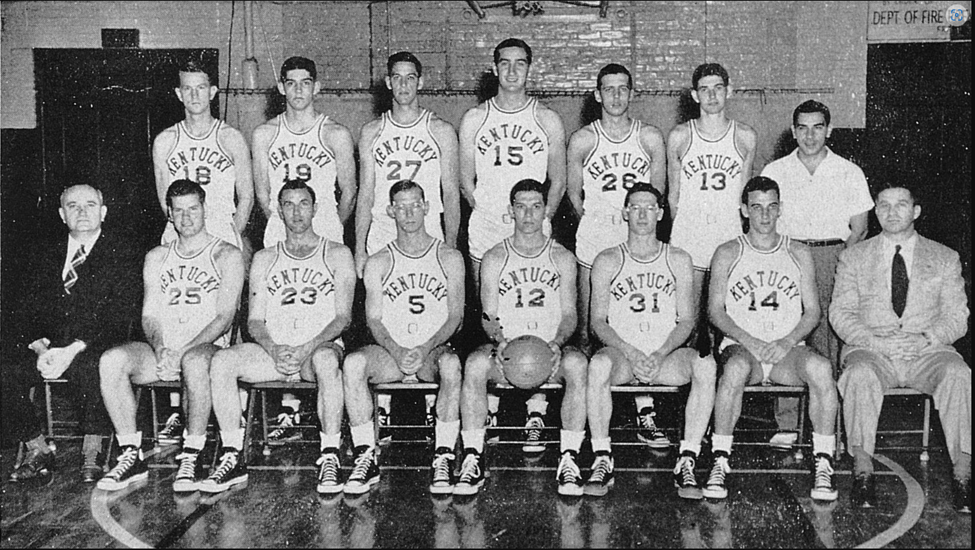
March 23, 1948: Kentucky's "Fabulous Five"

March 23, 1948: The University of Kentucky win the NCAA Basketball Tournament for the 1st time, defeating Baylor University, 58-42 at the old Madison Square Garden in New York.

Baylor had a player named Jackie Robinson -- a white man who would play with some of the Kentucky players on the 1948 U.S. Olympic Team in London, and became a minister. That's the most interesting thing about the Baylor squad.

But the Kentucky team was perhaps the best college basketball team ever assembled to this point. Their head coach, Adolph Rupp, called them "The Fabulous Five": Guards Ralph Beard and Kenny Rollins, forwards Wallace "Wah Wah" Jones and Cliff Barker, and center Alex Groza. They went 34-2, with the only losses being by 1 point to Temple in Philadelphia, a loss they avenged by 20 points in a rematch in Lexington; and 9 away to Notre Dame.

Rupp had been born in 1901 in Kansas, and had played at the University of Kansas under Forrest "Phog" Allen, while Allen's mentor, Dr. James Naismith, the literal inventor of basketball, was still alive and teaching there. After coaching in high school, Kentucky named him head coach in 1930, and he would lead them to 27 Southeastern Conference titles, 13 SEC Tournament wins, and 876 wins, more than any coach before him. He became known as "the Baron of the Bluegrass."

Rollins graduated in 1948, but the other four of the returned for the 1948-49 season. Dale Barnstable took Rollins' place in the starting lineup, and the Wildcats went 32-2, losing by 2 away to Saint Louis University, and by 11 against Loyola of Chicago, knocking UK out of the NIT at The Garden. But they won the NCAA, beating Oklahoma A&M (who became Oklahoma State in 1958) in the Final at Seattle.

After the 1949 NCAA Tournament, Coach Rupp then retired the uniform numbers of Beard, 12; Groza, 15; Barker, 23; Rollins, 26; and Jones, 27. Barnstable's 18 has never been retired.

It was these back-to-back National Championships that established Kentucky as an elite team. Fans of the "Bluegrass Boys" are sometimes mocked as the "Blue Bloods," and are said to be as arrogant as fans of the New York Yankees, the Dallas Cowboys, the Boston Celtics, the basketball team at Duke University, and the football team at the University of Notre Dame. (The Yankees, the Cowboys and Duke also wear blue and white; Notre Dame, blue but with gold.)

In 1948, Rollins was selected by the Fort Wayne Pistons in the NBA Draft, but they traded him to the Chicago Stags. In 1949, a new team in the NBA, the Indianapolis Olympians, tried to reassemble the U.S. Olympic Team. They selected Groza in the 1st round of the NBA Draft, Beard in the 2nd round. Barker was drafted by the Washington Capitols, but the Olympians acquired him in a trade. Barnstable was drafted by the Boston Celtics in 1950, but instead took a teaching and coaching job at a Louisville high school.

With Barker as player-coach, the Olympians won the NBA Western Division in 1950, and beat the Sheboygan Red Skins in the 1st round of the Playoffs, before losing the Division Finals to the Anderson Packers. In 1951, they just made the Playoffs, and lost to the Minneapolis Lakers in the 1st round.

But at the start of the 1951-52 season, Groza, Beard and Barnstable were arrested for taking bribes from gamblers to "shave points" while they were at Kentucky. When the dust settled in 1952, they were banned from the NBA for life. UK got its 1952-53 season canceled, and was banned from competing in the NCAA Tournament and the NIT in 1954.

Barker, Rollins and Jones were not implicated, and were allowed to play the 1951-52 season. But Barker and Jones left Olympians after that season, and never played professionally again. Rollins last played in 1953, with the Celtics. After that season, the Olympians folded, having lost to the Lakers again in the Playoffs in 1952 and '53.

Kentucky, still banned from the postseason at that point, went 25-0 in 1954, and the Helms Foundation declared them -- not NCAA Champion LaSalle or NIT Champion Holy Cross -- the National Champions.

Kentucky would win another title in 1958, with a bunch of players that Rupp said were "just fiddling around." Thus, they became known as the Fiddlin' Five. They made the Final again in 1966, with a team lacking much height, and thus known as "Rupp's Runts," but famously lost to the school now known as Texas-El Paso. This would lead to Rupp finally racially integrating his team.

After his retirement, Joe B. Hall, a reserve on the 1949 and 1951 title teams, led Kentucky to the National Championship in 1978, a few months after Rupp's death. Rick Pitino did so in 1996, Tubby Smith in 1998, and John Calipari in 2012. Baylor made what would later be called the Final Four again in 1950, but did not do so again until 2021, when they won the whole thing. By that point, they had become better known for their successful women's basketball program.

Groza, brother of Pro Football Hall-of-Famer Lou Groza, would later coach in college and in the ABA. Beard tried to play professional baseball, but his gambling connection got him banned from that sport as well. He became a scout for the ABA's Kentucky Colonels, and worked in the pharmaceutical industry. Barnstable wasn't playing in the pros anyway, but had gotten a job as a high school coach in Louisville, and was fired from that job as a result of the scandal. He later became a successful seller of air filters, and won senior golf tournaments. But none of the 3 were were ever involved in the NBA again, as their bans were never lifted.

Groza died in 1995, Barker in 1998, Beard in 2007, Rollins in 2012, Jones in 2014, Barnstable in 2019. None of them has ever been elected to the Basketball Hall of Fame. They were, however, all allowed to keep their Olympic Gold Medals.

*

March 23, 1948 was a Tuesday. Baseball was in Spring Training. Football was out of season. And the NHL was between the end of the regular season and the start of the Stanley Cup Playoffs.

There were 2 games in the NBA. The Chicago Stags beat the Washington Capitols, 74-70 at the Chicago Stadium. And the St. Louis Bombers beat the Philadelphia Warriors, 60-58 at the St. Louis Arena.

Tuesday, March 8, 2022

March 8, 1945: Jack Lummus Is Killed In Action

March 8, 1945: Lieutenant Andrew Jackson Lummus Jr., U.S. Marine Corps, is killed in action on Iwo Jima at the age of 29. His last words were, "Well, Doc, the New York Giants lost a mighty good end today."

Born on October 22, 1915 on a farm outside Ennis, Texas, Jack Lummus (pronounced "LOO-mis") played baseball and football at Baylor University, then was a 2-way end with the Giants. He played just 1 regular-season game in the NFL, on September 19, 1941, at Municipal Stadium (later John F. Kennedy Stadium) in Philadelphia. The Giants beat the Philadelphia Eagles, 24-0. He caught 1 pass for 5 yards. He didn't play again until the NFL Championship Game, on December 21. The Giants lost to the Chicago Bears, 37-9. He played, but did not catch a pass.

He never played again, because America got into World War II. He joined the Marines, rose to the rank of 1st Lieutenant, and was killed at the Battle of Iwo Jima. He was posthumously awarded the Congressional Medal of Honor.

Al Blozis, a tackle, also played for the Giants, from 1942 to 1944, and was killed in the war in 1945. Lummus and Blozis both got plaques on the clubhouse wall in center field at the Polo Grounds. Blozis got his Number 32 retired by the Giants, while Lummus' Number 29 remains available, most notably since having been worn by 1950s and '60 running back Alex Webster.

After the baseball New York Giants moved following the 1957, the Polo Grounds plaques – for Lummus, Blozis, John McGraw, Christy Mathewson, Ross Youngs, Mayor Jimmy Walker, and the monument to World War I casualty Eddie Grant – were lost. No one knows for sure where they are today. The San Francisco Giants claim not to have them.

*
March 8, 1945 was a Thursday. Baseball and football were out of season. The NBA hadn't been founded yet. There were 2 games played in the NHL. The New York Rangers lost to the Detroit Red Wings, 7-3 at the Olympia Stadium in Detroit. And the Montreal Canadiens beat the Boston Bruins, 3-2 at the Montreal Forum.

December 31, 1999 & January 1, 2000: The Millennium

December 31, 1999:  The Millennium arrives. The people of planet Earth survived. At a terrible cost. But we hadn't destroyed ourselves. ...