Showing posts with label britain. Show all posts

Saturday, December 31, 2022

December 31, 1984: Rick Allen's Car Crash

December 31, 1984: Rick Allen, the drummer for British hard-rock band Def Leppard, is badly injured in a car crash, outside the hometown of most of the band's members, Sheffield, South Yorkshire.

Allen, himself from Dronfield, in Derbyshire, in the East Midlands, was thrown from his Chevrolet Corvette. He had a seat belt on. The belt did not restrain him. It did restrain his left arm, severing it.

Until this moment, Allen seemed to be living a charmed life with one of the biggest bands in the world. On his 15th birthday, November 1, 1978, he was admitted to the band, after responding to their classified ad for a new drummer. On his 16th birthday, they opened for one of the biggest rock bands in the world, AC/DC.

But at 21, his career seemed to be over. As lead singer Joe Elliott said, "If I lose my arm, I can still sing. If he loses his voice, he can still play drums." How can a drummer play drums with one arm?

Allen had a specially-rigged drum kit made by Whirlwind USA, whose cables allowed his left foot to play the parts his left hand would have. This setup made its debut on August 5, 1986, at the Monsters of Rock festival, at the Donington Park race track in Leicestershire, England. The band went on to have its biggest album, Hysteria, in 1987.

Def Leppard's guitarists, Phil Collin and Steve Clark, were known as "The Terror Twins." Clark died from excessive drinking in 1991. He was subsequently replaced by Dio guitarist Vivian Campbell. He, Allen, Elliott, Collin and bass guitarist Rick Savage (his real name, not a stage name) are still together in 2022.

*

December 31, 1984 was a Monday. Baseball was out of season. The NFL was between its Divisional Playoffs and its Conference Championships. There were 2 college football bowl games. Virginia beat Purdue, 27-24 in the Peach Bowl at Atlanta-Fulton County Stadium. And West Virginia beat Texas Christian University (TCU), 31-14 in the Bluebonnet Bowl at the Astrodome in Houston.

There were no games played in the NBA, but there were 4 games played in the NHL:

* The New York Islanders lost to the Minnesota North Stars, 4-3 at the Metropolitan Sports Center in the Minneapolis suburb of Bloomington, Minnesota.

* The New Jersey Devils lost to the Buffalo Sabres, 6-4 at the Buffalo Memorial Auditorium.

* The Quebec Nordiques and their arch-rivals, the Montreal Canadiens, played to a 4-4 tie at the Montreal Forum.

* And the Pittsburgh Penguins and the Detroit Red Wings played to a 4-4 tie at the Joe Louis Arena in Detroit.

Friday, December 30, 2022

December 30, 1966: "One Million Years B.C." Premieres

December 30, 1966: The film One Million Years B.C. premieres. Produced by Britain's Hammer Films, which specialized in horror films, and directed by Don Chaffey, it was a remake of the 1940 film One Million B.C.

Like so many other films of the era with fantasy elements, the special effects were provided by the master of stop-motion photography, Ray Harryhausen. Like so many other films set in humanity's prehistoric era, it puts people alongside dinosaurs. The dinosaurs were wiped out around 65 million years ago, while humans emerged back 3 million years ago, with our species, Homo sapiens, developing about 300,000 years ago.

Even the timeline of dinosaurs tends to get messed up by such films: Brontosaurus, the long-necked dinosaur, and Stegosaurus, with its triangular fins along its spine, both lived around 155 to 145 million years ago; and Tyrannosaurus rex, whose terrifying appearance, standing with long, sharp teeth, tends to make it the most familiar dinosaur, and Triceratops, with its 2 front horns and its horned collar, developed about 69 million years ago, making it a comparatively short-lived species. In other words, Brontosaurus and Stegosaurus co-existed, and Tyrannosaurus and Triceratops co-existed; but the latter 2 were closer in time to humans than to the 1st 2.

The film features a rivalry between the dark-haired Rock Tribe and the fair-haired, more civilized Shell Tribe. John Richardson plays Tumak, cast out of the Rock Tribe, and Raquel Welch plays Loana, a member of the Shell Tribe who takes him in. She eventually has to fight his former girlfriend, Nupodi, played by Hammer veteran Martine Beswick. Despite Beswick's experience in "catfights," having won one in the James Bond film From Russia with Love, Loana wins. Finally, a volcano erupts, killing members of both tribes, and the survivors of each are forced to form a new tribe, working together to survive.

Having already appeared in the science-fiction film Fantastic Voyage earlier in the year, One Million Years B.C. made Welch a star, as she went from a futuristic skin-tight pressure suit to a cavewoman's fur-skin bikini. Already 26 years old, with a son and a daughter, and engaged to the 2nd of what would be 4 husbands, she became one of the leading sex symbols of her generation.

Don Chaffey died in 1990. Ray Harryhausen died in 2013. John Richardson died in 2021. As of December 30, 2022, Raquel Welch and Martine Beswick are still alive. (UPDATE: She died in 2023.)

*

December 30, 1966 was a Friday. Baseball was out of season. The NFL and the AFL were between the ends of their regular seasons and their Championship Games. The NHL had no games scheduled.

There was 1 game played in the NBA: The Detroit Pistons bat the Los Angeles Lakers, 124-121, on a neutral court at the Montreal Forum.

December 30, 1899: Ibrox Stadium Opens

December 30, 1899: Ibrox Park opens in the Ibrox neighborhood, on the West Side of Glasgow, Scotland. Home to Rangers Football Club, it hosted its 1st game 2 days later, on January 1, 1900, against the team that had already become their "Old Firm" arch-rivals, Celtic F.C., who won, 3-2.

This was the 2nd Ibrox Park, built just to the west of the 1st one, which Rangers had called home since 1887. While playing there, Rangers had won the Scottish Football League in 1891 and 1899. After moving to the 2nd Ibrox, they raised their title total to a national record 54: Adding them in 1900, '01, '02, '11, '12, '13, '18, '20, '21, '23, '24, '25, '27, '28, '29, '30, '31, '33, '34, '35, '37, '39, '47, '49, '50, '53, '56, '57, '59, '61, '63, '64, '75, '76, '78, '87, '89, '90, '91, '92, '93, '94, '95, '96, '97, '99, 2000, '03, '05, '09, '10 and '11.

(Unlike England, Scotland did not suspend league "football" for the duration of World War I. They did, however, suspend it for the duration of World War II.)

The stadium has been the site of 3 fatal disasters. On April 5, 1902, shortly after kickoff of a match between the national teams of Scotland and England, a section of terracing collapsed, causing 125 people to fall 50 feet to the ground below, killing 25 of them. Repairs were made, and also an expansion, raising capacity from the original 40,000 to 63,000.

The stadium was expanded again in 1929. On January 2, 1939 -- it has been tradition for the "Old Firm" rivals to play on New Year's Day, or on January 2 if January 1 falls on a Sunday -- Rangers beat Celtic, 2-1, in front of 118,567. This remains the largest attendance for a football match in any league in the United Kingdom.

The stadium got lights in 1953. Safety legislation cut capacity to about 80,000. But Ibrox Park had the worst fan safety record in Britain. Two fans died on September 16, 1961, when a barrier collapsed on Stairway 13, resulting in a crush. Stairway 13 was a popular exit from the East Terracing due to its proximity to the Copland Road subway station and parking areas for the Rangers supporters' coaches, but it was often overcrowded and very steep.

After this incident, Rangers installed safety measures, but further injuries were sustained in crushes on Stairway 13 in both 1967 and 1969. On October 23, 1968, the main stand was hit by fire. Just 7 months later, there was another fire, which destroyed more than 200 seats behind the directors box.

But when people speak of "The Ibrox Disaster," they usually mean what happened after the Old Firm game on January 2, 1971, when 66 people died of asphyxiation, due to another crush on Stairway 13. The game itself ended in a 1–1 draw, with Colin Stein scoring a late equalizer for Rangers. This led to a widespread belief that the crush had been caused by fans who had left the game early, but had turned back when they heard the roar that greeted the Rangers goal.

A public inquiry discounted this initial story. It established that the crowd had been travelling in the same direction when the crush happened, with it perhaps being precipitated by some bending over to pick up items that had been discarded during the goal celebrations. The downward force of the crowd leaving the stadium meant that when people started to fall there was no means of preventing a crush.

Adjustments made after the passage of the Safety of Sports Grounds Act 1975 cut the capacity of Ibrox to 44,000 by 1981. The Taylor Report, which applied to Scotland was well as England, led to a total rebuilding of each stand, which was completed in 1997, at which point Ibrox Park was officially renamed Ibrox Stadium. Capacity is now 50,817, all-seater.

In 2012, financial issues forced the liquidation of Rangers Football Club, ending them after 140 years. A new organization was founded, and a team of the same name took up residence at Ibrox, climbing up the Scottish "football pyramid." In 2021, they won the Scottish Premier League. Rangers fans count this as a 55th title. The rest of Scotland, who treat Rangers the way Englishmen treat Manchester United, and Americans treat the New York Yankees, do not.

*

December 30, 1899 was a Saturday. Among the games in English soccer, Leicester Fosse and Woolwich Arsenal played to a 0-0 draw at Filbert Street in Leicester, in the East Midlands. Woolwich Arsenal moved from South London to North London in 1913, becoming simply Arsenal. Leicester Fosse became Leicester City in 1919.

But in North America, there were no scores on this historic day.

Thursday, December 29, 2022

December 29, 1940: President Franklin D. Roosevelt's "Arsenal of Democracy" Speech

December 29, 1940: The Nazis' Luftwaffe carries out a massive incendiary bombing raid on London, starting 1,500 separate fires. Many famous buildings, including the Guildhall and Trinity House, are either damaged or destroyed. It becomes known as the Second Great Fire of London. (The first was in 1666.)

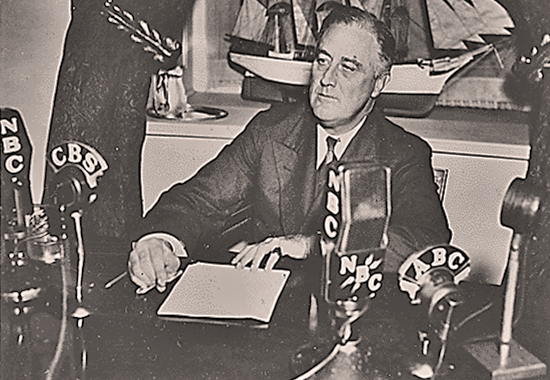
Hours later, President Franklin D. Roosevelt speaks from the White House, and his radio speech is broadcast around the world. He leaves no doubt that the fate of America is tied in with the fate of Britain. He used a phrase which had been hinted at before.

In 1918, Doubleday publishing executive Herbert S. Houston analyzed the soon-to-end World War I with an article titled "Blocking New Wars." He wrote that American business was the "Protector of Democracy," while the American free press was "one of the most effective weapons in the arsenal of democracy."

Writing in German, Nazi propagandist Joseph Goebbels useed the expression "arsenal of democracy" on April 30, 1928, in his newspaper Der Angriff (The Attack) to refer to using democratic institutions against themselves: "We enter the Reichstag to use the arsenal of democracy in order to assault it with its own weapons."

The concept of America as an actual arsenal came from the American playwright Robert E. Sherwood, who had written speeches for FDR. He who was quoted in the May 12, 1940 edition of The New York Times, as saying, "This country is already, in effect, an arsenal for the democratic Allies." Although the French economist Jean Monnet had used the phrase later in 1940, he was urged by Supreme Court Justice Felix Frankfurter, another longtime FDR ally, not to use it again, so FDR could make use of it in his speeches.

Which he did:

This is not a "fireside chat" on war. It is a talk on national security; because the nub of the whole purpose of your President is to keep you, now, and your children later, and your grandchildren much later, out of a last-ditch war for the preservation of American independence, and all the things that American independence means to you and to me and to ours...

The Nazi masters of Germany have made it clear that they intend not only to dominate all life and thought in their own country, but also to enslave the whole of Europe, and then to use the resources of Europe to dominate the rest of the world.

It was only three weeks ago that their leader stated this: "There are two worlds that stand opposed to each other." And then in defiant reply to his opponents, he said this: "Others are correct when they say: With this world we cannot ever reconcile ourselves... I can beat any other power in the world." So said the leader of the Nazis.

In other words, the Axis not merely admits, but the Axis proclaims that there can be no ultimate peace between their philosophy, their philosophy of government and our philosophy of government...

Some of our people like to believe that wars in Europe and in Asia are of no concern to us. But it is a matter of most vital concern to us that European and Asiatic war-makers should not gain control of the oceans which lead to this hemisphere.

One hundred and seventeen years ago, the Monroe Doctrine was conceived by our Government as a measure of defense in the face of a threat against this hemisphere by an alliance in Continental Europe. Thereafter, we stood guard in the Atlantic, with the British as neighbors. There was no treaty. There was no "unwritten agreement."

And yet, there was the feeling, proven correct by history, that we as neighbors could settle any disputes in peaceful fashion. The fact is that during the whole of this time the Western Hemisphere has remained free from aggression from Europe or from Asia.

Does anyone seriously believe that we need to fear attack anywhere in the Americas while a free Britain remains our most powerful naval neighbor in the Atlantic? Does anyone seriously believe, on the other hand, that we could rest easy if the Axis powers were our neighbors there?

If Great Britain goes down, the Axis powers will control the continents of Europe, Asia, Africa, Australasia, and the high seas -- and they will be in a position to bring enormous military and naval resources against this hemisphere. It is no exaggeration to say that all of us, in all the Americas, would be living at the point of a gun, a gun loaded with explosive bullets, economic as well as military...

Some nations of Europe were bound by solemn non-intervention pacts with Germany. Other nations were assured by Germany that they need never fear invasion. Non-intervention pact or not, the fact remains that they were attacked, overrun; thrown into modern slavery at an hour's notice, or even without any notice at all. As an exiled leader of one of these nations said to me the other day, "The notice was a minus quantity. It was given to my Government two hours after German troops had poured into my country in a hundred places."

The fate of these nations tells us what it means to live at the point of a Nazi gun.

The Nazis have justified such actions by various pious frauds. One of these frauds is the claim that they are occupying a nation for the purpose of "restoring order." Another is that they are occupying or controlling a nation on the excuse that they are "protecting it" against the aggression of somebody else.

For example, Germany has said that she was occupying Belgium to save the Belgians from the British. Would she then hesitate to say to any South American country, "We are occupying you to protect you from aggression by the United States"?

Belgium today is being used as an invasion base against Britain, now fighting for its life. And any South American country, in Nazi hands, would always constitute a jumping-off place for German attack on any one of the other Republics of this hemisphere.

In the election that FDR won a few weeks earlier, it was thought -- incorrectly, as it turned out -- that he might lose States in the Northeast where the Irish-American and Portuguese-American votes might turn on him, because the Irish hate the British and Portugal was neutral. So FDR went on to address the status of their ancestral homelands, to win their support:

Analyze for yourselves the future of two other places even nearer to Germany if the Nazis won. Could Ireland hold out? Would Irish freedom be permitted as an amazing pet exception in an unfree world? Or the Islands of the Azores which still fly the flag of Portugal after five centuries? You and I think of Hawaii as an outpost of defense in the Pacific. And yet, the Azores are closer to our shores in the Atlantic than Hawaii is on the other side.

There are those who say that the Axis powers would never have any desire to attack the Western Hemisphere. That is the same dangerous form of wishful thinking which has destroyed the powers of resistance of so many conquered peoples. The plain facts are that the Nazis have proclaimed, time and again, that all other races are their inferiors and therefore subject to their orders. And most important of all, the vast resources and wealth of this American Hemisphere constitute the most tempting loot in all the round world.

Let us no longer blind ourselves to the undeniable fact that the evil forces which have crushed and undermined and corrupted so many others are already within our own gates. Your Government knows much about them and every day is ferreting them out.

Their secret emissaries are active in our own and in neighboring countries. They seek to stir up suspicion and dissension to cause internal strife. They try to turn capital against labor, and vice versa. They try to reawaken long slumbering racial and religious enmities which should have no place in this country. They are active in every group that promotes intolerance. They exploit for their own ends our own natural abhorrence of war. These trouble-breeders have but one purpose. It is to divide our people; to divide them into hostile groups and to destroy our unity and shatter our will to defend ourselves.

There are also American citizens, many of them in high places, who, unwittingly in most cases, are aiding and abetting the work of these agents. I do not charge these American citizens with being foreign agents. But I do charge them with doing exactly the kind of work that the dictators want done in the United States.

These people not only believe that we can save our own skins by shutting our eyes to the fate of other nations. Some of them go much further than that. They say that we can and should become the friends and even the partners of the Axis powers. Some of them even suggest that we should imitate the methods of the dictatorships. But Americans never can and never will do that.

The experience of the past two years has proven beyond doubt that no nation can appease the Nazis. No man can tame a tiger into a kitten by stroking it. There can be no appeasement with ruthlessness. There can be no reasoning with an incendiary bomb. We know now that a nation can have peace with the Nazis only at the price of total surrender...

In a military sense Great Britain and the British Empire are today the spearhead of resistance to world conquest. And they are putting up a fight which will live forever in the story of human gallantry.
There is no demand for sending an American Expeditionary Force outside our own borders. There is no intention by any member of your Government to send such a force. You can, therefore, nail, nail any talk about sending armies to Europe as deliberate untruth...
He began his closing with the use of the key phrase:
As planes and ships and guns and shells are produced, your Government, with its defense experts, can then determine how best to use them to defend this hemisphere. The decision as to how much shall be sent abroad and how much shall remain at home must be made on the basis of our over-all military necessities.
We must be the great arsenal of democracy. For us this is an emergency as serious as war itself. We must apply ourselves to our task with the same resolution, the same sense of urgency, the same spirit of patriotism and sacrifice as we would show were we at war.

We have furnished the British great material support and we will furnish far more in the future.

There will be no "bottlenecks" in our determination to aid Great Britain. No dictator, no combination of dictators, will weaken that determination by threats of how they will construe that determination.

The British have received invaluable military support from the heroic Greek army, and from the forces of all the governments in exile. Their strength is growing. It is the strength of men and women who value their freedom more highly than they value their lives.

I believe that the Axis powers are not going to win this war. I base that belief on the latest and best of information.

We have no excuse for defeatism. We have every good reason for hope—hope for peace, yes, and hope for the defense of our civilization and for the building of a better civilization in the future.

I have the profound conviction that the American people are now determined to put forth a mightier effort than they have ever yet made to increase our production of all the implements of defense, to meet the threat to our democratic faith.

As President of the United States I call for that national effort. I call for it in the name of this nation which we love and honor and which we are privileged and proud to serve. I call upon our people with absolute confidence that our common cause will greatly succeed.


Given the preceding decade of English "football," FDR's use of the term "Arsenal" had greater resonance for the British than he could have realized.

At one point in this process, FDR called for the building of 50,000 airplanes to aid the Allied cause. In the end, twice as many were built: Over 100,000.

*

December 29, 1940 was a Sunday. Baseball and football were out of season. The NBA hadn't been founded yet.

There were 2 games in the NHL. The New York Rangers beat the Toronto Maple Leafs, 3-2 at the old Madison Square Garden. And the Detroit Red Wings beat the Chicago Black Hawks, 2-1 at the Olympia Stadium in Detroit. 

Sunday, December 25, 2022

December 25, 1932: The 1st Royal Christmas Message

December 25, 1932: King George V delivers a Royal Christmas Message to the British Empire, broadcast live over the British Broadcasting Corporation and its Worldwide Service, thus beginning a tradition.

John Reith, founder of the BBC, had first approached the King about the idea in 1922, but the King declined, saying that radio was mainly an entertainment. Reith waited 10 years before trying again. This time, he was smart: He gave the idea to Queen Mary first. When she told her husband it was a good idea, he relented. To be on the safe side, he also talked to the Prime Minister, James Ramsay MacDonald, who was prepared to be an additional voice to try to talk the King into it.

The tradition of the British royal family staying at Sandringham House, their country retreat in Norfolk, East Anglia, for the Christmas season had been put in place ever since it was bought in 1862, as a summer home for the King's father, then the Prince of Wales, later King Edward VII. A temporary studio was set up there, eventually replaced by a permanent one.

The address was written for the King by one of Britain's most honored (if not "greatest") authors then living, Rudyard Kipling, and is said to have been heard by 20 million people. The broadcast began at 3:00 PM London time, for the best possible distribution across the time zones: Eastern Canada, 10:00 AM; South Africa, 5:00 PM; New Dehli, 8:30 PM; Hong Kong, 11:00 PM; Sydney and Melbourne, 1:00 AM on December 26.

The speech was introduced by a local shepherd named Walton Handy. The town church rang its bells, and its choir sang Christmas carols. Finally, the King spoke, for a little over 3 minutes:

Through one of the marvels of modern science, I am enabled, this Christmas Day, to speak to all my peoples throughout the Empire.

I take it as a good omen that Wireless should have reached its present perfection at a time when the Empire has been linked in closer union. For it offers us immense possibilities to make that union closer still.

It may be that our future may lay upon us more than one stern test. Our past will have taught us how to meet it unshaken.

For the present, the work to which we are all equally bound is to arrive at a reasoned tranquility within our borders; to regain prosperity without self-seeking, and to carry with us those whom the burden of past years has disheartened or overborne.

My life's aim has been to serve as I might, towards those ends. Your loyalty, your confidence in me has been my abundant reward.

I speak now from my home and from my heart to you all.

To men and women so cut off by the snows, the desert or the sea, that only voices out of the air can reach them; to those cut off from fuller life by blindness, sickness, or infirmity; and to those who are celebrating this day with their children and grandchildren.

To all, to each, I wish a Happy Christmas. God Bless You!

George V delivered such Messages again in 1933 and 1934. In 1935, it was noticed that his voice sounded weaker. Sure enough, he died less than a month later, on January 20, 1936.

His son, King Edward VIII, abdicated the throne on December 11, 1936, so not only did he never get a Coronation, he never got to deliver a Royal Christmas Message. His brother became King George VI. He did not deliver a Royal Christmas Message in 1936. He did in 1937, but not in 1938. But in 1939, all through World War II, and into his final illness, he and delivered them every year through 1951. He died on February 6, 1952.

Since then, his daughter, Queen Elizabeth II, has delivered the Message every December 25. Her 1st Message, in 1952, was simulcast, in sound only, on BBC television. Not until 1957 would it be broadcast live on TV.

In 1953, as she and her husband, Prince Philip, Duke of Edinburgh, were on a tour of the British Commonwealth, she delivered her Message from Auckland, New Zealand. Since then, it has been pre-recorded at either Sandringham House or Buckingham Palace.

*

December 25, 1932 was a Sunday. Baseball was out of season. The NBA hadn't been founded yet. The NFL season had ended the previous Sunday, with the Chicago Bears defeating the Portsmouth Spartans (of Ohio) for the Championship.

There were 2 games played in the NHL that day. The New York Rangers beat the Montreal Maroons, 2-0 at the old Madison Square Garden. And the Detroit Red Wings beat the Chicago Black Hawks, 4-0 at the Olympia Stadium in Detroit.

"Back in Blighty," this was the era when England's Football League still regularly played games on Christmas Day. But not on Sundays, so there were no games played in that League.

December 25, 1914: The Christmas Truce

A recreation of the match for the BBC's Centennial coverage, 2014

December 25, 1914: Upon hearing German soldiers sing Christmas carols in their trench on the Western Front of what was then called The Great War (later World War I), the British soldiers start to do so in theirs. Soon, the men on both sides come out of their trenches, and stop treating each other as enemies for a few hours, exchanging food, drinks, and trinkets. It becomes known as the Christmas Truce.

Legend has it that there was even a soccer game. Sorry, forgot to "speak English" there: A football match. It's not clear which side produced the ball, but according to most accounts that discuss the match, the Germans beat the English, 3-2.


This is the 1st time that Englishmen would be defeated by Germans at their national game. There have been many more. But, as England manager Alf Ramsey pointed out before the 1966 World Cup Final, twice in the 20th Century, the English (well, the British, and their allies) would beat the Germans at their 
national game (war), and on their soil no less.

Military historian Andrew Robertshaw, a technical advisor for the film version of the World War I story War Horse, says such a truce would have been unthinkable a year later: "This was before the poisoned gas, before aerial bombardment. By the end of 1915, both sides were far too bitter for this to happen again."

In 1997, Garth Brooks and Joe Henry wrote a song titled "Belleau Wood" for Brooks' album Sevens.  It describes a Christmas truce between American and German soldiers at Belleau Wood in 1917. But this is fiction, as the battle of Belleau Wood took place in June 1918, in Aisne, Picardy, France.


The Football League did not suspend operations until the conclusion of the 1914-15 season. On Christmas, Arsenal began a home-and-home series, defeating Leicester Fosse away 4-1 on the 25th, and 6-0 at home on the 26th.

December 25, 1914 was a Sunday. Baseball was in the off-season. American football had just ended its season. Professional basketball barely existed. And the National Hockey Association didn't start their 1914-15 season until the day after Christmas. So there were no scores in North America on this historic day.

Thursday, December 22, 2022

December 22, 1962: Britain's "Big Freeze" Begins

December 22, 1962: The "Big Freeze" begins in Britain. There were no frost-free nights until March 5, 1963 – 74 straight days.

The Winter of 1962–1963 remains the coldest since at least 1894-95 in all meteorological districts of the United Kingdom, although in north Scotland the Winter of 2009-10 was equally cold.

A cold easterly set in on December 22, as an anticyclone formed over Scandinavia, drawing cold continental winds from Russia. Throughout the Christmas period, the Scandinavian high collapsed, but a new high formed near Iceland, bringing northerly winds. Significant snowfall occurred on December 26 and 27, as the air mass moved south, and became firmly established.

Overnight on December 29 and 30, 1962 a blizzard swept across southern England and Wales. Snow drifted to more than 20 feet deep in places, driven by gale force easterly winds, blocking roads and railways. The snow stranded villages and brought down power lines.

On December 31, the clock on the Palace of Westminster -- often called Big Ben, even though that's actually the name of the bell in the clock -- was delayed by 10 minutes due to the large amount of snow that had accumulated on the clock hands, and the New Year ended up being 10 minutes late.

The near-freezing temperatures meant that the snow cover lasted for more than 2 months in some areas. There was so much snow, and temperatures were so cold, that the 3rd Round of the FA Cup, which normally begins on the 1st Saturday in January, was not completed until March 11, at a time when the 6th Round, the Quarterfinals, would usually be played. As a result, the Final, usually set for the 1st Saturday in May, was pushed back to the last, May 25.

*

December 22, 1962 was a Saturday. Also starting in England on this day is Ralph Nathanial Twisleton Wykeham Fiennes, in Ipswich, Suffolk. We would know him as the actor Ralph Fiennes, pronounced "Raif Fines."

And, on that day, for the first time, a British band hit Number 1 on the American popular music charts. No, it wasn't The Beatles. It was The Tornadoes, with the instrumental "Telstar," named for the communications satellite launched earlier in the year. As far as the U.S. charts were concerned, The Tornadoes turned out to be "one-hit wonders."

The cold postponed all Football League games in England. In American football, the NFL was between the last week of its regular season and its Championship Game, which, on December 30, the Green Bay Packers won, beating the New York Giants, 16-7 at Yankee Stadium. The American Football League played its Championship Game on December 23, and the Dallas Texans beat the Houston Oilers, 20-17 in overtime at Jeppesen Stadium in Houston. (I have separate entries for each of those games.)

There were 2 college football bowl games played that day. The Tangerine Bowl was played at the stadium then carrying the same name, now named Camping World Stadium, in Orland, Florida. The University of Houston beat Miami University of Ohio, 49-21.

UH did not play its bowl game in Houston. That would be the Bluebonnet Bowl, at Rice Stadium. Missouri beat Georgia Tech, 14-10.

Baseball was out of season. There were 3 games in the NBA, and 2 were a doubleheader at the Boston Garden. The Detroit Pistons beat the Chicago Zephyrs, 122-110. The Zephyrs became the Baltimore Bullets the next season. And the New York Knicks beat the Boston Celtics, 120-106 at the Boston Garden. Richie Guerin scored 37 points for the Knicks.

* And the San Francisco Warriors beat the Syracuse Nationals, 123-118 at the Onondaga County War Memorial in Syracuse, New York. It was just another day at the office for Wilt Chamberlain: He scored 39 points and grabbed 28 rebounds, leading the Warriors to victory. This was the NBA's only season without a Philadelphia team: The Warriors had moved in the previous off-season, while the Nats would move the next off-season, becoming the Philadelphia 76ers for 1963-64.

And there were 2 games in the NHL. The New York Rangers lost to the Toronto Maple Leafs, 4-2 at Maple Leaf Gardens in Toronto. And the Chicago Black Hawks and the Montreal Canadiens played to a tie, 1-1 at the Montreal Forum. The Boston Bruins and the Detroit Red Wings were not scheduled.

Wednesday, December 21, 2022

December 21, 1988: The Bombing of Pan Am Flight 103

December 21, 1988: Pan Am Flight 103 is blown up over Lockerbie, Scotland. It is one of the most notorious cases of terrorism to date, and remains the deadliest ever to occur in the British Isles.

A Boeing 747, it had taken off from Frankfurt, Germany at 4:19 PM, and stopped over at Heathrow Airport in London at 5:40. At 6:25, it took off again, heading for John F. Kennedy International Airport in New York. After a refueling, it would then have taken off for Detroit, its final stop.

But at 7:03 PM, Greenwich Mean Time -- 2:03, U.S. Eastern Time -- the plane exploded over Lockerbie, about 15 miles northwest of the Scotland-England "border," 74 miles south of Edinburgh, 72 miles southeast of Glasgow, and 341 miles northwest of Central London.

The bombing and crash claimed the lives of all 259 individuals on board the plane, and 11 people on the ground below. The victims were citizens of 21 countries. Of those killed, 190 were United States citizens, making the bombing of Pan Am Flight 103 the deadliest terrorist attack against American civilians prior to September 11, 2001. It remains the deadliest attack in the history of the United Kingdom.

The bombing didn't just kill 270 people. Essentially, it killed Pan American World Airways as well: Already in financial trouble, Pan Am never recovered, and went out of business on December 4, 1991, just under 3 years later.

The bombing hung over the Christmas season in both America and Britain. On December 23, 2 days later, reports surfaced that the U.S. Embassy in Finland received bomb threats against a Pan Am flight. On December 28, 5 days after that, British investigators reported that a bomb in the luggage compartment caused the explosion.

The bombing came 2 1/2 years after President Ronald Reagan retaliated for Libyan terrorist attacks that had killed American soldiers stationed in Europe, by bombing targets in Libya, including a palace owned by dictator Muammar Gaddafi.

Conservatives used to tell me that once Reagan bombed Libya, Gaddafi left Americans alone. He did – until he gave Reagan, who was to leave office a month later due to term limits, something dictators don't officially have, this going-away present.

Arrest warrants were issued for two Libyan nationals in November 1991. After protracted negotiations and United Nations sanctions, on April 5, 1999, Gaddafi handed over the two men for trial at Camp Zeist, the Netherlands. On January 31, 2001, Abdelbaset al-Megrahi, a Libyan intelligence officer, was found guilty of 270 counts of murder in connection with the bombing. He remains the only person ever convicted of involvement. The other man handed over, Lamin Khalifah Fhimah, was found not guilty, and released.

On November 2, 2009, having been diagnosed with cancer, the Scottish government released him on compassionate grounds. He had been in custody for 10 1/2 years, for murdering 270 people. He lived until May 20, 2012.

In 2003, Gaddafi accepted Libya's responsibility for the Lockerbie bombing, and paid over $1 billion dollars in compensation to the families of the victims, a very unusual outcome for a terrorist bombing. He maintained that he had never personally given the order for the attack.

He finally answered for his crime on October 20, 2011. His former Minister of Justice, Mustafa Abdul Jalil, claimed that Gaddafi had personally ordered the attack.

As of December 21, 2022, Lamin Khalifah Fhimah is still alive.

*

December 21, 1988 was a Wednesday. Baseball was out of season. The NFL was in midweek, and there were no college bowl games that day. There were 6 games in the NBA:

* The New Jersey Nets beat the Dallas Mavericks, 122-120 in overtime at the Brendan Byrne Arena at the Meadowlands.

* The Cleveland Cavaliers beat the Boston Celtics, 115-114 at the Boston Garden.

* The Utah Jazz beat the Washington Bullets, 98-82 at the Capital Centre in the Washington suburb of Landover, Maryland.

* The Milwaukee Bucks beat the Charlotte Hornets, 112-100 at the Charlotte Coliseum.

* The Seattle SuperSonics beat the Miami Heat, 109-101 at the Miami Arena.

* And the San Antonio Spurs beat the Sacramento Kings, 125-107 at the HemisFair Arena in San Antonio.

And there were 8 games in the NHL:

* The New York Rangers lost to the Buffalo Sabres, 5-2 at Madison Square Garden.

* The New Jersey Devils and the Winnipeg Jets played to a tie, 5-5 at the Winnipeg Arena.

* The Montreal Canadiens beat their Provincial rivals, the Quebec Nordiques, 6-4 at the Montreal Forum.

* The Boston Bruins beat their fellow New Englanders, the Hartford Whalers, 4-3 at the Hartford Civic Center (now the PeoplesBank Arena).

* The Pittsburgh Penguins beat the Toronto Maple Leafs, 6-1 at Maple Leaf Gardens in Toronto.

* The Washington Capitals beat the Chicago Blackhawks, 4-3 at the Chicago Stadium.

* The Vancouver Canucks beat the Edmonton Oilers, 3-1 at the Northlands Coliseum in Edmonton.

* And The Los Angeles Kings beat the Minnesota North Stars, 8-6 at The Forum outside Los Angeles in Inglewood, California.

Thursday, December 15, 2022

December 15, 1944: Glenn Miller Disappears

December 15, 1944: Glenn Miller, the biggest name of the "Big Band" era of music, disappears.

Miller was a trombonist, and led The Glenn Miller Orchestra. In 1939, they had hits with "Moonlight Serenade" and "In the Mood." In 1940, he would record "Tuxedo Junction" and "PEnnsylvania 6-5000." In 1941 came "Chattanooga Choo Choo." In 1 day, May 20, 1942, he recorded "At Last" (now better known for the 1961 version by Etta James) and "(I've Got a Gal in) Kalamazoo."

So in a span of a little over 3 years, he recorded 7 iconic songs, which led to his band being featured in some movies. They became the biggest band of the World War II years (I'm talking about popularity, not just in number of members) -- bigger than Benny Goodman's, bigger than either Tommy Dorsey's or Jimmy Dorsey's, and (no doubt helped by the fact that he and his band were white) bigger than Duke Ellington's and Count Basie's.

Miller's career came to what was expected to be a temporary interruption when he joined the war effort. He was ready to give up a civilian income of $20,000 per week -- about $339,000 in 2022 money, or around $17 million a year, so it was comparable to today's biggest stars -- to put on a uniform and serve his country.

At 38, he was too old to be drafted by the U.S. Army. So he volunteered for the U.S. Navy. They told him they didn't need him. So he wrote to an Army General, suggesting that he "be placed in charge of a modernized Army band."

This was done, as he was assigned to the U.S. Army Air Forces, the precursor to the U.S. Air Force. This allowed his band members -- not the same ones he had in his Orchestra -- to fly to various U.S. installations and perform for their fellow troops.

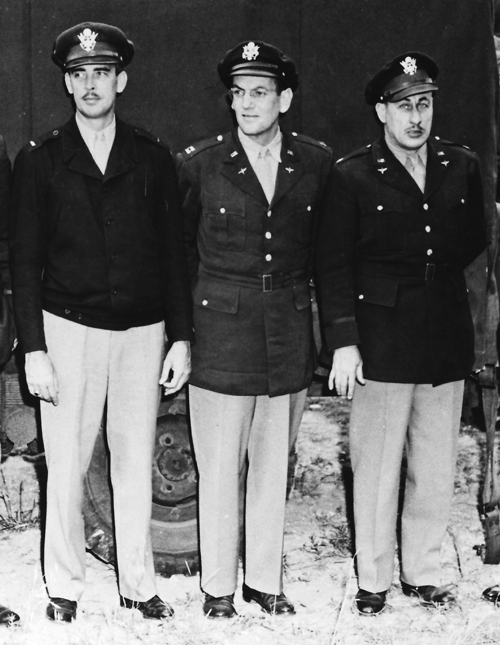
On December 15, 1944, Major Glenn Miller boarded a single-engine UC-64 Norseman at Clapham, England, heading for recently-liberated Paris, where he would establish the headquarters his band intended to have for the duration of the War. With him were 2 other officers: Lieutenant Colonel Norman Baessell, who would supervise the construction of the HQ; and the pilot, Flight Officer John Morgan.
Left to right: Morgan, Miller, Baessell

The weather was bad the day before, leading to all planes being grounded. Miller was expected to be in Paris on the 16th, but on the 15th, Baessell made a guess that there would be enough of a break in the weather to fly. So the plane took off at 1:55 PM Greenwich Mean Time (8:55 AM on the U.S. East Coast).

No one was expecting the plane to arrive in Paris that afternoon, and so, when it didn't show up, no one thought to look for it. It was only when the rest of the band arrived at Paris' Orly Airport on December 18, and Miller wasn't there to meet them, that anybody realized that anything was wrong. The intended hotel was called, and Miller hadn't checked in.

It was only on December 24, Christmas Eve, that it was announced by the Army that Miller's plane was missing and presumed lost. No trace of it has ever been found. The band's deputy leader, Technical Sergeant Jerry Gray, led the band in that evening's performance in Miller's place.

Investigations turned up nothing solid, but the most common theory is that, given the weather, the plane's carburetor iced up, causing a crash that would have killed everybody on impact with the water. Suggestions of the Nazis shooting the plane down, or a horrible mistake of "friendly fire," or Miller having made it to Paris, dying in a brothel, and having the Army cover it up were dismissed as impossible.

Miller was 39, and left behind a wife and 2 children. His wife, Helen, was given a Bronze Star awarded to him 3 months later.

Today, as with some of the other bands I mentioned, a "legacy band," authorized by the Miller estate, performs the Miller catalog. Trumpeter Ray Anthony was the last surviving member of the original Glenn Miller Orchestra. On January 20, 2022, he celebrated his 100th birthday.

*

December 15, 1944 was also the day the Battle of the Bulge began in the Ardennes Forest of France, Belgium and Luxembourg, Nazi Germany's last stand on the Western Front. On December 22, the Nazis sent an officer to deliver a surrender demand to the U.S. Army's 101st Airborne Division, then stationed in Bastogne, Belgium, and virtually surrounded. General Anthony McAuliffe, in command, sent him away with a one-word reply: "Nuts!"

The Nazis held the upper hand through Christmas, but the day after, the 4th Armored Division arrived with reinforcements, and turned the tide of the battle. Once that happened, the Nazis were doomed, both on the Western Front and overall.

It was also the day the first five-star Generals were promoted. I have a separate entry for that.

And it was the day the film Hollywood Canteen opened. I have a separate entry for that, too.

December 15, 1944 was a Friday. Baseball was in the off-season. The NFL Championship Game was played 2 days later, with the Green Bay Packers beating the New York Giants, 14-7 at the Polo Grounds in New York. The NBA hadn't been founded yet. And, while the NHL was in-season, no games were scheduled for that day. So there are no scores on this historic day.

Wednesday, December 14, 2022

December 14, 1926: Agatha Christie Is Found

December 14, 1926: Agatha Christie, the world's best-selling mystery novelist, is found, safe and sound, 11 days after disappearing. It was a story worthy of one of her own fictional detectives.

Born in Torquay, Devon, in England's West Country in 1890, she struggled as a writer until 1920, when The Mysterious Affair at Styles was published, introducing the world to Hercule Poirot, her Belgian private detective. More Poriot stories followed.

She had married Army officer Archie Christie in 1914, and both served in World War I: Archie in the Royal Flying Corps, Agatha as a nurse back in Torquay. He survived the war, and Agatha's only child, Rosalind, was born in 1919.

In April 1926, Agatha's mother, Clara Miller, died, leaving her in a deep depression. In August, Archie asked her for a divorce, because he'd fallen in love with another woman. She wouldn't grant it. On December 3, Archie announced he was going to spend the next weekend with friends, without Agatha. That night, she drove off from their house at Sunningdale, Berkshire, about 25 miles west of London.

The next day, her car, a Morris Cowley, was found at Newlands Corner, about 14 miles to the southeast. Inside were women's clothes and an expired driver's license. The search was on, with the police, civilians, and early airplanes searching the rural area. Sherlock Holmes' creator, Dr. Sir Arthur Conan Doyle, gave one of her gloves to a spirit medium, with no luck. The British press, always on the look for a sensational story, the more salacious the better for them, went wild. The rest of the world covered it as well, with The New York Times featuring an account of her disappearance on a front page.

On December 14, she was found, at the Swan Hydropathic Hotel in Harrogate, North Yorkshire, 184 miles north of her house. She was registered as Mrs. Tressa Neele, from Cape Town, South Africa. This was a dig at her husband: His mistress was named Nancy Neele, spelled exactly the same way.

The next day, her sister Margaret, a.k.a. Madge, took Agatha to her home in Cheadle, outside Manchester, and kept her "in guarded hall, gates locked, telephone cut off, and callers turned away." "Callers" meaning "visitors." She acted as though she had no memory of leaving Sunningdale, and 2 doctors diagnosed her memory loss as genuine. Perhaps she had a nervous breakdown, but the fact that she had signed her name as that of her husband's mistress led many to consider it a publicity stunt, perhaps to frame her husband for murder (despite the lack of a dead body), and turn on her.

A year later, the December 1927 issue of The Royal Magazine published The Tuesday Night Club, a Christie story that introduced a new consulting detective, an old lady whose vast experience enable her to solve current cases. The following year, Archie got the divorce he wanted, and married Nancy Neele. He died in 1962.

Also in 1928, Agatha first rode the Orient Express, the already-famous Paris-to-Istanbul train, and traveled to the Middle East, to indulge her love of archaeology. On a subsequent trip in 1930, she met archaeologist Max Mallowan, 13 years younger, and they married, and went on expeditions together. They were together until death did they part.

In 1934, she published Murder On the Orient Express, in which Poirot is on the eponymous train, and is called on to solve a murder on board. It became her most famous work, although it wasn't filmed until 1974, with Albert Finney playing Poirot. It was filmed again in in 2001, with Alfred Molina; 2010, with David Suchet, who is usually considered to be the role's definitive portrayer; and 2015, with Kenneth Branagh.

Agatha Christie was knighted in 1971, and died in 1976. Her daughter, Rosalind Hicks, married an Army officer just as her mother had, but he was killed in action in World War II. She remarried, and guarded her mother's estate and legacy until her own death in 2004. Her only child, Matthew Prichard, inherited the estate, which is now run by his son, James Prichard.

*

December 14, 1926 was a Tuesday. Baseball was out of season. Football was in midweek. The NBA hadn't yet been founded. There were 3 NHL games that night:

* The New York Americans lost to the Ottawa Senators, 2-0 at the new Madison Square Garden -- which, since 1968, has been known as the old Madison Square Garden. Cy Denneny scored both goals.

* The Montreal Maroons beat the Toronto St. Patricks, 3-0 at the Montreal Forum. The following season, under new ownership, the St. Patricks were renamed the Maple Leafs, and their dominant color from green to blue.

* And the Boston Bruins beat the Detroit Cougars, 7-2 at the Boston Arena (now the Matthews Arena). The Cougars became the Detroit Falcons in 1930, and the Detroit Red Wings in 1932.

Saturday, December 10, 2022

December 11, 1886: The 1st Arsenal Match

Not quite the 1st Arsenal team, but perhaps the earliest known team photo,
1888, including some of the original players.

December 11, 1886: The Arsenal Football Club played its 1st game. It was on the Isle of Dogs, at a ground recently occupied by Millwall Football Club, against a team named Eastern Wanderers, which went out of business a few years later. The new club won, 6-0.

They were originally a works team -- what we in the U.S. would call a company team, as both the Chicago Bears and Green Bay Packers began -- at the Royal Arsenal (hence the nickname "The Gunners," which led to their fans later being tagged "The Gooners") in Woolwich (the 2nd W is silent), in what was then the county of Kent, but is now part of Southeast London (SE16).

They called themselves Dial Square Football Club, after the section of the Arsenal where they worked. On Christmas Day, December 25, 1886, they met at the nearby Royal Oak pub, to make things more official, and changed their name to the Royal Arsenal Football Club.

The 1st game under the new name, and the 1st game that could be called a "home game" for them, was on January 8, 1887, at Plumstead Common, 2 miles away, against a nearby club called Erith, and Royal Arsenal won, 6-1.
The Royal Arsenal at Woolwich. Photo dated 1960.

In 1893, they turned professional, and were admitted to England's Football League, but had to change their name, as Queen Victoria had signed a law that prohibited any professional sports team from having "Royal" in its name. (This is not the case in Spain, where there are professional soccer teams named Real Madrid, Real Mallorca, Real Betis, etc.)

And, of course, being professional, they had ceased to be a "club," even though the word remains part of the organization's name, and the fans continue to call their team "my club."

So they took on the name of their locality, and were Woolwich Arsenal from then until 1913, when they moved to a new stadium at Highbury in North London, "The Arsenal" until 1919 and "Arsenal Football Club" since, although "The Arsenal," Capital T, Capital A, is frequently still used, especially by the club's fans.

They could have changed their name to "Highbury Arsenal," or "Islington Arsenal," even though neither the Borough of Islington nor the Highbury neighborhood had any connection to the Royal Arsenal, aside from the club. As a result, Arsenal are 1 of only 2 professional clubs in England without a locality as part of their official name. The other is Port Vale, located in Stoke-on-Trent, Staffordshire.

Herbert Chapman was signed to manage Arsenal in 1925. He led them to win the Football Association Cup in 1930, and the Football League Division One in 1931 and 1933, before his death midway through the 1933-34 season. Under Joe Shaw, and then George Allison, the team he built went on to win the League again in 1934, 1935 and 1938, and the FA Cup in 1936. A rebuild after World War II, under manager Tom Whittaker, resulted in League titles in 1948 and 1953, and an FA Cup in 1950.

Like Chapman, Whittaker died in office, in 1956, and a down period resulted. The team's fortunes were turned around under Bertie Mee. In 1970, he guided the team to the Inter-Cities Fairs Cup, the tournament now known as the UEFA Europa League. In 1971, Arsenal took both the League and the FA Cup, "The Double." A mid-1970s rebuild under Terry Neill led to an FA Cup win in 1979.

In 1986, George Graham, one of the players from the '71 Double was named manager. He led the team to the 1987 League Cup, the 1989 and 1991 League titles, the 1st-ever English domestic "cup double" (the League Cup and the FA Cup) in 1993, and the European Cup Winners' Cup (a tournament that no longer exists) in 1994.

In 1996, Arsène Wenger was named the team's 1st manager not a native of the British Isles, and he revamped everything, from tactics to exercise to diet. In 1998, now in the era of the Premier League, he took Arsenal to another Double. He did it again in 2002. He led them to another FA Cup in 2003. And he led them through the entire 2003-04 Premier League season without losing a game: Played 38, won 26, drawn 2, lost exactly none. It had never been done before, and it hasn't been done since. The unbeaten string eventually reached 49 games.

(The 1st season of the Football League was in 1888-89, and Lancashire team Preston North End went through the 22-game season unbeaten, and also won the FA Cup. But 38 is a lot more games than 22.)

After another FA Cup win in 2005, Arsenal advanced to the Final of the UEFA Champions League in 2006, their last season at Highbury. With the opening of the new 60,000-seat Emirates Stadium, the construction debt had to be paid off, and Wenger had less of a budget than before. Still, he managed to keep the team in the Champions League places.

A small but loud and angry section of the fanbase began to demand that Wenger spend more money on "world-class players," because they believed that winning the League title was all that mattered. When Wenger ended a 9-year trophy drought by winning the 2014 FA Cup, this small but loud and angry section decided that it wasn't enough.

Nor was it enough when he did it again in 2015 and 2017. They demanded that he be fired for not giving them another League title -- as if he hadn't already given them 3, as many as any other Arsenal manager had ever done. (Allison had won 3; Chapman, Whittaker and Graham had each won 2, Shaw 1.)

By 2017, Arsenal had been surpassed by bigger-spending teams run by billionaire owners, and fell out of the Champions League places. Late in the 2018 season, Wenger announced he was leaving. It is still debated whether he was fired, or he quit due to even his great patience finally being worn out by the whiners.

New manager Unai Emery turned out to be a poor replacement, and was fired in favor of Mikel Arteta, the Spanish midfielder who had captained the 2014 and '15 Cup wins. His leadership led to victory in the 2020 FA Cup, and a 2nd-place finish and a return to Champions League qualification in 2022.

The Arsenal have a great past, and a promising future. The hope is that the team can, within a short time, return to its former heights.

Good old Arsenal, we're proud to say your name.
While we sing this song, we'll win the game!

There are no other scores on this historic day. England's Football League wouldn't be founded for another 2 years, and, given the distances involved in the pre-automobile era, scheduling was risky. In America, the baseball season was over, the college football season was also over, basketball hadn't been invented yet, and hockey hardly had been.

December 31, 1999 & January 1, 2000: The Millennium

December 31, 1999:  The Millennium arrives. The people of planet Earth survived. At a terrible cost. But we hadn't destroyed ourselves. ...