Showing posts with label chicago stadium. Show all posts

Sunday, December 18, 2022

December 18, 1932: The NFL Moves Indoors

December 18, 1932: A Playoff game is held to determine the Champion of the National Football League. Snow forces the young League indoors for the 1st time.

There had been controversies for the League title in 1921 and 1925, so having a definitive title game would have helped. This time, there would be no questions.

The Chicago Bears, owned and coached by NFL founder George Halas, and with the all-time greatest running back tandem of Red Grange and Bronko Nagurski, were the best team in the League. Their record was 6 wins, 1 loss... and 6 ties.

They began the season badly, not scoring at all in their 1st 4 games. Their 1st 3 games were all scoreless ties, away to the Green Bay Packers, away to New York's Staten Island Stapletons, and against the Chicago Cardinals. And then the Bears lost 2-0 at home to the Green Bay Packers, so they were 0-3-1.

For a reason I haven't been able to find, the Cardinals shared Wrigley Field with the Bears and baseball's Chicago Cubs for the 1932 season, instead of playing their home games at the White Sox' Comiskey Park like they usually did. So while the 0-0 tie between the Chicago teams was at Wrigley, it was officially a home game for the Cardinals.

The Bears snapped out of it. The Stapletons came into Wrigley, and the Bears beat them, 27-7. The Bears made an Eastern swing, and tied the Boston Braves (the team that would become the Washington Redskins) 7-7, and beat the New York Giants 28-8. With 3 straight home games, they tied the Portsmouth Spartans, 13-13; beat the football version of the Brooklyn Dodgers, 20-0, and beat the Cardinals, 34-0.

Portsmouth, Ohio, across the Ohio River from Portsmouth, Kentucky, about 100 miles east of Cincinnati, was one of those small Midwestern cities like the ones that founded the NFL: Green Bay, Wisconsin; Decatur, Illinois, from whence the Bears came; Muncie, Indiana; Canton, Ohio; Rochester, New York. Of those, only Green Bay survives today.

The Spartans began in 1930, and were 5-6-3. But under head coach George "Potsy" Clark, they started 1931 out at 8-0, before falling to 11-3, and finishing 2nd in the NFL to the Packers. With a backfield -- both offensive and defensive in those days -- of Earl "Dutch" Clark (no relation to Potsy), Glenn Presnell, LeRoy "Ace" Gutowski and Roy "Father" Lumpkin, they were 5-1-3 when they hosted the Bears at Universal Stadium on November 27, the Sunday after Thanksgiving. The game ended in a 7-7 tie.

The Spartans played just 1 more game, beating the Packers, 19-0 at home. The Bears played 2 more, both at Wrigley, beating the Giants 6-0 and the Packers 9-0. The Bears had finished 6-1-6, the Spartans 6-1-4. Under current rules, with winning percentage being the decider, and ties being counted as half a win and half a loss, the title would actually have gone to the Packers: Their 10-3-1 record gave them a winning percentage of .750, to the Bears' .692 and the Spartans' .636. Of course, under current rules, every team would have played the same number of games: The Packers had played 14, the Bears 13, the Spartans 11.

But ties weren't counted, and so the percentages were actually Bears .857, Cardinals .857, and Packers .769. After winning the NFL Championship in each of the preceding 3 seasons, Green Bay were out, and there was a tie for the title. So a Playoff game was set for Sunday, December 18, at Wrigley Field, since it had more seats than Universal Stadium. The Spartans did not object: Money from gate receipts mattered more than home-field advantage. It was the depth of the Great Depression, after all, between the electoral rejection of Herbert Hoover and the Inauguration of Franklin Delano Roosevelt.

But Chicago was hit by snow, and it stayed cold all week. It was impossible to play the game at Wrigley, or at Comiskey, or at Soldier Field, or at the University of Chicago's Stagg Field, or at Northwestern University's Dyche Stadium.

In 1929, the Chicago Stadium, on the West Side, opened as the new home of the NHL's Chicago Black Hawks. In 1930, the Bears and the Cardinals had played a postseason charity exhibition game indoors there. George Halas suggested to Potsy Clark that they move the Playoff game to the Stadium. Since the only other option was to wait until an outdoor stadium was available, by which point his team might have gotten stale in waiting, he agreed.

A week before the game, the concrete surface had tanbark, the bark of oak trees, placed atop it, for a Salvation Army-sponsored circus. Elephant manure that had seeped into the surface produced an odor that caused a Bears player to throw up on the field. And because of the limited dimensions of the indoor arena, special rules were adopted for the game:

  • The tanbark-covered field itself was only 80 yards long -- 60 yards between the goal lines -- and 45 yards wide, 10 yards narrower than the regulation width at the time.
  • The goalposts were moved from the endlines to the goal lines.
  • Every time a team crossed the 10-yard line, the ball was moved back 20 yards to allow for the shortened field.
  • For the first time, all plays started with the ball on or between the hash marks, which were 10 yards from the sidelines.
  • The forward pass, officially legal only from 5 yards behind the line of scrimmage, was legalized from anywhere behind the line of scrimmage.
  • Drop kicks (still relatively common) and field goals would not be used in the game, for fear of footballs going into the stands, and the referees running out of them.

The high temperature for that Sunday in Chicago was 20 °F, warmer than anticipated earlier in the week. Attendance was listed at 11,198 -- about half the heated Stadium's capacity, but probably more than would have braved the cold at Wrigley, had the snow been removed from the field to make playing a game there possible. The host Bears wore white jerseys, the Spartans purple.

With terrible footing on the mulch, limited room for the offenses to work, and the circumstances of the era making the NFL a defense-oriented league at the time, anyway, the defenses dominated the game's 1st 3 quarters, with the game remaining scoreless. Bears quarterback John Doehling's 1st pass flew into the stands, as did most punts and kickoffs, rendering the fear that caused the cancellation of dropkicks and field goals very real. One punt collided with a Black Hawks sign. Another hit Al Melgard, the Stadium's organist. Only 1 punt had the chance to be returned.
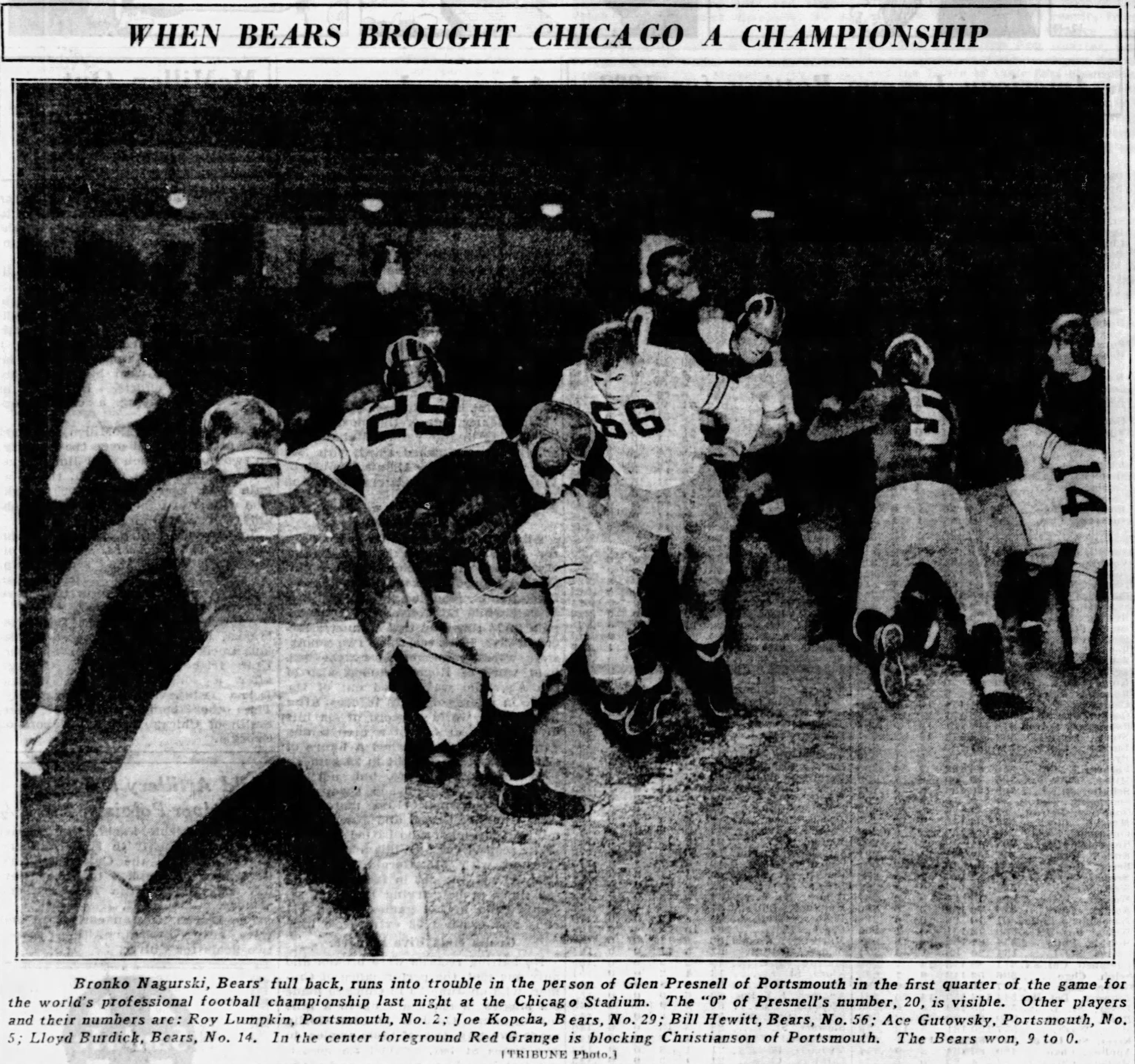
On one drive, the Spartans were in position to score when Presnell tripped before he could reach the end zone. In the 4th quarter, the Bears scored on a controversial touchdown: Carl Brumbaugh handed the ball off to Nagurski, who pulled up and threw to Grange in the end zone for the score. The Bears later scored a safety after the Spartans fumbled the ball out of their end zone, making the final score 9-0, and the Bears were Champions.

To eliminate the circumstances of the 1932 Playoff -- barring the weather, which, of course, even George Halas couldn't control, or at least buy control of -- the NFL got seriously revamped prior to the 1933 season. The liberalized passing rules required by the smaller field from the Playoff were written into the regular rules. So was the creation of hashmarks, to keep the ball closer to midfield, lengthwise. Putting the goalposts on the goal line was kept, until they were moved back to the end line in 1974. 

The League was divided into an Eastern Division and a Western Division, with each team playing each of its Division opponents home and away, no more, no less; and each Division winner facing the other in an NFL Championship Game, to determine a definitive title-winner.

The Western Division winner would host the Championship Game in odd-numbered years, the Eastern winner in even-numbered years. The Bears won the 1st such game, beating the Giants, 23-21 at Wrigley. The following year, the Giants beat the Bears at the Polo Grounds in New York.

All these changes, and a slimmer football that was introduced for the 1934 season, led to more scoring, and fewer ties, and helped increase the NFL's popularity. It was these changes that turned the NFL from what could still be called a minor league into a major league.

In 1934, Detroit radio executive George Richards bought the Spartans, and moved them, making them the Detroit Lions. They won the NFL Championship in 1935. The 8,500-seat Universal Stadium, the Spartans' former home, is one of the few remaining relics of the early NFL: It has been renamed Spartan Municipal Stadium, after both of the teams famous for playing there, the other being Portsmouth's Notre Dame High School.

Today, Portsmouth is home to about 18,000 people. It was the hometown of Major League Baseball stars Al Bridwell, Del Rice, Rocky Nelson, Al Oliver, Gene Tenace and Larry Hisle; baseball executive Branch Rickey; opera singer Kathleen Battle; Ohio Governor Ted Strickland; and "singing cowboy" Roy Rogers.

In 1968, the American Football League's Houston Oilers moved into the Astrodome. In 1970, with the rest of the AFL, they were merged into the NFL. On September 27, 1970, they played the NFL's 1st indoor regular-season game, losing to the Miami Dolphins, 20-10. In 2022, out of the NFL's 32 teams, 10 play under domes, 5 of them having retractable roofs, allowing both indoor and outdoor games. The Chicago Bears are not one of them, but the Detroit Lions, who used to be the Portsmouth Spartans, are.

*

December 18, 1932 was a Sunday. Baseball was out of season. The NBA hadn't been founded yet. There were 2 games in the NHL. Chicago Stadium was available because the Chicago Black Hawks were on the road, and played the New York Americans to a tie, 0-0 at Madison Square Garden. And the Detroit Red Wings, in their 1st season under that name, beat the Boston Bruins, 2-1 at the Olympia Stadium in Detroit.

Monday, November 7, 2022

November 7, 1962: Glenn Hall's Streak Ends

November 7, 1962: The Boston Bruins and the Chicago Black Hawks play to a 3-3 tie at the Chicago Stadium. The Bruins' John Bucyk scored a shorthanded goal with 1:07 left in the game to forge the tie. (There was no overtime in NHL regular-season games from 1942 to 1983.)

At the 10:21 mark of the 1st period, Hawks goaltender Glenn Hall had to leave the game with an injury, and Dennis DeJordy was in goal the rest of the way. This ends Hall's streak of 502 consecutive games, playing every minute of every game for the last 5 years -- and although he also did so when the Hawks made the Playoffs, those games are not counted in his total. If they are, then he really played 536 straight games, never missing a minute. He didn't play any of those games with a facemask, either, although he later began wearing one.

True, teams played 70 games a season back then, not 82 like they do now. But Hall's record remains unchallenged. There have been better goaltenders in the history of hockey, including his contemporaries Jacques Plante of the Montreal Canadiens and Terry Sawchuk of the Toronto Maple Leafs. But just as Gordie Howe of the Detroit Red Wings is forever known as "Mr. Hockey," Glenn Hall is forever known as "Mr. Goalie."

He appeared in 13 NHL All-Star Games, and 7 Stanley Cup Finals, although he only won 1, in 1961. He won the Calder Memorial Trophy as Rookie of the Year in 1956; the Vezina Trophy as top goaltender in 1963, 1967 and 1969; and the Conn Smythe Trophy as Playoff MVP in 1968, with the St. Louis Blues, despite their getting swept in the Finals by the Canadiens. He may be best remembered for giving up Bobby Orr's "Flying Goal" that won the 1970 Cup for the Bruins. Hall would later win another Cup in 1989, as the goaltending coach for the Calgary Flames.

In 1975, he was elected to the Hockey Hall of Fame. In 1998, The Hockey News ranked him 16th on their list of the 100 Greatest Players, among goalies trailing only Sawchuk (who was named 9th overall) and Plante (13th). In 2017, he was named to the NHL's 100th Anniversary 100 Greatest Players.

As of November 7, 2022, Glenn Hall is 91 years old. His grandson, Grant Stevenson, played 47 games as a right wing for the San Jose Sharks, all in the 2005-06 season.

*

November 7, 1962 was a Wednesday. It was also the day of the event that has gone down in history, both inaccurately and sarcastically, as "Richard Nixon's Last Press Conference." I have a separate entry for that.

Baseball season was over. Football was in midweek. There was 1 other game played in the NHL: The Toronto Maple Leafs beat the New York Rangers, 5-1 at the old Madison Square Garden. The Leafs got 2 goals from Billy Harris.

And there were 3 NBA games played on this day:

* The New York Knicks beat the St. Louis Hawks, 122-112 at the Kiel Auditorium in St. Louis. Richie Guerin scored 33 points for the Knicks, while Bob Pettit scored 37 in defeat for the Hawks.

* The Boston Celtics beat the Cincinnati Royals, 106-105 at the Cincinnati Gardens. Oscar Robertson scored 42 points in defeat.

* And the Los Angeles Lakers beat the San Francisco Warriors, 132-108 at the Cow Palace outside San Francisco in Daly City, California. For the Lakers, Elgin Baylor scored 30, and Jerry West scored 28. For the Warriors, in their 1st season by the Bay after moving from Philadelphia, Wilt Chamberlain scored 38 points and grabbed 29 rebounds, to no avail.

November 7, 1962: Richard Nixon's "Last Press Conference"

November 7, 1962: The results of the previous day's elections are in. Normally, the Party that holds the White House loses the Congressional elections in Year 2 of a Presidency. But the Democratic Party, led by President John F. Kennedy, doesn't do so badly. In the U.S. House of Representatives, they lost 4 seats, but the Republican Party only gained 1.
As a result, the Democrats will have 258 seats in the 88th Congress, whose term will begin on January 3, 1963 (although they won't have their swearing-in ceremony until January 9). The Republican Party will have 176. One seat remains vacant for the time being.
In the U.S. Senate, the Democrats actually gained 4 seats. Among the new Senators are the President's brother, Edward M. "Ted" Kennedy, but that's not a Democratic gain: That's the seat that JFK had to resign after being elected President.
Also newly elected were Democrats George McGovern of South Dakota, Abe Ribicoff of Connecticut, Birch Bayh of Indiana, Gaylord Nelson of Wisconsin and Daniel Inouye of Hawaii. 
But the most interesting election is that for Governor of California. The Democratic incumbent, Edmund G. "Pat" Brown went into the election thinking that the Republican nominee was going to be Mayor George Christopher of San Francisco. (That's right: As late as January 8, 1964, San Francisco had a Republican Mayor.) Instead, Christopher was nominated for Lieutenant Governor, and the nominee for Governor was Richard Nixon, who had been Dwight D. Eisenhower's Vice President, and had previously served California in both houses of Congress.
Why did Nixon want to be Governor? Wouldn't that be a step down? Actually, he didn't want to be Governor, but California Republican officials talked him into it. Still, he wanted to win, especially since it would confirm him as the nation's leading Republican politician, rather than Governor Nelson Rockefeller of New York, who was expected to win re-election easily (and did), or Senator Barry Goldwater of Arizona, leader of the Party's conservative wing.
When the final vote was tallied, Brown had a little over 3 million votes, or about 51.9 percent. Nixon had around 2.7 million, or 46.8 percent. Scattered other candidates got 1.3 percent. It was close, but Brown was the definitive winner.
Nixon became the 1st notable Republican politician to publicly blame his defeat on negative coverage by the media. At a press conference that morning, at the Beverly Hilton Hotel in Beverly Hills, the man known as Tricky Dick said, "I leave you gentlemen now. And you will now write it. You will interpret it. That's your right. But as I leave you, I want you to know: Just think how much you're going to be missing. You don't have Nixon to kick around anymore. Because, gentlemen, this is my last press conference."
Nixon did not keep that promise. It took nearly another 12 years before America truly didn't have Nixon to kick around anymore.
One person who would definitely not be giving any more press conferences was former First Lady Eleanor Roosevelt, who died on this day, at her apartment on the Upper East Side of Manhattan, of heart failure, at age 78. 
*

November 7, 1962 was a Wednesday. Baseball season was over. Football was in midweek. There were 3 NBA games played on this day:

* The New York Knicks beat the St. Louis Hawks, 122-112 at the Kiel Auditorium in St. Louis. Richie Guerin scored 33 points for the Knicks, while Bob Pettit scored 37 in defeat for the Hawks.

* The Boston Celtics beat the Cincinnati Royals, 106-105 at the Cincinnati Gardens. Oscar Robertson scored 42 points in defeat.

* And the Los Angeles Lakers beat the San Francisco Warriors, 132-108 at the Cow Palace outside San Francisco in Daly City, California. For the Lakers, Elgin Baylor scored 30, and Jerry West scored 28. For the Warriors, in their 1st season by the Bay after moving from Philadelphia, Wilt Chamberlain scored 38 points and grabbed 29 rebounds, to no avail.

There were 2 games played in the NHL. The Toronto Maple Leafs beat the New York Rangers, 5-1 at the old Madison Square Garden. The Leafs got 2 goals from Billy Harris.

And the Boston Bruins and the Chicago Black Hawks played to a 3-3 tie at the Chicago Stadium. The Bruins' John Bucyk scored a shorthanded goal with 1:07 left in the game to forge the tie. (There was no overtime in NHL regular-season games from 1942 to 1983.)

At the 10:21 mark of the 1st period, Hawks goaltender Glenn Hall had to leave the game with an injury, and Dennis DeJordy was in goal the rest of the way. This ends Hall's streak of 502 consecutive games, playing every minute of every game for the last 5 years -- and although he also did so when the Hawks made the Playoffs, those games are not counted in his total. If they are, then he really played 536 straight games, never missing a minute.

True, teams played 70 games a season back then, not 82 like they do now. But no goalie, not even Martin Brodeur, has ever come close to matching that. I have a separate entry for this event.

Tuesday, October 18, 2022

October 18, 1974: The NBA's "First Quadruple-Double"

October 18, 1974: The Chicago Bulls beat the Atlanta Hawks, 120-115 in overtime at the Chicago Stadium. John Drew of the defeated Hawks led all scorers. But the real story came from a former Golden State Warriors star, making his debut for the Bulls: Nate Thurmond scored 22 points, grabbed 14 rebounds, had 13 assists, and blocked 12 shots.

Previously, there had been "triple-doubles" in NBA games: Double figures, 10 or more, in points, assists and steals. This was the first official "quadruple-double."

It wasn't really the first, for one simple season: Nobody recorded blocked shots as an official statistic until the 1973-74 season -- the 1st season since 1958-59 without Wilt Chamberlain playing in the NBA. Coincidence is what the incurious believe in.

(In 1968, Chamberlain had a game in which he reached double figures in points, rebounds, assists, blocks and steals -- a quintuple-double. That was found in a review of a game shown on television. As far as is known, it's the only such game in NBA history.)

A native of Akron, Ohio, Thurmond starred at Bowling Green University, before being drafted by the San Francisco Warriors in 1963. In 1971, they moved across San Francisco Bay, to Oakland, becoming the Golden State Warriors. He was a 7-time NBA All-Star, and helped the Warriors reach the NBA Finals in 1964 and 1967.

Only 3 other players have ever recorded an official quadruple-double. Alvin Robertson of the San Antonio Spurs did it on February 18, 1986, with 20 points, 11 rebounds, 10 assists and 10 steals; Hakeem Olajuwon of the Houston Rockets on March 29, 1990, with 18 points, 16 rebounds, 10 assists and 11 blocks; and David Robinson of the Spurs on February 17, 1994, with 34 points, 10 rebounds, 10 assists and 10 blocks. Unlike Thurmond, those 3 men did not need overtime to do it.

Thurmond is 1 of 5 players to average at least 15 rebounds per game for his career, along with Chamberlain, Bill Russell, Bob Pettit and Jerry Lucas. Those are also the only 5 players to average at least 20 rebounds per game during a season, and he did it twice: 21.3 in 1966-67, and 22.0 in 1967-68. 

Along with Chamberlain, Russell and Lucas, he's 1 of 4 players to grab 40 or more rebounds in a game: 42, against the Detroit Pistons, on November 9, 1965 -- the night of the big New York City blackout. And on February 28, 1965, against the Baltimore Bullets, he set an NBA record with 18 rebounds in a single quarter. Chamberlain, first a teammate and then an opponent, called him the toughest opponent he ever faced.

Unfortunately, luck was not on his side: For the 1974-75 season, he was traded to the Chicago Bulls, and that would be the season the Warriors won their 1st NBA title since 1956, when they were in Philadelphia. He played 2 more seasons, for the Cleveland Cavaliers, and helped them reach the 1976 Eastern Conference Finals, a Playoff run known as "The Miracle of Richfield."

He was elected to the Basketball Hall of Fame, and both the Dubs and the Cavs retired his Number 42. He was named to the NBA's 50th and 75th Anniversary Teams. He died in 2016, at the age of 75, having lived just long enough to have been invited to participate in the NBA Championship parades for the 2015 Warriors and the 2016 Cavaliers.

*

October 18, 1974 was a Friday. There were 6 other games in the NBA that night:

* The Buffalo Braves beat the Boston Celtics, 126-119 at the Boston Garden. Ernie DiGregorio, the Providence College star, and the previous season's NBA Rookie of the Year, scored 33 points in this game.

A lot of white NBA fans were hoping he would become the next Pete Maravich. But he was never this good again. Like Maravich, he would end his career with the Celtics before they started winning titles again, and Larry Bird became the player that such fans hoped both Pistol Pete and Ernie D would be.

* The Philadelphia 76ers beat the New Orleans Jazz, 112-99 at The Spectrum in Philadelphia. This was the 1st-ever regular-season game of the team that became the Utah Jazz in 1979. Maravich, previously with the Atlanta Hawks, and having played in Louisiana with Louisiana State University, scored 15 points. But Steve Mix scored 33 for the Sixers.

* The Houston Rockets beat the Milwaukee Bucks, 106-101 at the Milwaukee Exposition, Convention Center and Arena, or "The MECCA." Since 2014, it has been named the UW-Panther Arena.

* The Los Angeles Lakers beat the Golden State Warriors, 105-90 at The Forum, outside Los Angeles in Inglewood, California. Gail Goodrich scored 34 points.

* The Portland Trail Blazers beat the Cleveland Cavaliers, 131-129... in 4 overtimes at the Portland Memorial Coliseum. Austin Carr scored 34 in defeat for the Cavs.

* And the Detroit Pistons beat the Seattle SuperSonics, 100-95 at the Seattle Center Coliseum.

There were 4 games played in the ABA:

* The New York Nets beat the Utah Stars, 105-89 at the Nassau Coliseum.

* The Kentucky Colonels beat the Denver Nuggets, 117-99 at Freedom Hall in Louisville, Kentucky.

* The San Antonio Spurs beat the Indiana Pacers, 129-121 in double overtime at the Market Square Arena in Indianapolis. James Silas scored 40 points. This was the Pacers' 1st game there, and they would play there until 1999.

* And the Memphis Sounds beat the Spirits of St. Louis, 97-92 at the St. Louis Arena.

The World Series was won the night before, with the Oakland Athletics beating the Los Angeles Dodgers in 5 games. There was 1 game in the NHL: The Atlanta Flames beat the Kansas City Scouts, 4-2 at The Omni in Atlanta. And there were 4 games in the WHA:

* The Toronto Toros beat the Indianapolis Racers, 3-1 at Maple Leaf Gardens in Toronto.

* The Winnipeg Jets beat the Edmonton Oilers, 4-0 at the Winnipeg Arena.

* The Phoenix Roadrunners beat the Houston Aeros, 6-4 at the Arizona Veterans Memorial Coliseum in Phoenix.

* And the Chicago Cougars beat the Vancouver Blazers, 2-1 at the Pacific Coliseum in Vancouver.

Friday, October 7, 2022

October 7, 1955: Allen Ginsberg Howls

October 7, 1955: Allen Ginsberg gives the 1st public reading of his poem "Howl," at the Six Gallery in the North Beach section of San Francisco.

The poets reading that night were, in order: Philip Lamantia, Michael McClure, Philip Whalen, Ginsberg and Gary Snyder. The organizer was Kenneth Rexroth. They were introduced by Lawrence Ferlinghetti, who also owned the nearby City Lights Bookstore. Both Rexroth and Ferlinghetti were published poets, but neither read his work that night. Jack Kerouac, already a published novelist but 2 years away from his magnum opus On the Road being published, refused to read his own poetry, but cheered the other writers on, and passed a jug of wine around.

"Howl" is best remembered for its opening:

I saw the best minds of my generation destroyed by madness, starving hysterical naked,
dragging themselves through the negro streets at dawn looking for an angry fix,
angelheaded hipsters burning for the ancient heavenly connection to the starry dynamo in the machinery of night,
who poverty and tatters and hollow-eyed and high sat up smoking in the supernatural darkness of cold-water flats floating across the tops of cities contemplating jazz,
who bared their brains to Heaven under the El and saw Mohammedan angels staggering on tenement roofs illuminated,
who passed through universities with radiant cool eyes hallucinating Arkansas and Blake-light tragedy among the scholars of war,
who were expelled from the academies for crazy & publishing obscene odes on the windows of the skull,
who cowered in unshaven rooms in underwear, burning their money in wastebaskets and listening to the Terror through the wall...

And so on. But the part that sticks out to me is Part II, in which Ginsberg compares America's consumer culture to a Canaanite god, usually in the form of a giant bull and demanding the sacrifice of children, mentioned in the Old Testament as Molech (MOLL-ick) or Moloch (MOH-lock):

What sphinx of cement and aluminum bashed open their skulls and ate up their brains and imagination?

Moloch! Solitude! Filth! Ugliness! Ashcans and unobtainable dollars! Children screaming under the stairways! Boys sobbing in armies! Old men weeping in the parks!

Moloch! Moloch! Nightmare of Moloch! Moloch the loveless! Mental Moloch! Moloch the heavy judger of men!
Moloch the incomprehensible prison! Moloch the crossbone soulless jailhouse and Congress of sorrows! Moloch whose buildings are judgment! Moloch the vast stone of war! Moloch the stunned governments!
Moloch whose mind is pure machinery! Moloch whose blood is running money! Moloch whose fingers are ten armies! Moloch whose breast is a cannibal dynamo! Moloch whose ear is a smoking tomb!
Moloch whose eyes are a thousand blind windows! Moloch whose skyscrapers stand in the long streets like endless Jehovahs! Moloch whose factories dream and croak in the fog! Moloch whose smokestacks and antennae crown the cities!
Moloch whose love is endless oil and stone! Moloch whose soul is electricity and banks! Moloch whose poverty is the specter of genius! Moloch whose fate is a cloud of sexless hydrogen!...

Moloch! Moloch! Robot apartments! invisible suburbs! skeleton treasuries! blind capitals! demonic industries! spectral nations! invincible madhouses! granite cocks! monstrous bombs! 
They broke their backs lifting Moloch to Heaven!
Moloch in whom I sit lonely! Moloch in whom I dream angels! Crazy in Moloch!

Moloch had appeared in literature before. In his 1667 Paradise Lost, John Milton described him as a child-eating fallen angel, a "horrid king besmeared with blood / Of human sacrifice, and parents’ tears." Charles Dickens mentioned him in his 1848 novella The Haunted Man. In his 1862 novel Salammbô, set in Carthage during the Mercenary Revolt after the First Punic War in 237 BC, Gustauve Flaubert described Moloch as a god who represents the destructive power of the Sun.

"Howl" became the subject of an obscenity trial, for its profanity and sexual imagery, including the homosexual inferences made by Ginsberg, one of the few openly gay celebrities of the era. It was Ferlinghetti and his store, for selling the book, that were sued, not Ginsberg for writing it. On October 3, 1957, Judge Clayton W. Horn ruled that the poem was not obscene, and could be publicly sold.

As a native of Paterson, New Jersey and a New York resident for most of his life, he certainly had the opportunity to face sports. He was invited to read a poem and throw out a ceremonial first ball before a San Francisco Giants game on June 1, 1994. The Giants lost, 1-0 to the Atlanta Braves, in front of 28,808 fans, the biggest audience one of his readings had ever received. The poem was not well-received, but, 2 days short of his 68th birthday, he threw a strike from the mound.
Ginsberg admitted that day that he had never previously been inside a baseball stadium, except once for a Rolling Stones concert. "I'm just a four-eyed sissy," he remarked that day. In contrast, Kerouac was a star football player and track performer in high school, who washed out at Columbia University.

Certainly, the 1955 edition of Ginsberg wouldn't have been surprised at the move of the Brooklyn Dodgers to Los Angeles just 2 years later; at the corporations buying the naming rights to stadiums and arenas; or at the massive amounts of money that TV networks pay to televise sports, to the point where the NFL teams could lock their stadiums and not admit one single fan to a game, and not collect one single admission fee, and still make a profit.

Kerouac died in 1969, Ginsberg in 1997, Whalen in 2002, Lamantia in 2005, McClure in 2020, and Ferlinghett in 2021, at the age of 101. As of October 7, 2022, Snyder is the only reader from that night still alive.

*

October 7, 1955 was a Friday. Classical cellist Yo-Yo Ma was born.

The baseball season had ended 3 days earlier, with the Brooklyn Dodgers finally winning the World Series, beating the New York Yankees. Football was in midweek. And the NBA season wouldn't start until November 5.

There was 1 game in the NHL: The New York Rangers beat the Chicago Black Hawks, 7-4 at the Chicago Stadium. Ron Murphy scored 3 goals, a hat trick.

And there were 5 games in college football:

* Number 5 Notre Dame beat Number 15 University of Miami, 14-0 at Burdine Stadium (later renamed the Orange Bowl) in Miami. The Fighting Irish lost their next game, to Michigan State.

* Number 7 UCLA beat Oregon State, 38-0 at the Los Angeles Memorial Coliseum. The week before, UCLA had been Number 1, but lost away to then-Number 5 Maryland. UCLA did recover to win the Pacific Coast Conference title, but lost the Rose Bowl to Michigan State, who were awarded the National Championship.

* The Citadel, a military college in Charleston, South Carolina, beat the University of Richmond, 14-12 at City Stadium in Richmond, Virginia. Both schools would eventually be relegated to NCAA Division I-AA, now the Football Championship Subdivision or FCS.

Friday, September 9, 2022

September 9, 1994: Chicago Stadium Closes

September 9, 1994: Chicago Stadium closes, with its final event being Scottie Pippen's Ameritech Classic charity basketball game. Pippen captained the Red team, and Michael Jordan scored 52 points as he captained the White team, which won, 187-150. When the game ended, Jordan knelt down and kissed the bull logo at center court.

Although not an outdoor venue, the building, as was its rival the Olympia in Detroit, was called a "stadium." It stood at 1800 Madison Street, on the West Side of Chicago. It became known as "The Madhouse On Madison."

It opened on March 28, 1929 with a boxing card. The NHL's Chicago Black Hawks played their 1st game there on December 8, 1929, beating the New York Americans, 4-2. Normie Himes of the Amerks scored the 1st goal, and Earl Miller scored the 1st for the Hawks, the 1st of a hat trick.

The Black Hawks began play in 1926, playing home games at the Chicago Coliseum. They always wrote the team's name as two words: "Black Hawks." This held until 1986, when the document containing the team's original charter was found, and it was discovered that the name was written as one word, "Blackhawks." And so that's how it's been written ever since.

The Blackhawks reached the Stanley Cup Finals 10 times while playing at Chicago Stadium; winning them in 1934, 1938 and 1961; and losing them in 1931, 1944, 1962, 1965, 1971, 1973 and 1992. Crowds of 17,317 would roar from the National Anthem to the final horn, unless they were singing along to the 3,663-pipe Barton organ, played by Al Melgard from 1930 to 1974, by White Sox organist Nancy Faust from then until 1990, and from then onward by Frank Pellico, who still plays for the Hawks today.
In 1946, the Basketball Association of America was founded, and the Chicago Stags took up residence at the Stadium. They made the Finals in the 1st season, losing to the Philadelphia Warriors. The BAA became the National Basketball Association in 1949, but the Stags lasted only the 1 more season.

The Stadium also hosted the February 19, 1948 game between the National Basketball League Champions, the Minneapolis Lakers, and the all-black Harlem Globetrotters. Before 18,000, the 'Trotters, dispensing with the comedy routines to play serious basketball, to show everyone just how good they really were, won 61-59, on a 30-foot buzzer-beater by Ermer Robinson.

The Lakers, led by George Mikan, a native of nearby Joliet, Illinois and a graduate of Chicago's DePaul University, got a rematch with the Globetrotters, but lost that, too. They played 6 more times, and the Lakers won all 6, while also entering the NBA and winning the Championship in 1949, 1950, 1952, 1953, and 1954.

The Chicago Majors played at the Stadium in the short-lived National Basketball League in the 1961-62 and 1962-63 seasons. The Chicago Bulls started in the NBA in 1966, but played their 1st season at the International Amphitheatre, on the South Side, before moving into the Stadium in 1967. They had a few good seasons before Michael Jordan arrived in 1984. It took them until 1991 to win their 1st title, but it launched a run of 6 NBA Championships in 8 years.
In 1932, the Chicago Bears and the southern Ohio-based Portsmouth Spartans finished in a tie for the NFL Championship. A Playoff was to be held in Wrigley Field on December 18, but it snowed. The game was moved indoors to the Chicago Stadium, and the field was not only narrower than normal, but only 80 yards long. Still, over 20,000 fans packed the place, which would not have been possible at Wrigley with the snow. The Bears won, 9-0.

Boxing was key to the Stadium's operation from beginning. The 2nd fight in the Middleweight Championship trilogy between Rocky Graziano and Tony Zale, the only one that Graziano won, happened on July 16, 1947.

On February 14, 1951, in a fight so brutal it was called the St. Valentine's Day Massacre, Sugar Ray Robinson defended the Welterweight title title by pounding Jake LaMotta to the point where it was stopped in the 13th round. It was the 6th time they had fought. LaMotta had won only the 2nd, and, to this point, that was the only professional fight that Robinson had lost.

On May 15, 1953, the Stadium hosted its only Heavyweight Championship fight. Eight months earlier, Rocky Marciano had won the title by knocking Jersey Joe Walcott out in the 13th round in Philadelphia. This time, Marciano knocked Walcott out in the 1st round.

Both the Democrats and the Republicans had their Convention at Chicago Stadium in 1932. Both Franklin D. Roosevelt and Alf Landon had pre-election rallies there in 1936. The Democrats had their Convention there again in 1940, and both parties had them there in 1944.

By a weird turn of events, in 1932, FDR became the 1st Presidential nominee to accept the nomination in person, something that was not previously done, as the nomination was always supposed to be seen as reluctantly accepted, lest the nominee be seen as too eager for power; and in 1944, due to his illness, he became, so far, the last nominee to not accept in person, with a radio hookup between the Stadium and the White House.

Across Madison Street from the Stadium was the original version of the Billy Goat Tavern. The owner, William "Billy Goat" Sianis, put up a sign in 1944, saying, "No Republicans allowed," which raised an incredible fuss. But it also generated him more publicity than anything he ever did -- including his stunt of bringing his bar's mascot, a goat, to Wrigley Field to the 1945 World Series, which led to them being ejected, which led to "The Curse of the Billy Goat" that supposedly prevented the Cubs from winning the Pennant until 2016. Sianis moved the Tavern to its current location, on the lower deck of Michigan Avenue, in 1963, so he could be closer to the city's newspaper offices.

The Stadium hosted shows from the beginning. In 1946, Roy Rogers, "King of the Cowboys," proposed to Dale Evans, "Queen of the West," backstage at a rodeo. But they were slow to allow rock and roll concerts. The first rocker to play the place? Elvis Presley. But it wasn't in 1956 or 1957. It was on June 16 and 17, 1972.

Other notable shows there: Bob Dylan, Elton John and George Harrison in separate shows in 1974; The Rolling Stones, The Who and Led Zeppelin in separate shows in 1975; the Beach Boys and Chicago together in 1975; Frank Sinatra on a New Year's show, 1975-76; Paul McCartney's Wings Across America tour in 1976; the Beach Boys and Billy Joel together in 1976; Elvis again on October 15, 1976; Led Zeppelin again on there last tour in 1977; Elvis on his last tour on May 1 and 2, 1977; Queen on their Day at the Races and News of the World Tours in 1977; The Jacksons in 1979 and 1981; and, in the Stadium's last show, March 10, 1994, Pearl Jam.

In 1992, Chicago Stadium hosted both the NBA Finals and the Stanley Cup Finals, but only the Bulls won. But there was only so much that an arena built in 1992 could do. Even with standing room, the Stadium only seated 18,472 for hockey, and 18,676 for basketball. And it was built before the NHL standardized rink size at 200 feet long by 85 feet wide. The Stadium's was 185 by 85.

So Bulls owner Jerry Reinsdorf and Blackhawks owner Bill Wirtz got together to build a new arena, the United Center, across the street at 1901 West Madison Street. The Hawks' last game was Game 6 of the Western Conference Quarterfinals, on April 28, 1994, a 1-0 loss to the Toronto Maple Leafs. Mike Gartner scored the last goal.

The Bulls' last game was Game 6 of the Eastern Conference Semifinals, on May 20, 1994. They beat the New York Knicks, 93-79, but lost Game 7 at Madison Square Garden. 

The Stadium was demolished in 1995, and the site now serves as parking for the 23,129-seat (for basketball, 22,428 for hockey) United Center. A statue honoring the Stadium stands outside, with the words "REMEMBER THE ROAR" inscribed on the base.

The console of the Barton organ was saved, bought by Phil Maloof, and installed in his house in Las Vegas. (Ironically, he owns a different NBA team, the Sacramento Kings.) And Jordan preserved the Bulls floor at his mansion in North Carolina.

September 9, 1994 was a Friday. Major League Baseball was on strike, it was too soon for the NBA and NHL seasons to start, and there were no football games. So there were no scores on this historic day. 

Thursday, July 21, 2022

July 21, 1944: "The Second Missouri Compromise"

Truman and Roosevelt at FDR's home in Hyde Park, New York,
after the Convention. The color is real.
Truman was 60 and healthy. FDR was 62 and not.

July 21, 1944: The Democratic Convention is held at Chicago Stadium. 12 years earlier, at the same building, Franklin Delano Roosevelt was nominated for President for the 1st time, and, decided to show his physical vitality (and dampen the rumors polio having rendered him an invalid) by flying there, something that was considered truly daring at the time, and became the 1st nominee of either major party to delivers acceptance speech in person.

This time, his 4th nomination, he became the last major party nominee to not show up, a concession to his worsening health, but use the excuse that World War II was keeping him at home. Instead, a radio hookup was made to the White House, so he could give his acceptance speech remotely.

To make matters worse, the more conservative elements in the party demanded that he dumped Vice President Henry Wallace from the ticket, because he was seen as being too friendly to the Soviet Union, which was still our ally at the time; but also because he was too friendly with both organized labor and the civil rights movement. They thought FDR might be dying, and they didn't want Wallace as President.

The more conservative elements of the Party, especially the Southern wing, wanted James F. Byrnes. On paper, he was definitely qualified to be President, let alone Vice President. He had served South Carolina in both houses of Congress, had briefly been an Associate Justice of the U.S. Supreme Court, and was, at this point, the Director of the Office of War Mobilization. But, like most Southern politicians of the time, he was racist and anti-labor. And both the civil rights movement and the labor movement, both friendly to Wallace, wouldn't allow Byrnes to be nominated.

So the Convention was at an impasse. And Party insiders knew what the general public did not: FDR was already ill, and the thought had come to them that he might not survive a full 4th term. Whoever they chose as Vice President to the 32nd President was likely to be the 33rd. That's why civil rights and labor wanted Wallace, and the South wanted Byrnes: They wanted the next President to be one of their guys, and wanted it badly.

FDR -- having once told a reporter, "You know, I'm a juggler, and I have to keep several balls in the air at the same time" -- needed a Vice Presidential nominee was acceptable to both the Byrnes side of the party and the Wallace side. What became known as "The Second Missouri Compromise" was made, and that State's Senator, Harry Truman, was chosen.

(The first "Missouri Compromise" was in 1820, designed to keep the number of free States and slave States even: Missouri would be admitted as a slave State, while Maine was separated from Massachusetts, and added as a free State.)

Truman wasn't a total unknown: He had chaired the Senate committee that exposed war profiteers, and had appeared on the cover of Time magazine the year before. He was in his 2nd term, and was qualified. One thing bugged some people: He had come out of the "political machine" in Kansas City, run by the crooked Thomas Pendergast. But no one ever found any evidence of corruption on Truman's part.

Truman was offered the nomination, but wasn't sure. FDR had to convince him over the phone, and he accepted. But FDR wanted to assure labor leaders that the choice was a good one. Robert Hannegan was the Chairman of the Democratic National Committee, and, as a native of St. Louis, on the other side of Missouri, was an ally of Truman, and key to his nomination. Referring to Sidney Hillman, President of the Congress of Industrial Organizations, "And clear everything with Sidney!"

Founded in 1935 as a more liberal labor group than the American Federation of Labor, the CIO had been assailed as Communist by conservatives. When FDR's demand that Truman's nomination be cleared with Hillman reached the press, Republican-leaning newspapers suggested that Hillman was actually running the Party. Hillman had actually worked hard to keep Communists out of the CIO. Nevertheless, someone wrote a limerick, a Red-baiting smear -- and possibly an anti-Semitic one, as Hillman was Jewish:

Clear it with Sidney, you Yanks.
Then offer Joe Stalin your thanks.
You'll bow to Sid's rule
no matter how cruel
for that's a directive of Frank's.

The Republicans nominated Governor Thomas E. Dewey of New York for President, and Governor John Bricker of Ohio for Vice President. This allowed them to write one of those campaign slogans that occasionally rhymes with the ticket: "Win the war quicker with Dewey and Bricker."

Despite the Republicans' insistence that they could win The War quicker (which was unlikely), and the insinuations that FDR was dying (which he was) and his Administration was loaded with Communists (which it wasn't), Roosevelt and Truman won. It had little to do with Dewey's youth and inexperience (he was just 41, and had been Governor less than 2 years after several years as a crusading District Attorney), and more to do with FDR being the man America knew, and knew it could trust to win The War and avoid another depression after it.

Just 3 months into his 4th term, with the European phase of The War nearly won, FDR died, and Truman became President. After V-E Day, Truman decided that Secretary of State Edward Stettinius was too cozy with the Soviet Union, fired him, and replaced him with Byrnes, who had been a friend in the Senate. But relations between them soured after V-J Day, and Byrnes lasted just a year and a half in the office.

In 1950, he was elected Governor of South Carolina. This was unusual, especially at the time, because it usually worked the other way around: Southern Governors often used their jobs as springboards for the Senate, mainly because their State Constitutions usually prevented Governors from serving consecutive terms. (Most now can, with Virginia the only exception.) In South Carolina, this has since included Strom Thurmond and Ernest "Fritz" Hollings. Unfortunately, Byrnes was a typical Southern politician of his time, and resisted desegregation. After leaving the Governorship after his mandated single term, he never ran for office again.

Byrnes never endorsed another Democrat for President, endorsing Thurmond over Truman in 1948, independent segregationist Harry Byrd Sr. in 1956, and Republicans Dwight D. Eisenhower in 1952, Richard Nixon in 1960 and 1968, and Barry Goldwater in 1964. That year, over the Civil Rights Act, Thurmond, who had returned to the Democratic Party after the 1948 election, became the 1st major Southern politician to switch to the Republican Party, and Byrnes supported him, though himself remaining officially a Democrat.

Byrnes died in 1972, 8 months before Truman did, and 7 years after Wallace. By this point, Byrnes had been mostly forgotten outside his home State, with most Americans being unaware of how close he came to becoming President of the United States. Wallace came even closer. Truman actually made it.

*

July 21, 1944 was a Friday. Paul Wellstone was born, and, like Truman and Byrnes, would be elected to the U.S. Senate, in his case Minnesota. He became one of the most liberal Senators, and many people wanted him to run for President. He never did, dying in a suspicious plane crash while running for re-election in 2002.

These baseball games were played:

* The New York Yankees beat the St. Louis Browns, 8-2 at Sportsman's Park in St. Louis. Atley Donald went the distance for the win. In spite of this, the Browns won their one and only American League Pennant this season, ending the Yankees' run of 3 straight and 7 out of 8.

* The New York Giants lost to the St. Louis Cardinals, 5-0 at the Polo Grounds. Harry "the Cat" Brecheen pitched a 5-hit shutout. Mel Ott, now the Giants' player-manager, got 1 of those hits. So did former Cincinnati catching star Ernie Lombardi, now running out the string with the Giants. Stan Musial, one of the few big stars not yet serving in The War (he would spend the 1945 season in the Navy), went 2-for-5.

* The Brooklyn Dodgers lost to the Cincinnati Reds, 3-2 at Ebbets Field in Brooklyn.

* The Chicago Cubs beat the Boston Braves, 4-2 at Braves Field in Boston.

* And the Pittsburgh Pirates beat the Philadelphia Phillies, 5-3 at Shibe Park in Philadelphia.

* The Cleveland Indians beat the Philadelphia Athletics, 4-1 at Cleveland Municipal Stadium.

* The Detroit Tigers beat the Washington Senators, 6-5 at Briggs Stadium (later Tiger Stadium) in Detroit. Dizzy Trout outpitched Early Wynn.

* The Chicago White Sox beat the Boston Red Sox, 5-3 at Comiskey Park in Chicago.

Saturday, July 16, 2022

July 16, 1940: "We Want Roosevelt!"

July 16, 1940: The Democratic National Convention is being held at the Chicago Stadium, the big Midwestern city's largest arena, home of the NHL's Chicago Black Hawks. (Starting in 1986, the official spelling became one word: "Blackhawks.")

It's not going well. The Democratic Party is badly divided. Their leader, the incumbent President, Franklin Delano Roosevelt, is in his 8th year, the last year of his 2nd term. Only 2 of the previous 30 men to hold the Presidency have run for a 3rd term, or what would have amounted to one: Ulysses S. Grant and FDR's cousin, Theodore Roosevelt. Only 2 others have even seriously considered it, before realizing that they were unlikely to win: Grover Cleveland and Woodrow Wilson.

But FDR has made no announcement as to whether he would run again. To make matters worse, the Democrats appear to have no obvious successor in place:

* Vice President John Nance Garner was a Southerner, from Texas. Although Andrew Johnson had become President upon the death of Abraham Lincoln, and Woodrow Wilson had been a Virginia native but the Governor of New Jersey when he was elected, no politician representing a Southern State had been elected President since Zachary Taylor from Kentucky in 1848. And even he wasn't exactly a "politician": He was the leading General of a war that had just been won, and had never run for office before. Garner was also considered too conservative outside the South.

* The other major candidate was the Chairman of the Democratic National Committee, who was also in FDR's Cabinet, as Postmaster General: James A. Farley of New York. Farley was considered a great organizer, but didn't really have name recognition among the general public, and was a Catholic. Except for Alfred E. Smith, who lost the general election of 1928 very badly, no Catholic had ever even been nominated for President by a major party.

* FDR might have wanted his Secretary of State, Cordell Hull, to be the next President. But Hull was another Southerner, having served Tennessee in both houses of Congress. What's more, Hull had a speech impediment on top of his Southern accent, which would have ruined a campaign in this era of radio and newsreels.

* Another would-be President, Joseph P. Kennedy, the U.S. Ambassador to Great Britain, a Boston native who thought that his large personal fortune and network of personal contacts could make him the 1st Catholic President, but his isolationism and apparent favoritism toward Nazi Germany made him persona non grata in the Party.

* Several potential Presidential candidates had been defeated in the Republican tide of the 1938 elections, including James Michael Curley, the former Mayor of Boston and Governor of Massachusetts, who lost a Senate race that year. And, besides, he was a Catholic.

* And then, of course, there were the Republicans. Having gotten clobbered in the elections of 1930, 1932, 1934 and 1936, they didn't have a clear President-in-the-making, either. They ended up nominating Wendell Willkie, a man with no political experience, but a strong anti-New Deal message, but also a willingness to help Britain against Nazi Germany in World War II, while otherwise keeping the U.S. out of it -- in other words, FDR's position.

FDR had been thinking about running for a 3rd term, even in 1939, but he really wanted to retire to his mansion on the Hudson River in Hyde Park, New York. Certainly, the Republicans' rhetoric at their Convention, in Philadelphia, suggested that they were running against him, as the avatar of American liberalism, rather than against the Democratic Party in general.

What made FDR run again was the Nazis' leader, Adolf Hitler. In May, his troops began marching across Western Europe. By mid-June, it had all fallen to him, even France. Britain was next in their sights, and whoever was going to be President starting on January 20, 1941, the end of FDR's 2nd term, was going to have to deal with Hitler's seemingly limitless ambition. And he, Roosevelt, was the only person in the country who was even remotely experienced enough to take Hitler on.

The problem was, being that he was seeking an unprecedented 3rd term, he had to do what Presidential candidates used to do, before his time: Make it look like he wasn't actively running. The idea was that the office should seek the man, not the other way around. So he drafted a statement for the Convention Chairman, Senate Majority Leader Alben Barkley of Kentucky, to read to the Delegates. It concluded:

The President has never had, and has not today, any desire or purpose to continue in the office of President, to be a candidate for that office, or to be nominated by the convention for that office. He wishes in earnestness and sincerity to make it clear that all of the Delegates in this Convention are free to vote for any candidate.

The Delegates sat in shocked silence for a moment. Then came a voice thundering over the stadium loudspeakers: "We want Roosevelt! We want Roosevelt! We want Roosevelt!"

The voice belonged to Thomas D. Garry, Superintendent of Chicago's Department of Sanitation -- in other words, the sewer department. He was a trusted henchman of Chicago Mayor Edward J. Kelly, the Convention's host, an FDR loyalist, and, himself, chief engineer of the Chicago Sanitary District during the 1920s.

Garry was stationed in a basement room with a microphone, waiting for that moment. Kelly had posted hundreds of Chicago city workers and precinct captains around the Stadium. Other Democratic bosses had brought followers from their home territories. All of them joined Garry's chant. Within a few seconds, hundreds of delegates joined in. Many poured into the aisles, carrying state delegation standards for impromptu demonstrations. Whenever the chant began to die down, State chairmen, who also had microphones connected to the speakers, added their own endorsements: "New Jersey wants Roosevelt!" "Arizona wants Roosevelt!" "Iowa wants Roosevelt!"

Despite coming out of the loudspeakers, Garry was in the basement, and thus became known as "The Voice From the Sewers." Life magazine, conservative as always, called it a "shabby pretense" that "fooled nobody." Nevertheless, on the 1st ballot, FDR got 946 Delegates, Farley 73, Garner 61, and others got 20. There would be no 2nd ballot.

It would be harder to get the Vice President FDR wanted. Nobody wanted Garner to have the job for a 3rd term, including Garner himself: The former Speaker of the House had said, "The job isn't worth a pitcher of warm piss." For public consumption, it was printed as "a pitcher of warm spit."

FDR wanted his Secretary of Agriculture, Henry Wallace. There were problems with this: Wallace was a former Republican, was pro-civil rights, and was considered to have questionable ties, both to the Soviet Union and to Nicholas Roerich, a Russian painter, writer and philosopher with some odd views. The conservative Southerners were adamant that Wallace not be nominated.

So FDR sent First Lady Eleanor Roosevelt to Chicago, to speak on behalf of Wallace. She flew there, and told the Delegates, "You cannot treat this as you would an ordinary nomination in an ordinary time." It was the best-received speech of the Convention, and Wallace defeated the Speaker of the House, William Bankhead of Alabama, on the 1st ballot.

Perhaps Bankhead would have made a stronger bid for the office had he not been ill, and he died 2 months later. His father, John, had served Alabama in both houses of Congress; his brother, John II, was a Senator and a Delegate to the Convention; and his daughter, Tallulah Bankhead, was one of America's greatest actresses.

Unlike in 1932 in Chicago, and in 1936 in Philadelphia, FDR felt he had to stay in Washington, and so he delivered his acceptance speech remotely, by radio, which was piped into the Convention. He would do the same in Chicago in 1944. He was the 1st Presidential nominee to deliver his acceptance speech in person, and he remains, through the 2020 election, the last one to not do so.
The 1940 Convention was not one of the Democratic Party's best. But it did show a commitment to the principles that FDR had stood for, and wanted to stand for. For all intents and purposes, it is still his Party.

Ed Kelly served as Mayor of Chicago from 1933 to 1947, and lived until 1950. Thomas D. Garry, who had worked on a sewer survey under Kelly, served as Assistant Commissioner until 1963, and who always insisted that the D stood for "Democrat," lived until 1976.

*

July 16, 1940 was a Tuesday. These baseball games were played:

* Elsewhere in Chicago, at Wrigley Field, the New York Giants lost to the Chicago Cubs, 2-0. Vern Olsen pitched a 6-hit shutout, outpitching Harry Gumbert. Phil Cavarretta drove in both runs with a 7th-inning single. Mel Ott went 1-for-3 with a walk.

* The New York Yankees lost to the Chicago White Sox, 5-1 at Yankee Stadium. Johnny Rigney outpitched Marius Russo. Joe Kuhel hit a home run. Joe DiMaggio went 1-for-4, driving in the Yankees' only run.

* The Brooklyn Dodgers lost to the Pittsburgh Pirates, 5-3 at Forbes Field in Pittsburgh.

* The Philadelphia Athletics beat the Detroit Tigers, 3-1 at Shibe Park in Philadelphia. Hank Greenberg went 1-for-4.

* The Washington Senators beat the Cleveland Indians, 11-8 at Griffith Stadium in Washington.

* The St. Louis Cardinals beat the Boston Bees, 4-3 at Sportsman's Park in St. Louis. This was the last of 5 seasons in which the Boston team of the National League used the Bees name. The next season, they went back to their former name, the Boston Braves.

* The Boston Red Sox and the St. Louis Browns moved their game scheduled for today back 2 days, to have a Sunday doubleheader and a bigger gate. The BoSox won the opener, 5-4. Roger "Doc" Cramer doubled Dom DiMaggio (Joe's brother) home with the winning run in the bottom of the 11th inning. This made Emerson Dickman the winning pitcher in relief of Lefty Grove. Dickman would win 22 games in his career; Grove, 300.

The Red Sox won the nightcap, 7-3. Over the 2 games, Ted Williams went 1-for-9.

* And the Cincinnati Reds and the Philadelphia Phillies were rained out at Crosley Field in Cincinnati. It was agreed to play the game on July 28, as part of a Sunday doubleheader, and move it to Shibe Park. The Reds won the 1st game, 7-2. The Phils won the 2nd game, 4-1.

December 31, 1999 & January 1, 2000: The Millennium

December 31, 1999:  The Millennium arrives. The people of planet Earth survived. At a terrible cost. But we hadn't destroyed ourselves. ...