Showing posts with label john thorn. Show all posts

Saturday, December 31, 2022

December 31, 1967: The Ice Bowl

Lambeau Field as it appeared in 1967.
Note the shadow cast by the scoreboard
at the south end. This will matter later on.

December 31, 1967: As the narrator for a 1987 NFL Films production put it, "On a day savage enough to make a Saint Bernard whimper, they played the 1967 NFL Championship Game." Or, as it has become known in football lore, The Ice Bowl.

I don't know who the narrator was -- the Internet has failed me in this regard -- but the film was made in 1987, so it wasn't John Facenda, the voice of NFL Films from 1966 until his death in 1984. Let the record show that Facenda never actually spoke the words "the frozen tundra of Lambeau Field." ESPN's Chris Berman, imitating Facenda, made that up.

The Ice Bowl isn't even the coldest game in NFL history anymore. The 1981 AFC Championship Game, played at Riverfront Stadium in Cincinnati on January 10, 1982, was 9 degrees below zero without the wind chill factor, and 37 below with it. The San Diego Chargers, used to warm weather, had played one of the hottest games in NFL history just 8 days earlier, against the Miami Dolphins at the Orange Bowl, and were totally unused to this kind of cold. The Bengals won, 27-7. This one is known as the Freezer Bowl.

Many NFL Championship Games, nearly all played in December to that point, had been plagued by cold weather. Vince Lombardi had been born and raised in Brooklyn, and had coached the Green Bay Packers since 1959, so he could handle cold weather.

But from having coached in the title games of 1956, 1958 (these 2 as an assistant coach with the New York Giants), 1961, 1962 and 1965, he knew that cold weather could be a problem for football. Fortunately, since the Packers' unusual ownership structure, and his role as both head coach and general manager, left him a virtual dictator, he had the field torn up, and heating coils placed under the field. When resodded, the idea was that the coils would keep the field from freezing. It became known as "Lombardi's Electric Blanket."

Lombardi had been offensive coordinator to Giants head coach Jim Lee Howell. The defensive coordinator was Tom Landry, who became the 1st head coach of the Dallas Cowboys, the team the Packers had defeated to win the 1966 NFL Championship, and whom they would have to beat again to win for 1967. Lombardi and Landry were opposites: Landry was a great stone face, never showing emotion during the game; while Lombardi was, in the words of his Hall of Fame guard Jerry Kramer, "a raving Italian lunatic!"

But the teams were the other way around: The Cowboys -- not yet the dominant team that they would become -- were braggarts, having earned very little right to do so thus far; while the Packers let their performance do the talking for them. The exception was Hall of Fame running back Paul Hornung, but he was retired by this point. The Packers were going for their 5th NFL Championship in 7 years, which included ending the previous season by winning "The AFL-NFL World Championship Game," retroactively named "Super Bowl I."

The day before the game, NFL Commissioner Pete Rozelle made some phone calls, and was told that the game-time temperature would be about 5 degrees above zero. (All temperatures mentioned in this post will be in degrees Fahrenheit.)

Rozelle didn't like that, and began to consider postponing the game to the next day, Monday, New Year's Day 1968, despite the fact that it would compete for TV ratings with the college bowl games. But he was told that the oncoming cold front would make it even colder on Monday. So, already in Green Bay, he called Lombardi at his house, and Landry at his hotel, and told them the game would go on as scheduled.

But the cold front arrived sooner, and was worse than expected. As Cowboy receiver Rentzel reported, he was told that it was 15 degrees below zero. The official NFL Films record of the game shows a rotating bank clock backing that up, reading "-15°."
I couldn't find a photo online.
I had to photograph it off my computer screen.
Yes, that's me and my phone in the reflection.

When Lombardi got to Lambeau Field, he discovered that it was so cold (This was before comedians began doing things like, "How cold was it?"), the mechanism for the heating coils broke. With the machine inoperable, the field was frozen. To make matters worse, when the tarp was taken off the field, it had left moisture on it, which froze. The field was an ice rink.

At the time, Lambeau Field held 50,861 people. That was the official attendance: In spite of the cold, there was not an empty seat in the house -- until an elderly spectator died from exposure. Yes, only one fan died from the cold. Among those in attendance was a 12-year-old boy from Appleton, Wisconsin, who went on to become a renowned actor: Willem Dafoe. In 2017, NFL Films released a 50th Anniversary documentary on the Ice Bowl, with Dafoe narrating. 

The marching band of the University of Wisconsin-La Crosse was scheduled to perform the pregame and halftime shows. But during -- pardon the choice of words -- the warmups, the spit inside their woodwind instruments froze, rendering them impossible to play. The mouthpieces of brass instruments stuck to their players' lips. Seven members of the band were taken to the hospital for hypothermia.

The officials' whistles also had the spit freeze inside, and, during the pregame midfield meeting with the team captains, they said that play would be stopped by the officials putting their hands on the backs of players who, due to concentrating on the ballcarrier, couldn't otherwise see that play had stopped.

Frank Gifford, the Hall of Fame running back for the Giants who was serving as one of the CBS announcers for the game, said, on the air, "I'm going to take a bite of my coffee."
The game was played anyway. When it kicked off at 1:00 PM Central Standard Time -- 2:00 Eastern -- it was 13 below, with a wind-chill factor, on the since-changed current scale, of -36.
Note the ticket price: $10. That's about $83 in 2022 money.
For the Championship Game. Today, a regular-season game
would almost certainly cost you much more.

The game did affect the Cowboys more than the Packers. The film shows Hall of Fame linebacker Ray Nitschke running onto the field in short sleeves, with no gloves. He was from Chicago. He could handle it. But Meredith's face froze, to the point where he couldn't make his words understood in the huddle unless he pressed on his cheeks. Bob Hayes, the Olympic sprinting champion who'd hauled in so many of Meredith's passes, had to run with his hands tucked in a hole cut in his jersey.

The Packers opened the game with a 9-minute drive that ended with a touchdown pass from Bart Starr to Boyd Dowler. Starr connected with Dowler again in the 2nd quarter, giving the Packers a 14-0 lead. It would then have been very easy to guess that the Texas-based team were done in by the cold, and were finished.

They weren't. They showed a tremendous amount of courage, and came back. They didn't get a single 1st down in the 2nd quarter, but fumbles by Starr and of a punt return by Wood led to Cowboy scores, making it 14-10 Green Bay at the half.

In the 3rd quarter, the Packers stopped a Cowboy drive with a fumble, and ended another that resulted in a missed field goal by Danny Villanueva. At the start of the 4th quarter, Landry gambled, and called an option pass for Dan Reeves -- later to coach the Denver Broncos, the Giants and the Atlanta Falcons -- to Rentzel. It went for 50 yards and a touchdown.

Despite seemingly everything going against them, the Cowboys led 17-14. The Packers' Don Chandler missed a field goal, and it looked like the Packers would be dethroned.

With 4 minutes and 50 seconds left, the Packers took over on their own 32-yard line. Since the goalposts would be on the goal line until the 1974 season, but Chandler had already missed a 40-yard attempt, this meant that they probably needed to get the ball to the Dallas 30-yard line for a field goal -- but that would only have tied it, and sent this already-miserable experience to overtime.

Starr advanced the Packers with short passes to Dowler and Donny Anderson. But a hit knocked Dowler down, and his head hit the frozen turf. Even with the protection of a football helmet, he was knocked unconscious. As with the Super Bowl nearly a year earlier, Max McGee came in to replace him. Unlike that Super Bowl, McGee would not turn out to be the hero this time.

Lombardi's most famous play was the "power sweep": Both guards, Kramer and Fred "Fuzzy" Thurston, would pull out of the line at the snap, and run in the same direction (either left or right), and Starr would pitch to a running back, who would then run behind the guards. This had worked so many times with Hornung and Jim Taylor, and now with Anderson and Elijah Pitts.

This time, Lombardi had a trick up his sleeve, a play known in the Packer playbook as "54-Give." He called it the "sucker play": It was a fake power sweep, with Gale Gillingham, having replaced Thurston, pulling to the right. This caught the attention of the Cowboys' Hall of Fame defensive tackle, Bob Lilly, and he followed. This left a hole up the middle, and running back Chuck Mercein got to the 3-yard line.

The Packers then needed to get to the 1-yard line for a 1st down, and did. Some of the Cowboys thought Anderson had scored. Had there been a rule at the time, allowing a coach to challenge a call via instant replay, what happened next might not have happened, and Anderson would have been the big hero of the game. But the officials didn't see the ball cross the plane of the goal line, and so it was 1st and goal on the 1.

It was getting late. Lambeau Field did have lights, so darkness was not going to be an issue. But a lack of sunlight was. To make matters worse, the action was now at the south end of the field, where the shadow of the scoreboard loomed, making it even colder. I've seen sources say that, with the wind chill factor (on the old scale), it was as low as 48, or even 55, degrees below zero.

There was less than a minute left. On 1st down, Starr handed off to Anderson, but he slipped on the icy field. On 2nd down, Anderson slipped even before Starr could get the ball to him. Now, it was 3rd and goal on the 1. The Packers called their last timeout. There were 16 seconds left.

On the film, Lilly can be shown kicking the field, and he kicks up specks of frost. The Cowboys actually considered getting a drill, and drilling holes in the field, to get a better footing. I don't know if that was legal at the time, or if they would have had time for it, even if they took all their remaining timeouts.

The Packers' dilemma was equally tricky. Run the ball and fail, and they wouldn't be able to stop the clock in time to kick the tying field goal. Pass the ball, and it could fall incomplete, leaving 4th down with the clock stopped with a few seconds left, and you could still kick the field goal -- but it could also be intercepted, as Tom Brown did with Meredith's desperation pass with just under a minute to play, which clinched the Packer victory in the Championship Game the year before, in Dallas. Kick the field goal now, on 3rd down, and Chandler could miss again; and, even if he makes it, the game is still only tied.

Starr wasn't as good a passer as his contemporaries Johnny Unitas, Sonny Jurgensen and Joe Namath, but he was smarter than any of them. He recommended a play called "31-Wedge," telling Lombardi, "Coach, the linemen can get their footing on the wedge, but the backs are slipping. I'm right there. I can just shuffle my feet and lunge in."

At this point, Lombardi, who had famously said, "Fatigue makes cowards of us all," was as cold and as tired as anyone, and was not looking forward to overtime, so he told Starr, "Run it, and let's get the hell out of here!"

Starr called the play. It required guard Kramer and center Ken Bowman to double-team the Cowboys' other tackle, Jethro Pugh. Bowman snapped the ball, Starr took it, lowered his head, and followed the block.

Touchdown. On the film, Mercein can be shown raising his hands. He's not signaling, "Touchdown!" He's showing the referee that he's not illegally helping Starr. To this day, Cowboy fans insist that Kramer was offside. As if the Cowboys wouldn't win a whole slew of games due to cheating and favorable officials' calls in the years to come. Besides, Anderson might have broken the plane of the goal line 3 plays earlier, and the refs missed that.
Starr (15) over the goal line. Mercein (30) with his hands up.
Kramer (64) having blocked Pugh (75).
This is Walter Iooss Jr.'s photo for Sports Illustrated.
The most familiar shot of the touchdown is in black & white,
and I wanted a color photo.

In his 1981 book Pro Football's 10 Greatest Games, in which he included both this game and the previous season's NFL Championship Game between the Packers and the Cowboys, sports historian (usually specializing in baseball) John Thorn wrote, "It is the most famous touchdown in football history."

He published that book before the 1982 Dwight Clark "The Catch," but put Starr's Sneak ahead of the 1958 Alan Ameche overtime score (he included that title game in the book), and the 1974 Clarence Davis "Sea of Hands" catch (he included that game, too), and apparently ahead of the 1972 Franco Harris "Immaculate Reception" (he did not include that game).

Chandler kicked the extra point to make it 21-17. There were still 13 seconds left. The Packers kicked off, and the Cowboys let it go into the end zone. Meredith threw 2 incompletions, and, at 3:44 PM Central Time (4:44 Eastern), the game was over.
How anybody still had any desire to remain outside
long enough to tear down the goalposts, I'll never know.

The Packers went Super Bowl II, in considerably friendlier weather at the Orange Bowl in Miami, and beat the AFL Champion Oakland Raiders, 33-14. Lombardi retired as head coach after that game, but stayed on as general manager. As with the 1964-65 Yankees, the team seemed to get old all at once, and the dynasty collapsed. The team wouldn't reach the title game again for 29 years, winning Super Bowl XXXI in the 1996-97 season.

After the 1968 season, Lombardi accepted Edward Bennett Williams' offer to be head coach and general manager of the Washington Redskins, and began to rebuild them in 1969. But he developed colon cancer -- much more easily treatable now, but fatal then. He died on September 3, 1970, only 57 years old. The Redskins hired George Allen away from the Los Angeles Rams, and reached Super Bowl VII 3 seasons later.

The Cowboys got tagged as a team that "can't win the big one." They reached Super Bowl V, but lost to the Baltimore Colts. Finally, they came to dominate the NFC in the 1970s, reaching 5 Super Bowls, winning Super Bowls VI and XII. They began calling themselves "America's Team." They were featured on TV so much that people joked that CBS stood for "Cowboys Broadcasting System." Landry remained head coach until 1989, and died in 2000.

The Ice Bowl lives on in sports memory. It still gives chills, even to people like me who weren't even born yet. In 2019, a poll ranked this game 3rd on a list of the 100 Greatest Games of the NFL's 1st 100 years.

*

December 31, 1967 was a Sunday. The 1967 AFL Championship Game was played the same day. The Oakland Raiders beat the Houston Oilers, 40-7 at the Oakland Coliseum. While that stadium has been known for chilly conditions, there was no issue with the weather there on that day.

There were 2 games played in the NBA. The Los Angeles Lakers beat the expansion San Diego Rockets, 147-118. It was the 1st game the Lakers played at their new arena, The Forum, outside Los Angeles in Inglewood, California.

And the San Francisco Warriors beat the other expansion team, the Seattle SuperSonics, 126-124 at the Seattle Center Coliseum. For the Warriors, Nate Thurmond had 34 points and 25 rebounds.

There was 1 game played in the American Basketball Association, which was in its 1st season: The Pittsburgh Pipers beat the Indiana Pacers, 121-106 at the Civic Arena in Pittsburgh. The Pipers would go on to win the 1st ABA Championship. But before the 1972-73 season, they were out of business. The Pacers would win the ABA title in 1970, '72 and '73, and were 1 of the 4 teams absorbed from the ABA into the NBA in 1976.

There were 4 games played in the NHL that day:

* The New York Rangers beat the Toronto Maple Leafs, 4-0, in one of the last events at the old Madison Square Garden.

* The Philadelphia Flyers beat the Los Angeles Kings, 9-1 at The Spectrum in Philadelphia.

* The Detroit Red Wings beat the Boston Bruins, 6-4 at the Olympia Stadium in Detroit.

* The Chicago Blackhawks beat the Oakland Seals, 3-0 at the Chicago Stadium.

* The Montreal Canadiens, the Pittsburgh Penguins, the St. Louis Blues and the Minnesota North Stars were not scheduled.

Wednesday, December 28, 2022

December 28, 1958: Pro Football's "Greatest Game"

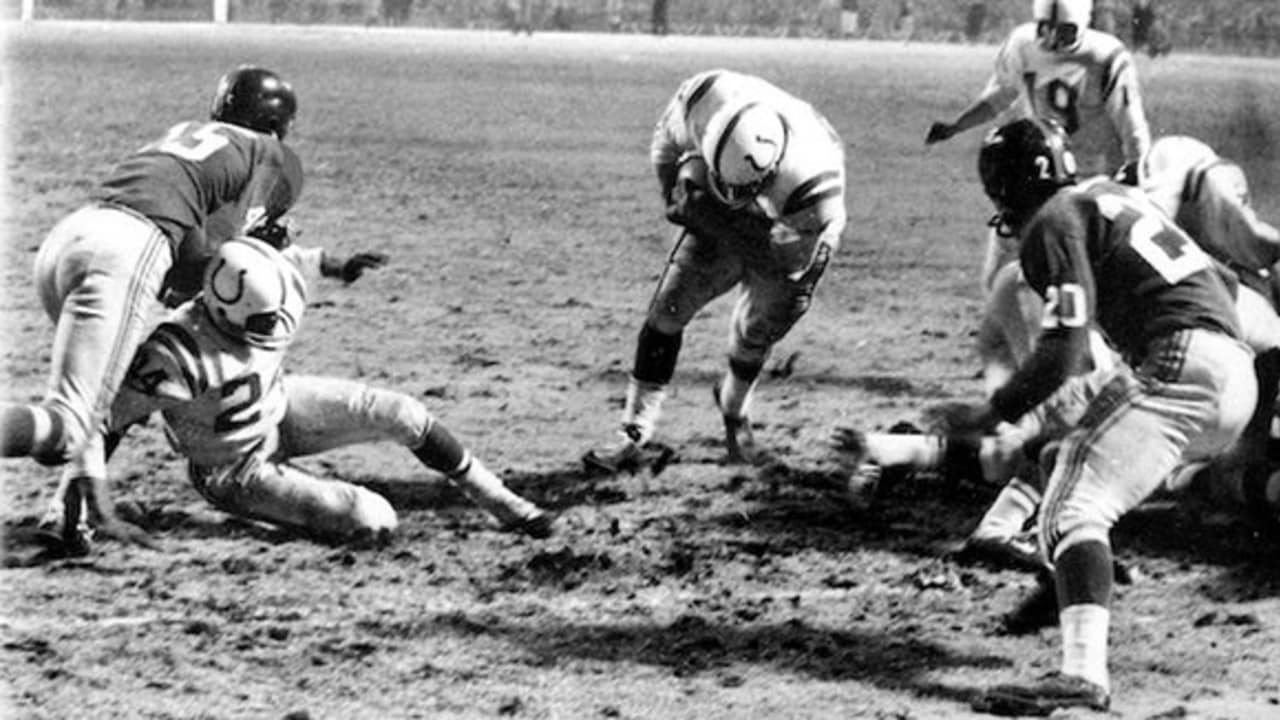
Alan Ameche scores the winning touchdown.
Lenny Moore (24) provides the key block on Emlen Tunnell.
Johnny Unitas (19) watches.

December 28, 1958: The NFL Championship Game is held at Yankee Stadium. The New York Giants, Champions of the NFL Eastern Division, play the Baltimore Colts, Champions of the Western Division. It is the 1st Championship Game for the Colts, the 10th for the Giants, who had previously won it in 1934, 1938 and 1956. (Why Baltimore, a Northeastern city, was placed in the League's Western Division, I don't know.)

The Giants had Charlie Conerly as their quarterback, and the biggest football star of the time, Frank Gifford, at running back. They were the 1st team to really make defense a priority, led by future Hall-of-Famers Sam Huff, Andy Robustelli and Emlen Tunnell. Two years earlier, they had destroyed the Chicago Bears in the Championship Game, 47-7.
The pre-renovation original Yankee Stadium, set up for football

But the Colts were on the rise. Their quarterback was Johnny Unitas. He had Raymond Berry to throw to, Lenny Moore in his backfield, and Jim Parker to block for him. All 4 would make the Hall of Fame. His defense was led by Hall-of-Famers Gino Marchetti and Art Donovan.

The 1st half was a bit sloppy, and didn't live up to the legend. Pat Summerall, future broadcasting legend, began the scoring with a field goal in the 1st quarter, putting the Giants up 3-0. In the 2nd quarter, Alan Ameche, who won the Heisman Trophy at the University of Wisconsin in 1954, scored a touchdown to put the Colts ahead. Unitas threw a touchdown pass to Berry, giving the Colts a 14-13 lead at the half.

In the 3rd quarter, Mel Triplett snuck the ball over the goal line to put the Giants back in it. Early in the 4th quarter, Conerly threw a touchdown pass to Gifford, giving the Giants a 17-14 lead. As the clock wound down, Unitas drove the Colts, but couldn't get them over. So Steve Myhra was sent in to kick a field goal as time expired. With the clock reading 0:00, the scoreboard read 17-17.

No NFL Championship Game had ever ended in a tie. Overtime was needed, for the 1st time in NFL history. (The League didn't institute overtime for the regular season until 1974.) The Giants won the toss, but couldn't score. Unitas led an inspiring drive, toward what would have been left field in The Stadium's baseball setup, which finally ended with Ameche scoring from the 1-yard line -- appropriately where Monument Park would later be in The Stadium's post-renovation period (1976-2008).

Bob Wolff, who had been in the same Stadium 2 years earlier to call Don Larsen's perfect game for the New York Yankees against the Brooklyn Dodgers in the 1956 World Series, was at the microphone for NBC again, and had the call: "Unitas gives to Ameche... The Colts are the World Champions! Ameche scores!" He later said he was glad he didn't "bury the lead" by saying, "Ameche scores!" first.

This game had the largest TV audience in NFL history to that point, 45 million people. The fact that it was in New York, and involved a New York team, helped it loom large in the public consciousness. This was the game that launched the NFL on a path to becoming, at least in perception, more popular than Major League Baseball.

It made legends of the Colts, and Unitas in particular. He would go on to be recognized as the greatest quarterback of all time. It's been 62 years, and some people still think he is. And the Colts, playing in a city that didn't have a big college football team -- Morgan State University is a historically black school, the U.S. Naval Academy is a national school, and the University of Maryland is closer to Washington -- became known as the team of America's working class, an "America's Team" in a way that felt artificial when the Dallas Cowboys later called themselves that.
Johnny Unitas

It also became known as "The Greatest Game Ever Played." It has been noted that it would never have been called that had the Colts beaten, say, the Philadelphia Eagles. But it was the New York team that they beat, in New York City. And so, every so often, polls are taken that show this game as the "greatest." The most recent was in 2019, for the NFL's 100th Anniversary. In 1981, John Thorn left his comfort zone, baseball, and published Pro Football's 10 Greatest Games. He included this game as one of them.

The teams had a rematch in the 1959 NFL Championship Game. In those days, home field was rotated between the Eastern and Western Champions, and the Colts hosted it at Memorial Stadium, beating the Giants again.

It remains the longest game in New York Giants history.

When The Sporting News ranked its 100 Greatest Football Players in 1999, Unitas came in 5th, Marchetti 15th, Parker 24th, Berry 40th, and Moore 71st. When the NFL Network ranked its 100 Greatest Players in 2010, Unitas was 6th, Parker 32nd, Berry 36th, Marchetti 39th and Moore 94th.


*

December 28, 1958, as you may have guessed, was a Sunday. There were no more NFL games to be played. It was the off-season for baseball.

There was only 1 NBA game played that day: The Cincinnati Royals beat the Minneapolis Lakers, 120-116 at the Cincinnati Gardens. Jack Twyman of the Royals scored 32 to lead all players in this game. Bob "Slick" Leonard, later to coach the Indiana Pacers to 3 ABA Championships, led the Lakers with 20 points.

The Lakers moved to Los Angeles in 1960. The Royals moved to Kansas City, becoming the Kings, in 1972, and to Sacramento in 1985.

All of the NHL's "Original Six" were in action that day:

* The New York Rangers beat the Montreal Canadiens, 5-3 at the old Madison Square Garden. This was an anomaly, as the Canadiens were in the middle of a run of 5 straight Stanley Cups, and the Rangers were in a down period.

* The Detroit Red Wings, beat the Boston Bruins, 5-3 at the Olympia Stadium in Detroit.

* And the Chicago Black Hawks beat the Toronto Maple Leafs, 4-3 at the Chicago Stadium. ("Black Hawks" was written as 2 words until 1986, when the team's original charter document was found, and it was discovered that "Blackhawks" was written as one word, and it has officially been so ever since.) 

Monday, December 26, 2022

December 26, 1965: The Tom Matte Game

December 26, 1965: The Green Bay Packers play the Baltimore Colts in a Playoff to decide the Championship of the NFL's Western Conference, at Lambeau Field in Green Bay, Wisconsin. Like its predecessor, the facility had been named City Stadium, but had recently been renamed, in memory of Earl "Curly" Lambeau, the Packers' co-founder and original head coach, who guided them to 6 NFL Championships.

Both teams finished the season 10-3-1. The Packers had won both games between them that season, but head-to-head was not a tiebreaker: Won-lost record was the only one, and so a Playoff was mandated. 

In this win-or-go-home game, both teams would have to rely on backup quarterbacks. For the Packers, Edmund "Zeke" Bratkowski, a career backup now 34 years old -- he was born on October 20, 1931, the same day as baseball legend Mickey Mantle -- had to substitute for the injured Bart Starr early in the game.

The Packers were thus taken by surprise. The Colts were not, but they were down to their 4th string quarterback. They were 9-1-1 when Johnny Unitas, then considered the best quarterback in the game, was injured in a 13-0 loss to the Baltimore Colts. Gary Cuozzo stepped in, but he was injured in the next game, a 42-27 loss to the Packers.

The only player the Colts had left on their roster who had ever played quarterback was running back Tom Matte, who had played quarterback at Ohio State, under coach Woody Hayes. But, given Hayes' disdain for the passing game -- he famously said, "There are three things that can happen when you throw the football, and two of them are bad," meaning an incompletion and an interception -- that meant that he hardly ever threw the ball. So he wasn't considered a long-term option.

For their season finale, the Colts signed a free agent, Ed Brown, who was also a good punter. He guided them to a 20-17 win over the Los Angeles Rams. The problem was, he was signed too late in the season to be eligible for any postseason games. So the Colts were stuck with Matte as quarterback. And it would be in Green Bay, and it would be "Packer Weather": No snow, but just 22 degrees, with the wind-chill factor making it 12. Baltimore can get cold in the Winter, but that kind of cold was unusual for Colt games at Memorial Stadium.

At first, it seemed to work. Matte threw 12 passes, completing 5, ran for 57 yards, and was sacked only once. Don Shinnick picked up a fumble by the Packers' Donny Anderson, and returned it 25 yards for a touchdown, just 21 seconds into the game. Starr was the last man between the huge Shinnick and the end zone, and hurt his ribs in his failure to make the tackle, resulting in Bratkowski having to take over.

Lou Michaels kicked the extra point. In the 2nd quarter, Matte drove the Colts downfield, and Michaels kicked a 15-yard field goal, and the Colts went into the locker room leading, 10-0.

In the 3rd quarter, Paul Hornung, who was a Heisman Trophy-winning quarterback at Notre Dame before becoming a running back with the Packers, ran the ball in from the 1-yard line to score a touchdown. Don Chandler kicked the extra point.

With 1:58 left to play in regulation, Chandler attempted a tying field goal from 22 yards out. The ball appeared to be wide of the right upright, and Chandler's reaction suggested that he thought he'd missed it. But referee Jim Tunney ruled that it was good, and it was 10-10. Overtime.

Bratkowski led the Packers downfield, and, with 1:21 left in the 1st overtime, Chandler attempted a 25-yard field goal. There was no doubt about this one: It was good, and the Packers would host the NFL Championship Game, against the Cleveland Browns. 

Baltimore football fans have complained ever since that Chandler's 4th quarter field goal was no good. Before the 1966 season, the NFL made 2 changes in response to these complaints: Goalposts were extended from to 10 feet high to 20 feet, and an official would be placed directly under each upright on field goal attempts.

In 1981, John Thorn left his comfort zone, baseball, and published Pro Football's 10 Greatest Games. He included this game as one of them.

The Packers beat the Browns, 23-12. They won the next 2 NFL Championships, and the subsequent games, too, which were retroactively renamed Super Bowl I and Super Bowl II. With Matte as running back, and Earl Morrall filling in for an injured Unitas, the Colts won the 1968 NFL Championship, but lost Super Bowl III to the New York Jets. Unitas led them to win the 1970 NFC Championship, but got hurt in Super Bowl V, and Morrall had to come to the rescue, and the Colts beat the Dallas Cowboys. Matte, and all the other Colts who had lost Super Bowl III, got their redemptions and their rings.

Bratkowski died in 2019, Matte in 2021.

*

December 26, 1965 was a Sunday. The American Football League held its Championship Game that day, and the Buffalo Bills beat the San Diego Chargers, 23-0 at Balboa Stadium in San Diego. The Bills had now won 2 straight AFL Championships. They have not won a league championship since.

Baseball was out of season. There were 3 games played in the NBA:

* The Boston Celtics beat the Baltimore Bullets, 120-99 at the Boston Garden. Sam Jones scored 34 points.

* The Philadelphia 76ers beat the San Francisco Warriors, 121-107 at the Philadelphia Civic Center. Wilt Chamberlain had 33 points and 30 rebounds.

* And the Cincinnati Royals beat the St. Louis Hawks, 117-115 at the Kiel Auditorium in St. Louis. Oscar Robertson led all scorers on the day with 37 points.

And the NHL's entire "Original Six" were in action:

* The New York Rangers beat the Boston Bruins, 6-4 at the old Madison Square Garden. Bob Nevin had a hat trick.

* The Toronto Maple Leafs and the Chicago Black Hawks played to a tie, 1-1 at the Chicago Stadium.

* And the Detroit Red Wings beat the Montreal Canadiens, 1-0 at the Olympia Stadium in Detroit. This turned out to be a preview of the Stanley Cup Finals, but the Canadiens beat the Wings.

Sunday, December 25, 2022

December 25, 1971: The NFL's Longest Game

December 25, 1971: For the 1st time, the NFL plays a game on Christmas Day. It turned out to be the longest game in the league's history.

The Kansas City Chiefs played the Miami Dolphins at Kansas City Municipal Stadium. The Chiefs had been the defining team of the American Football League, winning the title in 1962, 1966 and 1969. From the AFL's founding in 1960 until the 1962 Championship Game, they were the Dallas Texans. That '62 title game, which they beat the Houston Oilers, went to 2 overtimes, becoming the longest game in pro football history.

The Dolphins had only been founded in 1966, and made the Playoffs for the 1st time in 1970. They were a team on the rise, and this would be their biggest challenge yet. Despite the game being in Kansas City in December, the weather was just fine by Miami standards: 62 degrees and partly cloudy at the 3:00 kickoff (4:00 Eastern Time).

The scoring began with Jan Stenerud kicking a field goal for the Chiefs. They went ahead 10-0 following an interception by Willie Lanier and a touchdown pass from Len Dawson to Ed Podolak. The Dolphins came back, with Larry Csonka running for a touchdown and Garo Yepremian kicking a field goal, making the score 10-10 at the half.

Dawson launched a 75-yard, 10-minute drive that ended with a Jim Otis touchdown, but the Dolphins came back with a Jim Kiick touchdown to make it 17-17. In the 4th quarter, Nick Buoniconti picked up a fumble, but Jim Lynch intercepted Griese to end that threat. Dawson then drove the Chiefs 91 yards, capped by a 3-yard run by Podolak, making it 24-17 Kansas City.

The Dolphins struck back, going 71 yards until Griese threw a 5-yard touchdown pass to Marv Fleming, tying it 24-24 with 1:25 left in regulation. Podolak took the kickoff back 78 yards, but Stenerud missed a 32-yard field goal, and the game went to overtime.

At this point, overtime was still rare. There would not be a provision for it in the regular season until 1974. It had happened in the 1958 NFL Championship Game, with the Baltimore Colts beating the New York Giants. It had happened, as I said, in the 1962 AFL Championship Game. And it had happened in a Playoff for the NFL Western Division Championship in 1965, with the Green Bay Packers beating the Colts. This would be only the 4th time in pro football history that a game went beyond the standard 60 minutes.

Podolak returned the overtime kickoff to the 46-yard line, setting up a 42-yard field goal attempt by Stenerud. But the Dolphins blocked it. Later in the 5th quarter, Yepremian tried a field goal from 52 yards, but this was short. At the end of this 1st overtime period, Jake Scott intercepted a Dawson punt, but this came to nothing, and the teams traded punts.

Finally, Csonka -- on his 25th birthday -- broke off a 29-yard run, setting up a 37-yard field goal attempt by Yepremian, with 7:40 left in the 6th quarter -- 82 minutes and 40 seconds of play. The left-footed Armenian from Cyprus made the kick, it was good, and the Dolphins had won, 24-21.

Chiefs coach Hank Stram said, "I don't think any one player in a big game, a monumental game like that, had a day like Eddie Podolak had." Stram had a point: 17 rushes for 85 yards, 8 catches for 110 yards, 3 kickoff returns for a 154 yards, and 2 punt returns for 2 yards. That's 350 all-purpose yards, still a postseason record, and the 4th-highest total in NFL history. But for all he, and Hall-of-Famers like Len Dawson, Willie Lanier, Buck Buchanan, Bobby Bell, Curley Culp, Johnny Robinson and Jan Stenerud did, it wasn't enough.

In 1981, historian John Thorn left his comfort zone, baseball, and published Pro Football's 10 Greatest Games. He included this game.

This defeat meant that this was the last game the Chiefs would play at Municipal Stadium. They would not host the AFC Championship Game, and the next season, Arrowhead Stadium opened, and it remains the Chiefs' home to this day.

More than this, it was the end of one era, and the beginning of another. The Chiefs had played 8 postseason games in 9 years, winning 3 AFL Championships and Super Bowl IV. They would not play another Playoff game for 15 years, only that 1 for 19 years, and wouldn't win a Playoff game for 20 years.

The Dolphins hosted the Colts, another great team getting old, in the AFC Championship Game, and won, 21-0. They lost Super Bowl VI to the Dallas Cowboys, 24-3. But the following season, they went undefeated, 14-0, and won Super Bowl VII over the Washington Redskins, 14-7. They would win Super Bowl VIII as well.

In 2019, a poll ranked this game 18th on a list of the 100 Greatest Games of the NFL's 1st 100 years.

*

December 25, 1971 was a Saturday. Earlier in the day, the Dallas Cowboys had beaten the Minnesota Vikings, 20-12 at Metropolitan Stadium in the Minneapolis suburb of Bloomington, Minnesota.

The following day, December 26, the Baltimore Colts beat the Cleveland Browns, 20-3 at Cleveland Municipal Stadium; and the San Francisco 49ers beat the Washington Redskins, 24-20 at Candlestick Park in San Francisco.

There were 6 games played in the NHL. Since this day, the League has never played on Christmas Day again. In fact, traditionally, it has not played on December 24, or 25, and usually not on 26, either.

The New York Rangers beat the Minnesota North Stars, 2-1 at the Metropolitan Sports Center in Bloomington. The Boston Bruins beat the Philadelphia Flyers, 5-1 at the Boston Garden. The Toronto Maple Leafs beat the Detroit Red Wings, 5-3 at Maple Leaf Gardens in Toronto. The Pittsburgh Penguins beat the Montreal Canadiens, 4-2 at the Civic Arena in Pittsburgh. 

The St. Louis Blues and the Buffalo Sabres played to a tie, 4-4 at the St. Louis Arena. And the Oakland-based California Golden Seals beat the Los Angeles Kings, 3-1 at The Forum outside Los Angeles, in Inglewood, California.

There were 7 games played in the NBA. The New York Knicks beat the Golden State Warriors, 114-89 at Madison Square Garden. Walt Frazier scored 36 points.

The Boston Celtics beat the Cincinnati Royals, 99-94 at the Cincinnati Gardens. This was the end of a tradition: The last Christmas game in Cincinnati. The following season, the Royals moved, becoming the Kansas City-Omaha Kings.

Also, the Baltimore Bullets beat the Philadelphia 76ers, 117-114 at The Spectrum in Philadelphia. The Atlanta Hawks beat the Buffalo Braves, 140-117 at the Alexander Coliseum in Atlanta. Walt Bellamy scored 40 points. The Detroit Pistons beat the Milwaukee Bucks, 120-118 in overtime at Cobo Hall in Detroit. Kareem Abdul-Jabbar scored 38 points, but it wasn't enough to beat the Pistons.

The Phoenix Suns beat the Seattle SuperSonics, 116-86 at the Arizona Veterans Memorial Coliseum in Phoenix. Connie Hawkins scored 31 for the Suns. And the Chicago Bulls beat the Portland Trail Blazers, 109-88 at the Veterans Memorial Coliseum in Portland, Oregon.

There were 3 games played in the ABA. The Virginia Squires beat the Pittsburgh Condors, 133-126 at the Hampton Coliseum. The Memphis Pros beat the Carolina Cougars, 110-102 at the Mid-South Coliseum. And the Utah Stars beat the Indiana Pacers, 150-129 at the Salt Palace in Salt Lake City.

Pierre Trudeau, then the Prime Minister of Canada, became a father on this day, to Justin Trudeau, who would also go on to become Prime Minister. Florian Cloud de Bounevialle O'Malley Armstrong, the English singer known as Dido, was also born.

Saturday, December 24, 2022

December 24, 1950: The Cleveland Browns Make Their Point

The winning field goal, kicked by Groza, then wearing Number 50.
He would later switch to 76, which the Browns retired for him.
Note the snow on the field.

December 24, 1950: The NFL Championship Game is held at Cleveland Municipal Stadium. The weather was bitterly cold, but the action was hot.

In 1945, the Cleveland Rams had won the NFL Championship, but had low attendance. Team owner Dan Reeves (no relation to the later NFL coach of the same name) moved them to Los Angeles, where they became a runaway success at the box office, and on the field as well. In 1949, they won the NFL Western Division, and reached the NFL Championship Game. But, contrary to the image of sunny Southern California, a rainstorm hit the Los Angeles Memorial Coliseum, and the Rams lost to the Philadelphia Eagles.

They played the 1950 season as if on a benzedrine kick, with the most potent offense the NFL has ever seen. The "Greatest Show On Turf" that the St. Louis version of the Rams had half a century later had noting on this bunch.

Alternating quarterbacks between Bob Waterfield and Norm Van Brocklin, their runners included former Army Heisman Trophy winner Glenn Davis, Verda Thomas Smith (known as V.T. or "Vitamin"), Dick Hoerner, early black star "Deacon" Dan Towler, and one of the earliest NFL players from a "historically black" school, Paul "Tank" Younger of Grambling State University in Louisiana. Waterfield and Van Brocklin could throw to any of them, and to receivers Tom Fears and Elroy Hirsch, who was so fast, he was nicknamed "Crazy Legs."

The Rams went 9-3, and one of the losses was a 56-20 embarrassment against the Eagles. The other 2 losses came against the Chicago Bears. But on October 22, 1950, the Rams answered this question: "What would happen if the best offense in NFL history played the worst defense in NFL history?" The Rams ended up scoring more points per game in a season than any other, and the Baltimore Colts ended up allowing more per game than any other. Result: Rams 70, Colts 27. To this day, it's still the 3rd-highest-scoring single-game performance in NFL history. In addition, they hung 65 point on the Detroit Lions, 51 and 45 on the Green Bay Packers, 45 and 43 on the New York Yanks (not "Yankees"), and 35 on the San Francisco 49ers.

But the Cleveland Browns could match them for firepower. After winning the All-America Football Conference in all 4 seasons of its existence, 1946 to 1949, the Browns were invited to join the NFL from it, as were the 49ers and the Colts. The opening game of the 1950 season was against the defending Champion Eagles, in Philadelphia, and the Browns embarrassed the allegedly superior league's top team, 35-10.

Head coach Paul Brown was an offensive genius, and he built a team to carry out that genius: Quarterback Otto Graham, running back Marion Motley, and ends Mac Speedie and Dante Lavelli were weapons that any team would be lucky to have. Blocking for them were guard Bill Willis and tackles Lou Groza and Mike McCormack. All of these men would join Brown in the Pro Football Hall of Fame.

Motley and Willis were the men who provided the premiering AAFC with its racial integration, as the Rams' Kenny Washington and Woody Strode had done for the NFL. Alas, by 1950, neither Washington nor Strode was still with the Rams, but Younger and Towler were.

The Browns went 10-2, their only losses to the New York Giants, by a total of 10 points. In addition to the 35 they scored on the Eagles, they scored 45 each on the Pittsburgh Steelers and the Washington Redskins, 34 each on the 49ers and the Chicago Cardinals, and 31 on the Colts.

The Rams and the Browns won their respective Divisions, and, as it was the Eastern Division Champion's turn to host the NFL Championship Game, they met in Cleveland on a frigid Christmas Eve on the shore of Lake Erie. It was the team that did make it in Cleveland vs. the one that didn't in spite of bringing the city a title. It was also the 1st game back in Cleveland for the Rams, as the NFL did not yet allow crossover games from one Division to the other, except in the Championship Game.
The Rams wasted no time: On their 1st play from scrimmage, Waterfield passed to Davis, and he went 82 yards for a 7-0 Ram lead. The Browns responded with their own touchdown, but the Rams came back with another, leading 14-7 at the end of the 1st quarter.

The Browns scored a touchdown in the 2nd quarter, but a high snap caused Groza, also the team's main kicker, to miss the extra point. Waterfield, also the Rams' main kicker, attempted a field goal as the half ran out, from only 15 yards, but the stiff wind blasting in off the lake stopped it, and it was 14-13 Los Angeles.

In the 3rd quarter, Graham threw a 39-yard touchdown pass to Lavelli, giving the Browns a 20-14 lead. But the Rams scored 2 touchdowns, and it was 28-20 Rams after 3 quarters. With 10 minutes to go, the Browns faced 3 4th-down conversion attempts, and made them all. Graham threw another touchdown pass, and it was 28-27 Rams.

With 1:49 left, the Browns got the ball on their own 31-yard line. Graham threw for 1st downs, and ran for 2 of them himself. With 28 seconds left, Groza was sent on to attempt a 16-yard field goal. It was perfect, and it was 30-28 Cleveland. The Rams had 1 more chance, but could do nothing with it. The Browns had won, in their 1st season in the League, and, by staying in the city, gave Cleveland its 1st pro football championship defenders since the 1924 Cleveland Bulldogs.

Paul Brown called it the best game he ever saw, and never changed his mind. NFL Commissioner Bert Bell, who had orchestrated the sort-of-merger between the NFL and the AAFC, called the Browns "the greatest team ever to play football." The Browns may have dominated an inferior league, but now, they had won the superior one. They had made their point.

But it is more than that: By being the winning coach, Paul Brown, having coached Ohio State in 1942, became 1st head coach ever to win both a college football National Championship and an NFL Championship. It would take until the Super Bowl era before that happened again: Jimmy Johnson, with 1987 Miami and the 1993 and 1994 Dallas Cowboys; Barry Switzer, 1974, 1975 and 1985 Oklahoma and the 1996 Cowboys; and Pete Carroll, 2003 and 2004 USC and the 2014 Seattle Seahawks.

In 1981, historian John Thorn left his comfort zone, baseball, and published Pro Football's 10 Greatest Games. He included this game.

The same teams faced each other again the following year. But in 1951, at the Coliseum, the Rams beat the Browns for Los Angeles' 1st major league sports championship. They would play each other again in 1955, with the Browns winning in L.A. It would be Graham's last game, as he retired. The Browns had been to the AAFC or NFL Championship Game every year for 10 straight years. After missing in 1956, they made it 11 out of 12 in 1957. They beat the Detroit Lions in 1954, but lost to them in 1952, '53 and '57.

The fact that the Browns', the Lions', and the Chicago (now Arizona) Cardinals' titles came before the advent of the Super Bowl means that they get discounted: Even before the distance of time became what it is now, NFL fans have come to regard any title won before the Super Bowl, NFL or AFL, as not a "real" championship. This is unfair: A title is a title.

UPDATE: The Browns have a Ring of Honor. From their founding era, they have honored head coach Paul Brown, quarterback Otto Graham, running back Marion Motley; receivers Dante Lavelli, Mac Speedie and Bobby Mitchell; center Frank Gatski, guard Bill Willis, tackle and placekicker Lou Groza, tackle Mike McCormack and defensive end Len Ford.

From their 1964 NFL Championship, they have honored running backs Jim Brown and Leroy Kelly, receiver Paul Warfield and guard Gene Hickerson. From the 1980s, they have honored guard Joe DeLamielleure, tight end Ozzie Newsome, and linebacker Clay Matthews Jr. It says something about how the Browns have been run since their re-establishment in 1999 that they have honored just 1 player in that period, offensive tackle Joe Thomas.

Motley, Willis, Lavelli, Groza, Warfield, Hickerson, founding owner Arthur "Mickey" McBride, 1940s running back Tony Adamle, 1950s guard Chuck Noll, 1950s defensive tackle Bob Gain, 1950s linebacker Sam Palumbo (a Cleveland native), 1970s running backs Greg Pruitt and Mike Pruitt (not related to each other), 1970s offensive tackle Doug Dieken, 1980s head coach Sam Rutigliano, 1980s quarterback Bernie Kosar, 1980s running back Kevin Mack, 1980s defensive tackle Bob Golic, 1980s linebacker Tom Cousineau, and 1999-2002 re-establishing owner Al Lerner have been elected to the Greater Cleveland Sports Hall of Fame.

In 1999, The Sporting News released their list of the 100 Greatest Football Players. Graham ranked 7th, and Motley 32nd. In 2010, the NFL Network released their list of the 100 Greatest Players, with Graham 16th and Motley 74th.


*


December 24, 1950 was a Sunday. It was the end of the football season. No college games were played on this day. Baseball was out of season. No NBA games were played. And only 1 NHL game was played: The New York Rangers beat the Chicago Black Hawks, 6-1 at the old Madison Square Garden. Nick Mickoski had 4 goals and an assist for the Broadway Blueshirts.

Wednesday, December 21, 2022

December 21, 1974: The "Sea of Hands" Game

December 21, 1974: The Oakland Raiders host the Miami Dolphins in an AFC Divisional Playoff at the Oakland Coliseum. The Raiders went 12-2 and won the AFC Western Division, while the Dolphins went 11-3 and won the AFC Eastern Division.

The Dolphins had won the last 3 AFC Championships and the last 2 Super Bowls. In contrast, the Raiders were already known as a team that "can't win the big one": They had lost Super Bowl II to close the 1967 season, the 1968 and 1969 AFL Championship Games, the 1970 and 1973 AFC Championship Games, and a Divisional Playoff in 1972 on the Pittsburgh Steelers' "Immaculate Reception."

The 1974 season was the one in which NFL Films producer Steve Sabol was inspired to write a poem about the Raiders, a 4-verse piece titled The Autumn Wind, closing:

The Autumn Wind is a raider
pillaging just for fun.
He'll knock you 'round and upside-down
and laugh when he's conquered and won.

Sabol showed it to Raiders owner Al Davis, who loved it, and said, "This is what the Oakland Raiders are all about." So Sabol gave it to his voiceover maestro, John Facenda, who spoke the words over highlights, making it an NFL Films classic.

Raider fans were ready to dethrone the Champions. A banner -- incorrectly identifying dolphins as fish, rather than mammals, and also incorrectly writing "Super Bowl" as one word -- read, "THE DOLPHINS BELONG IN A FISHBOWL NOT A SUPERBOWL."

George Blanda, a former quarterback still playing for the Raiders at age 47, kicked off, and Nat Moore returned it 89 yards for a touchdown. But on the Raiders' next drive, despite holding them off, the Dolphins lost safety Jake Scott to injury. In the 2nd quarter, Ken Stabler threw a touchdown pass to Charlie Smith, but Garo Yepremian gave the Dolphins back the lead with a field goal, making it 10-7 Miami at the half.

A great catch of a Stabler pass by Fred Biletnikoff gave the Raiders a 14-10 lead early in the 3rd quarter. But a dumb pass interference penalty by the Raiders aided the Dolphins' drive, and Bob Griese threw a 16-yard touchdown pass to Paul Warfield. Former Baltimore Colts star and future actor Bubba Smith blocked Yepremian's extra point attempt, so the Dolphins only led 16-14. Yepremian made it 19-14 with a field goal early in the 4th quarter.

With 4:37 to play, Cliff Branch made a great catch of a Stabler pass, and took it 72 yards for a touchdown, and a 21-19 Oakland lead. The Dolphins struck back, and Benny Malone ran broke 4 tackles on a 23-yard touchdown run. With 2:08 left, the Dolphins led, 26-21.

The Raiders took over on their own 32-yard line, with 2 minutes and all 3 timeouts remaining, but facing the Dolphins' "No-Name Defense." It was a bad name: linebacker Nick Buoniconti was elected to the Pro Football Hall of Fame; and ends Bill Stanfill and Vern Den Herder, tackle Manny Fernandez, and safeties Dick Anderson and the injured Scott were regular Pro Bowlers.

Stabler threw a pair of 1st-down passes to Biletnikoff. He got the ball to the 8-yard line, calling his last timeout with 35 seconds left. On the next play, he looked for Biletnikoff in the end zone, but he was too well-covered. Den Herder bore down on him, and perhaps Stabler was thinking this was his "Immaculate Reception" moment. He threw in mid-sack. Clarence Davis was covered by 3 Dolphins in the end zone: Safety Charlie Babb, linebacker Larry Ball and Mike Kolen. Still, he made the catch.

Stabler later told NFL Films: "Clarence Davis made the play. I certainly didn't make the play. Vern Den Herder hits me, and I get very little on the ball, and it's kind of a dying duck, end-over-end deal, back into a sea of hands in the end zone." The term "Sea of Hands" would be applied to this game for all time.

The Raiders led, 28-26, but the Dolphins still had a chance. That chance ended with Phil Villapiano intercepted Griese on the Raider 45, and Stabler ran out the clock. Of all the crazy games in Raider history -- in Oakland, in Los Angeles, in Las Vegas, and on the road -- this may be their most cherished, outside of the 3 Super Bowls they've won.

In contrast, Dolphin head coach Don Shula -- who, remember, was the head coach of the Baltimore Colts when they lost Super Bowl III to the New York Jets in a shocking upset, 6 years earlier -- said, "This has to be the toughest loss I've ever suffered."

But, just as the Steelers did when they beat the Raiders with the Immaculate Reception, the Raiders ended up losing the AFC Championship Game, to the Steelers. And, as with the Steelers, it would take them 2 more years to go all the way, winning Super Bowl XI. The Dolphins have been to only 2 Super Bowls since, losing both.

In 1981, author John Thorn left his comfort zone, baseball, and published Pro Football's 10 Greatest Games. He included this game as one of them.

*

December 21, 1974 was a Saturday. There was 1 other NFL Playoff game that day: The Minnesota Vikings beat the football version of the St. Louis Cardinals, 30-14 at Metropolitan Stadium in the Minneapolis suburb of Bloomington, Minnesota.

There was a college football bowl game that day: Miami University of Ohio beat the University of Georgia, 21-10 in the Tangerine Bowl, at the stadium of the same name in Orlando, Florida. Miami, Champions of the Mid-American Conference, completed an undefeated season: 9-0-1. The game and the stadium would later be known as the Citrus Bowl, and the stadium is now named Camping World Stadium.

There were 7 games played in the NBA that day:

* The New York Knicks lost to the Boston Celtics, 109-91 at Madison Square Garden.

* The Washington Bullets beat the Philadelphia 76ers, 117-101 at the Capital Centre in the Washington suburb of Landover, Maryland.

* The Houston Rockets beat the Atlanta Hawks, 101-96 at The Omni in Atlanta.

* The Chicago Bulls beat the Cleveland Cavaliers, 87-74 at The Coliseum in the Cleveland suburb of Richfield, Ohio.

* The Kansas City-Omaha Kings beat the Golden State Warriors, 107-84 at the Kemper Arena (now the Hy-Vee Arena) in Kansas City.

* The Phoenix Suns beat the Los Angeles Lakers, 114-104 at the Arizona Veterans Memorial Coliseum in Phoenix.

* And the Portland Trail Blazers beat the Detroit Pistons, 108-97 at the Veterans Memorial Coliseum in Portland.

There were 4 games in the American Basketball Association:

* The New York Nets beat the Indiana Pacers, 134-122 at the new Market Square Arena in Indianapolis. Billy Paultz led the Nets with 30 points. Julius "Dr. J" Erving scored 18. George McGinnis had 33 points and 18 rebounds in defeat.

* The Virginia Squires beat the Spirits of St. Louis, 99-93 at the Hampton Coliseum outside Norfolk in Hampton, Virignia.

* The Kentucky Colonels beat the Memphis Sounds, 115-98 at Freedom Hall in Louisville.

* And the Denver Nuggets beat the San Antonio Spurs, 119-104 at the Denver Auditorium Arena. Mike Green scored 39 points.

There were 6 games played in the NHL that day:

* The New York Islanders and the Chicago Black Hawks played to a tie, 3-3 at the Nassau Coliseum.

* The Toronto Maple Leafs beat the Boston Bruins, 8-4 at Maple Leaf Gardens in Toronto.

* The Montreal Canadiens and the Los Angeles Kings played to a tie, 2-2 at The Forum outside Los Angeles in Inglewood, California.

* The Detroit Red Wings and the Philadelphia Flyers played to a tie, 2-2 at the Olympia Stadium in Detroit.

* The Minnesota North Stars beat the Pittsburgh Penguins, 8-7 at the Metropolitan Sports Center in the Minneapolis suburb of Bloomington, Minnesota.

* The St. Louis Blues beat the cross-State Kansas City Scouts, 6-4 at the St. Louis Arena.


* And the New York Rangers, the Oakland Seals, the Buffalo Sabres, the Vancouver Canucks, the Atlanta Flames and the Washington Capitals were not scheduled.

And there were 3 games in the World Hockey Association:

* The Houston Aeros beat the New England Whalers, 5-3 at the Big E Coliseum in West Springfield, Massachusetts.

* The Edmonton Oilers beat the Chicago Cougars, 3-0 at the International Amphitheatre in Chicago.

* And the Vancouver Blazers beat the San Diego Mariners, 2-1 at the Pacific Coliseum in Vancouver.

Also, Arsenal traveled to Stoke-on-Trent, Staffordshire, and beat Stoke City, 2-0 at the Victoria Ground. 

Saturday, December 17, 2022

December 17, 1933: The 1st NFL Championship Game

Hewitt's lateral to Karr

December 17, 1933: The 1st official NFL Championship Game is played. Appropriately, it's between the League's founding team, the Chicago Bears; and its team in the biggest market, the New York Giants.

There had been controversies for the League title in 1921 and 1925, so having a definitive title game would have helped. In 1932, the Bears and the Portsmouth Spartans (who became the Detroit Lions in 1934) finished tied for first: The Bears were 6-1-6, the Spartans 6-1-4. (At the time, ties were not counted in winning percentage.) So a playoff game was set, and the Bears won it, 9-0.

So, for the 1933 season, the NFL was divided into Eastern and Western Divisions, and the winners were to meet in a Championship Game. The Giants won the East, going 11-3. The Bears won the West, 10-2-1. So the decider was set for Wrigley Field. (Until the Super Bowl began, regardless of which team had the better record, the West winners would host the game in odd-numbered years, and the East winners would do so in even-numbered years.

Coached by Steve Owen, the Giants had some fantastic players: Quarterback Harry Newman, running back Ken Strong, end Ray Flaherty, and the man regarded for decades to come as the best center in NFL history, Mel Hein.

George Halas, one of the co-founders of the NFL, coached the Bears. They had 2 of the defining players of NFL history, speedy halfback Harold "Red" Grange and bruising fullback Bronislau "Bronko" Nagurski. They also had center George Trafton, tackles Link Lyman and George Musso, and end Bill Hewitt, who famously played without a helmet, at a time when that was still allowed, even though everybody knew it was a bad idea. All of them are in the Pro Football Hall of Fame.

Another difference in this new season was a liberalization of the passing rules. The Bears, the 1st NFL team to use the T formation, took advantage of this. The Giants had not done so as much. Nevertheless, when meeting with the officials before the game, Newman told them the Giants would be trying some trick plays, checking to ensure they would be legal.
Wrigley Field in its football configuration

The game kicked off at 1:45 PM Central Time (2:45 Eastern). It was broadcast on Chicago radio station WGN and a few other stations, but not on a national network. Nor was it broadcast on radio in New York.

Early in the game, the Giants' offensive line shifted, so that Hein was now on the end, and thus an eligible receiver. Hein snapped the ball to Newman, who handed it right back to him, then ran out to fake a run. While the Bears keyed on Newman, Hein took off. By the time the Bears caught on and caught up with him, he had gotten to the Bears' 15-yard line. But Chicago managed to, as their later fight song said "Bear Down," and hold the Giants to a field goal attempt, which the normally reliable Strong missed.

Jack Manders, so reliable he was known as "Automatic Jack," kicked field goals in each of the 1st 2 quarters, and the Bears led 6-0. But just before the half, Newman threw a 29-yard touchdown pass to Badgro, and the Giants went into the locker room up 7-6.

Manders kicked another field goal in the 3rd quarter, but a Giant drive resulted in Max Krause scoring from the 1-yard line, making it 14-9 New York. Finally, late in the quarter, Nagurski, not known as a passer, or as a jumper -- his style was to take the ball, crash into the line, and let the defenders fall where they may -- threw a jump pass to Bill Karr, who ran it in 8 yards for a touchdown, and the Bears led, 16-14.

The Giants had another trick play in them, early in the 4th quarter. Newman took off on a 30-yard run, then lateraled to Strong, who finished the touchdown, and then kicked the extra point. It was 21-16 Giants.

The minutes ticked away, and another Manders field goal would have done the Bears no good. Quarterback Carl Brumbaugh drove them to the Giants' 36 with less than 2 minutes left. He passed to Hewitt, and the Giant defense was ready to tackle him. But pulled the "hook and ladder play": He spun and lateraled to Karr, who took it in for a touchdown. The Bears led, 23-21.

The Giants got the ball back, and there was still time for them to get within Strong's field goal range. They got to their own 40, and again set Hein up as an eligible receiver. Running back Dale Burnett tried an option pass, and Hein was wide open on the Bear 30. But the pass was a bad one, and fell well short.

There was time for one more play. Newman passed to Badgro, who was ready to copy the earlier Hewitt-to-Karr hook and ladder. But this was the era of two-platoon football, where, no matter how big a star you were, you had to play both offense and defense. And there was no bigger star in football than Grange. He immediately figured out what was about to happen, and ran to Badgro, and wrapped his arms around Badgro's arms. Any lateral Badgro made wouldn't go very far. The clock ran out. Halas, eventually the grand old man of football, would later call it the greatest defensive play he ever saw.

The Bears were NFL Champions for the 3rd time, having won it in controversial fashion in 1921, and then definitively in 1932. The Giants had won in 1927, and would get revenge over the Bears in 1934, in the Polo Grounds, in a frigid contest known as The Sneaker Game.

These 2 teams would also meet in the NFL Championship Game in 1941, 1946, 1956 and 1963, with the Giants winning only in 1956. They've since met in the NFC Playoffs in the seasons of 1985, with the Bears winning; and 1990, with the Giants winning; and, each time, it was a good omen, as the winner went on to win the Super Bowl.

In 1981, John Thorn left his comfort zone, baseball, and published Pro Football's 10 Greatest Games. He included this game as the earliest of them.

In 2019, in connection with their 100th Season (not their 100th Anniversary, which was the next year), the Bears did fan balloting for their 100 Greatest Players. From the 1932 and 1933 NFL Champions, they chose running backs Red Grange and Bronislau "Bronko" Nagurski, guards Joe Kopcha and George Musso, tackle William "Link" Lyman, and ends Luke Johnsos and Bill Hewitt. From the 1934 team that didn't quite do it, they named halfback Beattie Feathers.

*

December 17, 1933 was a Sunday. It was the only football game played that day. Baseball was out of season. There was no NBA yet. There were 3 games played in the NHL:

* The New York Rangers and the Boston Bruins played to a tie, 2-2 at the old Madison Square Garden.

* The New York Americans and the Detroit Red Wings played to a tie, 4-4 at the Olympia Stadium in Detroit.

* And the Chicago Black Hawks beat the Montreal Canadiens, 4-1 at the Chicago Stadium. 

Friday, October 21, 2022

October 21, 1975, The Carlton Fisk Game

October 21, 1975: In The Curse of the Bambino, his somewhat skewed history of his beloved Boston Red Sox, Boston Globe columnist Dan Shaughnessy called it "a brilliant autumn day in New England," following a 3-day delay for rain. Brilliant though the Tuesday afternoon may have been, Game 6 of the 1975 World Series is played at night at Fenway Park.

The Red Sox, Champions of the American League after winning its Eastern Division and beating the 3-time defending World Champions, the Oakland Athletics, in the AL Championship Series, trail the Cincinnati Reds, a.k.a. the Big Red Machine, Champions of the National League after winning its Western Division and beating the Pittsburgh Pirates in the NLCS, 3 games to 2, and must win to force a Game 7.

The Sox haven't won the World Series in 57 years, including a loss as recently as 1967. The Reds haven't won the World Series in 35 years, including 2 Series losses in this decade already. Boston is looking for its 1st title since 1918; Cincinnati, for its 1st since 1940. Both teams need it badly. Something's gotta give.

Just 14 years later, Shaughnessy wrote, "Game Six has taken on a life of its own in the years since it was played, and it gets larger and more thrilling in each retelling. Some distance allows that there may be other contenders for the title of The Greatest Game Ever Played, but by any measure, 1975's Game Six will stand as one of the top ten games in World Series history, and one that came at a time when baseball needed it most." Shaughnessy was right.
In The New Yorker magazine, Roger Angell wrote, "Game Six... what can we say of it without seeming to diminish it by recapitulation or dull it with detail?" Roger, one of the greatest writers ever on the subject of baseball, was wrong on this one: The details are necessary.

Due to the rain, Sox manager Darrell Johnson was able to start Luis Tiant, winner of Games 1 and 4, on full rest. Reds manager Sparky Anderson started Gary Nolan. Fred Lynn, who, that season, became the 1st player ever to be awarded his league's Rookie of the Year and its Most Valuable Player award in the same season, hit a home run that gave the Sox a 3-0 lead in the 1st inning, and Tiant pitched shutout ball through 4.

But, as they would say in English soccer, Three-nil, and they fucked it up. The Reds got 2 men on in the 5th, and Ken Griffey Sr. sent Lynn to the wall. Lynn crashed, telling NBC's Bob Costas years later that he'd hurt his ribs, and that, for a moment, he was barely conscious and couldn't feel his legs. Griffey's triple scored 2 runs, and then Johnny Bench singled Griffey home to tie the game. A 2-run double by George Foster in the 7th and a solo homer by Cesar Geronimo in the 8th gave the Reds a 6-3 lead, with just 6 outs to go for the title.

Typical Boston choke, leading to a Reds win? As ESPN college football analyst Lee Corso would say, "Not so fast, my friend!" Six-three, and they fucked it up. In the bottom of the 8th, Reds reliever Pedro Borbon (who, like Griffey, would later see his son and namesake play in the major leagues) gave up a single to Lynn and a walk to Rico Petrocelli.

Sparky brought in Rawley Eastwick, who struck out Dwight Evans and got Rick Burleson to line out to left. He got 2 strikes on Bernie Carbo, a former Red, pinch-hitting for pitcher Roger Moret (who had relieved Tiant in the 8th), but Carbo drove one to dead center, and tied it up.

In the bottom of the 9th, Denny Doyle drew a leadoff walk. Carl Yastrzemski singled him over to 3rd. Sparky brought in reliever Will McEnaney, and had him intentionally walk Carlton Fisk. Did Sparky have a premonition? If so, it didn't help him later on.

Lynn flew to left, and Foster threw home. Doyle tagged up and broke for home, because he thought Sox 3rd-base coach Don Zimmer was telling him, "Go, go, go!" In fact, Zim was saying, "No, no, no!" Doyle was out at the plate. Had he scored, winning it for the Sox right there, this would still have been a superb game, but not the legendary game that it became -- except within New England. Outside those 6 States, few baseball fans would have ranked it as an all-time great game. Instead, it went to extra innings.

Dave Concepcion singled and stole 2nd with 1 out in the top of the 10th, but Sox reliever Dick Drago stranded him. Pat Darcy sent the Sox down 1-2-3 in the bottom of the 10th.

Pete Rose led off the top of the 11th, and turned to Sox catcher Fisk, and said, "Can you believe this game?" (Some sources have Rose's comment as, "Some kind of a game, isn't it?") Fisk may not have taken kindly to that, because Drago -- who would bean Thurman Munson in a Yanks-Sox game at Fenway 3 years later -- hit Rose with a pitch.

Griffey bunted, and, unlike the Ed Armbrister play in Game 3, did not even appear to interfere with Fisk, who threw Rose out at 2nd. With Griffey on 1st and 1 out, Joe Morgan, who would be named the NL's MVP that season and the next, drove the ball to right field, and at Fenway the right-field fence was, and remains, only 3 feet high. Evans reached over the fence to make a great catch, and then started a double play, throwing to Yaz, who threw to Burleson who had run over to cover 1st, to eliminate Griffey and end the Reds' rally.

The Sox went down 1-2-3 in the bottom of the 11th. In the top of the 12th, Tony Perez and Foster singled off Rick Wise, but Wise stranded them.

At 12:34 AM on October 22, 1975, Fisk led off the bottom of the 12th against Darcy, and hit a 1-0 pitch down the left-field line. It had enough distance. But would it be fair? Or would it be foul? Fisk, as though it would actually influence the flight of the ball, waved his arms to his right. The ball hit the pole near its top, for a home run. Final score, Boston 7, Cincinnati 6. The Series was tied, and would go to a Game 7.

John Kiley, the organist at Fenway Park (and also at the Boston Garden, thus the answer to the corny old trivia question about "the only man to play for the Red Sox, Celtics and Bruins"), played George Friedrich Handel's "Hallelujah Chorus." Then he played "Stout-Hearted Men." Then he played "The Beer Barrel Polka." ("Roll out the barrel, we'll have a barrel of fun.") Then he played "Seventy-six Trombones" from the Broadway musical The Music Man. (I have no idea why he played that one.)

The shot of Fisk thinking he can wave the ball fair, which I've dubbed the Fenway Twist, is the most familiar clip in the history of televised sports. (As they had with every World Series since 1947, NBC was televising it, although they would begin to alternate with ABC starting with the 1977 season, until 1989.)

From seeing this clip so much, and hearing so much talk about Game 6 of '75 from Red Sox fans, a reasonable person might have asked (through 2004 anyway), "Wait a minute. The Red Sox haven't won the World Series since 1918. That means... they lost Game 7! So why do people make such a big deal about this homer?" Well, it won one game, not a World Series, but it was still one of sports' greatest epics.

Game 6 of the 1975 World Series has been called "The Greatest Baseball Game Ever Played" by many people. Certainly, it is in the discussion, along with Game 8 in 1912 (Game 2 was tied when called due to darkness), Game 7 in 1924, Game 7 in 1960, and Game 7 in 1991, and also with the 1951 Giant-Dodger Playoff and the 1978 Yanks-Sox Playoff.

In 1981, baseball historian John Thorn published Baseball's 10 Greatest Games. He included this game as one of them. In 2010, the MLB Network listed this game on top of their list of MLB's 20 Greatest Games -- limited in scope, due to the availability of surviving videotape, to 1975 onward. Due to the timing -- 1975 to 1980 -- along with the Bucky Dent Game, it was 1 of 2 games to make both lists.

Dick Stockton, born in Philadelphia but grew up in Queens, then the 32-year-old lead broadcaster on Sox games for WSBK-Channel 39, and previously for Boston Celtics games on WBZ-Channel 4, then an NBC station, was the lead broadcaster for NBC in this Series.

A 22-year-old writer from Quincy named Lesley Visser was part of The Boston Globe's coverage. Stockton and Visser would both go on to become key cogs in CBS Sports' programming. Supposedly, they met on this night. Other sources say they met at another Boston-based event in 1982. Either way, they married in 1983, but got divorced in 2010, and each has since married someone else.

And, of course, this game has also been cited in the 1997 film Good Will Hunting, discussed by the characters played by Robin Williams and Matt Damon.

Of course, as Shaughnessy pointed out in his book, in the 1986 World Series, Game 6 would prove disastrous for the Red Sox. So now, if you're in New England, or in the presence of a Red Sox fan anywhere else, and you say the words, "Game Six," they have to ask, "Which one?"

UPDATE: The Reds have a team Hall of Fame. Elected from this 1975 "Big Red Machine" have been 1st baseman Tony Pérez, 2nd baseman Joe Morgan, shortstop Dave Concepción, 3rd baseman Pete Rose, left fielder George Foster, center fielder César Gerónimo, right fielder Ken Griffey Sr., catcher Johnny Bench; pitchers Gary Nolan, Don Gullett, Pedro Borbón, Jack Billingham, Fred Norman and Clay Carroll; manager George "Sparky" Anderson, general manager Bob Howsam, and broadcasters Joe Nuxhall and Marty Brennaman.

The Red Sox also have a team Hall of Fame. From their 1975 Pennant winners, they have inducted 1st baseman Yastrzemski, 3rd baseman Petrocelli, catcher Carlton Fisk, shortstop Rick Burleson, left fielder Jim Rice, center fielder Fred Lynn, right fielder Dwight Evans, pitchers Luis Tiant and Bill Lee, team owner Tom Yawkey, general manager Dick O'Connell, scout George Digby, executives Edward Kenney and Dick Bresciani, groundskeeper Joe Mooney, guest relations director Al Green, public address announcer Sherm Feller, broadcasters Ken Coleman and Ned Martin, and longtime vendor Arthur D'Angelo. 1st baseman George Scott had been traded away, but would be brought back.

*

October 21, 1975 was a Tuesday. Tom Waits releases his album Nighthawks at the Diner, including the song “Eggs and Sausage.” In that song, he sings, "Baby, you gotta understand, I'm in a graveyard charade, a spaceship masquerade." Good metaphors for the 1970s.

It was midweek for football, and the World Football League folded. I have a separate entry for that event.

The NBA and the ABA wouldn't start their seasons for another 2 days. But 3 games were played in the NHL:

* The New York Islanders and the Vancouver Canucks played to a tie, 5-5 at the Nassau Coliseum.

* The Montreal Canadiens beat the Pittsburgh Penguins, 7-1 at the Civic Arena in Pittsburgh.

* And the St. Louis Blues beat the Los Angeles Kings, 6-1 at the St. Louis Arena. From 1977 to 1983, the Arena was named the Checkerdome, because the Blues were owned by St. Louis-based Ralston Purina, whose logo was (and is) a "checkerboard square."

In the World Hockey Association that night:

* The Quebec Nordiques beat the New England Whalers, 6-1 at the Colisee de Quebec.

* The Minnesota Fighting Saints beat the Indianapolis Racers, 2-1 at the Market Square Arena in Indianapolis.

* And the Winnipeg Jets beat the Cincinnati Stingers, 7-0 at the Winnipeg Arena. 

Thursday, October 13, 2022

October 13, 1960: The Bill Mazeroski Game

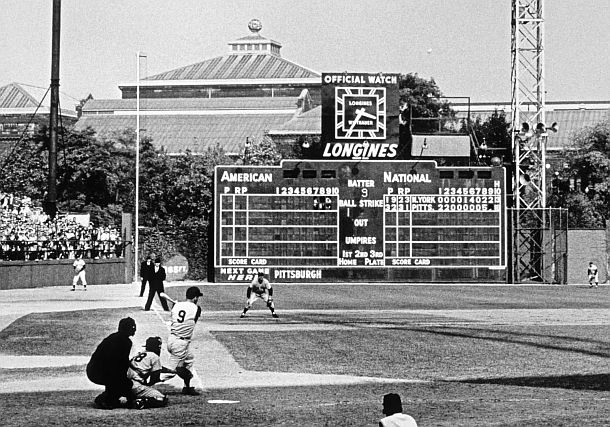
In case you're curious, the building behind the scoreboard
is the Carnegie Library of Pittsburgh.

October 13, 1960: Perhaps the greatest game in the history of baseball is played. But if you are among Yankee Fans age 70 and over, mention it at your peril.

The 1960 World Series may have been the wildest Fall Classic ever. The Pittsburgh Pirates, Champions of the National League for the 1st time in 33 years, faced the New York Yankees, the team they faced in their last appearance. Since that 1927 World Series, the Yankees had appeared in 19 of them, winning 16.

In Pittsburgh, the Pirates won Game 1, 6-4., but the Yankees won Game 2, 16-3. In New York, the Yankees won Game 3, 10-0, but the Pirates won Game 4, 3-2, and Game 5, 5-2. The Series went back to Pittsburgh, and the Yankees won Game 6, 12-0.

And so, on this Thursday afternoon, 36,683 people jammed themselves into Forbes Field for Game 7. Millions more listened to Pirates announcer Bob Prince and Yankees announcer Mel Allen call the game for television on NBC. Still more millions listened to NBC radio, with Baltimore Orioles announcer Chuck Thompson and Chicago Cubs announcer Jack Quinlan.

The game began at Forbes Field, precisely at 1:00 PM, Eastern Daylight Time, as home plate umpire Bill Jackowski said, "Play ball!" The other umpires: at 1st base, Nestor Chylak; and 2nd base, Dusty Boggess; at 3rd base, Johnny Stevens; in left field, Stan Landes; and in right field, Jim Honochick.
Forbes Field

The starting pitcher for the Pirates was Vernon Law, who would be named the winner of the Cy Young Award. Leading off for the Yankees was 2nd baseman Bobby Richardson, who lined out to short. Shortstop Tony Kubek popped up to 2nd. Right fielder Roger Maris closed the inning by popping up to 3rd.

The starting pitcher for the Yankees was Bob Turley, who had won the Cy Young and the World Series Most Valuable Player awards in 1958. He got center fielder Bill Virdon to fly to left, and shortstop Dick Groat, who would be named NL MVP that season, to pop up to his opposite number, Kubek.

Cliché Alert: Walks can kill you. Turley walked left fielder Bob Skinner. Then 1st baseman Rocky Nelson hit a home run to right field. Turley got right fielder Roberto Clemente -- eventually to become the most famous Pirate player who ever lived -- to pop up to 2nd, but after 1 inning, it was Pirates 2, Yankees 0.
Roberto Clemente

Things would get worse for the Yankees in the 2nd inning. Center fielder Mickey Mantle flew to center. Yogi Berra, now playing left field after switching positions with Elston Howard, now the catcher, grounded to 3rd. And 1st baseman Bill "Moose" Skorwon grounded to short.

Pirate catcher Smoky Burgess led off the bottom of the 2nd with a single to right. Perhaps overreacting to a bad 1st inning by Turley, Yankee manager Casey Stengel replaced him with Bill Stafford. This didn't work: Stafford walked 3rd baseman Don Hoak, and 2nd baseman Bill Mazeroski beat out a bunt.

Law grounded back to Stafford, who started a double play, eliminating Burgess at the plate and Law at 1st. But Hoak advanced to 3rd, Mazeroski to 2nd. Virdon singled to right, scoring Hoak. Maris mishandled the ball, allowing Mazeroski to score and Virdon to reach 2nd. Stafford got Groat to ground to 3rd, but after 2, it's Pirates 4, Yankees 0.

It got no better for the Yankees. In the top of the 3rd, Johnny Blanchard, catching in place of the injured Howard, grounded back to Law. The 3rd baseman, Clete Boyer, popped up to 2nd. Stengel sent Hector Lopez up to pinch-hit for Stafford, and he singled to left, but Richardson flied to left.

The new Yankee pitcher was Bobby Shantz, the 1952 AL MVP with the Philadelphia Athletics, whom Stengel put in the bullpen, and was rewarded by Shantz helping to win the 1958 World Series. He got Skinner to ground to 1st, walked Nelson, and got Clemente to ground into a 4-6-3 double play. End of 3, Pirates 4, Yankees 0.

Kubek popped to short. Maris hit a sinking liner to right that Clemente caught. Mantle singled to right, but Berra flew out in that direction. Shantz got Burgess and Hoak to both ground to 2nd, and Mazeroski to pop to short. Maybe Stengel should have started Shantz. After 4, Pirates 4, Yankees 0.

Skowron led off the 5th with a home run, but that's all the Yankees got. Blanchard flied to center, Boyer lined to 2nd, and, allowed to bat for himself, Shantz popped up to 1st. Shantz then got Law to ground to 3rd, Virdon to ground to 2nd, and Groat to hit a line shot right back at him, which he caught. End of 5, Pirates 4, Yankees 1.

Finally, in the top of the 6th, the Yankees woke up. Richardson singled to center. Kubek worked Law for a walk. Pirate manager Danny Murtaugh had seen enough, and replaced Law, bringing his closer, Roy Face, into the game in the 6th inning. Big risk, and it didn't work: He got Maris to pop up to 3rd, but Mantle singled up the middle to score Richardson, and Berra hit one down the right field line, for a 3-run homer, giving the Yankees the lead. Face got Skowron to pop to 3rd and Blanchard to ground to 1st, but the damage was done.

Shantz breezed through the Pirates in the bottom of the 6th, getting Skinner to line to right, Nelson to ground to 1st, and Clemente to ground back to him. Yankees 5, Pirates 4. Now, we had a game worth of Game 7 of the World Series.

The 7th inning was comparatively uneventful. Boyer flied to center. Shantz was again allowed to bat for himself, and rewarded Stengel's confidence by singling to left. Richardson grounded to 3rd, resulting in a force play that eliminated Shantz at 2nd. Kubek lined to right, and the 7th Inning Stretch was on.

Shantz allowed Burgess to single to center. Murtaugh sent Joe Christopher in to run for him. Hoak lined to left, and the fine-fielding Mazeroski got a taste of his own medicine, as he grounded to short, resulting in a Kubek-to-Richardson-to-Skowron double play. End of 7, Yankees 5, Pirates 4.

The 8th inning moved this game from merely interesting to classic. Hal Smith took Burgess' place behind the plate for Pittsburgh, and this would prove crucial. Maris grounded back to Face. Mantle lined to short. But, again, comes the cliche about the danger of walks: Berra drew one, and this was followed by a single by Skowron, and RBI single by Blanchard, and an RBI double by Boyer. Stengel again allowed Shantz to bat for himself, but he lined out to right. However, it was now 7-4 Yankees.

But the Pirates were far from done. Murtaugh sent Gino Cimoli up to bat for Face, and he singled to right. And then came a play that changed baseball history. Forbes Field was known for having the worst infield in the major leagues. And Virdon hit a grounder to short. It should have been an easy play for Kubek, and the start of a double play. But the ball hit a pebble, and jumped up and struck Kubek in the throat. He went down like a ton of bricks.

He had to leave the game. Stengel put Joe DeMaestri in to play short, and got Jim Coates up in the bullpen. The delay in getting Kubek off the field gave Coates time to get ready -- perhaps, a little too much time. Groat singled Cimoli home, to make it 7-5 Yankees. Stengel finally removed the heroic Shantz, and brought in Coates. Skinner bunted the runners over. Nelson flied out to right. But Clemente singled home Virdon, and Smith, batting for the 1st time in the game, hit a home run to left. The Pirates had the lead again.

Stengel brought Ralph Terry in to pitch. He got Hoak to fly to left. But after 8 innings, it was Pirates 9, Yankees 7. The Buccos were just 3 outs away from their 1st World Championship in 35 years.

But the Bronx Bombers refused to go down quietly. Bob Friend, who had been the Pirates ace before Law came into his own that year, was brought in to close it out. But Richardson dunked a single into short left-center. Dale Long, himself a former Pirate, who hit home runs in a record 8 straight games for them in 1956, was sent up to pinch-hit for DeMaestri. Now, Stengel would need his 3rd shortstop of the game. He singled to right, and, just like that, the tying runs were on with nobody out.

Murtaugh brought in Harvey Haddix. The previous year, Haddix had pitched a perfect game against the Milwaukee Braves for 12 innings. But because Lew Burdette, hero of the Milwaukee Braves' 1957 World Series triumph over the Yankees, was also pitching a shutout, the game kept going, and the Braves not only broke up the perfect game, the no-hitter and the shutout in the 13th inning, but won the game. Now, Haddix was being asked to save Game 7 of the World Series.

He got Maris to pop up to Smith. But Mantle, the Yankee superstar of the era, singled to right, scoring Richardson. Gil McDougald, who had announced his retirement and, win or lose, was playing in his last game, pinch-ran for Long. He would go in to play 3rd base, and Boyer would move to short -- if the Yankees could get that 9th run (or more) and send the game to a bottom of the 9th.

Yogi Berra was the batter. He hit a sharp grounder to 1st. Had the Pirates' other 1st baseman been in place, Dick Stuart, this could have been a disaster: Although he hit the ball nearly as far as Mantle, he was an atrocious fielder, eventually earning the nicknames "Stonefingers" and "Dr. Strangeglove." But Nelson grabbed the ball, and ran to 1st for the 2nd out. He should have tagged Mantle for the out that won the World Series.

But Mickey, not the brightest of men off the field, was a genius on it. He executes a head-fake, and makes Nelson think he's going to break for 2nd. That makes Nelson look toward Mazeroski at 2nd, and allows Mantle to get back to 1st base safely, and allows McDougald to score. Tie ballgame. Haddix got Skowron to ground to short for a force play, but the inning ended with the score tied 9-9.

On NBC radio, Thompson said, "Well, a little while ago, when we said this one was going right down to the wire, little did we know." He also mentioned that Art Ditmar was throwing -- but did not specify, "in the Yankee bullpen." That led a lot of Yankee Fans to incorrectly hold Ditmar responsible for what happened next, and he got a lot of nasty mail about it, and he got very bitter about it.

The leadoff batter in the bottom of the 9th was Mazeroski, 24 years old, born in Wheeling, West Virginia, and grown up on the other side of the Ohio River, 14 miles to the north, in Rush Run, Ohio. He grew up as a fan of his home State's Cleveland Indians, but Rush Run is considerably closer to the site of Forbes Field, 53 miles, than it is to that of Cleveland Municipal Stadium, 141 miles.

He had debuted with the Pirates in 1956, and had already become regarded as the best-fielding 2nd baseman in the major leagues. But he wasn't really known as a hitter: He had batted .273 that season, with 11 home runs and 64 RBIs. Those were decent numbers, especially for a righthanded hitter in that ballpark: Similar to Yankee Stadium at the time, Forbes had a 300-foot right field pole, but a 457-foot center field fence and was 360 feet to left. So, Maz was a good hitter, but not the player who would be expected to be the big hitting hero.

Terry's 1st pitch to Mazeroski was high, ball 1. Blanchard didn't like that, and went out to talk to Terry for a moment. Terry threw a 2nd pitch. The time was 3:36 PM. Chuck Thompson's call on radio:

Here's a swing, and a high fly ball, going deep to left, this may do it! Back to the wall goes Berra, it is over the fence, home run, the Pirates win!
Yogi played in 75 World Series games, more than anyone.
This is one he probably wanted back.

After pausing to let the cheering be heard, Thompson started again, and was so excited, he got the score wrong at first:

Ladies and gentlemen, Mazeroski has hit a one-nothing pitch over the left field fence at Forbes Field to win the 1960 World Series for the Pittsburgh Pirates by a score of ten to nothing! Once again, that final score, the Pittsburgh Pirates, the 1960 World Champions, defeat the New York Yankees. The Pirates ten, and the Yankees nine! And Forbes Field is an insane asylum!

Mel Allen, so often accused of being a "homer" for the Yankees, called it this way on TV:

There's a drive into deep left field, look out now! That ball is going, going, gone! And the World Series is over! Mazeroski hits it over the left field fence, and the Pirates win it 10–9, and win the World Series!

The ball went over Berra's head, at around the 406-foot mark in left field, and landed among the cherry trees in Schenley Park. Mazeroski took off his batting helmet and swung it around as he circled the bases. 
The ball was found by Andy Jerpe, 14 years old. Mazeroski would sign the ball for him, but he foolishly used the ball in a neighborhood game, and it was lost. No one knows where it is now. The Pirates don't have it. Neither does the Baseball Hall of Fame.

The Yankees outscored the Pirates 55-27 during the Series, but the Pirates won it, 4 games to 3. Richardson had a Series record 12 RBIs, and remains the only player from a losing side to be named the MVP of a World Series. Mazeroski? He batted .320 in that Series, and that was his 2nd homer in it, for his 5th RBI in it, and he played his usual good games in the field. He got robbed. But I'm sure he'd rather have the title.

After the game, Berra issued one of his "Yogi-isms," saying, "We made too many wrong mistakes." Mantle would later say that, of the 12 World Series he played in, this was the only time he believed that the better team lost. He also said he cried on the entire flight home, and this was confirmed by multiple teammates.

*

Was Yogi right? Did the Yankees make too many mistakes, "wrong" or "otherwise"? Pirate outfielder Gino Cimoli told Bob Prince, the Pirates' Hall of Fame broadcaster, in the locker room afterward, "They broke all the records, and we won the game! How 'bout that!" (So he closed by invoking the catchphrase of Allen, the Yankees' Hall of Fame broadcaster)

So why did the Yankees lose? How did the Pirates win?

The Yankees were in the process of making changes, including the manager: Team owners Del Webb and Dan Topping had decided that the 70-year-old Stengel, who missed several games that year due to an illness, would be fired even if the Yankees won the World Series.

They made Casey read a statement in which he said he is resigning. When Casey finished reading the statement, he put the paper down, and told the press, "I guess this means they fired me." He later said that they forced him out due to his age: "I'll never make the mistake of being 70 again."

Competitively, firing Casey may have been the right decision: Ralph Houk managed the Yankees to the next 3 American League Pennants, and the next 2 World Championships. Given that 4 new teams were being expanded into existence, and managerial changes are common, the Yankees would have lost Houk if they hadn't made him manager.

Still, Casey was treated shabbily. Topping and Webb could have done something. Casey was rich, having made savvy investments when he was younger, and owning a bank in the Los Angeles suburb of Glendale, California, where he lived in the off-season. They could have sold him a piece of the ownership. They could have made him a well-paid special consultant. They could have let him stay, or walk away, with dignity.

Instead, they canned him. It would be 10 more years, after they sold the team, before new Yankee president Mike Burke invited Casey back, to make peace and to retire his Number 37.

The Bill Mazeroski Game was also the last game as Yankee general manager for George Weiss. For all his cheapness and bigotry, Weiss was an organizational genius. First as farm system director from 1932 to 1947, and then as GM, he helped to build 23 Pennants (counting the 4 won in the 4 years after he left), and 17 World Series.

But he saw the writing on the wall. He knew that the system he used, of trading multiple players, usually a mix of over-the-hill veterans and prospects, for 1 of 2 players who could help the Yankees win the Pennant that year, couldn't work much longer, as the farm system was drying up.

He also knew that Topping and Webb didn't care, as they were planning to sell. At his resignation, Weiss told the press, "I give it 5 years." He was right: 1961, they won the Pennant and the World Series; 1962, they won the Pennant and the World Series; 1963, they won the Pennant but lost the World Series; 1964, they won the Pennant but lost the World Series; 1965, they finished in 6th place, the 1st of 7 straight seasons without even coming close to contending.

The Yankee stars of the 1950s, including the ones that had won 4 straight American League Pennants from 1955 to 1958, were on their way out. As a result, a lot of players -- 1960 AL Most Valuable Player Roger Maris, for one -- may have been good enough to be Yankees, but hadn't yet won the big one as Yankees.

The Yankees had last won the World Series in 1958, and would next win it in 1961, the year after the Mazeroski Game. How many players were on the World Series roster on both sides of this 3-year gap? Only 7: Mickey Mantle, Yogi Berra, Whitey Ford, Bill "Moose" Skowron, Elston Howard, Bobby Richardson and Tony Kubek. Bob Turley could have made it 8, but he was injured, and didn't play in the '61 Series.

The 1960 season was also the 1st in which catcher Yogi Berra and left fielder Elston Howard, whose natural position was catcher, had been switched, which is why Yogi was the left fielder tracking Mazeroski's homer, and it's his head, along with the outfield wall, that it went over.

The Pirates also had a distinct home-field advantage. Although Forbes Field had dimensions very similar to the pre-renovation Yankee Stadium, including a right-field pole 300 feet from home plate and a center field 457 feet away, it had only 35,000 seats, making it about half the size. As a result, while the noise at Yankee Stadium could be overwhelming, the fans were much closer to the field in Pittsburgh. Hence, Thompson's declaration that it was "an insane asylum."

Forbes Field was also known for having the worst infield in the National League. Even by the standards of ballparks that went up before World War II (and there were still 13 of the 16 teams, including the Yankees, playing in such ballparks in 1960), it was known to be bad. Since the Pirates, unlike any other team, played there regularly, they knew how to handle the comparatively high grass, the hard dirt, and the pebbles that were all over the place in said dirt.

Which leads us to the play that knocked Kubek out of the game. If that had happened to any of the the game's legendary losers, -- such as the Boston Red Sox, the Chicago Cubs, the Philadelphia Phillies, the Cleveland Indians, or, even though they didn't exist yet, the Mets -- it would be forever known as The Pebble, Capital T, Capital P, and we would never stop talking about it. 

But it happened to the Yankees, so hardly anybody makes a big deal out of it. And, of those who do, most think the Yankees had it coming.

And, of course, we must give due credit to the other team: The Pirates were not a better team than the Yankees, but they were worthy champions. They led the NL in batting average, on-base percentage, OPS, runs, hits and doubles; and were 2nd in slugging percentage and triples. Groat batted .325 in a season that got him named NL MVP. Clemente batted .314. Of their usual 8 starters, 6 had an OPS+ of 109 or higher: Clemente 121, Hoak 120, Dick Stuart 114, Groat 110, Smoky Burgess 110 and Skinner 109.

Only Stuart (23) had more than 16 home runs, a by-product of Forbes Field being a terrible park for righthanded hitters, and the team was 6th in the NL in homers. And none had at least 100 RBIs. But Clemente had 94, Skinner 86, Stuart 83, Hoak 79, and Mazeroski 64. Groat only had 50, a very low total for an MVP. Smith had only half as many plate appearances as you would get in a full season, and still had 45 RBIs.

In spite of Stuart, a born DH if ever there was one, and the bad infield, the Pirates were otherwise good defensively. Mazeroski's defensive prowess was already unquestioned: He did for 2nd base what Brooks Robinson later did for 3rd base. Despite the bad infield, Hoak only made 25 errors, and that was the most on the team. Groat, at shortstop, the most error-prone position, made 24. Stuart made 14 (a bad number for a 1st baseman, especially playing only 108 games, as Nelson was a frequent sub), Mazeroski only 10 in 151 games (an astoundingly low figure for a 2nd baseman).

The Pirates' .979 fielding percentage led the NL, and their 128 errors for their entire team were 3rd in the NL. In other words, this was a team that did not beat themselves.

Then there was the pitching. Between them, Law, Friend, Wilmer "Vinegar Bend" Mizell (later a Congressman from Mississippi) and Harvey Haddix (he of the 1959 game where he pitched 12 perfect innings but lost in the 13th, but was the winning pitcher in 1960 World Series Game 7) made 123 of the Pirates' 155 starts (the standard for the time, 154, plus a rainout makeup). Law went 20-9, Friend 18-12, Mizell 13-5 and Haddix 11-10. ERAs: Friend 3.00, Law 3.08, Mizell 3.12, Haddix 3.97. ERA+: Friend 125, Law 122, Mizell 121, Haddix 95. WHIP: Law 1.126, Friend 1.128, Mizell 1.201, Haddix 1.317.

The Pirates didn't really need a bullpen: Friend completed 37 of his 38 starts, Law all 35 of his, Haddix 28 of his 29, and Mizell all 23 of his. That's 121 complete games out of 123 starts, or 98.4 percent. (Don't show this stat to Brian Cashman.) It was when a 5th starter was needed that relief ace Face was needed, appearing 68 times, all in relief, a record at the time.

Face was the apparent inventor of the forkball, the pitch that was the "father" of the split-fingered fastball, and he used it to set a record for highest winning percentage in a season with at least 13 decisions: .947, 18-1, in 1959. A year later, he helped the Pirates win the World Series with a record of 10-8, 24 saves, and a glittering WHIP of 1.064.

Think about this: Baseball-Reference.com, a website which is your friend, whether you know it or not, lists photos of each team, each year, with its Top 12 Players according to WAR. And Clemente, a Hall-of-Famer, one of the Top 25 players of all time, is only 5th in WAR among '60 Bucs, behind Groat, Hoak, Friend and Law.

The Yankees weren't cheated, and they didn't give the Series away. They were simply defeated by a good team.

The Baseball Gods were cruel to Ralph Terry that day in Pittsburgh, but they would be kind to him for the next 2 years, allowing him to win 39 regular-season games for back-to-back Yankee World Championship teams, to add the 1962 Cy Young Award to his honors, and to add his own shutout in Game 7 of the 1962 World Series. So, as bad as certain moments of Yankee history, such as the Bill Mazeroski Game, have been, there's usually a sequel that sets it all right, and goats become heroes.
Ralph Terry

Still, this game stands out in the minds of Yankee Fans old enough to remember it. Don't ever ask actor-comedian Billy Crystal, who was 12 years old at the time, about it. You certainly can't ask paleontologist Stephen Jay Gould, then 19 and attending Antioch College in western Ohio, about it, since he died in 2002. But, when interviewed on the subject by Ken Burns for his 1994 miniseries Baseball, Gould said, "The one thing that must never be mentioned in my presence is Game 7 of the 1960 World Series."

In 1993, Joe Carter hit what we would now call a "walkoff home run" to win the World Series for the Toronto Blue Jays over the Philadelphia Phillies. His home run actually took the Jays from behind, 6-5, to win, 8-6. Mazeroski's team was tied when he came to the plate. But the Jays were already up 3 games to 2, and it was Game 6. Mazeroski remains the only player ever to win Game 7 of a World Series with a walkoff home run.

The image of Mazeroski swinging his helmet around in his right hand would later serve as the model for a statue of him that now stands outside the Pirates' current home, PNC Park. After the Pirates moved to Three Rivers Stadium in 1970, playing there until 2000, Forbes Field was demolished, and the University of Pittsburgh built classrooms on the site. The (approximate) location of Forbes Field is preserved under lucite, and it is the same plate (it wasn't moved to Three Rivers, although that stadium's plate was moved to PNC Park), so you can "touch" the plate that Mazeroski touched.

Part of the outfield wall was left standing. A line of bricks marks where the rest of the wall was, and a plaque marks the spot there the ball went over it.
The Pirates would also retire Mazeroski's Number 9, following a career that included 10 All-Star Games and 8 Gold Gloves, and ended in 1972. He and Clemente would be the only 2 players on this 1960 World Series-winning team still with the Pirates when they won their next World Series in 1971.

But it took until 2001 for him to be elected to the Baseball Hall of Fame. Why? Some people think he doesn't deserve it at all, because he doesn't have the hitting stats, and that he's only in because of the home run.

I think it's the exact opposite: I think the home run changed people's perception of him. Think about it: The 1st thing that comes to mind when you hear his name is, "He hit the home run that won the 1960 World Series."

Now, imagine that the Series had ended any other way, even one favorable to the Pirates. Suppose Mazeroski had led the inning off with a single, and scored the title-winning run on somebody else's hit. Then, the 1st thing that would come to mind when you hear his name is, "He's the greatest-fielding 2nd baseman who ever lived." He probably would have gotten in much sooner.

Today, William Stanley Mazeroski is 86 years old, retired and living in Panama City, Florida, and is a spring-training fielding instructor for the Pirates. 
At a still-standing, ivy-covered piece of the
Forbes Field outfield wall, October 13, 2010,
the 50th Anniversary of the home run.

One more note: Game 7, for all of its scoring, pitching changes, and other stops in the action, lasted 2 hours and 36 minutes, from first pitch to Mazeroski touching the plate. In fact, except for Game 2 going 3:14, none of these games went longer than 2:41.

In 1981, baseball historian John Thorn published Baseball's 10 Greatest Games. He included this game as one of them. (He also included Haddix' near-perfecto.) For 2 hours and 36 minutes, the New York Yankees and the Pittsburgh Pirates may have provided the greatest game in the history of baseball. And it definitely had the greatest ending in the history of baseball. Even if the team I would one day go on to root for lost it.

UPDATE: The Pirates have a team Hall of Fame. From their 1960 World Champions, they have inducted manager Danny Murtaugh; right fielder Roberto Clemente, 2nd baseman Bill Mazeroski, shortstop Dick Groat; and pitchers Vern Law, Bob Friend and Roy Face.

*

October 13, 1960 was a Thursday during football season, so no NFL or AFL games were played. And the NBA season hadn't started yet. There was one NHL game that day: The Montreal Canadiens beat the Detroit Red Wings, 4-3 at the Montreal Forum.

December 31, 1999 & January 1, 2000: The Millennium

December 31, 1999:  The Millennium arrives. The people of planet Earth survived. At a terrible cost. But we hadn't destroyed ourselves. ...