Showing posts with label indianapolis hoosiers. Show all posts

Friday, October 7, 2022

October 7, 1914: A Pennant For Indianapolis

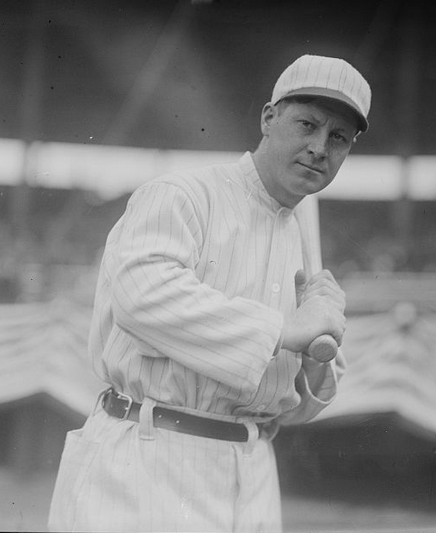
Benny Kauff

October 7, 1914: The Indianapolis Hoosiers defeat the St. Louis Terriers, 4-0 at Federal League Park in Indianapolis, and win the 1st Federal League Pennant. They finish a game and a half ahead of the Chicago Whales, and 4 1/2 ahead of the Baltimore Terrapins.

The Hoosiers, managed by Bill Phillips, had a future Hall-of-Famer, Indiana native Edd Roush, but he was still a rookie, and was not yet a starting player, let alone the great center fielder he would become. The outfielders they did have all batted at least .300: Al Scheer, Vin Campbell and Benny Kauff. 2nd baseman Frank LaPorte also did, and led the team with 107 RBIs. Kauff batted .370, with 95 RBIs. And Bill McKechnie, later to be a Pennant-winning manager, played 3rd base and batted .304. Cy Falkenberg was their ace, going 25-16 with a 2.22 ERA, and pitched a 3-hit shutout in the Pennant clincher.

However, their 4-2 win over the Terriers the next day will turn out to be the last Major League Baseball game ever played in the State of Indiana to this day -- if, that is, you consider the FL to have been a "major league." (MLB did not then, but it does now.) Financial losses lead them to be moved to Harrison, New Jersey, where they will become the Newark Peppers.

An Indiana-based team, the Fort Wayne Kekiongas, was a member of the 1st professional baseball league, the National Association, but only in its 1st season, 1871. Teams named the Indianapolis Hoosiers played in the American Association in 1884, and in the National League from 1887 to 1889.

But, despite Indianapolis being one of the 3 largest cities in the Midwest -- and, eventually, surpassing Detroit to become the 2nd-largest behind Chicago -- it's never had a major league team again after 1914. The Indianapolis Indians of the Class AAA version of the American Association won Pennants in 1920, 1908, 1917, 1928, 1949, 1956, 1963, 1982, 1986, 1987, 1988, 1989 and 1994. They moved to the International League, and won the Pennant in 2000, giving them 14 Pennants.

*

October 7, 1914 was a Wednesday. Elsewhere in the Federal League, the Baltimore Terrapins swept the Pittsburgh Rebels, 5-3 and 4-3 at Terrapin Park in Baltimore (later renamed Oriole Park); and the Brooklyn Tip-Tops beat the Buffalo Blues at Federal League Park in Buffalo.

No games were played in the National League. In the American League, at Fenway Park, the Washington Senators and the Boston Red Sox wound up the season in a meaningless game. Washington manager Clark Griffith, age 45, made his final mound appearance‚ while Boston's star center fielder Tris Speaker does the only pitching of his career‚ giving up a run in an inning. Babe Ruth‚ in relief of starter Hugh Bedient‚ pitches 3 innings for Boston. The Senators win, 11-4.

And the Philadelphia Athletics beat the New York Yankees, 10-0 at Shibe Park in Philadelphia. The A's had won their 4th Pennant in the last 5 years, while the Yankees were 30 games behind them. Oddly, Connie Mack used 4 pitchers to complete a 4-hit shutout: Rube Bressler for 3 innings; and, for 2 each, Bullet Joe Bush, Bob Shawkey and Herb Pennock. Those last 3 would all eventually pitch for the Yankees, and help them win Pennants.

Sunday, September 4, 2022

September 4, 1888: Pud Galvin Starts the 300 Win Club

September 4, 1888: The Pittsburgh Alleghenys beat the Indianapolis Hoosiers, 5-4 at Athletic Park (later renamed Tinker Park) in Indianapolis. For Alleghenys pitcher Pud Galvin, it is the 300th win of his career. He is the 1st pitcher to win that many.

James Francis Galvin is born on a Christmas Day, December 25, 1856, in St. Louis. The Hall of Fame pitcher was nicknamed "Pud" because he was said to have "reduced hitters to pudding." No word on whether it was figgy pudding. He was also known as "Gentle Jeems" -- it's been a long time since men named James were nicknamed "Jem" or "Jeems" -- and "the Little Steam Engine," as he was 5-foot-8, and 190 pounds.

He won 365 games -- a total topped by only 4 pitchers ever -- for the Buffalo Bisons (who went out of business in 1885) and the Pittsburgh team that would be renamed the Pirates before he retired, plus 12 games at the end with the team now known as the St. Louis Cardinals, in a career that lasted from 1875 to 1892. In 1883, and again in 1884, both with Buffalo, he won 46 games.

That career curiously stopped at age 36 -- aging, but hardly old, for a pitcher, even then -- right before the distance from home plate to the pitcher's mound was extended from 50 feet to the now-traditional 60 feet, 6 inches, thus making it harder on pitchers.

He was also widely regarded as the best-fielding pitcher of his generation, and his pickoff move was the stuff of legend. on September 23, 1886, against the Brooklyn team that would become the Dodgers, he got out of a bases-loaded jam by picking off the runner at first base, then the runner at third, followed by the runner at second. The Alleghenys won, 8-2.

2006 National Public Radio article refers to Galvin as "the first baseball player to be widely known for using a performance enhancer." The Washington Post reported that Galvin used the Brown-
Séquard elixir, which contained monkey testosterone, before a game in 1889. However, no one then seemed bothered by his use of the elixir, and the Post practically endorsed it after the game, saying that Galvin's performance was "the best proof yet furnished of the value of the discovery."

He was poor, and couldn't afford to take care of himself, and died on March 7, 1902, of a stomach disorder. He was only 45 years old.

Through the 2022 season, 24 pitchers have reached 300 wins. Galvin was followed by both Tim Keefe and Mickey Welch in 1890, Charles "Old Hoss" Radbourn in 1891, John Clarkson in 1892, Charles "Kid" Nichols in 1900, Cy Young in 1901, Christy Mathewson in 1912, Eddie Plank in 1915, Walter Johnson in 1920, Grover Cleveland Alexander in 1924, Lefty Grove in 1941, Warren Spahn in 1961, Early Wynn in 1963, Gaylord Perry in 1982, Steve Carlton in 1983, Tom Seaver and Phil Niekro in 1985, Don Sutton in 1986, Nolan Ryan in 1990, Roger Clemens in 2003, Greg Maddux in 2004, Tom Glavine in 2007, and Randy Johnson (no relation to Walter) in 2009.

Only Clemens, Maddux, Glavine and Randy Johnson have done it while pitching all or most of their careers in the Post-1990 Five-Man Rotation Era. Only they, Grove, Spahn, Wynn, Perry Carlton, Seaver, Niekro, Sutton and Ryan have done so in the Post-1920 Lively Ball Era. As of September 4, 2022, the active leader in wins is Justin Verlander, with 244. It might be a long time, and with a significant change in how pitchers are used, before we ever see another 300-game winner. Even 250-game winners might become rare.

*

September 4, 1888 was a Tuesday. In addition to Pittsburgh vs. Indianapolis, these games were played in the National League:

* The New York Giants beat the Philadelphia Phillies, 2-1 at the original Polo Grounds.

* The Boston Beaneaters beat the Washington Nationals, 9-4 at the South End Grounds in Boston.

* And the Detroit Wolverines beat the Chicago White Stockings, 5-2 at West Side Park in Chicago.

And these games were played in the American Association:

* The Brooklyn Bridegrooms, so named because several of their players got married the previous off-season, beat the St. Louis Browns, 3-1 at the original Washington Park in Brooklyn.

* The Philadelphia Athletics beat the Cincinnati Reds, 3-2 at the Jefferson Street Grounds in Philadelphia.

* The Baltimore Orioles beat the Kansas City Cowboys, 9-2 at the original Oriole Park in Baltimore.

* And the Cleveland Blues beat the Louisville Colonels, 12-3 at National League Park in Cleveland. Yes, that was the ballpark's name, even though the Blues were in the AA. Both teams did enter the NL later, but were contracted out of existence after the 1899 season.

Monday, May 30, 2022

May 31, 1889: The Johnstown Flood

May 31, 1889: The Johnstown Flood kills 2,208 people, one of the worst man-made disasters in history.

Johnstown, Pennsylvania is 67 miles east of Pittsburgh. It sits at the confluence of the Little Conemaugh River and the Stonycreek River, as they form the Conemaugh River. That river eventually flows into the Kiskiminetas River, which flows into the Allegheny River, which combines with the Monongahela River at Pittsburgh to form the Ohio River.

Like so many other Pennsylvania towns in the 19th Century, Johnstown became a producer of iron, coal and steel. But it flooded pretty much every year. On May 30, 1889, they had a Memorial Day parade, and got it done before the rain came. But the rain kept coming, and coming.

The next day, at 2:55 PM, the South Fork Dam, which had formed Lake Conemaugh, burst. The City of Johnstown, 14 miles downriver, never had a chance: It was hit with over 14 million cubic meters of water, about the average annual flow of the Mississippi River, coming at 40 miles per hour. It hit at 3:52, and in 10 minutes, Johnstown was ruined.

There were 1,600 homes destroyed. The 2,208 deaths included 396 children. Bodies of Johnstown residents were carried westward, past Pittsburgh. One was found as far down the Ohio River as Cincinnati. One person listed as missing wasn't found until 1911.

Frank Shomo, the last known person to have been living in Johnstown in 1889, lived until March 20, 1997, age 108.

Remarkably, the Pennsylvania Railroad was able to restore service in only 3 days. On June 5, Clara Barton, founder and President of the American Red Cross, arrived to lead their 1st major disaster relief effort. She stayed for 5 months, and it made the Red Cross the country's defining relief organization. Donations for relief amounted to over $3.7 million -- about $113 million in 2022 money.

Within a month, the mills were operating again. The city grew. By the turn of the 20th Century, Johnstown was home to 67,000 people. But on March 17, 1936, the city was stricken again, with the St. Patrick's Day Flood. This time, they were comparatively lucky, with just 25 deaths.

From 1938 to 1943, the U.S. Army Corps of Engineers altered the river channels, with the idea of making the city "flood-free." When Hurricane Agnes hit the Northeast in 1972, Johnstown was pretty much the only riverside town in Pennsylvania that didn't get flooded.

In 1926, Point Stadium opened, as a minor-league ballpark, right where the two rivers come together to form one. The Johnstown Johnnies had won the Middle Atlantic League Pennant the year before, and got a new ballpark as a reward. They won the Pennant again that 1st season, and won it again in 1930. But the team played until 1961, and never won another.

The ballpark was torn down and replaced in 2005, and they have since had teams in "independent" leagues. A a renovated 7,500-seat Sargent's Stadium at The Point became home Johnstown Mill Rats of the Prospect League in 2021.

The city became the home of a minor-league hockey team, the Johnstown Jets, starting in 1950. The 4,000-seat Cambria County War Memorial Arena opened that year. In 1976, the hockey movie Slap Shot was filmed in the city, including inside the Arena and outside the steel mills, even though it was said to be taking place in the Charlestown section of Boston.

Life imitated art: Like the movie's Charlestown Chiefs, the Johnstown Jets were moved after the 1976-77 season. But new teams have come and gone, including the Johnstown Chiefs, in honor of the movie, from 1988 to 2010. Since 2012, the Arena has been home to the Johnstown Tomahawks of the North American Hockey League.

But like Pennsylvania as a whole, the decline of industry in the 1970s clobbered Johnstown. And then, on July 19, 1977, they found out they weren't flood-proof. The Laurel Run Dam failed, and 84 people were killed. By the recession of the early 1990s, steel was out of Johnstown. In 2003, a survey rated Johnstown the least likely city in American to attract newcomers.

Today, Johnstown is a small city of about 19,000 people. The University of Pittsburgh opened a campus there, and that helped. Some of the abandoned mills have been turned into low-income housing, and studios for artists and dancers. But the city will never be what it was between the floods of 1889 and 1977.

*

May 31, 1889 was a Friday. There were three games played in what would later be called Major League Baseball.

Two of them were a National League doubleheader, at the Philadelphia Base Ball Grounds. The Philadelphia Quakers swept the Indianapolis Hoosiers, winning the 1st game 11-8, and the 2nd game 11-4.

The Hoosiers folded at the end of the season. The Quakers would change their name to the Philadelphia Phillies the next season. The Base Ball Grounds would burn down in 1894, and be replaced on the same site the next season by the ballpark eventually known as Baker Bowl.

And in the American Association, the Columbus Solons beat the Louisville Colonels, 7-2 at Recreation Park in Columbus, Ohio. The Solons folded with the AA in 1891, while the Colonels joined the NL, only to fold after the 1899 season.

December 31, 1999 & January 1, 2000: The Millennium

December 31, 1999:  The Millennium arrives. The people of planet Earth survived. At a terrible cost. But we hadn't destroyed ourselves. ...