Showing posts with label 19th amendment. Show all posts

Wednesday, November 2, 2022

November 2, 1920: Warren G. Harding Is Elected President

November 2, 1920: KDKA begins broadcasting out of Pittsburgh, the 1st commercial radio station in America. The first broadcast is the results of the Presidential election. Senator Warren Harding becomes the only person elected President of the United States on his birthday, turning 55, and defeating Governor James M. Cox of Ohio in a landslide.

The Republican candidate wins 404 Electoral Votes to the the 127 won by his fellow Ohioan, Governor James M. Cox. Harding won 60 percent of the popular vote, to Cox's 34. Cox wins 11 States, all in the anti-Republican, anti-civil rights "Solid South": Virginia, Kentucky, North Carolina, South Carolina, Georgia, Florida, Alabama, Mississippi, Louisiana, Arkansas and Texas. But not every Southern State: Tennessee and Oklahoma are among the 37 States that Harding wins.

A year later, KDKA will become the 1st radio station to broadcast a baseball game, and the 1st to broadcast a football game. Eventually establishing itself at 1020 on the AM dial, it was long a Westinghouse Broadcasting station, but since 1996 has been part of CBS. It broadcast Pirates games from 1955 to 2006, including the 1960, '71 and '79 World Championships.

The Democrats had won the last 2 elections. How did Cox lose so badly?

Cox was the 1st divorced man to be a major-party nominee for President, and had also married another woman, but it wasn't considered an especially big issue. As with the next divorced man to be nominated, Adlai Stevenson in 1952 and 1956 (and he hadn't yet married someone else, and never would), it wouldn't have mattered if he had been happily married: He would have lost in a landslide anyway. In his case, for these reasons:

Demographics: The 2 largest ethnic groups in America were German and Irish. Both saw Britain as their enemy. And both saw the Democrats, led by incumbent President Woodrow Wilson, showing favoritism to Britain.

That hurt Cox in the Midwest, with its strong German concentration, but he probably would have lost it anyway. It was the Irish Catholics, either staying home or, for the 1st time, voting Republican that killed Cox in States like Ohio (home State of both candidates, and Cox got just 38 percent there), Maryland (42 percent), New Jersey (28), Massachusetts (28), Pennsylvania (27), New York (27) and Illinois (25).

The 19th Amendment: Ratified the preceding August 18, it gave women the right to vote (except in the 4 States that already recognized it), and this was the 1st election in which it had an effect. Harding was considered good-looking -- good-looking enough, apparently, to have at least 2 mistresses. Cox was not.
Harding and fellow early 1920s chick magnet Babe Ruth

The Postwar Depression: When the men who won World War I came home, their jobs had been filled. Unemployment rose sharply. Farmers, no longer needing to sell their crops to the U.S. Department of War (it was renamed the Department of Defense in 1947), saw their prices plummet. It might not have been a depression as long as the one that began 10 years later, but it was bad enough. As is so often the case, the economy was a huge factor in an election.

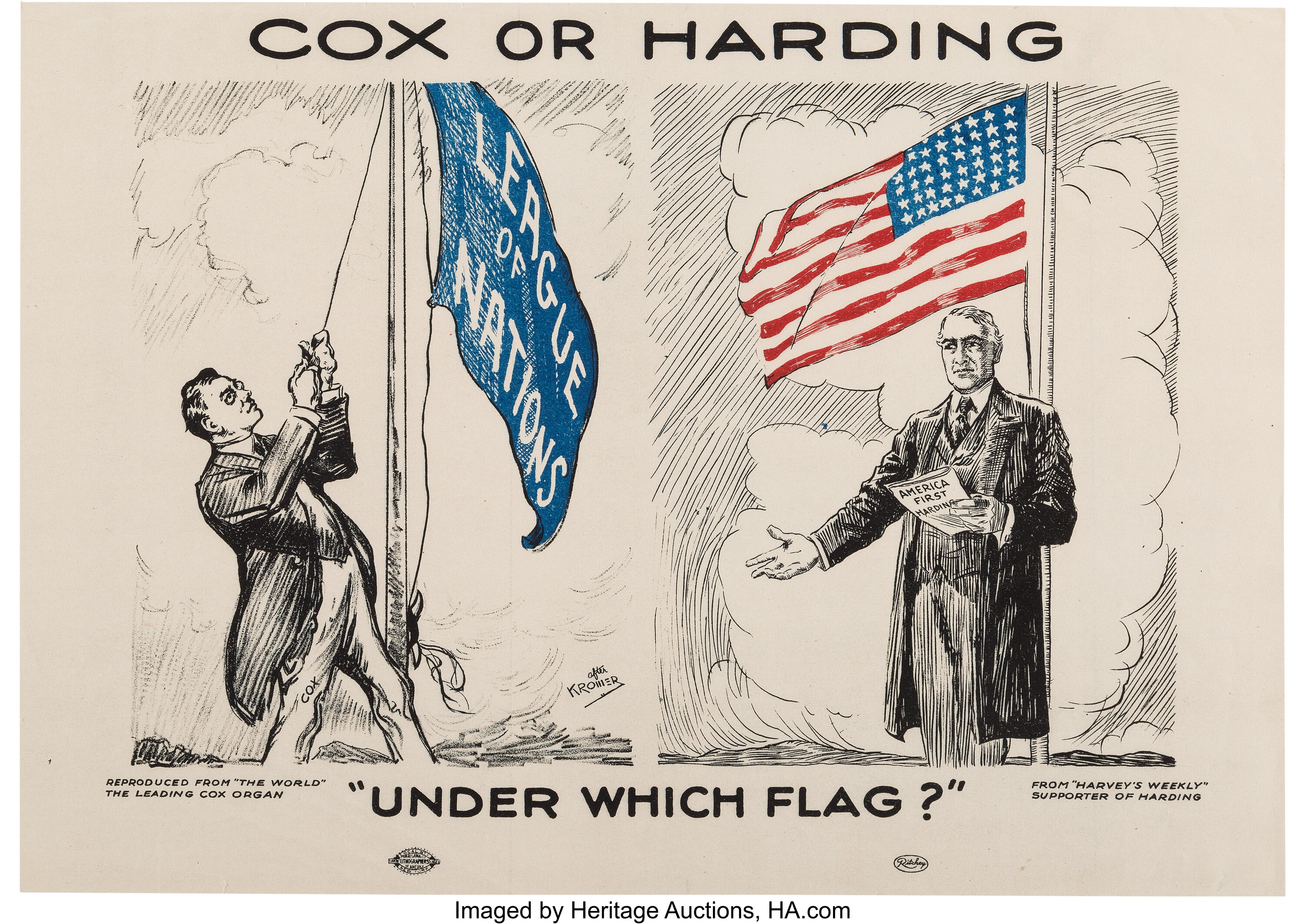
Wilson Fatigue: For the 1st 4 years of his Presidency, the Democratic incumbent, Woodrow Wilson, was rather popular. For the next 2 years, he was a beloved wartime leader. But his attempt to get America into the League of Nations scared people who didn't want America involved in another overseas war.
The stroke he suffered in 1919 made him look a bit
like Max Schreck, star of the 1922 vampire film Nosferatu.

No previous President had gone from enormously popular to enormously unpopular in just 1 year -- and only 2 have since: Herbert Hoover in 1930, and Richard Nixon in 1973. Voters took their frustrations out on the Democrats, including Cox, who, as a Governor, had absolutely nothing to do with the Wilson Administration.

It was unfair to Cox, but he stuck with Wilson's unpopular stances on things like the economy and getting America into the League of Nations. And he paid the price for it, every bit as much other Democratic candidates did that day: Already controlling both houses of Congress, the Republicans gained 63 seats in the House, and 10 seats in the Senate.
Most of all, after 2 years of America being in World War I, and 2 years of postwar disruption, Harding, to use a more recent expression, had his finger on the pulse of the nation. He wasn't particularly bright, but he knew what Americans wanted. With radio still in the process of being made public, no television, and no sound films, he made a phonograph record of his big speech, which was short on specifics, but had plenty of platitudes, and availed of alliteration:

America's present need is not heroics, but healing; not nostrums, but normalcy; not revolution, but restoration; not agitation, but adjustment; not surgery, but serenity; not the dramatic, but the dispassionate; not experiment, but equipoise; not submergence in internationality, but sustainment in triumphant nationality.

And enough Americans agreed with him to give him an overwhelming victory. When he died in office on August 2, 1923, just as the Teapot Dome scandal was breaking, he was still very popular. And the Democratic Party was divided enough that, even with the scandal, a living Harding probably would have won in 1924, anyway.

Instead, Harding died, and his Vice President, Calvin Coolidge, became President, and rode the "Coolidge Prosperity," the fact that he wasn't involved in Teapot Dome in any way, and the Democrats' division to ride to a landslide victory.

By the end of the decade, with the full revelations of the scandal, and of his affairs, including an illegitimate daughter, his reputation was in tatters. He is still often considered one of the country's worst Presidents, along with predecessors like Franklin Pierce, James Buchanan and Andrew Johnson; and successors like Herbert Hoover, Richard Nixon, George W. Bush and Donald Trump.

Regardless of who the Democrats ran in 1920, they would have lost. There was nothing Cox could have done that would have helped him. He was the better man, and may have had the better ideas, but he was the wrong man with the wrong ideas at the wrong time.

And what happened to Cox? He returned to his media empire, and ran it until his death in 1957. He is largely forgotten today, even by people who know the name Cox Communications, which his descendants have grown far beyond his imagination.

When he is remembered at all, it is for his connections to 2 Presidents: Harding, and his own Democratic nominee for Vice President, then the Assistant Secretary of the Navy: Franklin Delano Roosevelt.

In southern New Jersey, U.S. Route 40 is the Harding Highway. He was played by Harry Dean Stanton in The Legendary Curse of the Hope Diamond in 1975, George Kennedy in Backstairs at the White House in 1979, and Malachy Cleary on Boardwalk Empire in 2010.

*

November 2, 1920, like all modern American Election Days, was a Tuesday. There were no scores on this historic day: The baseball season was over, the football season was in midweek, the NHL season didn't start until December 22, and the NBA wasn't founded until 1946.

Thursday, August 18, 2022

August 18, 1920: Women Get the Right to Vote

August 18, 1920: The legislature of the State of Tennessee ratifies an Amendment to the Constitution of the United States, granting women the right to vote in all American elections.

Previously, only 4 States had granted women the right to vote, and that was just in State and local elections, not for federal offices such as President and Congress.

The Constitution prescribes a procedure for amending it: A proposed Amendment must pass each house of Congress by a 2/3rds majority, and then must pass 3/4 of the State legislatures. Under today's format, that means 290 out of 435 in the U.S. House of Representatives, 67 out of 100 in the U.S. Senate, and 38 out of the 50 State legislatures.

In 1920, there were 48 States, and Tennessee became the 36th State to ratify the proposal, making it the 19th Amendment to the Constitution. At least, all women at least 21 years of age who were U.S. Citizens could vote. (The 26th Amendment, in 1971, lowered the voting age to 18.)

In 1999, PBS premiered Ken Burns' documentary Not for Ourselves Alone: The Story of Elizabeth Cady Stanton & Susan B. Anthony. The 2 leading advocates for women's rights in the 19th Century did not live to see the great moment: Stanton died in 1902, and Anthony in 1906. For the film's ending, Burns interviewed 2 women who were 1st-time voters in 1920, and were, by the time of the interview, 100 years old.

*

August 18, 1920 was a Wednesday. It is fitting that the most famous person born on this day was a woman, actress Shelley Winters.

Major League Baseball scores on this historic day:

* New York Yankees 4, Cleveland Indians 3, at the Polo Grounds in New York. This was a continuation of the series in which, 2 days earlier, Indians shortstop Ray Chapman was hit in the head with a pitch by Carl Mays. He died the next day, August 17.

* Philadelphia Athletics 1, Chicago White Sox 0, at Shibe Park in Philadelphia.

* St. Louis Browns 13, Washington Senators 2, at Griffith Stadium in Washington.

* Boston Red Sox 6, Detroit Tigers 5, in 11 innings, at Fenway Park in Boston.

So all of the Amercan League teams played on this day, but none of the National League teams did: The Boston Braves, the Brooklyn Dodgers, the Chicago Cubs, the Cincinnati Reds, the New York Giants, the Philadelphia Phillies, the Pittsburgh Pirates and the St. Louis Cardinals were all idle. 

Friday, June 3, 2022

June 4, 1913: The Death of Emily Davison

June 4, 1913: A demonstration for women's rights takes a tragic turn at one of the world's great sporting events.

Emily Wilding Davison was born on October 11, 1872 in Blackheath, Southeast London. She was an early feminist, fighting for women's right to vote in Britain in the late 19th and early 20th Centuries. She was arrested 9 times, and would lead her fellow suffragettes in hunger strikes. In return, prison officials would force-feed them. American suffragettes would follow the tactics of their British counterparts -- and so would American prison officials.

On June 4, 1913, 40 years old, and never a wife or a mother, she attended the Epsom Derby in Epsom, Surrey, 16 miles southwest of Central London. She had bought a round-trip ticket from London's Victoria Station, indicating that she expected to return to London alive.

Along with the 2,000 Guineas Stakes and the St. Leger Stakes, the Epsom Derby is part of British thoroughbred racing's Triple Crown. Like the Belmont Stakes in America, it is held every 1st Saturday in June. First run in 1780, its length is 1 mile, 4 furlongs, 6 yards -- a shade over a mile and a half, the length of the Belmont Stakes.

In the 1913 Derby, King George V owned one of the competing horses, Anmer. Anmer was ridden by Herbert Jones, who had previously won the Triple Crown in 1900, aboard Diamond Jubilee, a horse so named because it was born in 1897, the year of Queen Victoria's 60th Anniversary on the throne, and owned by her son, then the Prince of Wales, soon to be King Edward VII, father of George V, who kept Jones on to race the royal thoroughbreds after his father died.

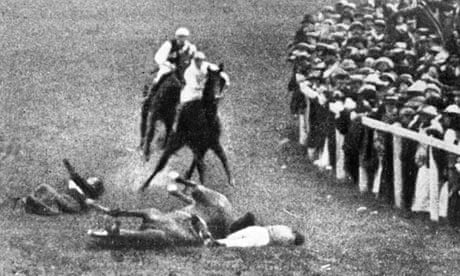
Emily Davison ran onto the track, and waited for Anmer to reach her. As newsreel footage examined for the 100th Anniversary of the incident showed, she had a clear view of the oncoming horses, and purposely targeted the King's horse, and attempted to attach a sash to Anmer's bridle. The sash was emblazoned with the colors of the British women's suffrage movement. Had she succeeded, it would not have meant that the King, or even that Jones, supported women's right to vote, but it would have been one strong public statement: That the King should support it.
Instead, she mistimed her action, and Anmer crashed into her. Both she and Jones were thrown and injured. Both suffered concussions. Davison also received a fractured skull, most likely when she hit the ground, but her other injuries may also have killed her. She died 4 days later.
Davidson is at the left, in the dark clothing.
Jones is at the bottom, in white, next to the fallen Anmer.
Jones survived the incident, and continued racing for another 10 years. Anmer also escaped serious injury, and Jones rode him just 2 months later, at England's other great thoroughbred track, Ascot Racecourse in Ascot, Berkshire, 6 miles southwest of Windsor Castle (making it a favorite weekend haunt of the royal family) and 31 miles west of Central London.
In 1928, Jones laid a wreath at the funeral of Emmeline Pankhurst, Britain's leading feminist, in her memory and in that of Emily Davison. When his wife died in 1951, he fell into a deep depression, and, unlike Davison, definitively took his own life. He was 70, and outlived King George V by 15 years and Davison by 38 years. In 2013, on the 100th Anniversary, a plaque was placed at Epsom Downs Racecourse in her memory.
Women age 30 and up got the right to vote in Britain in 1918. At the same time, the voting age for men was lowered to 21. Women age 21 and up got the right to vote in 1928. It has since been reduced to 18. American women got the right to vote in 1920, with the ratification of the 19th Amendment to the Constitution of the United States. Prior to that, only 4 States had given women the right to vote, including New York in 1917.
*
June 4, 1913 was a Saturday. These baseball games were played that day:
* The New York Yankees lost to the Cleveland Naps, 9-5 at the Polo Grounds. Napoleon "Nap" Lajoie, the Cleveland team's 2nd baseman, best hitter, manager and namesake, did not put himself into the game. He did put Joe Jackson in, and "Shoeless Joe" hit a home run. Left fielder Jack Graney, who went on to become the 1st former player to become a broadcaster, also hit a home run.
Shortstop Ray Chapman went 1-for-5 with an RBI. Seven years later, on that same field, Chapman would be hit in the head with a pitch, and become baseball's only fatality from an on-field event. Ed Sweeney homered for the Yankees. The Naps became the Cleveland Indians in 1915, after Lajoie left; and the Cleveland Guardians in 2022.
* The New York Giants lost to the St. Louis Cardinals, 6-4 at Robison Field in St. Louis. Christy Mathewson was in the unusual position of losing the game and only pitching 6 innings.
* The Brooklyn Dodgers lost to the Cincinnati Reds, 4-3 at Redland Field in Cincinnati. (It was renamed Redland Field in 1933.)
* The Chicago White Sox beat the Boston Red Sox, 4-1 at Fenway Park in Boston. Eddie Cicotte, later to be one of the 8 banned "Black Sox" (as was Shoeless Joe) went the distance for the win. For the Red Sox, Tris Speaker went 0-for-3, but had an RBI on a sacrifice fly.
* The Philadelphia Athletics beat the Detroit Tigers, 14-6 at Shibe Park in Philadelphia. Ty Cobb went 2-for-4. Eddie Collins went 3-for-5 with 3 RBIs.
* The Washington Senators beat the St. Louis Browns, 6-2 at National Park in Washington. (It was renamed Griffith Stadium in 1922.)
* The Philadelphia Phillies beat the Pittsburgh Pirates, 4-0 at Forbes Field in Pittsburgh. Honus Wagner went 1-for-4.
* And the Chicago Cubs beat the Boston Braves, 5-0 at West Side Park in Chicago. Orval Overall -- yes, that was his real name -- pitched a 5-hit shutout.

Monday, January 10, 2022

January 10, 1917: The Silent Sentinels

January 10, 1917: The Sentinels of Liberty, a group of "suffragettes," advocating for American women to be granted the right to vote, begins protesting in front of the White House in Washington. They were the 1st political group to directly picket the President of the United States at the White House.

Though they march and hold up signs marked with messages supporting their causes, they do no chanting. One of them, Harriot Stanton Blach, daughter of the late women's rights activist Elizabeth Cady Stanton, nicknamed them "the Silent Sentinels."

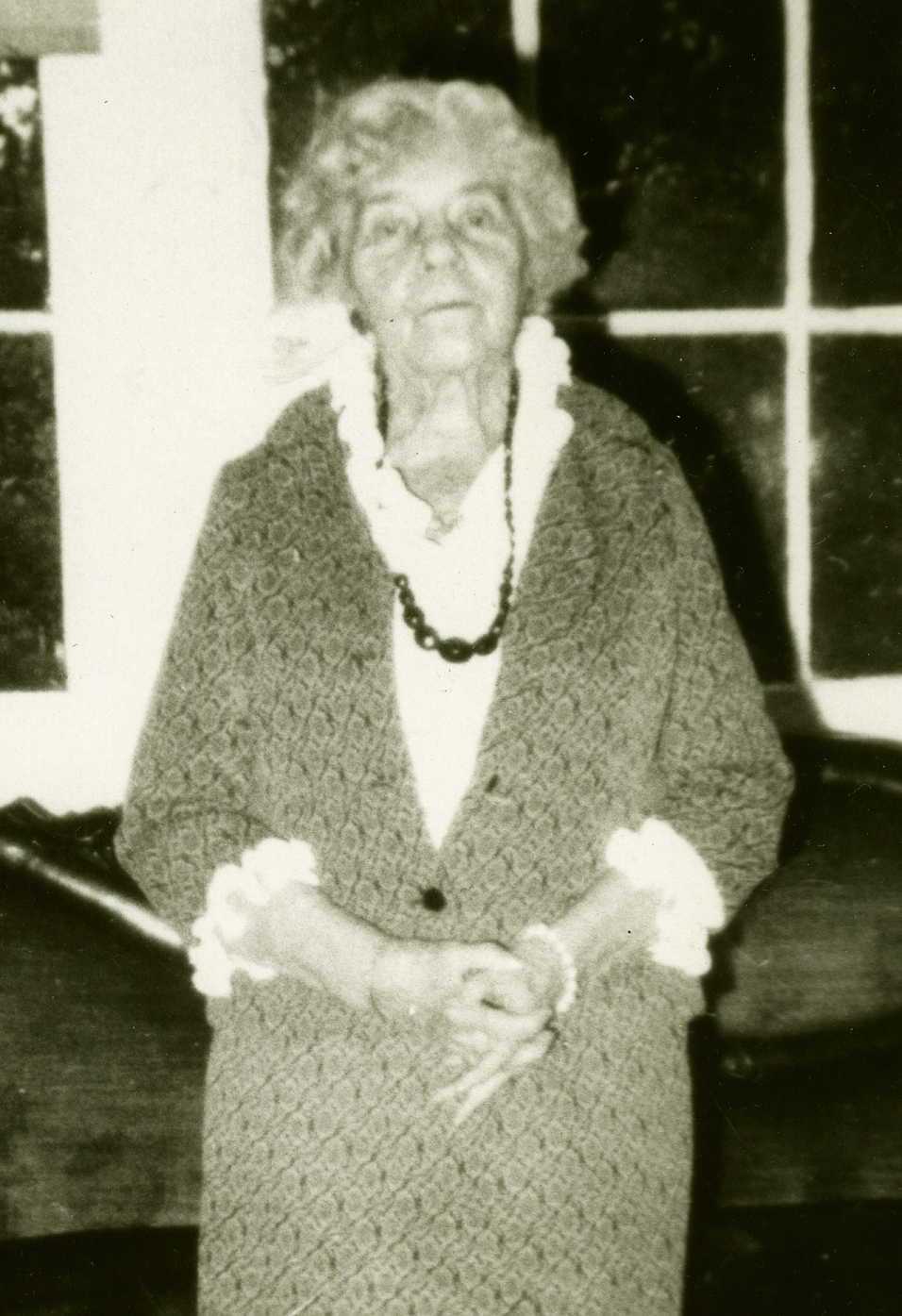
Organized by Alice Paul, then widely seen as the successor to Mrs. Stanton (who died in 1902) and Susan B. Anthony (who died in 1906) as the leader of the "women's suffrage movement," over 2,000 of them engaged in this nonviolent protest. They began doing so after a meeting between their representatives, including Paul, with Wilson on January 9, during which he told them that they should "concert public opinion on behalf of women's suffrage."
Alice Paul

At first, the picketers were tolerated, but they were later arrested on charges of obstructing traffic. Given the amount of automobiles in Washington at the time, this charge was ridiculous. Nearly 500 women were arrested, and 168 served jail time. In solidarity with other activists in her organization, Paul purposefully strove to receive the seven-month jail sentence. In her case, it started on October 20, 1917 at the District Jail.

Whether sent to the District Jail or the Occoquan Workhouse in nearby Lorton, Virginia (now the Lorton Correctional Complex, still a holding center for D.C. prisoners despite being in Virginia), the women were given no special treatment as political prisoners. They had to live in harsh conditions with poor sanitation, infested food, and dreadful facilities.

In protest of the conditions at the District Jail, Paul began a hunger strike. This led to her being moved to the prison's psychiatric ward, and being force-fed raw eggs through a feeding tube. "Seems almost unthinkable now, doesn't it?" Paul told an interviewer from American Heritage magazine when asked about forced feeding in 1974, "It was shocking that a government of men could look with such extreme contempt on a movement that was asking nothing except such a simple little thing as the right to vote."

On November 14, 1917, the suffragists who were imprisoned at Occoquan endured brutality allegedly endorsed by prison authorities, which became known as "the Night of Terror." There were beatings, chokings, draggings, and hanging from chains by the arms. However, no sexual assaults against these women have ever been alleged. One physician reported that Alice Paul had "a spirit like Joan of Arc, and it is useless to try to change it. She will die but she will never give up."

The National Woman's Party (NWP) went to court to protest the treatment of the women such as Dorothy Day, Lucy Burns, Dora Lewis, and Alice Cosu, Lewis' cellmate in Occoquan Prison, who suffered a heart attack at seeing Dora's condition.

The women were later moved to the District Jail. On November 27 and 28, all the suffragists were released from prison. Within two months, Wilson announced a bill on women's right to vote.

The irony was that there was little that the President could do about the situation. Wilson did eventually lobby Congress to pass an Amendment to the Constitution of the United States. But the President cannot sign an Amendment into law: It becomes law when two-thirds majorities of each house of Congress, and then majorities of the legislatures of three-quarters of the States (at the time, 36 out of 48), ratify it. The 19th Amendment was ratified by the U.S. House of Representatives on May 21, 1919; by the U.S. Senate on June 4, 1919, at which point the Sentinels finally stopped their protest; and by a 36th States, Tennessee, on August 18, 1920. It was certified as adopted by the U.S. Department of State on August 26, 1920.

Alice Cosu was said to be older than any of the Sentinels, and history loses track of her after 1917: I can find no information on her after that. Dora Lewis, also older than most of the Sentinels, lived until 1928; Harriot Stanton Blach, until 1940; Lucy Burns, until 1966; Alice Paul, until 1977; and Dorothy Day, until 1980. Paul and Day lived to see some of the gains of what became known as "second-wave feminism."
Alice Paul, photo dated 1965

On January 21, 2017, the day after Donald Trump first became President, 100 years to the month after the Sentinels' vigil began, there was a large women's rights protest in Washington. Some of the demonstrators showed up dressed as 1917-20 suffragettes.
I seriously doubt that Alice Paul would have permitted
profanity on her group's picket signs. But if the slogan fits...

*

January 10, 1917 was a Wednesday. This was also the day the Shackleton Expedition got home without losing a man. I have a separate entry for this event.

Baseball and football were out of season. Professional basketball barely existed. This was the last season of the National Hockey Association. One of its teams was a military team, the Toronto 228th Battalion, taking the place of the disbanded Toronto Shamrocks, and with a roster of professional players. On this day, the Montreal Canadiens beat them, 6-1 at the Montreal Arena (a.k.a. the Westmount Arena). The 228th were coached and captained by Howard McNamara, who had played for both the Canadiens and the Shamrocks.

Also on this day, the Quebec Bulldogs beat the Ottawa Senators, 5-4 at the Quebec Arena. And the Toronto Blueshirts beat the Montreal Wanderers, 9-4 at the Mutual Street Arena in Toronto. 

December 31, 1999 & January 1, 2000: The Millennium

December 31, 1999:  The Millennium arrives. The people of planet Earth survived. At a terrible cost. But we hadn't destroyed ourselves. ...