Showing posts with label maury wills. Show all posts

Monday, October 3, 2022

October 3, 1962: The West Coast Giant-Dodger Playoff

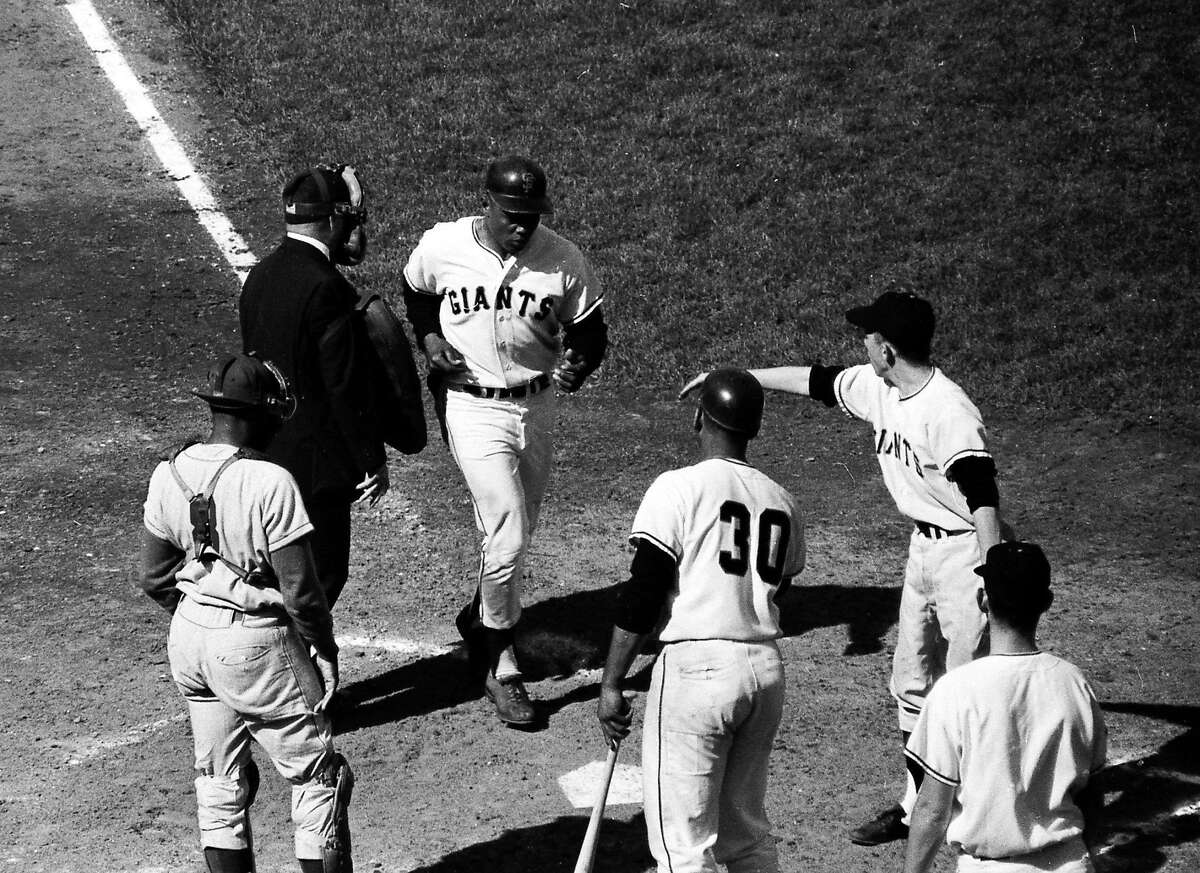
Felipe Alou walks home with the winning run

October 3, 1962: The Giants beat the Dodgers in a Playoff for the National League Pennant again -- this time on the West Coast, and at the Dodgers' home. At Dodger Stadium, San Francisco wins the rubber game, beating Los Angeles, 6-4 as Don Larsen (yes, the hero of 1956 bedevils the Dodgers again) gets the win in relief of Juan Marichal.

The Giants took a 2-0 lead in the 3rd inning, but the Dodgers got a run back in the 4th, and took a 3-2 lead on a home run by Tommy Davis in the 6th. Maury Wills steals 3rd base in the 7th inning, and scores on a bad throw by Giant catcher Ed Bailey.

So, another parallel: The Giants needed to come back from a 4-2 deficit. Actually, in 1951, they had to come back from 4-1, but it was already 4-2 when Bobby Thomson hit that home run. And, this time, instead of at home, the Giants had to do it on the road.

They did. Matty Alou, pinch-hitting for Larsen, led off the top of the 9th with a single. Harvey Kuenn's groundout moved him over. Ed Roebuck, one of the Dodgers' holdovers from Brooklyn, walked Willie McCovey and Felipe Alou to load the bases. Willie Mays singled Kuenn home, and it was 4-3 L.A., with the bases still loaded, and still only 1 out.

Dodger manager Walter Alston pulled Roebuck, and brought in Stan Williams. Orlando Cepeda hit a sacrifice fly that made it 4-4. Following a wild pitch, Alston ordered Williams to intentionally walk Bailey to set up the double play, or at least a forceout at home plate. Instead, he walked Jim Davenport, forcing Felipe Alou home with what turned out to be the Pennant-winning run. And José Pagán reached on an error that made it 6-4. Billy Pierce, who had pitched for the American League Pennant-winning Chicago "Go-Go White Sox" of 1959, sent the Dodgers down 1-2-3 in the bottom of the 9th, to end it.

This was the 3rd and last time the Dodgers had lost a Playoff for the Pennant, all on an October 3. They did, however, win one in 1959, against the Milwaukee Braves, but that was on a September 29.

Thanks to the extended season, Wills sets a major league record for the most games played in a season, appearing in 165 games. This was the year he stole 104 bases, setting a new major league record. However, like Roger Maris' 61 home runs the season before, he didn't break the old record in 154 games, so his achievement and Ty Cobb's 96 steals in 1915 were listed as separate records. As with Babe Ruth's 60 homers in 1927 and Maris' 61 in '61, there was never actually an asterisk in the
record book.

The Giants played the New York Yankees in the World Series, losing in 7 games.

October 3, 1962 was a Wednesday. This was the only baseball game played that day. Football was in midweek. The NHL season wouldn't start for another 7 days, the NBA season for another 13 days. So there were no other scores on this historic day.

This was the day that Wally Schirra flew into Earth orbit aboard Sigma 7. I have a separate entry for that post.

And Tommy Lee, the drummer for heavy metal band Mötley Crüe, was born.

Sunday, July 10, 2022

July 10, 1962: Telstar 1 Is Launched

July 10, 1962: The Telstar 1 communications satellite is launched at Cape Canaveral, Florida. By July 23, it was beaming television signals from each side of the Atlantic Ocean to the other. It relayed its first, and non-public, television pictures, a flag outside Andover Earth Station, to Pleumeur-Bodou, France the following day. 

Almost two weeks later, on July 23, at 3:00 PM Eastern Time, it relayed the 1st publicly available live transatlantic television signal. The broadcast was shown in Europe by Eurovision, and in North America by NBC, CBS, ABC, and the CBC. The 1st public broadcast featured CBS's Walter Cronkite and NBC's Chet Huntley in New York, and the BBC's Richard Dimbleby in Brussels, Belgium. The first pictures were the Statue of Liberty in New York and the Eiffel Tower in Paris.

The first broadcast was to have been remarks by President John F. Kennedy, but the signal was acquired before the president was ready, so engineers filled the lead-in time with a short segment of a televised baseball game at Wrigley Field in Chicago, between the Philadelphia Phillies and the Chicago Cubs. The batter, the Phillies' Tony Taylor, was seen hitting a ball pitched by Cal Koonce to the right fielder, George Altman. (The Phillies won the game, 5-3, thanks to a home run by Don Demeter.)

From there, the video switched first to Washington, D.C.; then to Cape Canaveral, Florida; to the World's Fair in Seattle; then to Quebec City; and, finally, to Stratford, Ontario. The Washington segment included remarks by a now-ready Kennedy, talking about the price of the American dollar, which was causing concern in Europe. When Kennedy denied that the United States would devalue the dollar, it immediately strengthened on world markets. Cronkite later said that "we all glimpsed something of the true power of the instrument we had wrought."

On February 21, 1963, due to increased nuclear testing in the atmosphere, Telstar 1 stopped functioning – around the time the song "Telstar" by The Tornadoes -- the 1st song by a British band to hit Number 1 in America, over a year before The Beatles did it -- dropped off the music charts. Telstar 2 was launched on May 7, 1963, and lasted about as long. Although completely useless for 59 years, both of these satellites are still in orbit around the Earth.

*

July 10, 1962 was a Tuesday. Unlike the day of the Phillies-Cubs broadcast, when there were other games, there was only 1 score on this historic day. From 1958 to 1962, Major League Baseball held 2 All-Star Games every season, 1 in a ballpark of each League. This day was the 1st, at the new District of Columbia Stadium in Washington. I have a separate entry for this event, because it included the 1st All-Star for the New York Mets: Richie Ashburn.

President Kennedy attended, and threw out the ceremonial first ball. No one could have foreseen that, within just 6 years, both JFK and his brother, then the Attorney General of the United States, would be assassinated, and that, a year after that, D.C. Stadium would be renamed Robert F. Kennedy Memorial Stadium.

Before the first ball ceremony, JFK spoke to Stan Musial of the St. Louis Cardinals, an ardent Democrat. Musial was 41 years old, 2 years younger than JFK was when he was elected. JFK said, "They said I was too young to be President, and you were too old to play baseball. I guess we both proved them wrong."

Selected for the American League team from the defending World Champion New York Yankees: Center fielder Mickey Mantle, right fielder Roger Maris (both starting), catcher Elston Howard, 2nd baseman Bobby Richardson, shortstop Tom Tresh (the eventual AL Rookie of the Year, who would be moved to left field when Tony Kubek returned from his military service), and pitcher Ralph Terry. The opposing starting pitchers were Jim Bunning of the Detroit Tigers and Don Drysdale of the Los Angeles Dodgers.

For the 1st time, the All-Star Game had a Most Valuable Player award. It was given to Maury Wills of the Dodgers, on his way to setting a new major league record with 104 stolen bases in a season. In the 6th inning, he entered the game as a pinch-runner for Musial. Wills stole 2nd base, and was singled home by Dick Groat of the Pittsburgh Pirates. In the 8th inning, Wills singled, was singled to 3rd by Jim Davenport of the San Francisco Giants, and scored on a sacrifice fly by the Giants' Felipe Alou. The NL won, 3-1.

Thursday, April 14, 2022

April 14, 1969: The 1st Major League Baseball Game Outside the U.S.

April 14, 1969: For the 1st time, a regular-season Major League Baseball game is played outside the United States of America.

The location was Jarry Park, a 28,000-seat no-frills stadium on the north side of Montreal, Quebec, Canada. The Montreal Expos, an expansion team, had debuted a week earlier, playing their 1st 6 games on the road, going 3-3.
That pool beyond the right field fence
was the landing place for a few home runs.

Jarry Park was never meant to be their permanent home. A condition for Montreal getting the franchise was a domed stadium that would be ready for the 1972 season. And when the city was awarded the 1976 Olympics, it looked like the domed stadium would be ready.

It wasn't: When the Olympics got underway in 1976, the stadium still wasn't ready -- not for the Olympics, not for baseball, not for the Canadian Football League's Montreal Alouettes, and not for any of the professional soccer teams that played there.

But that was a problem for the future. At this moment in 1969, the Expos, named for the Expo '67 World's Fair that had been held in Montreal, took the field against the St. Louis Cardinals, 2-time defending National League Champions.

Larry Jaster was the starting pitcher, and he began the game by getting Lou Brock to line out to 2nd baseman Gary Sutherland. The 1st Expo batter was Don Bosch, and he singled off Nelson Briles. Maury Wills popped up, but Rusty Staub drew a walk, and then Mack Jones hit a home run to right field to make it 3-0 Expos. Jones hit a triple in the 2nd inning to make it 5-0. Jaster helped his own cause with an RBI single in the 3rd.

But he fell apart in the 4th, blowing the 6-0 lead he'd been given, giving up a grand slam to Dal Maxvill, an RBI single by Vada Pinson, and a 2-run homer by Joe Torre. (Torre had also hit the 1st home run in a regular-season major league game at Atlanta-Fulton County Stadium, 3 years earlier.) It was 7-6 St. Louis.

But Briles didn't last much longer. A single, a double, a walk and a wild pitch tied the game in the bottom of the 4th. With 1 out in the bottom of the 7th, 3rd baseman José "Coco" Laboy doubled. Following a groundout, pitcher Dan McGinn singled Laboy home with what turned out to be the winning run. The Expos won, 8-7. McGinn turned out to be the winning pitcher.

For a long time, this was the high-water mark for the Expo franchise. They lost 110 games in that 1st season. In 1973, there were 6 teams in the National League Eastern Division, and except for the Philadelphia Phillies, none of them seemed willing to lose it -- but the other 5 didn't seem to be willing to win it, either. The Expos finished 79-83, but only 3 1/2 games out of 1st place.

They moved into the Olympic Stadium in 1977, finally reached their 1st Pennant race in 1979, just missed the NL East title in 1980, and won it in 1981, before losing the NL Championship Series to the Los Angeles Dodgers. In 1994, they had the best record in MLB when the strike hit, and never recovered, having to trade off several good players before the games resumed. After the 2004 season, they were moved, becoming the Washington Nationals, finally winning their 1st Pennant and World Series in 2019.

In 1996, Jarry Park was converted into the 11,815-seat national tennis stadium of Canada, now named Stade IGA (IGA Stadium in English), after a supermarket chain. The home plate stands are the only remaining original part of the stadium, serving as its west end.

*

April 14, 1969 was a Monday. These other MLB games were played that day:

* The New York Mets lost to the Philadelphia Phillies, 5-1 at Connie Mack Stadium in Philadelphia. Woody Fryman limited the Mets to 4 hits, and they fell to 2-5. At this point, anybody saying that they would have won the season's World Series would have been taken to Bellevue Hospital. (The New York Yankees did not play on the day.)

* The Boston Red Sox beat the Baltimore Orioles, 5-3 at Fenway Park in Boston. For the Red Sox, Carl Yastrzemski went 2-for-4. For the Orioles, Brooks Robinson went 0-for-4, and Frank Robinson went 1-for-3.

* The Chicago Cubs beat the Pittsburgh Pirates, 4-0 at Wrigley Field in Chicago. Ken Holtzman pitched a 7-hit shutout, and Ernie Banks went 1-for-4. For the Pirates, Roberto Clemente went 0-for-3, and Willie Stargell went 1-for-3.

* The Houston Astros beat the Los Angeles Dodgers, 11-5 at the Astrodome.

* The Chicago White Sox beat the California Angels, 4-3 at Anaheim Stadium. (It was renamed Edison Field in 1998, and Angel Stadium in 2004.)

* And in a game between the 2 expansion teams in the American League, the Kansas City Royals beat the Seattle Pilots, 2-1 at Sick's Stadium in Seattle. Roger Nelson outpitched Mike Marshall, and the Pilots did not, as their manager Joe Schultz wanted, "Zitz 'em and then go pound some Budwieser."

Jim Bouton, pitching for the Pilots, recorded the season in a diary, published the next season under the title Ball Four. That night, he was sent down to the Pilot's Class AAA farm team, the Vancouver Mounties of the Pacific Coast League. Or, as he put it, using a classic ballplayer's phrase for being sent down: "I died tonight." He was called back up on April 29.

The Stanley Cup Playoffs were between rounds. Game 5 of the NBA Eastern Division Finals was played at Madison Square Garden. The New York Knicks beat the Boston Celtics, 112-104. But the Celtics won Game 6 in Boston to take the series. They would beat the Los Angeles Lakers in the NBA Finals.

December 31, 1999 & January 1, 2000: The Millennium

December 31, 1999:  The Millennium arrives. The people of planet Earth survived. At a terrible cost. But we hadn't destroyed ourselves. ...